Overview
Rates in tables represent one of the most practical and frequently tested concepts in SAT math. This topic combines the fundamental understanding of rates—how one quantity changes in relation to another—with the ability to extract, interpret, and manipulate data presented in tabular format. On the SAT, students encounter tables displaying information about speed, work rates, unit prices, population changes, and various other real-world scenarios where relationships between quantities must be analyzed and calculated.
The SAT emphasizes rates in tables because they test multiple skills simultaneously: reading comprehension of numerical data, proportional reasoning, unit conversion, and algebraic manipulation. Questions involving sat rates in tables typically require students to identify patterns, calculate missing values, compare different rates, or use tabular information to solve multi-step problems. These questions appear in both the calculator and no-calculator sections, making fluency with this topic essential for achieving a competitive score.
Understanding rates in tables builds directly upon foundational concepts in ratios, proportions, and unit rates while serving as a gateway to more complex topics like linear functions, data analysis, and modeling. The ability to work efficiently with tabular rate data is not merely an isolated skill—it represents a critical intersection of algebraic thinking and quantitative literacy that the SAT uses to assess college readiness in mathematics.
Learning Objectives
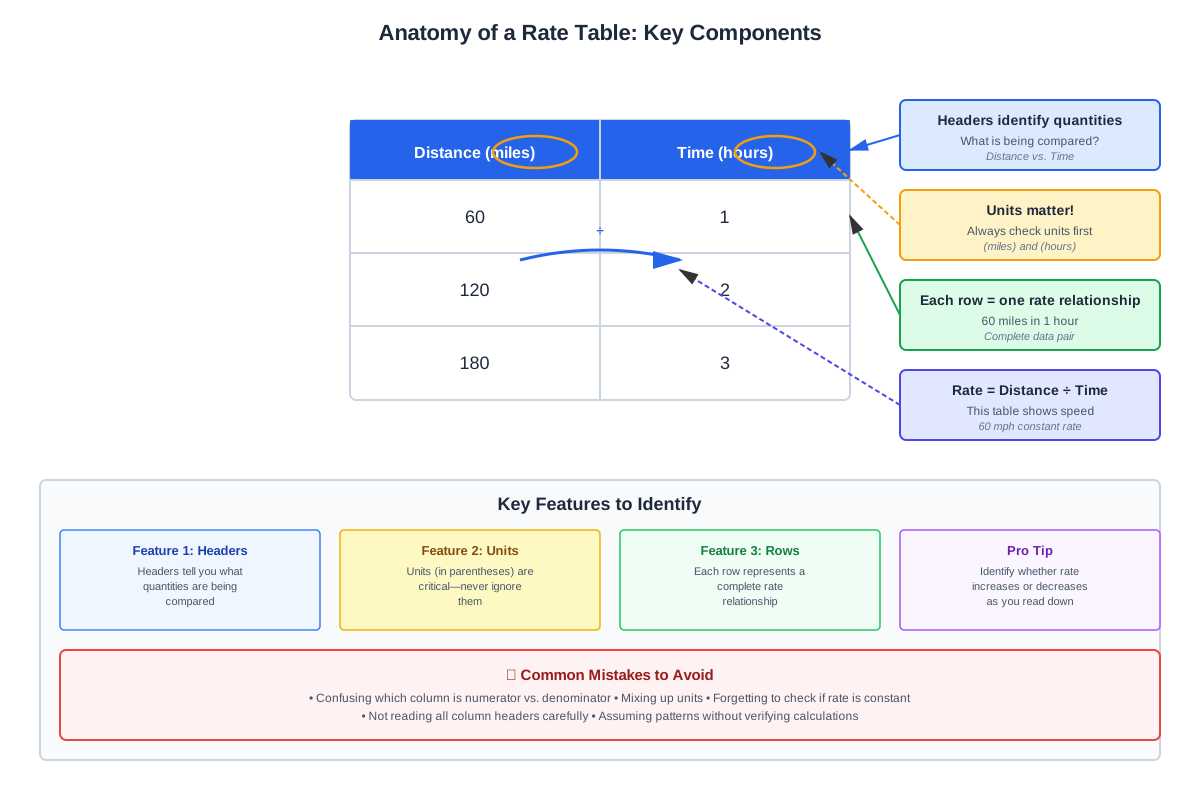
- [ ] Identify key features of rates in tables, including headers, units, and rate relationships
- [ ] Explain how rates in tables appears on the SAT, including question formats and common scenarios
- [ ] Apply rates in tables to answer SAT-style questions with accuracy and efficiency
- [ ] Calculate unit rates from tabular data and use them to solve comparison problems
- [ ] Determine missing values in rate tables using proportional reasoning
- [ ] Convert between different units within rate problems presented in tables
- [ ] Analyze multi-row or multi-column tables to identify optimal choices or maximum/minimum values
Prerequisites
- Basic rate concepts: Understanding that a rate compares two quantities with different units (miles per hour, dollars per item) is essential for interpreting what table values represent
- Ratio and proportion fundamentals: The ability to set up and solve proportions enables students to find missing values and scale rates appropriately
- Unit conversion: Familiarity with converting between units (hours to minutes, feet to inches) is necessary since SAT questions often require working across different measurement systems
- Basic algebraic manipulation: Solving for variables and rearranging equations allows students to work backward from table data to find unknown quantities
- Table reading skills: The ability to locate specific information in rows and columns and understand how headers organize data is fundamental to all table-based problems
Why This Topic Matters
Rates in tables appear in countless real-world contexts: comparing cell phone plans, analyzing fuel efficiency across different vehicles, evaluating worker productivity, calculating travel times for different routes, and assessing cost-effectiveness of bulk purchases. This practical applicability makes the topic a favorite for SAT test writers who aim to assess mathematical reasoning in authentic contexts. Students who master this topic develop transferable skills for personal finance, business analysis, and scientific data interpretation.
On the SAT, rates in tables questions appear with high frequency—typically 2-4 questions per test across both the calculator and no-calculator sections. These questions account for approximately 5-8% of the total math score, making them a high-yield area for focused study. The questions range from straightforward unit rate calculations to complex multi-step problems requiring synthesis of information from multiple table cells.
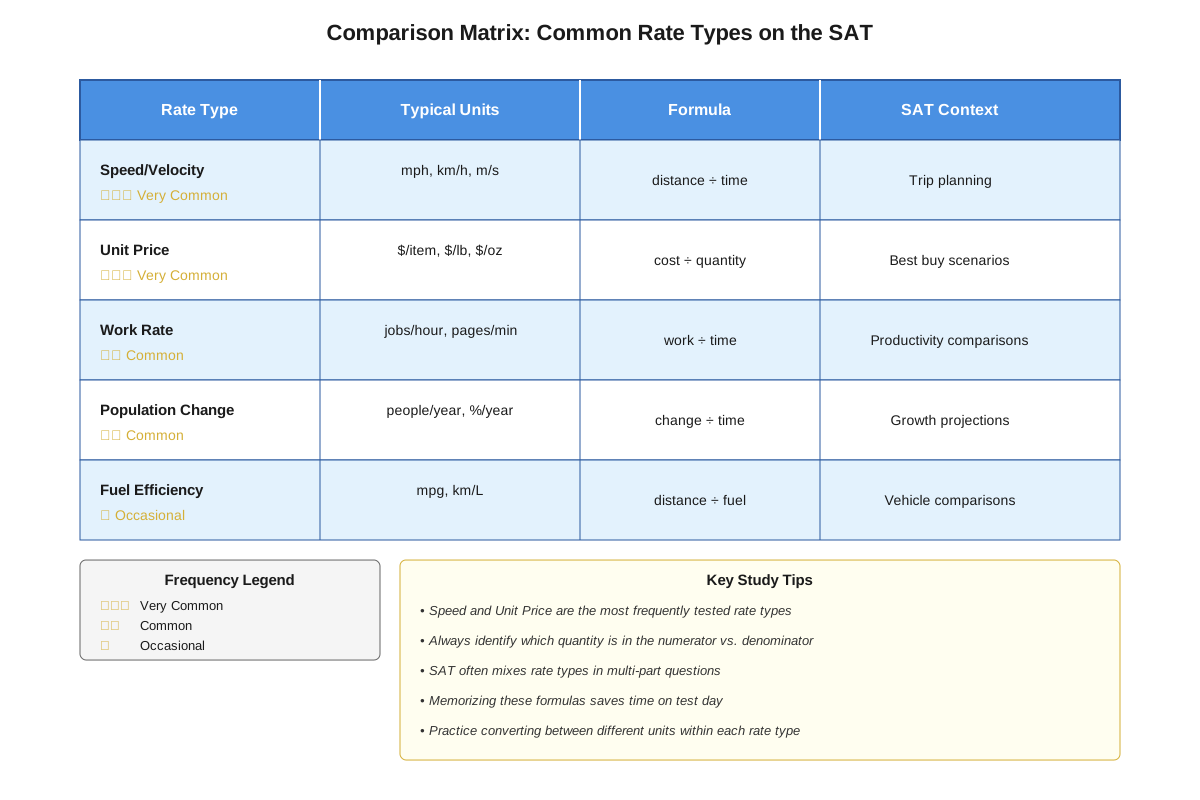
Common SAT presentations include: comparison tables showing rates for different options (shipping costs, rental fees, production rates), time-distance-speed tables for travel problems, work-rate tables showing productivity of individuals or machines, pricing tables with tiered or bulk discount structures, and conversion tables relating different measurement systems. Questions may ask students to identify the best value, calculate total cost or time, determine when two options become equal, or predict values beyond the given data range.
Core Concepts
Understanding Rate Structure in Tables
A rate expresses how one quantity changes relative to another, always involving two different units. In tabular format, rates appear as organized data where rows and columns systematically present related information. The fundamental structure includes headers that identify what each column or row represents, units that specify the measurement system, and values that provide the numerical data. When examining a rate table, the first critical step involves identifying which quantity is the independent variable (often time, quantity purchased, or distance) and which is the dependent variable (often cost, distance traveled, or items produced).
Tables may present rates explicitly (showing "miles per hour" or "dollars per pound") or implicitly (showing total values from which rates must be calculated). For example, a table might show distances traveled at different time intervals, requiring students to calculate the speed by dividing distance by time. Understanding whether rates are constant (linear relationship) or variable (changing rate) is essential for accurate problem-solving.
Calculating Unit Rates from Tables
A unit rate expresses how much of one quantity corresponds to exactly one unit of another quantity. To extract unit rates from tables, students divide the dependent variable by the independent variable. For instance, if a table shows that 3 pounds of apples cost $4.50, the unit rate is $4.50 ÷ 3 = $1.50 per pound. This unit rate becomes a powerful tool for:
- Comparing different options presented in the table
- Calculating values not explicitly shown in the table
- Determining proportional relationships
- Identifying the best value or most efficient choice
When tables present cumulative data (total distance after each hour, total cost for different quantities), students must sometimes calculate the rate between consecutive entries rather than from zero. For example, if a table shows 100 miles after 2 hours and 175 miles after 3 hours, the rate during the third hour is (175 - 100) ÷ (3 - 2) = 75 miles per hour.
Proportional Reasoning with Rate Tables
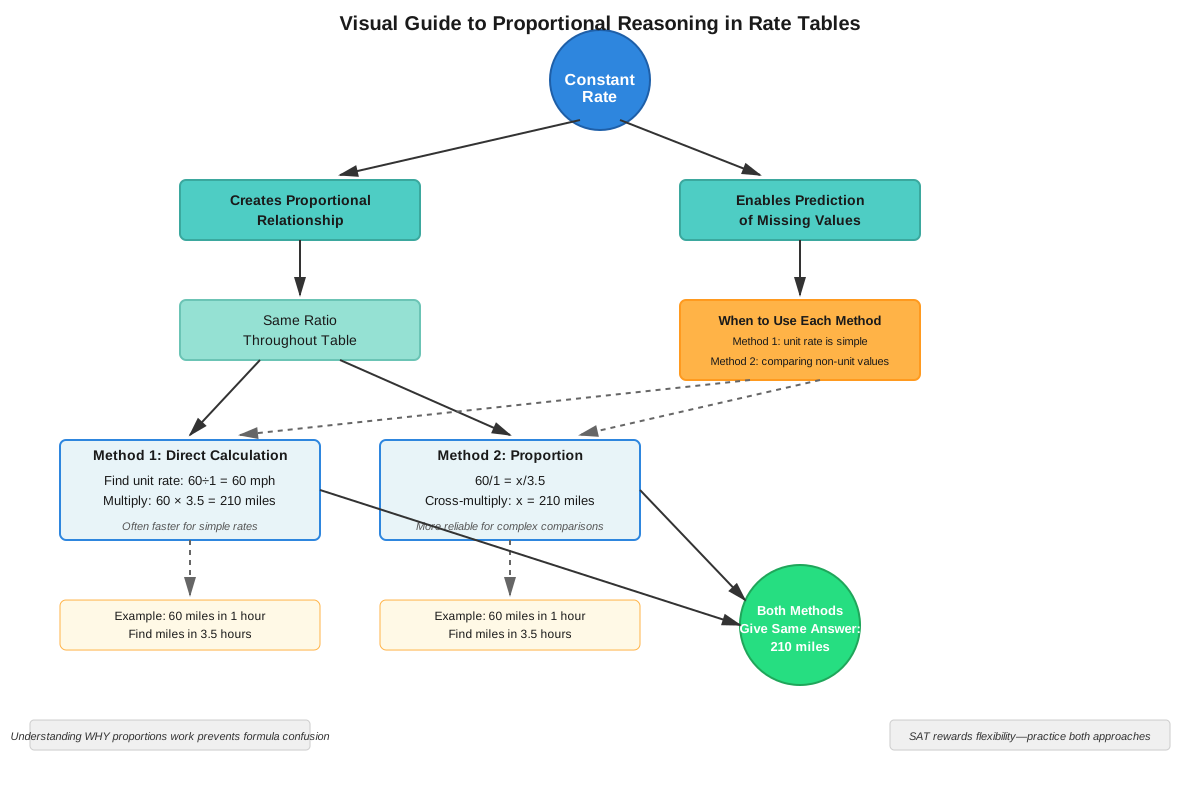
Proportional reasoning allows students to scale rates up or down to find missing values. If a table establishes that 5 widgets cost $12.50, finding the cost of 8 widgets requires setting up a proportion:
5 widgets / $12.50 = 8 widgets / x dollarsCross-multiplying yields: 5x = 100, so x = $20. This technique works when rates remain constant throughout the table. SAT questions often test whether students recognize when proportional reasoning applies versus when rates change at different levels.
Comparing Rates Across Table Entries
Many SAT questions require comparing multiple rates within a single table to identify optimal choices. This involves:
- Calculating unit rates for each option: Converting all entries to a common basis (per hour, per item, per mile)
- Identifying break-even points: Determining when two different rate structures yield equal results
- Recognizing tiered pricing: Understanding that some tables show different rates for different quantity ranges
- Evaluating trade-offs: Balancing factors like speed versus cost or quality versus price
| Shipping Method | Cost for First Pound | Cost per Additional Pound | Total Cost for 5 Pounds |
|---|---|---|---|
| Standard | $4.00 | $1.50 | $10.00 |
| Express | $8.00 | $2.00 | $16.00 |
This table structure requires students to calculate total costs using the formula: Base cost + (additional pounds × rate per additional pound).
Working with Composite Rates
Composite rates involve multiple rates working together or in sequence. Common SAT scenarios include:
- Combined work rates: If Person A completes a task at one rate and Person B at another, their combined rate is the sum of individual rates
- Average rates: When rates change over different intervals, the overall average rate requires weighted calculation based on time or distance
- Sequential processes: When items pass through multiple stages, each with different rates, finding total time requires adding individual stage times
For example, if a table shows that Machine A produces 20 units per hour and Machine B produces 30 units per hour, working together they produce 50 units per hour. To find how long they take to produce 200 units together: 200 ÷ 50 = 4 hours.
Unit Conversion in Rate Tables
SAT questions frequently require converting between units within rate problems. Common conversions include:
- Time: hours ↔ minutes ↔ seconds
- Distance: miles ↔ feet ↔ inches, kilometers ↔ meters
- Weight: pounds ↔ ounces, kilograms ↔ grams
- Volume: gallons ↔ quarts ↔ cups
When a table presents rates in one unit system but questions ask for answers in another, students must apply conversion factors. For example, if a table shows speed in miles per hour but asks for feet per second, the conversion requires: (miles/hour) × (5280 feet/mile) × (1 hour/3600 seconds).
Concept Relationships
The concepts within rates in tables form an interconnected hierarchy. Understanding rate structure serves as the foundation, enabling students to correctly identify units and variables. This identification leads directly to calculating unit rates, which becomes the primary tool for comparing different options presented in tables. Proportional reasoning builds upon unit rates, allowing students to find missing values and scale relationships. When tables present changing rates or multiple stages, composite rate calculations integrate individual rates into overall solutions.
The relationship flows: Rate Structure → Unit Rate Calculation → Proportional Reasoning → Comparison and Optimization → Composite Rate Problems.
Rates in tables connects backward to prerequisite topics: ratios provide the conceptual foundation for understanding rate relationships, proportions supply the algebraic tools for solving rate problems, and unit conversion enables working across measurement systems. Forward connections include linear functions (constant rates produce linear relationships), systems of equations (finding break-even points), and data analysis (interpreting trends and making predictions from tabular data).
Quick check — test yourself on Rates in tables so far.
Try Flashcards →High-Yield Facts
- ⭐ A unit rate expresses the quantity per ONE unit of another measure; always divide the dependent variable by the independent variable to find it
- ⭐ When comparing options in a table, calculate the unit rate for each option to identify the best value
- ⭐ Tables with tiered pricing require different calculations for different quantity ranges; identify which tier applies before calculating
- ⭐ To find a missing value in a proportional rate table, set up a proportion using known values and cross-multiply
- ⭐ Combined work rates equal the sum of individual rates when workers or machines operate simultaneously
- The average rate for a trip is NOT the average of two speeds; it equals total distance divided by total time
- When rates change between table entries, calculate the rate for each interval separately rather than using the overall change
- Break-even points occur where two different rate structures produce equal total values; set expressions equal and solve
- Unit conversion in rate problems requires multiplying by conversion factors that cancel unwanted units
- Tables may present cumulative totals rather than individual rates; subtract consecutive entries to find interval-specific rates
- Constant rates in tables indicate proportional (linear) relationships; the ratio between corresponding values remains constant
- Reading table headers carefully prevents unit errors; distinguish between "per hour" versus "total hours" or "each" versus "total"
Common Misconceptions
Misconception: The average rate for a round trip equals the average of the two speeds.
Correction: Average rate equals total distance divided by total time. If you travel 60 mph for one hour and 30 mph for two hours, the average rate is 90 miles ÷ 3 hours = 30 mph, not (60 + 30) ÷ 2 = 45 mph. Time spent at each rate matters.
Misconception: All rate tables show constant rates that can be extended proportionally.
Correction: Many tables show tiered pricing or changing rates. A bulk discount table might show $2 per item for 1-10 items but $1.50 per item for 11-20 items. Always check whether the rate changes across different ranges.
Misconception: When two workers combine efforts, the time required is the average of their individual times.
Correction: Combined rates add together. If Worker A takes 4 hours alone (rate = 1/4 job per hour) and Worker B takes 6 hours alone (rate = 1/6 job per hour), together they work at 1/4 + 1/6 = 5/12 job per hour, completing the job in 12/5 = 2.4 hours, not (4 + 6) ÷ 2 = 5 hours.
Misconception: The unit in a rate can be ignored when setting up proportions.
Correction: Units must match on both sides of a proportion. If comparing dollars per pound to dollars per ounce, convert to the same weight unit first. Ignoring units leads to answers that are off by conversion factors.
Misconception: To find the rate between two table entries, divide the second value by the second time.
Correction: For interval-specific rates, use the change in values divided by the change in time: (value₂ - value₁) ÷ (time₂ - time₁). If a table shows 50 miles at 1 hour and 120 miles at 2 hours, the rate during the second hour is (120 - 50) ÷ (2 - 1) = 70 mph, not 120 ÷ 2 = 60 mph.
Misconception: All table values represent rates rather than totals.
Correction: Tables may show cumulative totals, individual amounts, or actual rates. A table showing "Total Cost" requires different interpretation than one showing "Cost per Unit." Always read headers to determine what values represent.
Worked Examples
Example 1: Comparing Shipping Options
Problem: A shipping company provides the following rate table:
| Shipping Method | Base Fee | Rate per Pound |
|---|---|---|
| Ground | $5.00 | $0.80 |
| Express | $12.00 | $0.50 |
For what package weight do both methods cost the same?
Solution:
Step 1: Set up expressions for total cost of each method.
- Ground cost = $5.00 + $0.80w (where w = weight in pounds)
- Express cost = $12.00 + $0.50w
Step 2: Set the expressions equal to find the break-even point.
5.00 + 0.80w = 12.00 + 0.50wStep 3: Solve for w.
0.80w - 0.50w = 12.00 - 5.00
0.30w = 7.00
w = 7.00 ÷ 0.30
w = 23.33 pounds
Step 4: Interpret the result.
For packages weighing exactly 23.33 pounds, both methods cost the same ($23.67). For lighter packages, Ground is cheaper; for heavier packages, Express becomes more economical despite the higher base fee.
Connection to Learning Objectives: This problem demonstrates identifying key features (base fees and per-pound rates), applying proportional reasoning, and comparing rates to determine optimal choices—all essential SAT skills for rates in tables.
Example 2: Combined Work Rates
Problem: A factory uses the following production table:
| Machine | Units Produced per Hour |
|---|---|
| Machine A | 45 |
| Machine B | 60 |
| Machine C | 30 |
If Machines A and B work together for 3 hours, then Machine C joins them for an additional 2 hours, how many total units are produced?
Solution:
Step 1: Calculate the combined rate for Machines A and B.
- Combined rate (A + B) = 45 + 60 = 105 units per hour
Step 2: Calculate units produced during the first 3 hours.
- Units (first 3 hours) = 105 units/hour × 3 hours = 315 units
Step 3: Calculate the combined rate for all three machines.
- Combined rate (A + B + C) = 45 + 60 + 30 = 135 units per hour
Step 4: Calculate units produced during the next 2 hours.
- Units (next 2 hours) = 135 units/hour × 2 hours = 270 units
Step 5: Find the total production.
- Total units = 315 + 270 = 585 units
Connection to Learning Objectives: This problem requires extracting rates from a table, understanding composite rates (combined work), and applying multi-step calculations—demonstrating mastery of how rates in tables appears in complex SAT scenarios.
Exam Strategy
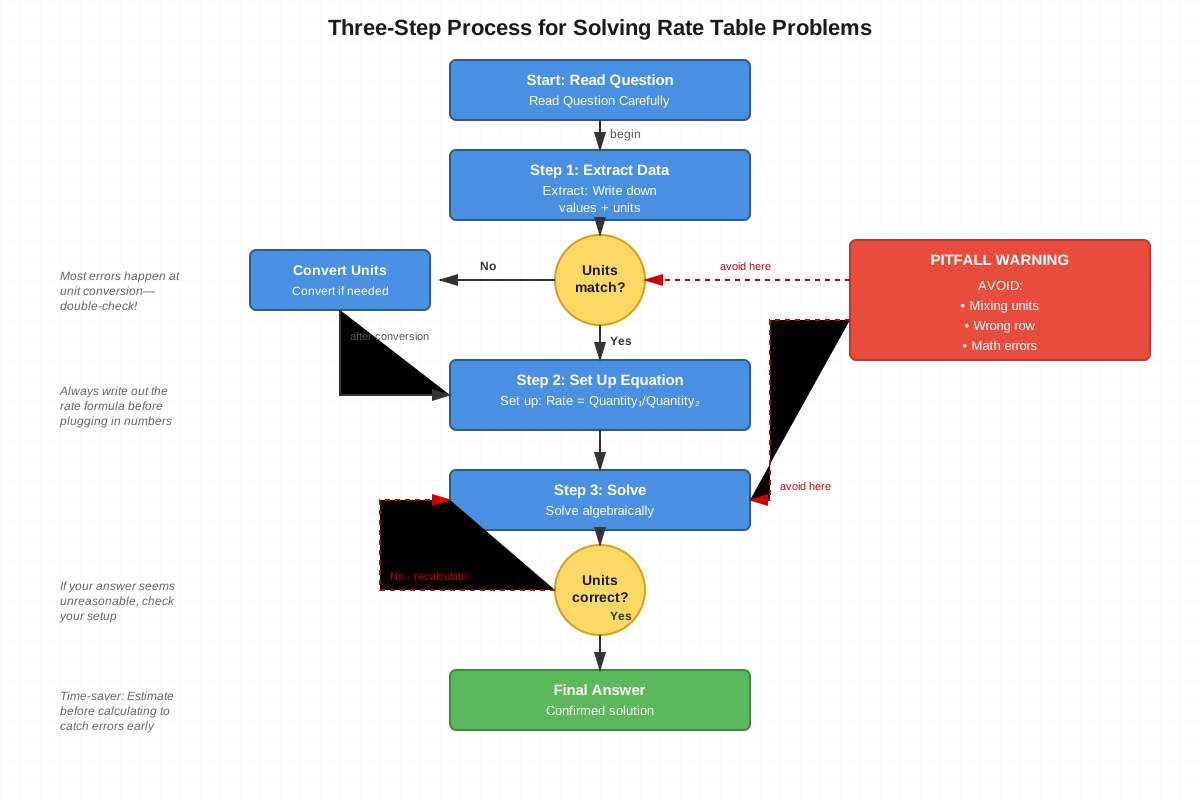
When approaching SAT questions involving rates in tables, begin by carefully reading all table headers and units. Misidentifying what values represent (totals versus rates, per hour versus per minute) causes more errors than calculation mistakes. Circle or underline the units in both the table and the question to ensure consistency throughout your work.
Trigger words and phrases that signal rates in tables questions include: "per," "each," "rate," "speed," "cost for," "produces," "travels," "charges," "at this rate," "how many," "how much," and "which option." Questions asking to "compare," "find the best value," or "determine when" typically require calculating and comparing unit rates.
For process of elimination, calculate the unit rate for one option and immediately eliminate answer choices that don't make mathematical sense. If you determine that Option A costs $2.50 per pound, eliminate any answer choice suggesting it's cheaper than an option with a $3.00 per pound rate. When questions ask "at what point," eliminate extreme values first—break-even points typically fall somewhere in the middle of reasonable ranges.
Time allocation: Simple unit rate calculations should take 30-45 seconds. Multi-step comparison problems warrant 60-90 seconds. Complex problems involving changing rates or multiple stages may require up to 2 minutes. If a table problem extends beyond 2 minutes, mark it for review and move forward—these questions rarely require advanced mathematics, just careful organization.
Set up your work systematically: write the formula or proportion, substitute values, show one calculation step, then the answer. This organization prevents errors and allows quick checking. For calculator-permitted sections, use the calculator for arithmetic but write the setup by hand to maintain logical flow.
Memory Techniques
RATE acronym for table analysis:
- Read all headers and units carefully
- Analyze what type of rate is shown (constant, tiered, cumulative)
- Translate the question into a mathematical operation
- Evaluate by calculating unit rates first
"DIVIDE to DECIDE": When comparing options in a table, DIVIDE to find unit rates, then DECIDE which option is best. This reminds students that comparison requires standardization through unit rate calculation.
Visualization strategy: Picture rates as slopes on a graph. Steeper slopes mean faster rates. When comparing two options, imagine their lines—the steeper line represents the higher rate. Break-even points are where the lines cross.
The "Per One" Rule: Whenever you see a rate, mentally add "per ONE" to clarify the unit rate. "60 miles per hour" becomes "60 miles per ONE hour," reinforcing that unit rates always reference a single unit of the denominator.
Combined Work Mnemonic: "Rates ADD, Times don't AVERAGE." When workers combine, add their rates. When calculating average speed, don't average the speeds—use total distance over total time.
Summary
Rates in tables represent a high-yield SAT math topic that combines data interpretation, proportional reasoning, and algebraic problem-solving. Success requires identifying whether tables present explicit rates or cumulative totals, calculating unit rates to enable comparison, and applying proportional reasoning to find missing values. Students must distinguish between constant rates that extend proportionally and tiered structures where rates change at different levels. Combined rate problems require adding individual rates, while average rate calculations demand total distance divided by total time rather than averaging speeds. Unit conversion frequently appears in these problems, requiring careful attention to measurement systems. The key to mastering rates in tables lies in systematic analysis: read headers and units carefully, identify the rate structure, calculate unit rates for comparison, set up proportions for missing values, and verify that units match throughout calculations. Questions involving break-even points, optimal choices, and multi-stage processes all build upon these fundamental skills, making rates in tables an essential component of SAT math preparation.
Key Takeaways
- Always calculate unit rates (per ONE unit) when comparing different options in a table to identify the best value
- Tables may show cumulative totals, individual values, or explicit rates—read headers carefully to determine what values represent
- Set up proportions to find missing values in rate tables, ensuring units match on both sides of the equation
- Combined work rates equal the sum of individual rates; workers or machines operating together add their rates
- Break-even points occur where two rate structures produce equal results; set up equations and solve for the variable
- Average rate equals total distance divided by total time, not the average of two speeds
- Tiered pricing tables require identifying which range applies before calculating; rates may change at different quantity levels
Related Topics
Linear Functions and Slope: Constant rates in tables correspond to linear functions where the rate represents the slope. Mastering rates in tables provides intuitive understanding of how slope represents rate of change, enabling progression to graphical analysis and function notation.
Systems of Equations: Break-even problems in rate tables extend naturally to systems of equations where two linear expressions are set equal. The algebraic techniques developed through rates in tables transfer directly to solving systems.
Direct and Inverse Variation: Rate tables often illustrate direct variation (as one quantity increases, another increases proportionally). Understanding these relationships in tabular form builds foundation for recognizing variation in equations and graphs.
Data Analysis and Scatterplots: Skills in extracting and comparing rates from tables prepare students for analyzing trends in scatterplots, calculating lines of best fit, and making predictions from data—all frequent SAT topics.
Word Problems and Modeling: Rates in tables develop the translation skills necessary for converting verbal descriptions into mathematical models, a critical competency for complex SAT word problems across all math domains.
Practice CTA
Now that you've mastered the core concepts of rates in tables, it's time to solidify your understanding through active practice. Attempt the practice questions to apply these strategies to authentic SAT-style problems, and use the flashcards to reinforce high-yield facts and formulas. Remember: rates in tables questions are highly predictable once you recognize the patterns—consistent practice transforms this medium-difficulty topic into a reliable source of points on test day. Your investment in mastering this material will pay dividends not only on the SAT but in countless real-world situations requiring quantitative comparison and decision-making. Start practicing now to build the confidence and speed that distinguish top scorers!
Sign up free to keep reading
Create a free AnvayaPrep account to finish this SAT guide on Rates in tables — plus flashcards and practice questions.