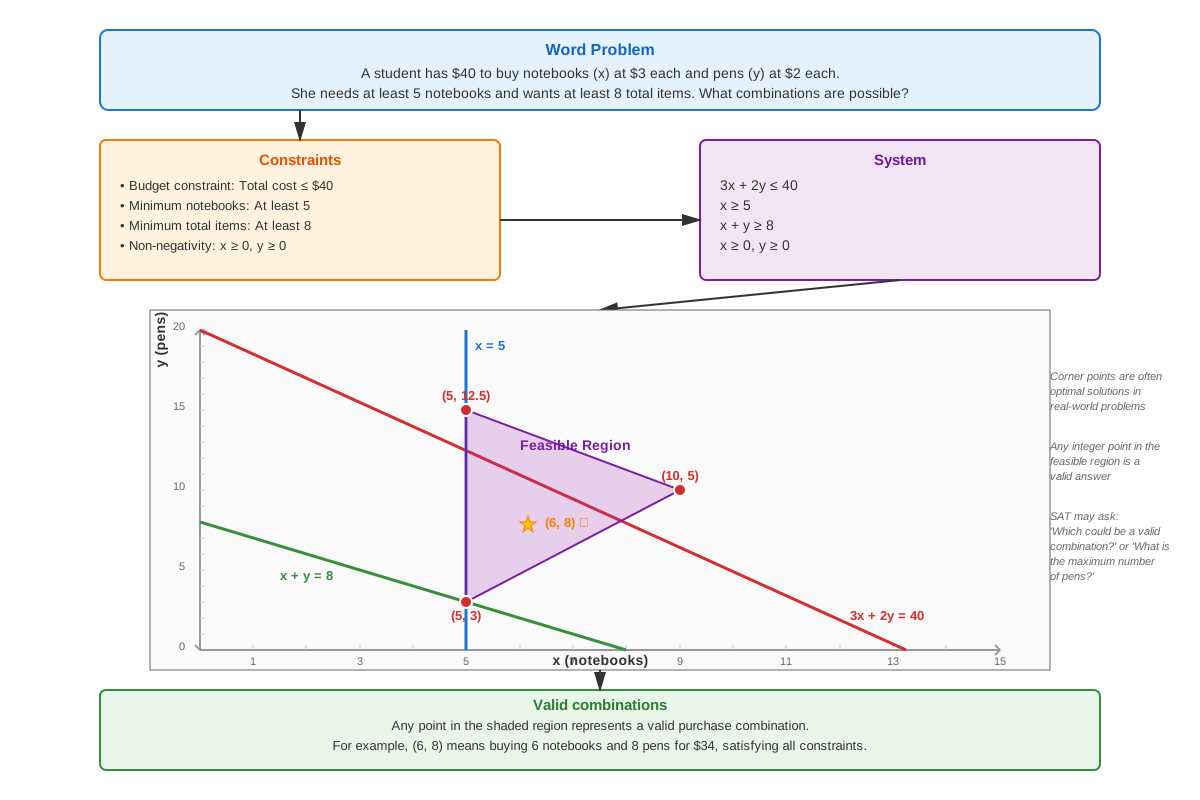
Overview
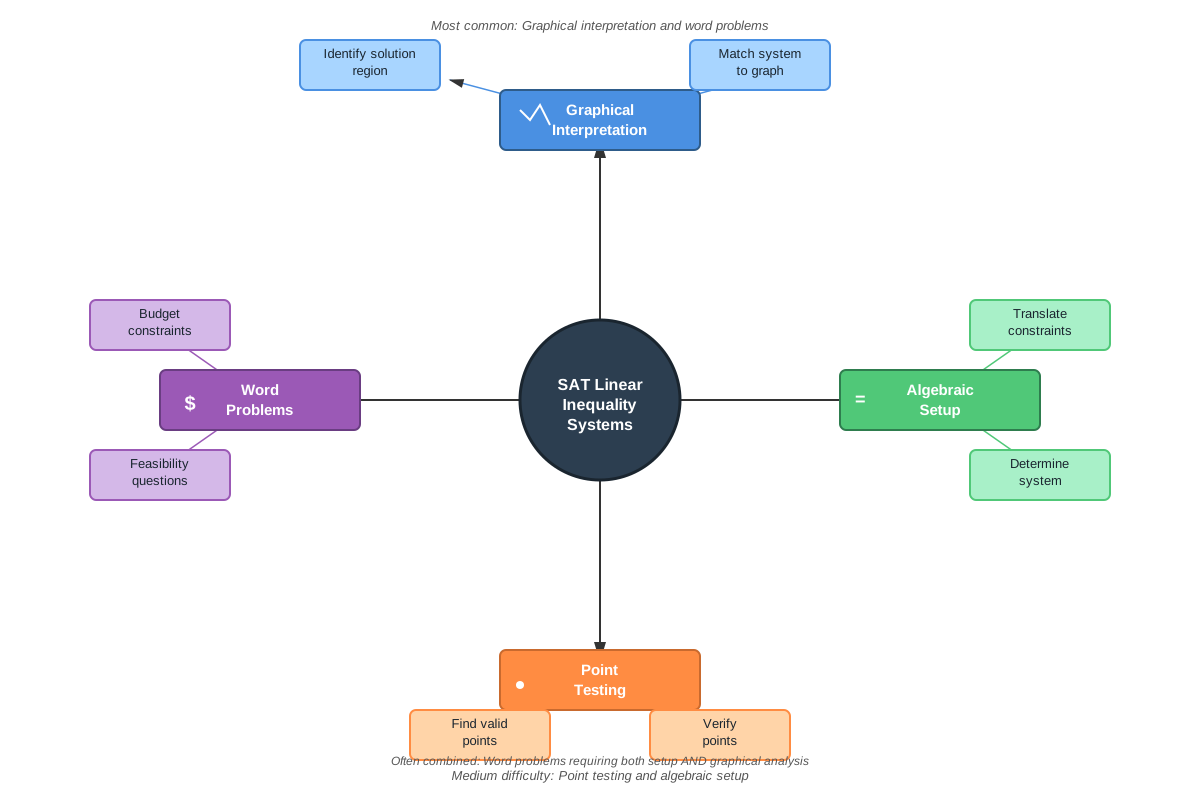
Systems of linear inequalities represent one of the most practical and frequently tested topics in SAT math. Unlike single linear inequalities that define a half-plane on a coordinate grid, linear inequalities systems involve two or more inequalities working together to create a bounded or unbounded region of solutions. This topic bridges algebraic manipulation with geometric visualization, requiring students to think both symbolically and spatially. On the SAT, these systems appear in multiple formats: graphical interpretation questions, word problems requiring inequality setup, and questions asking students to identify solution regions or test specific points.
Understanding sat linear inequalities systems is essential because they model real-world constraints—situations where multiple conditions must be satisfied simultaneously. Whether determining feasible production levels given resource limitations, identifying valid combinations of purchases within a budget, or analyzing scientific data with multiple boundary conditions, systems of inequalities provide the mathematical framework. The SAT tests this topic because it assesses both computational skills and conceptual understanding, requiring students to translate between algebraic expressions, graphical representations, and contextual scenarios.
This topic builds directly on foundational algebra concepts including solving single-variable inequalities, graphing linear equations, and understanding coordinate geometry. It also connects forward to optimization problems, linear programming concepts tested in advanced mathematics, and data analysis questions where constraint satisfaction is crucial. Mastery of linear inequalities systems strengthens overall problem-solving abilities and prepares students for the integrated, multi-step reasoning that characterizes higher-difficulty SAT questions.
Learning Objectives
- [ ] Identify key features of linear inequalities systems including boundary lines, solution regions, and intersection areas
- [ ] Explain how linear inequalities systems appears on the SAT in graphical, algebraic, and word problem formats
- [ ] Apply linear inequalities systems to answer SAT-style questions involving constraint satisfaction and feasibility
- [ ] Graph systems of linear inequalities accurately and determine solution regions through shading
- [ ] Test ordered pairs to verify whether they satisfy all inequalities in a system
- [ ] Translate real-world constraint problems into systems of linear inequalities and interpret solutions contextually
Prerequisites
- Solving single-variable linear inequalities: Essential for understanding how inequality symbols behave and how to manipulate algebraic expressions while preserving inequality direction
- Graphing linear equations in slope-intercept and standard form: Necessary because boundary lines of inequalities are linear equations that must be graphed before determining solution regions
- Understanding coordinate plane geometry: Required to visualize solution regions, identify points, and interpret graphical representations of inequality systems
- Inequality notation and symbols: Fundamental for distinguishing between strict inequalities (< or >) and inclusive inequalities (≤ or ≥), which affects boundary line representation
- Substitution and evaluation of expressions: Needed to test whether specific ordered pairs satisfy inequality conditions
Why This Topic Matters
Systems of linear inequalities model countless real-world scenarios where multiple constraints operate simultaneously. Businesses use them for resource allocation and production planning, ensuring they don't exceed material supplies or labor hours while maximizing output. Scientists employ inequality systems to define acceptable parameter ranges in experiments. Financial planners use them to model investment portfolios that must satisfy risk tolerance, minimum return requirements, and diversification rules. Even everyday decisions—like planning a party within budget and space constraints—involve inequality systems thinking.
On the SAT, linear inequalities systems appear in approximately 3-5% of math questions, typically 1-2 questions per test. These questions span multiple difficulty levels and formats. Students encounter them as:
- Graphical interpretation questions showing shaded regions and asking which inequality system matches the graph
- Word problems describing constraints that must be translated into inequality notation
- Solution verification questions providing a system and asking whether specific points satisfy all conditions
- Boundary analysis questions testing understanding of solid versus dashed lines and appropriate shading directions
The College Board specifically values this topic because it assesses mathematical modeling—the ability to translate between verbal descriptions, symbolic notation, and visual representations. Questions often integrate multiple skills: reading comprehension, algebraic manipulation, and spatial reasoning. High-performing students recognize inequality systems quickly and apply systematic solution strategies rather than relying on trial-and-error approaches.
Core Concepts
Understanding Linear Inequalities
A linear inequality in two variables takes the form ax + by < c, ax + by ≤ c, ax + by > c, or ax + by ≥ c, where a, b, and c are constants. Unlike a linear equation that defines a line (a one-dimensional set of points), a linear inequality defines a half-plane—an entire region of the coordinate plane on one side of a boundary line.
The boundary line itself is the graph of the related equation ax + by = c. Whether this boundary line is included in the solution set depends on the inequality symbol:
- Strict inequalities (< or >) use a dashed line to indicate the boundary points are NOT part of the solution
- Inclusive inequalities (≤ or ≥) use a solid line to indicate the boundary points ARE part of the solution
Graphing Individual Inequalities
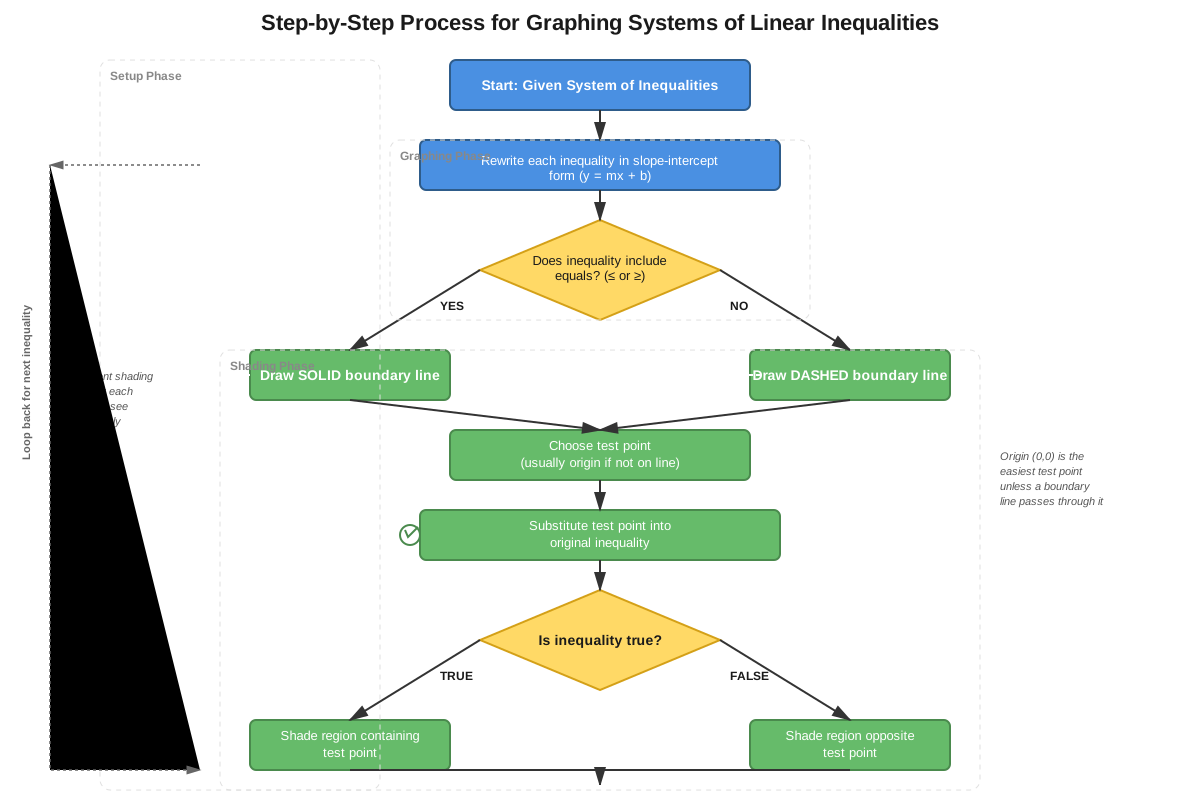
To graph a single linear inequality, follow this systematic process:
- Convert to slope-intercept form (y = mx + b) if possible, solving for y
- Graph the boundary line using the related equation (y = mx + b)
- Determine line style: dashed for < or >, solid for ≤ or ≥
- Choose a test point not on the line (origin (0,0) works well unless the line passes through it)
- Substitute the test point into the original inequality
- Shade the appropriate region: if the test point satisfies the inequality, shade the region containing it; otherwise, shade the opposite region
Important consideration: When solving for y, if you multiply or divide by a negative number, you must reverse the inequality symbol. For example, -2y < 6 becomes y > -3 (not y < -3).
Systems of Linear Inequalities
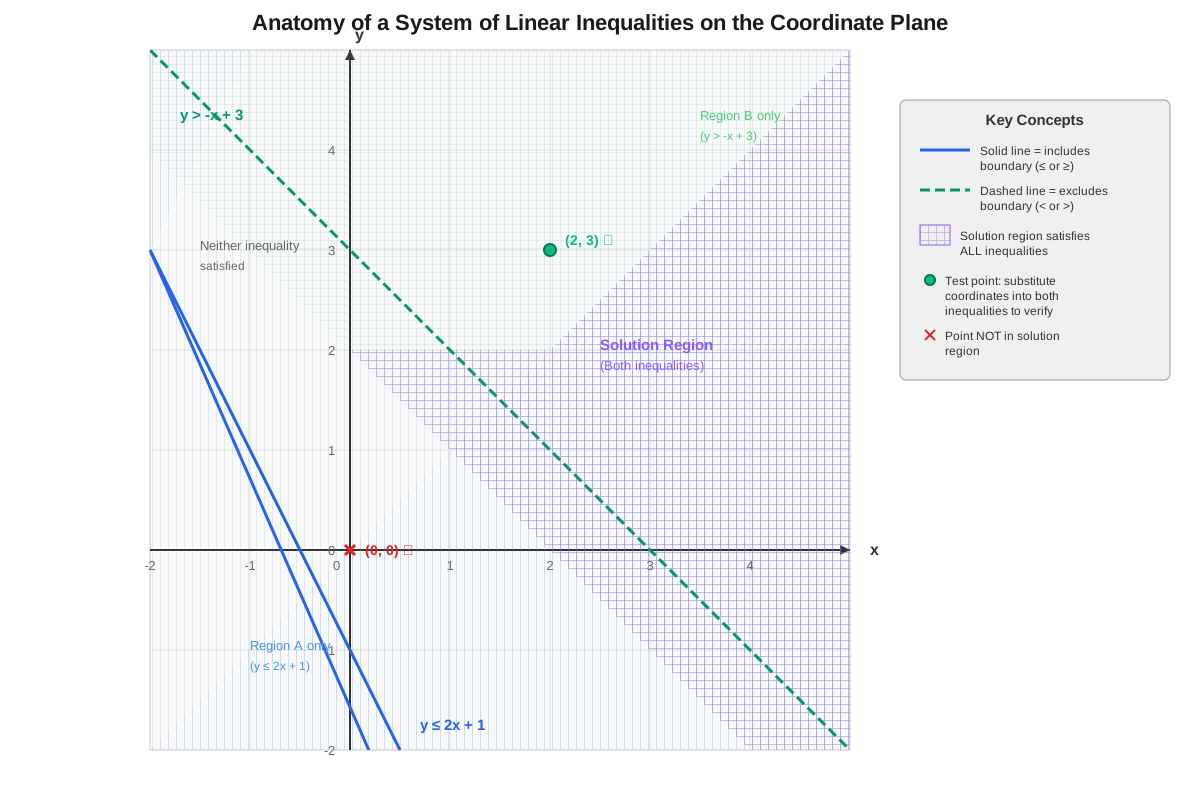
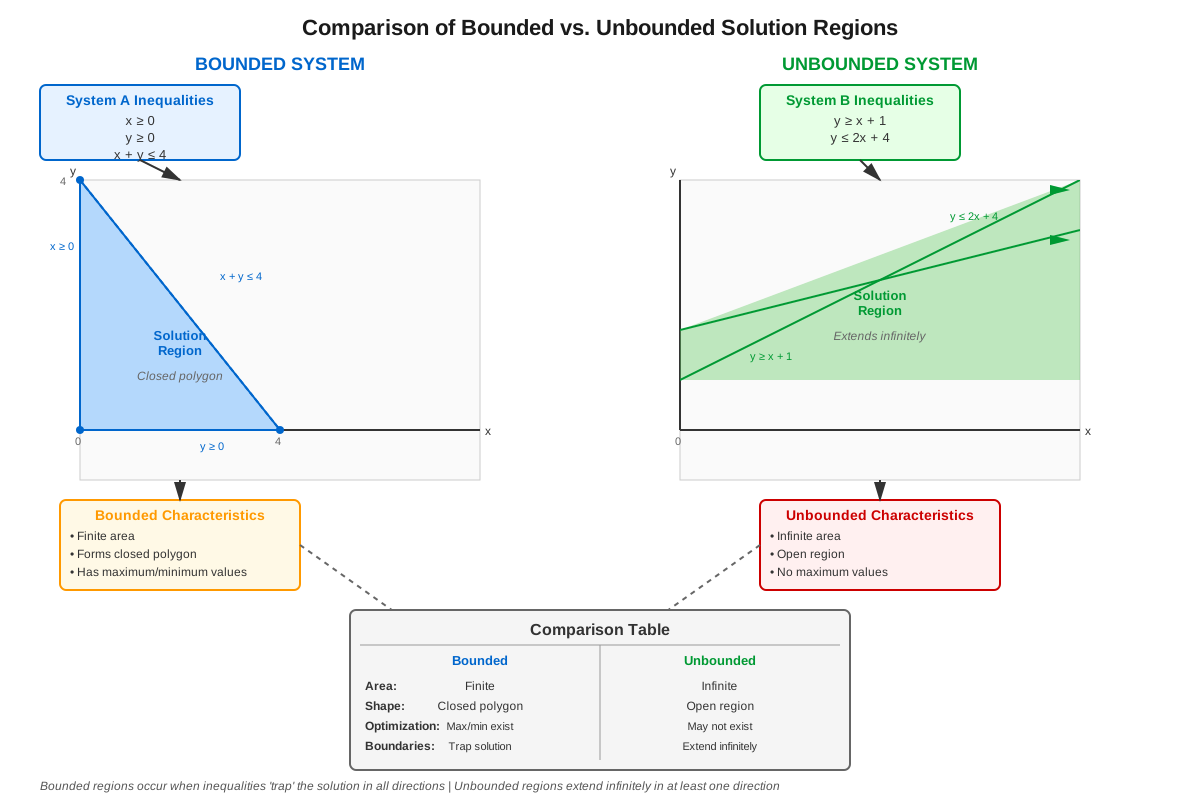
A system of linear inequalities consists of two or more inequalities that must be satisfied simultaneously. The solution to the system is the intersection of all individual solution regions—the area where all shaded regions overlap. This intersection can be:
- A bounded region (enclosed polygon)
- An unbounded region (extends infinitely in one or more directions)
- A line segment or ray (when boundaries overlap)
- The empty set (when no points satisfy all inequalities simultaneously)
Graphing Systems of Linear Inequalities
The process for graphing systems extends the single-inequality approach:
- Graph each inequality separately on the same coordinate plane
- Use different shading patterns or colors to distinguish each inequality's region (on the SAT, you'll typically identify regions mentally or with light marks)
- Identify the intersection region where all shadings overlap
- Verify with test points from the intersection region to confirm they satisfy all inequalities
Testing Points in Systems
To determine whether an ordered pair (x, y) is a solution to a system, substitute the x and y values into every inequality in the system. The point is a solution only if it satisfies all inequalities. This method is particularly useful for SAT multiple-choice questions where you can test answer choices directly.
Boundary Line Intersections
The vertices (corner points) of bounded solution regions occur where boundary lines intersect. To find these vertices:
- Identify pairs of boundary lines that form corners of the solution region
- Solve the system of equations formed by those two boundary lines
- Verify the intersection point lies within the solution region by testing it in all inequalities
These vertices are crucial in optimization problems (though less common on the SAT) and help define the exact shape of solution regions.
Special Cases and Constraints
Some systems include non-negativity constraints (x ≥ 0 and y ≥ 0), which restrict solutions to the first quadrant. These appear frequently in real-world modeling since many quantities (prices, quantities, time) cannot be negative. When graphing such systems, only consider the portion of the solution region in the first quadrant.
Translating Word Problems
SAT questions often present constraints verbally rather than algebraically. Key translation strategies include:
| Verbal Phrase | Mathematical Translation |
|---|---|
| "at most" | ≤ |
| "no more than" | ≤ |
| "at least" | ≥ |
| "no less than" | ≥ |
| "exceeds" | > |
| "less than" | < |
| "maximum" | ≤ |
| "minimum" | ≥ |
| "between A and B" | A < x < B or A ≤ x ≤ B |
When translating, identify:
- Variables: What quantities are unknown?
- Constraints: What limitations exist?
- Relationships: How do variables relate to each other and to constants?
Concept Relationships
The concepts within linear inequalities systems build hierarchically. Single linear inequalities form the foundation, establishing how to graph boundary lines and determine half-plane solutions. This leads to systems of inequalities, where multiple half-planes intersect to create solution regions. Testing points serves as both a verification method and an alternative solution strategy, connecting algebraic and geometric representations.
Boundary line analysis connects to the prerequisite knowledge of graphing linear equations, while inequality symbol interpretation (solid versus dashed lines) links back to understanding strict versus inclusive inequalities from single-variable work. The intersection of solution regions applies set theory concepts (intersection of sets) in a geometric context.
Relationship map:
- Graphing linear equations → enables → Drawing boundary lines
- Boundary lines + Inequality symbols → determine → Half-plane shading
- Multiple half-planes → intersect to form → System solution regions
- Solution regions ← verified by → Point testing
- Word problem constraints → translate to → Inequality systems → solve via → Graphical or algebraic methods
This topic connects forward to linear programming (optimization within constraints), absolute value inequalities (which create V-shaped boundary regions), and systems of equations (where solution regions reduce to single points or lines). It also relates to function domain and range concepts, as inequalities define valid input/output regions.
High-Yield Facts
⭐ The solution to a system of linear inequalities is the intersection (overlap) of all individual solution regions, not their union.
⭐ Boundary lines are dashed for strict inequalities (< or >) and solid for inclusive inequalities (≤ or ≥).
⭐ When solving an inequality for y and multiplying/dividing by a negative number, the inequality symbol must be reversed.
⭐ A point is a solution to a system only if it satisfies ALL inequalities in the system simultaneously.
⭐ To test which side of a boundary line to shade, substitute a test point (often the origin) into the inequality.
- The solution region of a system can be bounded (enclosed), unbounded (extending infinitely), or empty (no solutions exist).
- Vertices of bounded solution regions occur at intersections of boundary lines.
- Non-negativity constraints (x ≥ 0, y ≥ 0) restrict solutions to the first quadrant.
- Parallel boundary lines with inequality symbols pointing in opposite directions create empty solution sets.
- The inequality y > mx + b represents the region ABOVE the line y = mx + b, while y < mx + b represents the region BELOW.
- When boundary lines coincide (same line), the system reduces to a single inequality along that line.
- Systems with three or more inequalities typically create triangular or polygonal solution regions.
Quick check — test yourself on Linear inequalities systems so far.
Try Flashcards →Common Misconceptions
Misconception: The solution to a system of inequalities is the union (combination) of all shaded regions.
Correction: The solution is the intersection where ALL shaded regions overlap. Only points in this overlapping area satisfy every inequality simultaneously.
Misconception: All boundary lines should be solid lines.
Correction: Boundary line style depends on the inequality symbol. Use dashed lines for strict inequalities (< or >) because points on the boundary don't satisfy the inequality. Use solid lines for inclusive inequalities (≤ or ≥) because boundary points are solutions.
Misconception: When an inequality is written as y < mx + b, shade above the line.
Correction: The inequality y < mx + b means y-values are less than those on the line, so shade below the line. Conversely, y > mx + b means shade above the line. The inequality symbol points toward the shaded region.
Misconception: If a point satisfies one inequality in a system, it's a solution to the system.
Correction: A point must satisfy every single inequality in the system to be a solution. Test the point in all inequalities before concluding it's a solution.
Misconception: You can always use (0, 0) as a test point.
Correction: The origin works as a test point only when the boundary line doesn't pass through (0, 0). If the line contains the origin, choose a different test point like (1, 0) or (0, 1).
Misconception: Reversing the inequality symbol is necessary whenever you solve for y.
Correction: Reverse the inequality symbol only when multiplying or dividing both sides by a negative number. Simply moving terms from one side to another (adding or subtracting) doesn't require reversal.
Worked Examples
Example 1: Graphing and Identifying Solution Regions
Problem: Graph the system of inequalities and determine whether the point (2, 3) is a solution:
y ≤ 2x + 1
y > -x + 4
x ≥ 0Solution:
Step 1: Graph the first inequality y ≤ 2x + 1
- Boundary line: y = 2x + 1 (slope = 2, y-intercept = 1)
- Line style: solid (because of ≤)
- Test point (0, 0): Is 0 ≤ 2(0) + 1? Is 0 ≤ 1? Yes.
- Shade: Below and including the line (region containing origin)
Step 2: Graph the second inequality y > -x + 4
- Boundary line: y = -x + 4 (slope = -1, y-intercept = 4)
- Line style: dashed (because of >)
- Test point (0, 0): Is 0 > -(0) + 4? Is 0 > 4? No.
- Shade: Above the line (region NOT containing origin)
Step 3: Graph the third inequality x ≥ 0
- Boundary line: x = 0 (the y-axis)
- Line style: solid (because of ≥)
- Shade: Right of and including the y-axis (all points with non-negative x-coordinates)
Step 4: Identify the intersection region
The solution region is where all three shaded areas overlap—a triangular region in the first quadrant bounded by the three lines.
Step 5: Test whether (2, 3) is a solution
- First inequality: Is 3 ≤ 2(2) + 1? Is 3 ≤ 5? ✓ Yes
- Second inequality: Is 3 > -(2) + 4? Is 3 > 2? ✓ Yes
- Third inequality: Is 2 ≥ 0? ✓ Yes
Conclusion: Since (2, 3) satisfies all three inequalities, it IS a solution to the system.
Example 2: Translating a Word Problem
Problem: A bakery makes cookies and brownies. Each batch of cookies requires 2 hours of oven time and each batch of brownies requires 3 hours. The bakery has at most 24 hours of oven time available per day. Cookies require 1 pound of flour per batch and brownies require 2 pounds per batch, with a maximum of 14 pounds of flour available daily. Write a system of inequalities representing these constraints, where c represents batches of cookies and b represents batches of brownies.
Solution:
Step 1: Identify variables
- c = number of cookie batches
- b = number of brownie batches
Step 2: Translate oven time constraint
"Each batch of cookies requires 2 hours and each batch of brownies requires 3 hours, with at most 24 hours available"
- Total oven time: 2c + 3b
- Constraint: 2c + 3b ≤ 24
Step 3: Translate flour constraint
"Cookies require 1 pound per batch and brownies require 2 pounds per batch, with a maximum of 14 pounds available"
- Total flour: 1c + 2b (or simply c + 2b)
- Constraint: c + 2b ≤ 14
Step 4: Add non-negativity constraints
Since the bakery cannot make negative batches:
- c ≥ 0
- b ≥ 0
Complete System:
2c + 3b ≤ 24
c + 2b ≤ 14
c ≥ 0
b ≥ 0Interpretation: Any point (c, b) in the solution region represents a feasible production plan. For example, (3, 4) would mean 3 batches of cookies and 4 batches of brownies. Testing: 2(3) + 3(4) = 18 ≤ 24 ✓ and 3 + 2(4) = 11 ≤ 14 ✓, so this is feasible.
Exam Strategy
Approach SAT questions systematically: When encountering a linear inequalities system question, first identify the question type. Is it asking you to graph a system, identify which system matches a graph, test whether points are solutions, or translate a word problem? Each type requires a slightly different strategy.
For graphical interpretation questions (given a graph, identify the system):
- Examine each boundary line to determine its equation (identify slope and y-intercept)
- Determine whether each line should be solid or dashed based on the graph
- Pick a test point clearly in the shaded region and substitute into answer choices
- Eliminate choices that don't match the line styles or don't include your test point in their solution region
For point-testing questions (is point P a solution?):
- Substitute the point's coordinates into each inequality
- Verify ALL inequalities are satisfied—even one failure means the point is NOT a solution
- Be careful with inequality symbols and negative numbers during substitution
For word problem translation:
- Define variables clearly based on what the problem asks
- Identify each constraint separately before combining
- Watch for trigger words: "at most" (≤), "at least" (≥), "exceeds" (>), "less than" (<)
- Don't forget non-negativity constraints when quantities can't be negative
Trigger words and phrases to watch for:
- "Shaded region" → graphical interpretation question
- "Which point satisfies" → point-testing question
- "At most," "maximum," "no more than" → ≤ inequality
- "At least," "minimum," "no less than" → ≥ inequality
- "System of inequalities" → multiple constraints working together
Process-of-elimination tips:
- If a boundary line in the graph is dashed, eliminate any answer choice with ≤ or ≥ for that inequality
- If a boundary line is solid, eliminate choices with < or > for that inequality
- Test the origin (0, 0) if it's clearly inside or outside the shaded region—this quickly eliminates wrong answers
- For word problems, eliminate any system that doesn't include non-negativity constraints when the context requires them
Time allocation: Most linear inequalities system questions should take 60-90 seconds. If graphing mentally takes too long, use the test point strategy instead—it's often faster and less error-prone on the SAT. Don't spend time creating elaborate graphs unless absolutely necessary; the SAT rewards efficient problem-solving.
Memory Techniques
Mnemonic for inequality symbols and line styles: "Strict means Skip the line" (< and > use dashed lines that "skip" the boundary). Inclusive inequalities (≤ and ≥) use solid lines that "include" the boundary.
Visualization for shading direction: Picture the inequality symbol as an arrow pointing toward the shaded region. For y > mx + b, the ">" points upward, so shade above. For y < mx + b, the "<" points downward, so shade below.
Acronym for word problem translation - VCRT:
- Variables: Define what letters represent
- Constraints: Identify all limitations
- Relationships: Write inequalities
- Test: Verify with a sample point
Memory aid for intersection vs. union: "ALL must be satisfied" → solution is where ALL regions overlap (intersection). Think of it as the "AND" region—points must satisfy inequality 1 AND inequality 2 AND inequality 3.
Reversal rule reminder: "Negative Flips Inequality" (NFI). When you multiply or divide by a Negative number, Flip the Inequality symbol.
Summary
Systems of linear inequalities represent multiple constraints that must be satisfied simultaneously, creating solution regions on the coordinate plane through the intersection of half-planes. Each inequality defines a half-plane bounded by a line that is either solid (for ≤ or ≥) or dashed (for < or >), with shading indicating which side of the boundary contains solutions. The solution to a system is the overlapping region where all individual inequality solutions intersect, which can be bounded, unbounded, or empty. Testing whether a point is a solution requires verifying it satisfies every inequality in the system. On the SAT, these concepts appear in graphical interpretation questions, point-testing problems, and word problems requiring translation of real-world constraints into mathematical notation. Success requires fluency in graphing linear equations, understanding inequality notation, applying systematic test-point strategies, and translating verbal descriptions into algebraic expressions. The key to mastering this topic is recognizing that systems model situations with multiple simultaneous limitations and that solutions must satisfy all constraints together, not just individual ones.
Key Takeaways
- The solution to a system of linear inequalities is the intersection (overlap) of all individual solution regions where all constraints are satisfied simultaneously
- Boundary lines are solid for inclusive inequalities (≤, ≥) and dashed for strict inequalities (<, >)
- A point is a solution only if it satisfies every single inequality in the system—test all inequalities before concluding
- When solving inequalities for y, reverse the inequality symbol only when multiplying or dividing by a negative number
- Use the test point method (often with the origin) to determine which side of a boundary line to shade or to verify solutions quickly
- Word problems require careful translation: "at most/maximum" means ≤, "at least/minimum" means ≥, and non-negativity constraints (x ≥ 0, y ≥ 0) apply when quantities can't be negative
- For SAT efficiency, test answer choices directly rather than graphing elaborately—systematic point substitution often saves time
Related Topics
Linear Programming and Optimization: Building on systems of linear inequalities, linear programming finds maximum or minimum values of objective functions within constraint regions. This advanced topic uses the vertices of solution regions to identify optimal solutions.
Absolute Value Inequalities: These create V-shaped or angular boundary regions rather than straight lines, requiring understanding of how absolute value affects inequality solutions and extending the graphing techniques learned here.
Systems of Linear Equations: While inequality systems have region solutions, equation systems typically have point solutions (or no solution/infinitely many). Understanding both types strengthens overall systems-solving skills.
Quadratic Inequalities: These involve parabolic boundaries rather than linear ones, creating curved solution regions. Mastering linear inequalities provides the foundation for understanding these more complex constraint shapes.
Piecewise Functions: These functions have different rules for different domain regions, often defined using inequalities. Understanding inequality systems helps interpret and graph piecewise-defined functions.
Practice CTA
Now that you've mastered the core concepts of systems of linear inequalities, it's time to solidify your understanding through practice! Attempt the practice questions to apply these strategies to SAT-style problems, testing your ability to graph systems, verify solutions, and translate word problems. Use the flashcards to reinforce high-yield facts and ensure you can quickly recall key concepts under test conditions. Remember: consistent practice with immediate feedback is the most effective way to build the speed and accuracy needed for SAT success. You've built a strong foundation—now strengthen it through application!
Sign up free to keep reading
Create a free AnvayaPrep account to finish this SAT guide on Linear inequalities systems — plus flashcards and practice questions.