Overview
Systems word problems represent one of the most practical and frequently tested applications of algebra on the SAT math section. These problems require students to translate real-world scenarios into mathematical equations and solve them using systems of linear equations. Unlike straightforward algebraic manipulation questions, systems word problems test both mathematical reasoning and reading comprehension, making them a critical skill for achieving a competitive score.
On the SAT, sat systems word problems typically appear 2-4 times per test and account for a significant portion of the Problem Solving and Data Analysis domain as well as the Heart of Algebra domain. These questions assess whether students can identify relevant information from verbal descriptions, define appropriate variables, construct accurate equations, and solve systems using substitution, elimination, or graphical methods. The ability to work efficiently with systems word problems demonstrates mathematical maturity and problem-solving flexibility—qualities that the SAT specifically targets.
Understanding systems word problems connects directly to broader mathematical concepts including linear relationships, rate problems, mixture problems, and optimization. This topic builds upon foundational algebra skills while preparing students for more complex mathematical modeling. Mastery of this topic not only improves SAT performance but also develops critical thinking skills applicable to economics, physics, chemistry, and everyday decision-making scenarios involving multiple constraints or conditions.
Learning Objectives
- [ ] Identify key features of systems word problems, including the number of unknowns and the relationships between variables
- [ ] Explain how systems word problems appears on the SAT, including common contexts and question formats
- [ ] Apply systems word problems to answer SAT-style questions using appropriate solution methods
- [ ] Translate verbal descriptions into accurate mathematical equations with correctly defined variables
- [ ] Determine the most efficient solution method (substitution, elimination, or graphing) based on problem structure
- [ ] Verify solutions by checking them against the original problem context and constraints
- [ ] Recognize when a system has no solution, one solution, or infinitely many solutions in word problem contexts
Prerequisites
- Linear equations in one variable: Essential for understanding each individual equation within a system and for solving after substitution or elimination
- Coordinate plane and graphing: Necessary for visualizing systems and understanding solution points as intersections
- Basic algebraic manipulation: Required for rearranging equations, isolating variables, and performing substitution or elimination
- Rate, distance, and time relationships: Many systems word problems involve motion, requiring understanding of d = rt
- Percentage and proportion concepts: Mixture and investment problems frequently use these relationships within systems
Why This Topic Matters
Systems word problems represent authentic mathematical modeling—the process of taking messy, real-world situations and translating them into solvable mathematical frameworks. In practical applications, systems of equations help businesses determine optimal pricing strategies, engineers calculate load distributions, economists model supply and demand, and scientists analyze chemical reactions. The skill of setting up and solving systems transfers directly to college-level coursework in STEM fields, business, and social sciences.
On the SAT, systems word problems appear with high frequency and predictability. Approximately 10-15% of SAT math questions involve systems of equations, with roughly half of these presented as word problems rather than pure algebraic expressions. These questions typically appear in both the calculator and no-calculator sections, with point values ranging from 1 to 4 points depending on complexity. The College Board consistently includes at least one multi-step systems word problem in each test administration.
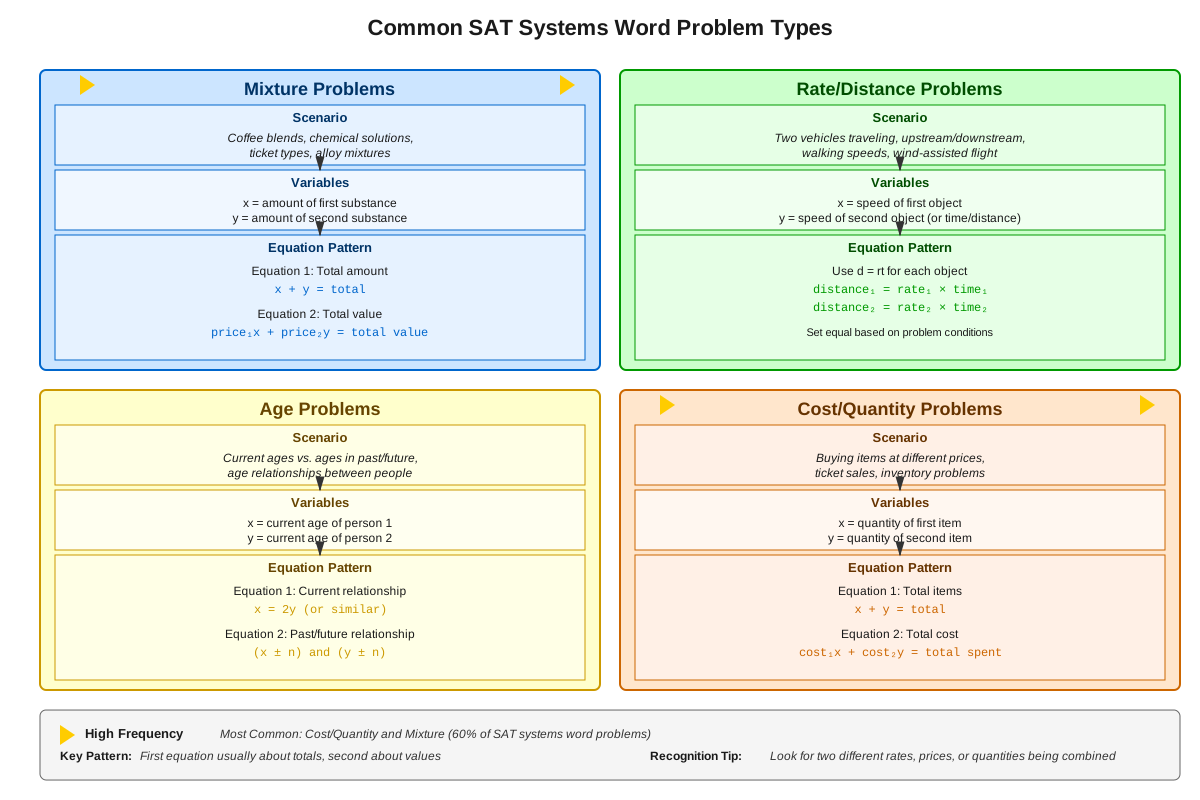
Common SAT contexts for systems word problems include: ticket sales scenarios (adult vs. child tickets), mixture problems (combining solutions or foods with different concentrations), age problems (comparing ages at different times), rate problems (two objects moving toward or away from each other), cost analysis (comparing pricing plans or production costs), and investment scenarios (allocating money between different interest rates). Recognizing these standard formats allows students to quickly identify the problem type and apply appropriate solution strategies.
Core Concepts
Understanding Systems of Equations
A system of equations consists of two or more equations with two or more variables that must be solved simultaneously. In systems word problems, each equation represents a different constraint or relationship described in the problem. The solution to a system is the set of values that satisfies all equations simultaneously. For linear systems with two variables, the solution represents the point where two lines intersect on a coordinate plane.
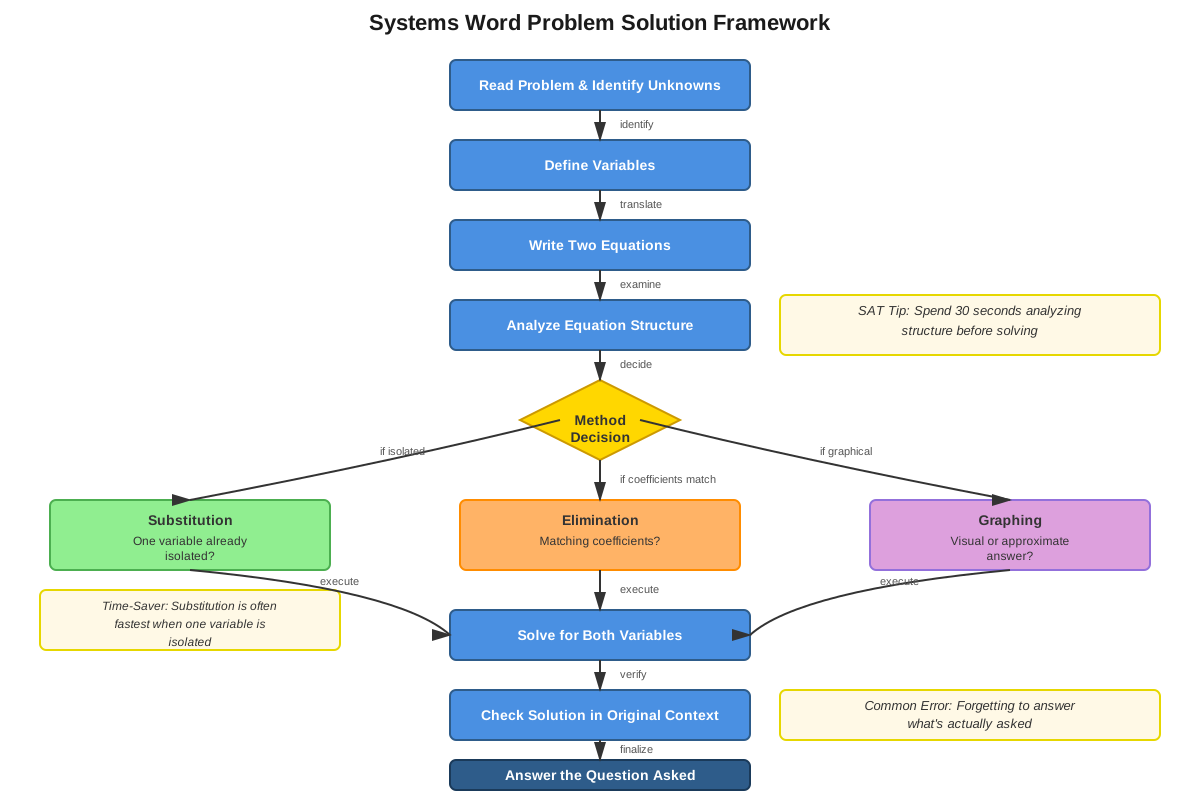
Systems word problems require three distinct phases: translation (converting words to equations), solution (finding the values of variables), and verification (checking that the solution makes sense in context). The translation phase is often the most challenging because it requires careful reading and identification of what each variable represents.
Setting Up Variables and Equations
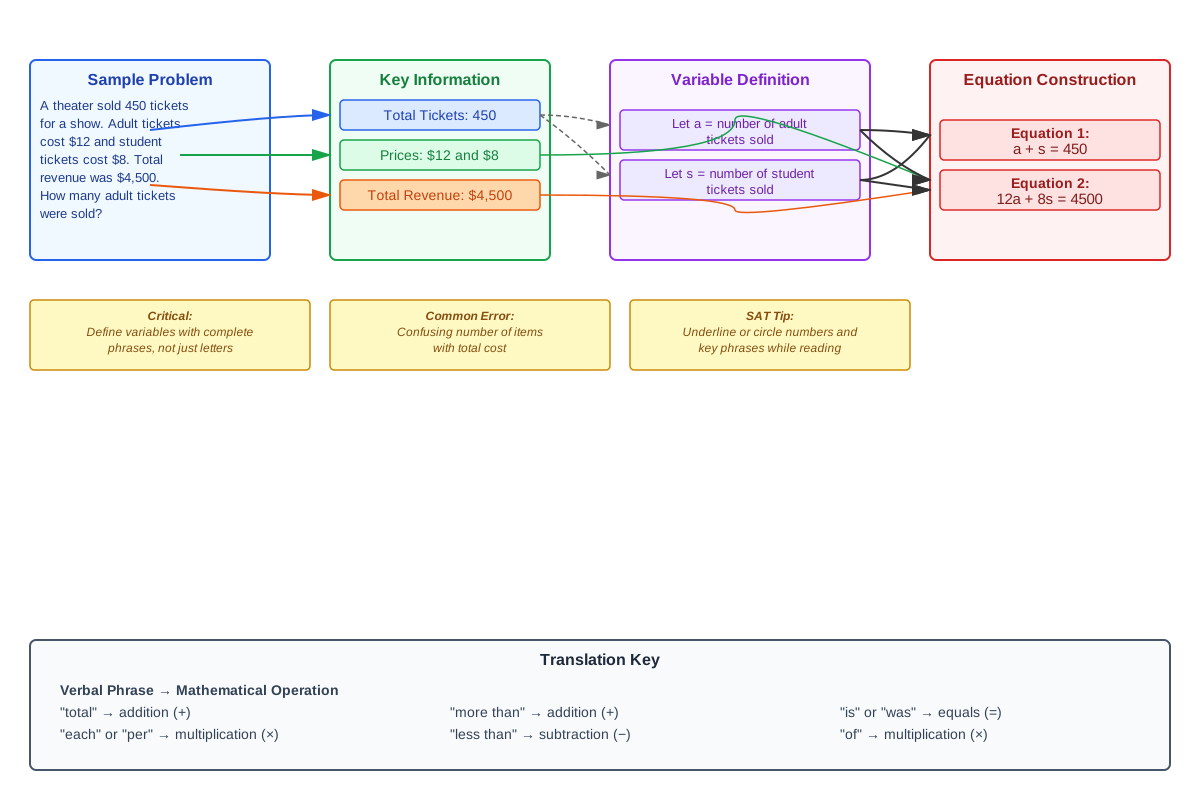
The first critical step in any systems word problem is defining variables clearly and explicitly. Students should write out what each variable represents using complete phrases, not just single letters. For example, write "Let x = the number of adult tickets sold" rather than just "x = adults." This precision prevents confusion and errors in equation setup.
When translating word problems into equations, look for these key indicators:
- Total or sum: Suggests addition (x + y = total)
- Difference: Suggests subtraction (x - y = difference)
- Cost per item: Suggests multiplication (price × quantity)
- Combined value: Suggests adding products (price₁ × quantity₁ + price₂ × quantity₂ = total value)
- Ratio or proportion: Suggests equations with fractions or cross-multiplication
Common Problem Types
| Problem Type | Typical Structure | Key Relationships |
|---|---|---|
| Ticket/Item Sales | Two types of items at different prices | Equation 1: Total quantity; Equation 2: Total revenue |
| Mixture Problems | Combining substances with different concentrations | Equation 1: Total volume/mass; Equation 2: Total pure substance |
| Age Problems | Comparing ages at different times | Equation 1: Current age relationship; Equation 2: Past/future relationship |
| Rate/Motion Problems | Two objects moving | Equation 1: Distance relationship; Equation 2: Time relationship |
| Investment Problems | Money in different accounts | Equation 1: Total investment; Equation 2: Total interest earned |
Solution Methods
Substitution Method: This approach works best when one equation is already solved for a variable or can be easily solved for a variable. The steps are:
- Solve one equation for one variable in terms of the other
- Substitute this expression into the second equation
- Solve the resulting single-variable equation
- Substitute back to find the other variable
Elimination Method: This approach works best when coefficients can be easily manipulated to eliminate a variable. The steps are:
- Multiply one or both equations by constants to create opposite coefficients for one variable
- Add or subtract the equations to eliminate that variable
- Solve the resulting single-variable equation
- Substitute back to find the other variable
Graphical Method: While less common for exact solutions on the SAT, understanding the graphical interpretation helps with conceptual questions. The solution is the intersection point of the two lines.
Special Cases
Systems can have one solution (lines intersect at one point), no solution (parallel lines that never intersect), or infinitely many solutions (the same line written in different forms). In word problem contexts:
- No solution indicates contradictory constraints (impossible situation)
- Infinitely many solutions indicates redundant information (the two conditions are actually the same)
- One solution is the most common scenario in SAT problems
Verification and Reasonableness
After solving, always verify that the solution makes sense in the problem context. Check that:
- Values are positive when they represent quantities that cannot be negative (number of items, time, etc.)
- Values are whole numbers when they represent discrete items (people, tickets, etc.)
- The solution satisfies both original equations
- The answer addresses what the question actually asks for (sometimes you solve for x but the question asks for y or x + y)
Concept Relationships
The core concepts within systems word problems form a logical progression: Problem Reading → Variable Definition → Equation Translation → Method Selection → Algebraic Solution → Verification. Each step depends on the previous one, and errors early in the chain compound through the solution process.
Systems word problems connect directly to prerequisite knowledge of linear equations, as each equation in the system is itself a linear equation. The graphing skills from coordinate geometry provide visual understanding of what a solution represents (intersection point). Rate and proportion concepts from arithmetic appear frequently in the equation setup phase.
This topic also connects forward to more advanced mathematical concepts. Systems word problems introduce mathematical modeling—the process of representing real situations with mathematical structures. This skill extends to linear programming, optimization problems, and multivariable calculus in college mathematics. The logical reasoning developed through systems word problems transfers to proof-based mathematics and computer programming.
Within the SAT Math section, systems word problems integrate with functions (understanding that each equation represents a function), data analysis (interpreting solutions in context), and problem-solving strategies (working backward, testing answer choices). Strong performance on systems word problems correlates with strong performance on other multi-step reasoning questions throughout the test.
High-Yield Facts
⭐ Systems word problems on the SAT almost always involve exactly two variables and two equations—if you identify more or fewer, reread the problem carefully.
⭐ The question often asks for something other than the variables you solve for—always read the final question carefully (it might ask for x + y when you solved for x and y separately).
⭐ When one equation involves only addition/subtraction and the other involves multiplication, substitution is usually faster than elimination.
⭐ If answer choices are given, plugging them back into the problem context can be faster than algebraic solution, especially for complex systems.
⭐ The total quantity equation and the total value equation are the two most common equation types in SAT systems word problems.
- Systems word problems appear 2-4 times per SAT test administration across both math sections.
- Mixture problems always follow the pattern: (concentration₁)(amount₁) + (concentration₂)(amount₂) = (final concentration)(total amount).
- In rate problems where two objects move toward each other, their rates add; when moving in the same direction, their rates subtract.
- Age problems require careful attention to time shifts—if the problem mentions "5 years ago," subtract 5 from current ages in that equation.
- Investment problems use the formula: Interest = Principal × Rate × Time, creating equations from total interest earned.
- When a system has no solution in a word problem context, the problem describes an impossible situation with contradictory constraints.
- Calculator use is permitted on most systems word problems, but setting up equations correctly is more important than calculation speed.
Quick check — test yourself on Systems word problems so far.
Try Flashcards →Common Misconceptions
Misconception: Both equations in a system must use the same operations or have similar structures.
Correction: Systems typically pair different types of relationships—commonly one equation about total quantity (addition) and one about total value (multiplication then addition). The equations represent different constraints and naturally have different structures.
Misconception: The solution to a system is always both variable values, so both must be reported.
Correction: SAT questions frequently ask for only one variable, a sum (x + y), a difference (x - y), or some other expression involving the variables. Always identify what the question asks for before selecting your answer.
Misconception: Substitution and elimination always produce the same difficulty level for any given problem.
Correction: Problem structure determines which method is more efficient. When one equation is already solved for a variable (like y = 3x + 2), substitution is faster. When coefficients align nicely (like 2x + 3y = 10 and 2x - y = 2), elimination is faster.
Misconception: If you get a negative or fractional answer, you made an error because real-world quantities must be positive integers.
Correction: While some contexts require positive integers (number of people), others allow negatives (temperature, profit/loss) or fractions (hours, distances, concentrations). Always consider the specific context before dismissing an answer.
Misconception: Word problems with percentages or rates require special formulas beyond basic systems of equations.
Correction: These problems still reduce to standard systems of linear equations. Convert percentages to decimals and express rates as coefficients, then solve using standard methods. The context may be different, but the mathematical structure remains the same.
Misconception: Graphing systems is impractical on the SAT because it takes too long and lacks precision.
Correction: While algebraic methods are usually preferred for exact answers, quickly sketching a graph can help verify that an algebraic solution is reasonable, identify whether a system has no solution (parallel lines), and provide intuition about the problem structure.
Worked Examples
Example 1: Ticket Sales Problem
Problem: A theater sold 450 tickets for a performance. Adult tickets cost $12 and child tickets cost $8. If the total revenue was $4,800, how many adult tickets were sold?
Solution:
Step 1: Define variables clearly
- Let a = number of adult tickets sold
- Let c = number of child tickets sold
Step 2: Translate the problem into equations
The first sentence gives us total tickets:
a + c = 450The revenue information gives us total value:
12a + 8c = 4800Step 3: Choose a solution method
Since the first equation is simple, substitution works well. Solve the first equation for c:
c = 450 - aStep 4: Substitute into the second equation
12a + 8(450 - a) = 4800
12a + 3600 - 8a = 4800
4a + 3600 = 4800
4a = 1200
a = 300
Step 5: Find the other variable (if needed)
c = 450 - 300 = 150Step 6: Verify and answer the question
Check: 300 + 150 = 450 ✓
Check: 12(300) + 8(150) = 3600 + 1200 = 4800 ✓
The question asks for adult tickets, so the answer is 300 adult tickets.
Connection to Learning Objectives: This example demonstrates identifying key features (two unknowns, two constraints), translating verbal information into equations, and applying substitution method to reach a solution.
Example 2: Mixture Problem
Problem: A chemist needs to create 100 mL of a 15% acid solution by mixing a 10% acid solution with a 25% acid solution. How many milliliters of the 25% solution should be used?
Solution:
Step 1: Define variables
- Let x = milliliters of 10% solution
- Let y = milliliters of 25% solution
Step 2: Set up equations
Total volume equation:
x + y = 100Total pure acid equation (this is the key insight for mixture problems):
0.10x + 0.25y = 0.15(100)The right side represents the amount of pure acid in the final mixture.
Step 3: Simplify the second equation
0.10x + 0.25y = 15Multiply by 100 to eliminate decimals:
10x + 25y = 1500Step 4: Use elimination method
Multiply the first equation by -10:
-10x - 10y = -1000
10x + 25y = 1500
Add the equations:
15y = 500
y = 33.33... or 100/3
Step 5: Verify
x = 100 - 100/3 = 200/3 ≈ 66.67Check: (0.10)(200/3) + (0.25)(100/3) = 20/3 + 25/3 = 45/3 = 15 ✓
The answer is 100/3 mL or approximately 33.33 mL of the 25% solution.
Connection to Learning Objectives: This example shows how to handle percentage-based systems, demonstrates the elimination method, and illustrates that fractional answers are sometimes appropriate in context.
Exam Strategy
When approaching SAT systems word problems, follow this systematic process:
1. Read the entire problem first without trying to solve it. Identify what the question asks for at the end—circle or underline it. Many students solve for the wrong variable because they don't note what the question actually wants.
2. Identify and define variables explicitly. Write "Let x = ..." with a complete description. This takes 10 seconds but prevents costly errors. If the problem involves two types of items, two people, or two substances, you likely need two variables.
3. Look for trigger words and phrases:
- "Total," "combined," "altogether" → addition equation
- "Costs," "revenue," "value" → multiplication then addition
- "More than," "less than," "difference" → subtraction or inequality
- "Twice," "three times," "half" → multiplication or division relationship
- "Percent," "concentration" → decimal coefficients
4. Set up both equations before solving. Resist the urge to start solving after writing one equation. Having both equations visible helps you choose the most efficient solution method.
5. Choose your method strategically:
- If one equation is already solved for a variable or easily solved → substitution
- If coefficients align or can be easily manipulated → elimination
- If answer choices are given and simple → test answer choices
6. Use the calculator section wisely. The calculator helps with arithmetic but cannot set up equations for you. Focus mental energy on translation and setup; let the calculator handle computation.
7. Check reasonableness before bubbling. Does your answer make sense? If you calculated that 1,000 adult tickets were sold but the problem stated 450 total tickets, you made an error.
Time Management Tip: Allocate 2-3 minutes for systems word problems. If you're stuck after 90 seconds, mark it and move on. These problems are worth the same points as simpler questions, so don't sacrifice easy points by getting trapped on one difficult problem.
Memory Techniques
DAVE - The four-step process for systems word problems:
- Define variables clearly
- Analyze the problem for two relationships
- Verify your equations make sense
- Execute the solution method
"Total Tickets, Total Cash" - Remember that most SAT systems word problems involve one equation about total quantity and one about total value. If you can't find two relationships, look for these two types.
"SUBS before ELIM" - When in doubt, try SUBstitution before ELIMination. Substitution works for all systems, while elimination requires coefficient manipulation that can introduce arithmetic errors under time pressure.
Visualization Strategy: Picture systems word problems as two constraints creating a "fence" around the solution. Each equation eliminates possibilities. The solution is the one point that satisfies both constraints—where the fences intersect.
The "What am I solving for?" sticky note: Mentally place a sticky note on the final question. Before selecting your answer, check the sticky note. Did you solve for x when the question asks for y? Did you find both variables when the question asks for their sum?
Summary
Systems word problems represent a critical intersection of algebraic skill and reading comprehension on the SAT. These problems require students to translate real-world scenarios into mathematical equations, solve systems using substitution or elimination, and interpret solutions in context. The key to success lies in careful variable definition, accurate equation translation, strategic method selection, and thorough verification. Most SAT systems word problems follow predictable patterns—ticket sales, mixtures, rates, ages, and investments—each with characteristic equation structures. Students must recognize that the question often asks for something other than the variables themselves, requiring an additional calculation step. Mastery of systems word problems demonstrates mathematical maturity and problem-solving flexibility, skills that extend far beyond the SAT into college coursework and real-world applications. By following systematic approaches, recognizing common patterns, and practicing verification strategies, students can consistently earn points on these high-value questions.
Key Takeaways
- Systems word problems always require defining variables explicitly and translating two distinct relationships into two equations
- The most common pattern pairs a "total quantity" equation with a "total value" equation involving multiplication
- Always identify what the question asks for before solving—it may not be the variables themselves but rather their sum, difference, or another expression
- Choose between substitution and elimination based on equation structure: use substitution when one equation is already solved for a variable
- Verify solutions by checking both equations and confirming the answer makes sense in the problem context
- Trigger words like "total," "combined," "revenue," and "difference" signal specific mathematical operations and equation types
- Testing answer choices can be faster than algebraic solution when answers are provided and the system is complex
Related Topics
Linear Inequalities and Systems of Inequalities: After mastering systems of equations, students can extend these skills to systems involving inequalities, which introduce solution regions rather than single points. This topic appears on the SAT in optimization and constraint problems.
Functions and Function Notation: Understanding that each equation in a system represents a function helps with graphical interpretation and prepares students for more advanced function composition and transformation questions.
Quadratic Systems: Some advanced SAT problems involve systems where one equation is linear and one is quadratic, requiring substitution and quadratic formula application. Mastering linear systems provides the foundation for these more complex scenarios.
Matrix Methods for Systems: While not directly tested on the SAT, understanding matrix representation of systems provides powerful tools for college mathematics and demonstrates the deep structure underlying systems of equations.
Linear Programming: This optimization technique uses systems of linear inequalities to find maximum or minimum values, appearing occasionally in SAT word problems involving constraints and optimal solutions.
Practice CTA
Now that you've mastered the core concepts, strategies, and common patterns for systems word problems, it's time to put your knowledge into action. Work through the practice questions to reinforce these skills and build the speed and confidence you need for test day. Each practice problem is designed to mirror actual SAT questions, giving you authentic preparation. Remember, systems word problems are high-yield questions—investing time to master them will directly improve your score. Challenge yourself with the flashcards to cement key facts and formulas in your memory. You've got this!
Sign up free to keep reading
Create a free AnvayaPrep account to finish this SAT guide on Systems word problems — plus flashcards and practice questions.