Overview
45-45-90 triangles are one of the two special right triangles that appear frequently on the SAT. These isosceles right triangles possess unique properties that allow test-takers to quickly determine missing side lengths without relying on the Pythagorean theorem or trigonometric functions. Understanding the fixed ratio between the legs and hypotenuse of a 45-45-90 triangle is essential for solving geometry problems efficiently under timed conditions.
On the SAT math section, 45-45-90 triangles appear in multiple contexts: as standalone geometry problems, embedded within coordinate geometry questions, hidden in square diagonals, and integrated into complex multi-step problems involving area and perimeter. The College Board expects students to recognize these triangles immediately and apply their properties to solve problems in under a minute. Mastery of this topic directly impacts performance on approximately 2-4 questions per test, making it a high-yield area for focused study.
The relationship between 45-45-90 triangles and broader mathematical concepts is significant. These triangles connect to the Pythagorean theorem (serving as a special case), properties of squares (since diagonals create 45-45-90 triangles), coordinate geometry (particularly when calculating distances along diagonal lines), and trigonometry (where sine and cosine of 45° both equal √2/2). Understanding 45-45-90 triangles provides a foundation for more advanced geometric reasoning and serves as a time-saving tool that distinguishes high-scoring students from those who must calculate each problem from first principles.
Learning Objectives
- [ ] Identify key features of 45-45-90 triangles
- [ ] Explain how 45-45-90 triangles appears on the SAT
- [ ] Apply 45-45-90 triangles to answer SAT-style questions
- [ ] Derive the side ratio relationship (x : x : x√2) from the Pythagorean theorem
- [ ] Recognize disguised 45-45-90 triangles in squares, coordinate planes, and composite figures
- [ ] Calculate areas and perimeters of figures containing 45-45-90 triangles efficiently
Prerequisites
- Right triangle properties: Understanding that one angle measures 90° is essential because 45-45-90 triangles are a special case of right triangles
- Pythagorean theorem (a² + b² = c²): Needed to understand why the side ratio relationship holds and to verify calculations when necessary
- Properties of isosceles triangles: Recognizing that equal angles correspond to equal sides helps identify 45-45-90 triangles quickly
- Square root operations: Manipulating expressions with √2 is required for all calculations involving hypotenuses
- Basic properties of squares: Since diagonals of squares create 45-45-90 triangles, understanding square geometry is fundamental
Why This Topic Matters
In real-world applications, 45-45-90 triangles appear in architecture, engineering, and design whenever diagonal bracing or corner-to-corner measurements are needed. Construction projects frequently use 45° angles for aesthetic symmetry and structural stability. Computer graphics and game design rely on these triangles for diagonal movement calculations and isometric projections. Understanding these relationships allows professionals to make quick mental calculations without computational tools.
On the SAT, 45-45-90 triangles appear with remarkable frequency—typically 2-4 times per test across both the calculator and no-calculator sections. Questions may directly present a 45-45-90 triangle and ask for a missing side, or they may embed these triangles within more complex scenarios. Common question types include: finding the diagonal of a square given its side length, determining coordinates of points on a coordinate plane, calculating areas of composite figures, and solving multi-step problems where recognizing the 45-45-90 relationship saves significant time.
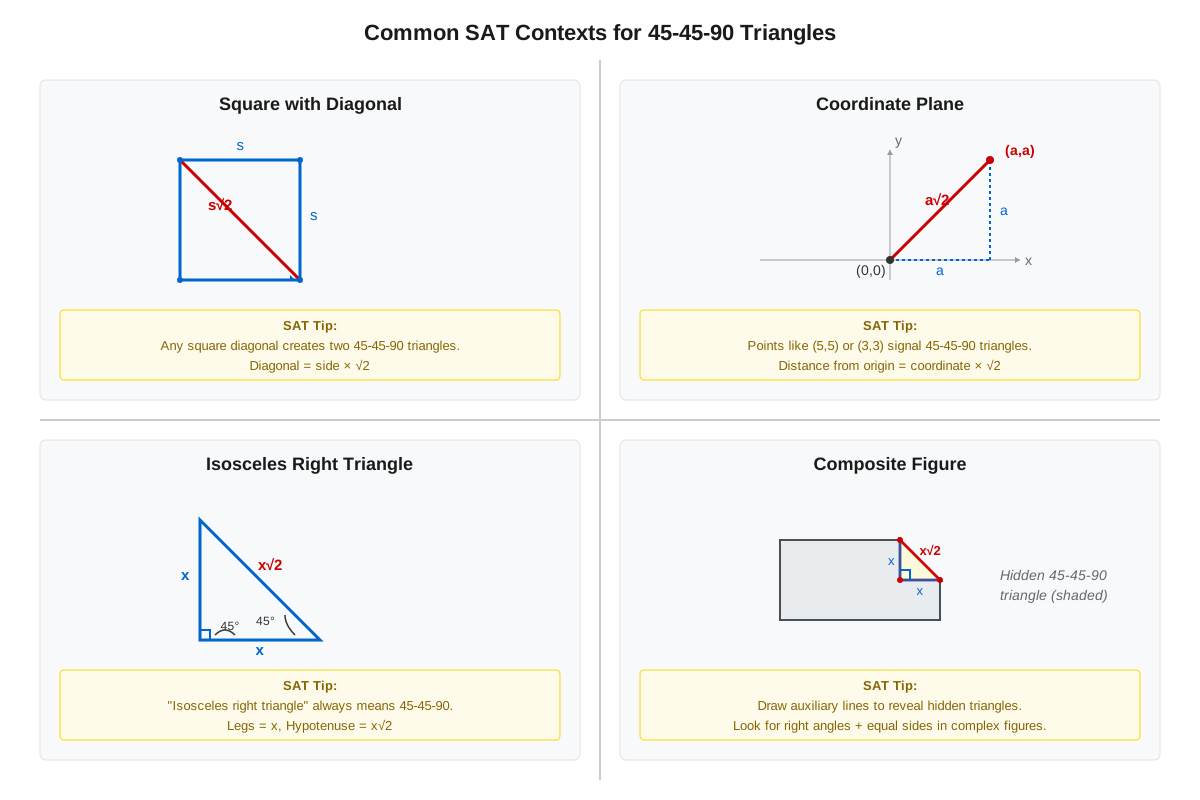
The topic appears in various disguised forms: a square with a diagonal drawn, a right triangle with two equal legs, an isosceles right triangle, or even implicitly through angle measures (when two angles are 45° and one is 90°). The SAT frequently tests whether students can recognize these triangles in non-obvious contexts rather than simply applying memorized formulas. Students who master this recognition skill gain a substantial time advantage, often solving problems in 30 seconds that might otherwise require 2-3 minutes of calculation.
Core Concepts
Definition and Basic Properties
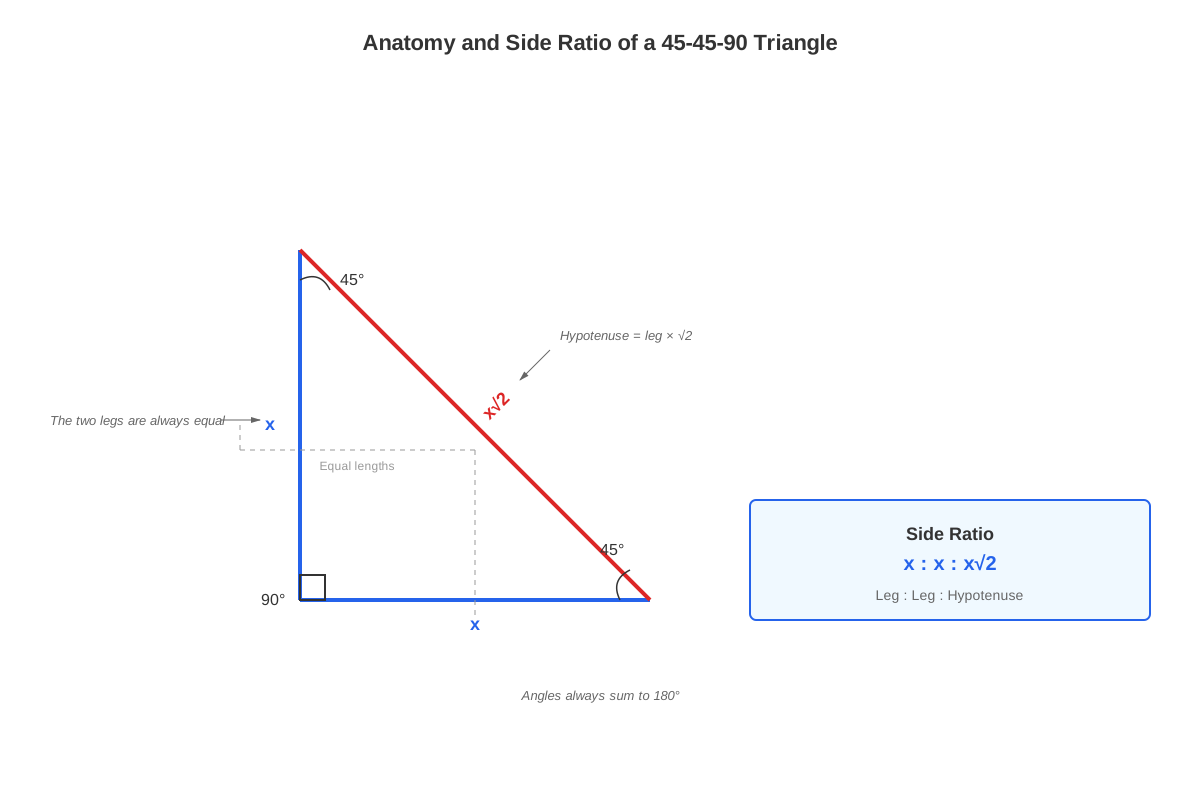
A 45-45-90 triangle is a right triangle with two 45° angles and one 90° angle. Because two angles are equal, the triangle is also isosceles, meaning the two legs (the sides adjacent to the right angle) have equal length. This combination of properties—being both a right triangle and an isosceles triangle—creates the special side length relationships that make these triangles so useful.
The angle sum property of triangles (all angles sum to 180°) guarantees that if two angles measure 45°, the third must measure 90°. Conversely, if a right triangle has two equal legs, the base angles must each be 45°. This bidirectional relationship allows for quick identification: equal legs → 45-45-90 triangle, or 45° angles → equal legs.
The Side Ratio Relationship
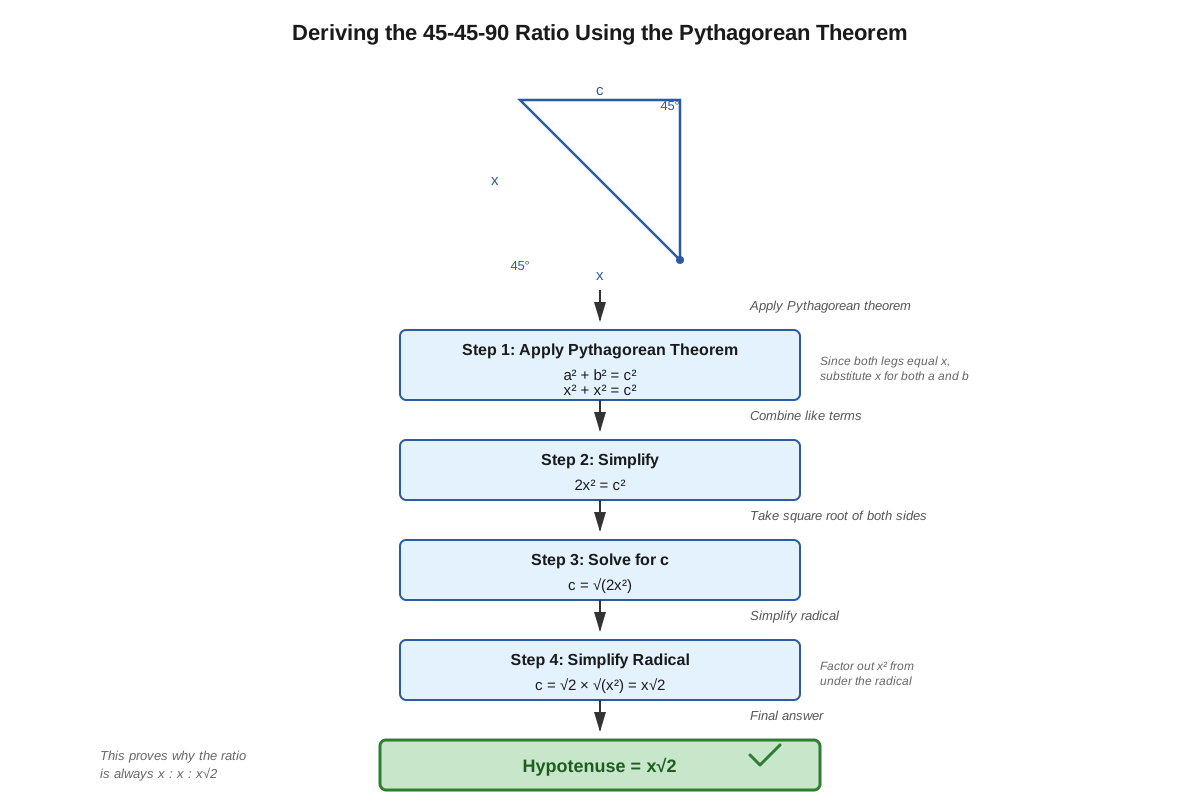
The fundamental property of sat 45-45-90 triangles is the fixed ratio between sides: x : x : x√2, where x represents the length of each leg and x√2 represents the length of the hypotenuse. This ratio can be derived using the Pythagorean theorem:
If both legs have length x, then:
x² + x² = (hypotenuse)²
2x² = (hypotenuse)²
hypotenuse = √(2x²) = x√2
This derivation shows why the hypotenuse is always √2 times the length of a leg. Students should understand both the ratio itself and its origin, as this deeper understanding prevents confusion and enables problem-solving when the ratio is presented in different forms.
Working with the Ratio in Different Scenarios
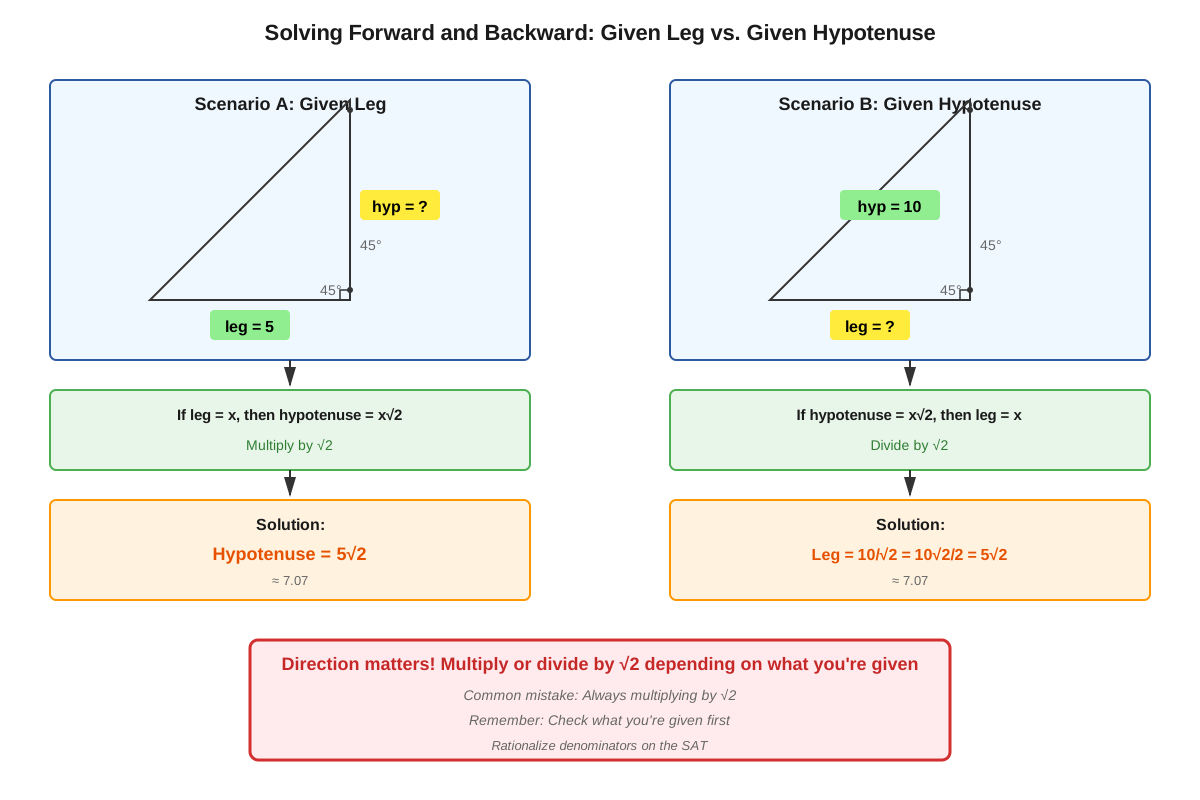
The x : x : x√2 ratio can be applied in three common scenarios:
- Given a leg, find the hypotenuse: Multiply the leg length by √2
- If leg = 5, then hypotenuse = 5√2
- Given the hypotenuse, find a leg: Divide the hypotenuse by √2 (or multiply by √2/2)
- If hypotenuse = 10√2, then leg = 10√2 ÷ √2 = 10
- If hypotenuse = 8, then leg = 8 ÷ √2 = 8√2/2 = 4√2
- Given one leg, find the other leg: They are equal
- If one leg = 7, then the other leg = 7
Rationalizing Denominators
When dividing by √2, students must often rationalize the denominator to match SAT answer choices. This process involves multiplying both numerator and denominator by √2:
x/√2 = (x/√2) × (√2/√2) = x√2/2For example, if the hypotenuse is 12 and you need to find a leg:
leg = 12/√2 = (12√2)/2 = 6√2Recognition in Squares
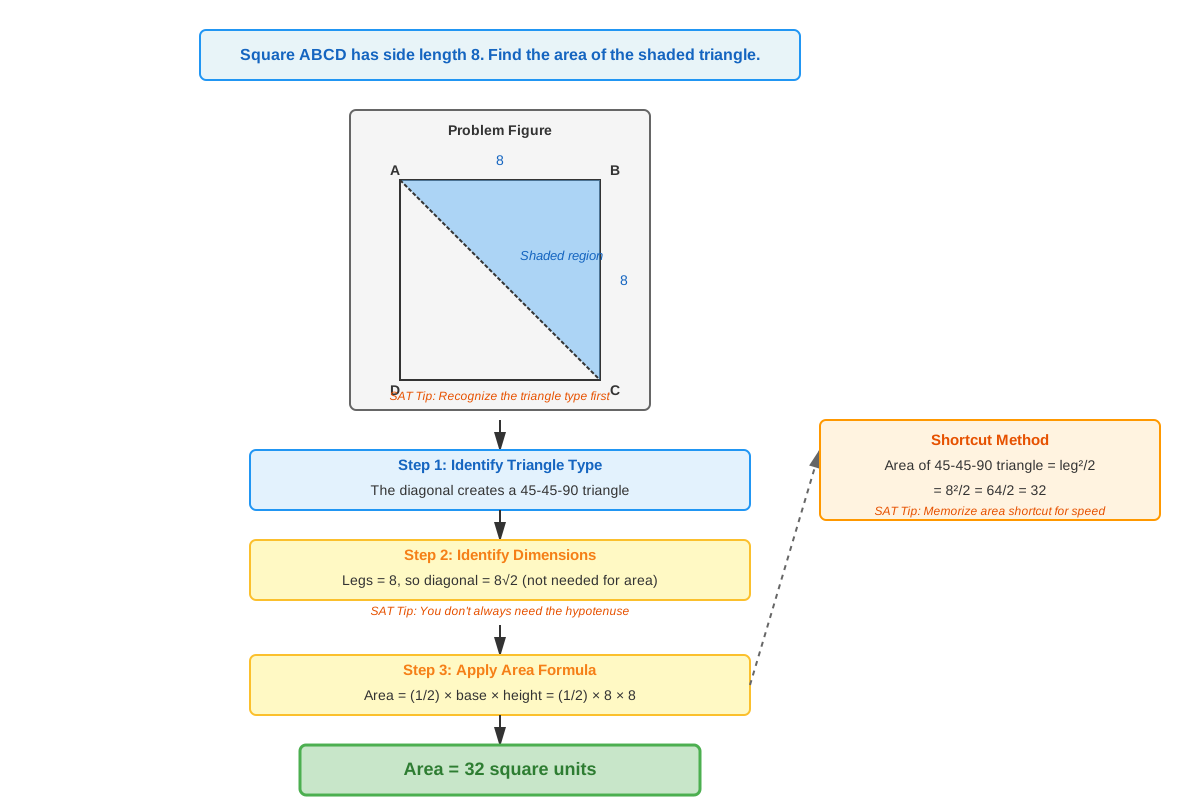
Every square contains four 45-45-90 triangles when its diagonals are drawn. If a square has side length s, each diagonal has length s√2. This relationship appears frequently on the SAT:
| Square Side Length | Diagonal Length |
|---|---|
| 1 | √2 |
| 5 | 5√2 |
| 10 | 10√2 |
| x | x√2 |
Conversely, if the diagonal is known, the side length can be found by dividing by √2. A square with diagonal 8√2 has sides of length 8.
Coordinate Geometry Applications
On the coordinate plane, 45-45-90 triangles appear when points form diagonal relationships. If a point moves equal distances horizontally and vertically from the origin, the straight-line distance follows the 45-45-90 ratio. For example, the distance from (0,0) to (3,3) is 3√2 because the horizontal and vertical distances are both 3.
Area Calculations
The area of a 45-45-90 triangle with legs of length x is:
Area = (1/2) × base × height = (1/2) × x × x = x²/2If only the hypotenuse h is known, first find the leg length (h/√2), then calculate:
Area = (1/2) × (h/√2)² = (1/2) × (h²/2) = h²/4Concept Relationships
The core concepts within 45-45-90 triangles form a logical progression: angle properties → equal leg identification → side ratio derivation → practical applications. Understanding that two 45° angles create equal legs is the foundation. This equal-leg property, combined with the right angle, leads directly to the x : x : x√2 ratio through the Pythagorean theorem.
The relationship to prerequisite topics is essential: Pythagorean theorem provides the mathematical justification for the side ratio, while isosceles triangle properties enable quick recognition. Square root operations are necessary for all calculations, and square properties reveal the most common SAT context where these triangles appear.
Connections to related topics include: 30-60-90 triangles (the other special right triangle with memorizable ratios), trigonometry (where 45-45-90 triangles demonstrate that sin(45°) = cos(45°) = √2/2), coordinate geometry (diagonal distances), and similarity (all 45-45-90 triangles are similar to each other, maintaining the same ratio regardless of size).
The concept map flows as: Recognition → Ratio Application → Calculation → Verification. Students must first identify the triangle type, then apply the appropriate ratio relationship, perform calculations (often involving rationalization), and finally verify that the answer makes geometric sense.
High-Yield Facts
⭐ The side ratio of a 45-45-90 triangle is always x : x : x√2, where x is the leg length
⭐ The hypotenuse of a 45-45-90 triangle is √2 times the length of either leg
⭐ The diagonal of a square with side length s is s√2
⭐ If the hypotenuse is given, divide by √2 (or multiply by √2/2) to find the leg length
⭐ All 45-45-90 triangles are isosceles right triangles with two equal legs
- A right triangle with two equal legs is always a 45-45-90 triangle
- The area of a 45-45-90 triangle with leg x is x²/2
- When rationalizing x/√2, the result is x√2/2
- The perimeter of a 45-45-90 triangle with leg x is 2x + x√2 or x(2 + √2)
- On the coordinate plane, moving from (0,0) to (a,a) creates a distance of a√2
- Each 45-45-90 triangle is similar to every other 45-45-90 triangle
- The altitude to the hypotenuse of a 45-45-90 triangle creates two smaller 45-45-90 triangles
- If a square has area A, its diagonal has length √(2A)
Quick check — test yourself on 45-45-90 triangles so far.
Try Flashcards →Common Misconceptions
Misconception: The hypotenuse is 2 times the leg length → Correction: The hypotenuse is √2 times the leg length (approximately 1.414 times, not 2 times). The factor of 2 appears under the square root, not as a direct multiplier.
Misconception: All right triangles have the x : x : x√2 ratio → Correction: Only 45-45-90 triangles have this ratio. Other right triangles require the Pythagorean theorem or, in the case of 30-60-90 triangles, a different special ratio.
Misconception: When the hypotenuse is 10, each leg is 5 → Correction: When the hypotenuse is 10, each leg is 10/√2 = 5√2 ≈ 7.07. Students often incorrectly divide by 2 instead of √2.
Misconception: The ratio can be simplified to 1 : 1 : √2 only when the legs equal 1 → Correction: The ratio 1 : 1 : √2 is the simplified form that applies to all 45-45-90 triangles regardless of size. Multiply each term by the actual leg length to find specific side lengths.
Misconception: √2 ≈ 2 for estimation purposes → Correction: √2 ≈ 1.4 or 1.41, not 2. Using 2 as an approximation leads to significant errors. For quick estimation, remember that √2 is between 1 and 2, closer to 1.5.
Misconception: The area formula requires the hypotenuse → Correction: The area formula for any triangle is (1/2) × base × height. For 45-45-90 triangles, use the two equal legs as base and height, not the hypotenuse. If only the hypotenuse is known, first find the leg length.
Misconception: Rationalizing denominators changes the value of the expression → Correction: Rationalizing (multiplying by √2/√2) is multiplying by 1, which doesn't change the value—it only changes the form to match SAT answer conventions.
Worked Examples
Example 1: Finding Missing Sides
Problem: A 45-45-90 triangle has one leg with length 6. Find the length of the hypotenuse and the area of the triangle.
Solution:
Step 1: Identify the triangle type and recall the ratio.
- This is a 45-45-90 triangle with the ratio x : x : x√2
- One leg = 6, so x = 6
Step 2: Find the other leg.
- Since both legs are equal in a 45-45-90 triangle, the other leg = 6
Step 3: Find the hypotenuse.
- Hypotenuse = x√2 = 6√2
Step 4: Calculate the area.
- Area = (1/2) × leg₁ × leg₂
- Area = (1/2) × 6 × 6 = 18 square units
Answer: The hypotenuse is 6√2 and the area is 18 square units.
Connection to learning objectives: This example demonstrates identification of key features (equal legs, specific ratio) and application to find missing measurements, directly addressing the first and third learning objectives.
Example 2: Working Backward from the Hypotenuse
Problem: A square has a diagonal of length 10√2. What is the perimeter of the square?
Solution:
Step 1: Recognize the hidden 45-45-90 triangle.
- The diagonal of a square creates two 45-45-90 triangles
- The diagonal is the hypotenuse of these triangles
Step 2: Identify what we know.
- Hypotenuse = 10√2
- We need to find the side of the square (which is a leg of the 45-45-90 triangle)
Step 3: Apply the ratio to find the leg.
- In a 45-45-90 triangle: leg = hypotenuse ÷ √2
- leg = 10√2 ÷ √2 = 10
Step 4: Calculate the perimeter.
- The square has four sides of length 10
- Perimeter = 4 × 10 = 40
Answer: The perimeter of the square is 40 units.
Connection to learning objectives: This example shows how 45-45-90 triangles appear disguised in other geometric figures (squares) on the SAT, addressing the second learning objective about recognizing how this topic appears on the test.
Example 3: Coordinate Geometry Application
Problem: Point A is at the origin (0, 0) and point B is at (5, 5). What is the distance from A to B?
Solution:
Step 1: Visualize or sketch the situation.
- Moving from (0,0) to (5,5) means moving 5 units right and 5 units up
- This creates a right triangle with legs of length 5 each
Step 2: Recognize the 45-45-90 triangle.
- Horizontal distance = 5
- Vertical distance = 5
- These are the two equal legs of a 45-45-90 triangle
- The direct distance from A to B is the hypotenuse
Step 3: Apply the ratio.
- Hypotenuse = leg × √2
- Distance = 5√2
Answer: The distance from A to B is 5√2 units.
Connection to learning objectives: This demonstrates recognition of 45-45-90 triangles in coordinate geometry contexts, a common SAT application that addresses multiple learning objectives.
Exam Strategy
When approaching SAT 45-45-90 triangle questions, begin by scanning for trigger words and visual cues. Look for phrases like "isosceles right triangle," "square diagonal," "two equal legs," or explicit angle measures of 45° and 90°. In diagrams, watch for small squares in corners (indicating right angles) combined with tick marks showing equal sides.
The most efficient approach follows this sequence:
- Identify: Confirm you have a 45-45-90 triangle (equal legs or 45° angles)
- Determine what's given: Is it a leg or the hypotenuse?
- Apply the ratio: Use x : x : x√2 appropriately
- Calculate: Perform the arithmetic, rationalizing if needed
- Check: Does the answer make geometric sense?
For process of elimination, remember that the hypotenuse must be the longest side. If answer choices include values smaller than the given leg, eliminate them immediately. When a leg is given, the hypotenuse will always include √2 in its expression (unless the √2 cancels out). If you're given a leg of 4 and see answer choices of 4, 4√2, 8, and 8√2 for the hypotenuse, you can eliminate 4 (too small—can't equal the leg) and 8 (would require multiplying by 2, not √2).
Time allocation for these questions should be 30-60 seconds for straightforward problems and up to 90 seconds for multi-step problems involving areas or composite figures. If you find yourself using the Pythagorean theorem on what appears to be a 45-45-90 triangle, stop and reconsider—you're likely taking too long. The special ratio exists precisely to save time.
Watch for trap answers that result from common errors: dividing by 2 instead of √2, forgetting to rationalize denominators, or confusing the 45-45-90 ratio with the 30-60-90 ratio. The SAT deliberately includes these incorrect results as answer choices.
Memory Techniques
Mnemonic for the ratio: "X-X-Xtra Root Two" reminds you that both legs are x and the hypotenuse has the "extra" √2 factor.
Visualization strategy: Picture a square cut diagonally. The two equal sides are the legs (x), and the diagonal cutting across is longer (x√2). This mental image instantly recalls both the ratio and the most common SAT context.
The "Square Root of Two" chant: When you see equal legs, mentally chant "times root two" to remember the hypotenuse relationship. When you see the hypotenuse, chant "divide by root two" to find the legs.
Finger trick: Hold your hands at a 45° angle (like a roof peak). Your two forearms are equal (the legs), and the imaginary line connecting your elbows is longer (the hypotenuse). This physical reminder reinforces the equal-leg property.
Acronym for problem-solving steps: IRAC - Identify the triangle type, Recall the ratio, Apply to find unknowns, Check your answer.
Number association: Remember that √2 ≈ 1.414, which you can memorize as "one-four-one-four" or think of as "1/4/1/4" (January 4th, 1:41). Having this decimal approximation helps with estimation and answer checking.
Summary
45-45-90 triangles are special right triangles characterized by two 45° angles, two equal legs, and a hypotenuse that is √2 times the length of each leg. The fundamental ratio x : x : x√2 enables rapid calculation of missing sides without the Pythagorean theorem. These triangles appear frequently on the SAT in multiple contexts: as standalone geometry problems, within squares (as diagonals), in coordinate geometry (diagonal movements), and embedded in complex figures. Recognition is key—students must identify these triangles quickly through equal legs, 45° angles, or square diagonals. The most common calculations involve multiplying a leg by √2 to find the hypotenuse or dividing the hypotenuse by √2 (rationalizing to multiply by √2/2) to find a leg. Mastery requires understanding both the ratio itself and its derivation from the Pythagorean theorem, enabling flexible application across diverse problem types. This high-yield topic directly impacts 2-4 questions per SAT and provides significant time-saving advantages when recognized and applied correctly.
Key Takeaways
- The side ratio of any 45-45-90 triangle is x : x : x√2, where x represents each equal leg and x√2 is the hypotenuse
- All 45-45-90 triangles are isosceles right triangles with two 45° angles and one 90° angle
- To find the hypotenuse from a leg, multiply by √2; to find a leg from the hypotenuse, divide by √2 (or multiply by √2/2)
- Square diagonals create 45-45-90 triangles, with the diagonal being √2 times the side length
- Recognition is crucial—look for equal legs, 45° angles, or square diagonals as indicators
- Always rationalize denominators by multiplying by √2/√2 to match SAT answer formats
- The area of a 45-45-90 triangle with leg x is x²/2
Related Topics
30-60-90 Triangles: The other special right triangle with a memorizable side ratio (x : x√3 : 2x). Mastering 45-45-90 triangles provides the foundation for understanding this related special triangle, and both appear with similar frequency on the SAT.
Pythagorean Theorem: While 45-45-90 triangles provide shortcuts, understanding the Pythagorean theorem (a² + b² = c²) explains why the special ratio works and enables solving non-special right triangles.
Trigonometric Ratios: The 45-45-90 triangle demonstrates that sin(45°) = cos(45°) = √2/2, providing a geometric foundation for understanding trigonometric functions.
Coordinate Geometry: Diagonal distances on the coordinate plane frequently involve 45-45-90 triangles, making this topic essential for distance formula applications and optimization problems.
Similarity and Proportions: All 45-45-90 triangles are similar to each other, reinforcing concepts of proportional reasoning and scale factors in geometry.
Practice CTA
Now that you've mastered the core concepts of 45-45-90 triangles, it's time to solidify your understanding through active practice. Work through the practice questions to test your ability to recognize these triangles in various contexts and apply the x : x : x√2 ratio efficiently. Use the flashcards to drill the key facts until they become automatic—speed and accuracy on test day depend on instant recognition. Remember, every minute you save by recognizing a 45-45-90 triangle instead of using the Pythagorean theorem is a minute you can invest in more challenging problems. You've got this!
Sign up free to keep reading
Create a free AnvayaPrep account to finish this SAT guide on 45-45-90 triangles — plus flashcards and practice questions.