Overview
30-60-90 triangles are a special category of right triangles that appear frequently on the SAT and represent one of the most testable geometric concepts in the math section. These triangles possess unique angle measurements—30 degrees, 60 degrees, and 90 degrees—and their sides maintain a constant, predictable ratio regardless of the triangle's size. Understanding this ratio allows students to solve complex geometry problems in seconds rather than minutes, making it an essential tool for maximizing both accuracy and speed on test day.
The importance of sat 30-60-90 triangles cannot be overstated. These triangles appear not only in straightforward geometry questions but also embedded within coordinate geometry problems, trigonometry contexts, and even word problems involving real-world scenarios. The College Board frequently tests whether students can recognize these special triangles in disguise—perhaps as half of an equilateral triangle, within a hexagon, or as part of a three-dimensional figure. Mastery of this topic directly translates to points earned, as questions involving 30-60-90 triangles typically appear 2-4 times per SAT administration.
Within the broader landscape of triangle geometry, 30-60-90 triangles connect intimately with concepts like the Pythagorean theorem, similar triangles, equilateral triangles, and basic trigonometric ratios. They serve as a bridge between pure geometry and algebraic problem-solving, requiring students to recognize patterns, apply formulas, and manipulate ratios—all core mathematical reasoning skills that the SAT assesses. Students who master 30-60-90 triangles gain confidence in tackling multi-step problems and develop the pattern recognition skills necessary for success across the entire math section.
Learning Objectives
- [ ] Identify key features of 30-60-90 triangles
- [ ] Explain how 30-60-90 triangles appears on the SAT
- [ ] Apply 30-60-90 triangles to answer SAT-style questions
- [ ] Derive the side ratio of a 30-60-90 triangle from an equilateral triangle
- [ ] Recognize 30-60-90 triangles embedded within other geometric figures
- [ ] Calculate missing side lengths given any one side of a 30-60-90 triangle
- [ ] Solve coordinate geometry problems using 30-60-90 triangle properties
Prerequisites
- Right triangle fundamentals: Understanding that one angle equals 90 degrees and the Pythagorean theorem applies is essential for recognizing when special triangle shortcuts can replace longer calculations
- Angle relationships: Knowledge that angles in a triangle sum to 180 degrees helps verify that a triangle with 30° and 60° angles must be a right triangle
- Ratio and proportion: The ability to work with ratios is crucial since the entire concept of 30-60-90 triangles centers on a fixed side-length ratio
- Radical simplification: Comfort with simplifying expressions involving √3 is necessary for working with the middle-length side
- Equilateral triangle properties: Understanding that equilateral triangles have three 60° angles and equal sides helps visualize how 30-60-90 triangles are formed
Why This Topic Matters
In real-world applications, 30-60-90 triangles appear in architecture, engineering, and design. The angles naturally occur when bisecting equilateral triangles, making them fundamental to hexagonal structures, roof trusses, and even molecular geometry in chemistry. Navigation and surveying frequently involve these angles, as do problems in physics involving vector components and inclined planes.
On the SAT specifically, 30-60-90 triangles appear with remarkable consistency. Statistical analysis of released SAT exams shows that approximately 15-20% of geometry questions either directly test or can be efficiently solved using special right triangle properties. These questions typically appear in both the calculator and no-calculator sections, with difficulty levels ranging from medium to hard. The College Board particularly favors questions where students must recognize the triangle pattern rather than having it explicitly stated, testing both geometric knowledge and problem-solving insight.
Common SAT question formats include: finding the height of an equilateral triangle (which creates two 30-60-90 triangles), determining coordinates of points on a coordinate plane, calculating areas of composite figures, solving for diagonal lengths in rectangles with specific angle constraints, and analyzing three-dimensional figures where 30-60-90 triangles form cross-sections. The test also frequently embeds these triangles within circle problems, where radii and chords create the special angle relationships. Students who can quickly identify these patterns gain significant time advantages, often solving in 30 seconds what might otherwise require 2-3 minutes of calculation.
Core Concepts
The Fundamental Side Ratio
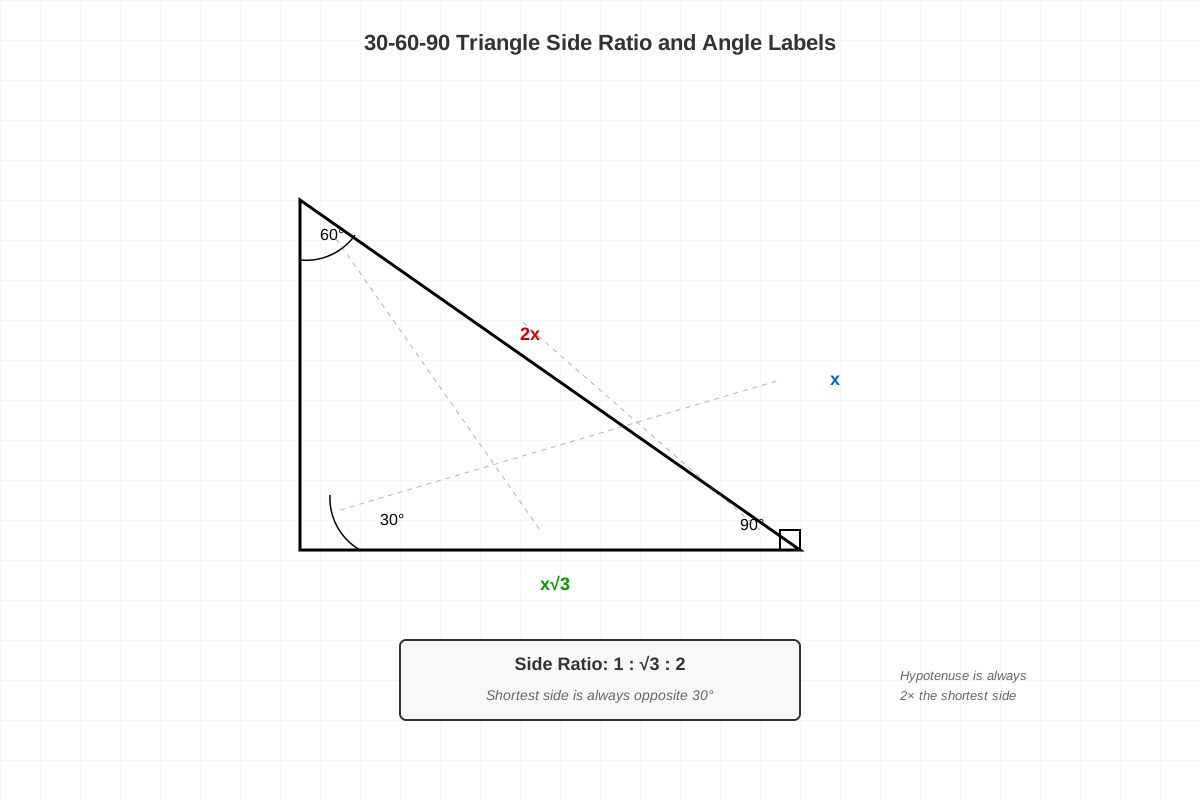
The defining characteristic of a 30-60-90 triangle is its side-length ratio, which remains constant regardless of the triangle's size. If we label the side opposite the 30° angle as the short leg, the side opposite the 60° angle as the long leg, and the hypotenuse opposite the 90° angle, the ratio is always:
Short leg : Long leg : Hypotenuse = 1 : √3 : 2
This ratio can also be expressed as x : x√3 : 2x, where x represents the length of the shortest side. This algebraic representation proves particularly useful for SAT problems because it allows students to set up equations quickly. If any one side length is known, the other two can be calculated immediately by applying this ratio.
Deriving the Ratio from an Equilateral Triangle
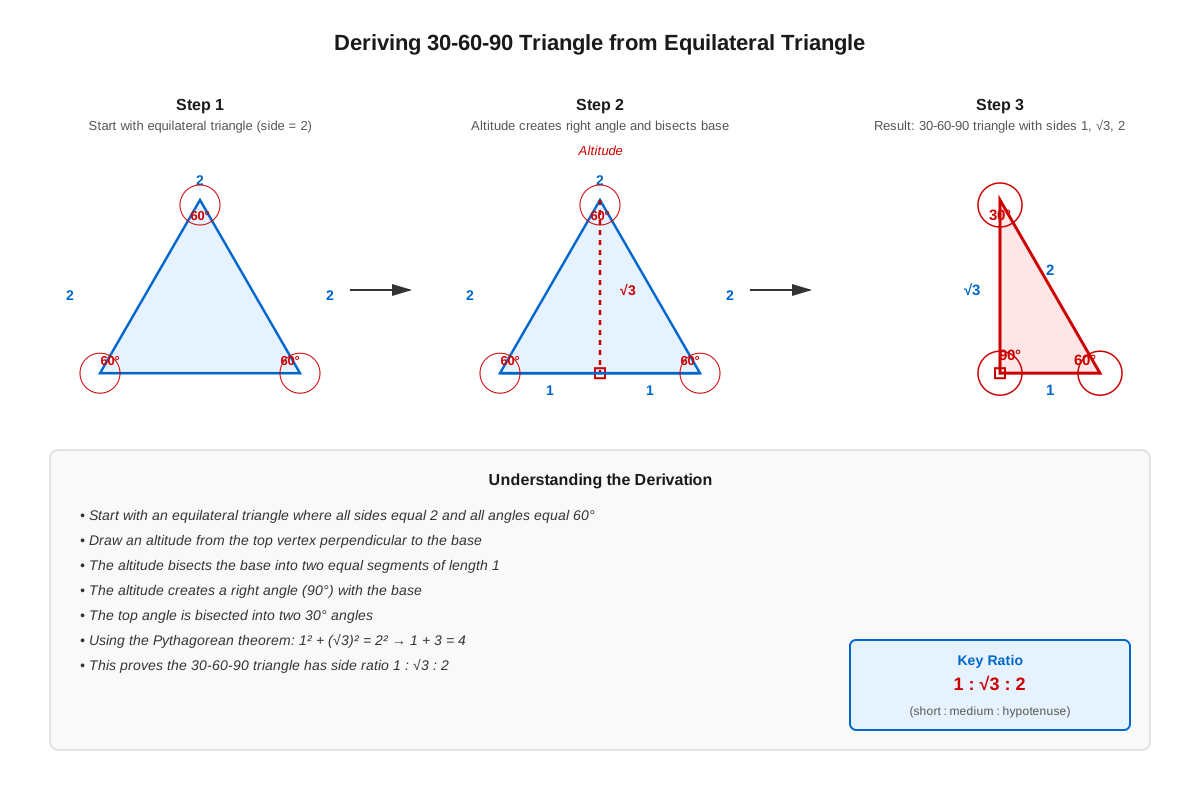
Understanding where this ratio originates strengthens retention and provides insight into why these triangles appear so frequently. Consider an equilateral triangle with side length 2 (choosing 2 simplifies the arithmetic). All three angles measure 60°, and all three sides equal 2.
When an altitude is drawn from any vertex to the opposite side, it:
- Creates a right angle with the base (90°)
- Bisects the vertex angle, creating two 30° angles
- Bisects the base, creating two segments of length 1
The result is two congruent 30-60-90 triangles. Each has:
- A short leg (half the base) = 1
- A hypotenuse (original side) = 2
- A long leg (the altitude) = ?
Using the Pythagorean theorem: 1² + h² = 2², which gives h² = 3, so h = √3.
This confirms the ratio: 1 : √3 : 2.
Identifying the Sides by Angle
A critical skill for SAT success is quickly identifying which side corresponds to which part of the ratio. The shortest side always opposes the smallest angle (30°), the longest side always opposes the largest angle (90°, the hypotenuse), and the middle-length side opposes the middle angle (60°).
| Angle | Side Name | Ratio Value | Algebraic Expression |
|---|---|---|---|
| 30° | Short leg | 1 | x |
| 60° | Long leg | √3 | x√3 |
| 90° | Hypotenuse | 2 | 2x |
Solving for Unknown Sides
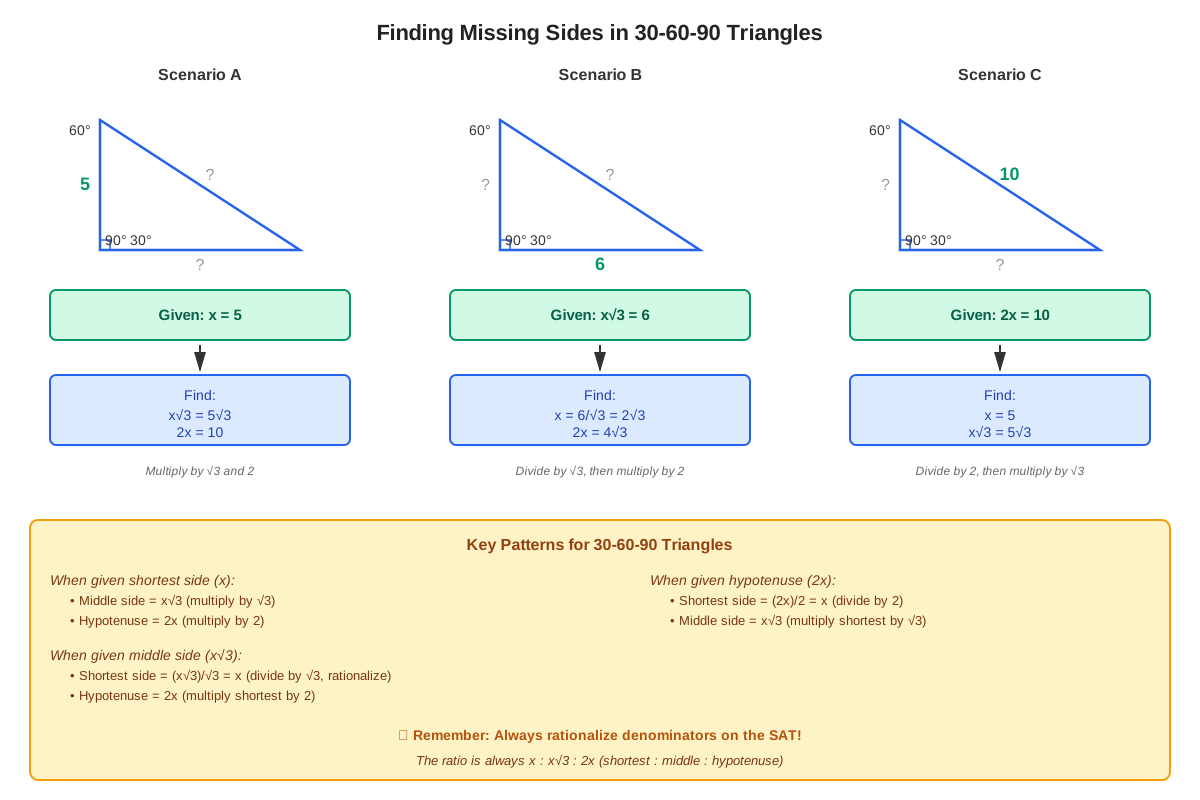
When given one side length, follow this systematic approach:
If given the short leg (opposite 30°):
- Long leg = short leg × √3
- Hypotenuse = short leg × 2
If given the long leg (opposite 60°):
- Short leg = long leg ÷ √3 = (long leg × √3) ÷ 3
- Hypotenuse = (long leg × 2) ÷ √3 = (long leg × 2√3) ÷ 3
If given the hypotenuse:
- Short leg = hypotenuse ÷ 2
- Long leg = (hypotenuse ÷ 2) × √3 = (hypotenuse × √3) ÷ 2
Recognition Patterns on the SAT
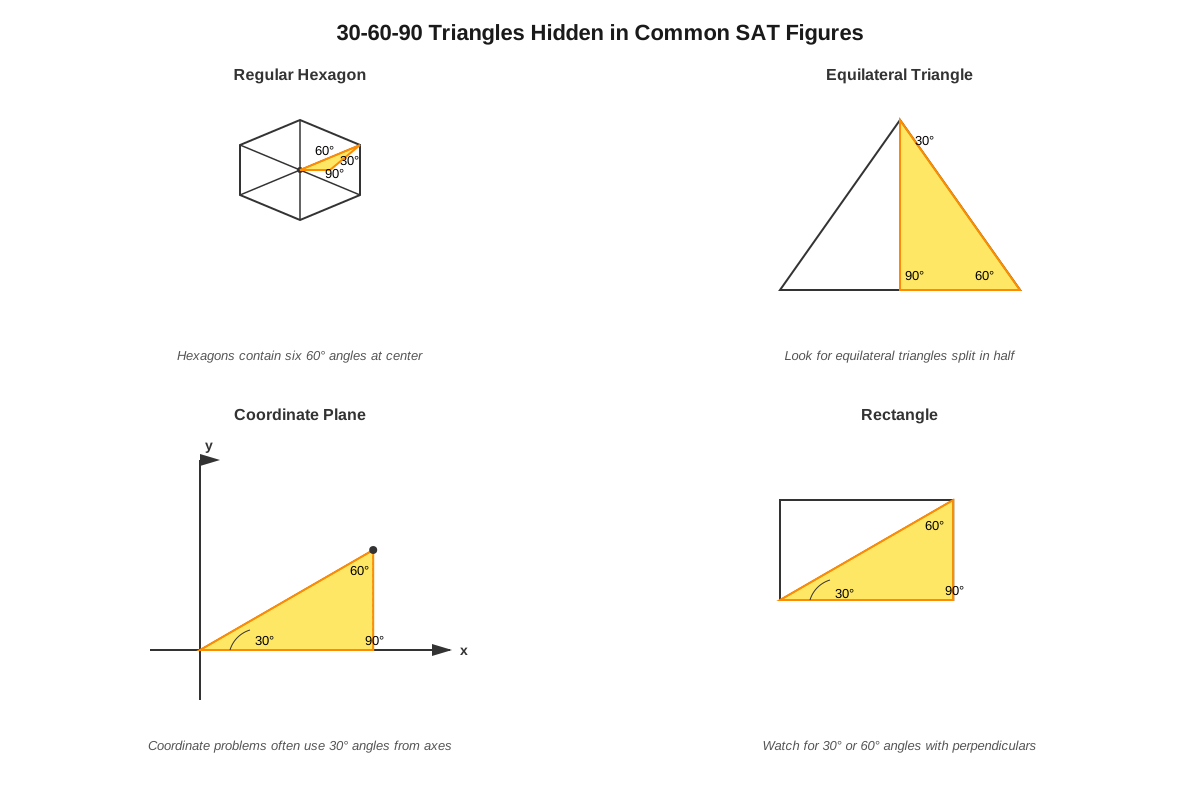
The SAT rarely labels a triangle as "30-60-90" explicitly. Instead, students must recognize these triangles through various clues:
- Equilateral triangle with an altitude: Always creates two 30-60-90 triangles
- Half of a square's diagonal at specific angles: Sometimes creates these triangles
- Regular hexagons: Contain six equilateral triangles, which can be subdivided
- Explicit angle measures: If two angles are given as 30° and 60°, the third must be 90°
- Coordinate plane problems: Points at specific coordinates may form these triangles
- Word problems mentioning these specific angles: Especially in real-world contexts
Working with Multiples and Scaling
Since the ratio is constant, any multiple of the basic ratio (1 : √3 : 2) represents a valid 30-60-90 triangle. For example:
- 3 : 3√3 : 6
- 5 : 5√3 : 10
- 2√3 : 6 : 4√3
The key is recognizing the pattern. If you see sides in the ratio where one side is twice another, and the third involves √3, you likely have a 30-60-90 triangle.
Concept Relationships
The 30-60-90 triangle concept builds directly on right triangle fundamentals, as it represents a special case where the Pythagorean theorem produces a predictable pattern. This connection flows bidirectionally: understanding right triangles enables recognition of 30-60-90 triangles, while mastering 30-60-90 triangles provides shortcuts that eliminate the need for Pythagorean calculations.
Equilateral triangles → create → 30-60-90 triangles when an altitude is drawn. This relationship appears frequently on the SAT, where finding the height or area of an equilateral triangle requires recognizing the two 30-60-90 triangles formed.
Ratio and proportion skills → enable → side length calculations in 30-60-90 triangles. The constant ratio x : x√3 : 2x requires facility with algebraic manipulation and radical expressions.
30-60-90 triangles → combine with → coordinate geometry when points on a coordinate plane form these special triangles, allowing quick distance calculations without the distance formula.
Trigonometric ratios → derive from → 30-60-90 triangles. The exact values of sin(30°), cos(30°), sin(60°), and cos(60°) come directly from this triangle's side ratios, though the SAT typically doesn't require explicit trigonometry knowledge.
30-60-90 triangles → appear within → composite figures, three-dimensional solids, and circle problems, making them a foundational tool for advanced geometry questions.
Quick check — test yourself on 30-60-90 triangles so far.
Try Flashcards →High-Yield Facts
⭐ The side ratio of a 30-60-90 triangle is always 1 : √3 : 2 (or x : x√3 : 2x)
⭐ The shortest side is always opposite the 30° angle
⭐ The hypotenuse is always twice the length of the short leg
⭐ Drawing an altitude in an equilateral triangle creates two 30-60-90 triangles
⭐ If you know any one side, you can find the other two using the ratio
- The long leg equals the short leg multiplied by √3
- The long leg equals the hypotenuse multiplied by (√3/2)
- To find the short leg from the long leg, divide by √3 (or multiply by √3/3)
- 30-60-90 triangles appear 2-4 times per SAT test administration
- These triangles are always right triangles (the 90° guarantees this)
- The area formula is (1/2) × short leg × long leg = (1/2) × x × x√3 = (x²√3)/2
- Regular hexagons contain six equilateral triangles, which contain twelve 30-60-90 triangles
Common Misconceptions
Misconception: The side opposite 60° is twice the side opposite 30°.
Correction: The side opposite 60° is √3 times (not 2 times) the side opposite 30°. The hypotenuse is twice the short leg, but the long leg involves √3.
Misconception: Any triangle with a 30° or 60° angle is a 30-60-90 triangle.
Correction: A triangle must have BOTH a 30° angle AND a 60° angle (which automatically makes the third angle 90°) to be a 30-60-90 triangle. Having just one of these angles is insufficient.
Misconception: The ratio 1 : √3 : 2 can be applied to any right triangle.
Correction: This ratio applies ONLY to 30-60-90 triangles. Other right triangles (like 45-45-90 triangles or random right triangles) have different ratios. Always verify the angles before applying the ratio.
Misconception: When given the long leg, multiply by √3 to find the hypotenuse.
Correction: When given the long leg (opposite 60°), you must first divide by √3 to find the short leg, then multiply by 2 to find the hypotenuse. Alternatively, multiply the long leg by 2/√3 (or 2√3/3) directly.
Misconception: The ratio must always start with 1.
Correction: The ratio can be scaled to any multiple. A triangle with sides 6, 6√3, and 12 is still a 30-60-90 triangle (it's the basic ratio multiplied by 6). Focus on the proportional relationship, not the absolute values.
Misconception: You need to use the Pythagorean theorem to solve 30-60-90 triangle problems.
Correction: The entire point of memorizing the ratio is to avoid using the Pythagorean theorem. If you recognize a 30-60-90 triangle, apply the ratio directly for faster solutions.
Worked Examples
Example 1: Finding Missing Sides in an Equilateral Triangle
Problem: An equilateral triangle has a side length of 10. What is the length of its altitude?
Solution:
Step 1: Recognize that an altitude in an equilateral triangle creates two 30-60-90 triangles.
Step 2: Identify the known side. The original side (length 10) becomes the hypotenuse of each 30-60-90 triangle.
Step 3: Apply the ratio. In a 30-60-90 triangle with hypotenuse = 2x, we have 2x = 10, so x = 5.
Step 4: The altitude is the long leg (opposite the 60° angle), which equals x√3 = 5√3.
Answer: The altitude is 5√3 (approximately 8.66).
Connection to learning objectives: This example demonstrates identifying key features (the altitude creates 30-60-90 triangles), recognizing how these triangles appear (within equilateral triangles), and applying the ratio to solve for missing sides.
Example 2: Coordinate Geometry Application
Problem: In the coordinate plane, point A is at the origin (0, 0), point B is at (6, 0), and point C is directly above point B. If angle CAB measures 30°, what are the coordinates of point C?
Solution:
Step 1: Sketch the situation. We have a right triangle with the right angle at B (since C is directly above B, BC is vertical and AB is horizontal).
Step 2: Identify the angles. Angle CAB = 30°, angle ABC = 90°, so angle BCA = 60°. This is a 30-60-90 triangle.
Step 3: Identify the known side. AB (the horizontal distance from A to B) = 6. This is the side opposite the 60° angle (the long leg).
Step 4: Apply the ratio. If the long leg = x√3, then x√3 = 6, so x = 6/√3 = 6√3/3 = 2√3.
Step 5: Find BC (the short leg, opposite the 30° angle) = x = 2√3.
Step 6: Since C is directly above B at (6, 0), and BC = 2√3, point C is at (6, 2√3).
Answer: Point C is at coordinates (6, 2√3).
Connection to learning objectives: This example shows how 30-60-90 triangles appear in coordinate geometry contexts and requires applying the ratio when given the long leg, a common SAT challenge.
Exam Strategy
When approaching SAT questions involving 30-60-90 triangles, follow this systematic process:
Step 1: Scan for angle clues. Look for explicit mentions of 30° or 60° angles, or descriptions that imply these angles (like "half of an equilateral triangle" or "the angle measures 30 degrees").
Step 2: Draw and label a diagram if one isn't provided. Even if a figure exists, redraw it with clear labels for the angles and the ratio components (x, x√3, 2x).
Step 3: Identify which side you know. Determine whether the given information represents the short leg, long leg, or hypotenuse. This is crucial because each requires different calculations.
Step 4: Set up the ratio equation. Write x, x√3, and 2x next to the appropriate sides, then substitute the known value.
Step 5: Solve algebraically. Isolate x first, then calculate the other sides as needed.
Trigger words and phrases to watch for:
- "Equilateral triangle" (almost always involves 30-60-90 triangles)
- "Altitude," "height," or "perpendicular" in the context of equilateral triangles
- Explicit angle measures of 30° or 60°
- "Regular hexagon" (contains multiple 30-60-90 triangles)
- "Half of" when referring to triangles
Process of elimination tips:
- If answer choices contain √3, you're likely dealing with a 30-60-90 or equilateral triangle
- Eliminate answers that don't maintain the proper ratio relationships
- If the short leg is given as an integer, the hypotenuse must be twice that integer (eliminate non-multiples)
- Check whether answers are rationalized (SAT typically requires rationalized denominators)
Time allocation: Once you recognize a 30-60-90 triangle, the problem should take 30-60 seconds. If you're spending more than 90 seconds, you may be overcomplicating it—step back and verify you've correctly identified the triangle type and which side is given.
Memory Techniques
The "1-Root3-2" Mnemonic: Remember the phrase "One root three grew two branches" to recall the ratio 1 : √3 : 2. Visualize a plant with one root, three leaves, and two branches.
The "Small-Medium-Large" Angle Association:
- Smallest angle (30°) → Shortest side (x)
- Medium angle (60°) → Medium side (x√3)
- Largest angle (90°) → Longest side (2x)
The "Half-Triangle" Visualization: Always picture a 30-60-90 triangle as half of an equilateral triangle. When you see an equilateral triangle on the SAT, mentally draw the altitude and see two 30-60-90 triangles.
The "Double-Short" Rule: The hypotenuse is always double the short leg. This is the easiest relationship to remember and can help you reconstruct the full ratio if you forget the √3 component.
Finger Counting for Angles: Hold up three fingers. The first finger represents 30°, the second represents 60°, and the third represents 90°. The number of fingers corresponds to the relative size of the angle.
The "Root-3-in-the-Middle" Reminder: The √3 always appears in the middle-length side (opposite 60°), never in the shortest or longest side. This prevents confusion about where √3 belongs in the ratio.
Summary
30-60-90 triangles represent one of the most valuable pattern-recognition tools for SAT math success. These special right triangles maintain a constant side ratio of 1 : √3 : 2 (or x : x√3 : 2x), where the shortest side opposes the 30° angle, the middle-length side opposes the 60° angle, and the hypotenuse opposes the 90° angle. This ratio allows students to calculate any unknown side when given just one side length, eliminating the need for time-consuming Pythagorean theorem calculations. The triangles most commonly appear when altitudes are drawn in equilateral triangles, but they also emerge in coordinate geometry, composite figures, and word problems. Mastery requires three core skills: recognizing when a 30-60-90 triangle is present (often implicitly), identifying which side corresponds to which part of the ratio, and correctly applying algebraic manipulation to solve for unknowns. Students who internalize this ratio and practice recognizing these triangles in various contexts gain significant speed and accuracy advantages on test day, as these triangles appear multiple times per SAT administration across various question types and difficulty levels.
Key Takeaways
- The fundamental ratio for 30-60-90 triangles is x : x√3 : 2x (short leg : long leg : hypotenuse)
- The hypotenuse is always exactly twice the length of the short leg
- Drawing an altitude in any equilateral triangle creates two 30-60-90 triangles
- Recognize these triangles by angle measures (30° and 60° together) or by context (equilateral triangles, hexagons)
- Given any one side, you can immediately calculate the other two using the ratio—no Pythagorean theorem needed
- The side opposite 60° involves √3; the sides opposite 30° and 90° do not
- These triangles appear 2-4 times per SAT, making them high-yield study material
Related Topics
45-45-90 Triangles: The other special right triangle with a constant ratio (1 : 1 : √2), equally important for SAT success and often tested alongside 30-60-90 triangles.
Pythagorean Theorem: While 30-60-90 triangles provide shortcuts, understanding the Pythagorean theorem remains essential for verifying relationships and solving non-special right triangles.
Equilateral Triangles: Deep connections exist since these triangles generate 30-60-90 triangles; mastering both topics together strengthens geometric reasoning.
Trigonometric Ratios: The exact values of sine, cosine, and tangent for 30° and 60° derive directly from 30-60-90 triangles, relevant for advanced math courses.
Similar Triangles: All 30-60-90 triangles are similar to each other, making this a practical application of similarity principles.
Coordinate Geometry: These triangles frequently appear in coordinate plane problems, connecting geometric and algebraic reasoning.
Practice CTA
Now that you've mastered the core concepts of 30-60-90 triangles, it's time to solidify your understanding through active practice. Work through the practice questions to test your ability to recognize these triangles in various contexts and apply the ratio efficiently. Use the flashcards to drill the fundamental ratio until it becomes automatic—speed and accuracy on test day come from having this pattern deeply ingrained. Remember, every minute spent practicing 30-60-90 triangles now translates directly to points earned and time saved on the SAT. You've got this!
Sign up free to keep reading
Create a free AnvayaPrep account to finish this SAT guide on 30-60-90 triangles — plus flashcards and practice questions.