Overview
Relative clauses are essential grammatical structures that appear frequently on the SAT Reading and Writing (RW) section, particularly in questions testing sentence structure and boundaries. A relative clause is a dependent clause that modifies a noun or pronoun, providing additional information about it. These clauses typically begin with relative pronouns such as "who," "whom," "whose," "which," or "that," or occasionally with relative adverbs like "where," "when," or "why."
Understanding relative clauses is crucial for SAT success because they appear in multiple question types within the Boundaries and Sentence Structure unit. Students must recognize how these clauses function within sentences, identify proper punctuation around them, and determine when they create sentence fragments or run-ons. The SAT frequently tests whether students can distinguish between essential (restrictive) and non-essential (non-restrictive) relative clauses, as this distinction directly affects punctuation choices. Mastery of this topic enables students to confidently tackle questions about comma placement, sentence boundaries, and clause relationships.
Within the broader context of Reading and Writing concepts, relative clauses connect directly to understanding sentence structure, punctuation rules, and the relationship between independent and dependent clauses. This topic builds upon foundational grammar knowledge while serving as a gateway to more complex sentence construction patterns. Students who master relative clauses gain the ability to parse sophisticated academic prose—a skill that benefits them not only in grammar questions but also in comprehension passages throughout the exam.
Learning Objectives
- [ ] Identify key features of relative clauses
- [ ] Explain how relative clauses appear on the SAT
- [ ] Apply relative clauses to answer SAT-style questions
- [ ] Distinguish between essential (restrictive) and non-essential (non-restrictive) relative clauses
- [ ] Determine correct punctuation for relative clauses in various sentence contexts
- [ ] Recognize and correct sentence fragments and run-ons involving relative clauses
- [ ] Evaluate whether a relative pronoun is used correctly based on its antecedent
Prerequisites
- Independent and dependent clauses: Understanding the difference between clauses that can stand alone and those that cannot is fundamental to recognizing how relative clauses function as dependent structures.
- Basic punctuation rules: Knowledge of comma usage, particularly with introductory elements and parenthetical information, provides the foundation for punctuating relative clauses correctly.
- Parts of speech: Familiarity with nouns, pronouns, verbs, and adjectives helps students understand how relative clauses modify nouns and function as adjective clauses.
- Subject-verb agreement: This concept is relevant because relative pronouns must agree with their antecedents, affecting verb conjugation within the relative clause.
Why This Topic Matters
Relative clauses represent one of the most frequently tested grammatical structures on the SAT, appearing in approximately 15-20% of all Reading and Writing questions related to sentence structure. The College Board consistently includes questions that require students to identify proper punctuation around relative clauses, recognize sentence boundary errors involving these structures, and select appropriate relative pronouns. This high frequency makes relative clauses a high-yield topic that directly impacts test scores.
In real-world applications, relative clauses enable sophisticated, concise writing by allowing writers to combine related ideas without creating choppy, repetitive sentences. Academic writing, professional communication, and literary analysis all rely heavily on the effective use of relative clauses to convey complex relationships between ideas. Students who master this structure improve not only their test performance but also their ability to comprehend and produce college-level writing.
On the SAT, relative clauses commonly appear in questions asking students to choose the correct punctuation for a sentence, identify sentence fragments, combine sentences effectively, or select the appropriate relative pronoun. The exam often presents sentences where the distinction between essential and non-essential information determines whether commas should be used. Additionally, the SAT tests whether students can recognize when a relative clause creates a fragment by leaving no independent clause in the sentence, or when improper punctuation creates a run-on sentence.
Core Concepts
Definition and Structure of Relative Clauses
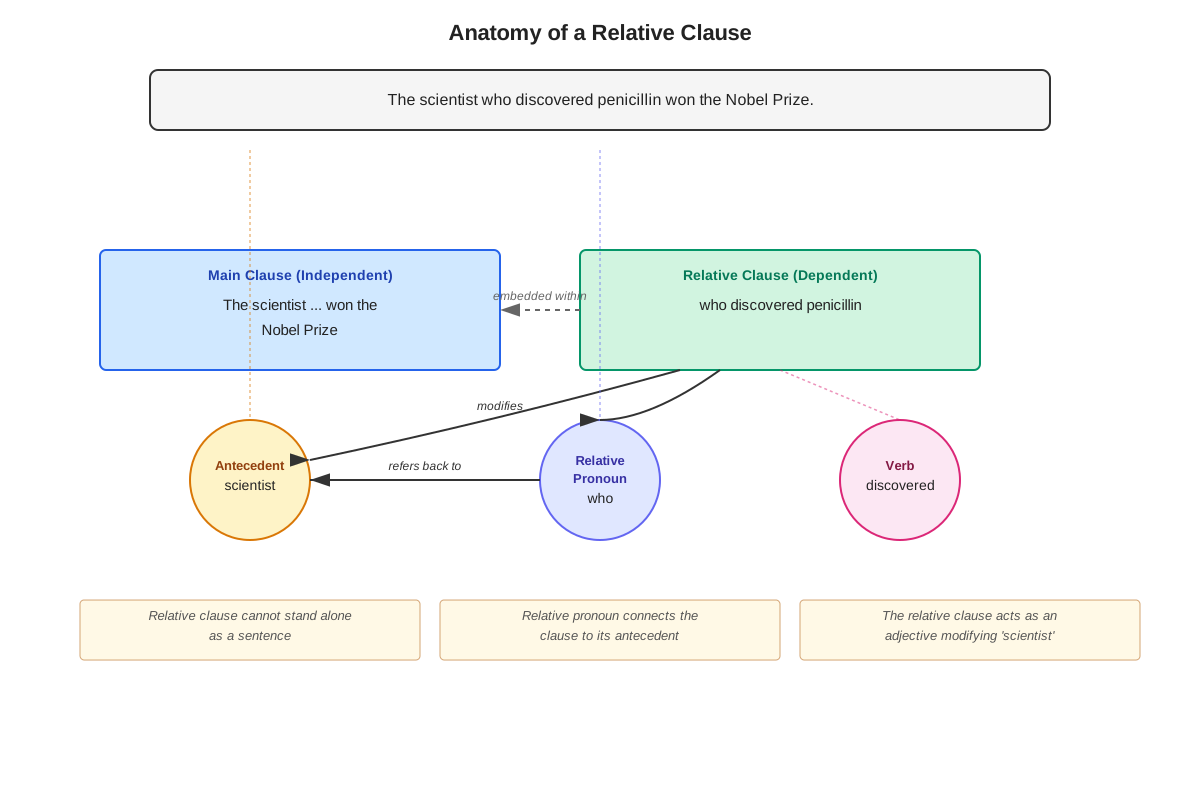
A relative clause (also called an adjective clause) is a dependent clause that modifies a noun or pronoun in a sentence. These clauses cannot stand alone as complete sentences; they must be attached to an independent clause. The clause begins with a relative pronoun (who, whom, whose, which, that) or a relative adverb (where, when, why) that connects the clause to the noun it modifies, called the antecedent.
The basic structure follows this pattern: [Antecedent] + [Relative Pronoun/Adverb] + [Subject (if different from relative pronoun)] + [Verb] + [Additional Information]
Example: "The scientist who discovered the cure received international recognition."
- Antecedent: "scientist"
- Relative pronoun: "who"
- Verb: "discovered"
- Complete relative clause: "who discovered the cure"
Essential vs. Non-Essential Relative Clauses
The distinction between essential and non-essential relative clauses is critical for SAT relative clauses questions, as it determines punctuation choices.
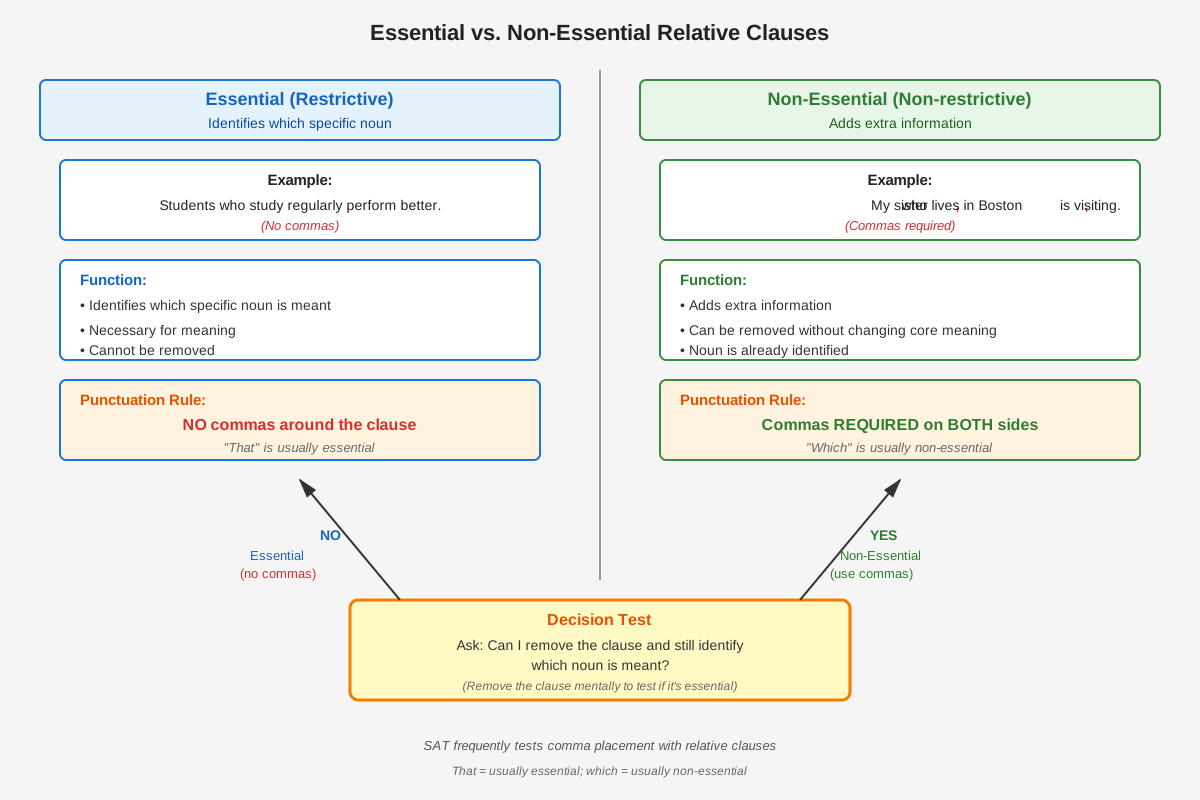
Essential (Restrictive) Relative Clauses provide information that is necessary to identify which specific noun is being discussed. Without this information, the sentence's meaning becomes unclear or changes significantly. Essential clauses are NOT set off by commas.
Example: "Students who study regularly tend to perform better on standardized tests."
- The clause "who study regularly" is essential because it specifies which students perform better—not all students, only those who study regularly.
Non-Essential (Non-Restrictive) Relative Clauses provide additional information about a noun that is already clearly identified. This information could be removed without changing the fundamental meaning of the sentence. Non-essential clauses ARE set off by commas (or dashes/parentheses).
Example: "Dr. Martinez, who has taught for twenty years, will retire next month."
- The clause "who has taught for twenty years" is non-essential because Dr. Martinez is already clearly identified by name. The clause adds interesting information but isn't necessary for identification.
| Feature | Essential Clause | Non-Essential Clause |
|---|---|---|
| Punctuation | No commas | Commas (or dashes/parentheses) |
| Function | Identifies/restricts the noun | Adds extra information |
| Removability | Cannot remove without changing meaning | Can remove without changing core meaning |
| "That" usage | Can use "that" | Cannot use "that" (use "which") |
Relative Pronouns and Their Uses
Different relative pronouns serve different functions based on what they refer to and their role within the relative clause:
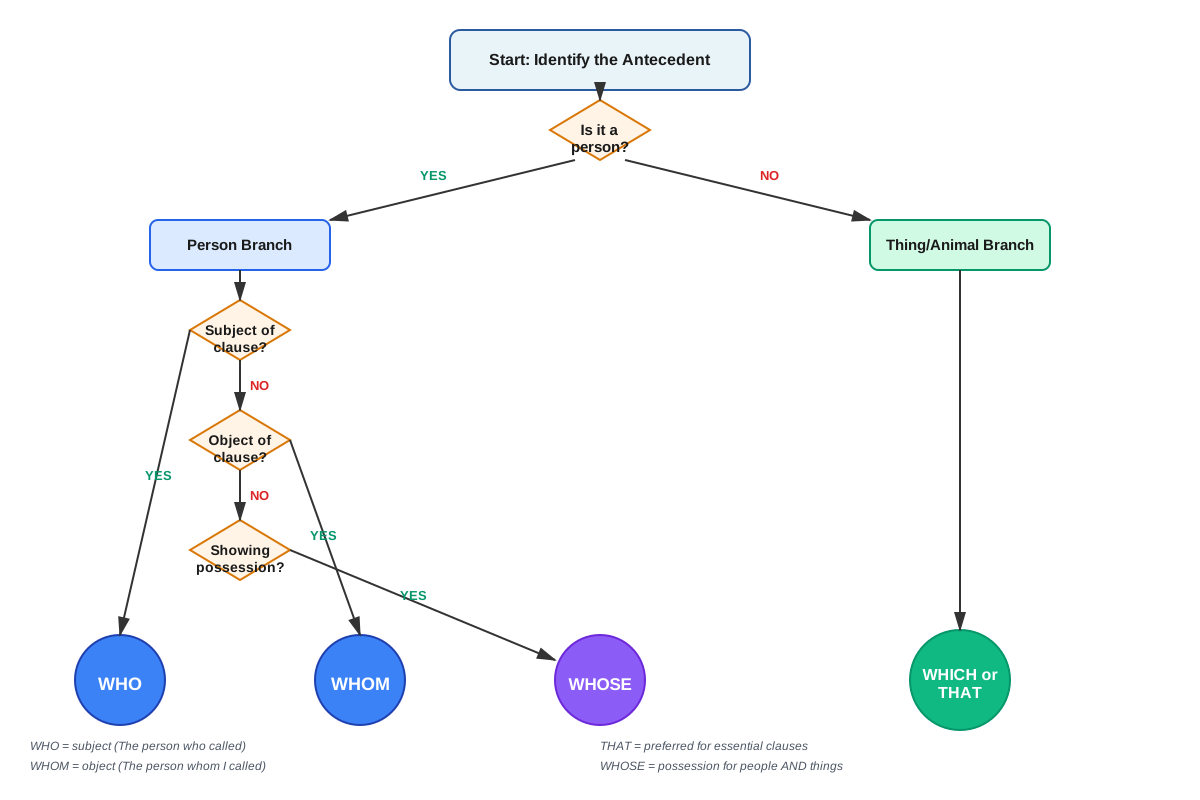
Who/Whom: Refer to people
- "Who" functions as a subject: "The author who wrote this novel won a Pulitzer Prize."
- "Whom" functions as an object: "The colleague to whom I sent the report responded quickly."
Whose: Shows possession (can refer to people or things)
- "The artist whose paintings hang in the museum is visiting today."
Which: Refers to animals or things (typically in non-essential clauses)
- "The experiment, which took three years, yielded surprising results."
That: Refers to people, animals, or things (only in essential clauses)
- "The theory that Einstein proposed revolutionized physics."
Where: Refers to places
- "The library where I study closes at midnight."
When: Refers to times
- "The era when dinosaurs roamed Earth lasted millions of years."
Common SAT Question Types
The SAT tests relative clauses through several recurring question formats:
- Punctuation questions: Students must decide whether to use commas, no punctuation, or other marks around a relative clause.
- Sentence boundary questions: Students identify whether a relative clause creates a fragment or is properly connected to an independent clause.
- Relative pronoun selection: Students choose the correct relative pronoun based on the antecedent and the pronoun's function in the clause.
- Sentence combining: Students select the option that most effectively combines two sentences using a relative clause.
Placement and Position
Relative clauses typically appear immediately after the noun they modify to maintain clarity. Misplaced relative clauses create confusion about what is being modified.
Clear: "The report that was submitted yesterday contained several errors."
Unclear: "The report contained several errors that was submitted yesterday." (This suggests the errors were submitted yesterday, not the report.)
On the SAT, questions may test whether students can identify when a relative clause is positioned correctly or when its placement creates ambiguity.
Concept Relationships
The concepts within relative clauses form an interconnected system where understanding one element reinforces others. The relative pronoun selection depends on identifying the antecedent correctly, which in turn affects subject-verb agreement within the clause. The distinction between essential and non-essential clauses directly determines punctuation choices, creating a decision tree that students must navigate on exam questions.
The relationship flows as follows: Identify antecedent → Determine if clause is essential or non-essential → Select appropriate relative pronoun → Apply correct punctuation → Verify sentence boundaries are maintained.
Relative clauses connect to prerequisite knowledge of independent and dependent clauses because they represent a specific type of dependent clause that cannot stand alone. This relationship extends to sentence fragments, as a common error involves writing a relative clause as if it were a complete sentence. The connection to punctuation rules is direct: non-essential clauses follow the same comma rules as other parenthetical elements, while essential clauses follow the principle that necessary information should not be separated from what it modifies.
Looking forward, mastery of relative clauses enables understanding of more complex structures like noun clauses and adverbial clauses, as well as sophisticated punctuation scenarios involving multiple dependent clauses in a single sentence. The skills developed here—identifying clause boundaries, determining relationships between sentence elements, and applying punctuation logically—transfer directly to other grammar topics tested on the SAT.
High-Yield Facts
⭐ Essential relative clauses are NOT set off by commas; non-essential relative clauses ARE set off by commas.
⭐ "That" can only be used in essential clauses; "which" is typically used in non-essential clauses.
⭐ A relative clause by itself is a sentence fragment and must be attached to an independent clause.
⭐ The relative pronoun "who" is used for people as subjects; "whom" is used for people as objects.
⭐ Relative clauses should be placed immediately after the noun they modify to avoid ambiguity.
- "Whose" is the only possessive relative pronoun and can refer to both people and things.
- Relative clauses always contain a verb, distinguishing them from simple prepositional phrases.
- The verb in a relative clause must agree with the antecedent of the relative pronoun, not with other nouns nearby.
- Commas around a relative clause can completely change the meaning of a sentence, not just the punctuation.
- On the SAT, if you can remove a clause and the sentence still identifies the specific noun being discussed, the clause is non-essential and needs commas.
- The relative adverbs "where," "when," and "why" can introduce relative clauses when referring to places, times, or reasons.
- Two commas (or two dashes) are required for non-essential clauses in the middle of sentences—using only one creates a sentence boundary error.
Quick check — test yourself on Relative clauses so far.
Try Flashcards →Common Misconceptions
Misconception: All relative clauses need commas around them.
Correction: Only non-essential relative clauses require commas. Essential clauses that restrict or identify the noun should not have commas because the information is necessary to the sentence's meaning.
Misconception: "That" and "which" are always interchangeable.
Correction: "That" should be used for essential clauses (no commas), while "which" is typically used for non-essential clauses (with commas). Using "which" without commas or "that" with commas violates standard written English conventions tested on the SAT.
Misconception: A relative clause can stand alone as a complete sentence if it contains a subject and verb.
Correction: Despite containing a subject and verb, a relative clause is a dependent clause that cannot stand alone. The relative pronoun makes the clause dependent, requiring attachment to an independent clause. Writing "Who studied for the exam." as a complete sentence creates a fragment.
Misconception: The verb in a relative clause should agree with the nearest noun.
Correction: The verb in a relative clause must agree with the antecedent of the relative pronoun, not with other nouns that may appear closer to the verb. In "One of the students who are graduating," the verb "are" agrees with "students" (the antecedent of "who"), not with "one."
Misconception: "Whom" is outdated and never appears on the SAT.
Correction: While "whom" is less common in casual speech, the SAT still tests the distinction between "who" (subject) and "whom" (object). Questions may require students to identify when "whom" is the correct choice, particularly after prepositions ("to whom," "for whom").
Misconception: If a sentence is long, it needs commas around the relative clause.
Correction: Sentence length does not determine punctuation; the essential vs. non-essential distinction does. A short sentence can have a non-essential clause requiring commas, while a long sentence might have an essential clause requiring no commas.
Misconception: Starting a sentence with a relative pronoun is always wrong.
Correction: While relative clauses are dependent and cannot stand alone, they can appear at the beginning of a sentence if properly connected to an independent clause: "Whoever finishes first will receive a prize." Here, the entire relative clause functions as the subject of the sentence.
Worked Examples
Example 1: Punctuation and Essential vs. Non-Essential Clauses
Question: Which choice correctly punctuates the sentence?
The researchers discovered a new species of frog [blank] lives exclusively in high-altitude cloud forests.
A) that
B) that,
C) , which
D) , which,
Solution:
Step 1: Identify the relative clause and its antecedent.
- The relative clause describes "a new species of frog"
- The clause tells us where this species lives
Step 2: Determine if the clause is essential or non-essential.
- Ask: "Is this information necessary to identify which frog species we're discussing?"
- Yes—without this information, we don't know which specific new species is being referenced
- The clause is essential (restrictive)
Step 3: Apply punctuation rules for essential clauses.
- Essential clauses should NOT be set off by commas
- This eliminates choices C and D
Step 4: Choose between "that" and "which" for essential clauses.
- "That" is the preferred relative pronoun for essential clauses
- "Which" is typically reserved for non-essential clauses
- Choice B adds an unnecessary comma after "that"
Answer: A) that
The correct sentence reads: "The researchers discovered a new species of frog that lives exclusively in high-altitude cloud forests."
This example demonstrates the critical connection between identifying clause type and applying correct punctuation—a high-frequency SAT question pattern.
Example 2: Sentence Boundaries and Relative Clauses
Question: Which choice results in a complete, grammatically correct sentence?
The ancient manuscript. Which was discovered in a monastery library in 2019.
A) NO CHANGE
B) manuscript, which
C) manuscript which
D) manuscript, which,
Solution:
Step 1: Identify the sentence boundary error.
- The original has two sentence fragments
- "The ancient manuscript." is incomplete (no predicate)
- "Which was discovered in a monastery library in 2019." is a relative clause fragment
Step 2: Recognize that relative clauses must attach to independent clauses.
- The relative clause needs to modify "manuscript"
- These two fragments should form one complete sentence
Step 3: Determine if the relative clause is essential or non-essential.
- Ask: "Is there more than one ancient manuscript being discussed?"
- The context suggests this is THE manuscript being discussed (already identified)
- The discovery information is additional detail, not necessary for identification
- The clause is non-essential
Step 4: Apply punctuation rules for non-essential clauses.
- Non-essential clauses require commas
- Since this clause comes at the end of the sentence, only one comma is needed (before "which")
- Choice D incorrectly adds a comma after "which" (unnecessary at sentence end)
Answer: B) manuscript, which
The correct sentence reads: "The ancient manuscript, which was discovered in a monastery library in 2019."
Note: This sentence is still technically incomplete without a main verb for "manuscript," but among the choices given, B correctly handles the relative clause punctuation. In a full SAT question, the complete sentence might read: "The ancient manuscript, which was discovered in a monastery library in 2019, contains previously unknown historical records."
This example illustrates how the SAT tests both sentence boundaries and relative clause punctuation simultaneously, requiring students to recognize fragments and apply appropriate corrections.
Exam Strategy
When approaching RW questions involving relative clauses on the SAT, follow this systematic process:
Step 1: Identify the relative clause
Look for relative pronouns (who, whom, whose, which, that) or relative adverbs (where, when, why). Determine where the clause begins and ends.
Step 2: Locate the antecedent
Find the noun or pronoun that the relative clause modifies. This should typically appear immediately before the relative clause.
Step 3: Apply the "essential vs. non-essential" test
Ask yourself: "If I remove this clause, can I still identify the specific noun being discussed?" If yes, the clause is non-essential (use commas). If no, the clause is essential (no commas).
Step 4: Check for sentence boundaries
Verify that the sentence contains at least one independent clause. A relative clause alone is always a fragment.
Trigger words and phrases to watch for:
- Question stems containing "punctuation," "correctly punctuated," or "grammatically correct"
- Answer choices that differ only in comma placement
- Sentences with "which" or "that"—these often signal essential vs. non-essential clause questions
- The phrase "such as" followed by examples (not a relative clause, but often confused with one)
Process-of-elimination tips:
- Eliminate any choice that uses "that" with commas or "which" without commas in standard contexts
- Eliminate choices that create sentence fragments (relative clause with no independent clause)
- Eliminate choices that use only one comma when a non-essential clause appears mid-sentence (need two commas)
- If "who" and "whom" are both options, identify whether the pronoun functions as subject (who) or object (whom)
Time allocation advice:
Relative clause questions should take 30-45 seconds each. If you can quickly identify whether the clause is essential or non-essential, the punctuation choice becomes straightforward. Don't overthink—trust the systematic approach. If you're uncertain, mark the question and return to it, but make an educated guess based on whether the information seems necessary for identification (essential = no commas) or additional (non-essential = commas).
Exam Tip: When in doubt between essential and non-essential, read the sentence aloud (in your mind) with pauses where commas would go. If the pauses make the sentence sound like you're adding a side comment or extra information, the clause is likely non-essential and needs commas.
Memory Techniques
THAT vs. WHICH Mnemonic: "THAT is Tight" (no commas, essential information held tightly to the noun) vs. "WHICH needs a Wrap" (wrapped in commas, non-essential information).
Essential vs. Non-Essential Test: Use the acronym RICE
- Remove the clause
- Identify if the noun is still clear
- Commas if yes (non-essential)
- Eliminate commas if no (essential)
WHO vs. WHOM: Remember "M for Me" → If you can replace the relative pronoun with "him" or "them" (words ending in M), use "whom." If you'd use "he" or "they," use "who."
- Example: "The person (who/whom) I called" → "I called him" → use "whom"
- Example: "The person (who/whom) called me" → "He called me" → use "who"
Comma Visualization: Picture non-essential clauses as parenthetical asides—information you could whisper as an aside in conversation. Just as you'd pause before and after an aside, you need commas (or dashes/parentheses) before and after non-essential clauses.
Relative Pronoun Selection Chart: Memorize this simple grid:
People (subject) → WHO
People (object) → WHOM
People (possessive) → WHOSE
Things (essential) → THAT
Things (non-essential) → WHICH
Places → WHERE
Times → WHEN
Fragment Check: Use the acronym FROG to remember that relative clauses are fragments:
- Fragment
- Relative pronoun signals
- Only dependent
- Gotta attach to independent clause
Summary
Relative clauses are dependent clauses that modify nouns or pronouns, beginning with relative pronouns (who, whom, whose, which, that) or relative adverbs (where, when, why). The fundamental distinction between essential and non-essential relative clauses determines punctuation: essential clauses provide necessary identifying information and require no commas, while non-essential clauses add extra information and must be set off by commas. The SAT frequently tests this distinction, along with proper relative pronoun selection, sentence boundary maintenance, and clause placement. Students must recognize that relative clauses cannot stand alone as complete sentences and must be positioned immediately after their antecedents to maintain clarity. Mastery requires understanding that "that" introduces essential clauses without commas, while "which" typically introduces non-essential clauses with commas. Success on SAT relative clause questions depends on systematically identifying the clause type, applying appropriate punctuation rules, and ensuring sentence completeness—skills that appear in approximately 15-20% of sentence structure questions on the exam.
Key Takeaways
- Essential relative clauses restrict or identify the noun and require NO commas; non-essential relative clauses add extra information and require commas
- Use "that" for essential clauses and "which" for non-essential clauses in standard written English
- A relative clause alone is always a sentence fragment and must be attached to an independent clause
- "Who" functions as a subject, "whom" as an object, and "whose" shows possession
- Relative clauses should be placed immediately after the noun they modify to avoid ambiguity
- The distinction between essential and non-essential can completely change a sentence's meaning, not just its punctuation
- On the SAT, test whether a clause is essential by removing it—if the noun is still clearly identified, the clause is non-essential and needs commas
Related Topics
Independent and Dependent Clauses: Understanding the broader category of clause types provides context for why relative clauses function as they do and cannot stand alone. Mastering relative clauses strengthens the ability to identify all dependent clause types.
Comma Usage and Punctuation: Relative clauses represent one specific application of comma rules. Further study of comma usage with introductory elements, coordinating conjunctions, and parenthetical expressions builds comprehensive punctuation skills.
Sentence Fragments and Run-ons: Relative clauses frequently appear in questions about sentence boundaries. Deeper exploration of fragment and run-on errors extends the principles learned here to other grammatical structures.
Pronoun-Antecedent Agreement: The relationship between relative pronouns and their antecedents exemplifies broader pronoun agreement principles tested throughout the SAT.
Sentence Combining and Style: Advanced applications of relative clauses involve using them to create more sophisticated, concise sentences—a skill tested in rhetorical effectiveness questions on the SAT.
Practice CTA
Now that you've mastered the core concepts of relative clauses, it's time to solidify your understanding through active practice. Attempt the practice questions designed specifically for this topic, paying close attention to the essential vs. non-essential distinction and punctuation choices. Use the flashcards to reinforce relative pronoun selection and key rules until they become automatic. Remember: understanding the concepts is the first step, but consistent practice transforms that understanding into the quick, confident decision-making you'll need on test day. Every practice question you complete strengthens your ability to spot these patterns instantly when they appear on the SAT. You've got this—now prove it to yourself through practice!
Sign up free to keep reading
Create a free AnvayaPrep account to finish this SAT guide on Relative clauses — plus flashcards and practice questions.