Overview
Subordinating conjunctions are essential connecting words that establish relationships between clauses in complex sentences. These words—such as "although," "because," "while," and "if"—introduce dependent clauses and show how those clauses relate to independent clauses. On the SAT Reading and Writing section, understanding subordinating conjunctions is critical for answering questions about sentence structure, punctuation, and logical relationships between ideas.
The SAT frequently tests subordinating conjunctions in multiple question types. Students encounter them in questions about combining sentences, fixing run-ons and fragments, choosing appropriate punctuation, and selecting transitions that accurately express logical relationships. Because sat subordinating conjunctions questions appear in approximately 15-20% of the grammar and usage items on the rw section, mastery of this topic directly impacts overall scores. Questions may ask students to identify sentence boundaries, determine whether a clause can stand alone, or select the conjunction that best expresses the intended relationship between ideas.
Understanding subordinating conjunctions connects to broader concepts in sentence structure and boundaries. These conjunctions are fundamental to distinguishing between independent and dependent clauses, recognizing sentence fragments, and properly punctuating complex sentences. They work alongside coordinating conjunctions and conjunctive adverbs to create the full toolkit for expressing relationships between ideas. Mastering subordinating conjunctions enables students to tackle more advanced topics like parallel structure, modifier placement, and rhetorical synthesis questions that require understanding how sentences connect within paragraphs.
Learning Objectives
- [ ] Identify key features of subordinating conjunctions
- [ ] Explain how subordinating conjunctions appears on the SAT
- [ ] Apply subordinating conjunctions to answer SAT-style questions
- [ ] Distinguish between subordinating conjunctions and other types of connectors (coordinating conjunctions, conjunctive adverbs)
- [ ] Recognize and correct sentence fragments created by misuse of subordinating conjunctions
- [ ] Determine appropriate punctuation when subordinating conjunctions are used in different positions within sentences
- [ ] Select the subordinating conjunction that accurately expresses the logical relationship between clauses
Prerequisites
- Independent and dependent clauses: Understanding the difference between clauses that can stand alone and those that cannot is essential for recognizing how subordinating conjunctions function
- Basic sentence structure: Knowledge of subjects, verbs, and complete thoughts enables students to identify when subordinating conjunctions create dependent clauses
- Comma usage fundamentals: Familiarity with basic comma rules helps students punctuate sentences with subordinating conjunctions correctly
- Logical relationships: Understanding cause-effect, contrast, condition, and time relationships allows students to choose appropriate subordinating conjunctions
Why This Topic Matters
Subordinating conjunctions appear throughout academic writing, professional communication, and everyday language. They allow writers to express complex relationships between ideas efficiently and precisely. In college-level reading and writing, students must understand these relationships to comprehend sophisticated arguments and to construct their own nuanced prose. The ability to recognize and use subordinating conjunctions correctly demonstrates linguistic maturity and analytical thinking.
On the SAT, subordinating conjunctions appear in approximately 3-5 questions per test, making them a high-yield topic for score improvement. These questions typically fall into several categories: sentence structure questions that test whether students can identify fragments or run-ons, transition questions that require selecting the word that best expresses a logical relationship, and punctuation questions that test comma placement with dependent clauses. The College Board consistently includes these questions because they assess fundamental writing skills that predict college readiness.
In exam passages, subordinating conjunctions appear in various contexts. Students might see them in questions about combining sentences for conciseness, in questions about fixing grammatical errors in student essays, or in questions about selecting appropriate transitions within informational or argumentative passages. The SAT often presents answer choices that include subordinating conjunctions alongside coordinating conjunctions or conjunctive adverbs, testing whether students can distinguish between these different types of connectors and their punctuation requirements. Understanding subordinating conjunctions also helps students navigate the reading comprehension portion of the test, as recognizing these logical relationships aids in understanding complex passages.
Core Concepts
Definition and Function of Subordinating Conjunctions
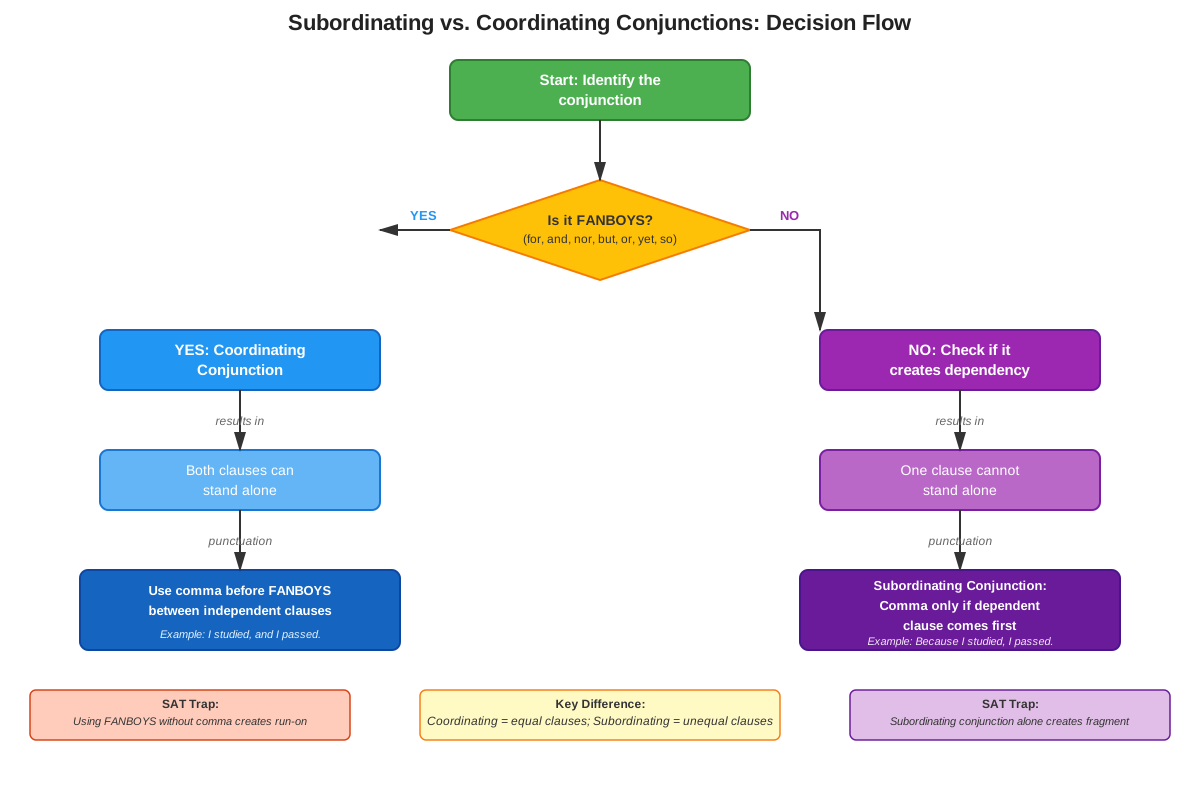
Subordinating conjunctions are words that connect a dependent clause to an independent clause, creating a complex sentence. Unlike coordinating conjunctions (FANBOYS: for, and, nor, but, or, yet, so), which connect two independent clauses of equal grammatical weight, subordinating conjunctions make one clause dependent on another. The dependent clause introduced by a subordinating conjunction cannot stand alone as a complete sentence—it relies on the independent clause to complete its meaning.
When a subordinating conjunction introduces a clause, that clause becomes subordinate (dependent), meaning it serves a supporting role in the sentence. The dependent clause provides additional information about time, cause, condition, contrast, or purpose related to the main clause. For example, in the sentence "Because it was raining, we stayed inside," the subordinating conjunction "because" introduces the dependent clause "Because it was raining," which explains why the action in the independent clause occurred.
Common Subordinating Conjunctions and Their Functions
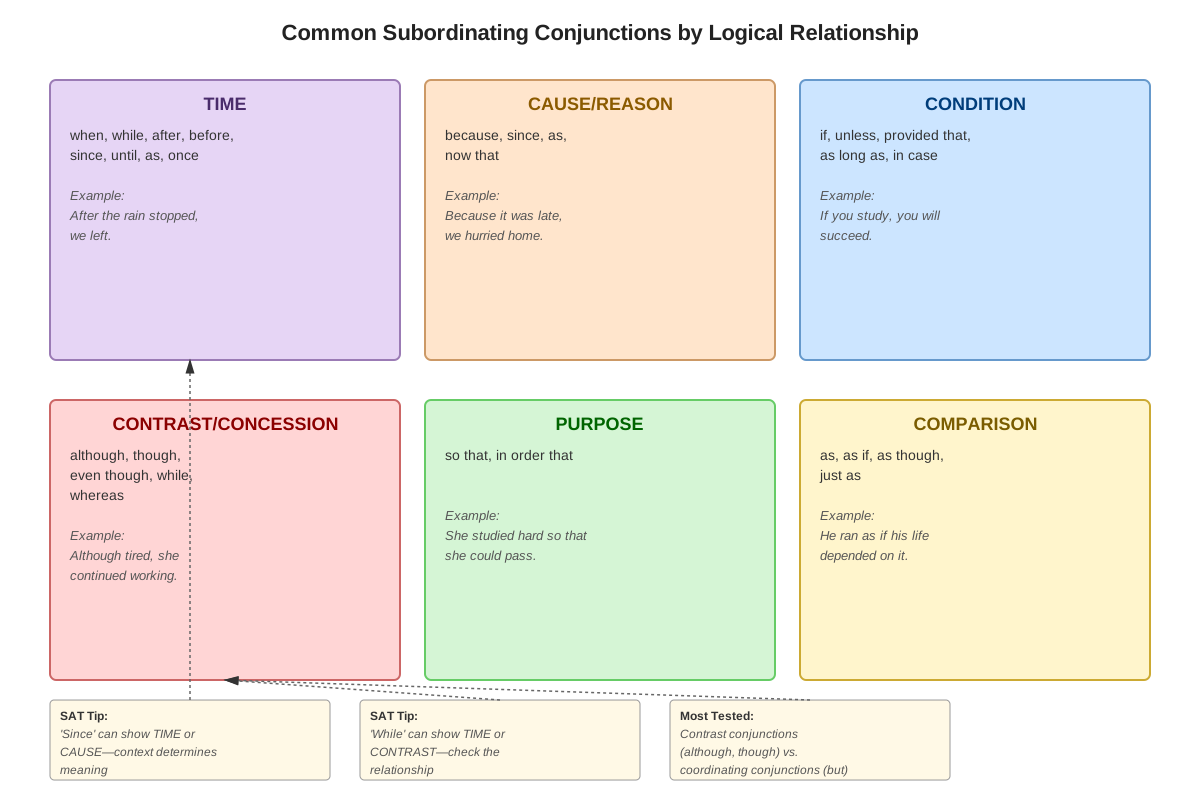
Subordinating conjunctions can be categorized by the type of relationship they express between clauses:
| Relationship Type | Subordinating Conjunctions | Example |
|---|---|---|
| Time | when, while, before, after, since, until, as, once, whenever | After the concert ended, the crowd dispersed quickly. |
| Cause/Reason | because, since, as | The experiment failed because the temperature was too high. |
| Condition | if, unless, provided that, as long as | Unless you study regularly, you won't improve your score. |
| Contrast/Concession | although, though, even though, whereas, while | Although she was tired, she finished her homework. |
| Purpose | so that, in order that | He arrived early so that he could get a good seat. |
| Comparison | as, just as, as if, as though | The building looked as if it had been abandoned for years. |
Understanding these categories helps students select the appropriate conjunction to express the intended logical relationship between ideas. The SAT frequently tests whether students can distinguish between similar relationships—for example, choosing between "because" (cause) and "although" (contrast).
Sentence Structure with Subordinating Conjunctions
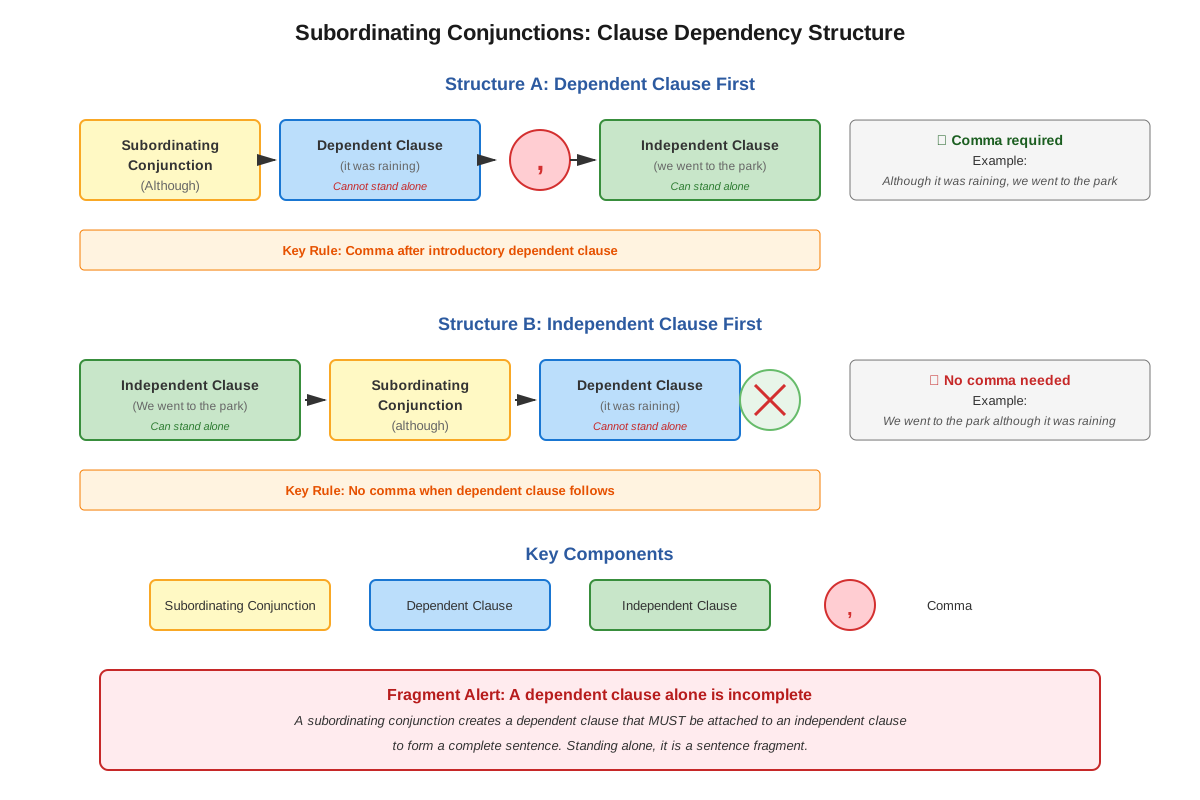
Subordinating conjunctions create complex sentences with specific structural patterns. The dependent clause can appear either before or after the independent clause, and the position affects punctuation:
Pattern 1: Dependent Clause + Independent Clause
When the dependent clause comes first, it is followed by a comma:
- "Although the weather was poor, the game continued."
- "Because she studied diligently, Maria earned a high score."
Pattern 2: Independent Clause + Dependent Clause
When the independent clause comes first, no comma is typically needed:
- "The game continued although the weather was poor."
- "Maria earned a high score because she studied diligently."
This punctuation rule is frequently tested on the SAT. Students must recognize that the comma is required when the dependent clause introduces the sentence but is generally omitted when the dependent clause follows the independent clause. There are exceptions when the dependent clause is nonessential or when it creates a strong contrast, but the basic pattern holds for most SAT questions.
Distinguishing Subordinating Conjunctions from Other Connectors
The SAT often includes answer choices that mix subordinating conjunctions with other types of connectors. Understanding the differences is crucial:
Subordinating Conjunctions vs. Coordinating Conjunctions
- Coordinating conjunctions (FANBOYS) connect two independent clauses and require a comma before them when joining complete sentences
- Subordinating conjunctions create a dependent clause that cannot stand alone
- Example: "I studied, and I passed" (coordinating) vs. "I passed because I studied" (subordinating)
Subordinating Conjunctions vs. Conjunctive Adverbs
- Conjunctive adverbs (however, therefore, moreover, consequently) connect independent clauses and require a semicolon or period before them
- Subordinating conjunctions integrate clauses more tightly without needing semicolons
- Example: "It rained; therefore, we stayed inside" (conjunctive adverb) vs. "Because it rained, we stayed inside" (subordinating conjunction)
Fragments Created by Subordinating Conjunctions
One of the most common errors involving subordinating conjunctions is creating sentence fragments. When a subordinating conjunction introduces a clause that is punctuated as a complete sentence, the result is a fragment:
Fragment: "Because the experiment required precise measurements."
Correction: "Because the experiment required precise measurements, the scientists worked carefully." OR "The scientists worked carefully because the experiment required precise measurements."
The SAT tests this concept by presenting sentences that begin with subordinating conjunctions and asking whether they are complete or by offering answer choices that would create fragments. Students must recognize that a clause beginning with a subordinating conjunction needs to be attached to an independent clause.
Concept Relationships
Subordinating conjunctions function as the bridge between understanding basic sentence structure and mastering complex sentence construction. The relationship flows as follows: Independent clauses (complete thoughts) → Subordinating conjunctions (connecting words) → Dependent clauses (incomplete thoughts that rely on independent clauses) → Complex sentences (sentences containing both independent and dependent clauses).
This topic connects directly to comma usage because the position of the dependent clause determines punctuation. It also relates to sentence boundaries because subordinating conjunctions help define where one complete thought ends and another begins. Understanding subordinating conjunctions enables students to tackle sentence combining questions, where multiple short sentences must be merged efficiently, and transition questions, where the logical relationship between ideas must be expressed precisely.
The concept also connects to parallel structure when subordinating conjunctions introduce multiple dependent clauses that must maintain grammatical consistency. Additionally, subordinating conjunctions relate to modifier placement because dependent clauses often function as adverbial modifiers that must be positioned logically in relation to what they modify.
High-Yield Facts
⭐ Subordinating conjunctions create dependent clauses that cannot stand alone as complete sentences.
⭐ When a dependent clause begins a sentence, it must be followed by a comma before the independent clause.
⭐ When a dependent clause follows an independent clause, no comma is typically needed.
⭐ Common subordinating conjunctions include: although, because, since, when, while, if, unless, after, before, though, whereas.
⭐ Subordinating conjunctions differ from coordinating conjunctions (FANBOYS), which connect two independent clauses with a comma.
- Subordinating conjunctions express specific logical relationships: time, cause, condition, contrast, purpose, or comparison.
- A sentence fragment often results when a dependent clause introduced by a subordinating conjunction is punctuated as a complete sentence.
- The subordinating conjunction "since" can express either time or cause, depending on context.
- Subordinating conjunctions differ from conjunctive adverbs (however, therefore, moreover), which require semicolons or periods.
- The SAT frequently tests whether students can choose the subordinating conjunction that accurately expresses the intended relationship between ideas.
- Multiple subordinating conjunctions can appear in a single sentence when there are multiple dependent clauses.
- Some subordinating conjunctions consist of multiple words (even though, as long as, provided that, in order that).
Quick check — test yourself on Subordinating conjunctions so far.
Try Flashcards →Common Misconceptions
Misconception: All conjunctions require commas before them.
Correction: Only coordinating conjunctions joining two independent clauses require commas before them. Subordinating conjunctions follow different rules: comma after the dependent clause when it begins the sentence, but typically no comma when the dependent clause follows the independent clause.
Misconception: A clause beginning with a subordinating conjunction can stand alone as a complete sentence.
Correction: A clause introduced by a subordinating conjunction is dependent and cannot stand alone. It must be connected to an independent clause to form a complete sentence. "Because it was raining" is a fragment; "Because it was raining, we stayed inside" is complete.
Misconception: "However" and "although" can be used interchangeably.
Correction: "Although" is a subordinating conjunction that creates a dependent clause and can begin a sentence followed by a comma. "However" is a conjunctive adverb that connects independent clauses and requires a semicolon or period before it. "Although it rained, we went hiking" is correct, but "However it rained, we went hiking" is incorrect.
Misconception: Subordinating conjunctions always appear at the beginning of sentences.
Correction: Subordinating conjunctions can appear in the middle of sentences when the independent clause comes first. "We stayed inside because it was raining" places the subordinating conjunction in the middle, introducing the dependent clause that follows the independent clause.
Misconception: "Since" always means "because."
Correction: "Since" can express either causation ("Since you studied, you passed") or time ("I've been waiting since noon"). Context determines which meaning applies, and the SAT may test whether students can distinguish between these uses.
Misconception: All dependent clauses need commas to separate them from independent clauses.
Correction: Only dependent clauses that begin sentences require commas. When the dependent clause follows the independent clause, no comma is typically needed unless the dependent clause is nonessential or creates a strong contrast.
Worked Examples
Example 1: Identifying and Correcting Fragments
Question: Which version correctly combines the following sentences?
- The researchers collected data for six months.
- They wanted to ensure accuracy.
A) The researchers collected data for six months, they wanted to ensure accuracy.
B) Because the researchers collected data for six months. They wanted to ensure accuracy.
C) The researchers collected data for six months because they wanted to ensure accuracy.
D) The researchers collected data for six months, because they wanted to ensure accuracy.
Solution:
Step 1: Identify the logical relationship between the ideas. The second sentence explains WHY the researchers collected data for six months—this is a cause-and-effect relationship.
Step 2: Evaluate each answer choice:
- Choice A creates a comma splice (two independent clauses joined only by a comma)
- Choice B creates a fragment ("Because the researchers collected data for six months" cannot stand alone)
- Choice C correctly uses the subordinating conjunction "because" to show the causal relationship, with the dependent clause following the independent clause (no comma needed)
- Choice D incorrectly places a comma before "because" when the dependent clause follows the independent clause
Step 3: Select the correct answer.
Answer: C
This question tests the learning objective of applying subordinating conjunctions to answer SAT-style questions. It requires recognizing the appropriate subordinating conjunction for a causal relationship and understanding the punctuation rules when the dependent clause follows the independent clause.
Example 2: Choosing the Appropriate Subordinating Conjunction
Question: The ancient city thrived for centuries _____ it was eventually abandoned due to drought.
Which choice best establishes a logical relationship between the two parts of the sentence?
A) because
B) although
C) since
D) if
Solution:
Step 1: Analyze the relationship between the two clauses. The first clause states that the city thrived, while the second states it was abandoned. These ideas contrast with each other—the city's success is surprising given its eventual abandonment.
Step 2: Evaluate each subordinating conjunction:
- "Because" indicates cause, suggesting the city thrived BECAUSE it was abandoned—this is illogical
- "Although" indicates contrast/concession, suggesting the city thrived DESPITE eventually being abandoned—this makes logical sense
- "Since" could indicate cause or time, but neither meaning creates a logical relationship here
- "If" indicates condition, suggesting the city's thriving depends on being abandoned—this is illogical
Step 3: Select the conjunction that expresses contrast.
Answer: B (although)
This question tests the learning objective of selecting the subordinating conjunction that accurately expresses the logical relationship between clauses. It requires understanding that "although" signals a contrast between two ideas that seem contradictory or unexpected in relation to each other.
Exam Strategy
When approaching SAT questions involving subordinating conjunctions, follow this systematic process:
Step 1: Identify the Question Type
Determine whether the question asks about sentence structure (fragments/run-ons), punctuation, or logical relationships. This helps you focus on the relevant aspect of subordinating conjunctions.
Step 2: Locate the Clauses
Identify the independent and dependent clauses in the sentence. Look for subordinating conjunctions that signal dependent clauses. Remember that a dependent clause cannot stand alone.
Step 3: Check for Fragments
If a sentence begins with a subordinating conjunction, verify that it contains both a dependent clause and an independent clause. Watch for answer choices that create fragments by separating these clauses with a period.
Step 4: Apply Punctuation Rules
- Dependent clause first → comma after it
- Independent clause first → typically no comma before the dependent clause
- Eliminate answer choices that violate these rules
Step 5: Evaluate Logical Relationships
When choosing between subordinating conjunctions, identify the relationship between ideas:
- Cause/effect: because, since, as
- Contrast: although, though, even though, whereas, while
- Condition: if, unless
- Time: when, while, before, after, until
Trigger Words to Watch For:
- "Although," "though," "even though": Signal contrast; the SAT often tests whether students recognize that these show unexpected or contradictory relationships
- "Because," "since": Signal causation; watch for questions that test whether students can distinguish cause from other relationships
- "While," "whereas": Can signal either time or contrast depending on context
- "If," "unless": Signal conditions; "unless" means "if not"
Process of Elimination Tips:
- Eliminate answer choices that create comma splices (two independent clauses joined only by a comma)
- Eliminate answer choices that create fragments (dependent clauses punctuated as complete sentences)
- Eliminate subordinating conjunctions that express illogical relationships (e.g., "because" when the ideas contrast)
- Eliminate answer choices with incorrect punctuation (comma before "because" when the dependent clause follows)
Time Allocation:
Subordinating conjunction questions should take 30-45 seconds each. If you can quickly identify the clause structure and logical relationship, select your answer. If the question seems complex, mark it and return after completing easier questions. Don't spend more than one minute on any single question.
Memory Techniques
AAAWWUBBIS Mnemonic for common subordinating conjunctions:
- After
- Although
- As
- When
- While
- Until
- Because
- Before
- If
- Since
Comma Rule Visualization:
Picture a dependent clause as a "helper" that needs to introduce itself before the main idea. When the helper comes first, it waves (comma) before stepping aside for the main clause. When the main clause comes first, the helper just follows quietly without waving.
Relationship Categories Acronym - TCCCP:
- Time (when, while, before, after)
- Cause (because, since)
- Condition (if, unless)
- Contrast (although, though, whereas)
- Purpose (so that, in order that)
Fragment Check Technique:
When you see a subordinating conjunction at the beginning of a sentence, mentally cover it up. If what remains could stand alone as a complete sentence, you need to check that there's also an independent clause in the full sentence. If the sentence ends after the first clause, it's a fragment.
"DC, IC" vs. "IC DC" Pattern:
Remember the pattern as a simple formula:
- Dependent Clause, Independent Clause (comma needed)
- Independent Clause Dependent Clause (no comma)
Summary
Subordinating conjunctions are essential connecting words that create dependent clauses and establish logical relationships between ideas in complex sentences. These conjunctions—including although, because, when, while, if, and since—make one clause subordinate to another, creating sentences that express time, cause, condition, contrast, or purpose. On the SAT Reading and Writing section, subordinating conjunctions appear frequently in questions about sentence structure, punctuation, and logical relationships. Students must recognize that dependent clauses introduced by subordinating conjunctions cannot stand alone as complete sentences and must be connected to independent clauses. Punctuation rules dictate that when a dependent clause begins a sentence, it must be followed by a comma, but when it follows an independent clause, no comma is typically needed. Success on SAT questions requires distinguishing subordinating conjunctions from coordinating conjunctions and conjunctive adverbs, identifying fragments created by misused subordinating conjunctions, and selecting the conjunction that accurately expresses the intended relationship between ideas.
Key Takeaways
- Subordinating conjunctions create dependent clauses that cannot stand alone and must be attached to independent clauses to form complete sentences
- When a dependent clause begins a sentence, place a comma after it; when it follows an independent clause, typically no comma is needed
- Common subordinating conjunctions (AAAWWUBBIS: after, although, as, when, while, until, because, before, if, since) express relationships of time, cause, condition, contrast, or purpose
- The SAT tests subordinating conjunctions through sentence structure questions (fragments/run-ons), punctuation questions, and transition questions requiring selection of the appropriate logical connector
- Subordinating conjunctions differ from coordinating conjunctions (FANBOYS) and conjunctive adverbs (however, therefore) in both function and punctuation requirements
- Choosing the correct subordinating conjunction requires identifying the logical relationship between clauses: cause (because), contrast (although), condition (if), time (when), or purpose (so that)
- Recognizing subordinating conjunctions helps students avoid common errors like fragments, comma splices, and illogical transitions between ideas
Related Topics
Coordinating Conjunctions (FANBOYS): Understanding how coordinating conjunctions differ from subordinating conjunctions is essential for proper punctuation and sentence structure. Mastering subordinating conjunctions provides the foundation for distinguishing between these two types of connectors.
Conjunctive Adverbs: These transitional words (however, therefore, moreover, consequently) connect independent clauses differently than subordinating conjunctions. Understanding subordinating conjunctions helps students recognize when semicolons are needed versus when commas suffice.
Sentence Fragments and Run-ons: Subordinating conjunctions are frequently involved in creating or correcting these errors. Mastery of subordinating conjunctions enables students to identify and fix boundary errors efficiently.
Complex and Compound-Complex Sentences: These sentence types rely on subordinating conjunctions to create sophisticated structures. Understanding subordinating conjunctions is prerequisite knowledge for analyzing and constructing these advanced sentence patterns.
Parallel Structure: When subordinating conjunctions introduce multiple dependent clauses, those clauses must maintain parallel grammatical form. Mastering subordinating conjunctions prepares students for parallelism questions.
Practice CTA
Now that you've mastered the fundamentals of subordinating conjunctions, it's time to reinforce your learning through active practice. Complete the practice questions to test your ability to identify subordinating conjunctions, apply punctuation rules, and select appropriate connectors for different logical relationships. Use the flashcards to memorize common subordinating conjunctions and their functions. Remember that consistent practice with SAT-style questions is the key to achieving automaticity—the ability to recognize and apply these concepts quickly and accurately under test conditions. Each practice question you complete strengthens your understanding and builds the confidence you need to excel on test day. You've invested the time to learn this high-yield topic; now solidify that knowledge through deliberate practice!
Sign up free to keep reading
Create a free AnvayaPrep account to finish this SAT guide on Subordinating conjunctions — plus flashcards and practice questions.