Overview
Inference from multiple sentences is a critical skill tested extensively on the SAT Reading and Writing section. Unlike questions that ask students to locate explicitly stated information, inference questions require synthesizing information from two or more sentences to arrive at a logical conclusion that isn't directly stated in the text. This cognitive process mirrors real-world reading comprehension, where understanding often depends on connecting ideas across multiple statements to grasp the author's full meaning.
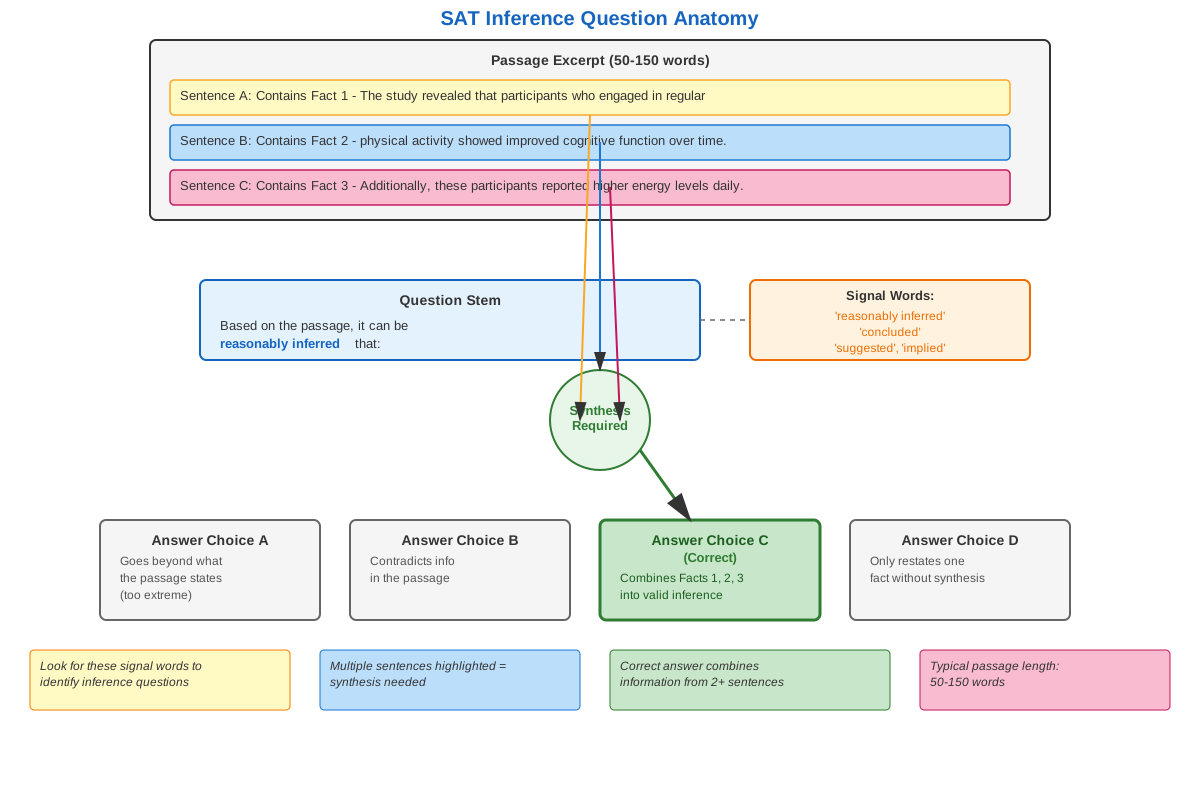
The SAT places significant emphasis on this skill because it measures genuine reading comprehension rather than simple information retrieval. Students must demonstrate the ability to recognize patterns, identify relationships between ideas, and draw reasonable conclusions based on textual evidence. These questions typically present a short passage (50-150 words) followed by a question asking what can be "reasonably inferred," "concluded," or "determined" from the information provided. Success requires careful attention to how sentences relate to one another and the ability to distinguish between what is explicitly stated and what logically follows from the given information.
Within the broader RW (Reading and Writing) section, inference from multiple sentences connects directly to other essential skills including identifying central ideas, understanding supporting details, and analyzing authorial purpose. Mastering this topic strengthens overall reading comprehension and prepares students for the analytical thinking required throughout the exam. The ability to make sound inferences is foundational not only for standardized testing but for academic success across all disciplines.
Learning Objectives
- [ ] Identify key features of inference from multiple sentences
- [ ] Explain how inference from multiple sentences appears on the SAT
- [ ] Apply inference from multiple sentences to answer SAT-style questions
- [ ] Distinguish between valid inferences and unsupported assumptions
- [ ] Synthesize information from disconnected sentences to form coherent conclusions
- [ ] Recognize textual clues that signal relationships between multiple statements
- [ ] Evaluate answer choices to identify those that go beyond or contradict textual evidence
Prerequisites
- Basic reading comprehension: Understanding individual sentences and their explicit meaning is essential before attempting to connect ideas across multiple sentences
- Vocabulary knowledge: Recognizing transition words, conjunctions, and relationship markers helps identify how sentences connect logically
- Literal comprehension skills: Students must accurately understand what is directly stated before inferring what is implied
- Attention to detail: Noticing specific words, qualifiers, and nuances in language prevents drawing incorrect conclusions
Why This Topic Matters
Inference from multiple sentences represents one of the most frequently tested skills on the SAT Reading and Writing section, appearing in approximately 15-20% of all questions. This question type assesses authentic reading comprehension—the ability to understand not just what a text says explicitly, but what it means when multiple pieces of information are considered together. In academic settings, students constantly need to synthesize information from various sources, connect related concepts, and draw logical conclusions, making this skill invaluable beyond test day.
On the SAT, these questions appear across all passage types: literature, history/social studies, and science. They often follow passages discussing research findings, historical events, biographical information, or scientific phenomena. The College Board specifically designs these questions to reward careful, evidence-based reasoning while penalizing hasty assumptions or over-interpretation. Students who master this skill typically see significant score improvements because these questions, while challenging, follow predictable patterns once the underlying logic is understood.
Real-world applications extend far beyond standardized testing. Professionals in every field must regularly synthesize information from multiple sources—whether analyzing data reports, understanding legal documents, interpreting research studies, or evaluating news articles. The cognitive skills developed through practicing SAT inference from multiple sentences translate directly to critical thinking abilities essential for college coursework and career success. Medical professionals diagnose by connecting symptoms, lawyers build cases by linking evidence, and scientists form hypotheses by synthesizing observations—all applications of multi-sentence inference.
Core Concepts
What Constitutes an Inference
An inference is a logical conclusion drawn from evidence presented in a text. Unlike explicit statements that directly tell the reader something, inferences require the reader to combine information from multiple sentences to arrive at a conclusion that, while not stated outright, must be true based on the given evidence. Valid inferences are always supported by textual evidence and never contradict any information provided in the passage.
The key distinction lies between three types of comprehension:
| Comprehension Type | Definition | Example |
|---|---|---|
| Literal | Information stated directly in text | "The experiment lasted three weeks." |
| Inferential | Conclusion logically derived from combining textual evidence | If sentence 1 says "The experiment began January 1" and sentence 2 says "It concluded January 21," we can infer it lasted three weeks. |
| Speculative | Assumption that goes beyond available evidence | Guessing why the experiment lasted that duration without textual support |
The Multi-Sentence Requirement
Inference from multiple sentences specifically requires synthesizing information that appears in two or more separate statements. This distinguishes it from single-sentence inference, where context clues within one sentence allow readers to determine implied meaning. The SAT deliberately spreads relevant information across multiple sentences to test whether students can:
- Identify which sentences contain relevant information
- Recognize the logical relationship between those sentences
- Combine the information to reach a valid conclusion
- Avoid drawing conclusions based on only partial evidence
Consider this example: "Maria studied marine biology for eight years. She now leads the oceanographic research team at the institute." From these two sentences, we can reasonably infer that Maria has expertise in marine biology and that her education likely contributed to her leadership position. Neither sentence alone provides this complete picture.
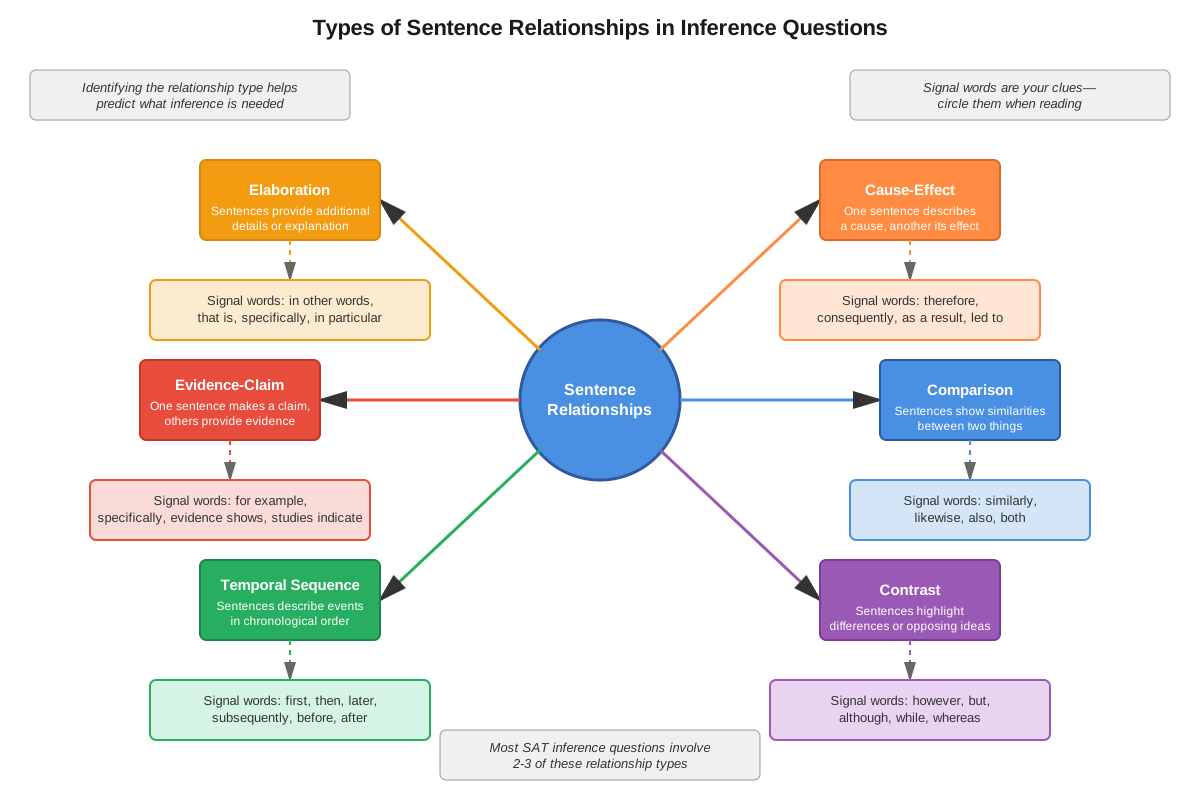
Types of Logical Relationships
Understanding how sentences relate to each other is crucial for making accurate inferences. Common relationship patterns include:
Cause and Effect: One sentence describes a cause while another describes its effect. The inference connects these to understand the causal relationship.
Comparison and Contrast: Multiple sentences present different subjects, time periods, or conditions. Inferences involve understanding similarities or differences.
Problem and Solution: One sentence presents a challenge while another describes a response. The inference might involve understanding effectiveness or motivation.
Evidence and Conclusion: Multiple sentences provide supporting details that collectively point toward a broader conclusion not explicitly stated.
Temporal Sequence: Sentences describe events at different times. Inferences involve understanding progression, change, or development.
The Boundaries of Valid Inference
A critical skill involves recognizing what can and cannot be inferred. Valid inferences must be:
- Supported by explicit textual evidence: Every part of the inference must connect to something actually stated
- Logically necessary or highly probable: The conclusion should be the most reasonable interpretation
- Consistent with all provided information: Valid inferences never contradict any part of the passage
- Limited to what the text supports: Avoiding bringing in outside knowledge or assumptions
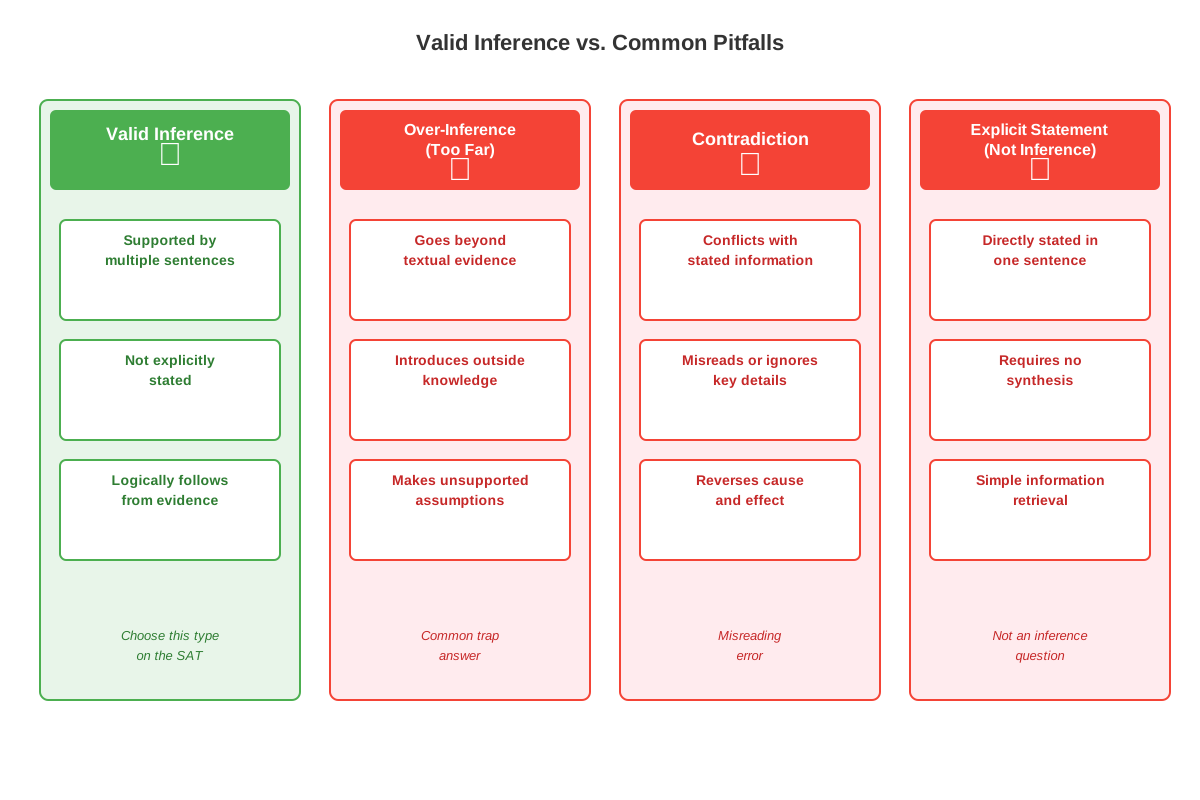
Invalid inferences typically fall into these categories:
- Over-generalization: Extending a specific statement too broadly
- Assumption: Adding information not present in or derivable from the text
- Contradiction: Drawing a conclusion that conflicts with stated information
- Speculation: Guessing about possibilities rather than determining what must be true
Signal Words and Transition Markers
Certain words and phrases indicate relationships between sentences, serving as clues for inference questions:
- Contrast markers: however, nevertheless, despite, although, while, whereas
- Cause indicators: because, since, therefore, thus, consequently, as a result
- Addition signals: furthermore, moreover, additionally, also, in addition
- Time markers: previously, subsequently, before, after, meanwhile, eventually
- Emphasis indicators: indeed, in fact, notably, significantly, particularly
Recognizing these markers helps students identify which sentences connect and how they relate to each other.
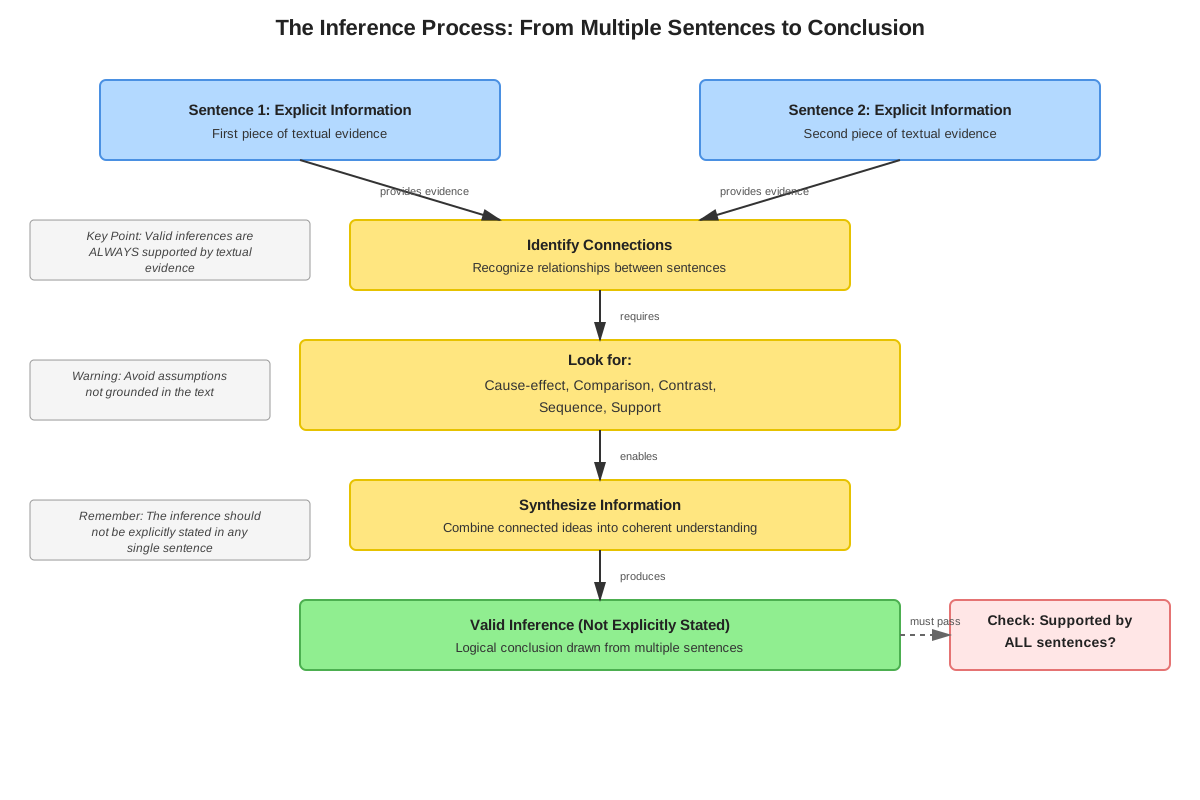
The Process of Making Multi-Sentence Inferences
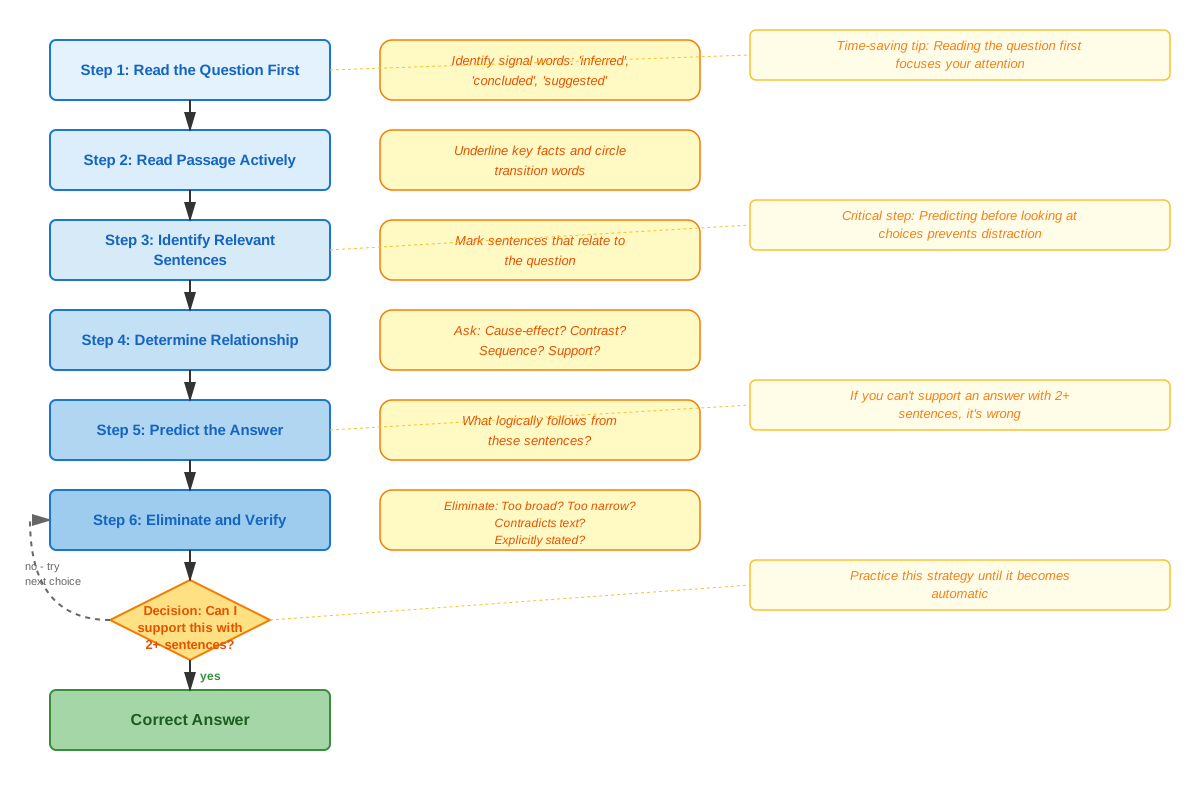
Effective inference follows a systematic approach:
- Read the entire passage carefully: Understand each sentence's literal meaning first
- Identify the question's focus: Determine what type of inference is being requested
- Locate relevant sentences: Find all statements that relate to the question
- Analyze relationships: Determine how these sentences connect logically
- Formulate the inference: Combine the information to reach a conclusion
- Verify against the text: Ensure the inference is supported and doesn't contradict anything
- Evaluate answer choices: Select the option that best matches the valid inference
Concept Relationships
The skill of inference from multiple sentences builds directly upon literal comprehension—students must first understand what each individual sentence states before attempting to connect them. This foundational skill then enables more complex analytical tasks.
Within the topic itself, understanding logical relationships between sentences (cause-effect, comparison, sequence) provides the framework for synthesizing information. Recognizing signal words and transition markers facilitates identifying these relationships, which in turn enables drawing valid conclusions. The boundaries of valid inference serve as quality control, ensuring conclusions remain evidence-based rather than speculative.
Relationship Map:
Literal Comprehension → Identifying Relevant Sentences → Recognizing Logical Relationships → Synthesizing Information → Drawing Valid Inferences → Evaluating Against Textual Evidence → Selecting Correct Answer
This topic connects to other SAT Reading and Writing skills:
- Central Ideas: Inferences often support or reveal the passage's main point
- Supporting Details: The sentences used for inference typically serve as supporting evidence
- Purpose and Function: Understanding why an author includes certain information aids inference
- Vocabulary in Context: Precise word meaning affects the accuracy of inferences drawn
- Text Structure: How a passage is organized influences which sentences relate to each other
Mastering multi-sentence inference strengthens overall reading comprehension because it develops the cognitive flexibility to move between explicit and implicit meaning—a skill essential for understanding complex academic texts.
High-Yield Facts
⭐ Inference questions require combining information from at least two separate sentences to reach a conclusion not explicitly stated in the passage
⭐ Valid inferences must be supported by textual evidence and cannot contradict any information provided in the passage
⭐ The correct answer to an inference question is the most reasonable conclusion based on the evidence, not merely a possible interpretation
⭐ Signal words like "however," "therefore," "meanwhile," and "consequently" indicate logical relationships between sentences
⭐ Inference questions often use phrases like "based on the text," "it can reasonably be inferred," "the author suggests," or "which conclusion is supported"
- Incorrect answer choices frequently include information that is explicitly stated (not inferred), contradicts the passage, or requires outside knowledge
- Temporal markers (before, after, previously, subsequently) often signal that information across sentences should be synthesized chronologically
- Cause-and-effect relationships are among the most common patterns requiring multi-sentence inference
- The SAT rewards conservative inferences that stay close to textual evidence rather than creative interpretations
- Approximately 15-20% of SAT Reading and Writing questions test inference from multiple sentences, making it one of the highest-yield skills to master
Quick check — test yourself on Inference from multiple sentences so far.
Try Flashcards →Common Misconceptions
Misconception: Any statement that could possibly be true based on the passage is a valid inference.
Correction: Valid inferences must be the most reasonable or necessary conclusion based on the evidence, not merely possible. The SAT requires inferences that are strongly supported, not speculative possibilities.
Misconception: If information appears in the passage word-for-word, it's the correct answer to an inference question.
Correction: Inference questions ask what can be concluded from the text, not what is explicitly stated. Answer choices that directly quote or paraphrase explicit statements are typically incorrect because they don't require inference.
Misconception: Making an inference means using outside knowledge or personal experience to interpret the passage.
Correction: Valid inferences must be based solely on information provided in the passage. Bringing in external knowledge often leads to incorrect answers because the SAT tests reading comprehension, not general knowledge.
Misconception: The correct inference will always combine information from consecutive sentences.
Correction: Relevant information may be spread throughout the passage, including the first and last sentences or other non-consecutive statements. Students must scan the entire passage for related information.
Misconception: Longer or more complex answer choices are more likely to be correct.
Correction: Answer choice length and complexity don't indicate correctness. The SAT often includes verbose incorrect answers that sound sophisticated but aren't supported by the text, while correct answers may be concise and straightforward.
Misconception: If most of an answer choice is supported by the passage, it's correct even if one part isn't.
Correction: Every element of the correct answer must be supported by the passage. Even one unsupported or contradictory detail makes an answer choice incorrect.
Worked Examples
Example 1: Scientific Research Passage
Passage:
"Dr. Chen's research team observed that coral reefs in the northern region showed 40% less bleaching than those in the southern region during the 2022 heat wave. Water temperature data revealed that northern currents maintained temperatures 2-3 degrees Celsius cooler throughout the summer months. The team noted that coral species composition was similar across both regions."
Question:
Based on the text, which conclusion about the coral bleaching is most strongly supported?
Answer Choices:
A) Coral species in the northern region are genetically superior to southern species.
B) The temperature difference between regions likely contributed to the variation in bleaching rates.
C) Southern coral reefs will completely disappear within the next decade.
D) Dr. Chen's team discovered a new coral species resistant to heat.
Step-by-Step Solution:
- Identify relevant sentences: All three sentences contain information relevant to understanding coral bleaching patterns.
- Analyze relationships:
- Sentence 1: Northern reefs had less bleaching (40% less)
- Sentence 2: Northern waters were cooler (2-3°C difference)
- Sentence 3: Coral species were similar in both regions
- Synthesize information: The difference in bleaching cannot be attributed to species differences (sentence 3 rules this out). The main variable is temperature (sentence 2), which correlates with the bleaching difference (sentence 1).
- Evaluate answer choices:
- A is incorrect: Sentence 3 explicitly states species composition was similar, contradicting genetic superiority
- B is correct: Combines information from all three sentences to draw a reasonable cause-effect inference
- C is incorrect: Makes an extreme prediction not supported by any textual evidence
- D is incorrect: No mention of discovering new species appears in the passage
Correct Answer: B
This inference requires synthesizing all three sentences: recognizing the bleaching difference (sentence 1), identifying the temperature variable (sentence 2), and ruling out species differences (sentence 3) to conclude that temperature likely explains the bleaching variation.
Example 2: Historical Biography Passage
Passage:
"Eleanor Roosevelt transformed the role of First Lady during her twelve years in the White House from 1933 to 1945. Unlike her predecessors, she held regular press conferences, wrote a daily newspaper column, and traveled extensively to observe social conditions firsthand. Her advocacy for civil rights and social justice often placed her at odds with political advisors who preferred a more traditional approach. After her husband's death, she continued her public service, becoming a delegate to the United Nations."
Question:
The text most strongly suggests which of the following about Eleanor Roosevelt's approach to her role?
Answer Choices:
A) She followed the example set by previous First Ladies.
B) She prioritized political advisors' recommendations over her own convictions.
C) She viewed the position as an opportunity for active public engagement rather than ceremonial duties.
D) She began her advocacy work only after becoming a UN delegate.
Step-by-Step Solution:
- Identify relevant sentences: Sentences 2, 3, and 4 describe her activities and approach.
- Analyze relationships:
- Sentence 2: Lists active, public-facing activities (press conferences, writing, traveling)
- Sentence 3: Notes she pursued her convictions despite opposition
- Sentence 4: Shows continued public service after her White House years
- Synthesize information: The pattern across these sentences shows consistent, active public engagement that went beyond traditional expectations and continued throughout her life.
- Evaluate answer choices:
- A is incorrect: Sentence 2 explicitly states "Unlike her predecessors"
- B is incorrect: Sentence 3 indicates she often disagreed with advisors, not that she prioritized their recommendations
- C is correct: Synthesizes the active, public-facing activities (sentence 2), her willingness to challenge convention (sentence 3), and continued engagement (sentence 4)
- D is incorrect: Sentence 3 describes advocacy during her White House years, before UN service
Correct Answer: C
This inference requires connecting multiple pieces of evidence: the specific activities listed in sentence 2 (active engagement), the willingness to face opposition in sentence 3 (prioritizing substance over tradition), and the continuation of service in sentence 4 (consistent pattern) to conclude that she viewed the role as an opportunity for active engagement.
Exam Strategy
Question Recognition
Inference from multiple sentences questions typically include these trigger phrases:
- "Based on the text, it can reasonably be inferred that..."
- "Which conclusion is most strongly supported by the passage?"
- "The text suggests that..."
- "According to the passage, which statement about [topic] is most likely true?"
- "The author indicates that..."
When encountering these phrases, immediately recognize that the answer will require synthesizing information rather than locating a single explicit statement.
Systematic Approach
- Read the question first: Understanding what type of inference is needed helps focus attention while reading
- Read the passage completely: Never attempt to answer based on partial reading
- Annotate connections: Mark sentences that relate to the question with brackets or mental notes
- Predict before looking at choices: Formulate what the inference should be based on textual evidence
- Eliminate systematically: Remove choices that are explicitly stated, contradict the text, or require outside knowledge
- Verify the winner: Ensure the remaining choice is supported by multiple sentences and doesn't overreach
Process of Elimination Strategies
Eliminate answers that:
- Restate explicit information without requiring inference
- Contradict any detail in the passage
- Introduce information not present in or derivable from the text
- Make extreme claims (always, never, only, must) unless strongly supported
- Require specialized knowledge beyond what the passage provides
- Combine one supported element with one unsupported element
Keep answers that:
- Require combining information from at least two sentences
- Use moderate language (likely, suggests, indicates, may)
- Stay logically close to textual evidence
- Account for all relevant information in the passage
Time Management
Allocate approximately 60-75 seconds per inference question:
- 20-30 seconds: Reading and understanding the passage
- 15-20 seconds: Identifying relevant sentences and their relationships
- 20-25 seconds: Evaluating answer choices and verifying the selection
If struggling beyond 90 seconds, mark the question for review and move forward. These questions reward careful analysis, but spending excessive time on one question compromises performance on others.
Common Traps to Avoid
The "True But Not Inferred" Trap: Answer choices that state something accurate based on the passage but don't require inference—they're explicitly stated.
The "Possible But Not Supported" Trap: Statements that could be true but aren't the most reasonable conclusion based on the evidence provided.
The "Outside Knowledge" Trap: Answers that seem correct based on general knowledge but aren't supported by the specific passage.
The "Partial Support" Trap: Answers where part is supported but another part goes beyond or contradicts textual evidence.
Memory Techniques
The VALID Inference Checklist
Use VALID to verify answer choices:
- Verifiable: Can point to specific textual evidence
- All-inclusive: Accounts for all relevant information
- Logical: Follows reasonable cause-effect or other relationships
- Implicit: Requires synthesis, not explicitly stated
- Defensible: Can explain why it's the best answer
The Three-Sentence Rule
Remember: "Three is key"—most inference questions require synthesizing information from at least three related pieces of evidence (which may appear in two or more sentences). Train yourself to identify three supporting elements before selecting an answer.
Signal Word Categories Mnemonic
CATCH the relationships:
- Contrast: however, despite, although
- Addition: furthermore, moreover, also
- Time: before, after, meanwhile
- Cause: because, therefore, thus
- Highlight: indeed, notably, particularly
The Goldilocks Principle
Think of inference answers as "just right"—not too explicit (that's literal comprehension), not too speculative (that's assumption), but requiring just the right amount of synthesis from textual evidence.
Visualization Strategy
Picture inference questions as puzzle pieces: Each sentence is a piece, and the correct answer shows the complete picture that emerges when pieces are properly connected. Incorrect answers either show a picture from just one piece (too explicit) or a picture that includes pieces not in the box (unsupported).
Summary
Inference from multiple sentences represents a cornerstone skill for SAT Reading and Writing success, requiring students to synthesize information across two or more statements to reach logical conclusions not explicitly stated in the text. This skill distinguishes genuine reading comprehension from simple information retrieval. Valid inferences must be supported by textual evidence, consistent with all provided information, and represent the most reasonable conclusion based on the passage. The SAT tests this skill through questions asking what can be "reasonably inferred," "concluded," or "suggested" by the text. Success requires systematically identifying relevant sentences, recognizing logical relationships between them (cause-effect, comparison, sequence, etc.), synthesizing the information, and carefully evaluating answer choices to avoid common traps like selecting explicitly stated information, making unsupported assumptions, or bringing in outside knowledge. Mastering this skill not only improves SAT scores but develops critical thinking abilities essential for academic and professional success.
Key Takeaways
- Inference from multiple sentences requires synthesizing information from at least two separate statements to reach a conclusion not explicitly stated in the passage
- Valid inferences must be supported by textual evidence, logically sound, and consistent with all information provided—never contradicting any passage details
- Signal words (however, therefore, meanwhile, because) indicate logical relationships between sentences and guide the synthesis process
- Incorrect answer choices typically fall into predictable categories: explicitly stated information, contradictions, unsupported assumptions, or statements requiring outside knowledge
- The systematic approach—reading completely, identifying relevant sentences, recognizing relationships, predicting the inference, and eliminating methodically—maximizes accuracy and efficiency
- This skill appears in 15-20% of SAT Reading and Writing questions, making it one of the highest-yield topics to master
- Conservative inferences that stay close to textual evidence are rewarded over creative interpretations that extend beyond what the passage supports
Related Topics
Central Ideas and Main Purpose: Understanding how to identify a passage's main point builds upon inference skills, as central ideas often emerge from synthesizing multiple supporting details rather than being explicitly stated.
Supporting Details and Evidence: Recognizing which details support broader claims requires the same synthesis skills used in multi-sentence inference, creating a reciprocal relationship between these topics.
Vocabulary in Context: Precise understanding of word meanings affects inference accuracy, as subtle differences in language can change what can reasonably be concluded from multiple sentences.
Author's Purpose and Point of View: Determining why an author includes certain information or what perspective they hold often requires inferring from patterns across multiple statements rather than explicit declarations.
Text Structure and Organization: Understanding how passages are organized helps identify which sentences relate to each other and should be synthesized to form inferences.
Practice CTA
Now that you've mastered the core concepts of inference from multiple sentences, it's time to apply this knowledge! Complete the practice questions to reinforce your understanding and develop the quick recognition skills essential for test day. Each practice question has been carefully designed to mirror actual SAT patterns and difficulty levels. Review the flashcards to cement key concepts and strategies in your memory. Remember: inference skills improve dramatically with deliberate practice—the more you train yourself to recognize relationships between sentences and draw valid conclusions, the more automatic and accurate this process becomes. You're building a critical thinking skill that will serve you far beyond the SAT!
Sign up free to keep reading
Create a free AnvayaPrep account to finish this SAT guide on Inference from multiple sentences — plus flashcards and practice questions.