Overview
Overstatement in answer choices is one of the most frequently tested trap patterns on the SAT Reading and Writing section. This concept refers to answer choices that go beyond what the passage actually states or implies, making claims that are too broad, too extreme, or too absolute. The College Board deliberately crafts these tempting wrong answers to test whether students can distinguish between what a text actually says and what seems plausible but isn't fully supported by the evidence.
Understanding how to identify overstatement is crucial for success on the SAT because it appears across multiple question types, including main idea questions, detail questions, and inference questions. Students who fail to recognize overstatement often select answers that "sound good" or align with their background knowledge but aren't justified by the passage itself. The ability to spot these exaggerated claims is a fundamental skill in critical reading that separates high scorers from average performers.
This topic connects directly to the broader RW (Reading and Writing) skills of close reading, evidence-based reasoning, and textual analysis. Mastering overstatement recognition strengthens a student's ability to evaluate all answer choices critically, improves accuracy on Central Ideas and Details questions, and builds the foundation for success on inference and purpose questions throughout the exam.
Learning Objectives
- [ ] Identify key features of overstatement in answer choices
- [ ] Explain how overstatement in answer choices appears on the SAT
- [ ] Apply overstatement in answer choices to answer SAT-style questions
- [ ] Distinguish between appropriately supported claims and overstated claims in answer choices
- [ ] Recognize common linguistic markers that signal overstatement (absolute language, extreme modifiers)
- [ ] Evaluate answer choices by comparing their scope and intensity to passage evidence
Prerequisites
- Basic reading comprehension skills: The ability to understand main ideas and supporting details in college-level passages is essential for recognizing when an answer choice extends beyond the text.
- Understanding of textual evidence: Students must know how to locate and evaluate evidence in passages to determine whether claims are supported.
- Familiarity with SAT question formats: Knowledge of how Central Ideas and Details questions are structured helps students anticipate where overstatement traps typically appear.
- Vocabulary knowledge: Understanding nuanced differences between words like "always" versus "often" or "proves" versus "suggests" is necessary for detecting overstatement.
Why This Topic Matters
In real-world contexts, the ability to identify overstatement is essential for evaluating arguments, analyzing media claims, and making evidence-based decisions. Students who can recognize when claims exceed their supporting evidence become more critical consumers of information, better equipped to navigate academic research, news analysis, and professional communication.
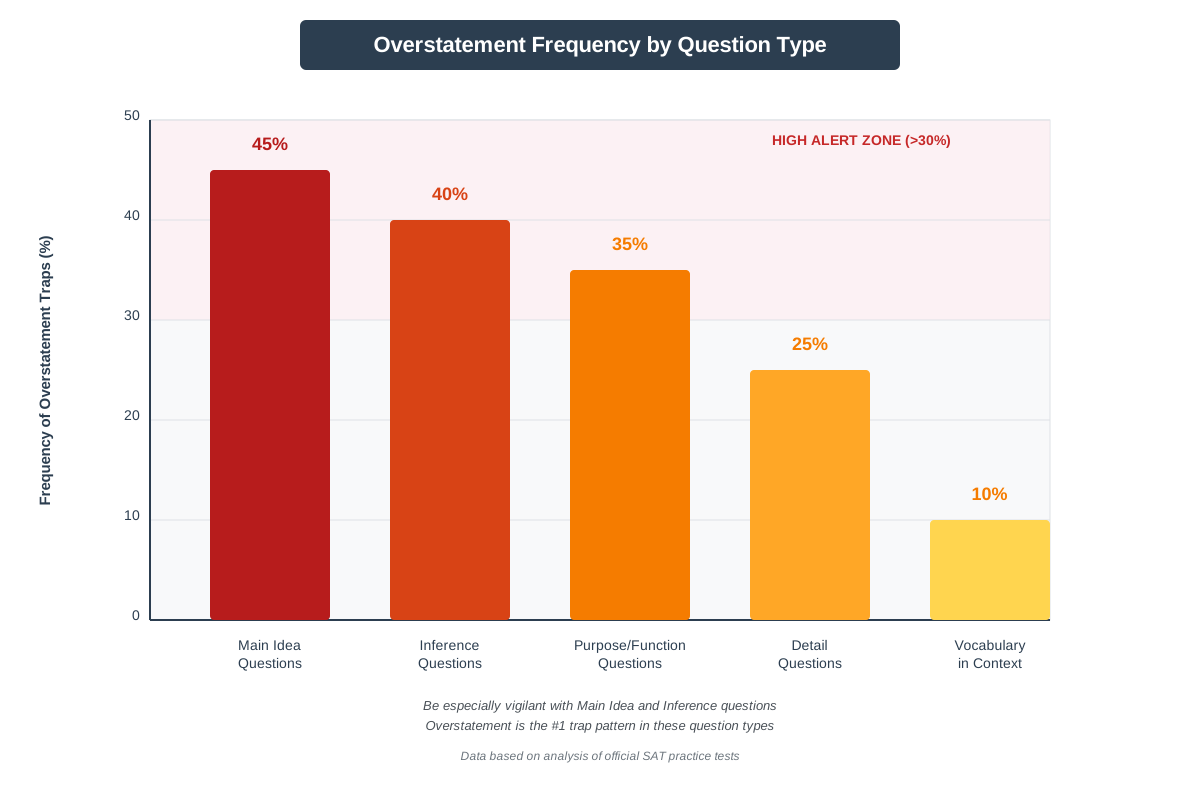
On the SAT, overstatement in answer choices appears with remarkable frequency—approximately 30-40% of incorrect answer choices contain some form of overstatement. This pattern appears most commonly in:
- Main idea and central claim questions (where wrong answers claim the passage argues something more extreme than it does)
- Detail questions (where wrong answers exaggerate specific information)
- Inference questions (where wrong answers draw conclusions that go too far beyond the evidence)
- Purpose and function questions (where wrong answers attribute overly broad or dramatic intentions to the author)
The College Board uses overstatement as a primary distractor because it exploits a common reading weakness: students often remember the general topic or theme of a passage but not the precise degree or scope of the author's claims. A passage might discuss "some benefits" of a practice, but an overstated answer choice will claim the passage argues for "numerous advantages" or "transformative effects."
Core Concepts
What Constitutes Overstatement
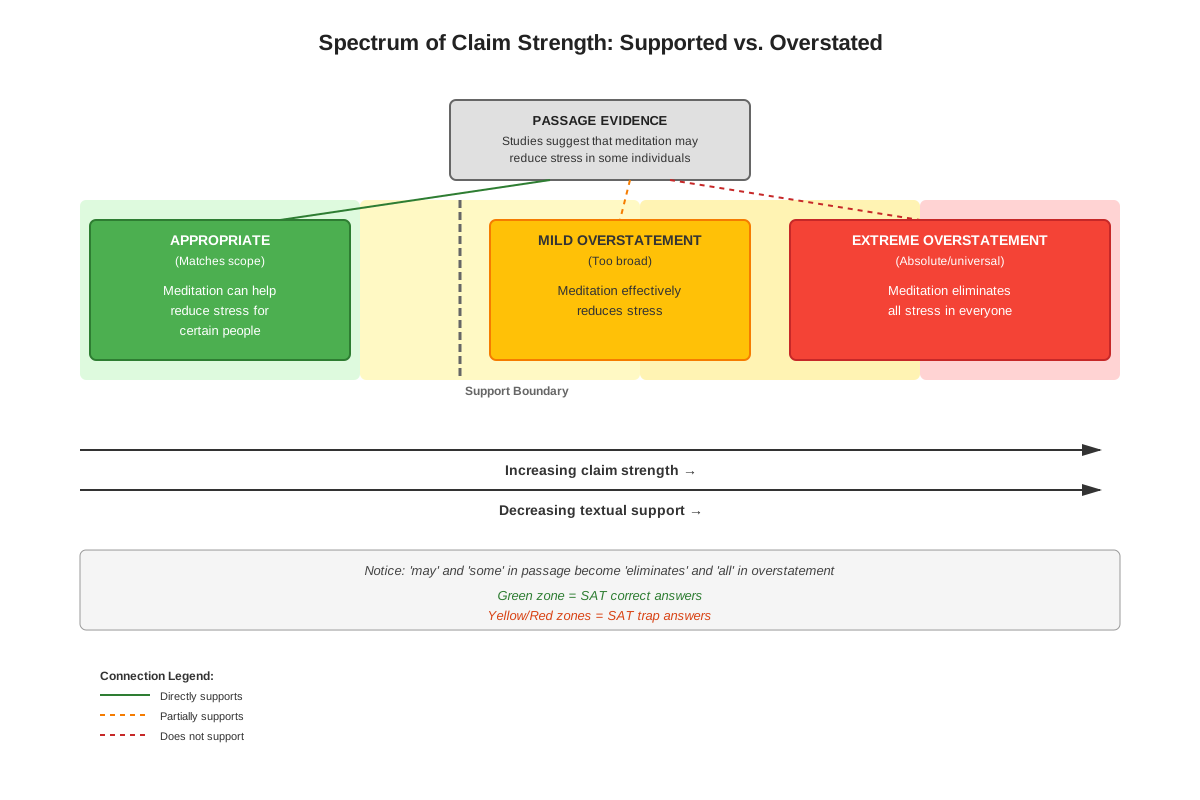
Overstatement in answer choices occurs when an option makes a claim that is broader, stronger, more absolute, or more extreme than what the passage actually supports. The key characteristic of overstatement is that it extends beyond the boundaries of the textual evidence—it's not necessarily false in the real world, but it's not justified by what the passage says.
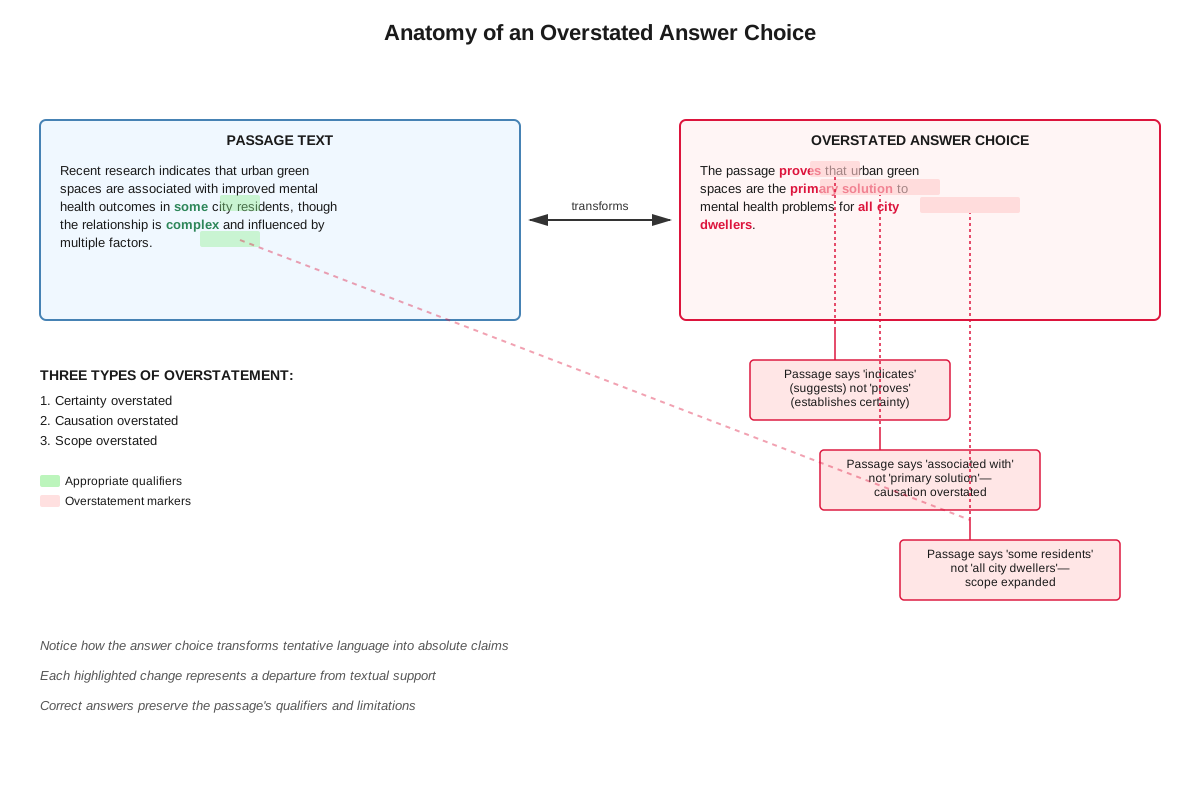
Overstatement typically manifests in three primary ways:
- Scope overstatement: The answer choice applies a claim to a broader category or larger group than the passage discusses
- Intensity overstatement: The answer choice uses stronger, more extreme language than the passage warrants
- Certainty overstatement: The answer choice presents something as definite or proven when the passage treats it as possible, likely, or suggested
Linguistic Markers of Overstatement
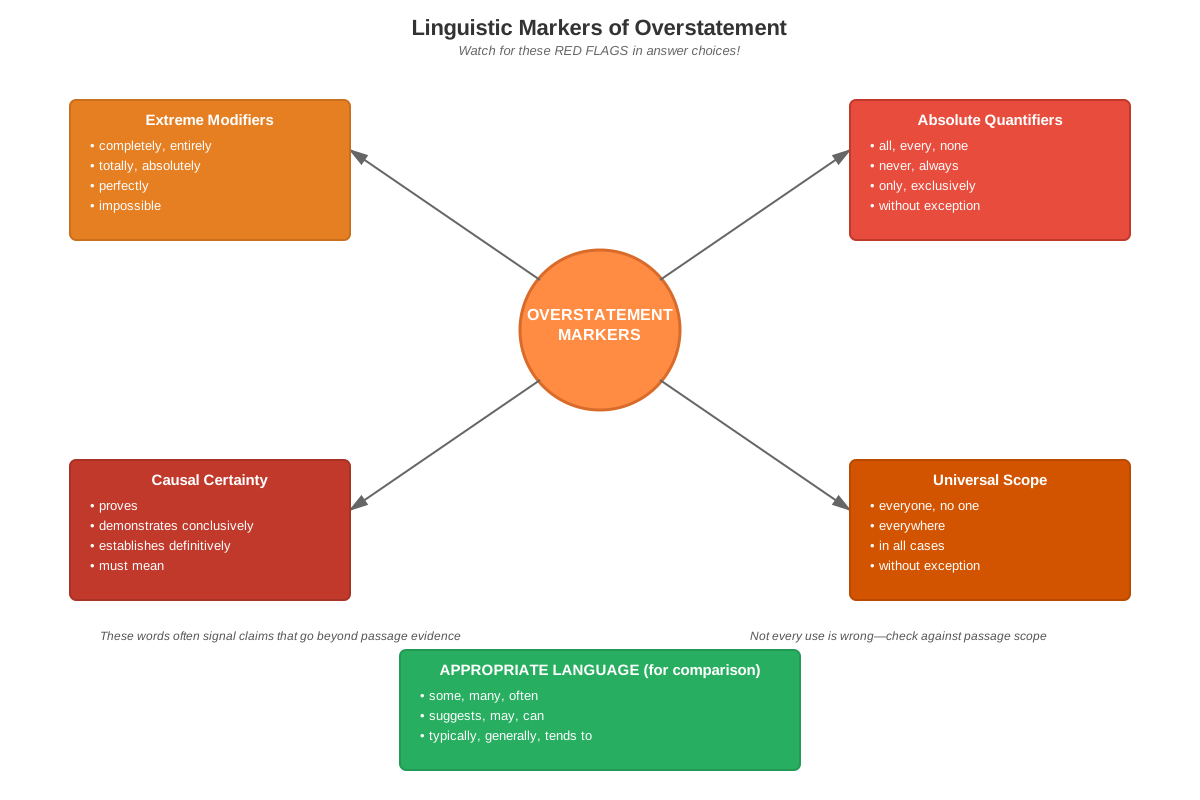
Certain words and phrases frequently signal overstatement. These absolute language markers include:
| Overstated Language | More Moderate Alternatives |
|---|---|
| always, never, all, none | often, rarely, most, few |
| proves, demonstrates conclusively | suggests, indicates, supports |
| completely, entirely, totally | largely, significantly, substantially |
| impossible, inevitable | unlikely, probable |
| only, exclusively, solely | primarily, mainly, largely |
| revolutionary, transformative | important, significant, notable |
However, students must be careful: not every answer choice with absolute language is wrong. The key question is whether the passage itself uses or supports such absolute claims. If a passage states "all participants showed improvement," then an answer choice saying "all participants improved" is accurate, not overstated.
The Scope Problem
One of the most common forms of SAT overstatement in answer choices involves scope expansion. A passage might discuss a specific example, case study, or limited context, but the wrong answer choice generalizes this to a much broader application.
For example:
- Passage scope: "The 2019 study of urban gardens in Seattle found increased community engagement"
- Overstated answer: "Urban gardens create community engagement in cities"
- Appropriate answer: "A study found that urban gardens in one city increased community engagement"
The overstated version removes the limitations (one study, one city, one year) and presents the finding as a universal truth.
The Intensity Problem
Intensity overstatement occurs when answer choices use more dramatic, emphatic, or extreme language than the passage supports. This is particularly common when passages present balanced, nuanced arguments but wrong answers make them sound one-sided or extreme.
Consider these intensity levels:
- Mild: mentions, notes, observes, describes
- Moderate: argues, demonstrates, shows, indicates
- Strong: proves, establishes definitively, conclusively demonstrates
If a passage "suggests" a relationship between two factors, an answer choice claiming the passage "proves" this relationship is overstated.
The Certainty Problem
Academic and informational passages often present ideas with appropriate epistemic modality—they acknowledge uncertainty, present hypotheses, or describe possibilities. Overstated answer choices remove this nuance and present tentative claims as established facts.
Passage language indicating uncertainty:
- "may contribute to"
- "could explain"
- "one possible factor"
- "researchers hypothesize"
- "preliminary evidence suggests"
Overstated answer language:
- "causes"
- "explains"
- "the factor responsible for"
- "researchers have proven"
- "evidence demonstrates"
Comparative and Superlative Overstatement
Another subtle form of overstatement involves comparative and superlative claims. A passage might indicate something is "important" or "significant," but an overstated answer will claim it's "the most important" or "the primary factor."
Example:
- Passage: "Temperature regulation is an important function of the skin"
- Overstated: "Temperature regulation is the skin's most important function"
- Appropriate: "Temperature regulation is one important function of the skin"
Concept Relationships
The concept of overstatement in answer choices connects directly to several fundamental reading comprehension skills. Close reading → enables → recognition of precise textual claims → which allows → identification of overstatement. Students must first understand exactly what the passage says before they can recognize when an answer choice goes beyond it.
Overstatement recognition also relates inversely to understatement in answer choices, another common wrong answer pattern where choices claim less than the passage supports. Together, these concepts form a spectrum: students must find the answer choice that matches the passage's scope, intensity, and certainty—not too much, not too little.
The skill of identifying overstatement builds directly on prerequisite knowledge of textual evidence. Students must constantly ask: "Where in the passage does it say this?" If the answer is "nowhere" or "not quite," the choice likely contains overstatement.
Furthermore, overstatement recognition connects to inference questions because both require understanding the difference between what's stated, what's implied, and what goes beyond the text. A valid inference stays within the logical boundaries of the passage; an overstatement crosses those boundaries.
High-Yield Facts
⭐ Overstatement in answer choices is one of the three most common wrong answer patterns on SAT Reading and Writing questions, appearing in 30-40% of incorrect options.
⭐ Absolute language (always, never, all, none, only, exclusively) is a red flag for potential overstatement, but not all absolute language is wrong—verify against the passage.
⭐ When a passage discusses a specific example or limited study, wrong answers often overgeneralize to broader populations or universal claims.
⭐ Intensity overstatement occurs when answer choices use stronger verbs (proves, demonstrates) than the passage warrants (suggests, indicates).
⭐ The correct answer matches the passage's level of certainty—if the passage is tentative or qualified, the right answer will be too.
- Comparative and superlative claims (most, primary, main, chief) in answer choices require explicit support in the passage.
- Overstatement often appears in main idea questions where wrong answers make the author's argument sound more extreme than it is.
- Time-related overstatement occurs when answers claim something is permanent, universal, or timeless when the passage discusses a specific time period.
- Causal overstatement happens when answer choices claim the passage establishes causation when it only describes correlation or association.
- The scope of an answer choice must match the scope of the passage—if the passage discusses "some scientists," the answer shouldn't say "scientists" generally.
Quick check — test yourself on Overstatement in answer choices so far.
Try Flashcards →Common Misconceptions
Misconception: If an answer choice is factually true in the real world, it must be correct. → Correction: SAT questions test what the passage says, not what's true in reality. An answer can be factually accurate but still be wrong if the passage doesn't support it or if it overstates what the passage claims.
Misconception: Longer, more detailed answer choices are more likely to be correct. → Correction: Overstatement often appears in longer answer choices that add extra claims or details not supported by the passage. Length doesn't indicate correctness.
Misconception: If the passage mentions a topic, any answer choice about that topic is potentially correct. → Correction: The passage must support not just the topic but the specific claim being made. An answer choice might discuss the right topic but make an overstated claim about it.
Misconception: Academic or sophisticated-sounding language makes an answer choice more credible. → Correction: The College Board often uses impressive-sounding language in wrong answers to make overstatement seem authoritative. Always verify against the passage regardless of how the answer is phrased.
Misconception: If most of an answer choice is correct, it's the right answer even if one part is overstated. → Correction: On the SAT, an answer choice must be entirely supported by the passage. Even one overstated element makes the entire choice wrong.
Worked Examples
Example 1: Main Idea Question
Passage: "Recent research on urban heat islands has revealed that cities with more tree coverage experience lower average temperatures during summer months. A 2020 study of fifteen metropolitan areas found that neighborhoods with at least 30% tree canopy coverage were, on average, 3-5 degrees Fahrenheit cooler than areas with less than 10% coverage. While these findings are promising, researchers caution that tree planting alone cannot solve all heat-related challenges in cities, as factors like building materials and street design also play significant roles."
Question: Which choice best states the main idea of the passage?
Answer Choices:
A) Tree coverage is the most effective solution for reducing urban temperatures.
B) Research indicates that increased tree coverage in cities correlates with lower summer temperatures, though other factors also affect urban heat.
C) A 2020 study proved that cities must achieve 30% tree canopy coverage to combat heat islands.
D) Urban heat islands can be completely eliminated through strategic tree planting initiatives.
Analysis:
Choice A contains intensity and comparative overstatement. The passage never claims tree coverage is "the most effective solution"—it presents it as one factor among several. The passage explicitly states that "tree planting alone cannot solve all heat-related challenges," directly contradicting the implied exclusivity of this answer.
Choice B is correct. It accurately captures the scope (research indicates, not proves), the relationship (correlation, not causation), and the qualification (other factors also matter). The language matches the passage's measured tone.
Choice C contains certainty overstatement ("proved") and scope overstatement (the study examined what exists, not what "must" be achieved). The passage describes findings from one study, not prescriptive requirements for all cities.
Choice D contains extreme overstatement ("completely eliminated"). The passage explicitly contradicts this with its caution that tree planting "alone cannot solve all heat-related challenges."
Key Takeaway: The correct answer preserves all the qualifications and limitations present in the passage, while wrong answers remove these nuances to make claims sound more dramatic or definitive.
Example 2: Detail Question
Passage: "The Impressionist movement, which emerged in France in the 1870s, represented a significant departure from academic painting traditions. Artists like Claude Monet and Pierre-Auguste Renoir experimented with capturing light and momentary visual impressions rather than creating detailed, polished compositions. While initially met with criticism from established art institutions, Impressionism gradually gained acceptance and influenced numerous subsequent artistic movements."
Question: According to the passage, what was true of Impressionism when it first emerged?
Answer Choices:
A) It was universally rejected by all art critics and institutions.
B) It received criticism from established art institutions.
C) It immediately revolutionized all aspects of European art.
D) It was the only artistic movement challenging academic traditions.
Analysis:
Choice A contains scope and intensity overstatement. The passage says Impressionism was "initially met with criticism from established art institutions," not that it was "universally rejected by all" critics and institutions. The absolute language ("universally," "all") goes beyond what the passage supports.
Choice B is correct. It directly matches the passage's statement without adding unsupported elements or removing important qualifications.
Choice C contains intensity and time-related overstatement. The passage says Impressionism "gradually gained acceptance," contradicting "immediately," and while it "influenced numerous subsequent artistic movements," this doesn't equal "revolutionized all aspects of European art."
Choice D contains exclusivity overstatement. The passage never claims Impressionism was "the only" movement challenging traditions—it simply describes Impressionism as "a significant departure" without making comparative claims about other movements.
Key Takeaway: Correct answers on detail questions match the passage's language closely, while overstated answers add absolute terms, extreme modifiers, or unsupported comparative claims.
Exam Strategy
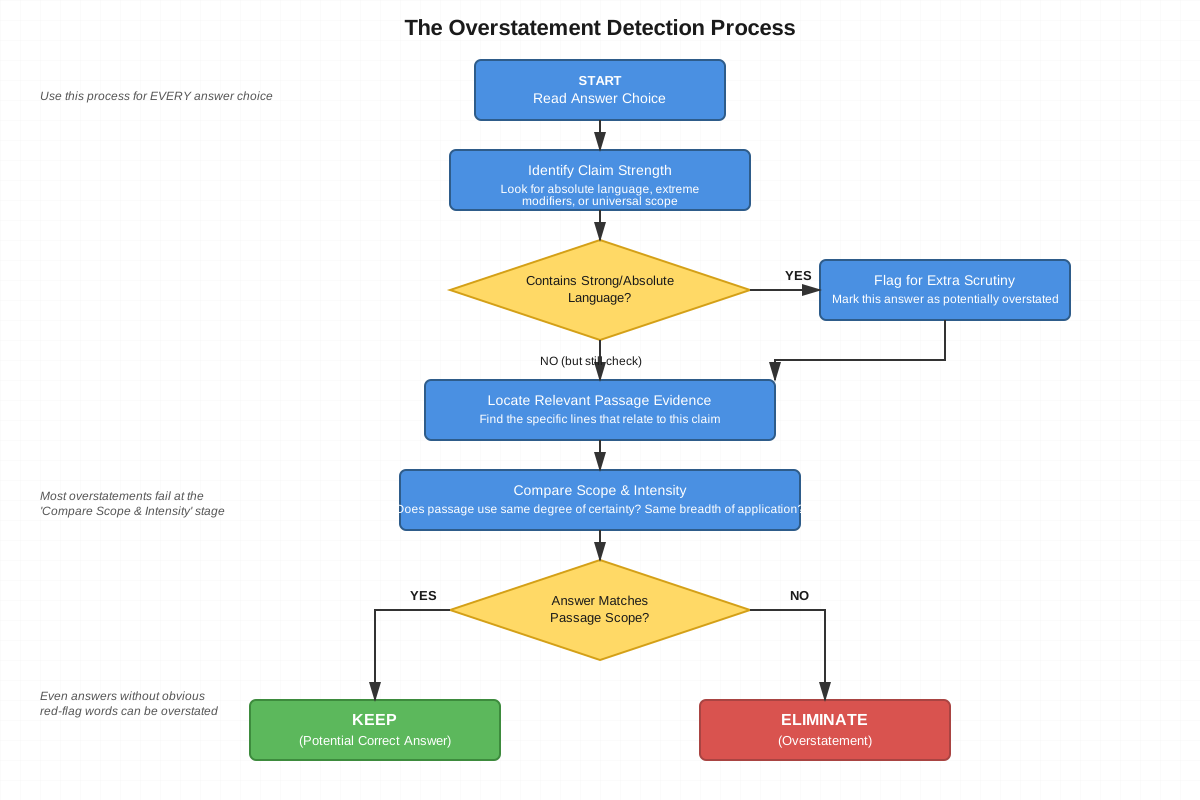
When approaching SAT questions where overstatement is a concern, follow this systematic process:
Step 1: Read the passage carefully and note qualifying language. Pay attention to words like "some," "may," "suggests," "one factor," and other hedging language that indicates limited scope or certainty.
Step 2: Before looking at answer choices, formulate your own answer based solely on what the passage states. This prevents you from being swayed by attractive but overstated options.
Step 3: Scan answer choices for red-flag words that signal potential overstatement:
- Absolute terms: always, never, all, none, only, exclusively
- Superlatives: most, best, primary, chief, main
- Strong certainty: proves, demonstrates conclusively, establishes
- Extreme modifiers: completely, entirely, revolutionary, transformative
Step 4: For each answer choice, ask three questions:
- Does the passage discuss this topic? (If no, eliminate)
- Does the passage support this specific claim? (If no, eliminate)
- Does the passage support this claim with this degree of certainty/scope/intensity? (If no, eliminate)
Step 5: Compare remaining choices to find the one that best matches the passage's precise level of commitment to the claim.
Exam Tip: When you're down to two answer choices, the one with more qualified, moderate language is usually correct. The SAT rewards precision over drama.
Time allocation: Don't rush through answer choice evaluation. Spending an extra 15-20 seconds carefully checking for overstatement is better than quickly selecting an attractive but wrong answer. Most students who miss questions due to overstatement do so because they read too quickly, not because they don't understand the concept.
Trigger phrases to watch for in questions:
- "According to the passage" = stick strictly to what's stated
- "The passage suggests" = look for supported inferences, but avoid overstatement
- "The main idea" = avoid answers that make the argument more extreme than it is
Memory Techniques
SCOPE Acronym for checking answer choices:
- Specific vs. general: Does the answer match the passage's level of specificity?
- Certainty level: Does the answer match how confident the passage is?
- Overreach check: Does the answer claim more than the passage supports?
- Precise language: Does the answer use appropriately qualified language?
- Evidence alignment: Can you point to specific passage evidence for every part of the answer?
The "Dial It Down" Visualization: Imagine each answer choice has a volume dial. The correct answer's dial should match the passage's volume. Overstated answers have their dials turned up too high—they're louder and more dramatic than the passage. When you spot extreme language, visualize turning that dial down to see what the answer would say at the passage's volume level.
The Three-Level Test:
- Topic level: Is this the right topic? (Most answers pass this)
- Claim level: Is this the right claim about the topic? (Some answers fail here)
- Intensity level: Is this claim made with the right strength? (Overstated answers fail here)
Mnemonic for absolute language red flags: "NANO PEAS"
- Never
- Always
- None
- Only
- Proves
- Exclusively
- All
- Solely
Remember: These words aren't automatically wrong, but they require extra scrutiny.
Summary
Overstatement in answer choices represents one of the most reliable and frequently tested wrong answer patterns on the SAT Reading and Writing section. This concept requires students to distinguish between what a passage actually states or supports and what merely sounds plausible or impressive. Overstatement manifests through excessive scope (claiming something applies more broadly than the passage indicates), excessive intensity (using stronger language than warranted), or excessive certainty (presenting tentative ideas as proven facts). Success in identifying overstatement depends on close reading skills, attention to qualifying language in passages, and systematic evaluation of answer choices against textual evidence. Students must resist the temptation to select answers based on real-world knowledge or dramatic phrasing, instead matching each answer choice precisely to the passage's level of commitment, scope, and certainty. The correct answer will preserve all the limitations, qualifications, and nuances present in the original text.
Key Takeaways
- Overstatement occurs when answer choices make claims that are broader, stronger, or more certain than the passage supports—it's about the mismatch between the answer and the text, not about real-world truth.
- Absolute language (always, never, all, only) and extreme modifiers (completely, revolutionary) are red flags that require careful verification against the passage.
- The correct answer matches the passage's scope, intensity, and certainty level—if the passage is qualified and tentative, the right answer will be too.
- Approximately 30-40% of wrong answers on SAT Reading and Writing contain some form of overstatement, making this one of the highest-yield patterns to master.
- Systematic answer choice evaluation using the SCOPE framework prevents falling for attractive but overstated options.
- When choosing between two similar answers, the more moderate, qualified option is typically correct on the SAT.
- Overstatement recognition requires active reading that notes not just what topics the passage discusses but precisely how strongly and broadly it discusses them.
Related Topics
Understatement in Answer Choices: The inverse pattern where wrong answers claim less than the passage supports, requiring students to recognize when answers are too weak or limited compared to the text.
Inference Questions: Building on overstatement recognition, inference questions require students to identify what logically follows from the passage without going too far—a valid inference versus an overstated leap.
Author's Purpose and Tone: Understanding overstatement helps students accurately identify an author's purpose because overstated answers often make the author's intent seem more extreme or one-sided than it actually is.
Evidence-Based Reading: The foundational skill of matching claims to textual evidence directly supports overstatement recognition and applies across all question types.
Scope and Limitation Recognition: A deeper exploration of how passages establish boundaries around their claims, which is essential for identifying when answers exceed those boundaries.
Practice CTA
Now that you understand how overstatement functions in SAT answer choices, it's time to put this knowledge into practice. Work through the practice questions to apply the SCOPE framework and test your ability to distinguish appropriately supported claims from overstated ones. Use the flashcards to reinforce your recognition of linguistic markers and common overstatement patterns. Remember: every practice question you analyze builds your pattern recognition skills and increases your accuracy on test day. The difference between a good score and a great score often comes down to catching these subtle overstatements that trap less careful readers. You've got this!
Sign up free to keep reading
Create a free AnvayaPrep account to finish this SAT guide on Overstatement in answer choices — plus flashcards and practice questions.