Overview
Paragraph placement is a critical skill tested in the SAT Reading and Writing section that requires students to determine the most logical position for a sentence within a multi-paragraph passage. This question type assesses a student's ability to recognize organizational patterns, understand how ideas flow within and between paragraphs, and identify the relationships between sentences based on context, transitions, and logical progression. Unlike other question types that focus on grammar or word choice, paragraph placement questions evaluate structural coherence and the ability to maintain a passage's argumentative or narrative flow.
This topic is essential for the SAT because it directly tests reading comprehension and organizational logic—skills that extend beyond test-taking into academic writing and critical analysis. Students must synthesize information from multiple paragraphs, identify topic sentences and supporting details, recognize transitional cues, and understand how writers develop ideas sequentially. The College Board includes these questions to assess whether students can recognize effective organization, a fundamental component of college-level reading and writing.
Sat paragraph placement questions connect to broader RW (Reading and Writing) concepts including main idea identification, transition usage, logical flow, and passage structure. Mastering this topic strengthens overall comprehension skills and improves performance on other Expression of Ideas questions, as it requires understanding how individual sentences contribute to paragraph unity and how paragraphs work together to develop a passage's central argument or narrative.
Learning Objectives
- [ ] Identify key features of paragraph placement questions on the SAT
- [ ] Explain how paragraph placement appears on the SAT and what skills it assesses
- [ ] Apply paragraph placement strategies to answer SAT-style questions accurately
- [ ] Analyze the logical flow and coherence of multi-paragraph passages
- [ ] Recognize transitional phrases and contextual clues that signal proper sentence placement
- [ ] Evaluate how topic sentences and supporting details create paragraph unity
- [ ] Distinguish between effective and ineffective organizational patterns in passages
Prerequisites
- Basic paragraph structure: Understanding topic sentences, supporting details, and concluding sentences is essential because paragraph placement requires recognizing how sentences function within paragraphs.
- Transition words and phrases: Familiarity with transitional expressions (however, furthermore, for example) helps identify logical connections between sentences.
- Main idea identification: The ability to determine a paragraph's central point enables students to assess whether a sentence belongs in that paragraph.
- Pronoun reference: Understanding how pronouns refer to antecedents helps track what information must come before a sentence containing pronouns.
- Chronological and logical sequencing: Recognizing time order and cause-effect relationships aids in determining proper sentence placement.
Why This Topic Matters
Paragraph placement questions appear regularly on the SAT, typically 1-2 times per test administration, making them a high-yield topic for focused study. These questions carry the same weight as other Reading and Writing questions, and because they test organizational logic rather than obscure grammar rules, they represent an accessible opportunity to earn points for students who develop systematic approaches.
In real-world applications, the skills tested by paragraph placement questions are fundamental to academic success. College students must organize research papers, construct coherent arguments, and revise drafts for logical flow. Professional writers, journalists, and business communicators constantly make decisions about sentence and paragraph order to maximize clarity and persuasiveness. The ability to recognize effective organization also improves reading comprehension across disciplines, as students learn to anticipate how authors structure arguments and develop ideas.
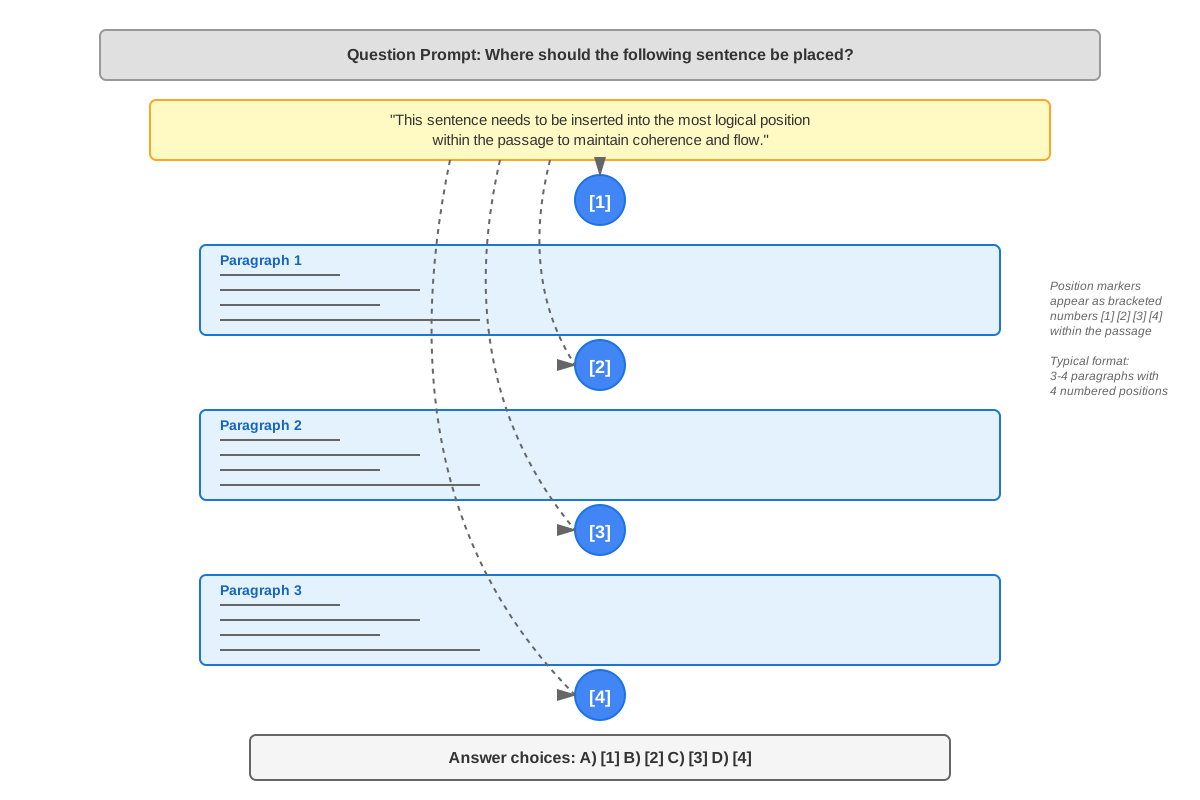
On the SAT, paragraph placement questions typically appear in passages of 100-150 words divided into numbered paragraphs. The question presents a sentence (often underlined or in a text box) and asks where it should be placed to maintain the passage's logical flow. Students must choose between four options: after specific numbered sentences or at the beginning of a particular paragraph. These questions commonly appear in informative, argumentative, and narrative passages across various subject areas including science, history, literature, and social studies.
Core Concepts
Understanding Paragraph Placement Questions
Paragraph placement questions on the SAT present a sentence that needs to be inserted into a multi-paragraph passage at the most logical location. The question format typically states: "Where should the following sentence be placed?" or "To make the passage most logical, the sentence should be placed..." followed by four answer choices indicating specific positions within the passage. Each position is identified by a numbered sentence marker (e.g., "after sentence 2" or "before sentence 5").
The fundamental skill being tested is organizational coherence—the ability to recognize how sentences connect to create unified paragraphs and how paragraphs work together to develop a complete idea. Students must evaluate multiple factors simultaneously: the content of the sentence to be placed, the context surrounding each potential position, transitional relationships, and the overall logical progression of the passage.
Key Features of Sentences in Placement Questions
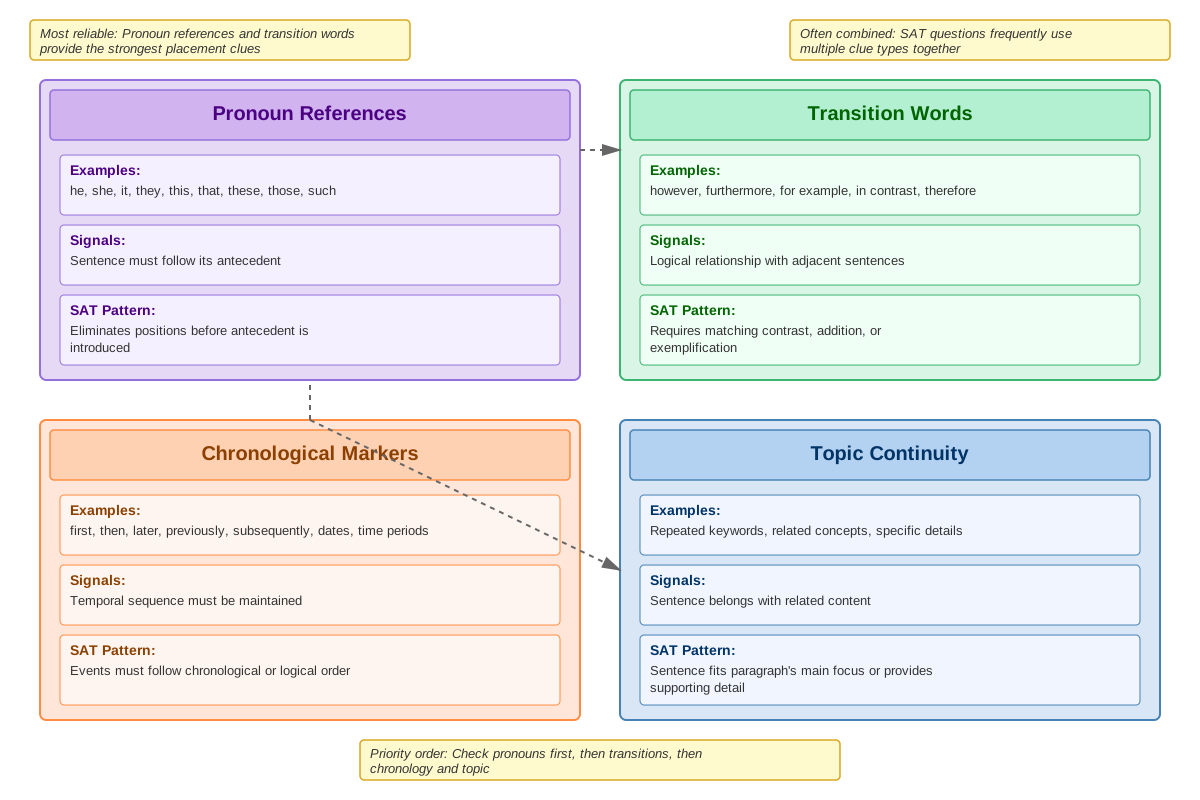
The sentence requiring placement typically contains specific features that provide clues about its proper location:
Transitional markers: Words like "however," "additionally," "for instance," or "consequently" signal the relationship between the sentence and surrounding content. A sentence beginning with "however" must follow a contrasting idea, while "for instance" must follow a general statement it exemplifies.
Pronoun references: Sentences containing pronouns (it, they, this, these) must be placed after their antecedents have been introduced. If a sentence begins with "This discovery," students must find where "the discovery" was first mentioned.
Specific details vs. general statements: Sentences providing examples or specific evidence must follow the general claims they support. Conversely, topic sentences introducing new ideas typically begin paragraphs or follow transitions between topics.
Chronological markers: Time-related phrases ("later that year," "initially," "by the end of the decade") indicate where a sentence fits in a temporal sequence.
Analyzing Paragraph Structure and Unity
Each paragraph in an SAT passage maintains paragraph unity—all sentences relate to a single main idea. When determining placement, students must identify each paragraph's focus and assess whether the sentence to be placed supports that focus or introduces a new topic requiring a different paragraph.
Topic sentences typically appear at the beginning of paragraphs and introduce the main idea. Supporting sentences provide evidence, examples, or elaboration. Concluding sentences may summarize or transition to the next paragraph. A sentence that introduces a new subtopic likely belongs at the start of a new paragraph, while a sentence providing additional evidence for an existing claim belongs within the paragraph discussing that claim.
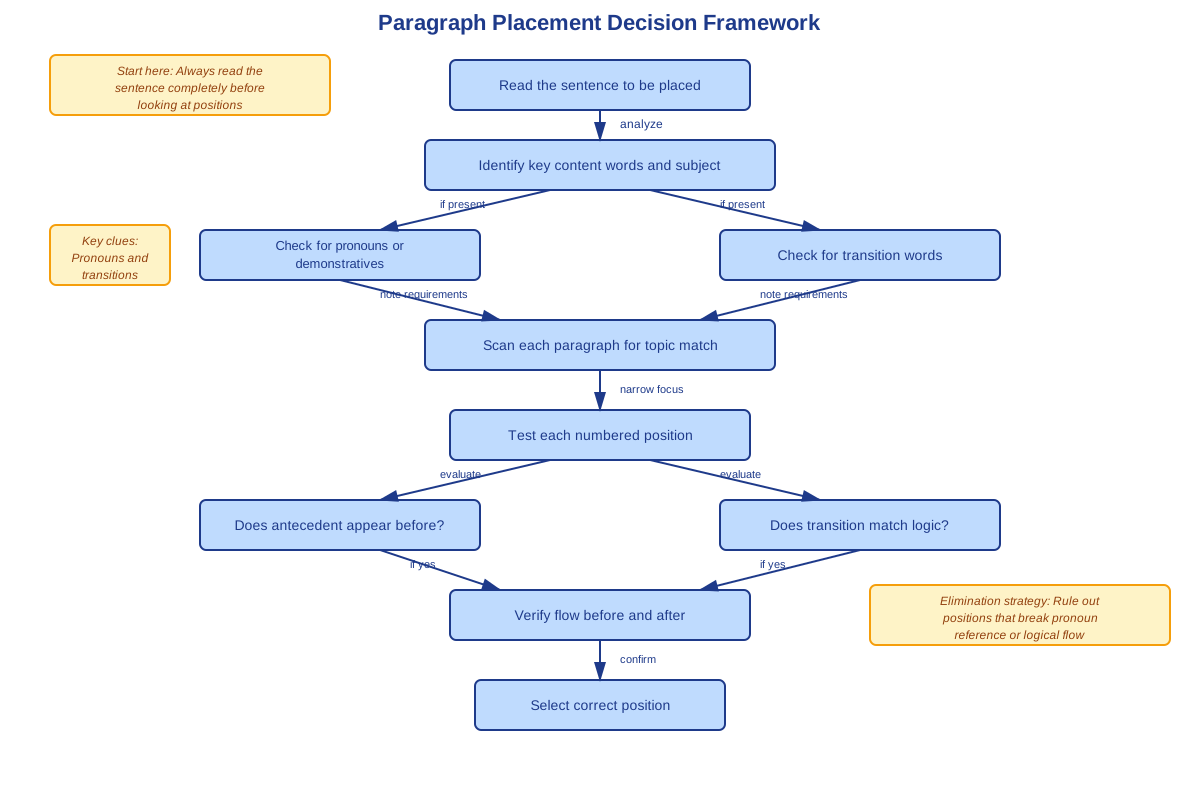
The Four-Step Placement Process
| Step | Action | Purpose |
|---|---|---|
| 1. Read the sentence | Identify key features: transitions, pronouns, specificity level, topic | Understand what the sentence does and what it needs |
| 2. Skim the passage | Note each paragraph's main idea and the flow of information | Create a mental map of the passage structure |
| 3. Test each position | Read before and after each potential placement point | Evaluate logical connections and coherence |
| 4. Verify the answer | Confirm the sentence fits smoothly and maintains flow | Ensure no better option exists |
Recognizing Logical Flow Patterns
SAT passages follow predictable organizational patterns that guide placement decisions:
Chronological order: Events or developments are presented in time sequence. Sentences must maintain this temporal progression.
General to specific: Passages often move from broad claims to specific examples. A sentence providing an example must follow the general statement it illustrates.
Problem-solution: Some passages present a problem then discuss solutions. Sentences must align with the appropriate stage of this structure.
Cause-effect: When passages explain causal relationships, sentences must respect the logical order of causes preceding effects.
Comparison-contrast: Passages comparing two subjects typically discuss them in parallel structure. Sentences about one subject belong in sections focused on that subject.
Context Clues and Transitional Relationships
The sentences immediately surrounding a potential placement point provide crucial context. Students should examine:
Semantic connections: Does the content of the sentence relate to the topic being discussed at this point in the passage?
Transitional coherence: Do transition words in the sentence or surrounding sentences create logical relationships?
Referential clarity: Are all pronouns and references clear when the sentence is placed at this position?
Tonal consistency: Does the sentence match the formality and style of the surrounding text?
Common Placement Scenarios
Beginning of a paragraph: Sentences placed here typically introduce new topics, provide transitions from previous paragraphs, or present topic sentences. Look for sentences that shift focus or introduce broad concepts.
Middle of a paragraph: Sentences placed here usually provide supporting details, examples, or elaboration on the paragraph's main idea. They should connect smoothly to both preceding and following sentences.
End of a paragraph: Sentences placed here often provide concluding details, final examples, or transitions to the next paragraph. They should feel like natural stopping points before a topic shift.
Between paragraphs: Sometimes the correct placement is at the boundary between paragraphs, where the sentence serves as a bridge connecting two related but distinct ideas.
Concept Relationships
The concepts within paragraph placement are hierarchically organized: understanding paragraph unity forms the foundation, as students must first recognize that each paragraph focuses on a single main idea. This understanding leads to recognizing topic sentences and supporting details, which helps identify whether a sentence introduces a new idea (suggesting paragraph-initial placement) or supports an existing idea (suggesting mid-paragraph placement).
Transitional markers and pronoun references work together to create logical flow—transitions signal the relationship between ideas while pronouns maintain referential continuity. Both must be satisfied for a placement to be correct. These elements connect to organizational patterns (chronological, general-to-specific, cause-effect), which provide the overarching structure within which individual sentences must fit.
The relationship map flows as follows:
Paragraph Unity → Topic Sentences & Supporting Details → Transitional Relationships → Pronoun Reference → Logical Flow → Organizational Patterns → Correct Placement
This topic connects to prerequisite knowledge of basic paragraph structure by applying those principles to multi-paragraph contexts. It extends to related topics like transition usage and passage organization, as mastering placement requires understanding how writers use transitions to guide readers and how effective organization enhances clarity. Success with paragraph placement also improves performance on main idea questions and purpose questions, as all require understanding passage structure and development.
High-Yield Facts
⭐ Paragraph placement questions typically appear 1-2 times per SAT test, making them a reliable question type to master.
⭐ Sentences containing pronouns (it, they, this, these) must be placed after their antecedents have been clearly established.
⭐ Transitional words at the beginning of a sentence (however, furthermore, for example) directly indicate the relationship the sentence must have with preceding content.
⭐ A sentence introducing a new subtopic or shifting focus typically belongs at the beginning of a new paragraph, not in the middle of an existing paragraph.
⭐ Specific examples and evidence must follow the general claims they support—never place specific details before the general statement they illustrate.
- Chronological markers (dates, time phrases) require placement that maintains temporal sequence throughout the passage.
- Topic sentences that introduce a paragraph's main idea almost always appear at the beginning of that paragraph.
- A sentence that provides additional evidence for a claim belongs in the same paragraph as that claim, not in a different paragraph.
- When testing placement options, read at least one sentence before and after each potential position to evaluate flow.
- The correct placement creates smooth transitions both into and out of the sentence being placed.
- Sentences ending with colons or phrases like "such as" or "including" must be followed by the examples or lists they introduce.
- If a sentence references "this research" or "these findings," it must follow the paragraph where the research or findings were discussed.
- Placement at the end of a paragraph is correct when the sentence provides a concluding detail or transitions to the next paragraph's topic.
- The wrong placement often creates pronoun ambiguity, illogical transitions, or disrupts the passage's organizational pattern.
- Always verify that the chosen placement maintains the passage's overall argumentative or narrative progression.
Quick check — test yourself on Paragraph placement so far.
Try Flashcards →Common Misconceptions
Misconception: A sentence can be placed anywhere within a paragraph as long as it relates to the general topic. → Correction: Sentences must fit the specific logical flow within a paragraph, not just the general topic. A sentence about a specific example must follow the general claim it exemplifies, even if both relate to the same topic.
Misconception: Transitional words like "however" or "furthermore" are just stylistic choices that don't affect placement. → Correction: Transitional words create specific logical relationships that dictate placement. "However" requires a contrasting idea to precede it, while "furthermore" requires a similar idea to build upon.
Misconception: The correct placement is always at the beginning or end of a paragraph. → Correction: While these positions are common, many correct placements occur mid-paragraph where the sentence provides supporting detail or continues a logical sequence.
Misconception: If a sentence mentions a topic discussed in a paragraph, it belongs in that paragraph. → Correction: The sentence must fit the specific point being made at a particular location within the paragraph. A paragraph might discuss multiple aspects of a topic in sequence, and the sentence must align with the specific aspect being discussed at each potential placement point.
Misconception: Pronoun references can be understood from context even if the antecedent appears several sentences earlier. → Correction: On the SAT, correct placement requires clear, immediate pronoun reference. If a sentence begins with "This approach," the antecedent "approach" should appear in the immediately preceding sentence or very nearby.
Misconception: The longest answer choice or the one that sounds most complex is usually correct. → Correction: Placement questions test logical organization, not complexity. The correct answer is the position that creates the smoothest, most logical flow, regardless of where it appears in the answer choices.
Misconception: Reading just the sentence to be placed is sufficient to determine its correct location. → Correction: Students must read the entire passage to understand the organizational structure, main ideas of each paragraph, and the specific context at each potential placement point.
Worked Examples
Example 1: Scientific Passage with Pronoun Reference
Passage:
[1] Marine biologists have long studied the communication methods of dolphins. [2] These highly intelligent mammals use a complex system of clicks, whistles, and body movements to convey information. [3] Recent research has revealed even more sophisticated behaviors. [4] Scientists now believe that dolphins may have individual "signature whistles" that function like names.
Sentence to place: This discovery has significant implications for our understanding of animal cognition.
Question: Where should the sentence be placed?
A) After sentence 1
B) After sentence 2
C) After sentence 3
D) After sentence 4
Solution Process:
Step 1: Analyze the sentence to be placed. It begins with "This discovery," indicating it must follow a sentence that describes a specific discovery. The sentence also discusses implications, suggesting it should follow the presentation of new research findings.
Step 2: Identify what "this discovery" refers to. Scanning the passage, sentence 4 presents the specific discovery about "signature whistles" functioning like names. This is the most concrete research finding in the passage.
Step 3: Test each position:
- After sentence 1: No discovery has been mentioned yet—only the general topic of dolphin communication. "This discovery" would have no clear referent.
- After sentence 2: This sentence describes known communication methods, not a new discovery.
- After sentence 3: This sentence mentions "sophisticated behaviors" but doesn't specify what they are. "This discovery" would be vague.
- After sentence 4: This sentence presents the specific discovery about signature whistles. "This discovery" clearly refers to this finding, and discussing implications logically follows presenting the discovery.
Step 4: Verify the answer. Placing the sentence after sentence 4 creates smooth flow: the passage introduces the topic, describes existing knowledge, mentions recent research, presents a specific discovery, then discusses that discovery's implications. The pronoun reference is clear and the logical progression is maintained.
Answer: D) After sentence 4
Connection to learning objectives: This example demonstrates how to identify pronoun references (learning objective 5) and apply placement strategies (learning objective 3) by recognizing that sentences discussing implications must follow the specific findings they reference.
Example 2: Historical Passage with Transitional Logic
Passage:
[1] The Industrial Revolution transformed manufacturing in the 19th century. [2] Factories replaced small workshops, and machines took over tasks previously done by hand. [3] Workers moved from rural areas to cities seeking employment. [4] Urban populations grew rapidly, creating new social challenges.
[5] City governments struggled to provide adequate housing and sanitation. [6] Overcrowding led to the spread of diseases like cholera and typhoid. [7] These conditions eventually prompted public health reforms.
Sentence to place: However, this economic progress came at a significant social cost.
Question: Where should the sentence be placed?
A) After sentence 2
B) After sentence 4
C) After sentence 5
D) After sentence 6
Solution Process:
Step 1: Analyze the sentence. It begins with "However," indicating contrast. The sentence contrasts "economic progress" with "social cost," so it must follow content describing economic benefits and precede content describing social problems.
Step 2: Map the passage structure. The first paragraph (sentences 1-4) describes industrial and economic changes. The second paragraph (sentences 5-7) describes social problems. The sentence creates a transition between these topics.
Step 3: Test each position:
- After sentence 2: This is mid-paragraph, describing economic changes. While it could contrast with sentence 2, the "social cost" hasn't been described yet, making the reference incomplete.
- After sentence 4: This ends the first paragraph, which describes economic transformation and urbanization. The next paragraph begins discussing social problems. This position allows "However" to contrast the economic progress (paragraph 1) with the social cost (paragraph 2).
- After sentence 5: This is within the paragraph about social problems. "However" would awkwardly interrupt the discussion of housing and sanitation issues.
- After sentence 6: This is deep within the social problems discussion, too late to serve as a transition from economic progress.
Step 4: Verify the answer. Placing the sentence after sentence 4 creates a clear transition: paragraph 1 establishes economic progress (factories, urbanization), the transitional sentence acknowledges this progress while introducing the contrasting idea of social cost, then paragraph 2 details those social costs (housing, sanitation, disease). The "However" effectively signals the shift in focus.
Answer: B) After sentence 4
Connection to learning objectives: This example demonstrates how to recognize transitional relationships (learning objective 5) and understand organizational patterns (learning objective 6) by identifying where a contrasting transition belongs in a passage's structure.
Exam Strategy
When approaching paragraph placement questions on the SAT, follow this systematic process to maximize accuracy and efficiency:
Initial Assessment (15-20 seconds): Read the sentence to be placed carefully, identifying key features: Does it contain pronouns? Does it begin with a transition word? Is it a general statement or specific example? Does it reference specific information? This analysis reveals what the sentence needs from its context.
Passage Mapping (30-40 seconds): Quickly read or skim the entire passage to understand its structure. Identify each paragraph's main idea and note the general flow of information. This prevents choosing a position that fits locally but disrupts the overall organization.
Position Testing (60-90 seconds): Systematically evaluate each answer choice by reading the sentence before and after each potential placement point. Ask: Does this create a logical flow? Are pronoun references clear? Do transitions make sense? Does the content fit the paragraph's focus?
Exam Tip: Always read at least one full sentence before and after each potential placement point. Reading just fragments or relying on memory often leads to errors.
Trigger words and phrases to watch for:
- Contrast transitions (however, nevertheless, on the other hand): Require preceding content that contrasts with the sentence
- Addition transitions (furthermore, additionally, moreover): Require preceding content that the sentence builds upon
- Example transitions (for instance, for example, such as): Must follow general statements they illustrate
- Result transitions (therefore, consequently, thus): Must follow causes or reasons
- Demonstrative pronouns (this, that, these, those): Require clear, nearby antecedents
- Time markers (later, initially, subsequently, eventually): Must maintain chronological sequence
- Specific references ("this discovery," "these findings," "the experiment"): Must follow where the referenced item was introduced
Process-of-elimination strategies:
- Eliminate positions that create pronoun ambiguity: If placing the sentence at a position makes "it" or "this" unclear, eliminate that option immediately.
- Eliminate positions that violate transitional logic: If the sentence begins with "however" but the preceding sentence doesn't present a contrasting idea, eliminate that position.
- Eliminate positions that disrupt paragraph unity: If placing the sentence mid-paragraph would introduce a new topic unrelated to that paragraph's focus, eliminate that option.
- Eliminate positions that violate chronological or logical sequence: If the sentence describes something that happens "later" but the position would place it before earlier events, eliminate it.
Time allocation: Paragraph placement questions should take approximately 60-90 seconds. If you're spending more than two minutes, make your best educated guess and move on. These questions are worth the same as others, so don't sacrifice time needed for multiple questions.
Final verification: Before confirming your answer, mentally read the passage with the sentence inserted at your chosen position. Does it flow naturally? Would a reader find the organization logical? If you feel any hesitation, quickly recheck the other options.
Memory Techniques
PLACE Acronym for Systematic Analysis:
- Pronouns: Check for clear antecedents
- Logical flow: Verify smooth transitions before and after
- Antecedent: Ensure references are clear and nearby
- Context: Confirm the sentence fits the paragraph's focus
- Examine: Test each position systematically
Transition Direction Mnemonic - "CARE":
- Contrast (however, nevertheless): Needs opposing idea before
- Addition (furthermore, moreover): Needs similar idea before
- Result (therefore, thus): Needs cause before
- Example (for instance): Needs general statement before
Visualization Strategy: Picture the passage as a train with connected cars. Each paragraph is a car, and sentences are passengers. A passenger (sentence) can only board a car (paragraph) where they belong based on their "ticket" (content and transitions). If a passenger tries to board the wrong car, the connection breaks and the train can't move smoothly.
Pronoun Reference Rule - "THIS Needs THAT": When a sentence begins with "this" or "these," mentally replace it with what it refers to. If you can't clearly identify what "this" means from the immediately preceding content, that placement is wrong.
General-to-Specific Funnel: Visualize information flowing from wide (general) to narrow (specific) like a funnel. General statements go at the top (beginning of paragraphs), specific examples flow down (middle of paragraphs), and conclusions or transitions appear at the bottom (end of paragraphs).
The "Before and After" Sandwich: Always read the sentence before (the bottom bun), insert the sentence to be placed (the filling), and read the sentence after (the top bun). If the sandwich doesn't hold together logically, try a different position.
Summary
Paragraph placement questions on the SAT assess the ability to recognize logical organization and maintain coherent flow in multi-paragraph passages. Success requires analyzing the sentence to be placed for key features—particularly transitional words, pronoun references, and specificity level—then systematically testing each potential position by evaluating the surrounding context. The correct placement creates smooth transitions, maintains clear pronoun references, preserves paragraph unity, and follows the passage's organizational pattern (chronological, general-to-specific, cause-effect, or comparison-contrast). Students must read the entire passage to understand its structure, identify each paragraph's main idea, and recognize how sentences connect to create logical progression. The most common errors involve placing sentences where pronoun references become ambiguous, transitional logic breaks down, or paragraph unity is disrupted. By following a systematic four-step process—analyzing the sentence, mapping the passage, testing each position, and verifying the answer—students can consistently identify correct placement and avoid common traps. Mastering this skill requires understanding that effective organization depends on both local coherence (sentence-to-sentence connections) and global structure (how paragraphs work together to develop ideas).
Key Takeaways
- Paragraph placement questions test organizational logic by requiring students to insert a sentence at the most coherent position within a multi-paragraph passage.
- Sentences containing pronouns must be placed where their antecedents are clear and immediately accessible, typically in the sentence just before.
- Transitional words (however, furthermore, for example) create specific logical relationships that dictate what content must precede the sentence.
- The correct placement maintains paragraph unity, with sentences supporting the specific focus of their paragraph rather than just relating to the general topic.
- Systematic testing of each position by reading surrounding sentences is essential—never rely on memory or partial context.
- Specific examples and evidence must follow the general claims they support, following a general-to-specific organizational pattern.
- Understanding the passage's overall structure and each paragraph's main idea prevents choosing positions that fit locally but disrupt global organization.
Related Topics
Transition Usage and Logical Connectors: Mastering paragraph placement naturally leads to deeper study of how transitional words and phrases create coherence within and between paragraphs. Understanding the full range of transitions and their specific functions enhances both placement skills and overall writing quality.
Passage Organization and Structure: This broader topic examines how entire passages are organized using various rhetorical patterns (chronological, compare-contrast, problem-solution, cause-effect). Paragraph placement skills provide the foundation for analyzing these larger organizational structures.
Main Idea and Supporting Details: Success with paragraph placement requires distinguishing between topic sentences and supporting details. Further study of how main ideas are developed through supporting evidence strengthens comprehension across all question types.
Cohesion and Coherence in Writing: This advanced topic explores how writers create unified, flowing texts through various cohesive devices including pronoun reference, repetition, parallel structure, and transitional expressions—all elements central to paragraph placement.
Rhetorical Purpose and Function: Understanding why authors place sentences in specific positions connects to analyzing the rhetorical purpose of paragraphs and passages, a skill tested in other SAT Reading and Writing questions.
Practice CTA
Now that you've mastered the core concepts of paragraph placement, it's time to apply these strategies to authentic SAT-style questions. The practice questions and flashcards will reinforce your understanding of transitional relationships, pronoun references, and organizational patterns while building the speed and confidence needed for test day. Remember: paragraph placement questions are highly learnable through systematic practice. Each question you work through strengthens your ability to recognize logical flow and organizational coherence—skills that will serve you not only on the SAT but throughout your academic career. Approach each practice question methodically, using the four-step process, and review both correct and incorrect answers to understand why each placement works or fails. You've got this!
Sign up free to keep reading
Create a free AnvayaPrep account to finish this SAT guide on Paragraph placement — plus flashcards and practice questions.