Overview
Logical predication is a fundamental grammar concept tested extensively in the SAT Reading and Writing (RW) section. At its core, logical predication concerns the relationship between a sentence's subject and its predicate—ensuring that what is stated about the subject makes logical and grammatical sense. When a sentence contains a logical predication error, the subject and predicate don't align properly, creating statements that are technically grammatically structured but logically nonsensical or misleading.
On the SAT logical predication questions, students must identify whether sentences make logical sense as written or select revisions that create proper subject-predicate relationships. These questions frequently appear in the Standard English Conventions domain and test whether students can recognize when a sentence says something unintended or illogical. For example, a sentence might accidentally claim that "The reason for the delay is because of weather" (illogical) rather than "The reason for the delay is the weather" (logical). The SAT tests this concept because clear, logical expression is essential for academic and professional communication.
Understanding logical predication connects directly to broader RW skills including sentence structure analysis, modifier placement, and parallel construction. Mastering this topic strengthens overall sentence comprehension and helps students identify subtle errors that might otherwise go unnoticed. Since logical predication errors often sound acceptable in casual speech, developing the ability to spot them requires careful attention to the precise meaning conveyed by sentence structure—a skill that benefits performance across all Reading and Writing question types.
Learning Objectives
- [ ] Identify key features of logical predication
- [ ] Explain how logical predication appears on the SAT
- [ ] Apply logical predication to answer SAT-style questions
- [ ] Distinguish between grammatically correct sentences with logical predication errors and truly correct sentences
- [ ] Recognize common patterns of logical predication errors including faulty equation structures and mismatched subjects
- [ ] Evaluate multiple answer choices to select the option that creates the most logical subject-predicate relationship
Prerequisites
- Basic sentence structure: Understanding subjects, predicates, and verbs is essential because logical predication concerns the relationship between these core sentence elements
- Clause identification: Recognizing independent and dependent clauses helps identify where logical predication errors occur, particularly in complex sentences
- Modifier function: Knowledge of how modifiers relate to the words they describe provides context for understanding when subjects are improperly described or defined
Why This Topic Matters
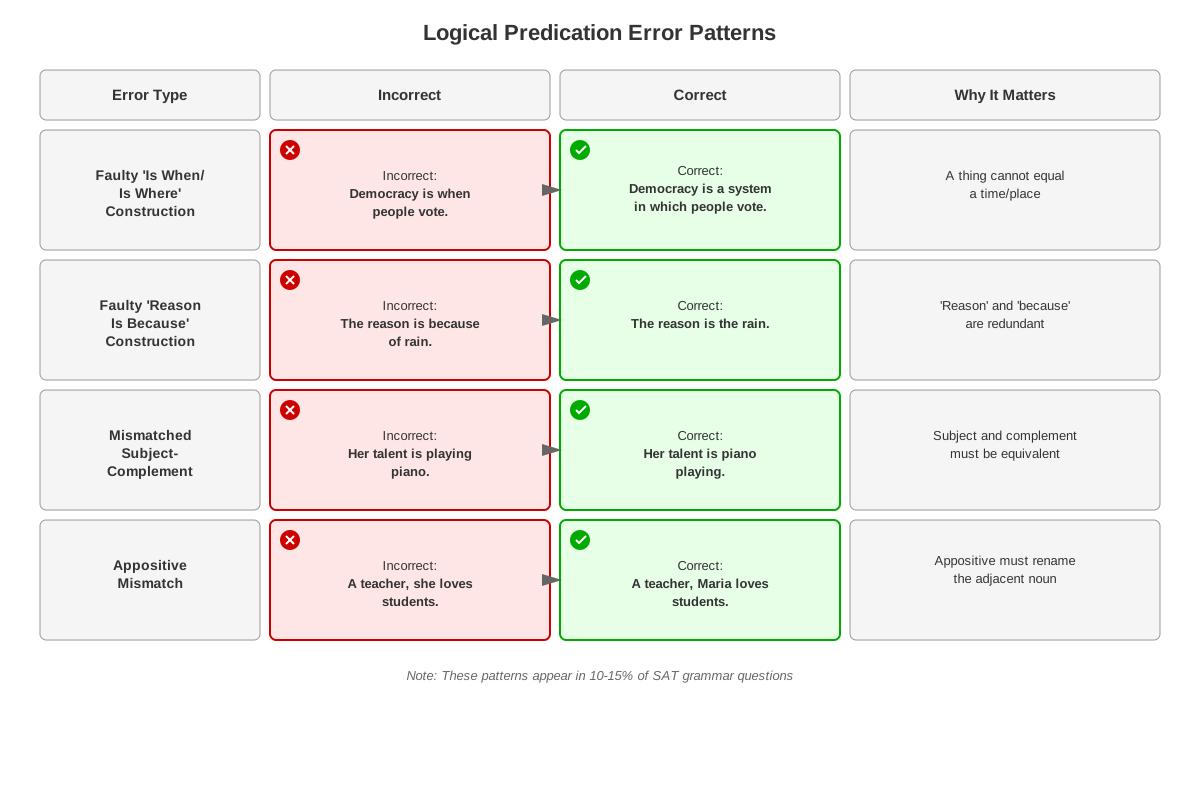
Logical predication represents one of the most frequently tested grammar concepts in the SAT Standard English Conventions questions. Approximately 10-15% of grammar questions on any given SAT test logical predication in some form, making it a high-yield topic that directly impacts scores. These questions appear across various passage types—from scientific articles to historical narratives—meaning students cannot avoid them by focusing on particular content areas.
In real-world applications, logical predication errors undermine professional and academic writing credibility. When a resume states "My experience includes being responsible for sales," it creates awkward, imprecise language compared to "My experience includes sales management." College essays, research papers, and business communications all require precise subject-predicate alignment to convey intended meanings clearly. The ability to construct logically sound sentences distinguishes competent writers from exceptional ones.
On the SAT, logical predication questions typically present a sentence with an underlined portion and ask students to select the best revision. The incorrect answer choices often sound plausible in casual speech but create logical inconsistencies when examined carefully. Common contexts include sentences using "is when," "is where," "is because," "the reason...is because" constructions, and sentences where opening modifiers don't logically connect to the subject that follows. Students who master this topic gain significant advantages because these questions reward careful analysis rather than intuition based on spoken English patterns.
Core Concepts
What Is Logical Predication?
Logical predication refers to the requirement that a sentence's subject and predicate must form a logical, sensible statement. The predicate—everything in the sentence that describes, defines, or makes a claim about the subject—must be compatible with the subject in meaning. When this relationship breaks down, the sentence commits a logical predication error, even if it follows grammatical rules for verb agreement and sentence structure.
Consider this example: "The museum is where ancient artifacts are displayed." While grammatically structured correctly, this sentence contains a logical predication error. The subject "museum" is a physical place, but the predicate "is where ancient artifacts are displayed" defines it as a location concept rather than the place itself. A logically correct version would be: "The museum displays ancient artifacts" or "The museum is a place where ancient artifacts are displayed."
The "Is When/Is Where/Is Because" Error Pattern
One of the most common logical predication errors on the SAT involves using "is when," "is where," or "is because" constructions incorrectly. These phrases create logical problems because they attempt to define a noun (the subject) using an adverbial clause (which describes time, place, or reason rather than defining what something is).
Incorrect: "Photosynthesis is when plants convert sunlight into energy."
Correct: "Photosynthesis is the process by which plants convert sunlight into energy."
In the incorrect version, "photosynthesis" (a process/noun) is being defined as "when" (a time), which is illogical. The correct version defines the noun with another noun phrase ("the process").
Incorrect: "The reason for the cancellation is because of severe weather."
Correct: "The reason for the cancellation is severe weather."
The phrase "the reason...is because" is redundant and illogical—"reason" already implies "because," so saying "is because" creates a logical mismatch. The predicate should directly state what the reason is, not use another causal connector.
Faulty Equation Structures
Logical predication errors often occur in sentences that use linking verbs (is, are, was, were, etc.) to create an equation between subject and predicate. These faulty equation structures attempt to equate things that aren't logically equivalent.
| Incorrect Structure | Why It's Wrong | Correct Alternative |
|---|---|---|
| "One example of renewable energy is solar panels harness sunlight." | "One example" (noun) ≠ "solar panels harness" (clause) | "One example of renewable energy is solar power, which harnesses sunlight." |
| "The purpose of the study is examining climate patterns." | "Purpose" (noun) ≠ "examining" (gerund phrase functioning as action) | "The purpose of the study is to examine climate patterns." |
| "Her goal was winning the championship." | While grammatically acceptable, "goal was winning" is less precise than alternatives | "Her goal was to win the championship." |
Mismatched Opening Modifiers and Subjects
Another frequent logical predication error involves introductory modifying phrases that don't logically connect to the subject that immediately follows them. The modifier describes or provides information about something, but if the sentence subject isn't the thing being modified, a logical predication error occurs.
Incorrect: "Having studied for weeks, the test was easy for Maria."
Correct: "Having studied for weeks, Maria found the test easy."
In the incorrect version, "having studied for weeks" appears to modify "the test," suggesting the test studied for weeks—clearly illogical. The correct version places "Maria" as the subject, which logically connects to the modifying phrase.
Incorrect: "To improve public health, new regulations were implemented by the city."
Correct: "To improve public health, the city implemented new regulations."
The infinitive phrase "to improve public health" should modify the entity taking action (the city), not the passive recipient (regulations).
Subject-Complement Compatibility
In sentences using linking verbs, the subject complement (the word or phrase following the linking verb that renames or describes the subject) must be logically compatible with the subject. This means nouns should be defined by noun phrases, and characteristics should be described by adjectives or compatible structures.
Incorrect: "The challenge facing researchers is how can they reduce costs."
Correct: "The challenge facing researchers is how to reduce costs" or "The challenge facing researchers is reducing costs."
The incorrect version uses a question structure ("how can they") as a complement, which doesn't logically complete the equation. The correct versions use noun phrases (infinitive or gerund) that can properly define "challenge."
Redundancy and Logical Predication
Sometimes logical predication errors involve redundancy where the subject and predicate repeat the same information in incompatible ways. These errors are particularly subtle because each part of the sentence seems reasonable in isolation.
Incorrect: "The reason why she succeeded is because she practiced daily."
Correct: "She succeeded because she practiced daily" or "The reason she succeeded is that she practiced daily."
"Reason why" and "is because" both express causation, creating redundancy and logical awkwardness. Eliminating one causal element creates a clearer, more logical sentence.
Concept Relationships
Logical predication connects intimately with several other grammar and writing concepts. Understanding sentence structure provides the foundation for identifying subjects and predicates, which is prerequisite knowledge for spotting logical predication errors. Once students can identify these core elements, they can evaluate whether the relationship between them makes logical sense.
Modifier placement relates directly to logical predication, particularly in sentences with introductory phrases. When modifiers are misplaced, they often create logical predication errors by appearing to modify the wrong sentence element. Mastering modifier placement helps prevent one major category of logical predication mistakes.
The relationship flow works as follows: Basic sentence structure → enables identification of → subjects and predicates → which allows evaluation of → logical predication → which connects to → modifier placement and parallel structure → all contributing to → clear, precise writing.
Logical predication also intersects with parallel structure because both concepts require consistency and logical alignment within sentences. While parallel structure focuses on grammatical consistency across list items or compared elements, logical predication ensures the fundamental subject-predicate relationship makes sense. Together, these concepts create the framework for constructing clear, logical sentences.
Understanding logical predication enhances performance on reading comprehension questions as well. Students who recognize logical predication errors develop sharper attention to precise meaning, helping them identify subtle distinctions in answer choices and better understand complex passages.
Quick check — test yourself on Logical predication so far.
Try Flashcards →High-Yield Facts
⭐ Logical predication errors occur when a sentence's subject and predicate don't form a logical, sensible statement, even if the grammar is technically correct.
⭐ The construction "is when" should not be used to define a noun; use "is" followed by a noun phrase instead.
⭐ The construction "is where" incorrectly defines nouns as locations; replace with proper noun definitions.
⭐ "The reason...is because" is always incorrect due to redundancy; use "the reason...is that" or eliminate "the reason" entirely.
⭐ Introductory modifying phrases must logically connect to the subject immediately following the comma.
- Linking verbs (is, are, was, were) create equations that require logically equivalent elements on both sides.
- Subject complements must be compatible with subjects in type and meaning (nouns with nouns, characteristics with adjectives).
- "Is because" constructions attempt to define nouns with causal clauses, creating logical incompatibility.
- Passive voice constructions often create logical predication errors with opening modifiers because the true actor isn't the sentence subject.
- Gerund phrases (verb + -ing) can serve as subject complements but must logically define or describe the subject.
- Questions embedded in sentences ("how can they," "what should we") cannot serve as subject complements without restructuring.
- Logical predication errors frequently sound acceptable in spoken English, making them harder to detect by ear alone.
Common Misconceptions
Misconception: If a sentence is grammatically correct with proper subject-verb agreement, it cannot have a logical predication error.
Correction: Logical predication errors can exist in sentences that follow all grammar rules. A sentence can have perfect subject-verb agreement and proper punctuation while still making an illogical statement about its subject.
Misconception: "Is when" and "is where" are always acceptable ways to define terms.
Correction: These constructions should be avoided when defining nouns because they create logical mismatches. "When" refers to time and "where" refers to place, so they cannot properly define what something is. Use noun phrases after linking verbs to define noun subjects.
Misconception: The longest or most complex answer choice is usually correct for logical predication questions.
Correction: SAT logical predication questions often reward conciseness and directness. The correct answer typically creates the clearest, most logical subject-predicate relationship, which may be simpler than incorrect alternatives that add unnecessary words or complexity.
Misconception: If an introductory phrase appears at the beginning of a sentence, it automatically modifies the entire sentence.
Correction: Introductory modifying phrases specifically modify the subject that immediately follows the comma. If that subject isn't the logical recipient of the modification, the sentence contains a logical predication error regardless of overall sentence meaning.
Misconception: "The reason is because" sounds wrong but is technically acceptable in formal writing.
Correction: This construction is never acceptable in formal writing or on the SAT. It's redundant because "reason" already implies causation, so adding "because" (another causal word) creates both logical and stylistic problems. Use "the reason is that" or restructure the sentence entirely.
Misconception: Logical predication only matters in sentences with linking verbs.
Correction: While linking verb sentences are common sites for logical predication errors, these errors can occur in any sentence where the relationship between subject and predicate is illogical, including sentences with action verbs and complex modifier structures.
Worked Examples
Example 1: Identifying and Correcting "Is When" Errors
Original Sentence: "Metamorphosis is when an organism undergoes a dramatic physical transformation during its life cycle."
Analysis Process:
- Identify the subject: "Metamorphosis" (a biological process/noun)
- Identify the linking verb: "is"
- Identify the predicate: "when an organism undergoes a dramatic physical transformation"
- Evaluate the logical relationship: The subject (a process) is being defined as "when" (a time), which is illogical
- Determine what the subject actually is: a process, not a time
- Restructure to create a logical equation: noun = noun phrase
Correct Version: "Metamorphosis is a process in which an organism undergoes a dramatic physical transformation during its life cycle."
Why This Works: The corrected version defines "metamorphosis" (noun) as "a process" (noun phrase), creating a logical equation. The clause "in which an organism undergoes..." now properly describes the process rather than attempting to define the noun as a time.
Connection to Learning Objectives: This example demonstrates how to identify the key feature of logical predication (subject-predicate compatibility), explains how this error type appears on the SAT (through "is when" constructions), and shows the application process for correcting such errors.
Example 2: Correcting Mismatched Opening Modifiers
Original Sentence: "Hoping to increase voter turnout, several new polling locations were opened by election officials."
Analysis Process:
- Identify the introductory modifier: "Hoping to increase voter turnout"
- Identify what immediately follows the comma: "several new polling locations"
- Ask: Can polling locations hope? No—locations are inanimate objects that cannot hope
- Identify the logical actor: "election officials" (they are the ones hoping)
- Restructure so the logical actor becomes the subject
Correct Version: "Hoping to increase voter turnout, election officials opened several new polling locations."
Alternative Correct Version: "To increase voter turnout, election officials opened several new polling locations."
Why This Works: The corrected versions place "election officials" immediately after the comma, making them the subject that the introductory phrase logically modifies. Officials can hope and take action, creating a logical predication. The alternative version uses an infinitive phrase that can modify either the actor or the action, providing flexibility while maintaining logical sense.
SAT Application: On the SAT, this error type frequently appears in questions about sentence structure and modifier placement. The incorrect version often uses passive voice ("were opened by") to obscure the logical actor, making the error less obvious. Students should always check that introductory modifiers connect logically to the subject following the comma.
Connection to Learning Objectives: This example shows how logical predication appears in complex sentence structures on the SAT and demonstrates the application process for identifying and correcting modifier-related logical predication errors.
Exam Strategy
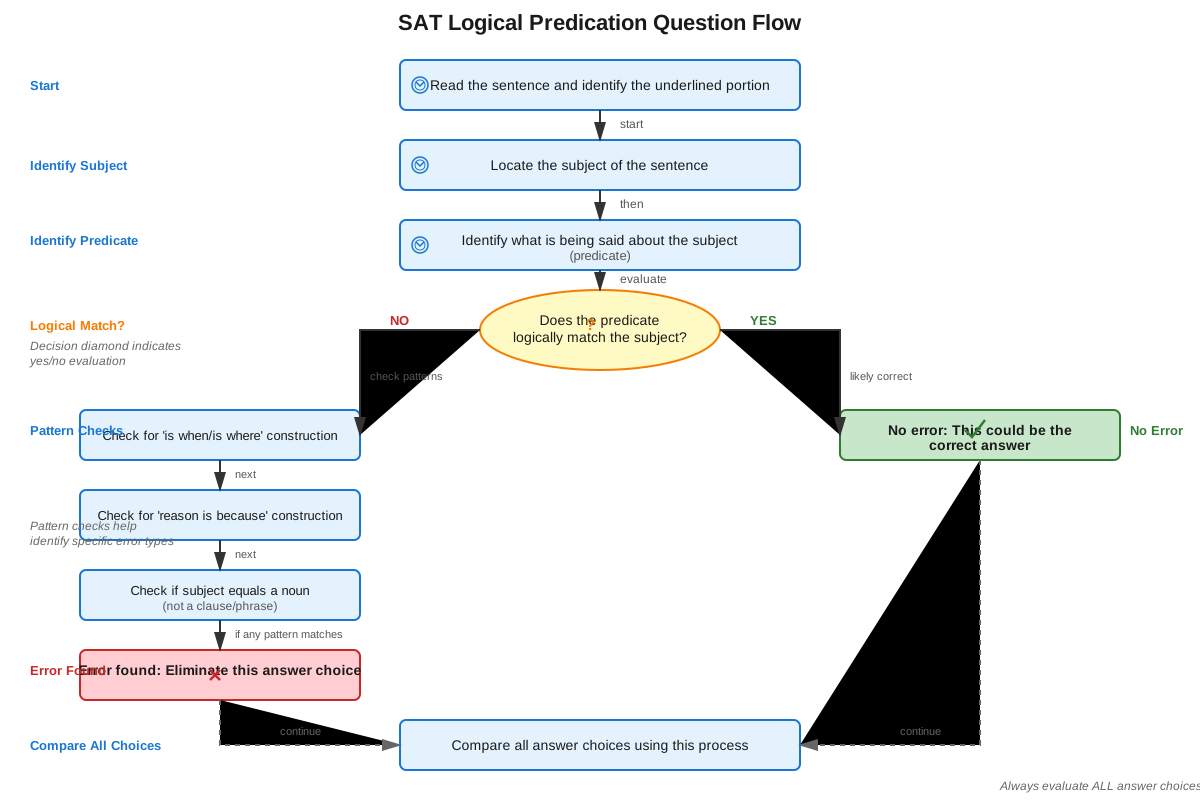
When approaching SAT logical predication questions, follow this systematic process:
Step 1: Identify the sentence structure. Locate the subject, verb, and predicate. For sentences with introductory phrases, identify what immediately follows the comma. This structural analysis takes 5-10 seconds but prevents careless errors.
Step 2: Check for trigger phrases. Scan for "is when," "is where," "is because," "the reason...is because," and similar constructions. These phrases signal potential logical predication errors approximately 80% of the time they appear in SAT questions.
Step 3: Ask the logical question. For linking verb sentences, ask: "Does this equation make sense?" For modifier sentences, ask: "Can the subject logically perform or receive the action described in the modifier?" If the answer is no, eliminate that option.
Step 4: Evaluate answer choices systematically. Don't just look for what sounds right—analyze what each choice actually says about the subject. Read the sentence with each option plugged in, focusing on the literal meaning created.
Exam Tip: When stuck between two answers, identify the subject and ask what each answer choice claims about that subject. The choice that makes the most direct, logical claim is usually correct.
Trigger words and phrases to watch for:
- "is when" / "is where" / "is because"
- "the reason...is because"
- Introductory phrases ending with commas (especially participial phrases starting with -ing verbs)
- Linking verbs (is, are, was, were, become, seem) followed by clauses
- Passive voice constructions with opening modifiers
Process of elimination tips:
- Eliminate any choice using "is when" or "is where" to define a noun (unless the noun actually is a time or place)
- Eliminate "the reason...is because" constructions immediately
- Eliminate choices where opening modifiers don't logically connect to the subject
- Eliminate choices that create noun = clause equations when noun = noun phrase is available
Time allocation: Spend 30-45 seconds on logical predication questions. These questions reward careful analysis but don't require extensive deliberation. If you've applied the systematic process and still feel uncertain, make your best choice and move on—spending extra time rarely changes answers on these questions.
Memory Techniques
The "WHEN-WHERE-BECAUSE" Elimination Rule: Remember the acronym WWB (World Wide Ban). On the SAT, there's a "world wide ban" on using "is when," "is where," and "is because" to define nouns. If you see WWB constructions, eliminate them immediately unless the noun actually is a time, place, or reason.
The "Comma Subject Connection" Check: For sentences with introductory modifiers, use the CSC technique: After the Comma, the Subject must Connect logically to the opening phrase. Visualize a bridge connecting the modifier to the subject—if the bridge doesn't make logical sense, the sentence is wrong.
The "Reason-Because Redundancy" Reminder: Think of "reason" and "because" as twins that can't appear together. Just as twins are separate people, these words express the same concept and must be separated. Use one or the other, never both.
The "Noun = Noun" Equation Rule: For linking verb sentences, remember N = N (Noun equals Noun). After "is," "are," "was," or "were," you need a noun phrase to define a noun subject, not a clause or question. Visualize an equals sign that requires matching types on both sides.
The "Actor-Action Alignment" Visualization: For modifier questions, visualize the actor performing the action described in the opening phrase. If you can't picture the sentence subject doing that action, the sentence is wrong. This mental image makes illogical constructions immediately obvious.
Summary
Logical predication is a critical SAT grammar concept that tests whether sentences create logical, sensible relationships between subjects and predicates. The most common errors involve "is when," "is where," and "is because" constructions that attempt to define nouns using adverbial clauses; "the reason...is because" redundancies; and mismatched opening modifiers that don't logically connect to the subjects following them. Success on these questions requires moving beyond what "sounds right" to analyze what sentences actually claim about their subjects. Students must identify sentence structure, recognize trigger phrases, evaluate subject-predicate compatibility, and select answer choices that create the most direct, logical relationships. Mastering logical predication improves performance on 10-15% of SAT grammar questions and strengthens overall writing clarity. The key is systematic analysis: identify the subject, examine what the predicate claims about it, and verify that the relationship makes logical sense.
Key Takeaways
- Logical predication requires that subjects and predicates form logically sensible statements, not just grammatically correct ones
- "Is when," "is where," and "is because" constructions are almost always incorrect when defining nouns on the SAT
- "The reason...is because" is redundant and should be replaced with "the reason...is that" or restructured entirely
- Introductory modifying phrases must logically connect to the subject immediately following the comma
- Linking verbs create equations requiring compatible elements: nouns should be defined by noun phrases, not clauses or questions
- Logical predication errors often sound acceptable in casual speech, requiring careful analysis rather than relying on intuition
- Systematic evaluation of subject-predicate relationships is more reliable than choosing answers that "sound right"
Related Topics
Modifier Placement and Dangling Modifiers: Understanding how modifiers function and where they should be placed builds directly on logical predication concepts, particularly for sentences with introductory phrases. Mastering logical predication provides the foundation for recognizing all types of modifier errors.
Parallel Structure: This topic extends logical predication principles to lists and comparisons, requiring that compared or listed elements maintain logical and grammatical consistency. Students who understand logical predication find parallel structure concepts more intuitive.
Subject-Verb Agreement: While distinct from logical predication, subject-verb agreement shares the requirement for careful subject identification. Strong logical predication skills enhance the ability to identify true subjects in complex sentences.
Sentence Structure and Clause Types: Advanced understanding of independent and dependent clauses, along with various sentence structures, enables more sophisticated analysis of logical predication in complex sentences.
Concision and Redundancy: Logical predication connects to broader writing clarity concepts, including eliminating wordiness and redundancy. Many logical predication errors involve redundant constructions that can be streamlined.
Practice CTA
Now that you've mastered the core concepts of logical predication, it's time to apply your knowledge! Work through the practice questions to test your ability to identify and correct logical predication errors under timed conditions. The flashcards will help reinforce trigger phrases and common error patterns, building the automatic recognition skills that lead to quick, confident answers on test day. Remember: logical predication questions reward systematic analysis and attention to precise meaning—skills that improve with focused practice. Each question you work through strengthens your ability to spot these errors instantly, giving you a significant advantage on the SAT Reading and Writing section.
Sign up free to keep reading
Create a free AnvayaPrep account to finish this SAT guide on Logical predication — plus flashcards and practice questions.