Overview
Possessive nouns are a fundamental element of English grammar that indicate ownership, origin, or close association between nouns. On the SAT Reading and Writing section, possessive noun questions test a student's ability to correctly form and punctuate possessives using apostrophes—a skill that appears frequently in the Standard English Conventions domain. These questions assess whether students can distinguish between singular possessives (the student's book), plural possessives (the students' books), and irregular plural possessives (the children's toys), as well as recognize when possessive pronouns (which never use apostrophes) are appropriate instead.
Mastery of sat possessive nouns is essential because apostrophe errors are among the most commonly tested punctuation issues on the exam. The SAT specifically targets students' understanding of when to add an apostrophe before or after the "s," when to use an apostrophe with singular nouns ending in "s," and how to avoid confusing possessives with contractions or plural forms. These questions typically appear in the context of authentic passages where students must identify and correct errors or choose the grammatically correct option among several alternatives.
Within the broader rw (Reading and Writing) section, possessive noun questions connect directly to other punctuation and grammar concepts, including apostrophe use in contractions, subject-verb agreement, and pronoun-antecedent relationships. Understanding possessives strengthens overall command of Standard English Conventions and contributes to the precision and clarity required for effective written communication—skills the SAT values highly across all question types in the Form, Structure, and Sense unit.
Learning Objectives
- [ ] Identify key features of possessive nouns, including singular, plural, and irregular forms
- [ ] Explain how possessive nouns appears on the SAT, including question formats and common error patterns
- [ ] Apply possessive nouns to answer SAT-style questions with accuracy and efficiency
- [ ] Distinguish between possessive nouns, possessive pronouns, contractions, and simple plurals
- [ ] Construct correct possessive forms for nouns ending in "s," "x," "z," and other challenging letters
- [ ] Recognize and correct common apostrophe errors in authentic passage contexts
Prerequisites
- Basic noun identification: Understanding what constitutes a noun (person, place, thing, or idea) is essential because possessives can only be formed from nouns, not other parts of speech
- Plural noun formation: Knowing how to form regular and irregular plurals is necessary because possessive formation depends on whether the noun is singular or plural
- Apostrophe fundamentals: Basic familiarity with apostrophe usage helps distinguish between possessive functions and contraction functions
- Subject-verb relationships: Understanding how nouns function in sentences aids in determining which noun should take possessive form when multiple nouns appear together
Why This Topic Matters
Possessive nouns represent one of the highest-yield grammar topics for SAT preparation. According to College Board data, apostrophe usage questions—predominantly testing possessive nouns—appear on virtually every SAT administration, typically comprising 2-4 questions per test. These questions offer students an excellent opportunity to secure quick, reliable points because possessive noun rules follow consistent, learnable patterns with minimal exceptions.
In real-world contexts, correct possessive formation is crucial for professional and academic writing. Misplaced or missing apostrophes can create confusion about meaning (compare "the teachers lounge" versus "the teacher's lounge" versus "the teachers' lounge"), undermine credibility, and suggest carelessness. Universities and employers consistently cite apostrophe errors as among the most noticeable and damaging grammar mistakes in written communication.
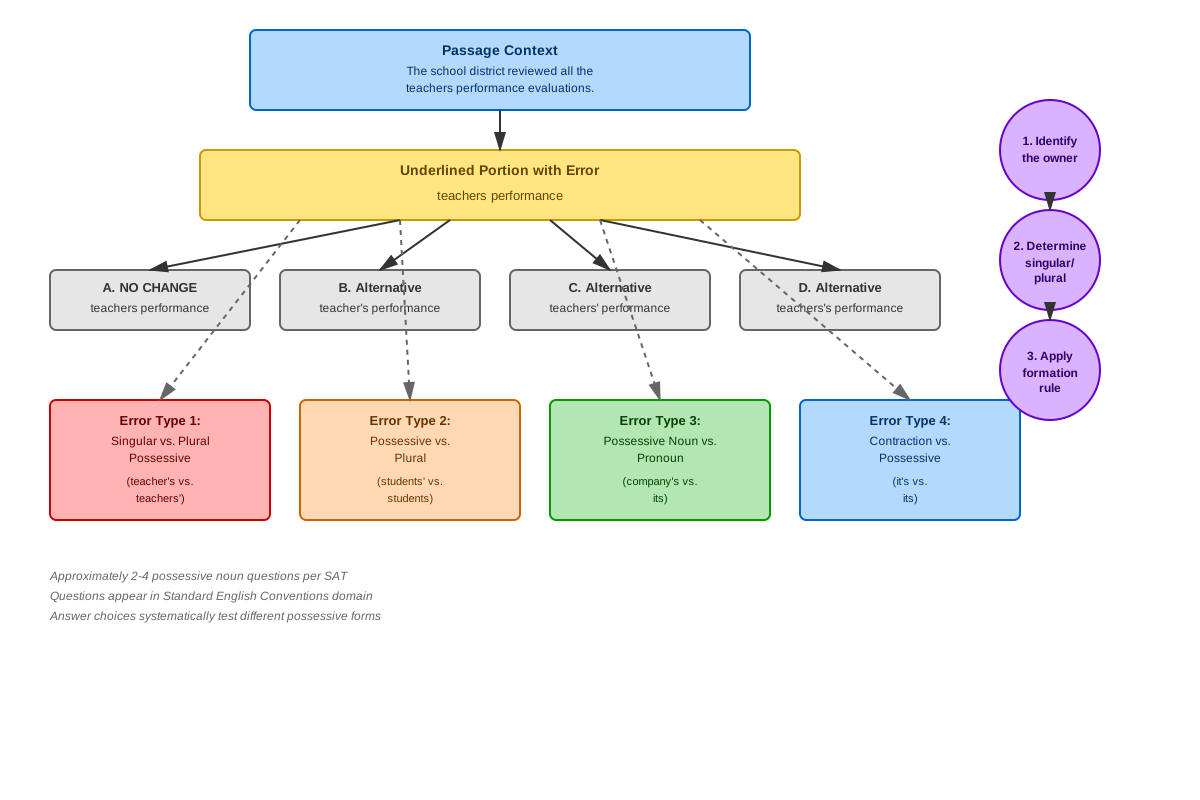
On the SAT, possessive noun questions most commonly appear in two formats: error identification questions where students must spot incorrect apostrophe placement, and revision questions where students choose the correctly punctuated version from four options. These questions typically embed possessive nouns within authentic passages about science, history, literature, or social studies, requiring students to apply grammatical knowledge while processing content. The passages often include multiple nouns in close proximity, compound possessives, or nouns ending in "s," deliberately creating opportunities for common errors that test-makers know students frequently make.
Core Concepts
Singular Possessive Nouns
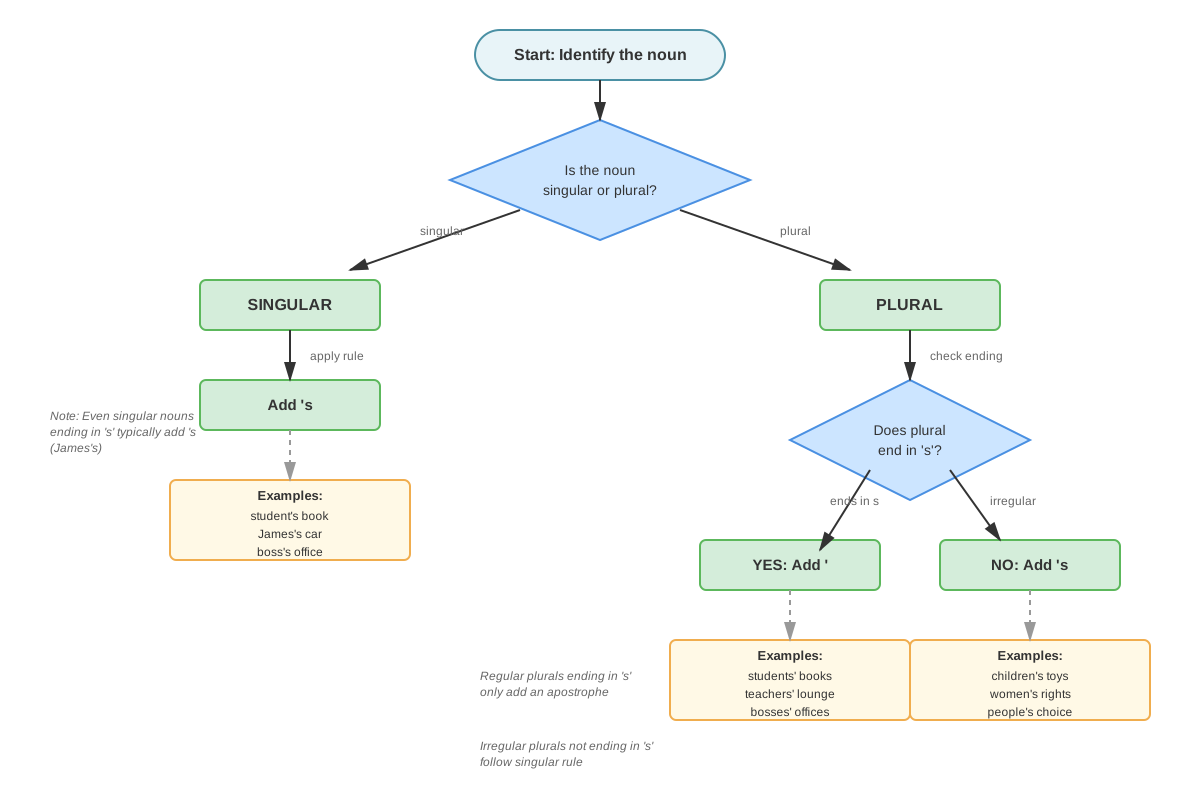
A singular possessive noun shows that one person, place, thing, or idea owns or is associated with something else. To form a singular possessive, add an apostrophe and the letter "s" ('s) to the end of the singular noun, regardless of what letter the noun ends with.
Formation rule: Singular noun + 's = Singular possessive
Examples:
- The dog's collar (one dog owns the collar)
- Maria's laptop (Maria owns the laptop)
- The company's policy (the company has a policy)
- James's presentation (James owns/gave the presentation)
Note that even when a singular noun ends in "s," "x," or "z," the standard rule applies: add 's. While some style guides permit adding only an apostrophe after singular nouns ending in "s" (James' presentation), the SAT consistently follows the rule of adding 's to all singular nouns, making this the safer choice on the exam.
Plural Possessive Nouns
A plural possessive noun indicates that multiple people, places, things, or ideas collectively own or are associated with something. The formation depends on how the plural noun is spelled.
For regular plurals ending in "s": Add only an apostrophe after the "s"
Examples:
- The students' textbooks (multiple students own textbooks)
- The teachers' meeting (a meeting for multiple teachers)
- The cars' engines (engines belonging to multiple cars)
For irregular plurals not ending in "s": Add 's just like singular possessives
Examples:
- The children's playground (multiple children use the playground)
- The women's conference (a conference for multiple women)
- The mice's nest (a nest belonging to multiple mice)
Distinguishing Possessives from Plurals and Contractions
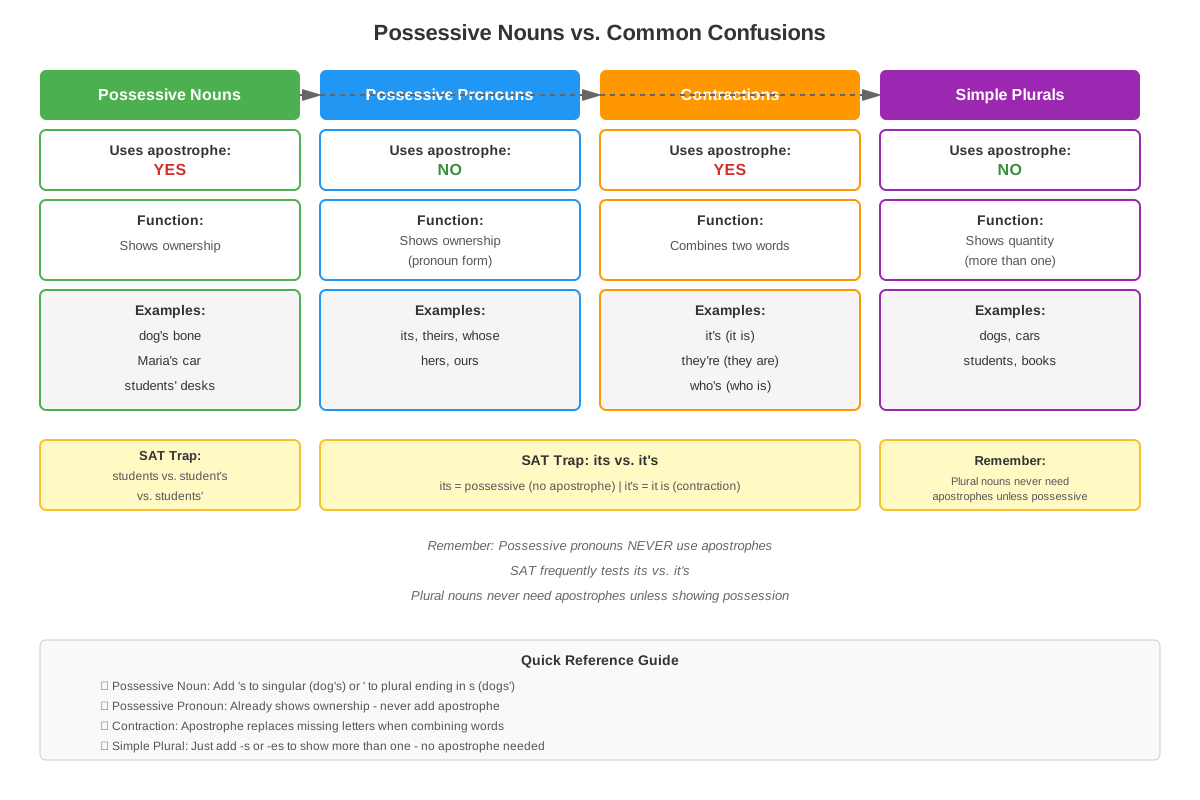
One of the most critical skills for SAT success is distinguishing between three similar-looking forms:
| Form | Function | Example | Apostrophe? |
|---|---|---|---|
| Simple plural | Shows quantity (more than one) | The students are here | No |
| Possessive | Shows ownership | The student's book | Yes |
| Contraction | Combines two words | The student's (student is) late | Yes |
The SAT frequently tests whether students can identify when a noun should be possessive versus when it should be a simple plural. Key diagnostic: Ask "Does something belong to this noun?" If yes, use possessive. If the noun simply indicates multiple items with no ownership, use simple plural with no apostrophe.
Possessive Pronouns vs. Possessive Nouns
Possessive pronouns (its, whose, their, your, her, his, our) never use apostrophes because they are already possessive in form. This creates a common confusion point:
- Its (possessive pronoun) vs. it's (contraction for "it is")
- Whose (possessive pronoun) vs. who's (contraction for "who is")
- Their (possessive pronoun) vs. they're (contraction for "they are")
- Your (possessive pronoun) vs. you're (contraction for "you are")
The SAT regularly tests these distinctions, particularly "its/it's" and "whose/who's," often in contexts where both options might seem plausible at first glance.
Compound Possessives and Joint Ownership
When two or more nouns share ownership of the same item, only the last noun takes the possessive form:
- John and Mary's house (they jointly own one house)
- The director and producer's vision (they share one vision)
When two or more nouns each own separate items, both nouns take possessive form:
- John's and Mary's cars (each owns a separate car)
- The director's and producer's offices (each has a separate office)
Time and Measurement Possessives
Expressions of time, value, and measurement often require possessive forms even when ownership isn't literal:
- A day's work
- Two weeks' notice
- A dollar's worth
- Three years' experience
These constructions follow the same singular/plural possessive rules: singular time periods use 's, while plural time periods use s'.
Concept Relationships
The core concepts of possessive nouns build upon each other in a logical hierarchy. Singular possessive formation serves as the foundation, establishing the basic apostrophe-s pattern that applies universally to all singular nouns. This concept directly leads to plural possessive formation, which requires first understanding whether the plural is regular (ending in "s") or irregular (not ending in "s"), then applying the appropriate possessive rule.
Both singular and plural possessive concepts connect to the critical skill of distinguishing possessives from plurals and contractions. This distinction requires students to analyze the grammatical function of the noun in context—a skill that also applies when differentiating possessive pronouns from possessive nouns. The pronoun distinction is particularly important because it prevents students from incorrectly adding apostrophes to words like "its" or "whose."
Compound possessives represent an advanced application that synthesizes understanding of both basic possessive formation and the semantic relationship between multiple nouns (joint versus separate ownership). Similarly, time and measurement possessives extend the basic possessive concept to abstract or non-literal ownership contexts.
Relationship map:
Basic noun identification → Singular possessive formation → Plural possessive formation → Distinguishing possessives/plurals/contractions → Possessive pronouns vs. nouns → Compound possessives and special cases
These possessive noun concepts also connect to prerequisite knowledge of plural formation (determining whether to add 's or s') and to related SAT topics including subject-verb agreement (possessive nouns can be subjects), pronoun-antecedent agreement (possessive pronouns must match their antecedents), and overall punctuation conventions (apostrophes serve multiple functions).
High-Yield Facts
⭐ To form a singular possessive, always add 's to the singular noun, even if it already ends in "s" (James's, boss's, class's)
⭐ To form a plural possessive for regular plurals ending in "s," add only an apostrophe after the "s" (students', teachers', cars')
⭐ To form a plural possessive for irregular plurals not ending in "s," add 's just like singular possessives (children's, women's, people's)
⭐ Possessive pronouns (its, whose, their, your, her, his, our) never use apostrophes
⭐ The contraction "it's" always means "it is" or "it has," never shows possession
- Simple plural nouns showing quantity never use apostrophes (books, students, cars)
- The contraction "who's" means "who is" or "who has," while "whose" shows possession
- For joint ownership, only the last noun takes possessive form (John and Mary's house)
- For separate ownership, all nouns take possessive form (John's and Mary's cars)
- Time expressions often require possessive forms (a day's work, two weeks' notice)
- The word "whose" can refer to both people and things (the book whose cover is torn)
- Inanimate objects can take possessive forms (the car's engine, the building's foundation)
- Company and organization names follow the same possessive rules as other nouns (Microsoft's products, the university's policy)
Quick check — test yourself on Possessive nouns so far.
Try Flashcards →Common Misconceptions
Misconception: All plural nouns need apostrophes because they end in "s"
Correction: Simple plurals showing quantity never use apostrophes. Only use apostrophes when showing possession or forming contractions. "The students are here" (plural, no apostrophe) versus "The students' books" (possessive, needs apostrophe).
Misconception: "Its" with an apostrophe (it's) is the possessive form of "it"
Correction: "Its" without an apostrophe is the possessive pronoun. "It's" with an apostrophe is always a contraction meaning "it is" or "it has." The dog wagged its tail (possessive, no apostrophe). It's raining today (contraction for "it is").
Misconception: Singular nouns ending in "s" should only get an apostrophe, not 's
Correction: The SAT follows the rule that all singular nouns, regardless of their ending letter, take 's to form possessives. Write "James's book," "the boss's office," and "the class's average," not "James' book" or "boss' office."
Misconception: Possessive nouns can only show literal ownership of physical objects
Correction: Possessive forms indicate various relationships including origin (Shakespeare's plays), association (the city's mayor), description (a day's work), or attribution (the theory's implications), not just physical ownership.
Misconception: When two people own something together, both names need 's
Correction: For joint ownership of the same item, only the last noun takes possessive form: "John and Mary's house" (one house they share). Use possessive form on both nouns only when they own separate items: "John's and Mary's cars" (each has their own car).
Misconception: The word "whose" can only refer to people, not things
Correction: "Whose" can serve as a possessive relative pronoun for both people and inanimate objects. Both "the student whose paper won" and "the building whose roof collapsed" are grammatically correct, though "of which" constructions are sometimes preferred for things in formal writing.
Worked Examples
Example 1: Singular vs. Plural Possessive
Question: The research team discovered that the ___ migration patterns had changed significantly over the past decade.
A) bird's
B) birds
C) birds'
D) bird
Step 1: Identify what owns or possesses something
The sentence discusses migration patterns that belong to birds. This indicates we need a possessive form, not a simple noun. This eliminates choices B and D.
Step 2: Determine if the owner is singular or plural
The phrase "migration patterns" (plural) and the context "over the past decade" suggest we're discussing multiple birds, not just one bird. The research would logically study patterns across many birds.
Step 3: Apply the correct possessive rule
Since we need a plural possessive and "birds" is a regular plural ending in "s," we add only an apostrophe after the "s": birds'
Answer: C) birds'
Connection to learning objectives: This example demonstrates identifying key features of possessive nouns (plural possessive formation) and applying possessive noun rules to answer SAT-style questions by distinguishing between singular possessive (bird's), simple plural (birds), and plural possessive (birds').
Example 2: Possessive Pronoun vs. Contraction
Question: The committee announced ___ decision to postpone the vote until more data could be collected.
A) it's
B) its
C) its'
D) it is
Step 1: Determine the grammatical function needed
The sentence needs a word that shows the decision belongs to the committee. We need a possessive form, not a contraction or verb phrase. This eliminates choice D.
Step 2: Recall the its/it's rule
"Its" (no apostrophe) is the possessive pronoun meaning "belonging to it." "It's" (with apostrophe) is always a contraction for "it is" or "it has." Since we need possession, not a contraction, we need "its."
Step 3: Eliminate impossible forms
Choice C (its') is not a valid form in English. Possessive pronouns never use apostrophes, and this construction incorrectly combines the possessive pronoun with an apostrophe.
Step 4: Test the answer
Substituting "its" gives us "The committee announced its decision," which correctly shows the decision belongs to the committee. If we tried "it's," we'd get "The committee announced it is decision," which is grammatically incorrect.
Answer: B) its
Connection to learning objectives: This example demonstrates explaining how possessive nouns appears on the SAT (testing the its/it's distinction) and applying the rule that possessive pronouns never use apostrophes, while also identifying the key feature that distinguishes possessive pronouns from contractions.
Exam Strategy
When approaching sat possessive nouns questions, follow this systematic process:
Step 1: Identify the relationship
Determine whether the sentence requires showing ownership, association, or origin. Ask: "Does something belong to or relate to this noun?" If no possessive relationship exists, the answer likely uses a simple plural or different construction.
Step 2: Count the owners
Decide whether one entity or multiple entities own the item. Look for context clues like "each," "both," "all," or plural verbs that indicate quantity. This determines whether you need singular or plural possessive.
Step 3: Check the noun ending
For plural possessives, identify whether the plural form ends in "s" (regular) or not (irregular). Regular plurals take only an apostrophe (students'), while irregular plurals take 's (children's).
Step 4: Watch for possessive pronouns
If the answer choices include words like "its," "whose," "their," "your," or "her," remember these never use apostrophes. Eliminate any choices that add apostrophes to these pronouns.
Trigger words and phrases to watch for:
- "Belonging to" or "of the" constructions that signal possessive relationships
- Time expressions (day, week, month, year) that often require possessive forms
- Multiple nouns in sequence that might indicate compound possessives
- Pronouns that could be confused with contractions (its/it's, whose/who's, their/they're)
Process-of-elimination tips:
- Immediately eliminate any choice that adds an apostrophe to a possessive pronoun
- Eliminate simple plurals when the context clearly requires showing possession
- Eliminate contractions when the sentence needs a possessive, not a verb phrase
- For singular nouns ending in "s," eliminate choices with only an apostrophe (the SAT prefers 's)
Time allocation:
Possessive noun questions should take 20-30 seconds once you've mastered the rules. If you find yourself spending more than 45 seconds, mark the question and return to it after completing easier questions. These questions reward quick pattern recognition rather than extended analysis.
Exam Tip: When in doubt between a possessive and a plural, try substituting "of the" or "belonging to." If the substitution works logically, you need a possessive form.
Memory Techniques
Apostrophe Placement Mnemonic: "S-A-P" (Singular-Apostrophe-Plural)
- Singular possessives: add 's (the cat's toy)
- Apostrophe only: for regular plural possessives ending in s (the cats' toys)
- Plural irregulars: treat like singular, add 's (the children's toys)
Its/It's Memory Device: "It's = It is (both have two words)"
When you see "it's," mentally replace it with "it is." If the sentence still makes sense, "it's" is correct. If not, use "its."
Whose/Who's Distinction: "Who's = Who is (both ask questions)"
"Who's" always means "who is" or "who has." If you can't substitute "who is," use "whose."
Plural Possessive Visualization: Picture the "S-Apostrophe Sandwich"
For regular plural possessives, the apostrophe sits between the plural "s" and the possessed item: students ['] books. The apostrophe is "sandwiched" after the plural marker.
Time Possessive Acronym: "TIME" = Time Intervals Must Express possession
Any expression of time duration (a day, two weeks, three years) requires possessive form when followed by a noun.
Joint Ownership Rule: "Last One Wins"
When multiple people share ownership, only the last person's name gets the possessive marker: John and Mary's house. Visualize the last person "winning" the apostrophe.
Summary
Possessive nouns are a high-yield SAT grammar topic that tests students' ability to correctly form and punctuate possessives using apostrophes. The fundamental rules are systematic: singular possessives always add 's regardless of the noun's ending letter; regular plural possessives ending in "s" add only an apostrophe; and irregular plural possessives not ending in "s" add 's like singular forms. Critical to SAT success is distinguishing possessive nouns from simple plurals (which never use apostrophes), contractions (which use apostrophes but serve different functions), and possessive pronouns (which are inherently possessive and never take apostrophes). The most commonly tested distinctions involve its/it's, whose/who's, and determining whether a noun should be singular possessive, plural possessive, or simple plural based on context. Students must also recognize special cases including compound possessives for joint versus separate ownership and time/measurement expressions that require possessive forms. Mastering these patterns enables students to quickly and accurately answer possessive noun questions, which appear on virtually every SAT administration and offer reliable opportunities to earn points through consistent rule application.
Key Takeaways
- Singular possessives always add 's to the singular noun, even when the noun ends in "s" (James's, boss's)
- Regular plural possessives ending in "s" add only an apostrophe after the "s" (students', teachers')
- Irregular plural possessives not ending in "s" add 's just like singular possessives (children's, women's)
- Possessive pronouns (its, whose, their, your) never use apostrophes; "it's" and "who's" are contractions, not possessives
- Simple plurals showing quantity never use apostrophes; only use apostrophes for possession or contractions
- For joint ownership, only the last noun takes possessive form; for separate ownership, all nouns take possessive form
- Time and measurement expressions often require possessive forms (a day's work, two weeks' notice)
Related Topics
Apostrophe Use in Contractions: Understanding how apostrophes form contractions (don't, can't, it's, who's) helps distinguish contractions from possessives and prevents confusion between similar-looking forms. Mastering possessive nouns provides the foundation for recognizing when apostrophes show possession versus when they indicate omitted letters.
Subject-Verb Agreement: Possessive nouns can function as subjects in sentences, requiring correct verb agreement. Understanding possessive formation helps identify the true subject when possessive constructions appear in complex sentences.
Pronoun-Antecedent Agreement: Possessive pronouns must agree with their antecedents in number and gender. Mastering possessive nouns strengthens the ability to select appropriate possessive pronouns and ensure they match the nouns they replace.
Comma Usage and Restrictive/Non-restrictive Clauses: Possessive forms often appear in clauses that require careful comma placement. Understanding possessives helps parse sentence structure when determining whether clauses are essential or non-essential.
Parallel Structure: Lists or series containing possessive forms must maintain consistent possessive construction throughout. Mastering possessive formation enables recognition of parallelism errors in complex sentences.
Practice CTA
Now that you've mastered the core concepts of possessive nouns, it's time to reinforce your learning through active practice. Complete the practice questions to test your ability to identify correct possessive forms in SAT-style contexts, and use the flashcards to drill the key rules until they become automatic. Remember: possessive noun questions offer some of the most reliable points on the SAT because the rules are consistent and learnable. With focused practice, you can achieve near-perfect accuracy on these questions and boost your overall Reading and Writing score. Every practice question you complete strengthens your pattern recognition and builds the confidence you need for test day success!
Sign up free to keep reading
Create a free AnvayaPrep account to finish this SAT guide on Possessive nouns — plus flashcards and practice questions.