Overview
Prepositional phrase traps represent one of the most frequently tested grammar concepts in the SAT Reading and Writing section. These traps occur when prepositional phrases are strategically placed between a subject and its verb, creating confusion about subject-verb agreement, pronoun reference, or sentence structure. The SAT deliberately uses these constructions to test whether students can identify the true grammatical relationships in a sentence by mentally "crossing out" or ignoring intervening prepositional phrases.
Understanding prepositional phrase traps is essential for success on the SAT because they appear in approximately 15-20% of all grammar questions in the RW (Reading and Writing) section. The College Board uses these constructions to assess whether students can parse complex sentence structures and identify core grammatical elements. Students who fall for these traps often select answers based on the nearest noun rather than the actual subject, leading to incorrect subject-verb agreement or pronoun choices.
This topic connects directly to broader concepts in Form, Structure, and Sense, including subject-verb agreement, pronoun-antecedent agreement, and sentence structure analysis. Mastering sat prepositional phrase traps provides students with a systematic approach to handling complex sentences, which is crucial not only for grammar questions but also for comprehending dense passages in the reading portion of the exam. The ability to identify and mentally eliminate prepositional phrases serves as a foundational skill that supports accurate analysis of sentence meaning and grammatical correctness.
Learning Objectives
- [ ] Identify key features of prepositional phrase traps
- [ ] Explain how prepositional phrase traps appears on the SAT
- [ ] Apply prepositional phrase traps to answer SAT-style questions
- [ ] Recognize common prepositional phrases that create subject-verb agreement errors
- [ ] Distinguish between the subject of a sentence and objects of prepositions
- [ ] Eliminate prepositional phrases mentally to reveal core sentence structure
- [ ] Identify pronoun-antecedent errors caused by intervening prepositional phrases
Prerequisites
- Basic parts of speech: Understanding nouns, verbs, pronouns, and prepositions is essential for identifying which words function as subjects versus objects in prepositional phrases
- Subject-verb agreement fundamentals: Students must know that singular subjects take singular verbs and plural subjects take plural verbs to recognize when prepositional phrases create agreement errors
- Common prepositions: Familiarity with words like "of," "in," "on," "with," "for," "to," "from," "by," and "about" helps students quickly identify prepositional phrases
- Sentence structure basics: Understanding the core components of a sentence (subject, verb, object) enables students to distinguish essential elements from modifying phrases
Why This Topic Matters
Prepositional phrase traps matter because they represent a high-yield, predictable question type that appears consistently across all SAT administrations. According to College Board data, questions involving prepositional phrases and subject-verb agreement constitute roughly 15-20% of the Standard English Conventions questions in the Reading and Writing section. This frequency makes mastering this concept one of the most efficient ways to improve scores.
In real-world applications, the ability to identify core sentence structure despite intervening phrases is crucial for clear professional and academic writing. Legal documents, scientific papers, and business communications often contain complex sentences with multiple prepositional phrases, and misunderstanding these structures can lead to significant misinterpretations.
On the SAT, prepositional phrase traps most commonly appear in three question formats: subject-verb agreement questions where the verb must match a subject separated by prepositional phrases; pronoun-antecedent agreement questions where the correct pronoun must match a noun that isn't the nearest one; and sentence structure questions where students must identify the main clause despite multiple modifying phrases. These questions typically present four answer choices with different verb forms or pronouns, testing whether students can correctly identify the grammatical relationship despite the intervening phrases.
Core Concepts
What Are Prepositional Phrases?
A prepositional phrase consists of a preposition followed by its object (a noun or pronoun) and any modifiers of that object. Common prepositions include: of, in, on, at, to, for, with, by, from, about, between, among, through, during, and without. For example, in the phrase "of the students," "of" is the preposition and "students" is the object of the preposition.
Prepositional phrases function as modifiers in sentences, providing additional information about location, time, direction, or relationships. Critically, the object of a preposition can never be the subject of a sentence. This fundamental rule is what creates the "trap" on the SAT—test writers place prepositional phrases between subjects and verbs to tempt students into making the object of the preposition agree with the verb instead of the actual subject.
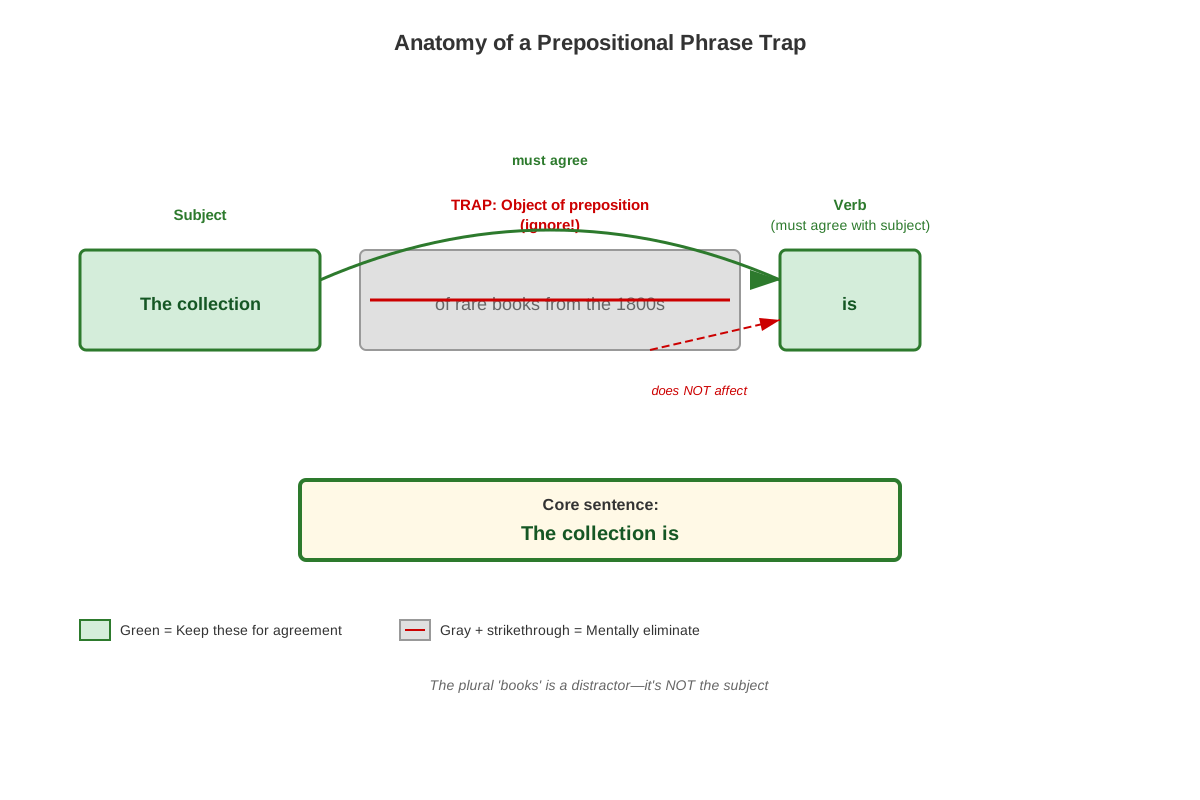
The Anatomy of a Prepositional Phrase Trap
The typical structure of a prepositional phrase trap follows this pattern:
Subject + Prepositional Phrase(s) + Verb
Example: "The collection of rare stamps is valuable."
In this sentence:
- Subject: "collection" (singular)
- Prepositional phrase: "of rare stamps"
- Verb: "is" (singular, correctly agreeing with "collection")
The trap occurs because "stamps" (plural) appears immediately before the verb, tempting students to choose "are" instead of "is." However, "stamps" is merely the object of the preposition "of" and cannot serve as the subject.
Multiple Prepositional Phrases
The SAT frequently uses multiple consecutive prepositional phrases to increase difficulty and obscure the subject-verb relationship:
Example: "The director of the department of environmental sciences oversees all research projects."
Breaking this down:
- Subject: "director" (singular)
- First prepositional phrase: "of the department"
- Second prepositional phrase: "of environmental sciences"
- Verb: "oversees" (singular)
Students must mentally eliminate both prepositional phrases to see that "director" is the singular subject requiring a singular verb.
Subject-Verb Agreement with Prepositional Phrase Traps
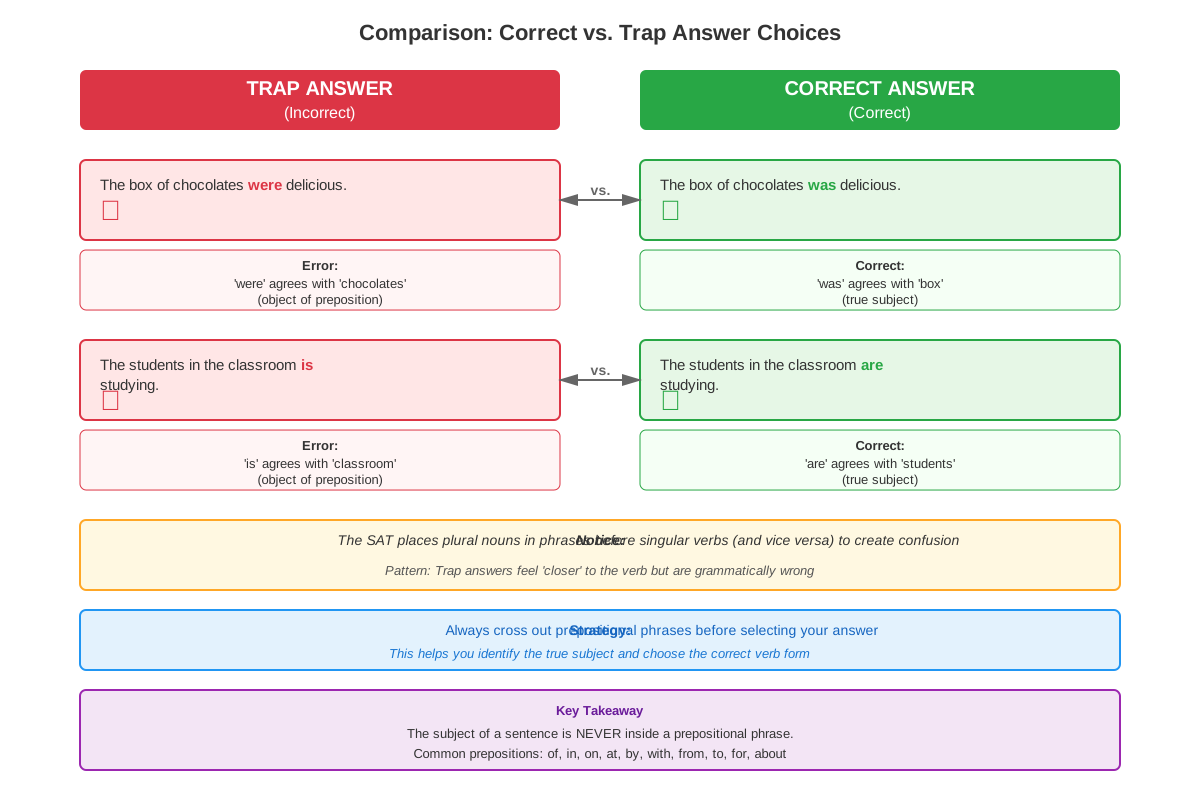
| Sentence Structure | Correct Verb | Incorrect Verb | Explanation |
|---|---|---|---|
| The box of chocolates is on the table | is (singular) | are | "Box" is singular subject |
| The students in the classroom are studying | are (plural) | is | "Students" is plural subject |
| One of the teachers has retired | has (singular) | have | "One" is singular subject |
| The effects of pollution are severe | are (plural) | is | "Effects" is plural subject |
The key strategy is to identify the subject by asking "Who or what is performing the action?" and then temporarily removing all prepositional phrases to check agreement.
Pronoun-Antecedent Agreement Traps
Prepositional phrases also create traps in pronoun-antecedent agreement questions:
Example: "Each of the scientists presented his or her findings."
- Antecedent: "Each" (singular)
- Prepositional phrase: "of the scientists"
- Pronoun: "his or her" (singular, correctly agreeing with "Each")
Students might incorrectly choose "their" because "scientists" (plural) appears closer to the pronoun, but "scientists" is the object of the preposition and cannot be the antecedent.
Compound Subjects with Prepositional Phrases
When compound subjects are involved, prepositional phrases can create additional complexity:
Example: "The manager, along with her assistants, is attending the conference."
Here, "along with her assistants" is a prepositional phrase, not part of a compound subject. The subject remains "manager" (singular), so the verb must be singular. If the sentence used "and" instead ("The manager and her assistants"), it would create a compound subject requiring a plural verb.
Inverted Sentence Structures
Prepositional phrases can appear before the subject in inverted sentences, creating another type of trap:
Example: "In the corner of the room stands a tall bookshelf."
- Prepositional phrases: "In the corner" and "of the room"
- Subject: "bookshelf" (singular)
- Verb: "stands" (singular)
Students must identify that the sentence is inverted and locate the true subject after the verb.
Concept Relationships
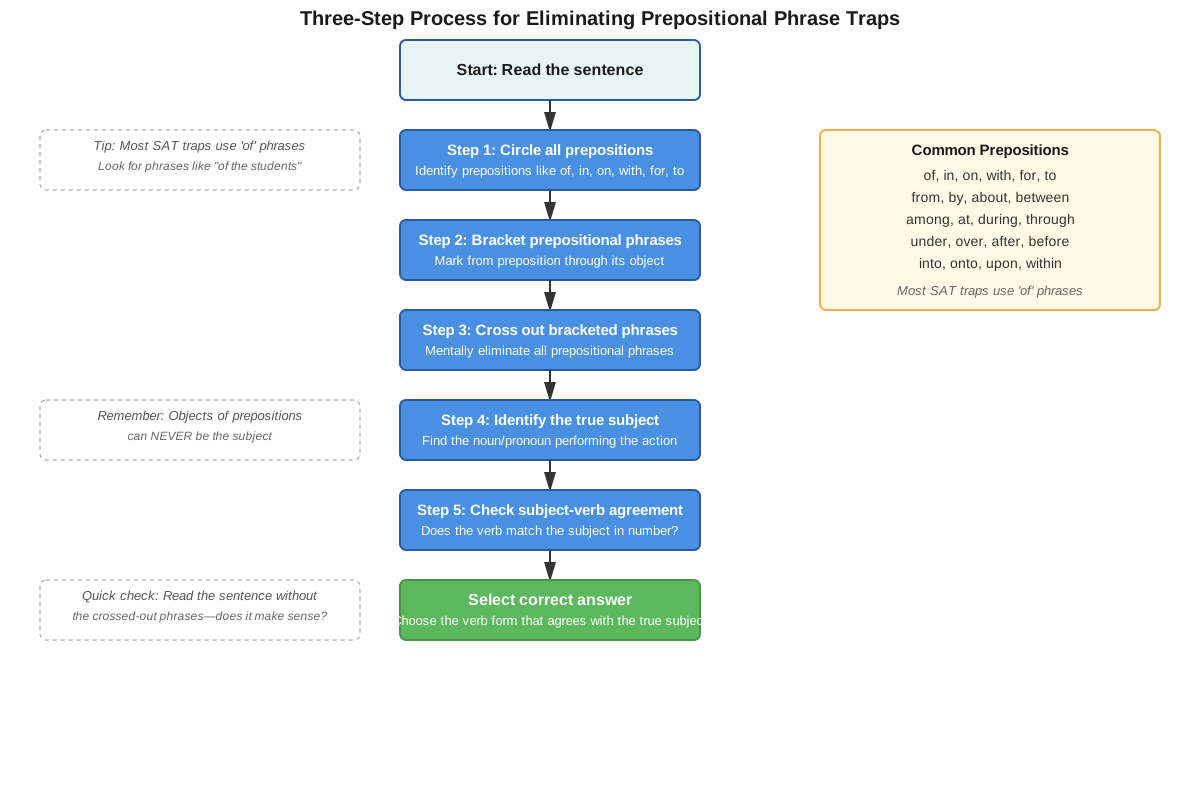
Prepositional phrase traps connect directly to subject-verb agreement as the primary grammatical rule being tested. The ability to identify prepositional phrases enables students to isolate the true subject, which then determines the correct verb form. This relationship flows as: Identify prepositional phrases → Eliminate them mentally → Locate true subject → Select verb that agrees with subject.
The concept also relates to pronoun-antecedent agreement through the same mechanism: prepositional phrases obscure the true antecedent, requiring students to look beyond the nearest noun. The relationship map is: Identify prepositional phrases → Eliminate them mentally → Locate true antecedent → Select pronoun that agrees with antecedent.
Additionally, prepositional phrase traps connect to sentence structure analysis and modification. Understanding that prepositional phrases function as modifiers (adjectives or adverbs) rather than core sentence elements helps students distinguish between essential and non-essential information. This skill supports comprehension of complex sentences throughout the Reading and Writing section.
Finally, mastering prepositional phrase traps builds toward more advanced concepts like parallel structure and modification errors, where prepositional phrases must be properly placed and structured to maintain clarity and grammatical correctness.
Quick check — test yourself on Prepositional phrase traps so far.
Try Flashcards →High-Yield Facts
⭐ The object of a preposition can never be the subject of a sentence—this is the fundamental rule that creates all prepositional phrase traps.
⭐ Common trap pattern: Singular subject + prepositional phrase with plural object + verb choice (the correct answer uses a singular verb).
⭐ Mental elimination strategy: Physically or mentally cross out prepositional phrases to reveal the core subject-verb relationship.
⭐ "Of" is the most common preposition used in SAT prepositional phrase traps, appearing in phrases like "one of the," "each of the," and "collection of."
⭐ Indefinite pronouns (each, every, one, everyone, someone, anyone, nobody) are always singular, even when followed by prepositional phrases with plural objects.
- Phrases beginning with "along with," "together with," "as well as," and "in addition to" are prepositional phrases, not conjunctions creating compound subjects.
- Multiple consecutive prepositional phrases increase difficulty but don't change the fundamental strategy of elimination.
- Inverted sentences place prepositional phrases before the subject, requiring students to locate the subject after the verb.
- Pronoun-antecedent traps using prepositional phrases follow the same elimination strategy as subject-verb agreement traps.
- Compound prepositions (such as "in addition to," "on behalf of," "in spite of") function the same way as single-word prepositions.
- The SAT typically places 1-3 prepositional phrases between subject and verb in trap questions.
- Collective nouns (team, group, committee) followed by prepositional phrases create frequent traps because students must determine whether the collective acts as one unit (singular) or as individuals (plural).
Common Misconceptions
Misconception: The noun closest to the verb should determine verb agreement.
Correction: The subject of the sentence, which may be separated from the verb by one or more prepositional phrases, always determines verb agreement. Proximity is irrelevant.
Misconception: Phrases like "along with" and "as well as" create compound subjects requiring plural verbs.
Correction: These phrases are prepositional, not conjunctions. Only "and" creates a true compound subject. "The teacher, along with her students, is attending" uses a singular verb because "teacher" alone is the subject.
Misconception: If there's a plural noun anywhere before the verb, the verb should be plural.
Correction: Only the grammatical subject determines verb form. Plural nouns within prepositional phrases are irrelevant to subject-verb agreement.
Misconception: Long sentences with multiple phrases always have plural subjects.
Correction: Sentence length and complexity don't determine subject number. A sentence with five prepositional phrases can still have a singular subject requiring a singular verb.
Misconception: Collective nouns are always singular or always plural.
Correction: Collective nouns can be either singular or plural depending on context, but this determination is independent of any prepositional phrases that follow them. The phrase "of the members" doesn't make "committee" plural.
Misconception: In inverted sentences, the first noun is always the subject.
Correction: Inverted sentences place the subject after the verb. Prepositional phrases at the beginning of inverted sentences are particularly tricky because students must skip past them and the verb to find the true subject.
Worked Examples
Example 1: Subject-Verb Agreement with Multiple Prepositional Phrases
Question: Which choice completes the sentence with correct subject-verb agreement?
"The collection of ancient artifacts from various regions of the Mediterranean _____ currently on display at the museum."
A) are
B) were
C) is
D) have been
Solution:
Step 1: Identify all prepositional phrases and mentally eliminate them.
- "of ancient artifacts" (prepositional phrase)
- "from various regions" (prepositional phrase)
- "of the Mediterranean" (prepositional phrase)
- "at the museum" (prepositional phrase)
Step 2: Identify the core sentence structure.
After eliminating prepositional phrases: "The collection _____ currently on display."
Step 3: Determine the subject and its number.
Subject: "collection" (singular noun)
Step 4: Select the verb that agrees with the singular subject.
The verb must be singular and present tense (indicated by "currently").
Step 5: Evaluate answer choices.
- A) "are" - plural, incorrect
- B) "were" - plural and past tense, incorrect
- C) "is" - singular and present tense, correct
- D) "have been" - plural, incorrect
Answer: C
Connection to learning objectives: This example demonstrates how to identify prepositional phrases (multiple instances), eliminate them to reveal the true subject, and apply subject-verb agreement rules despite intervening phrases.
Example 2: Pronoun-Antecedent Agreement with Prepositional Phrase Trap
Question: Which choice provides the pronoun that agrees with its antecedent?
"Each of the research participants in the longitudinal study completed _____ survey independently."
A) their
B) his or her
C) its
D) our
Solution:
Step 1: Identify the prepositional phrases.
- "of the research participants" (prepositional phrase)
- "in the longitudinal study" (prepositional phrase)
Step 2: Locate the antecedent by eliminating prepositional phrases.
After elimination: "Each completed _____ survey independently."
Step 3: Identify the antecedent and determine its number.
Antecedent: "Each" (singular indefinite pronoun)
Step 4: Recognize the trap.
The trap is "participants" (plural), which appears close to the pronoun but is merely the object of the preposition "of."
Step 5: Select the pronoun that agrees with the singular antecedent.
- A) "their" - plural, incorrect (this is the trap answer)
- B) "his or her" - singular, correct
- C) "its" - singular but used for things, not people, incorrect
- D) "our" - first person plural, incorrect
Answer: B
Connection to learning objectives: This example shows how prepositional phrase traps apply to pronoun-antecedent agreement, requiring the same elimination strategy to identify the correct antecedent and select an agreeing pronoun.
Exam Strategy
When approaching SAT questions involving prepositional phrase traps, follow this systematic process:
Step 1: Scan for prepositions. Quickly identify common prepositions (of, in, on, with, for, to, from, by, about) that signal prepositional phrases. This takes 2-3 seconds and immediately alerts you to potential traps.
Step 2: Use the bracket method. Mentally or physically (if using scratch paper) place brackets around each prepositional phrase: "The director [of the department] [of environmental sciences] oversees all projects." This visual separation helps isolate the core sentence.
Step 3: Read the simplified sentence. After bracketing prepositional phrases, read only the remaining words: "The director oversees all projects." This reveals the true subject-verb relationship.
Step 4: Identify the subject's number. Determine whether the subject is singular or plural, paying special attention to indefinite pronouns (each, every, one, everyone, someone) which are always singular.
Step 5: Eliminate trap answers first. On the SAT, wrong answers typically make the verb or pronoun agree with the object of a preposition rather than the true subject. Eliminate these immediately.
Exam Tip: If you see answer choices with both singular and plural verb forms, immediately look for prepositional phrases between the subject and verb. This pattern appears in approximately 80% of prepositional phrase trap questions.
Trigger words and phrases to watch for:
- "One of the..." (always singular subject)
- "Each of the..." (always singular subject)
- "Along with," "together with," "as well as" (prepositional, not compound subject)
- "The [singular noun] of [plural noun]" (classic trap pattern)
Process-of-elimination tips:
- Eliminate any answer that makes the verb agree with the nearest noun if that noun is in a prepositional phrase
- Eliminate plural verbs when the subject is an indefinite pronoun (each, every, one, etc.)
- Eliminate answers that change the intended meaning of the sentence, not just the grammar
Time allocation: Prepositional phrase questions should take 20-30 seconds once you've mastered the elimination strategy. Spending more than 45 seconds suggests you're not systematically eliminating phrases. Practice the bracket method until it becomes automatic.
Memory Techniques
The "OF" Mnemonic: Objects Fool—Objects of prepositions fool you into wrong agreement. When you see "of," remember that what follows cannot be the subject.
The Bracket Habit: Visualize placing brackets around prepositional phrases. Practice this physical motion (even just moving your finger) until it becomes automatic when you see prepositions.
The "Cross-Out" Visualization: Imagine a red line crossing out each prepositional phrase. This visual technique helps your brain ignore the intervening words and focus on the core sentence structure.
The Subject-Finder Question: Always ask "Who or what is doing the action?" This question forces you to identify the true subject rather than being distracted by nearby nouns.
The PREP Acronym:
- Preposition signals a phrase
- Remove it mentally
- Examine the core sentence
- Pick the verb that agrees
The "Each-One-Every" Rule: Remember that words beginning with "E" (each, every, everyone) are singular. Visualize a single person when you see these words, even if they're followed by "of the [plural noun]."
The "Along-With" Trick: Phrases with "along" or "with" are NOT creating compound subjects. Visualize these phrases in parentheses: "The teacher (along with students) is..."
Summary
Prepositional phrase traps represent a high-yield, predictable SAT question type that tests students' ability to identify core sentence structure despite intervening modifying phrases. The fundamental principle is that objects of prepositions can never serve as sentence subjects, yet the SAT strategically places prepositional phrases between subjects and verbs to create confusion about agreement. Mastering this concept requires students to systematically identify prepositional phrases (typically beginning with common prepositions like "of," "in," "with," and "for"), mentally eliminate them, and then determine the correct verb form or pronoun based on the true subject or antecedent. The most common trap pattern involves a singular subject followed by a prepositional phrase containing a plural object, tempting students to select a plural verb. Success on these questions depends on automatic recognition of prepositional phrases and disciplined application of the elimination strategy, which typically takes 20-30 seconds per question once mastered.
Key Takeaways
- Objects of prepositions can never be sentence subjects—this rule creates all prepositional phrase traps on the SAT
- The systematic elimination strategy (identify, bracket, eliminate, check agreement) works for both subject-verb and pronoun-antecedent questions
- "Of" is the most common preposition in SAT traps, especially in patterns like "one of the," "each of the," and "collection of"
- Indefinite pronouns (each, every, one, everyone, someone) are always singular, regardless of prepositional phrases that follow
- Phrases like "along with" and "as well as" are prepositional, not conjunctions—they don't create compound subjects
- Multiple consecutive prepositional phrases increase difficulty but don't change the fundamental elimination strategy
- Practicing the bracket method until it becomes automatic is the most efficient way to improve accuracy and speed on these questions
Related Topics
Subject-Verb Agreement Fundamentals: Understanding basic agreement rules provides the foundation for recognizing when prepositional phrases create traps. Mastering prepositional phrase traps builds directly on these fundamentals.
Pronoun-Antecedent Agreement: The same elimination strategy used for prepositional phrase traps applies to pronoun questions, making this a natural progression in grammar mastery.
Modification and Misplaced Modifiers: Prepositional phrases function as modifiers, so understanding their role connects to broader concepts about how modifying phrases should be placed and structured.
Compound Subjects and Parallel Structure: Distinguishing between true compound subjects (joined by "and") and subjects followed by prepositional phrases prepares students for more complex parallel structure questions.
Inverted Sentence Structure: Advanced prepositional phrase questions often involve inverted sentences where phrases appear before the subject, requiring more sophisticated analysis skills.
Practice CTA
Now that you understand prepositional phrase traps, it's time to cement your mastery through practice. Complete the practice questions to test your ability to identify prepositional phrases, eliminate them systematically, and select correct verbs and pronouns. Use the flashcards to drill common trap patterns until recognition becomes automatic. Remember: this is one of the most predictable question types on the SAT, which means consistent practice translates directly into points on test day. Every prepositional phrase trap you master is a question you'll answer correctly and confidently when it matters most.
Sign up free to keep reading
Create a free AnvayaPrep account to finish this SAT guide on Prepositional phrase traps — plus flashcards and practice questions.