Overview
Tense sequence is a fundamental grammatical concept that governs how verbs in different clauses of a sentence relate to one another in time. On the SAT Reading and Writing section, questions testing sat tense sequence require students to identify and correct errors in the logical flow of time between actions, events, or states of being. These questions assess whether students can recognize when verb tenses within a sentence or across sentences create confusion, contradiction, or illogical temporal relationships.
Understanding tense sequence is essential for the SAT because it appears frequently in the rw (Reading and Writing) section, particularly in questions that ask students to choose the most appropriate verb form to maintain consistency and clarity. The College Board tests this concept because proper tense sequence is crucial for clear academic and professional writing. When tense sequence breaks down, readers struggle to understand when events occurred relative to one another, which undermines the effectiveness of communication.
This topic connects directly to broader concepts in the Form, Structure, and Sense unit, including sentence structure, clause relationships, and logical coherence. Mastering tense sequence enables students to recognize not just isolated grammatical errors, but also how different parts of a sentence work together to create meaning. This skill extends beyond the SAT to college-level writing, where maintaining consistent and logical verb tenses across complex sentences and paragraphs is essential for academic success.
Learning Objectives
- [ ] Identify key features of tense sequence
- [ ] Explain how tense sequence appears on the SAT
- [ ] Apply tense sequence to answer SAT-style questions
- [ ] Distinguish between appropriate and inappropriate tense shifts in complex sentences
- [ ] Recognize temporal relationships between main clauses and subordinate clauses
- [ ] Evaluate whether verb tenses accurately reflect the logical sequence of events in a passage
Prerequisites
- Basic verb tenses: Understanding simple past, present, future, and perfect tenses is necessary because tense sequence involves coordinating these forms across clauses
- Clause structure: Recognizing independent and dependent clauses matters because tense sequence rules differ based on clause relationships
- Sentence boundaries: Identifying where sentences begin and end helps determine whether tense consistency is required or whether shifts are appropriate
Why This Topic Matters
In real-world writing, proper tense sequence ensures that readers can follow the chronology of events without confusion. Academic papers, professional reports, and narrative writing all depend on writers maintaining logical temporal relationships. When a writer shifts tenses inappropriately, readers must work harder to reconstruct the intended timeline, which disrupts comprehension and weakens the writing's impact.
On the SAT, tense sequence questions appear with high frequency—typically 2-4 questions per test in the Reading and Writing section. These questions usually present a sentence or short passage with an underlined verb, asking students to select the verb form that best maintains logical consistency with the surrounding context. The College Board reports that approximately 15-20% of Standard English Conventions questions involve verb tense, making this one of the most heavily tested grammar concepts.
Tense sequence questions commonly appear in passages discussing historical events, scientific processes, biographical information, or narratives. The SAT often tests whether students can recognize when a past event should be expressed in past perfect (to show it occurred before another past event), when present tense is appropriate for general truths or ongoing situations, and when future tense correctly expresses intentions or predictions. These questions may also test whether students understand that certain time markers (like "since," "before," "after," "while") require specific tense relationships.
Core Concepts
Understanding Tense Sequence Fundamentals
Tense sequence refers to the grammatical principle that verb tenses within a sentence or passage must logically reflect the temporal relationships between actions, events, or states. The core principle is straightforward: when multiple verbs appear in a sentence, their tenses should work together to create a coherent timeline that readers can easily follow.
The foundation of tense sequence rests on understanding that not all verbs in a sentence must be in the same tense. Instead, tense shifts are often necessary and correct when they accurately represent the actual sequence of events. The key question is always: "What is the logical time relationship between these actions?"
Main Clause and Subordinate Clause Relationships
The relationship between main clauses and subordinate clauses creates the most common tense sequence scenarios on the SAT. When a sentence contains both types of clauses, the verb tenses must reflect the temporal relationship between the actions they describe.
Same-time actions: When two actions occur simultaneously, the verbs typically share the same tense:
- "While she studies for the exam, her brother watches television." (both present)
- "While she studied for the exam, her brother watched television." (both past)
Sequential actions in the past: When one past action occurred before another past action, the earlier action uses past perfect, while the later action uses simple past:
- "By the time the rescue team arrived, the hikers had already found shelter."
- The finding of shelter (past perfect "had found") preceded the arrival (simple past "arrived")
Past actions with present relevance: When discussing a past action that continues to affect the present, present perfect is appropriate:
- "Scientists have discovered evidence that supports the theory." (The discovery happened in the past but remains relevant now)
Time Markers and Their Tense Requirements
Certain words and phrases signal specific temporal relationships and require corresponding verb tenses:
| Time Marker | Typical Tense Relationship | Example |
|---|---|---|
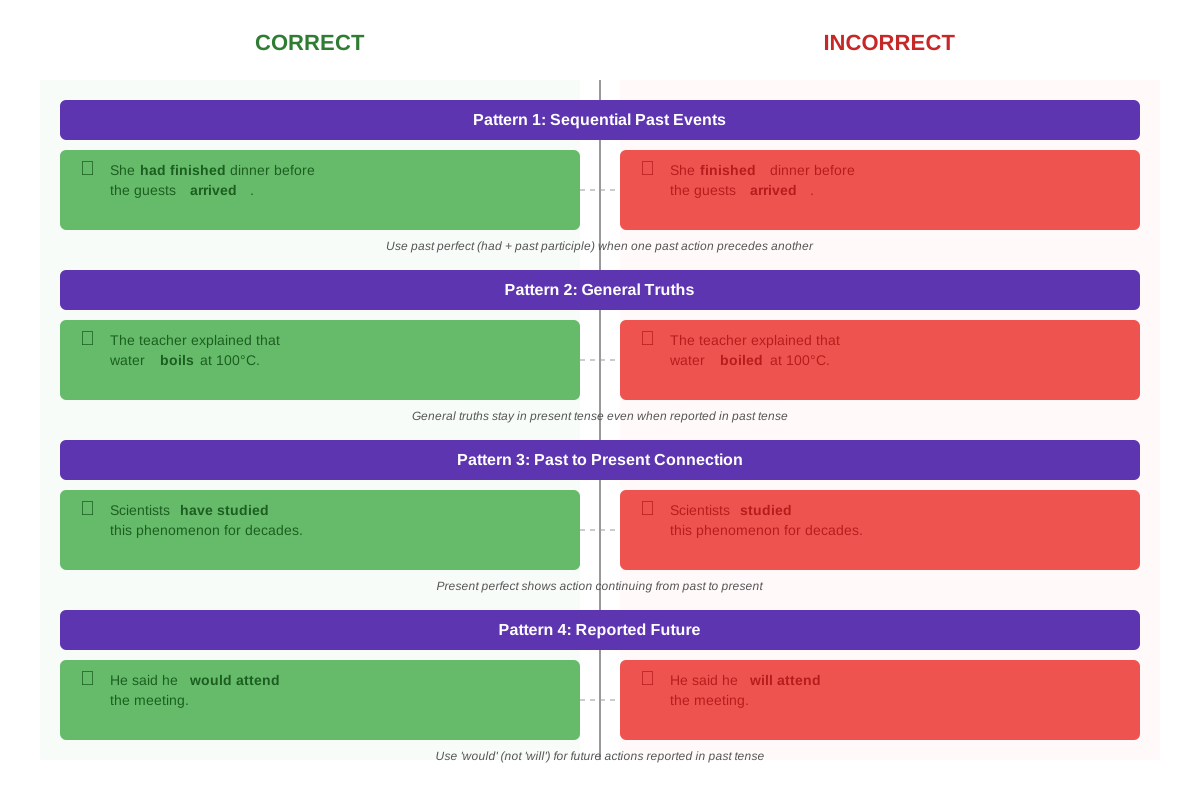
| Before | Earlier action: past perfect; later action: simple past | "She had finished dinner before the guests arrived." |
| After | Earlier action: simple past; later action: simple past or past perfect | "After the storm passed, residents returned home." |
| Since | Starting point: simple past; continuing action: present perfect | "Since 2010, the population has grown steadily." |
| While | Simultaneous actions: matching tenses | "While he was reading, she was writing." |
| By the time | Earlier action: past perfect; reference point: simple past | "By the time we left, the show had ended." |
| When | Depends on context; often matching tenses for simultaneous actions | "When the bell rang, students left the classroom." |
Present Tense for Universal Truths and Habitual Actions
Even in passages primarily written in past tense, present tense is appropriate for statements that express:
Universal truths or scientific facts: "The experiment demonstrated that water boils at 100 degrees Celsius." (The boiling point is always true, regardless of when the experiment occurred)
Habitual or characteristic actions: "The study revealed that nocturnal animals hunt at night." (This describes ongoing behavior, not a one-time event)
Current states or ongoing situations: "Researchers discovered a species that lives exclusively in deep ocean trenches." (The species still lives there)
Future-in-the-Past Constructions
When writing about past events that involved future plans or intentions, "would" often replaces "will":
- Direct future: "She says she will attend the conference."
- Future-in-the-past: "She said she would attend the conference."
This construction maintains logical tense sequence when the main verb shifts to past tense.
Conditional Sentences and Tense Sequence
Conditional sentences follow specific tense patterns based on the likelihood or reality of the condition:
Real conditions (likely or possible): Present tense in the "if" clause, future tense in the main clause:
- "If she studies diligently, she will pass the exam."
Hypothetical conditions (unlikely or contrary to fact): Past tense in the "if" clause, "would" in the main clause:
- "If she studied more diligently, she would pass the exam."
Past hypothetical conditions: Past perfect in the "if" clause, "would have" in the main clause:
- "If she had studied more diligently, she would have passed the exam."
Concept Relationships
Tense sequence connects intimately with clause structure because the relationship between independent and dependent clauses determines which tense patterns are appropriate. Understanding clause relationships → enables recognition of temporal relationships → which guides correct tense selection.
The concept also builds on knowledge of individual verb tenses. Mastery of simple past, present perfect, and past perfect → provides the foundation for understanding how these tenses work together → to create logical temporal sequences in complex sentences.
Time markers serve as signals that activate specific tense sequence patterns. Recognition of time markers → triggers awareness of required temporal relationships → which determines appropriate verb tense choices. This connection makes time markers crucial diagnostic tools for identifying tense sequence errors.
Tense sequence also relates to broader concepts of logical coherence and clarity in writing. Proper tense sequence → ensures clear temporal relationships → which supports overall sentence clarity → contributing to effective communication. This relationship explains why the SAT tests tense sequence within the Form, Structure, and Sense unit rather than treating it as an isolated grammar rule.
High-Yield Facts
⭐ When one past action occurred before another past action, the earlier action requires past perfect tense (had + past participle), while the later action uses simple past.
⭐ Universal truths, scientific facts, and general characteristics remain in present tense even when the surrounding passage is in past tense.
⭐ Time markers like "since," "before," "after," "by the time," and "while" signal specific tense relationships that must be maintained for logical coherence.
⭐ Present perfect tense (has/have + past participle) connects past actions to the present moment, indicating ongoing relevance or continuation.
⭐ Simultaneous actions typically require matching verb tenses to show they occurred at the same time.
- Past perfect is never used alone; it always relates to another past time reference point in the sentence or passage.
- The simple past tense is appropriate for completed actions with no connection to the present moment.
- Future tense shifts to "would" when the main clause shifts from present to past (future-in-the-past construction).
- Conditional sentences follow strict tense patterns based on whether the condition is real, hypothetical, or past hypothetical.
- Tense consistency within a passage does not mean all verbs must be in the same tense; it means tenses must logically reflect actual temporal relationships.
Quick check — test yourself on Tense sequence so far.
Try Flashcards →Common Misconceptions
Misconception: All verbs in a sentence must be in the same tense to maintain consistency. → Correction: Tense consistency means logical temporal relationships, not identical tenses. Different tenses are often necessary and correct when they accurately represent the sequence of events. For example, "She realized that she had forgotten her keys" correctly uses both simple past and past perfect to show the forgetting occurred before the realization.
Misconception: Past perfect can be used for any past action to make writing sound more sophisticated. → Correction: Past perfect should only be used when showing that one past action occurred before another past action. Using past perfect without this temporal relationship creates confusion. "Yesterday, I had gone to the store" is incorrect if there's no earlier reference point; it should be "Yesterday, I went to the store."
Misconception: Present tense is always wrong in a passage written primarily in past tense. → Correction: Present tense is appropriate and necessary for universal truths, scientific facts, and general characteristics, even in past-tense passages. "The archaeologist discovered that the ancient Romans used concrete" is correct because the use of concrete is a historical fact that remains true.
Misconception: "Since" always requires present perfect tense. → Correction: While "since" often appears with present perfect when describing actions continuing to the present ("Since 2010, enrollment has increased"), it can also appear with simple past when describing completed actions within a time frame ("Since the beginning of the semester, three students transferred to other schools").
Misconception: Time markers always appear in the same position relative to the verbs they affect. → Correction: Time markers can appear at the beginning, middle, or end of sentences, and their position doesn't change the tense relationships they signal. "Before the concert started, the audience had gathered" and "The audience had gathered before the concert started" both correctly use past perfect for the earlier action.
Worked Examples
Example 1: Historical Narrative with Multiple Time Frames
Question: Which choice completes the text with the most logical and precise word or phrase?
"Marie Curie's groundbreaking research on radioactivity _____ the foundation for modern nuclear physics. By the time she received her second Nobel Prize in 1911, she had already isolated pure radium and demonstrated its properties. Today, scientists continue to build upon her discoveries, which remain fundamental to our understanding of atomic structure."
A) laid
B) has laid
C) had laid
D) lays
Step 1: Identify the time frames in the passage. The passage discusses three distinct time periods: Curie's initial research (past), her 1911 Nobel Prize (past), and current scientific work (present).
Step 2: Determine the temporal relationship of the blank. The blank describes Curie's research, which established the foundation for modern physics. This is a completed past action.
Step 3: Evaluate each option:
- Option A (laid): Simple past tense for a completed past action. This correctly indicates that the foundation-laying occurred in the past.
- Option B (has laid): Present perfect suggests ongoing relevance to the present. While her work remains relevant, the actual act of laying the foundation was completed in the past.
- Option C (had laid): Past perfect requires a later past reference point. There's no indication that the foundation-laying occurred before another specific past event.
- Option D (lays): Present tense would suggest the action is happening now, which is illogical for historical events.
Step 4: Select the best answer. Option A is correct because it appropriately uses simple past for a completed historical action. The passage later uses present tense ("remain") for the ongoing truth about her discoveries, demonstrating proper tense sequence across different time frames.
Connection to learning objectives: This example demonstrates how to identify appropriate tense sequence when a passage spans multiple time periods and how to distinguish between completed past actions and ongoing present truths.
Example 2: Scientific Process with Sequential Actions
Question: Which choice completes the text with the most logical and precise word or phrase?
"Before researchers could analyze the data, they _____ the experimental equipment to ensure accuracy. The calibration process took three days, after which the team began collecting measurements. The results confirmed what scientists had long suspected about the phenomenon."
A) calibrate
B) calibrated
C) had calibrated
D) have calibrated
Step 1: Identify the time marker and its implications. "Before" signals that one action preceded another, requiring careful attention to which action occurred first.
Step 2: Determine the sequence of events:
- Equipment calibration (earliest action)
- Data analysis (later action, mentioned first in the sentence)
- Measurement collection (subsequent action)
- Results confirmation (final action)
Step 3: Evaluate each option:
- Option A (calibrate): Present tense is illogical for a completed scientific procedure described in a past-tense passage.
- Option B (calibrated): Simple past could work if both actions were simply listed sequentially, but "before" suggests a more complex relationship.
- Option C (had calibrated): Past perfect correctly shows that calibration was completed before the analysis could begin, which is the logical relationship signaled by "before."
- Option D (have calibrated): Present perfect suggests ongoing relevance to the present, but the passage describes a completed research project.
Step 4: Confirm the answer. Option C is correct because past perfect appropriately shows that the calibration (earlier action) was completed before the analysis (later action) could occur. The word "before" is the key signal requiring this tense relationship.
Connection to learning objectives: This example illustrates how time markers like "before" require specific tense relationships and how to apply past perfect when one past action preceded another past action.
Exam Strategy
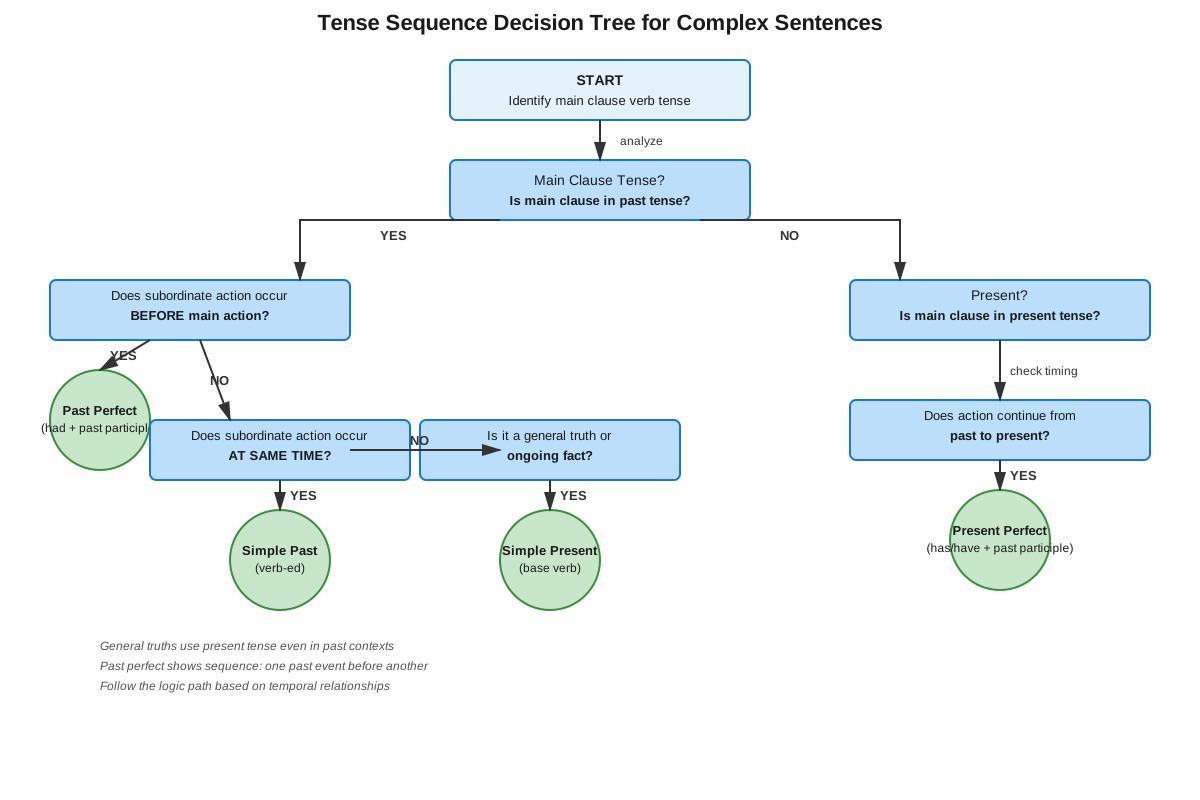
When approaching SAT tense sequence questions, follow this systematic process:
Step 1: Read the entire sentence or passage before looking at the answer choices. Understanding the full context is essential because tense sequence depends on relationships between multiple verbs and time frames.
Step 2: Identify all time markers in the sentence. Words like "before," "after," "since," "by the time," "while," and "when" are crucial signals that indicate specific tense relationships. Circle or mentally note these markers.
Step 3: Map the temporal relationships. Determine which actions occurred first, second, and third. Ask yourself: "What is the logical sequence of events?" and "Which actions are simultaneous?"
Step 4: Look for reference points. Past perfect requires a reference point—another past action that occurred later. If you see past perfect in an answer choice, verify that such a reference point exists.
Step 5: Check for universal truths or ongoing facts. If the sentence describes a scientific fact, general truth, or characteristic that remains true regardless of when it was discovered, present tense is likely correct even in a past-tense passage.
Exam Tip: The SAT rarely tests obscure tense rules. Focus on the most common patterns: past perfect for earlier past actions, present tense for universal truths, and present perfect for past actions with present relevance.
Trigger words to watch for:
- "Before" and "by the time" often signal past perfect for the earlier action
- "Since" with a specific date often requires present perfect
- "While" typically requires matching tenses for simultaneous actions
- "After" can work with simple past for both actions if the sequence is clear
Process of elimination tips:
- Eliminate any tense that creates an illogical timeline
- Eliminate present tense unless the statement is a universal truth or the passage is written in present tense
- Eliminate past perfect if there's no later past reference point
- Eliminate present perfect if the action has no connection to the present moment
Time allocation: Spend 30-45 seconds per tense sequence question. These questions require careful reading but shouldn't consume excessive time. If you're uncertain, mark the question and return to it after completing easier questions.
Memory Techniques
PAST Acronym for Past Perfect Usage:
- Preceding action (occurred before another past action)
- Another past reference point must exist
- Sequence matters (shows which came first)
- Time markers like "before" and "by the time" signal its use
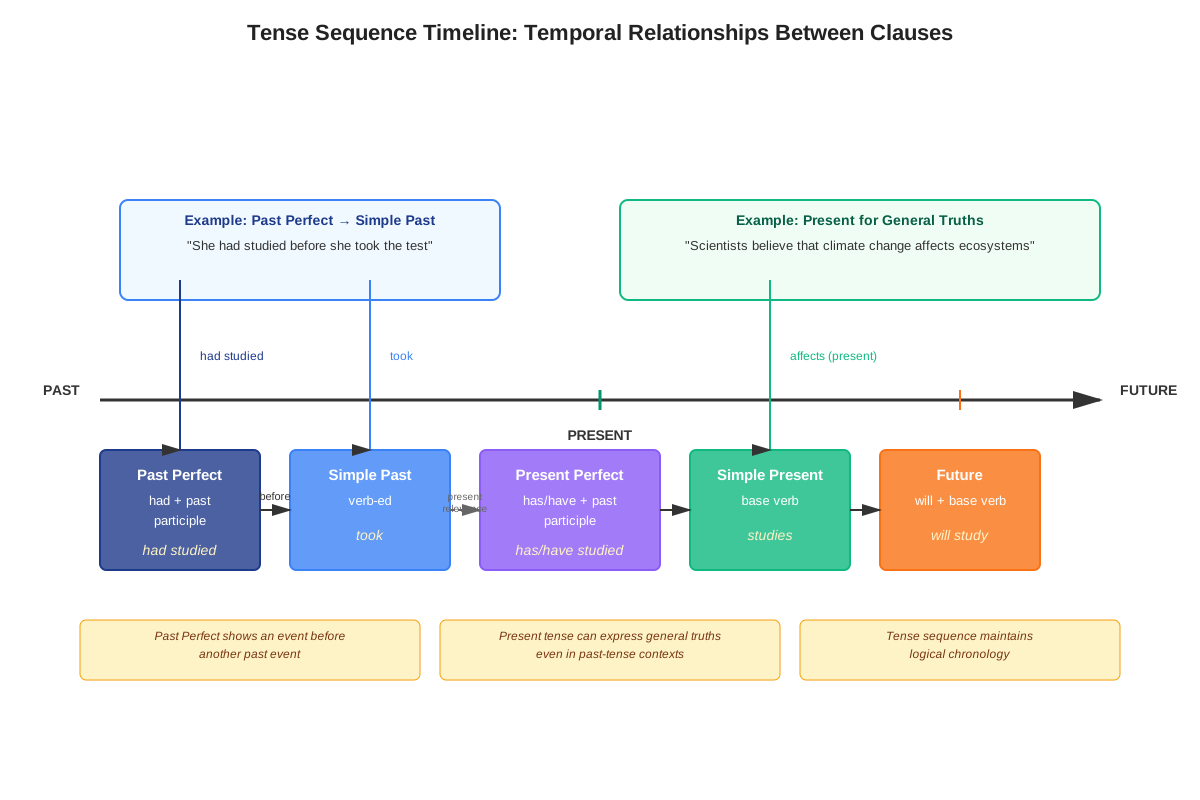
The Timeline Visualization: When encountering a complex sentence, mentally draw a timeline from left (earliest) to right (latest). Place each action on the timeline, then assign tenses based on their positions: furthest left gets past perfect, middle gets simple past, right side gets present or present perfect if connected to now.
The "Had-Have-Will" Progression:
- Had (past perfect) = furthest in the past
- Simple past = middle past
- Have (present perfect) = past connected to present
- Present = now
- Will = future
Universal Truth Reminder: Use the phrase "Always True" as a trigger. When you read a statement and think "this is always true," present tense is likely correct regardless of the surrounding passage's tense.
The "Before/After" Rule:
- Before = earlier action gets "had"
- After = both actions can use simple past (the word "after" makes the sequence clear)
Summary
Tense sequence is the grammatical principle governing how verb tenses work together to create logical temporal relationships within sentences and passages. On the SAT Reading and Writing section, students must identify and apply correct tense patterns based on the sequence of events, time markers, and the relationship between clauses. The most critical concepts include using past perfect for actions that occurred before other past actions, maintaining present tense for universal truths even in past-tense passages, and recognizing how time markers like "before," "since," and "while" signal specific tense requirements. Success on tense sequence questions requires understanding that consistency doesn't mean all verbs must share the same tense; rather, tenses must logically reflect actual temporal relationships. Students should focus on identifying reference points for past perfect, recognizing simultaneous versus sequential actions, and distinguishing between completed past actions and those with ongoing present relevance.
Key Takeaways
- Tense sequence requires logical temporal relationships between verbs, not identical tenses throughout a sentence or passage
- Past perfect (had + past participle) shows that one past action occurred before another past action and requires a later past reference point
- Present tense is correct for universal truths, scientific facts, and general characteristics even in past-tense passages
- Time markers like "before," "since," "by the time," and "while" signal specific tense relationships that must be maintained
- Present perfect (has/have + past participle) connects past actions to the present moment, indicating ongoing relevance or continuation
- Simultaneous actions typically require matching verb tenses, while sequential actions require different tenses to show the order of events
- The SAT tests tense sequence frequently (2-4 questions per test), making it a high-yield topic for focused study
Related Topics
Subject-Verb Agreement: Understanding how subjects and verbs must agree in number and person complements tense sequence knowledge, as both concepts involve ensuring grammatical consistency within sentences.
Parallel Structure: This topic extends tense sequence principles to series and lists, requiring consistent grammatical forms across multiple elements.
Modifier Placement: Like tense sequence, modifier placement affects sentence clarity and logical relationships between sentence elements.
Pronoun-Antecedent Agreement: This concept shares the principle of maintaining logical relationships between sentence elements, similar to how tenses must relate logically to one another.
Sentence Structure and Clause Relationships: Mastering tense sequence enables deeper understanding of how independent and dependent clauses work together to create complex, sophisticated sentences.
Practice CTA
Now that you've mastered the core concepts of tense sequence, it's time to put your knowledge into action! Complete the practice questions to reinforce your understanding and build confidence with SAT-style tense sequence problems. The flashcards will help you memorize key patterns and time marker relationships. Remember, tense sequence appears on virtually every SAT, so the time you invest in practice now will directly translate to points on test day. You've built a strong foundation—now strengthen it through deliberate practice!
Sign up free to keep reading
Create a free AnvayaPrep account to finish this SAT guide on Tense sequence — plus flashcards and practice questions.