Overview
Verb consistency is a fundamental grammar principle tested extensively on the SAT Reading and Writing (RW) section. This concept requires students to maintain logical and grammatical agreement between verbs within sentences and across related clauses. When the SAT tests verb consistency, it evaluates whether students can identify and correct shifts in verb tense, mood, or voice that create confusion or grammatical errors in written passages.
The SAT dedicates significant attention to verb consistency because it reflects a writer's ability to maintain clarity and coherence in communication. Questions on this topic typically present sentences where verb forms shift inappropriately, creating logical inconsistencies or grammatical errors. Students must recognize when verbs should remain parallel in form and when shifts are justified by changes in time, condition, or perspective. Mastering sat verb consistency enables test-takers to identify subtle errors that might otherwise go unnoticed, directly impacting their performance on 3-5 questions per test administration.
Within the broader context of Form, Structure, and Sense, verb consistency connects intimately with other grammatical principles including subject-verb agreement, parallel structure, and logical sequence. While subject-verb agreement ensures that individual verbs match their subjects in number and person, verb consistency extends this principle across multiple verbs, ensuring that temporal and logical relationships remain clear throughout a passage. This topic serves as a bridge between sentence-level grammar and paragraph-level coherence, making it essential for both the multiple-choice questions and the overall comprehension of complex passages on the SAT.
Learning Objectives
- [ ] Identify key features of verb consistency in SAT passages
- [ ] Explain how verb consistency appears on the SAT
- [ ] Apply verb consistency to answer SAT-style questions
- [ ] Distinguish between appropriate and inappropriate verb tense shifts
- [ ] Recognize when parallel verb forms are required in compound structures
- [ ] Evaluate whether verb mood and voice remain consistent within logical contexts
- [ ] Correct verb consistency errors efficiently under timed conditions
Prerequisites
- Basic verb tenses: Understanding past, present, and future tenses is essential because verb consistency questions require recognizing when tenses should match or appropriately shift
- Subject-verb agreement: Knowing how subjects and verbs must agree in number provides the foundation for understanding how multiple verbs relate to each other
- Sentence structure fundamentals: Recognizing independent and dependent clauses helps identify which verbs must maintain consistency within logical units
- Coordinating and subordinating conjunctions: Understanding how conjunctions connect clauses clarifies when verbs should remain parallel or when shifts are appropriate
Why This Topic Matters
Verb consistency represents one of the most frequently tested grammar concepts on the SAT, appearing in approximately 10-15% of all Standard English Conventions questions. The College Board consistently includes 3-5 questions per test that directly assess a student's ability to maintain or correct verb consistency. These questions appear in the Standard English Conventions domain, where students must identify the grammatically correct option among four choices.
In real-world applications, verb consistency is crucial for professional and academic writing. Inconsistent verb usage confuses readers, obscures meaning, and undermines a writer's credibility. Whether composing research papers, business communications, or creative narratives, maintaining appropriate verb consistency ensures that temporal relationships remain clear and that parallel actions receive parallel grammatical treatment. This skill directly transfers to college-level writing, where professors expect students to maintain sophisticated control over verb forms across complex, multi-clause sentences.
On the SAT, verb consistency questions typically appear in short passages (1-3 sentences) where students must select the verb form that maintains logical and grammatical consistency with surrounding context. Common question formats include identifying the correct tense to match an established timeframe, selecting parallel verb forms in lists or compound structures, and recognizing when shifts in tense are justified by changes in temporal reference. The test frequently embeds these questions in passages about historical events, scientific processes, biographical narratives, and descriptive accounts—contexts where maintaining clear temporal relationships is essential for comprehension.
Core Concepts
Understanding Verb Consistency
Verb consistency refers to the grammatical principle that verbs within a sentence or related sentences should maintain compatible forms unless a logical shift in time, condition, or perspective justifies a change. This principle operates on multiple levels: tense consistency (maintaining appropriate temporal relationships), voice consistency (maintaining active or passive voice when appropriate), and mood consistency (maintaining indicative, imperative, or subjunctive mood within logical contexts).
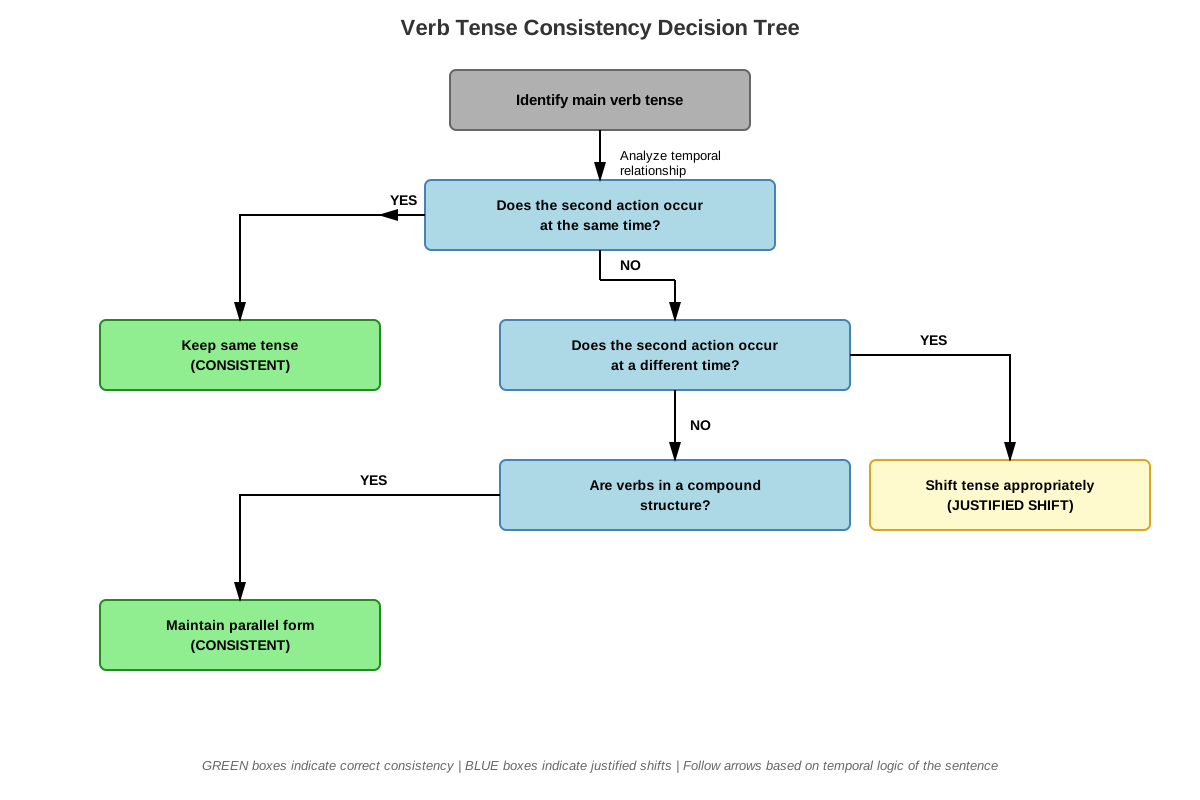
The fundamental rule is straightforward: when describing actions or states that occur within the same timeframe or logical context, verbs should use compatible tenses. However, the SAT tests students' ability to recognize when shifts are appropriate—for instance, when a sentence describes both a historical event (past tense) and its continuing relevance (present tense). Understanding this nuance separates high-scoring students from those who apply rules too rigidly.
Tense Consistency
Tense consistency requires that verbs describing simultaneous or sequentially related actions maintain logical temporal relationships. When multiple actions occur in the same timeframe, their verbs should typically use the same tense. Consider this example:
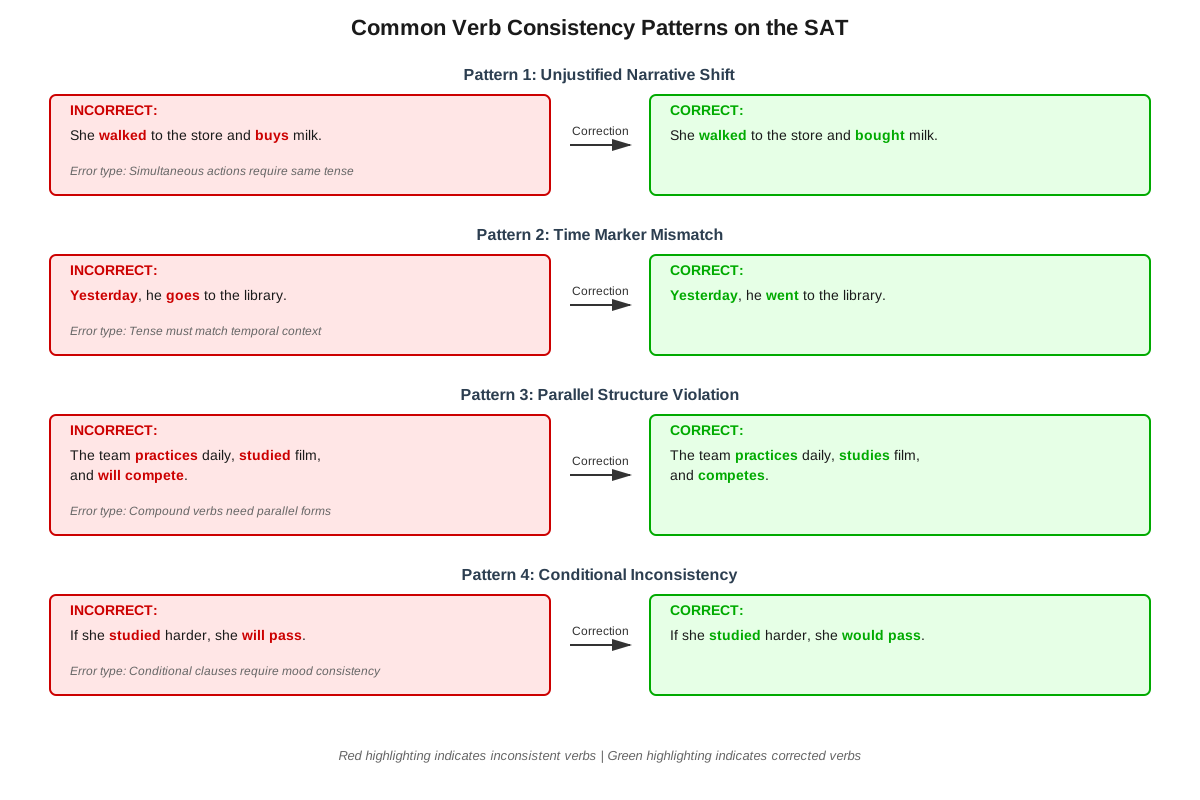
Incorrect: Maria walks to the store and bought groceries.
Correct: Maria walked to the store and bought groceries.
The correction maintains past tense throughout because both actions occurred in the same completed timeframe. However, tense shifts are appropriate when describing actions occurring at different times:
Correct: Maria studied biology in college, and now she works as a researcher.
This sentence appropriately shifts from past tense ("studied") to present tense ("works") because the actions occur in different timeframes. The SAT frequently tests whether students can distinguish between inappropriate shifts (errors) and appropriate shifts (correct usage).
Tense Consistency in Complex Sentences
Complex sentences with multiple clauses require careful attention to temporal relationships. The primary clause establishes a temporal anchor, and subordinate clauses must maintain logical relationships to this anchor:
| Temporal Relationship | Primary Clause | Subordinate Clause | Example |
|---|---|---|---|
| Simultaneous past actions | Past tense | Past tense | While she studied, her brother cooked dinner |
| Past action before another past action | Past tense | Past perfect | She had finished her homework before dinner started |
| Past action with present relevance | Present perfect | Present tense | Scientists have discovered evidence that supports the theory |
| General truth or habitual action | Any tense | Present tense | The teacher explained that water boils at 100°C |
Parallel Structure and Verb Consistency
When sentences contain compound verbs, lists of actions, or parallel constructions, all verbs must maintain the same form. This principle combines verb consistency with parallel structure:
Incorrect: The committee will review the proposal, discuss its implications, and then they are voting on it.
Correct: The committee will review the proposal, discuss its implications, and then vote on it.
The correction maintains parallel structure by using three infinitive forms without "to" (review, discuss, vote) that all relate to the modal verb "will." The SAT frequently tests this concept in sentences with three or more verbs connected by conjunctions.
Voice Consistency
While less commonly tested than tense consistency, voice consistency requires maintaining either active or passive voice within parallel structures unless a shift serves a clear rhetorical purpose:
Awkward: The researchers conducted the experiment, and the data was analyzed by them.
Better: The researchers conducted the experiment and analyzed the data.
The improved version maintains active voice throughout, creating a more direct and consistent sentence. However, shifts between active and passive voice are acceptable when they serve logical purposes, such as maintaining focus on a particular subject.
Mood Consistency
Mood consistency involves maintaining the same grammatical mood (indicative, imperative, or subjunctive) within related clauses. The SAT occasionally tests whether students recognize inappropriate shifts in mood:
Incorrect: If the hypothesis were correct, the results will confirm it.
Correct: If the hypothesis were correct, the results would confirm it.
The correction maintains subjunctive mood throughout the conditional statement, using "were" and "would" to express a hypothetical situation.
Justified Tense Shifts
Understanding when tense shifts are appropriate is crucial for SAT success. Justified shifts occur when:
- Describing actions at different times: "The ancient Romans built aqueducts that still stand today."
- Expressing general truths: "The professor explained that photosynthesis converts light energy into chemical energy."
- Showing cause-and-effect across time: "Because she practiced daily, she has become an accomplished pianist."
- Contrasting past and present: "While early computers filled entire rooms, modern smartphones fit in our pockets."
The SAT tests whether students can distinguish these justified shifts from unjustified errors.
Concept Relationships
Verb consistency operates as a central organizing principle that connects multiple grammatical concepts. At its foundation, verb consistency builds upon subject-verb agreement—once verbs agree with their subjects individually, they must also maintain consistency with each other. This relationship flows logically: Subject-verb agreement → Verb consistency → Parallel structure.
Parallel structure represents the broader category within which verb consistency operates. When sentences contain parallel elements (items in a list, compound verbs, or balanced clauses), verb consistency ensures that these parallel elements maintain grammatical uniformity. The relationship works bidirectionally: maintaining verb consistency often requires parallel structure, and creating parallel structure necessitates verb consistency.
Verb consistency also connects intimately with logical sequence and coherence. When verbs maintain appropriate consistency, they create clear temporal and logical relationships that enhance overall passage coherence. This connection extends to paragraph-level organization, where consistent verb usage helps readers track the progression of ideas across multiple sentences.
The relationship map flows as follows:
Basic verb knowledge → Subject-verb agreement → Verb consistency → Parallel structure → Sentence-level clarity → Paragraph-level coherence
Additionally, verb consistency intersects with pronoun consistency and modifier placement, as all three contribute to maintaining clear reference and logical relationships within sentences. Mastering verb consistency therefore supports broader competency in Standard English Conventions.
High-Yield Facts
⭐ Verbs describing simultaneous actions in the same timeframe should use the same tense unless a logical shift is justified
⭐ In compound verb structures connected by "and" or "or," all verbs must maintain parallel form
⭐ Past perfect tense (had + past participle) indicates an action completed before another past action
⭐ Present tense is appropriate for general truths and scientific facts, even when the main clause uses past tense
⭐ When a sentence establishes a clear temporal anchor in one tense, subsequent verbs should maintain consistency with that timeframe
- Inappropriate tense shifts most commonly occur between past and present tenses in narrative contexts
- The SAT frequently tests verb consistency in sentences containing three or more verbs in a series
- Conditional sentences require specific tense pairings: "If [past subjunctive], then [conditional]"
- Historical present tense (using present tense to describe past events) is acceptable when used consistently throughout a passage
- Infinitives and participles must maintain parallel form when appearing in lists or compound structures
- Voice shifts from active to passive (or vice versa) are acceptable when they serve clear rhetorical purposes but should be avoided in parallel structures
Quick check — test yourself on Verb consistency so far.
Try Flashcards →Common Misconceptions
Misconception: All verbs in a sentence must always use exactly the same tense.
Correction: Verbs should maintain logical temporal relationships, which sometimes requires different tenses. For example, "She studied engineering in college and now works as a software developer" correctly uses both past and present tense because the actions occur at different times.
Misconception: Shifting from past to present tense is always an error.
Correction: Tense shifts are appropriate when describing actions at different times, expressing general truths, or contrasting past and present situations. The key is whether the shift serves a logical purpose.
Misconception: In sentences with "and," all verbs must be in the same tense regardless of context.
Correction: While verbs connected by "and" often share the same tense when describing simultaneous actions, they may use different tenses when describing sequential actions at different times: "He graduated in 2020 and currently works in Boston."
Misconception: The present perfect tense (has/have + past participle) can be used interchangeably with simple past tense.
Correction: Present perfect indicates actions with present relevance or continuing effects, while simple past describes completed actions. "She has written three novels" (ongoing career) differs from "She wrote three novels" (completed period of writing).
Misconception: Passive voice is always incorrect and should be avoided.
Correction: Passive voice is grammatically correct and sometimes preferable, particularly when the actor is unknown or when maintaining focus on the object. However, unnecessary shifts between active and passive voice within parallel structures should be avoided.
Misconception: Historical events must always be described in past tense.
Correction: While past tense is standard for historical events, the historical present (using present tense for past events) is acceptable when used consistently to create immediacy: "In 1969, Armstrong steps onto the lunar surface."
Worked Examples
Example 1: Identifying and Correcting Tense Inconsistency
Question: Which choice maintains verb consistency in the following sentence?
"The archaeologists excavated the site for three months, carefully document their findings, and eventually published their results in a peer-reviewed journal."
A) NO CHANGE
B) carefully documented their findings,
C) carefully documenting their findings,
D) have carefully documented their findings,
Solution:
Step 1: Identify the temporal context. The sentence describes a sequence of completed past actions: excavated → documented → published.
Step 2: Examine the verb forms. "Excavated" and "published" are both simple past tense, establishing a clear past timeframe. The verb in question ("document") appears in present tense, creating an inconsistency.
Step 3: Evaluate each option:
- Option A maintains the error with present tense "document"
- Option B uses simple past "documented," matching the established timeframe
- Option C uses a participle "documenting," which doesn't maintain parallel structure with the finite verbs "excavated" and "published"
- Option D uses present perfect "have documented," which inappropriately suggests present relevance rather than completed past action
Step 4: Select the answer that maintains consistency. Option B correctly uses simple past tense to match "excavated" and "published," maintaining both tense consistency and parallel structure.
Answer: B
Connection to Learning Objectives: This example demonstrates how to identify key features of verb consistency (recognizing tense shifts) and apply verb consistency principles to answer SAT-style questions (selecting the grammatically correct option).
Example 2: Distinguishing Appropriate from Inappropriate Tense Shifts
Question: Which choice best maintains verb consistency while preserving the logical meaning?
"Throughout history, scientists studied the natural world and make discoveries that transform human understanding."
A) NO CHANGE
B) studied the natural world and made discoveries that transformed
C) have studied the natural world and make discoveries that transform
D) study the natural world and made discoveries that transformed
Solution:
Step 1: Analyze the temporal scope. The phrase "Throughout history" indicates an action beginning in the past and continuing to the present, suggesting present perfect tense may be appropriate.
Step 2: Identify the logical relationships. The sentence describes an ongoing pattern: scientists have continuously studied nature (from past to present) and continue to make discoveries (ongoing action) that transform understanding (continuing effect).
Step 3: Evaluate each option:
- Option A mixes past "studied" with present "make" and "transform" inconsistently
- Option B uses all past tense, suggesting the action is completed rather than ongoing
- Option C uses present perfect "have studied" (past to present) with present tense "make" and "transform" (ongoing actions), maintaining logical consistency
- Option D illogically mixes present "study" with past "made" and "transformed"
Step 4: Determine which option maintains both grammatical consistency and logical meaning. Option C correctly uses present perfect to indicate the ongoing nature of scientific study throughout history, followed by present tense verbs that describe continuing actions.
Answer: C
Connection to Learning Objectives: This example illustrates how to distinguish between appropriate and inappropriate verb tense shifts, demonstrating that consistency doesn't always mean using identical tenses but rather maintaining logical temporal relationships.
Exam Strategy
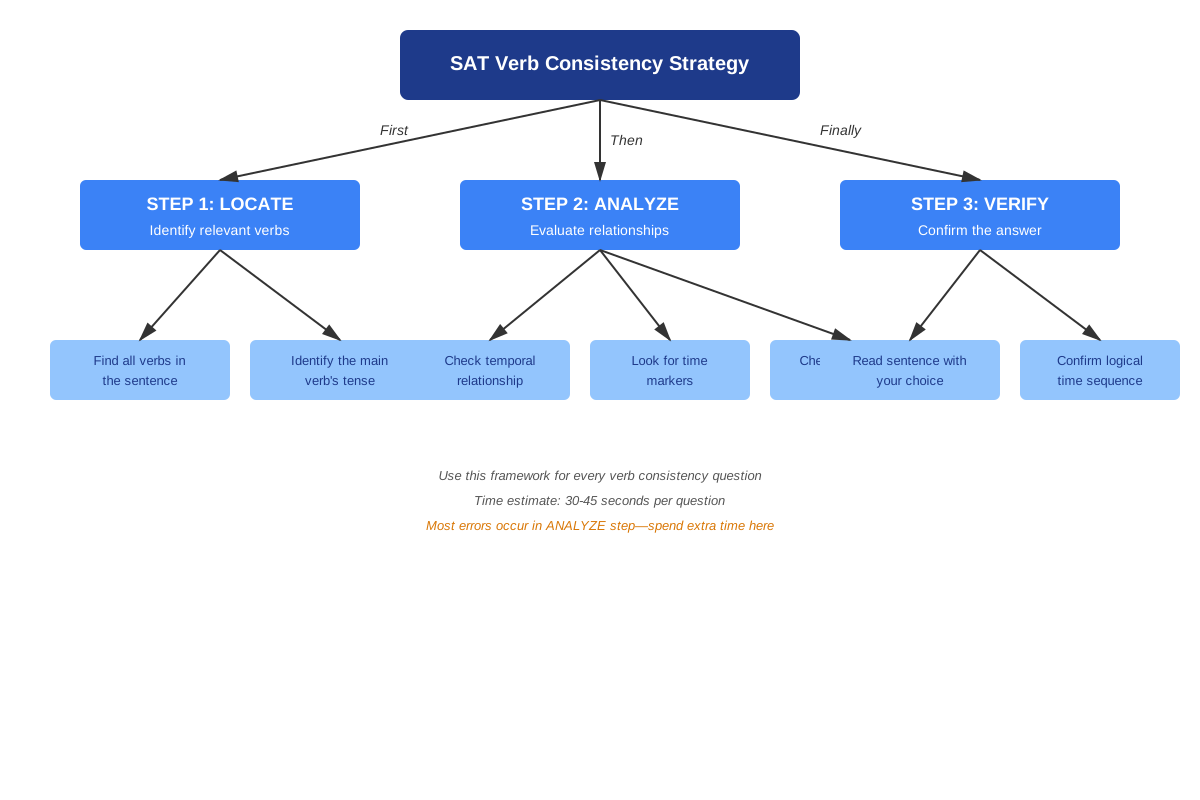
When approaching verb consistency questions on the SAT, follow this systematic process:
Step 1: Identify the temporal anchor. Locate the verb or time expression that establishes the primary timeframe. This anchor determines what tenses are appropriate for other verbs in the sentence.
Step 2: Map the temporal relationships. Determine whether the actions described are simultaneous, sequential, or occurring at different times. Simultaneous actions typically require the same tense; sequential actions may require different tenses.
Step 3: Check for parallel structures. When verbs appear in lists, compound structures, or balanced clauses, they must maintain parallel form unless a logical shift justifies a change.
Step 4: Watch for trigger words and phrases:
- "Throughout history," "over time," "for centuries": Often signal present perfect tense (have/has + past participle)
- "Before," "after," "by the time": May signal past perfect tense (had + past participle)
- "Currently," "now," "today": Signal present tense, even if earlier parts of the sentence use past tense
- "Always," "never," "generally": Often signal present tense for general truths
Step 5: Eliminate obviously incorrect options. Cross out choices that create clear tense inconsistencies with the established timeframe or that break parallel structure in compound verbs.
Step 6: Distinguish between the remaining options. Often, two options will be grammatically correct but only one will maintain the most logical and consistent temporal relationships.
Exam Tip: If a sentence contains three or more verbs, the SAT is likely testing parallel structure and verb consistency. Check that all verbs in the series maintain the same form.
Time allocation: Verb consistency questions should take 30-45 seconds each. If you're spending more than one minute, select your best answer and move on. These questions test recognition rather than complex analysis, so the correct answer should become apparent quickly once you identify the temporal anchor.
Process of elimination strategy: First eliminate options that clearly break parallel structure. Then eliminate options that create illogical temporal relationships. Finally, choose between remaining options based on which maintains the most consistent and logical verb usage.
Memory Techniques
PAST Mnemonic for Parallel Structure:
- Parallel verbs must match
- Anchor establishes timeframe
- Simultaneous actions = same tense
- Temporal shifts need justification
The "Timeline Test": Visualize actions on a mental timeline. If actions occupy the same point or period on the timeline, they should use the same tense. If they occupy different points, different tenses may be appropriate.
The "And Test": When you see verbs connected by "and," ask: "Are these actions happening at the same time in the same way?" If yes, the verbs should match in form. If no, a shift may be justified.
The "Three-Verb Rule": When a sentence contains three or more verbs in a series, the SAT is almost certainly testing parallel structure and verb consistency. Immediately check that all verbs maintain the same form.
Acronym for Justified Shifts - DGET:
- Different times (past vs. present)
- General truths (always present tense)
- Effect continuing to present (present perfect)
- Temporal markers signal shift (before, after, now)
Visualization Strategy: Picture verb tenses as colors. Consistent verbs should be the same color; justified shifts change colors at logical boundaries. This visual metaphor helps identify inappropriate shifts that "clash" with the established pattern.
Summary
Verb consistency is a high-yield SAT grammar concept that requires maintaining logical and grammatical agreement between verbs within sentences and across related clauses. The fundamental principle is straightforward: verbs describing actions in the same timeframe should use compatible tenses, while shifts are justified when describing actions at different times, expressing general truths, or showing cause-and-effect relationships across temporal boundaries. The SAT tests this concept through questions that require students to identify and correct inappropriate tense shifts, maintain parallel structure in compound verbs, and distinguish between errors and justified shifts. Success requires recognizing temporal anchors that establish timeframes, mapping logical relationships between actions, and understanding when consistency means using identical tenses versus maintaining logical temporal relationships. Students must also recognize that verb consistency extends beyond simple tense matching to include maintaining appropriate voice and mood within parallel structures. Mastering this topic requires both understanding the underlying grammatical principles and developing the ability to quickly identify temporal relationships and parallel structures under timed conditions.
Key Takeaways
- Verb consistency requires maintaining logical temporal relationships, not necessarily identical tenses in all cases
- Verbs in compound structures connected by "and" or "or" must maintain parallel form when describing simultaneous actions
- Temporal anchors (time expressions and initial verbs) establish the timeframe that subsequent verbs should maintain
- Justified tense shifts occur when describing actions at different times, expressing general truths, or showing continuing effects
- The SAT frequently tests verb consistency in sentences with three or more verbs in series or parallel structures
- Present perfect tense (has/have + past participle) indicates actions with present relevance or continuing from past to present
- Recognizing trigger words like "throughout history," "currently," and "before" helps identify appropriate tenses
Related Topics
Parallel Structure: Verb consistency is a component of the broader principle of parallel structure, which requires that grammatically equivalent elements maintain the same form. Mastering verb consistency provides the foundation for understanding how parallel structure operates across different grammatical categories.
Subject-Verb Agreement: While subject-verb agreement ensures individual verbs match their subjects, verb consistency extends this principle across multiple verbs. Understanding both concepts together creates comprehensive mastery of verb usage.
Modifier Placement and Clarity: Consistent verb usage contributes to overall sentence clarity, which connects to proper modifier placement. Both topics work together to ensure sentences communicate meaning precisely.
Pronoun Consistency: Similar to verb consistency, pronoun consistency requires maintaining logical agreement in person, number, and case. The analytical skills developed for verb consistency transfer directly to pronoun questions.
Logical Sequence and Transitions: Verb consistency supports logical sequence by maintaining clear temporal relationships. This connection becomes especially important in passage-level questions that assess overall coherence.
Practice CTA
Now that you've mastered the core concepts of verb consistency, it's time to reinforce your learning through active practice. Complete the practice questions to test your ability to identify temporal anchors, recognize parallel structures, and distinguish between appropriate and inappropriate tense shifts. Use the flashcards to memorize high-yield facts and trigger words that signal specific tense requirements. Remember: verb consistency appears on every SAT, and mastering this topic will directly improve your Reading and Writing score. Approach each practice question systematically, applying the strategies you've learned, and review any mistakes to understand why the correct answer maintains better consistency than the alternatives. Your investment in practice now will pay dividends on test day!
Sign up free to keep reading
Create a free AnvayaPrep account to finish this SAT guide on Verb consistency — plus flashcards and practice questions.