Overview
Verb mood is a grammatical feature that indicates the attitude or intent behind a statement. On the SAT Reading and Writing section (RW), understanding verb mood is crucial for identifying errors in sentence construction and selecting the most appropriate verb forms in context. The three primary moods in English—indicative, imperative, and subjunctive—each serve distinct communicative purposes, and the SAT frequently tests whether students can recognize when a particular mood is required by the grammatical structure of a sentence.
The SAT verb mood questions typically appear within the Standard English Conventions domain, where students must demonstrate command of grammar, usage, and punctuation. These questions often present sentences containing conditional statements, recommendations, demands, or hypothetical scenarios—contexts where the subjunctive mood is traditionally required but frequently misused in everyday speech. Because the subjunctive mood sounds formal and is declining in casual usage, many students struggle to identify when it's grammatically necessary, making this a high-yield topic for score improvement.
Mastery of verb mood connects directly to broader concepts in the Form, Structure, and Sense unit, particularly verb tense consistency and subject-verb agreement. Understanding mood helps students recognize the logical relationships between clauses and ensures that verb forms accurately convey the intended meaning. This knowledge also supports reading comprehension, as recognizing mood helps students interpret an author's tone, certainty level, and rhetorical purpose—skills essential for tackling inference and purpose questions throughout the Reading and Writing section.
Learning Objectives
- [ ] Identify key features of verb mood
- [ ] Explain how verb mood appears on the SAT
- [ ] Apply verb mood to answer SAT-style questions
- [ ] Distinguish between indicative, imperative, and subjunctive moods in context
- [ ] Recognize trigger words and phrases that require specific verb moods
- [ ] Correct verb mood errors in complex sentence structures
- [ ] Evaluate whether a verb mood appropriately matches the sentence's logical intent
Prerequisites
- Basic verb conjugation: Understanding how verbs change form is essential because mood affects verb structure, particularly in the subjunctive.
- Clause structure (independent and dependent): Verb mood often depends on the relationship between clauses, especially in conditional and subordinate constructions.
- Subject-verb agreement: Correct mood identification requires recognizing proper subject-verb relationships, as mood can affect agreement patterns.
- Verb tenses: Distinguishing mood from tense is critical, as students often confuse these two distinct grammatical features.
Why This Topic Matters
In real-world communication, verb mood conveys subtle but important distinctions in meaning. The difference between "If she was here" (indicative, suggesting uncertainty about a past fact) and "If she were here" (subjunctive, expressing a hypothetical contrary to fact) affects how listeners interpret the speaker's intent. Professional writing, academic discourse, and formal communication all require precise mood usage to maintain credibility and clarity.
On the SAT, verb mood questions appear in approximately 2-4 questions per test administration, making them moderately frequent but highly predictable. These questions typically appear as part of the Standard English Conventions question type, where students must select the grammatically correct option from four choices. The College Board specifically tests the subjunctive mood because it represents a formal grammatical rule that distinguishes sophisticated writers from those who rely solely on conversational patterns.
Common SAT passages featuring verb mood include formal recommendations (requiring subjunctive after verbs like "recommend," "suggest," or "require"), hypothetical scenarios (using subjunctive in contrary-to-fact conditions), and expressions of necessity or importance (demanding subjunctive in "that" clauses following certain adjectives and verbs). Students who master mood recognition can quickly identify correct answers and eliminate options that sound conversational but violate formal grammatical standards.
Core Concepts
The Three Primary Verb Moods
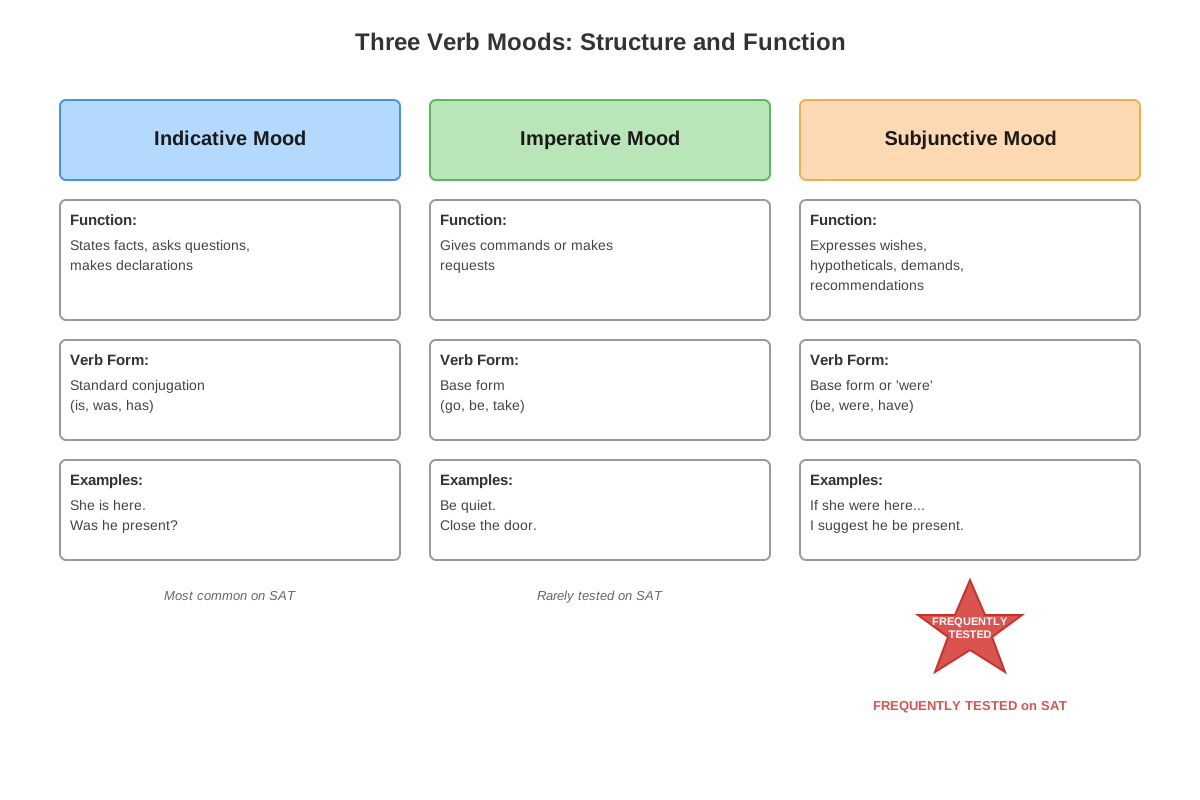
Verb mood refers to the form a verb takes to indicate the speaker's attitude toward the action or state being described. English employs three primary moods, each serving a distinct grammatical and communicative function.
| Mood | Purpose | Example |
|---|---|---|
| Indicative | States facts, asks questions, expresses opinions | "She walks to school every day." |
| Imperative | Issues commands or requests | "Walk to school today." |
| Subjunctive | Expresses wishes, hypotheticals, recommendations, or conditions contrary to fact | "I wish she were here." |
Indicative Mood
The indicative mood is the most common verb mood in English, used for statements of fact, questions, and declarations. This mood appears in all tenses and represents actions or states that the speaker presents as real, actual, or certain. On the SAT, the indicative mood itself is rarely tested directly; instead, questions focus on whether students incorrectly use indicative forms where subjunctive is required.
Examples of indicative mood:
- "The committee meets every Tuesday." (present tense, factual statement)
- "She was present at the meeting." (past tense, statement of fact)
- "Will you attend the conference?" (future tense, direct question)
Imperative Mood
The imperative mood expresses commands, requests, instructions, or advice. In imperative sentences, the subject "you" is typically implied rather than stated explicitly. The verb appears in its base form regardless of the subject. While the SAT rarely tests imperative mood directly, understanding it helps students distinguish between the three moods and recognize sentence structures.
Examples of imperative mood:
- "Submit your application by Friday."
- "Consider the implications carefully."
- "Please review the attached document."
Subjunctive Mood: The SAT Focus
The subjunctive mood is the primary focus of SAT verb mood questions. This mood expresses actions or states that are hypothetical, wished for, recommended, demanded, or contrary to fact. The subjunctive has specific forms and appears in predictable grammatical contexts.
Subjunctive Forms
The subjunctive mood has two main forms in modern English:
- Present subjunctive: Uses the base form of the verb (without -s for third person singular)
- "The teacher insists that he arrive on time." (not "arrives")
- "It is essential that she be present." (not "is")
- Past subjunctive: Uses "were" for all persons (including singular subjects)
- "If I were wealthy, I would travel." (not "was")
- "She acts as though she were in charge." (not "was")
Subjunctive Trigger Contexts
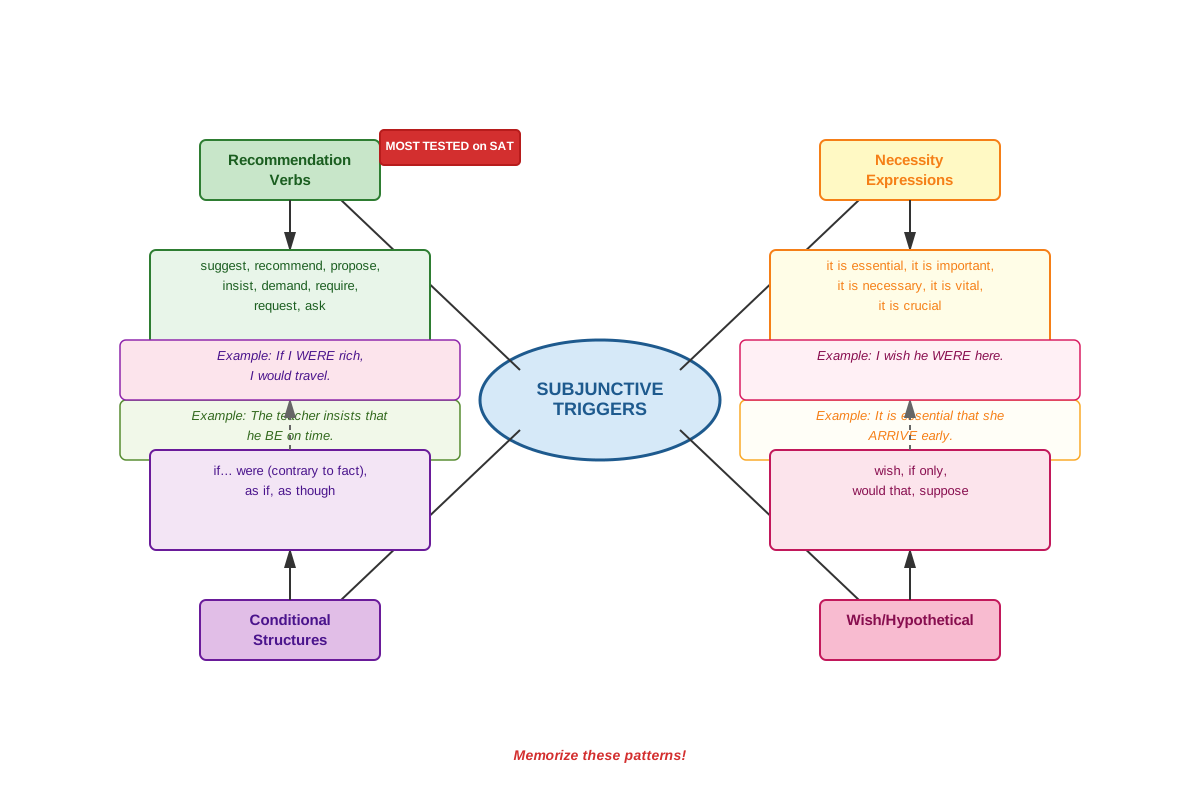
The SAT tests subjunctive mood in four primary contexts:
1. Recommendations, Requirements, and Demands
After verbs expressing recommendation, requirement, demand, or suggestion, use the present subjunctive (base form) in the "that" clause:
- Trigger verbs: recommend, suggest, propose, insist, demand, require, request, ask, urge, mandate, stipulate
- Structure: Subject + trigger verb + that + subject + base form verb
- Example: "The board recommends that the policy be revised." (not "is revised")
2. Expressions of Necessity or Importance
After adjectives expressing necessity, importance, or urgency in "it is/was [adjective] that" constructions:
- Trigger adjectives: essential, necessary, important, crucial, vital, imperative, critical
- Structure: It is/was + adjective + that + subject + base form verb
- Example: "It is crucial that every student submit the form." (not "submits")
3. Contrary-to-Fact Conditions
In "if" clauses expressing hypothetical situations contrary to present or past reality:
- Structure: If + subject + were (for all persons)
- Example: "If the proposal were accepted, we would proceed." (not "was")
- Note: This applies to present contrary-to-fact conditions; past contrary-to-fact uses "had been"
4. Wishes and Hypothetical Desires
After verbs expressing wishes or desires for situations that are not real:
- Trigger verbs: wish, suppose, imagine
- Structure: Subject + wish/suppose + (that) + subject + were/past subjunctive
- Example: "I wish I were able to attend." (not "was")
Common Subjunctive Errors on the SAT
The SAT exploits predictable errors in subjunctive usage:
- Using indicative instead of subjunctive after trigger verbs
- Incorrect: "The committee requires that she submits a report."
- Correct: "The committee requires that she submit a report."
- Using "was" instead of "were" in contrary-to-fact conditions
- Incorrect: "If the data was accurate, we would publish it."
- Correct: "If the data were accurate, we would publish it."
- Adding unnecessary helping verbs in present subjunctive
- Incorrect: "It is essential that he should complete the task."
- Correct: "It is essential that he complete the task."
- Confusing subjunctive with conditional mood
- Incorrect: "I recommend that she would attend the meeting."
- Correct: "I recommend that she attend the meeting."
Concept Relationships
Verb mood connects to several other grammatical concepts tested on the SAT. Understanding these relationships strengthens overall grammar mastery:
Verb Mood → Verb Tense: While mood indicates attitude or intent, tense indicates time. These features work together but serve different functions. The subjunctive mood has its own tense forms (present and past subjunctive), which students must distinguish from indicative tenses.
Verb Mood → Clause Structure: Subjunctive mood typically appears in dependent clauses following specific trigger words in independent clauses. Recognizing the relationship between clauses helps identify when subjunctive is required: Main clause (trigger verb/adjective) → leads to → Subordinate clause (subjunctive verb).
Verb Mood → Subject-Verb Agreement: The subjunctive mood creates apparent exceptions to standard agreement rules. In present subjunctive, third-person singular subjects don't take the -s ending ("he go" rather than "he goes"), which can seem incorrect to students who haven't learned this exception.
Verb Mood → Conditional Sentences: Contrary-to-fact conditional sentences require subjunctive mood in the "if" clause and conditional mood (would/could/might + base verb) in the result clause. Understanding this pattern helps students recognize complete conditional structures.
Relationship Map:
Trigger word (recommend/essential/if) → signals → Dependent clause → requires → Subjunctive mood → manifests as → Base form verb or "were" → creates → Grammatically correct sentence
High-Yield Facts
⭐ The subjunctive mood uses the base form of the verb (without -s) after verbs of recommendation, requirement, or demand in "that" clauses.
⭐ In contrary-to-fact conditions, use "were" for all subjects, including singular subjects like "I," "he," "she," or "it."
⭐ Common trigger verbs requiring subjunctive: recommend, suggest, propose, insist, demand, require, request, ask, urge.
⭐ After "it is essential/necessary/important/crucial that," use the base form of the verb in the following clause.
⭐ The subjunctive mood does not use helping verbs like "should," "would," or "will" in formal American English.
- The phrase "as if" or "as though" typically triggers subjunctive mood when expressing hypothetical comparisons.
- In wishes about present situations, use "were" rather than "was": "I wish I were taller."
- The subjunctive is more common in American English formal writing than in British English, where "should" is often used instead.
- Subjunctive mood appears in fixed expressions like "be that as it may," "far be it from me," and "suffice it to say."
- The SAT never tests the archaic subjunctive forms (like "if he go" in older literature), only modern standard forms.
Quick check — test yourself on Verb mood so far.
Try Flashcards →Common Misconceptions
Misconception: The subjunctive mood is outdated and no longer used in modern English.
Correction: While less common in casual speech, the subjunctive remains standard in formal writing and is required for grammatical correctness on the SAT. Professional, academic, and official documents consistently use subjunctive mood in appropriate contexts.
Misconception: "If I was" is always incorrect.
Correction: "If I was" is correct when referring to a real possibility or uncertain past fact (indicative mood): "If I was rude yesterday, I apologize." However, "If I were" is correct for hypothetical or contrary-to-fact situations: "If I were you, I would apologize."
Misconception: After "recommend" or "suggest," you should use "should" + base verb.
Correction: In American English formal writing (the SAT standard), use only the base form without "should": "I recommend that he study more" (not "should study"). British English often uses "should," but the SAT follows American conventions.
Misconception: Subjunctive mood only applies to the verb "to be."
Correction: All verbs have subjunctive forms. The subjunctive is most noticeable with "be" (because "were" and "be" sound distinctly different from indicative forms), but it applies to all verbs: "The rule requires that she arrive early" uses subjunctive "arrive" instead of indicative "arrives."
Misconception: You can use "was" with singular subjects in all "if" clauses.
Correction: In contrary-to-fact conditions (hypotheticals), use "were" for all subjects: "If the theory were correct" (not "was correct"). Use "was" only when discussing real past possibilities: "If she was at the meeting, she didn't speak" (uncertain about whether she attended).
Misconception: Subjunctive mood and conditional mood are the same thing.
Correction: These are distinct moods. Subjunctive expresses hypotheticals, wishes, or requirements (often in "if" or "that" clauses), while conditional expresses results dependent on conditions (using "would," "could," "might"). They often appear together: "If I were rich (subjunctive), I would travel (conditional)."
Worked Examples
Example 1: Recommendation Context
Question: The committee chair recommends that each member _____ the proposal before the next meeting.
A) reviews
B) review
C) will review
D) should review
Step 1: Identify the trigger word
The verb "recommends" is a trigger word that requires subjunctive mood in the following "that" clause.
Step 2: Recall the subjunctive rule
After verbs of recommendation (recommend, suggest, propose, etc.), use the base form of the verb without any helping verbs.
Step 3: Evaluate each option
- A) "reviews" - This is indicative mood (third person singular with -s). Incorrect.
- B) "review" - This is the base form, correct for subjunctive mood. Potentially correct.
- C) "will review" - This adds a helping verb "will," which violates subjunctive rules. Incorrect.
- D) "should review" - While this sounds natural, American English formal writing (SAT standard) doesn't use "should" in subjunctive constructions. Incorrect.
Step 4: Select the answer
Answer: B) review
Connection to learning objectives: This example demonstrates how to identify subjunctive triggers (recommendation verbs) and apply the correct subjunctive form (base verb) to answer SAT-style questions.
Example 2: Contrary-to-Fact Condition
Question: If the hypothesis _____ accurate, the experimental results would support the researchers' conclusions.
A) was
B) were
C) is
D) would be
Step 1: Analyze the sentence structure
This is an "if" clause followed by a result clause containing "would support," indicating a hypothetical or contrary-to-fact condition.
Step 2: Determine the reality status
The use of "would support" in the result clause signals that this is contrary to fact—the hypothesis is NOT accurate, but we're imagining what would happen if it were.
Step 3: Apply the subjunctive rule
For contrary-to-fact conditions, use "were" for all subjects, regardless of number.
Step 4: Evaluate each option
- A) "was" - Indicative past tense, inappropriate for contrary-to-fact conditions. Incorrect.
- B) "were" - Subjunctive mood, correct for hypothetical conditions. Potentially correct.
- C) "is" - Present indicative, doesn't match the conditional structure. Incorrect.
- D) "would be" - Conditional mood belongs in the result clause, not the "if" clause. Incorrect.
Step 5: Confirm the answer
The sentence expresses a hypothetical situation (the hypothesis isn't actually accurate), requiring subjunctive "were."
Answer: B) were
Connection to learning objectives: This example shows how to recognize contrary-to-fact conditions and distinguish between indicative "was" (for real past possibilities) and subjunctive "were" (for hypotheticals).
Exam Strategy
Approaching SAT Verb Mood Questions
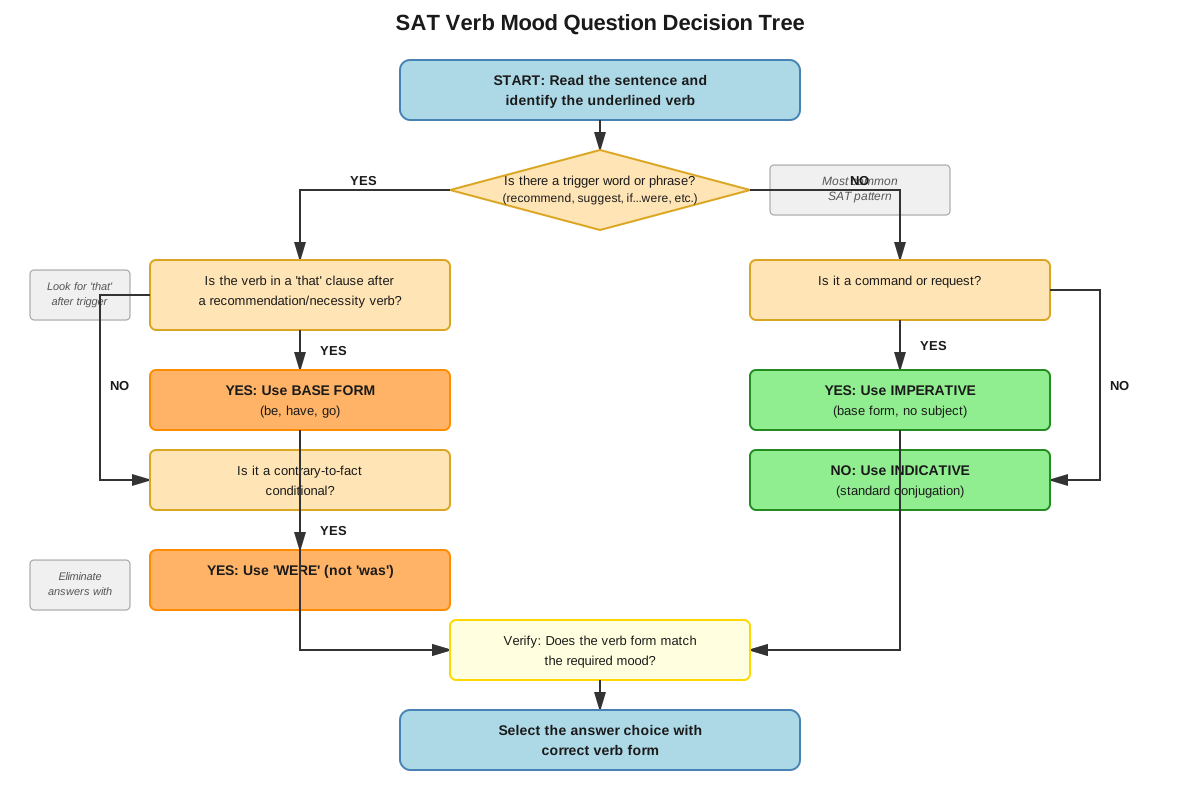
Step 1: Scan for trigger words
Before reading all answer choices, identify whether the sentence contains subjunctive triggers:
- Recommendation/demand verbs (recommend, suggest, require, insist, demand, propose, request, urge)
- Necessity adjectives in "it is [adjective] that" structures (essential, necessary, important, crucial, vital)
- "If" clauses with conditional results (would, could, might in the main clause)
- Wish expressions (wish, suppose, imagine)
Step 2: Determine the required mood
If triggers are present, subjunctive is likely required. If absent, indicative is probably correct.
Step 3: Apply the appropriate rule
- For recommendation/necessity contexts: base form verb (no -s, no helping verbs)
- For contrary-to-fact conditions: "were" for all subjects
- For wishes: "were" or past subjunctive forms
Step 4: Eliminate incorrect options
- Cross out options with -s endings after subjunctive triggers
- Eliminate "was" in contrary-to-fact conditions
- Remove options with "should," "would," or "will" in subjunctive contexts
Trigger Words and Phrases to Watch For
High-Alert Triggers: When you see these words, immediately consider whether subjunctive mood is required: - Recommendation verbs: recommend, suggest, propose, insist, demand, require, request, ask, urge, mandate - Necessity phrases: "it is essential that," "it is necessary that," "it is important that," "it is crucial that" - Contrary-to-fact signals: "if" + conditional result with "would/could/might" - Wish expressions: "I wish," "suppose that," "imagine if"
Process-of-Elimination Tips
- If you see a recommendation verb, eliminate any option with -s on the following verb: "The teacher insists that he arrive" (not "arrives")
- In "if" clauses with "would" in the result, eliminate "was" for subjunctive contexts: "If I were" (not "was") when expressing hypotheticals
- Eliminate options with "should" after American English trigger verbs: "I suggest that she attend" (not "should attend")
- Trust the base form in formal contexts: When in doubt between a base form and an inflected form after trigger words, choose the base form
Time Allocation Advice
Verb mood questions should take 30-45 seconds each. They're typically straightforward once you identify the trigger word. Don't overthink these questions—the SAT tests standard rules, not exceptions or ambiguous cases. If you've identified a clear trigger word, confidently apply the rule and move forward.
Memory Techniques
The RINS Mnemonic for Subjunctive Triggers
Recommend, Insist, Necessary, Suggest
When you see RINS words, use the base form verb in the following clause.
Example: "The doctor Recommends that he take (base form) the medication."
The "Were-Wolf" Visualization
Imagine a werewolf transformation as a metaphor for contrary-to-fact conditions. Just as a werewolf isn't real (it's hypothetical), contrary-to-fact conditions describe unreal situations. Both require "were":
- "If I were a werewolf..." (hypothetical, not real)
- "If the data were accurate..." (contrary to fact, not actually accurate)
The werewolf is always "were," never "was"—just like hypothetical conditions.
The "Base Jump" Acronym
Be careful with
All verbs after
Suggestions and
Essential statements—
Just
Use
Main form (base form)
Precisely
This reminds you that after suggestions and "essential" statements, jump straight to the base form without adding -s or helping verbs.
The "If-Then-Were" Pattern
For contrary-to-fact conditions, remember this rhythm:
"If [subject] were [adjective/noun], then [subject] would [verb]"
Example: "If I were president, then I would change the policy."
The pattern helps you remember that "were" pairs with "would" in hypothetical structures.
Summary
Verb mood is a grammatical feature indicating the speaker's attitude toward an action or state, with three primary moods in English: indicative (facts and questions), imperative (commands), and subjunctive (hypotheticals, wishes, and recommendations). The SAT primarily tests the subjunctive mood, which appears in four key contexts: after recommendation/demand verbs (recommend, suggest, require, insist), after necessity adjectives in "it is [adjective] that" structures, in contrary-to-fact conditional sentences, and in expressions of wishes. The subjunctive uses the base form of verbs (without -s for third person singular) in recommendation contexts and "were" for all subjects in hypothetical conditions. Common errors include using indicative forms where subjunctive is required, using "was" instead of "were" in contrary-to-fact conditions, and adding unnecessary helping verbs like "should" or "would." Success on SAT verb mood questions requires recognizing trigger words, applying the appropriate subjunctive form, and eliminating options that violate formal grammatical standards.
Key Takeaways
- Verb mood indicates attitude or intent; the SAT focuses primarily on subjunctive mood in formal writing contexts
- After recommendation verbs (recommend, suggest, require, insist, demand), always use the base form of the verb without -s or helping verbs
- In contrary-to-fact conditions, use "were" for all subjects, including singular subjects like "I," "he," "she," or "it"
- The phrase "it is essential/necessary/important/crucial that" triggers subjunctive mood with base form verbs
- Eliminate answer choices containing "should," "would," or "will" in subjunctive contexts following American English conventions
- Distinguish between real past possibilities (use "was") and hypothetical situations (use "were") in conditional sentences
- Trigger word recognition is the key skill—once identified, apply the standard subjunctive rules confidently
Related Topics
Verb Tense Consistency: Understanding how verb tenses must remain consistent within and across sentences builds on mood knowledge, as both features affect verb form selection. Mastering mood helps distinguish between tense shifts (time changes) and mood requirements (attitude/intent indicators).
Subject-Verb Agreement: The subjunctive mood creates apparent exceptions to standard agreement rules, particularly in present subjunctive where third-person singular subjects don't take -s endings. Solid agreement knowledge helps students recognize when subjunctive overrides typical patterns.
Conditional Sentences: Complete mastery of conditional structures requires understanding both subjunctive mood (in "if" clauses) and conditional mood (in result clauses). This topic extends mood knowledge to complex sentence patterns.
Parallel Structure: When multiple verbs appear in a series, maintaining consistent mood (along with tense and voice) ensures parallelism. Mood mastery supports recognizing and correcting parallelism errors.
Formal vs. Informal Register: Understanding when subjunctive is required versus when indicative is acceptable helps students navigate questions about tone, style, and appropriateness in different writing contexts.
Practice CTA
Now that you've mastered the core concepts of verb mood, it's time to reinforce your learning through active practice. Attempt the practice questions to apply these rules in SAT-style contexts, and use the flashcards to drill trigger words and subjunctive forms until recognition becomes automatic. Remember: verb mood questions are highly predictable on the SAT—once you've internalized the trigger words and rules, these become quick, confident points on test day. Your investment in mastering this topic will pay dividends across multiple questions on every SAT administration!
Sign up free to keep reading
Create a free AnvayaPrep account to finish this SAT guide on Verb mood — plus flashcards and practice questions.