Overview
The distinction between who vs whom represents one of the most frequently tested grammatical concepts in the SAT Reading and Writing section. This pronoun usage rule challenges students because it requires understanding both grammatical function and sentence structure—skills that extend far beyond simple memorization. While many native English speakers struggle with this distinction in everyday conversation, the SAT consistently tests whether students can identify the correct pronoun based on its role within a sentence.
Mastering sat who vs whom questions is essential for achieving a competitive score on the rw (Reading and Writing) section. These questions typically appear 1-3 times per test and are considered medium-difficulty, meaning they separate average scorers from high achievers. The College Board uses these questions to assess whether students understand subject versus object function, a foundational grammatical concept that underlies many other sentence structure questions. Students who can confidently distinguish between who and whom demonstrate command of formal written English—precisely what colleges expect from incoming students.
This topic connects directly to broader concepts in Form, Structure, and Sense, particularly pronoun case, sentence structure analysis, and grammatical function. Understanding who versus whom requires recognizing how pronouns operate within clauses, which builds the analytical skills needed for more complex questions about sentence boundaries, modifier placement, and parallel structure. The ability to identify whether a pronoun serves as a subject or object becomes a transferable skill that enhances overall grammatical reasoning throughout the Reading and Writing section.
Learning Objectives
- [ ] Identify key features of who vs whom in SAT questions
- [ ] Explain how who vs whom appears on the SAT and what grammatical principles are being tested
- [ ] Apply who vs whom rules to answer SAT-style questions accurately and efficiently
- [ ] Distinguish between subject and object pronouns in complex sentence structures
- [ ] Recognize prepositions and verbs that signal the need for "whom"
- [ ] Analyze dependent clauses to determine correct pronoun case
- [ ] Evaluate answer choices by substituting he/him or she/her to verify pronoun case
Prerequisites
- Basic sentence structure: Understanding subjects, verbs, and objects is essential because who/whom selection depends entirely on grammatical function within the sentence
- Pronoun fundamentals: Familiarity with personal pronouns (I/me, he/him, she/her, they/them) provides the foundation for understanding pronoun case
- Clause recognition: Ability to identify independent and dependent clauses helps determine the pronoun's function within its specific clause
- Preposition awareness: Knowing common prepositions (to, for, with, by, from) is crucial since prepositions always take object pronouns
Why This Topic Matters
In formal written English—the standard tested on the SAT—the who/whom distinction signals grammatical precision and attention to linguistic detail. While this distinction has relaxed in casual speech, academic writing, professional communication, and standardized tests maintain strict adherence to these rules. Students who master this concept demonstrate readiness for college-level writing where grammatical accuracy directly impacts credibility and clarity.
On the SAT, who versus whom questions appear with notable frequency, typically 1-3 times per Reading and Writing section. These questions carry the same weight as any other grammar question, making them high-value targets for score improvement. The College Board particularly favors testing this concept in complex sentences with multiple clauses, prepositional phrases, or interrupting elements that obscure the pronoun's grammatical function. Questions often embed the pronoun choice within sophisticated academic prose, requiring students to parse sentence structure while maintaining reading comprehension.
Common SAT presentations include: pronouns following prepositions ("to whom," "for whom"), pronouns in relative clauses ("the scientist who/whom discovered"), pronouns in questions ("Who/Whom should we contact?"), and pronouns separated from their verbs by intervening phrases. The test writers deliberately create sentences where the incorrect choice "sounds right" to students who rely on intuition rather than grammatical analysis. This makes systematic understanding—not just ear-based judgment—absolutely essential for consistent accuracy.
Core Concepts
Subject vs. Object Function
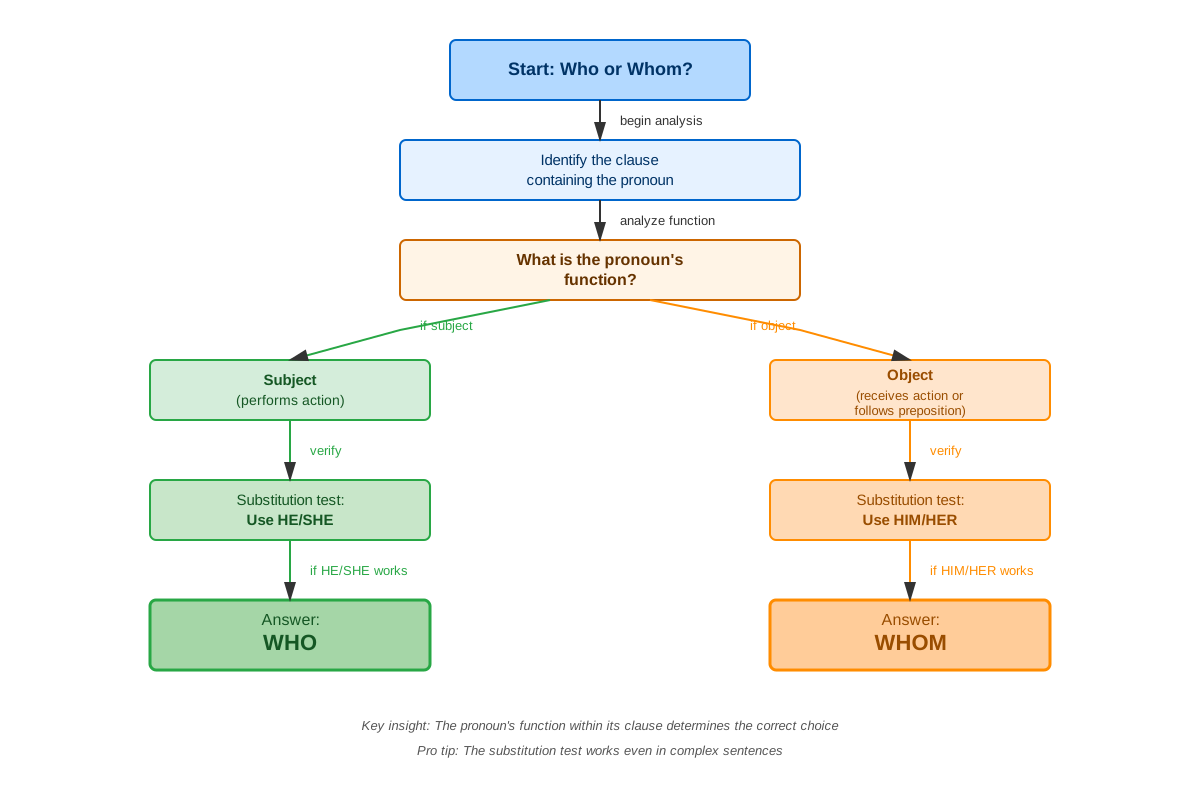
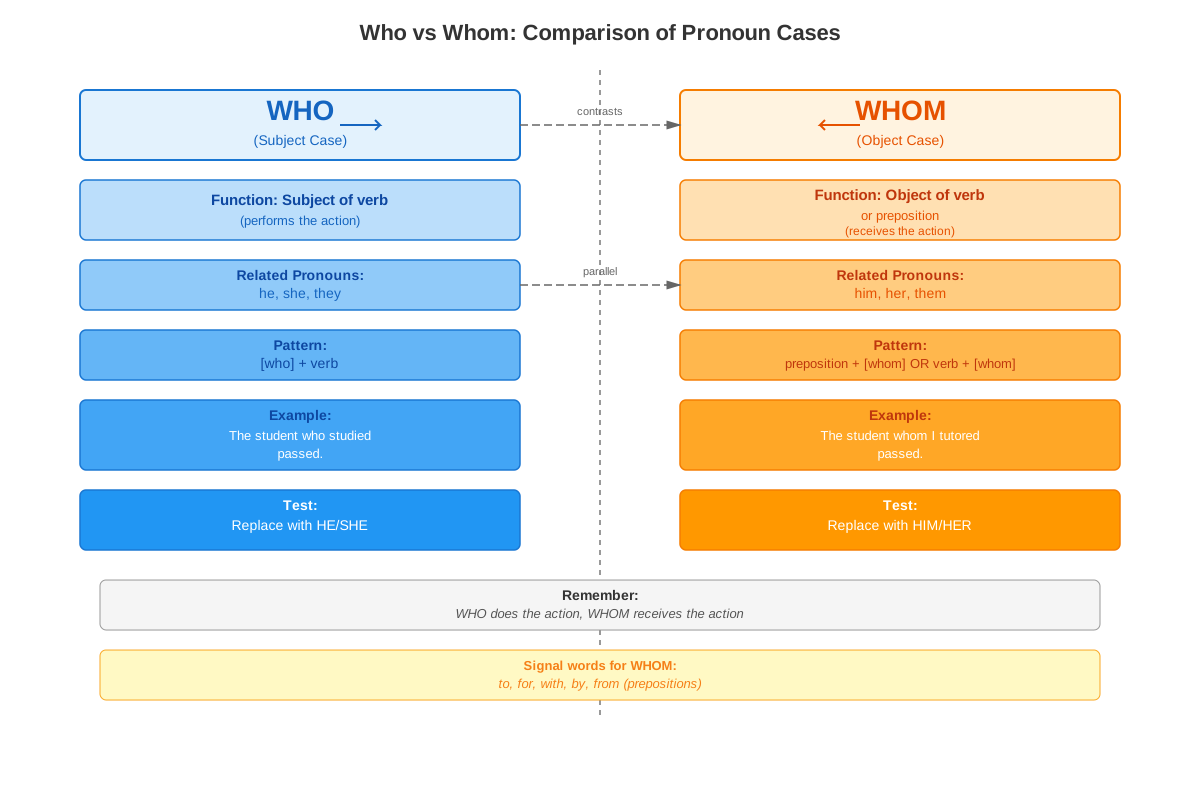
The fundamental principle underlying who vs whom is pronoun case: who functions as a subject pronoun (like he, she, they), while whom functions as an object pronoun (like him, her, them). A subject performs the action of a verb, while an object receives the action or follows a preposition. This distinction determines which pronoun form is grammatically correct in any given context.
Consider the parallel with other pronouns: just as we say "He called" (not "Him called") and "I called him" (not "I called he"), we use "who" when the pronoun performs an action and "whom" when it receives an action. The challenge arises because who/whom often appears in complex sentences where identifying the grammatical function requires careful analysis.
The Subject Pronoun: Who
Who serves as the subject of a verb—the entity performing the action. In the sentence "Who wrote this report?", "who" is the subject performing the action of writing. Similarly, in "The researcher who conducted the study received an award," "who" is the subject of "conducted" within the relative clause.
Key indicators that signal the need for "who":
- The pronoun directly precedes a verb it performs
- The pronoun can be replaced with he, she, or they
- The pronoun introduces a question asking about the performer of an action
- The pronoun begins a relative clause where it serves as the clause's subject
The Object Pronoun: Whom
Whom functions as an object—either the direct object of a verb or the object of a preposition. In "Whom did you contact?", "whom" receives the action of contacting. In "The colleague to whom I sent the email," "whom" serves as the object of the preposition "to."
Key indicators that signal the need for "whom":
- The pronoun follows a preposition (to, for, with, by, from, about, etc.)
- The pronoun can be replaced with him, her, or them
- The pronoun receives the action of a verb
- A complete subject and verb appear before the pronoun in a question
The Substitution Test
The most reliable method for determining correct pronoun case involves the substitution test: replace who/whom with he/him (or she/her, they/them) and observe which sounds correct. If "he" works, use "who"; if "him" works, use "whom." Both pairs follow identical case patterns: he/who are subjects, him/whom are objects.
Example: "The author (who/whom) we interviewed was fascinating."
- Test: "We interviewed he" or "We interviewed him"?
- "We interviewed him" is correct
- Therefore: "The author whom we interviewed was fascinating"
This test works because it transforms the question into a simpler structure where native English speakers can more easily recognize correct pronoun case.
Prepositions Always Take Objects
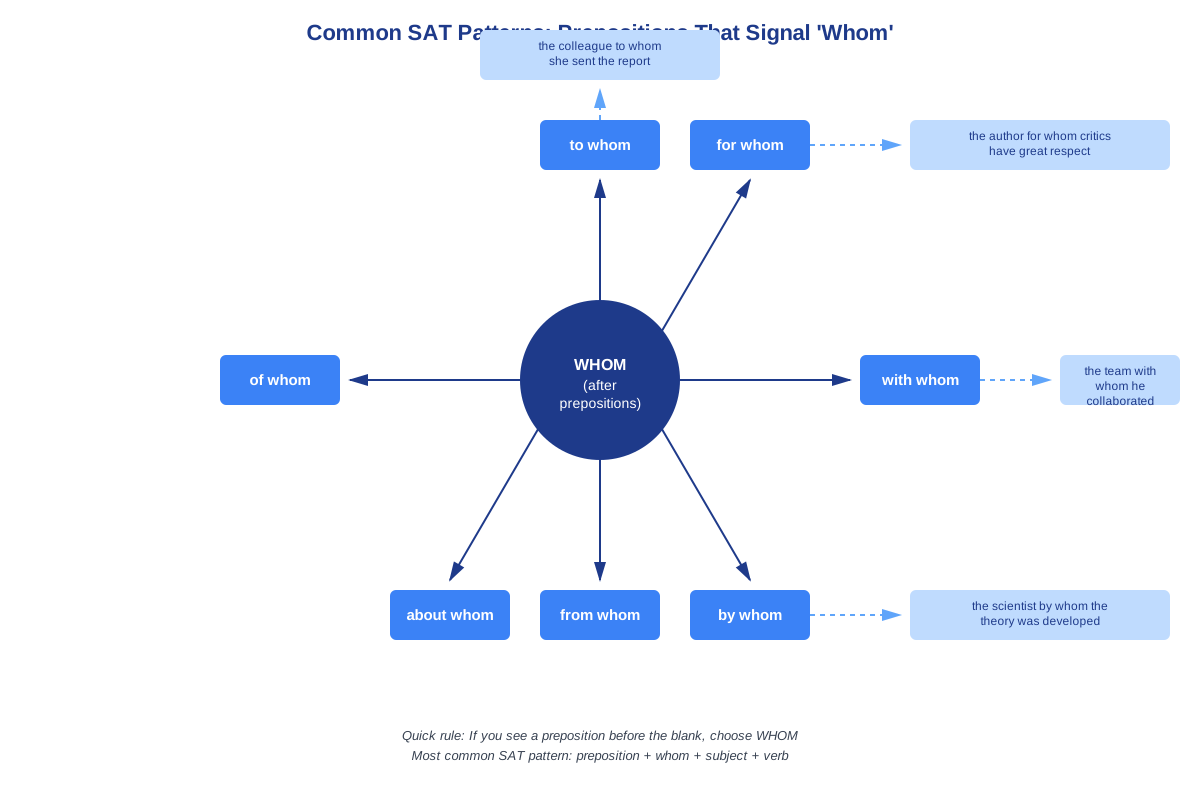
A critical rule: prepositions always require object pronouns. Any pronoun immediately following a preposition must be "whom," never "who." Common prepositional phrases include: to whom, for whom, with whom, by whom, from whom, about whom, and of whom.
Example: "The scientist to (who/whom) the award was given..."
- "To" is a preposition
- Prepositions require object pronouns
- Therefore: "The scientist to whom the award was given"
Relative Clauses and Embedded Structures
SAT questions frequently test who/whom in relative clauses—dependent clauses that modify nouns. The pronoun's function within its own clause determines the correct choice, regardless of the clause's function in the larger sentence.
Example: "She is the candidate (who/whom) most voters trust."
- Within the relative clause "most voters trust," the pronoun is the object of "trust"
- Test: "Most voters trust she" or "Most voters trust her"?
- "Most voters trust her" is correct
- Therefore: "She is the candidate whom most voters trust"
Interrupting Elements
The SAT often inserts phrases between the pronoun and its verb to obscure the grammatical relationship. These interrupting elements must be mentally removed to identify the pronoun's true function.
Example: "The researcher (who/whom), according to several sources, made the discovery..."
- Remove the interrupting phrase: "The researcher (who/whom) made the discovery"
- Test: "He made the discovery" or "Him made the discovery"?
- "He made the discovery" is correct
- Therefore: "The researcher who, according to several sources, made the discovery"
Question Formation
In questions, word order often inverts, placing the pronoun before the subject and verb. Mentally rearrange the question into statement form to clarify the pronoun's function.
Example: "(Who/Whom) did the committee select?"
- Rearrange: "The committee did select (who/whom)"
- Test: "The committee did select he" or "The committee did select him"?
- "The committee did select him" is correct
- Therefore: "Whom did the committee select?"
Concept Relationships
The who/whom distinction builds directly on pronoun case, which governs all pronoun forms (I/me, he/him, she/her, they/them, who/whom). Mastering this topic reinforces understanding of subject-verb relationships and object identification, both fundamental to sentence structure analysis.
The relationship flow: Sentence structure → Clause identification → Grammatical function → Pronoun case → Who vs whom
This topic connects forward to more advanced grammar concepts tested on the SAT, including pronoun-antecedent agreement (ensuring pronouns match their referents), relative clause punctuation (when to use commas with who/whom clauses), and parallel structure (maintaining consistent grammatical forms). Students who understand who/whom can more easily tackle questions about modifier placement because both require identifying what element a word or phrase relates to grammatically.
The substitution test strategy (using he/him to determine who/whom) parallels the approach for subject-verb agreement questions, where students substitute simpler subjects to clarify verb forms. This demonstrates how grammatical reasoning skills transfer across question types within the Reading and Writing section.
Quick check — test yourself on Who vs whom so far.
Try Flashcards →High-Yield Facts
⭐ Who is a subject pronoun; whom is an object pronoun—this is the foundational rule for all applications
⭐ Any pronoun following a preposition (to, for, with, by, from, about, of) must be whom
⭐ The substitution test (he/him, she/her, they/them) provides a reliable method for determining correct pronoun case
⭐ In relative clauses, the pronoun's function within its own clause determines whether to use who or whom
⭐ Interrupting phrases between the pronoun and verb do not affect the grammatical relationship—mentally remove them
- Questions often invert word order; rearrange into statement form to clarify the pronoun's function
- "Who" can be replaced with he, she, or they; "whom" can be replaced with him, her, or them
- The pronoun's role in the larger sentence does not determine case—only its function within its immediate clause matters
- SAT questions frequently place whom after verbs where it serves as the direct object
- Formal written English maintains the who/whom distinction even though casual speech often uses "who" for both functions
- The phrase "to who" is always incorrect; the correct form is always "to whom"
- When a pronoun both begins a clause and performs that clause's action, use "who"
Common Misconceptions
Misconception: "Whom" sounds more formal and educated, so it should be used in sophisticated writing regardless of grammatical function.
Correction: Formality does not determine pronoun choice; grammatical function does. Using "whom" incorrectly (as a subject) is a grammatical error that undermines credibility. Always base the choice on whether the pronoun serves as subject or object.
Misconception: If "whom" appears in a question, it must be correct because questions use more formal language.
Correction: Questions follow the same grammatical rules as statements. "Who called you?" is correct (who is the subject of called), while "Whom did you call?" is correct (whom is the object of call). The pronoun's function, not the sentence type, determines the correct form.
Misconception: When a pronoun follows a verb, it should always be "whom" because objects follow verbs.
Correction: Not all pronouns following verbs are objects. In "The scientist who discovered the cure was honored," "who" follows "scientist" but serves as the subject of "discovered" within the relative clause. Always identify the pronoun's function within its own clause.
Misconception: The substitution test doesn't work for complex sentences with multiple clauses.
Correction: The substitution test works for any sentence structure when applied correctly. The key is substituting within the same clause where who/whom appears, not in the main sentence. Isolate the relevant clause, perform the substitution, and the correct answer becomes clear.
Misconception: "Whom" is becoming obsolete, so the SAT accepts "who" in all contexts.
Correction: The SAT tests formal written English, which maintains the who/whom distinction. While casual speech may blur this difference, standardized tests assess knowledge of standard grammatical rules. The SAT will mark "who" as incorrect when "whom" is grammatically required.
Worked Examples
Example 1: Relative Clause with Interrupting Element
Question: The historian (who/whom), despite facing significant criticism, published groundbreaking research on ancient civilizations.
Step 1: Identify the clause structure
The pronoun appears in a relative clause modifying "historian." An interrupting phrase ("despite facing significant criticism") separates the pronoun from its verb.
Step 2: Remove the interrupting element
"The historian (who/whom) published groundbreaking research"
Step 3: Apply the substitution test
Replace who/whom with he/him: "He published research" or "Him published research"?
"He published research" is correct.
Step 4: Select the answer
Since "he" (subject pronoun) works, use "who" (subject pronoun).
Answer: who
Reasoning: The pronoun serves as the subject of "published" within the relative clause. The interrupting phrase creates distance between subject and verb but doesn't change the grammatical relationship. This example demonstrates why students must identify the pronoun's function within its immediate clause, ignoring distracting elements.
Example 2: Prepositional Phrase in a Question
Question: (Who/Whom) should the committee award the grant to?
Step 1: Identify the preposition
The sentence ends with the preposition "to," which requires an object.
Step 2: Recognize the prepositional phrase
Although the preposition appears at the sentence's end (a common structure in questions), it still governs the pronoun at the beginning. The complete prepositional phrase is "to (who/whom)."
Step 3: Apply the preposition rule
Prepositions always take object pronouns. Since "to" is a preposition, the pronoun must be "whom."
Step 4: Verify with substitution
Rearrange: "The committee should award the grant to (he/him)?"
"The committee should award the grant to him" is correct.
Answer: Whom
Reasoning: Despite the inverted question structure, the pronoun functions as the object of the preposition "to." This example illustrates how SAT questions test whether students can identify grammatical relationships even when word order obscures them. The preposition rule provides a quick, reliable solution: any pronoun following a preposition must be "whom."
Exam Strategy
When approaching sat who vs whom questions on the Reading and Writing section, implement this systematic process:
Step 1: Locate the pronoun and identify its clause
Determine whether the pronoun appears in the main clause or a dependent clause. The pronoun's function within its immediate clause—not the entire sentence—determines the correct choice.
Step 2: Check for prepositions first
Scan for prepositions (to, for, with, by, from, about, of) immediately before or after the pronoun. If a preposition governs the pronoun, "whom" is always correct. This quick check eliminates the need for further analysis in many questions.
Step 3: Remove interrupting elements
Mentally delete any phrases between the pronoun and its verb (such as "according to sources," "despite criticism," or "in many cases"). These insertions obscure the grammatical relationship but don't affect pronoun case.
Step 4: Apply the substitution test
Replace who/whom with he/him (or she/her, they/them) within the same clause. Rearrange questions into statement form if necessary. The pronoun that sounds correct indicates the answer: he→who, him→whom.
Trigger words and phrases to watch for:
- Prepositions: to, for, with, by, from, about, of (always signal "whom")
- Relative clause introducers: "the person who/whom," "the scientist who/whom"
- Question inversions: "Who/Whom did," "Who/Whom should"
- Interrupting phrases: "according to," "despite," "in addition to"
Process-of-elimination tips:
- Eliminate "who" immediately if a preposition directly precedes or governs the pronoun
- Eliminate "whom" if the pronoun directly precedes a verb it performs (with no intervening subject)
- If both choices seem possible, the sentence likely contains an interrupting element—remove it and retest
Time allocation:
These questions should take 20-30 seconds once the strategy is mastered. Spend 5 seconds identifying the structure, 10 seconds applying the substitution test, and 5 seconds confirming the answer. Avoid overthinking—the substitution test provides a definitive answer when applied correctly.
Exam Tip: If you're unsure, look for a preposition. Prepositional phrases account for approximately 60% of whom usage on the SAT, making this the highest-yield pattern to recognize.
Memory Techniques
The "M" Mnemonic:
Who = subject (no "m")
Whom = object (has "m" like "him," "them")
Remember: "Whom" and "him" both end in "m"—both are object pronouns.
The Preposition Rule Rhyme:
"After to, for, with, or by,
Whom's the word—don't ask me why!"
This rhyme reinforces that prepositions always take "whom."
The Substitution Chant:
"He or him? She or her?
If it's him, whom will occur.
If it's he, who's what you need—
Follow this and you'll succeed!"
Visual Association:
Picture "WHO" as a person standing upright (subject position, performing action)
Picture "WHOM" as a person receiving something (object position, receiving action)
The extra "m" in whom represents the extra element (the object) being acted upon.
The Question Flip:
For questions, remember: "Flip it to a statement, then you'll see—he means who, and him means whom, guaranteed!"
Summary
The distinction between who and whom represents a fundamental grammatical concept consistently tested on the SAT Reading and Writing section. Who functions as a subject pronoun (parallel to he, she, they), while whom functions as an object pronoun (parallel to him, her, them). The key to mastering this topic lies in identifying the pronoun's grammatical function within its immediate clause, not its role in the larger sentence. The substitution test—replacing who/whom with he/him to determine which sounds correct—provides a reliable method for selecting the right answer. Prepositions always require whom, making this the highest-yield pattern to recognize. SAT questions frequently obscure the grammatical relationship through interrupting phrases, complex clause structures, and inverted question formats, but systematic analysis reveals the correct choice. Students who understand subject versus object function and apply the substitution test consistently can achieve perfect accuracy on these medium-difficulty questions that separate competitive scorers from average performers.
Key Takeaways
- Who serves as a subject pronoun; whom serves as an object pronoun—this fundamental distinction underlies all applications
- The substitution test (he/him, she/her, they/them) provides a foolproof method for determining correct pronoun case in any sentence structure
- Prepositions (to, for, with, by, from, about, of) always require whom—this pattern accounts for the majority of whom usage on the SAT
- Analyze the pronoun's function within its immediate clause, ignoring interrupting phrases and the pronoun's role in the larger sentence
- In questions, rearrange into statement form to clarify grammatical relationships before applying the substitution test
- The who/whom distinction remains strictly enforced in formal written English and on standardized tests, regardless of casual speech patterns
- Mastering this topic builds transferable skills in grammatical analysis that enhance performance across all sentence structure questions
Related Topics
Pronoun Case (I/me, he/him, she/her, they/them): Understanding the broader system of pronoun case provides the foundation for who/whom mastery and extends to other pronoun selection questions on the SAT.
Relative Clauses and Punctuation: Who and whom frequently introduce relative clauses, making knowledge of when to use commas with these clauses essential for comprehensive grammar mastery.
Subject-Verb Agreement: Identifying subjects and verbs—the same skill required for who/whom questions—is fundamental to subject-verb agreement questions, another high-frequency SAT topic.
Pronoun-Antecedent Agreement: Once students master which pronoun form to use (who vs. whom), ensuring that pronouns agree with their antecedents in number and gender becomes the next level of pronoun mastery.
Sentence Structure and Clause Analysis: The ability to parse complex sentences into clauses and identify grammatical functions transfers directly to questions about fragments, run-ons, and modifier placement.
Practice CTA
Now that you've mastered the grammatical principles underlying who versus whom, it's time to cement your understanding through active practice. The concepts you've learned—subject versus object function, the substitution test, and preposition recognition—become automatic only through repeated application. Challenge yourself with the practice questions designed specifically to mirror SAT question formats and difficulty levels. Each question you work through strengthens your analytical skills and builds the confidence needed to approach these questions efficiently on test day. Remember: understanding the rules is the first step, but consistent practice transforms knowledge into the quick, accurate performance that elevates your score. You've invested the time to learn this high-yield topic—now maximize that investment by applying these strategies to real SAT-style questions!
Sign up free to keep reading
Create a free AnvayaPrep account to finish this SAT guide on Who vs whom — plus flashcards and practice questions.