Overview
Pronoun case is one of the most frequently tested grammar concepts in the SAT Reading and Writing (RW) section. Understanding pronoun case means knowing which form of a pronoun to use based on its grammatical function in a sentence—whether it acts as a subject, object, or possessive. The SAT tests this concept because proper pronoun usage is fundamental to clear, effective communication and demonstrates command of Standard English conventions.
On the SAT, sat pronoun case questions appear regularly in the Standard English Conventions domain, typically presenting sentences where students must choose the correct pronoun form from multiple options. These questions assess whether students can identify when to use subjective pronouns (I, he, she, we, they), objective pronouns (me, him, her, us, them), or possessive pronouns (my, his, her, our, their, mine, hers, ours, theirs). The College Board considers pronoun case mastery essential because errors in pronoun usage can obscure meaning and mark writing as non-standard.
This topic connects directly to broader concepts in Form, Structure, and Sense, particularly sentence structure, subject-verb agreement, and grammatical relationships between sentence elements. Mastering pronoun case requires understanding how pronouns function within clauses, how they relate to verbs and prepositions, and how compound structures affect pronoun selection. This foundational skill supports comprehension of more complex grammatical concepts and improves overall writing clarity.
Learning Objectives
- [ ] Identify key features of pronoun case
- [ ] Explain how pronoun case appears on the SAT
- [ ] Apply pronoun case to answer SAT-style questions
- [ ] Distinguish between subjective, objective, and possessive pronoun forms in context
- [ ] Recognize and correct pronoun case errors in compound structures
- [ ] Evaluate pronoun case in clauses with implied or omitted words
- [ ] Analyze pronoun case following prepositions and linking verbs
Prerequisites
- Basic parts of speech: Understanding what pronouns are and how they replace nouns is essential for recognizing when case rules apply
- Subject and predicate identification: Knowing how to identify the subject and verb of a sentence helps determine whether a pronoun functions as a subject or object
- Clause structure: Recognizing independent and dependent clauses enables proper pronoun case selection in complex sentences
- Prepositions: Familiarity with prepositional phrases helps identify when objective case pronouns are required
Why This Topic Matters
Pronoun case errors are among the most common grammatical mistakes in both formal and informal writing, making this a practical skill beyond test preparation. In professional communication, academic writing, and formal correspondence, correct pronoun usage signals education and attention to detail. Employers and educators consistently cite proper grammar as a critical skill, and pronoun case mastery demonstrates linguistic competence.
On the SAT, pronoun case questions appear in approximately 2-4 questions per test, representing a significant portion of the Standard English Conventions questions. These questions typically appear as multiple-choice items where students must select the grammatically correct pronoun from four options. The College Board reports that pronoun case questions have moderate difficulty, with approximately 60-70% of test-takers answering them correctly, meaning they offer excellent opportunities for score improvement.
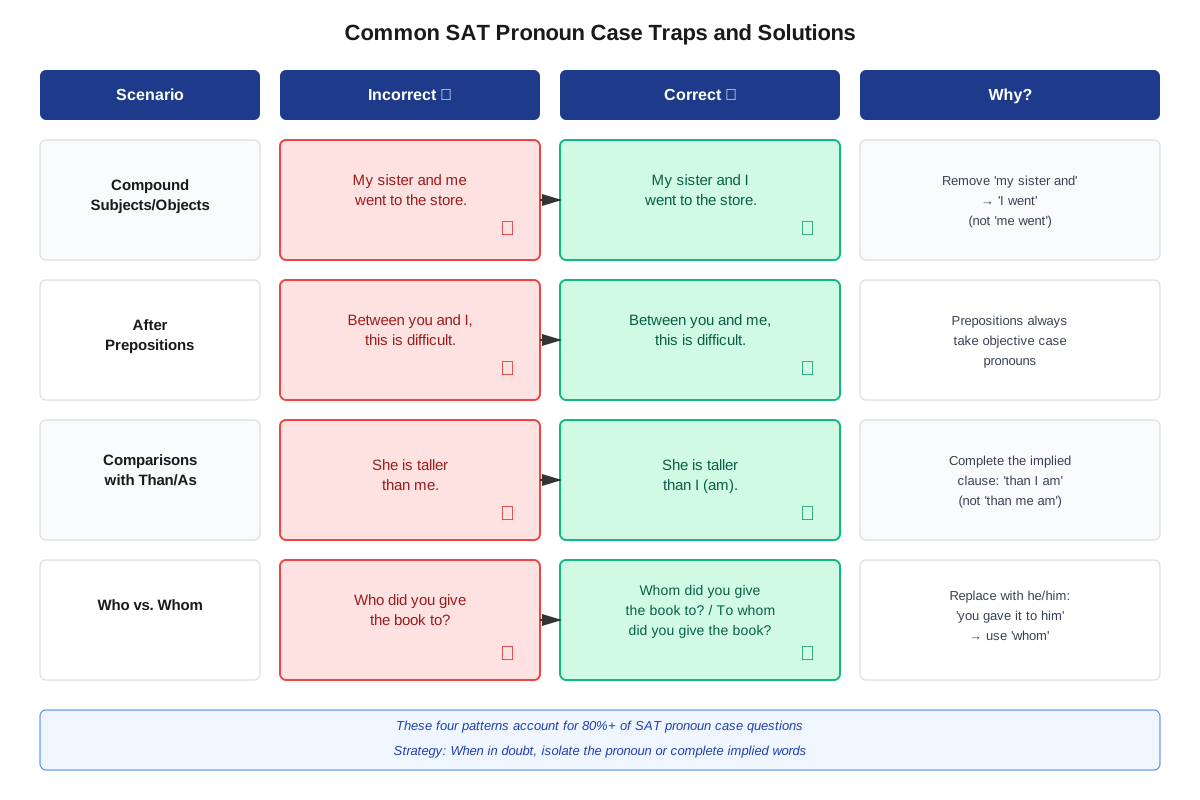
The SAT presents pronoun case challenges in various contexts: compound subjects and objects ("My sister and I/me went"), pronouns after prepositions ("between you and I/me"), pronouns in comparisons with implied words ("She is taller than I/me"), and pronouns following linking verbs ("It was I/me"). Understanding these patterns enables students to quickly identify and correct errors, improving both speed and accuracy on test day.
Core Concepts
The Three Pronoun Cases
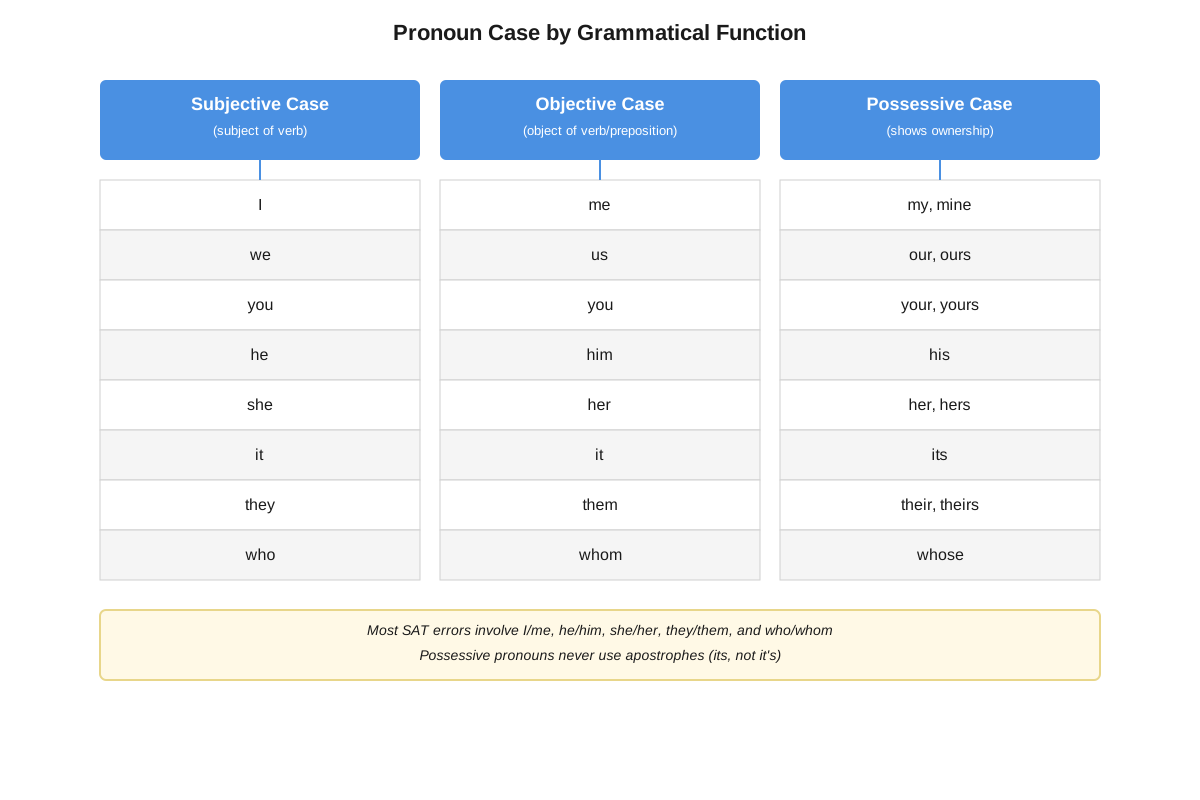
Pronoun case refers to the form a pronoun takes based on its grammatical function within a sentence. English has three distinct cases: subjective (nominative), objective (accusative), and possessive (genitive). Each case serves specific grammatical roles, and using the wrong case creates errors that the SAT consistently tests.
Subjective case pronouns function as the subject of a verb—the entity performing the action or being described. The subjective pronouns are: I, you, he, she, it, we, they, who, and whoever. These pronouns answer the question "Who or what is performing the action?" For example: "She completed the assignment" or "They arrived early."
Objective case pronouns function as objects—receiving the action of a verb (direct object), receiving the indirect benefit of an action (indirect object), or following a preposition (object of preposition). The objective pronouns are: me, you, him, her, it, us, them, whom, and whomever. For example: "The teacher praised him" (direct object), "She gave me the book" (indirect object), or "between you and me" (object of preposition).
Possessive case pronouns show ownership or relationship. They come in two forms: possessive determiners (my, your, his, her, its, our, their, whose) that modify nouns, and possessive pronouns (mine, yours, his, hers, its, ours, theirs, whose) that stand alone. For example: "This is my book" (determiner) versus "This book is mine" (standalone pronoun).
Pronoun Case in Compound Structures
Compound structures—where two or more nouns or pronouns are joined by "and" or "or"—create the most common pronoun case errors on the SAT. The key principle is that each pronoun in a compound structure must use the same case it would use if it appeared alone.
To determine correct pronoun case in compounds, mentally remove the other element and test the pronoun alone. For example, in "My brother and I/me went to the store," remove "My brother and" to get "I went to the store" (correct) versus "Me went to the store" (incorrect). Therefore, "My brother and I" is correct.
This strategy works for both subjective and objective cases. In "The teacher praised Sarah and I/me," removing "Sarah and" yields "The teacher praised me" (correct) versus "The teacher praised I" (incorrect). Therefore, "Sarah and me" is correct. The SAT frequently tests this pattern because many speakers incorrectly use "and I" in all contexts, hypercorrecting based on the common correction of "me and my friend" to "my friend and I."
Pronouns After Prepositions
Prepositions (such as between, with, for, to, from, by, about, among) always take objective case pronouns as their objects. This rule is absolute and creates a high-yield test pattern. Common prepositions that appear in SAT questions include:
| Preposition | Correct Usage | Incorrect Usage |
|---|---|---|
| between | between you and me | between you and I |
| with | with him and her | with he and she |
| for | for us students | for we students |
| to | to whom | to who |
| among | among them | among they |
The phrase "between you and I" is one of the most common errors in spoken English and appears frequently on the SAT. The correct form is always "between you and me" because "between" is a preposition requiring objective case pronouns.
Pronouns in Comparisons
Comparisons using "than" or "as" often have implied (omitted) words that determine correct pronoun case. The pronoun case depends on whether the pronoun functions as a subject or object in the implied complete clause.
Consider: "She is taller than I/me." The complete thought is "She is taller than I am [tall]," making "I" the subject of the implied verb "am." Therefore, "than I" is correct. However, in "The award surprised her more than me/I," the complete thought could be "The award surprised her more than [it surprised] me," making "me" the object of the implied verb "surprised." Context determines which interpretation is intended.
The SAT typically makes the intended meaning clear through context, but students must mentally complete the comparison to determine correct case. A useful strategy is to add the implied words and see which pronoun sounds natural.
Pronouns After Linking Verbs
Linking verbs (be, seem, appear, become, etc.) connect the subject to a subject complement that renames or describes it. Traditionally, formal grammar requires subjective case pronouns after linking verbs because the pronoun renames the subject. For example: "It was I who called" or "The winner is she."
However, modern usage increasingly accepts objective case in informal contexts ("It's me"), and the SAT reflects formal written standards. On the test, when a pronoun follows a linking verb and renames the subject, use subjective case. This pattern appears less frequently than other pronoun case questions but remains testable.
Who Versus Whom
The distinction between "who" (subjective) and "whom" (objective) follows the same principles as other pronouns. "Who" functions as a subject; "whom" functions as an object. To determine which to use, rearrange the clause into a statement and substitute he/him: if "he" fits, use "who"; if "him" fits, use "whom."
For example: "Who/Whom did you call?" Rearranged: "You did call him" (not "he"). Therefore, "whom" is correct. In "The person who/whom called left a message," rearranged: "He called" (not "him"). Therefore, "who" is correct.
The SAT tests this distinction moderately, particularly in relative clauses and questions. While "whom" is declining in casual speech, formal written English—the standard for the SAT—maintains the distinction.
Concept Relationships
Pronoun case connects fundamentally to sentence structure analysis. Understanding subjects and predicates → enables identification of subjective case pronouns → which distinguishes them from objective case pronouns used as objects. This relationship forms the foundation of all pronoun case decisions.
Compound structures → complicate pronoun case selection → requiring isolation of individual pronouns to determine correct case. This concept builds on basic pronoun case knowledge and represents the most common SAT test pattern.
Prepositions → always govern objective case pronouns → creating an absolute rule with no exceptions. This concept connects to prepositional phrase identification and object recognition.
Comparisons with implied words → require mental completion of elliptical clauses → to determine whether pronouns function as subjects or objects. This advanced concept combines pronoun case with clause structure understanding.
The who/whom distinction → parallels the he/him distinction → demonstrating that interrogative and relative pronouns follow the same case rules as personal pronouns. This connection helps students apply familiar patterns to less common pronoun types.
All these concepts ultimately serve the broader goal of Standard English Conventions mastery, which connects to effective communication and clear expression of ideas—central purposes of the SAT Reading and Writing section.
Quick check — test yourself on Pronoun case so far.
Try Flashcards →High-Yield Facts
⭐ Subjective case pronouns (I, he, she, we, they, who) function as subjects of verbs
⭐ Objective case pronouns (me, him, her, us, them, whom) function as objects of verbs and prepositions
⭐ All prepositions require objective case pronouns: "between you and me" is always correct; "between you and I" is always wrong
⭐ In compound structures, test each pronoun individually by removing the other element: "My friend and I went" (I went ✓) not "My friend and me went" (Me went ✗)
⭐ After linking verbs (is, was, seems), formal grammar requires subjective case pronouns: "It was I" not "It was me"
- Possessive pronouns (my, mine, your, yours, his, her, hers, its, our, ours, their, theirs) never use apostrophes
- "Who" functions as a subject; "whom" functions as an object—substitute he/him to test which is correct
- In comparisons with "than" or "as," mentally complete the implied clause to determine correct pronoun case
- The phrase "for we students" is incorrect; "for us students" is correct because "for" is a preposition requiring objective case
- When a pronoun appears before a gerund (verb form ending in -ing used as a noun), use possessive case: "I appreciated his helping" not "him helping"
Common Misconceptions
Misconception: "And I" is always correct in compound structures because "me" sounds uneducated. → Correction: Pronoun case depends on grammatical function, not position in the sentence. "The teacher praised Sarah and me" is correct because "me" is the object of "praised." Test by removing the other element: "The teacher praised me" is correct, while "The teacher praised I" is wrong.
Misconception: "Between you and I" sounds more formal and educated than "between you and me." → Correction: "Between" is a preposition, and all prepositions require objective case pronouns. "Between you and me" is the only grammatically correct form in Standard English, regardless of how formal the context.
Misconception: In comparisons, always use "than me" because it sounds natural. → Correction: Pronoun case in comparisons depends on the implied complete clause. "She is taller than I [am]" requires subjective case because "I" is the subject of the implied verb "am." Context determines whether subjective or objective case is correct.
Misconception: "Whom" is old-fashioned and can be replaced with "who" in all contexts. → Correction: While "whom" is declining in casual speech, the SAT tests formal written English where the who/whom distinction remains standard. "Whom did you call?" is correct because "whom" is the object of "call."
Misconception: Possessive pronouns like "its" and "theirs" need apostrophes to show possession. → Correction: Possessive pronouns never use apostrophes. "Its" (possessive) differs from "it's" (contraction of "it is"). "The dog wagged its tail" is correct; "the dog wagged it's tail" is wrong.
Misconception: After "to be" verbs, use whatever pronoun sounds natural in conversation. → Correction: The SAT tests formal written standards where subjective case pronouns follow linking verbs when they rename the subject. "It was she who won" follows formal grammar rules, even though "It was her who won" might sound more natural in speech.
Worked Examples
Example 1: Compound Structure with Preposition
Question: The scholarship committee awarded the grant to my lab partner and (I/me) for our collaborative research project.
Step 1: Identify the grammatical structure
The sentence contains a compound object of the preposition "to." The preposition "to" governs both "my lab partner" and the pronoun in question.
Step 2: Apply the preposition rule
All prepositions require objective case pronouns. Since "to" is a preposition, the pronoun must be in objective case.
Step 3: Test by isolation
Remove "my lab partner and" to test the pronoun alone: "The scholarship committee awarded the grant to me" (correct) versus "The scholarship committee awarded the grant to I" (incorrect).
Step 4: Verify the complete structure
"To my lab partner and me" uses objective case for both elements of the compound object, which is grammatically correct.
Answer: me
Connection to learning objectives: This example demonstrates identifying key features of pronoun case (objective case after prepositions) and applying pronoun case rules to answer SAT-style questions involving compound structures.
Example 2: Comparison with Implied Words
Question: The new training program benefited the experienced employees more than (we/us) recent hires.
Step 1: Identify the comparison structure
The sentence compares how much the training program benefited two groups: experienced employees and recent hires. The word "than" signals a comparison with potentially implied words.
Step 2: Determine the pronoun's function
The pronoun appears before the noun "recent hires," suggesting it modifies that noun. Consider what words might be implied: "more than [it benefited] us recent hires."
Step 3: Test both possibilities
If we complete the comparison as "more than we [were benefited]," the pronoun would be subjective. However, the structure "us recent hires" suggests the pronoun modifies the noun phrase, functioning as part of the object.
Step 4: Apply the appositive test
When a pronoun appears directly before a noun in this structure, use the case the pronoun would have if the noun were removed: "benefited us" (correct) versus "benefited we" (incorrect).
Step 5: Verify with the complete phrase
"More than us recent hires" is correct because "us" functions as part of the object of the implied verb "benefited."
Answer: us
Connection to learning objectives: This example demonstrates explaining how pronoun case appears on the SAT (in comparisons and before nouns) and evaluating pronoun case in clauses with implied or omitted words.
Exam Strategy
When approaching sat pronoun case questions on the RW section, follow this systematic process:
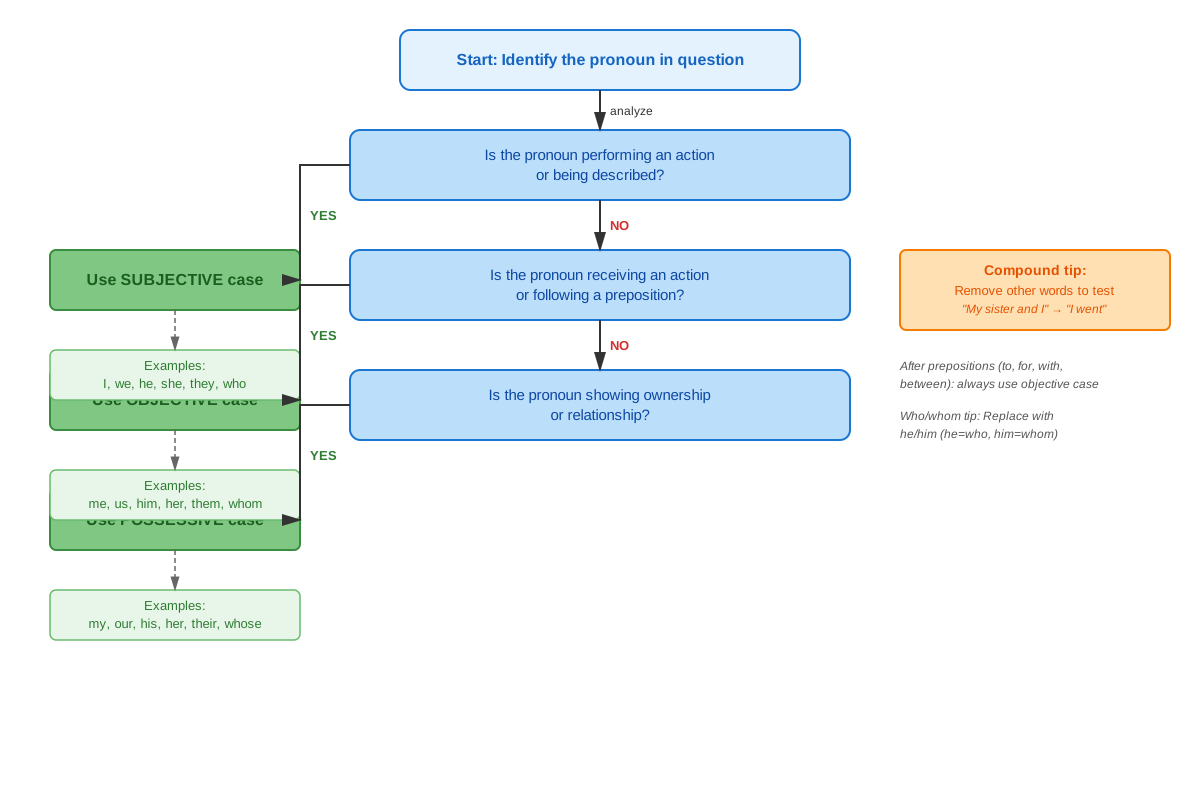
Step 1: Identify the pronoun's grammatical function
Determine whether the pronoun acts as a subject (performing an action), object (receiving an action or following a preposition), or possessive (showing ownership). This fundamental determination guides all subsequent decisions.
Step 2: Check for trigger structures
Watch for these high-yield patterns that frequently appear in SAT questions:
- Compound structures with "and" or "or" (test each element separately)
- Prepositions (always require objective case)
- Comparisons with "than" or "as" (complete the implied clause)
- Linking verbs (require subjective case in formal writing)
- Who/whom in questions or relative clauses (substitute he/him to test)
Step 3: Use the isolation technique
For compound structures, mentally remove the other element and test the pronoun alone. This technique eliminates the confusion that compounds create and makes the correct answer obvious.
Step 4: Trust formal grammar rules over conversational usage
The SAT tests Standard English conventions, which sometimes differ from casual speech. If an answer "sounds wrong" but follows formal grammar rules, it's likely correct. Conversely, "between you and I" might sound educated but violates preposition rules.
Step 5: Eliminate answers systematically
- First, eliminate any answer that violates absolute rules (objective case after prepositions)
- Second, eliminate answers that fail the isolation test in compounds
- Third, choose the answer that follows formal written standards
Exam Tip: Approximately 80% of SAT pronoun case questions involve either compound structures or prepositions. Mastering these two patterns will handle the vast majority of questions you encounter.
Time allocation: Pronoun case questions should take 20-30 seconds each. If you find yourself spending more than 45 seconds, apply the isolation technique and move forward. These questions test pattern recognition, not complex analysis.
Trigger words to watch for: between, with, for, to, among (prepositions); and, or (compounds); than, as (comparisons); who, whom (interrogatives/relatives); is, was, seems (linking verbs).
Memory Techniques
Preposition Pronoun Rule (PPR)
Remember: "Prepositions Prefer Objective Pronouns" or "Prepositions Pick Objective Pronouns." Every preposition requires objective case, no exceptions.
The Isolation Strategy
Create a mental image of physically removing one element from a compound structure, leaving the pronoun alone with the verb or preposition. Visualize erasing "my friend and" to reveal whether "I" or "me" works alone.
He/Him = Who/Whom
Remember this parallel: "He = Who" (both subjective, both end in vowel sounds) and "Him = Whom" (both objective, both end in 'm'). When testing who/whom, substitute he/him and match the ending sound.
SOAP for Pronoun Functions
- Subject = Subjective case (I, he, she, we, they, who)
- Object = Objective case (me, him, her, us, them, whom)
- After prepositions = Always objective
- Possessive = Never uses apostrophes (its, theirs, yours)
The "Than I Am" Expansion
For comparisons, mentally add "am" or another verb after "than I/me." If the sentence makes sense with the added verb, use subjective case: "She is taller than I [am]." If you need to add different words, reconsider the structure.
Compound Consistency Check
Both elements in a compound must use the same case. If you have "Sarah and [pronoun]," both must be subjective or both must be objective based on their function. They should be grammatically interchangeable.
Summary
Pronoun case mastery requires understanding that pronouns change form based on their grammatical function: subjective case (I, he, she, we, they, who) for subjects, objective case (me, him, her, us, them, whom) for objects, and possessive case for ownership. The SAT primarily tests pronoun case in compound structures, after prepositions, in comparisons with implied words, and in who/whom distinctions. The most reliable strategy is the isolation technique—testing each pronoun individually by removing other elements from compound structures. Absolute rules govern certain patterns: all prepositions require objective case pronouns, making "between you and me" always correct and "between you and I" always wrong. Understanding these patterns and applying systematic testing strategies enables students to quickly and accurately answer pronoun case questions, which appear 2-4 times per SAT test and represent significant scoring opportunities in the Standard English Conventions domain.
Key Takeaways
- Pronoun case depends on grammatical function: subjective for subjects, objective for objects and after prepositions, possessive for ownership
- Use the isolation technique for compound structures—remove other elements and test the pronoun alone with the verb or preposition
- All prepositions require objective case pronouns without exception: "between you and me," "with him and her," "for us students"
- In comparisons with "than" or "as," mentally complete the implied clause to determine whether the pronoun functions as subject or object
- The who/whom distinction parallels he/him: substitute these pronouns to determine correct case
- Trust formal grammar rules over conversational usage—the SAT tests Standard English conventions, not casual speech patterns
- Possessive pronouns never use apostrophes: its (not it's), theirs (not their's), yours (not your's)
Related Topics
Subject-Verb Agreement: Mastering pronoun case supports understanding subject-verb agreement because both require identifying sentence subjects and understanding how sentence elements relate grammatically. Pronoun case knowledge helps distinguish subjects from objects, which is essential for matching subjects with appropriate verb forms.
Pronoun-Antecedent Agreement: After mastering pronoun case, students should study how pronouns must agree with their antecedents in number, gender, and person. This topic builds on case knowledge by adding another layer of pronoun usage rules.
Relative Clauses: Understanding who/whom distinctions in pronoun case directly supports comprehension of relative clauses, where relative pronouns introduce dependent clauses and their case depends on their function within those clauses.
Parallel Structure: Pronoun case knowledge contributes to recognizing parallel structure because elements in parallel constructions must maintain consistent grammatical form, including consistent pronoun case.
Modifier Placement: Understanding how pronouns function in sentences supports proper modifier placement, as misplaced modifiers often create ambiguity about which noun a pronoun references.
Practice CTA
Now that you've mastered the core concepts of pronoun case, it's time to reinforce your learning through active practice. Complete the practice questions to test your ability to identify correct pronoun case in various contexts, especially compound structures and prepositional phrases. Use the flashcards to memorize the key rules and exceptions that appear most frequently on the SAT. Remember, pronoun case questions offer excellent scoring opportunities because they follow predictable patterns—with focused practice, you can answer these questions quickly and confidently on test day. Your investment in mastering this high-yield topic will pay dividends across the entire Reading and Writing section!
Sign up free to keep reading
Create a free AnvayaPrep account to finish this SAT guide on Pronoun case — plus flashcards and practice questions.