Overview
Hyphenated modifiers are compound adjectives formed by joining two or more words with hyphens to create a single descriptive unit that modifies a noun. On the SAT Reading and Writing (RW) section, understanding when and how to use hyphens in compound modifiers is a critical punctuation skill that appears regularly in Standard English Conventions questions. These questions test whether students can recognize when multiple words function together as a single modifier and require hyphenation to prevent ambiguity and maintain clarity.
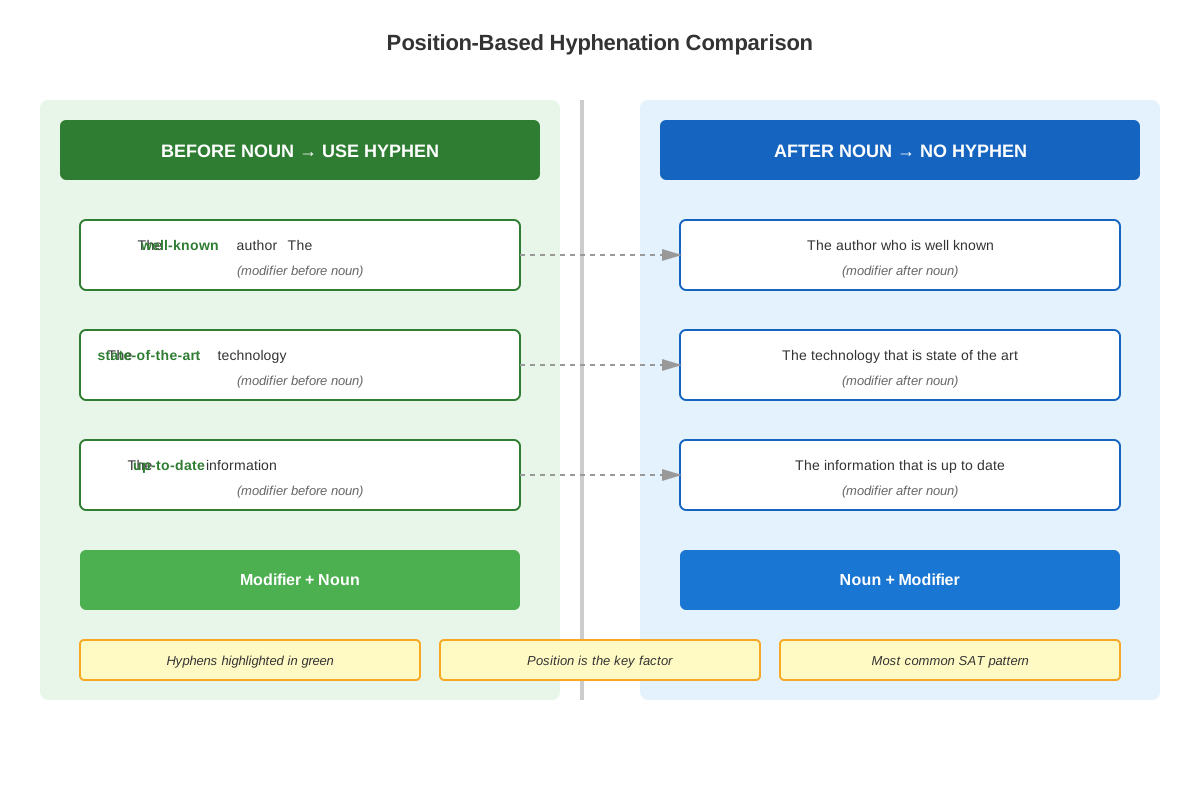
The SAT frequently presents sentences where compound modifiers appear before nouns, requiring students to determine whether hyphens are necessary. For example, "well-known author" requires a hyphen because "well" and "known" work together as a single unit to modify "author," but "author who is well known" does not require a hyphen because the modifier comes after the noun. This distinction is essential for achieving a high score on the SAT hyphenated modifiers questions, which typically appear 1-2 times per test administration.
Mastering hyphenated modifiers connects directly to broader punctuation principles tested throughout the RW section. This topic relates to comma usage, dash application, and overall sentence clarity—all fundamental components of Standard English Conventions. Understanding hyphenated modifiers also reinforces grammatical awareness of how adjectives function within sentences, helping students develop a more sophisticated approach to analyzing sentence structure and meaning on the SAT.
Learning Objectives
- [ ] Identify key features of hyphenated modifiers
- [ ] Explain how hyphenated modifiers appears on the SAT
- [ ] Apply hyphenated modifiers to answer SAT-style questions
- [ ] Distinguish between compound modifiers that require hyphens and those that do not
- [ ] Recognize the position of modifiers relative to nouns and determine appropriate hyphenation
- [ ] Evaluate sentences for clarity and apply hyphenation rules to eliminate ambiguity
- [ ] Analyze answer choices systematically to identify correct hyphenation patterns
Prerequisites
- Basic parts of speech: Understanding adjectives, nouns, and adverbs is essential because hyphenated modifiers function as compound adjectives that describe nouns.
- Sentence structure fundamentals: Recognizing subjects, predicates, and modifying phrases helps identify where compound modifiers appear in relation to the words they modify.
- General punctuation knowledge: Familiarity with basic punctuation marks (commas, dashes, hyphens) provides context for understanding when hyphens specifically are appropriate.
- Modifier function: Knowing how descriptive words and phrases modify nouns enables students to recognize when multiple words work together as a single modifying unit.
Why This Topic Matters
In professional and academic writing, hyphenated modifiers ensure precision and prevent misreading. Consider the difference between "small business owner" (an owner who is small) and "small-business owner" (an owner of a small business). This clarity is essential in legal documents, scientific papers, and business communications where ambiguity can lead to costly misunderstandings.
On the SAT, hyphenated modifier questions appear with high frequency—typically 1-2 questions per test, making them a reliable scoring opportunity. These questions usually appear in the Standard English Conventions domain, which comprises approximately 26% of the Reading and Writing section. Students who master this topic can quickly identify correct answers, saving valuable time for more challenging questions.
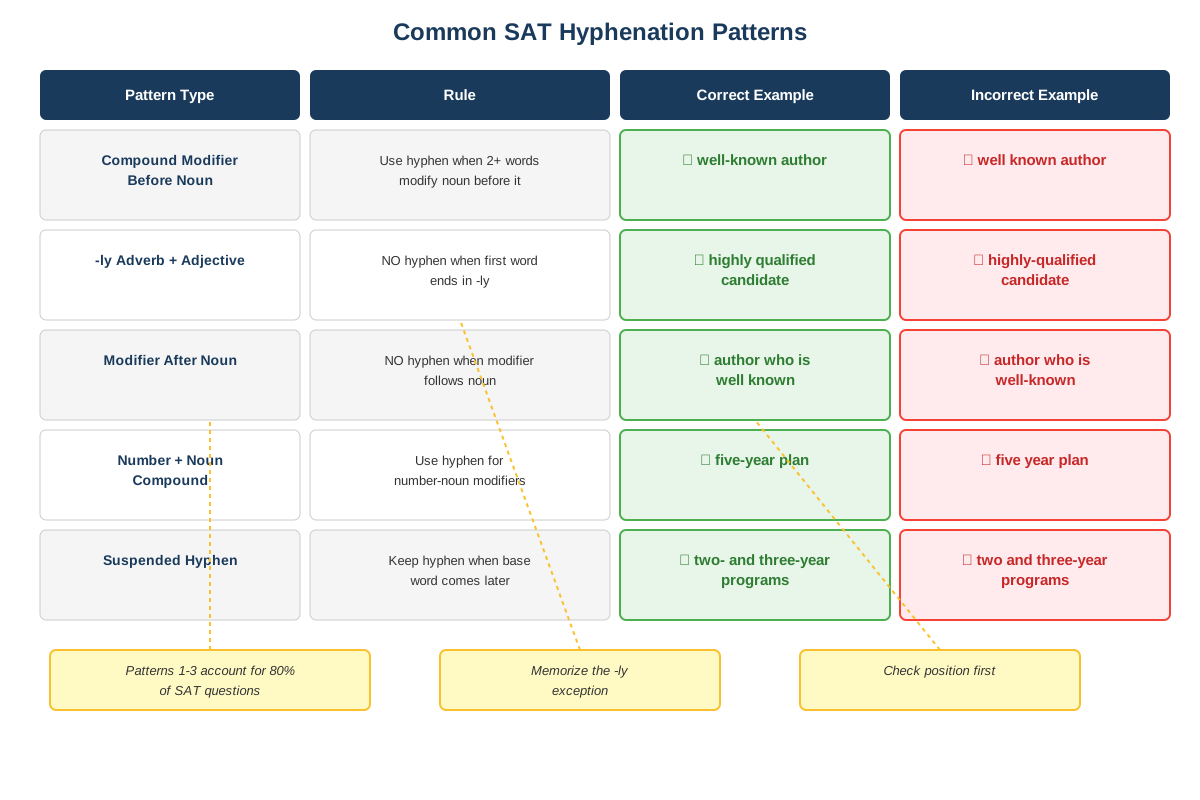
The SAT presents hyphenated modifiers in several common formats: sentences with compound adjectives before nouns requiring hyphenation, modifiers after nouns that should not be hyphenated, adverb-adjective combinations (which typically don't require hyphens when the adverb ends in -ly), and suspended hyphens in series. Recognizing these patterns enables students to approach questions systematically rather than relying on intuition, significantly improving accuracy and confidence.
Core Concepts
Definition and Function of Hyphenated Modifiers
Hyphenated modifiers, also called compound modifiers or compound adjectives, are two or more words that combine to function as a single adjective describing a noun. The hyphen signals to readers that these words work together as one unit rather than as separate, independent modifiers. For example, in "state-of-the-art technology," the phrase "state-of-the-art" functions as a single adjective describing "technology."
The primary purpose of hyphenation in compound modifiers is to eliminate ambiguity and ensure reader comprehension. Without proper hyphenation, readers might misinterpret which words modify which, leading to confusion about the sentence's intended meaning. The hyphen acts as a visual cue that binds the words together, clarifying their collective modifying function.
The Before-the-Noun Rule
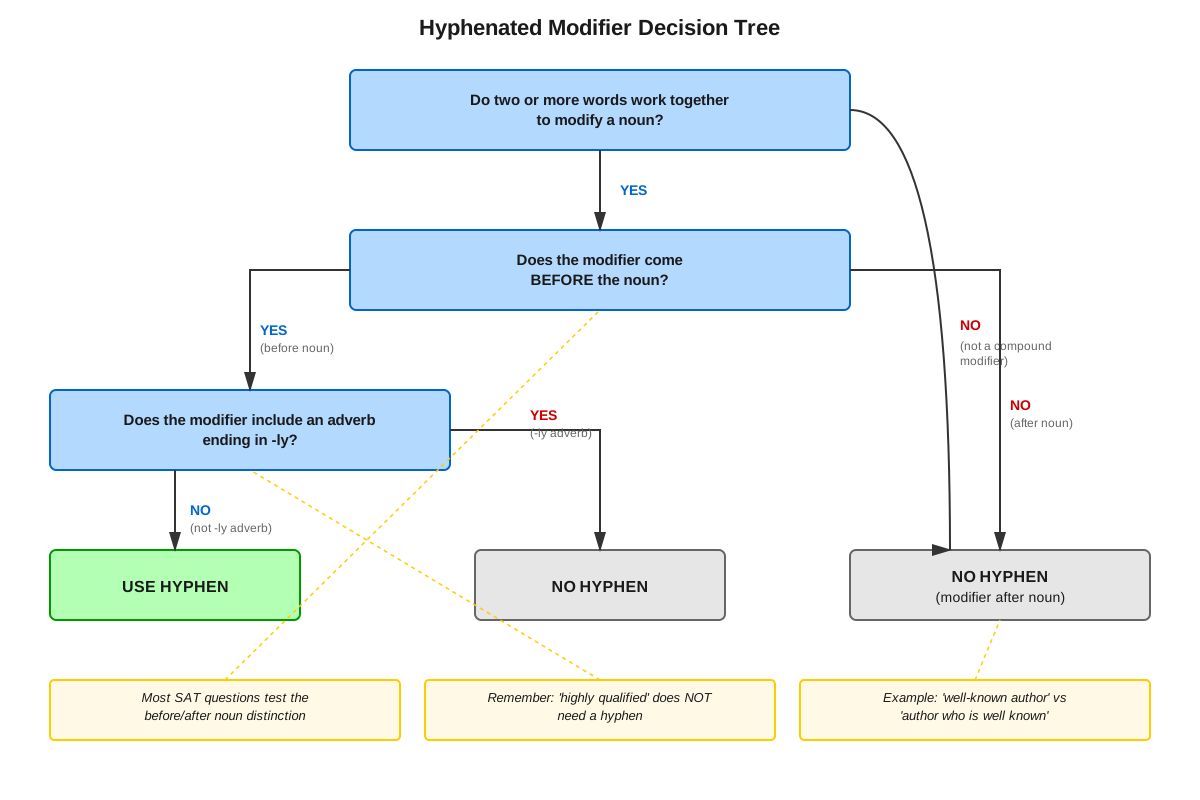
The most fundamental rule for sat hyphenated modifiers is the before-the-noun principle: compound modifiers typically require hyphens when they appear before the noun they modify, but not when they appear after the noun or as a predicate adjective.
Before the noun (hyphenate):
- "The well-known scientist presented her findings."
- "They attended a three-hour meeting."
- "She wore a navy-blue dress."
After the noun or as predicate adjective (no hyphen):
- "The scientist is well known for her research."
- "The meeting lasted three hours."
- "Her dress was navy blue."
This positional rule is the most frequently tested concept on the SAT. Students must quickly identify where the modifier appears relative to the noun to determine whether hyphenation is necessary.
Adverb-Adjective Combinations
An important exception to compound modifier hyphenation involves adverbs, particularly those ending in -ly. When an adverb ending in -ly modifies an adjective, and together they modify a noun, no hyphen is needed—even when this combination appears before the noun.
No hyphen needed (adverb ending in -ly):
- "The highly qualified candidate impressed the committee."
- "They visited a beautifully decorated home."
- "The carefully planned event succeeded."
However, when the adverb does not end in -ly, hyphenation may be required:
Hyphen needed (adverb not ending in -ly):
- "The well-qualified candidate impressed the committee."
- "They made a last-minute decision."
- "The much-anticipated event finally arrived."
This distinction is crucial because the SAT often includes answer choices that incorrectly hyphenate -ly adverb combinations to test whether students understand this exception.
Number-Noun Compounds
When numbers combine with nouns to form compound modifiers, hyphenation rules follow specific patterns. Number-noun compounds require hyphens when they precede the noun they modify and function as a single adjective.
Hyphenate number-noun compounds before nouns:
- "The five-year plan was ambitious."
- "She completed a 10-mile run."
- "They signed a three-year contract."
No hyphen when not functioning as compound modifier:
- "The plan spans five years."
- "The run covered 10 miles."
- "The contract lasts for three years."
Suspended Hyphens
Suspended hyphens (also called hanging hyphens) appear when multiple compound modifiers share a common base word. The hyphen is retained after the first element even though the base word appears only at the end of the series.
Examples of suspended hyphens:
- "The study included first-, second-, and third-grade students."
- "Both full- and part-time employees received benefits."
- "The store offers two- and three-bedroom apartments."
This construction maintains clarity while avoiding repetition. The SAT occasionally tests this concept, particularly in questions involving parallel structure.
Prefixes and Suffixes
Certain prefixes and situations require hyphens to prevent confusion or awkward letter combinations:
| Situation | Rule | Example |
|---|---|---|
| Prefix before capitalized word | Use hyphen | mid-September, pre-Columbian, anti-American |
| Prefix creating double vowels | Often use hyphen | anti-inflammatory, co-operate (though cooperation is also acceptable) |
| Self-, ex-, all- prefixes | Usually use hyphen | self-aware, ex-president, all-inclusive |
| Prefix with number | Use hyphen | pre-1900, post-2020 |
Clarity and Ambiguity Prevention
The ultimate purpose of hyphenation is preventing misreading. Consider these examples where hyphenation changes meaning:
- "man eating shark" (a man who is eating shark) vs. "man-eating shark" (a shark that eats men)
- "small business owner" (an owner who is small) vs. "small-business owner" (owner of a small business)
- "high school students" (students who are high) vs. "high-school students" (students attending high school)
The SAT may present sentences where the absence or presence of a hyphen significantly alters meaning, testing whether students recognize the importance of hyphenation for clarity.
Concept Relationships
The concepts within hyphenated modifiers build upon each other in a logical progression. The before-the-noun rule serves as the foundation → which then branches into specific applications including number-noun compounds and adverb-adjective combinations → all of which support the overarching principle of clarity and ambiguity prevention → while suspended hyphens represent an advanced application of the basic hyphenation principle.
Understanding hyphenated modifiers connects to prerequisite knowledge of parts of speech (recognizing adjectives and adverbs) and sentence structure (identifying what modifies what). This topic also relates to other punctuation concepts tested on the SAT, including comma usage with modifiers, dash application for emphasis, and overall sentence clarity.
Mastering hyphenated modifiers enables progression to more complex punctuation topics and strengthens overall grammatical awareness. Students who understand compound modifiers develop better instincts for sentence structure analysis, which benefits performance across all Standard English Conventions questions on the RW section.
High-Yield Facts
⭐ Compound modifiers require hyphens when they appear before the noun they modify but typically not when they appear after the noun.
⭐ Adverbs ending in -ly do not require hyphens when combined with adjectives, even before nouns (e.g., "highly qualified candidate").
⭐ Number-noun compounds functioning as adjectives require hyphens before nouns (e.g., "five-year plan").
⭐ The primary purpose of hyphenating compound modifiers is to prevent ambiguity and ensure clarity.
⭐ Prefixes like self-, ex-, and all- typically require hyphens (e.g., "self-aware," "ex-president," "all-inclusive").
- Suspended hyphens maintain clarity when multiple compound modifiers share a common base word (e.g., "first- and second-grade students").
- Hyphens are required when prefixes precede capitalized words (e.g., "mid-September," "pre-Columbian").
- Compound modifiers with "well," "better," "best," "ill," "worse," or "worst" require hyphens before nouns (e.g., "well-known author").
- Fractions used as adjectives require hyphens (e.g., "two-thirds majority") but not when used as nouns (e.g., "two thirds of the group").
- Compound modifiers with proper nouns generally do not require hyphens (e.g., "New York style pizza" rather than "New-York-style pizza," though style guides vary).
Quick check — test yourself on Hyphenated modifiers so far.
Try Flashcards →Common Misconceptions
Misconception: All compound modifiers require hyphens regardless of their position in the sentence.
Correction: Compound modifiers typically require hyphens only when they appear before the noun they modify. When the same words appear after the noun or as predicate adjectives, hyphens are usually unnecessary (e.g., "well-known author" vs. "author who is well known").
Misconception: Adverb-adjective combinations always need hyphens when they appear before nouns.
Correction: Adverbs ending in -ly do not require hyphens when combined with adjectives, even before nouns. Only adverbs that don't end in -ly may require hyphens (e.g., "highly qualified" needs no hyphen, but "well-qualified" does).
Misconception: Numbers always require hyphens when they appear before nouns.
Correction: Numbers require hyphens only when they combine with a noun to form a compound modifier (e.g., "five-year plan"). Simple numerical adjectives don't require hyphens (e.g., "five students," not "five-students").
Misconception: Hyphens and dashes are interchangeable punctuation marks.
Correction: Hyphens (-) are shorter and used specifically to join words in compound modifiers, while dashes (— or –) are longer and serve different functions such as setting off parenthetical information or indicating interruption.
Misconception: Once a compound modifier is hyphenated in one part of a sentence, it must remain hyphenated throughout.
Correction: Hyphenation depends on the modifier's position relative to the noun in each instance. The same words may require hyphens in one part of a sentence but not in another based on their position (e.g., "The state-of-the-art facility is state of the art").
Misconception: All prefixes require hyphens.
Correction: Most prefixes do not require hyphens (e.g., "prehistoric," "unhappy," "rewrite"). Hyphens are needed only in specific situations: before capitalized words, with certain prefixes like self- and ex-, or to prevent confusion.
Worked Examples
Example 1: Before vs. After the Noun
Question: Which choice completes the sentence with correct punctuation?
"The committee selected a _______ to lead the project."
A) highly motivated, experienced engineer
B) highly-motivated, experienced engineer
C) highly motivated experienced engineer
D) highly motivated, experienced, engineer
Step 1: Identify the modifiers and what they modify.
The phrase describes "engineer." We have two compound modifiers: "highly motivated" and "experienced."
Step 2: Check for -ly adverbs.
"Highly" ends in -ly, so "highly motivated" should NOT be hyphenated, even though it appears before the noun.
Step 3: Evaluate comma usage.
"Highly motivated" and "experienced" are coordinate adjectives (they could be reversed or separated by "and"), so a comma between them is appropriate.
Step 4: Eliminate incorrect answers.
- B is wrong because it incorrectly hyphenates the -ly adverb combination
- C is wrong because it lacks the comma between coordinate adjectives
- D is wrong because it includes an unnecessary comma after "experienced"
Answer: A - "highly motivated, experienced engineer" correctly avoids hyphenating the -ly adverb combination and properly uses a comma between coordinate adjectives.
Connection to learning objectives: This example demonstrates identifying key features of hyphenated modifiers (the -ly exception) and applying rules to answer SAT-style questions.
Example 2: Number-Noun Compounds and Position
Question: Which choice completes the sentence with correct punctuation?
"The _______ was approved by the board, though some members felt the timeline was too ambitious for a plan spanning ________."
A) five year plan . . . five years
B) five-year plan . . . five years
C) five-year plan . . . five-years
D) five year plan . . . five-years
Step 1: Analyze the first blank.
In the first blank, "five year" modifies "plan" and appears before the noun. This is a number-noun compound functioning as an adjective, so it requires a hyphen: "five-year plan."
Step 2: Analyze the second blank.
In the second blank, "five years" is not modifying a noun—it's the object of the preposition "spanning." The phrase describes a duration, not functioning as a compound modifier, so no hyphen is needed.
Step 3: Apply the before-the-noun rule.
The first instance requires a hyphen because it's before the noun; the second doesn't because it's not functioning as a compound modifier.
Step 4: Eliminate incorrect answers.
- A is wrong because it lacks the necessary hyphen in "five-year plan"
- C is wrong because it incorrectly hyphenates "five-years" when it's not a compound modifier
- D is wrong on both counts
Answer: B - "five-year plan . . . five years" correctly hyphenates the compound modifier before the noun but not when the phrase describes duration.
Connection to learning objectives: This example shows how to explain how hyphenated modifiers appear on the SAT (testing position-dependent hyphenation) and demonstrates distinguishing between compound modifiers that require hyphens and those that do not.
Exam Strategy
When approaching SAT hyphenated modifiers questions, follow this systematic process:
Step 1: Locate the potential compound modifier - Identify words that might be working together to describe a noun. Look for adjective-adjective, adverb-adjective, or number-noun combinations.
Step 2: Identify what the modifier describes - Determine which noun the compound modifier is describing and note its position relative to that noun.
Step 3: Apply the before-the-noun rule - If the compound modifier appears before the noun, it likely needs a hyphen. If it appears after the noun or as a predicate adjective, it likely doesn't.
Step 4: Check for -ly adverbs - If the first word is an adverb ending in -ly, no hyphen is needed regardless of position before the noun.
Step 5: Consider clarity - Ask whether the hyphen prevents ambiguity or misreading. If removing the hyphen could cause confusion, it's probably necessary.
Exam Tip: The SAT often includes three answer choices with different hyphenation patterns and one with no punctuation. Systematically eliminate choices that violate the before-the-noun rule or incorrectly hyphenate -ly adverbs.
Trigger words and phrases to watch for:
- "Well," "better," "best," "ill," "worse," "worst" before adjectives (usually require hyphens before nouns)
- Numbers combined with time periods or measurements (e.g., "three-hour," "10-mile")
- "Self-," "ex-," "all-" prefixes (typically require hyphens)
- Any -ly adverb (typically does NOT require hyphen)
Process-of-elimination strategy:
- Immediately eliminate any choice that hyphenates an -ly adverb combination
- Eliminate choices that hyphenate compound modifiers appearing after nouns
- Eliminate choices that fail to hyphenate clear compound modifiers before nouns
- Choose the remaining option after verifying it follows all rules
Time allocation: These questions should take 30-45 seconds once you've mastered the rules. Don't overthink—apply the systematic process and move forward confidently.
Memory Techniques
HYPHEN mnemonic for when to use hyphens in compound modifiers:
- Hyphenate before nouns
- Yes to clarity (prevents ambiguity)
- Prefixes (self-, ex-, all-)
- Hanging/suspended hyphens in series
- Except -ly adverbs
- Numbers with nouns (five-year, 10-mile)
The "Flip Test" visualization: Imagine flipping the sentence so the modifier comes after the noun. If you would remove the hyphen after flipping, you know the hyphen is position-dependent. This mental exercise reinforces the before-the-noun rule.
The "-ly Fly Away" rule: Picture -ly adverbs as having wings that make the hyphen "fly away." This whimsical image helps remember that -ly adverbs don't need hyphens.
The "Number-Noun Sandwich": Visualize a hyphen as the filling in a sandwich where the bread slices are a number and a noun. This image reinforces that number-noun compounds need hyphens when they modify another noun.
Position Matters Mantra: Repeat "Before the noun, hyphen down; after the noun, hyphen's gone" to internalize the most important rule.
Summary
Hyphenated modifiers are compound adjectives that combine two or more words with hyphens to function as a single descriptive unit. The fundamental rule governing their use on the SAT is position-dependent: compound modifiers require hyphens when they appear before the noun they modify but typically not when they appear after the noun or as predicate adjectives. Critical exceptions include adverbs ending in -ly, which never require hyphens when combined with adjectives, and specific prefixes like self-, ex-, and all-, which typically do require hyphens. Number-noun compounds functioning as adjectives require hyphens before nouns (e.g., "five-year plan") but not when describing duration or quantity independently. The primary purpose of hyphenation is preventing ambiguity and ensuring reader comprehension. SAT questions on this topic test whether students can systematically identify compound modifiers, determine their position relative to nouns, apply the before-the-noun rule, recognize -ly adverb exceptions, and select answers that maintain clarity. Mastering these concepts provides reliable scoring opportunities on 1-2 questions per test administration.
Key Takeaways
- Compound modifiers require hyphens before nouns but typically not after nouns or as predicate adjectives—this position-dependent rule is the most frequently tested concept.
- Adverbs ending in -ly never require hyphens when combined with adjectives, even before nouns, making this the most important exception to memorize.
- Number-noun compounds (five-year, 10-mile) require hyphens when functioning as adjectives before nouns but not when describing duration or quantity independently.
- The primary purpose of hyphenating compound modifiers is preventing ambiguity and ensuring clarity—when in doubt, consider whether the hyphen prevents misreading.
- Prefixes like self-, ex-, and all- typically require hyphens, as do prefixes before capitalized words (mid-September, pre-Columbian).
- Suspended hyphens maintain clarity in series where multiple compound modifiers share a common base word (first- and second-grade students).
- Systematic application of rules (identify modifier → determine position → check for -ly → apply before-the-noun rule) enables quick, accurate answers on SAT questions.
Related Topics
Comma Usage with Modifiers: Understanding how commas separate coordinate adjectives and set off nonessential modifying phrases complements hyphenated modifier knowledge and frequently appears alongside hyphenation questions on the SAT.
Dash Application: Mastering the distinction between hyphens (for joining words), en dashes (for ranges), and em dashes (for setting off information) provides comprehensive punctuation knowledge essential for Standard English Conventions questions.
Parallel Structure: Suspended hyphens often appear in parallel constructions, so understanding parallelism enhances the ability to recognize and correctly punctuate compound modifiers in series.
Modifier Placement: Knowing where modifiers should appear in sentences to avoid ambiguity connects directly to hyphenated modifier concepts and helps with broader sentence structure questions.
Subject-Verb Agreement with Compound Subjects: While distinct from hyphenated modifiers, this topic similarly requires analyzing how multiple words function together as a unit, reinforcing analytical skills applicable across grammar concepts.
Practice CTA
Now that you've mastered the core concepts of hyphenated modifiers, it's time to reinforce your learning through active practice. Attempt the practice questions to apply these rules in SAT-style contexts, and use the flashcards to drill the high-yield facts until they become automatic. Remember, hyphenated modifier questions represent reliable scoring opportunities—students who systematically apply the before-the-noun rule and recognize -ly adverb exceptions consistently answer these questions correctly. Your investment in mastering this topic will pay dividends on test day. Start practicing now to build the confidence and speed you need for SAT success!
Sign up free to keep reading
Create a free AnvayaPrep account to finish this SAT guide on Hyphenated modifiers — plus flashcards and practice questions.