Overview
The Oxford comma, also known as the serial comma, is a punctuation mark that appears before the coordinating conjunction in a list of three or more items. For example, in the sentence "I bought apples, oranges, and bananas," the comma after "oranges" is the Oxford comma. While its use remains stylistically debated in general writing, the SAT has a clear preference: the Oxford comma should be used to maintain clarity and prevent ambiguity in lists. Understanding when and how to apply this punctuation rule is essential for success on the RW (Reading and Writing) section of the SAT.
The Oxford comma frequently appears in SAT questions that test Standard English Conventions, particularly within the broader category of punctuation rules. Students encounter this concept in questions where they must choose the correctly punctuated version of a sentence containing a series. The College Board consistently favors the Oxford comma because it eliminates potential confusion about whether items in a list are separate entities or related pairs. Mastering this seemingly simple rule can secure quick points on test day, as these questions typically take less time to answer than complex rhetorical skills questions.
Beyond its immediate application to list punctuation, understanding the sat oxford comma connects to broader principles of clarity and precision in writing—core values that permeate the entire Reading and Writing section. The Oxford comma represents a microcosm of how punctuation serves meaning rather than arbitrary rules. Students who grasp this principle will find themselves better equipped to tackle other punctuation questions involving commas, semicolons, and dashes, all of which share the common goal of making written communication unambiguous and effective.
Learning Objectives
- [ ] Identify key features of Oxford comma
- [ ] Explain how Oxford comma appears on the SAT
- [ ] Apply Oxford comma to answer SAT-style questions
- [ ] Distinguish between sentences that require an Oxford comma and those that do not
- [ ] Recognize ambiguity created by the absence of an Oxford comma
- [ ] Evaluate answer choices based on clarity and SAT punctuation conventions
- [ ] Connect Oxford comma usage to broader principles of effective punctuation
Prerequisites
- Basic comma usage: Understanding fundamental comma rules provides the foundation for recognizing when the Oxford comma serves a specific clarifying function in series.
- Coordinating conjunctions: Familiarity with FANBOYS (for, and, nor, but, or, yet, so) is necessary because the Oxford comma appears immediately before these conjunctions in lists.
- Sentence structure: Recognizing independent clauses, phrases, and list elements helps distinguish between commas that separate series items and those that serve other grammatical functions.
- Reading comprehension: The ability to understand sentence meaning is essential for identifying when the absence of an Oxford comma creates ambiguity.
Why This Topic Matters
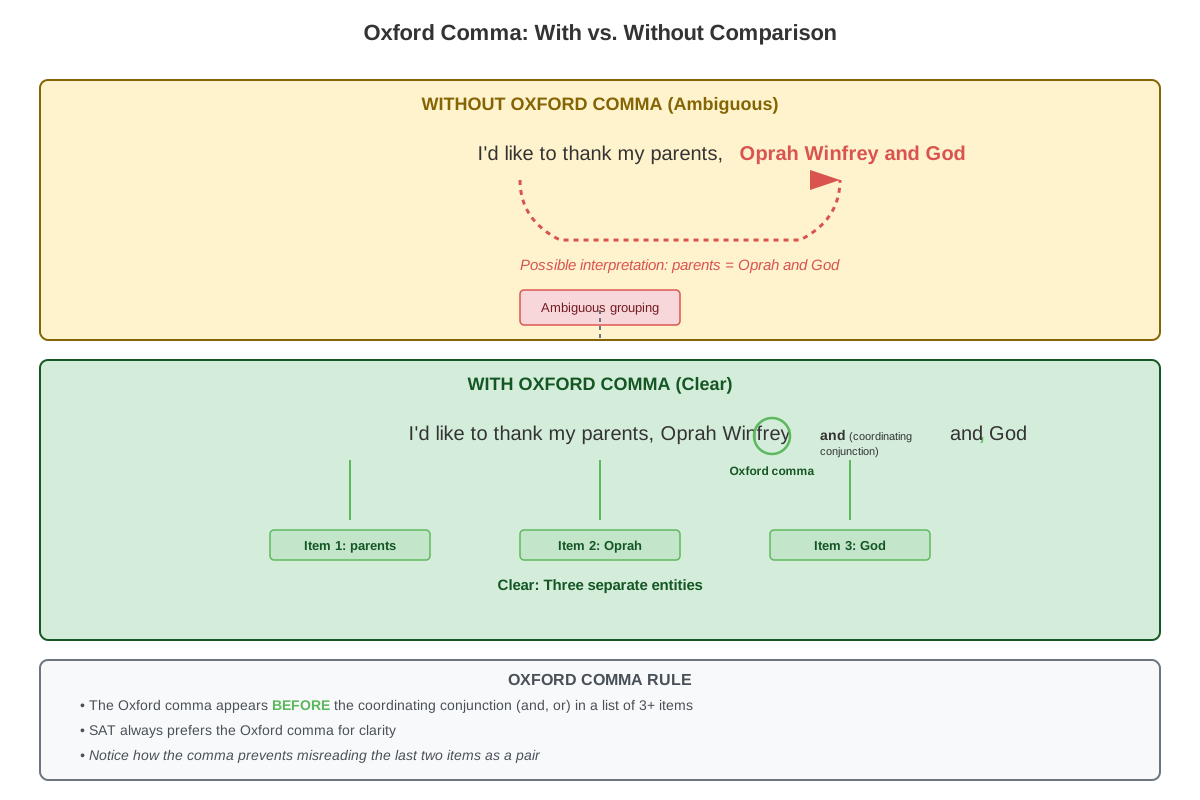
The Oxford comma serves a critical function in preventing misreading and ensuring that written communication conveys its intended meaning. In professional, academic, and legal contexts, the presence or absence of this comma can dramatically alter interpretation. Consider the famous example: "I'd like to thank my parents, Oprah Winfrey and God" versus "I'd like to thank my parents, Oprah Winfrey, and God." Without the Oxford comma, the sentence suggests that the speaker's parents are Oprah Winfrey and God—clearly not the intended meaning. This real-world significance extends to contracts, instructions, recipes, and any context where precision matters.
On the SAT, Oxford comma questions appear with moderate to high frequency, typically showing up 1-2 times per test in the Standard English Conventions domain. These questions usually present a sentence containing a series of three or more items, with answer choices that differ only in their punctuation of that series. The College Board's consistent preference for the Oxford comma makes these questions highly predictable and, with proper preparation, among the most straightforward points to secure. According to test analysis, students who master punctuation rules including the Oxford comma improve their overall Reading and Writing scores by an average of 20-40 points.
The topic commonly appears in passages across various content areas—science, humanities, social studies, and literature. Students might encounter Oxford comma questions in sentences describing experimental procedures ("The researchers measured temperature, humidity, and pressure"), historical events ("The treaty affected France, Germany, and Austria"), or character descriptions ("She was known for her intelligence, wit, and compassion"). The versatility of this punctuation rule across contexts makes it a high-yield study topic that applies regardless of passage content.
Core Concepts
Definition and Structure
The Oxford comma is the comma placed immediately before the coordinating conjunction (usually "and" or "or") in a list of three or more items. This comma follows the penultimate (second-to-last) item in the series and precedes the conjunction that introduces the final item. The basic structure follows this pattern:
Item 1, Item 2, and Item 3
Each item in the series can be a single word, a phrase, or even a clause. The Oxford comma maintains consistent separation between all elements, treating each item as equally distinct. For example:
- Single words: "The flag is red, white, and blue."
- Phrases: "She enjoys reading mystery novels, watching classic films, and hiking in national parks."
- Clauses: "The study found that exercise improves mood, that diet affects energy levels, and that sleep impacts cognitive function."
When to Use the Oxford Comma
On the SAT, the Oxford comma should be used in virtually all lists of three or more items. The test consistently favors this punctuation choice because it maximizes clarity and follows the style guide most commonly used in American academic writing. The rule applies regardless of whether the items are short or long, simple or complex.
The critical trigger for Oxford comma usage is the presence of three or more coordinate elements joined by a conjunction. Coordinate elements are items of equal grammatical rank that could theoretically be rearranged without changing the sentence's fundamental meaning. When you identify this structure, the Oxford comma belongs before the final conjunction.
Clarity and Ambiguity Prevention
The primary function of the Oxford comma is to prevent ambiguity by clearly separating the final two items in a list. Without this comma, readers might interpret the last two items as a unit or pair rather than as separate elements. Consider these examples:
| Without Oxford Comma | Potential Misreading | With Oxford Comma | Clear Meaning |
|---|---|---|---|
| "The menu included pasta, fish and chips and salad." | Are "fish and chips" one item or two? Is "chips and salad" a combination? | "The menu included pasta, fish and chips, and salad." | Three distinct items: pasta, fish and chips (as one dish), and salad |
| "She studied biology, history and political science and mathematics." | Is "political science and mathematics" one combined field? | "She studied biology, history and political science, and mathematics." | Four separate subjects |
| "The team consisted of two engineers, a designer and a project manager and a consultant." | Unclear groupings | "The team consisted of two engineers, a designer and a project manager, and a consultant." | Clear: engineers (2), designer-manager pair (1 unit), consultant (1) |
Lists with Two Items vs. Three or More
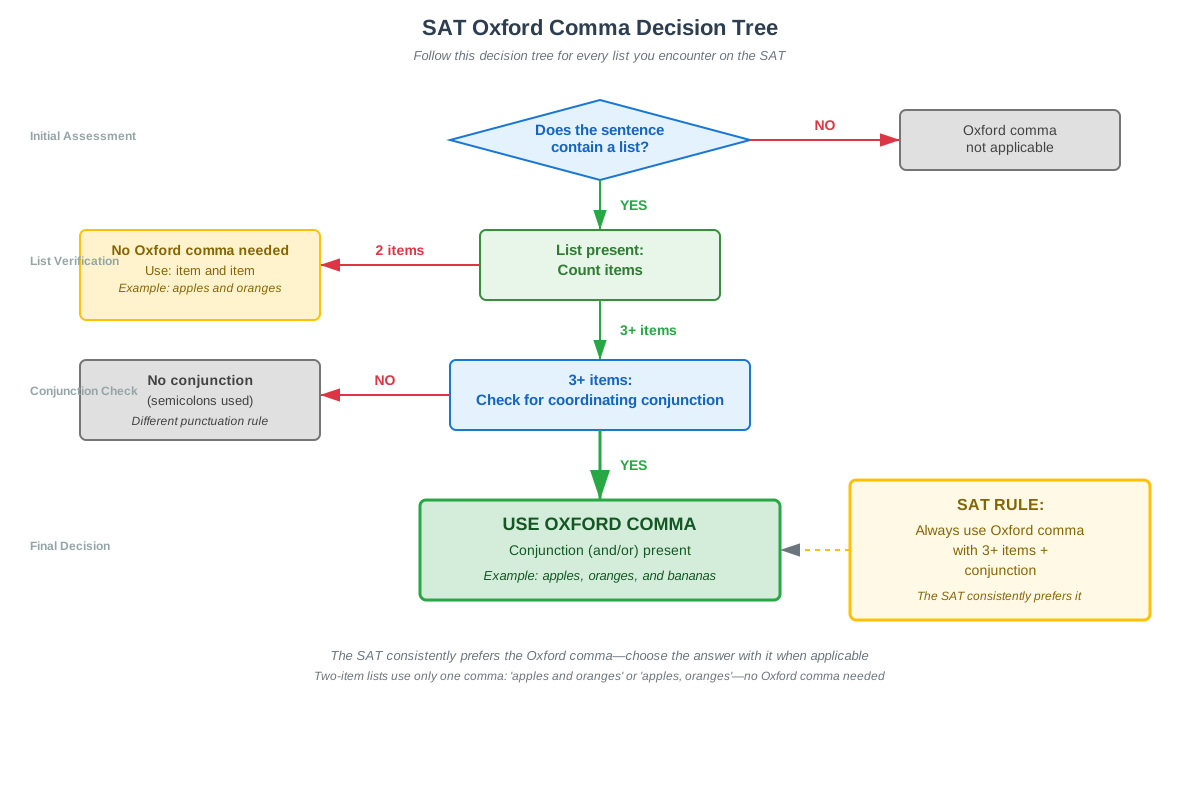
An essential distinction involves recognizing when a series contains only two items versus three or more. With exactly two items joined by a conjunction, no comma appears before the conjunction:
- Two items: "The experiment tested temperature and pressure." (no comma before "and")
- Three items: "The experiment tested temperature, pressure, and humidity." (Oxford comma before "and")
This distinction matters on the SAT because incorrect answer choices often include unnecessary commas before conjunctions in two-item series. Students must count the coordinate elements to determine whether the Oxford comma applies.
Complex Lists and Internal Commas
When list items themselves contain commas (internal punctuation), the Oxford comma still appears, though the entire series might require semicolons instead of commas to separate major elements. However, standard SAT questions typically avoid this complexity, focusing instead on straightforward series where the Oxford comma clearly applies.
For standard SAT purposes, focus on recognizing series where each item is cleanly separated and the Oxford comma provides the final separation before the conjunction.
SAT Answer Choice Patterns
On the SAT, Oxford comma questions typically present four answer choices that differ in punctuation:
- Correct: Includes the Oxford comma (Item 1, Item 2, and Item 3)
- Incorrect: Omits the Oxford comma (Item 1, Item 2 and Item 3)
- Incorrect: Includes unnecessary punctuation, such as a comma after the conjunction (Item 1, Item 2, and, Item 3)
- Incorrect: Uses incorrect punctuation like a semicolon or colon inappropriately
Recognizing this pattern helps students quickly identify the correct answer by looking for the choice that includes a comma before the conjunction in a three-or-more-item series.
Concept Relationships
The Oxford comma connects directly to broader comma usage principles, particularly the rule that commas separate coordinate elements in a series. This foundational comma function → extends to → the specific application of the Oxford comma as the final separator before a conjunction. Understanding basic comma rules enables students to recognize why the Oxford comma exists: to maintain consistent separation throughout a list.
The concept also relates to coordinating conjunctions, which serve as the trigger point for Oxford comma placement. Knowledge of FANBOYS → informs → recognition of where the Oxford comma appears, since it always precedes these conjunctions in lists. The conjunction signals the final item, and the Oxford comma ensures that item remains distinct from the penultimate one.
Within the broader punctuation unit, the Oxford comma connects to principles of clarity and ambiguity prevention that also govern semicolon and dash usage. All these punctuation marks → share the goal of → making sentence structure and meaning unambiguous. Students who understand this overarching principle can approach various punctuation questions with a unified strategy: choose the option that most clearly conveys the intended meaning.
The Oxford comma also relates to parallel structure, another key SAT concept. Lists that require Oxford commas typically contain parallel elements (items of the same grammatical type). Recognizing parallel structure → helps identify → series that need Oxford commas, since parallel coordinate elements in groups of three or more always require this punctuation.
Finally, Oxford comma mastery → prepares students for → more complex punctuation scenarios involving restrictive and nonrestrictive clauses, where comma placement similarly affects meaning. The analytical skills developed through Oxford comma practice transfer to these more challenging punctuation contexts.
High-Yield Facts
- ⭐ The Oxford comma appears before the coordinating conjunction in a list of three or more items
- ⭐ The SAT consistently prefers the Oxford comma in all standard series
- ⭐ The primary function of the Oxford comma is to prevent ambiguity by clearly separating the final two items in a list
- ⭐ No comma appears before a conjunction joining only two items
- ⭐ Oxford comma questions typically appear 1-2 times per SAT test
- The Oxford comma is also called the serial comma
- Each item in a series can be a word, phrase, or clause
- The Oxford comma follows the penultimate (second-to-last) item in the series
- Incorrect answer choices often omit the Oxford comma or add unnecessary punctuation after the conjunction
- The College Board follows American academic style, which favors the Oxford comma
- Counting the number of coordinate elements helps determine whether an Oxford comma is needed
- The Oxford comma maintains parallel separation between all items in a series
- Questions testing the Oxford comma fall under Standard English Conventions
- The absence of an Oxford comma can create unintended meanings where the last two items appear to be a unit
- Oxford comma usage is consistent across all content areas on the SAT (science, humanities, social studies, literature)
Quick check — test yourself on Oxford comma so far.
Try Flashcards →Common Misconceptions
Misconception: The Oxford comma is optional and stylistic, so any answer choice could be correct on the SAT.
Correction: While the Oxford comma is debated in general writing, the SAT has a clear, consistent preference for its use. The test follows American academic style, which requires the Oxford comma in series of three or more items. Answer choices without the Oxford comma are incorrect on the SAT.
Misconception: A comma should appear before every "and" or "or" in a sentence.
Correction: The Oxford comma only applies to lists of three or more coordinate items. When a conjunction joins just two items, no comma precedes it. For example, "She studied math and science" (two items, no comma) versus "She studied math, science, and history" (three items, Oxford comma required).
Misconception: If the items in a list are short (single words), the Oxford comma isn't necessary.
Correction: The length or complexity of list items doesn't determine whether the Oxford comma is needed. Even in a simple list like "red, white, and blue," the Oxford comma is required on the SAT. The rule applies uniformly regardless of item length.
Misconception: The Oxford comma goes after the conjunction ("and, or").
Correction: The Oxford comma always appears before the conjunction, not after it. The pattern is "Item 1, Item 2, and Item 3," never "Item 1, Item 2 and, Item 3." Answer choices with commas after conjunctions are always incorrect.
Misconception: When a sentence contains multiple commas, adding one more (the Oxford comma) makes it too cluttered.
Correction: The Oxford comma serves a grammatical function, not a stylistic preference about comma density. Even if a sentence already contains several commas for other purposes, the Oxford comma is still required before the final conjunction in a series. Clarity takes precedence over concerns about comma frequency.
Misconception: The Oxford comma is only needed when its absence would create obvious confusion.
Correction: On the SAT, the Oxford comma should be used in all series of three or more items, regardless of whether ambiguity seems likely. The test doesn't ask students to judge whether confusion might occur; it requires consistent application of the rule. Don't try to determine if the sentence "needs" the comma for clarity—just apply the rule uniformly.
Worked Examples
Example 1: Standard Three-Item List
Question: Which choice completes the sentence with correct punctuation?
"The research team analyzed data from surveys, interviews___ focus groups."
A) and
B) and,
C) , and
D) ; and
Step 1: Identify the structure
The sentence contains a list of three items: "surveys," "interviews," and "focus groups." These are coordinate elements (all nouns serving the same grammatical function).
Step 2: Count the items
Three items are present, which means the Oxford comma rule applies. With three or more items, a comma must appear before the coordinating conjunction.
Step 3: Locate the conjunction
The conjunction "and" introduces the final item ("focus groups").
Step 4: Apply the Oxford comma rule
A comma should appear after "interviews" (the penultimate item) and before "and" (the conjunction).
Step 5: Evaluate answer choices
- A) "interviews and focus groups" — Missing the Oxford comma (incorrect)
- B) "interviews and, focus groups" — Comma after the conjunction (incorrect)
- C) "interviews, and focus groups" — Oxford comma correctly placed (correct)
- D) "interviews; and focus groups" — Semicolon is inappropriate for a simple series (incorrect)
Answer: C
Connection to learning objectives: This example demonstrates the core application of the Oxford comma rule (Apply Oxford comma to answer SAT-style questions) and shows how to identify the key features of proper Oxford comma usage (Identify key features of Oxford comma).
Example 2: Distinguishing Two Items from Three
Question: Which choice completes the sentence with correct punctuation?
"The museum's new wing features galleries dedicated to ancient civilizations, modern art___ contemporary sculpture."
A) and
B) , and
C) and,
D) , and,
Step 1: Parse the sentence structure
At first glance, this might seem like a three-item list: "ancient civilizations," "modern art," and "contemporary sculpture." However, careful reading reveals the structure.
Step 2: Identify the actual items
The sentence describes galleries dedicated to:
- Ancient civilizations
- Modern art and contemporary sculpture (potentially one combined gallery or two separate ones)
Wait—let's reconsider. The phrase "galleries dedicated to" suggests multiple subjects. The items are:
- Ancient civilizations
- Modern art
- Contemporary sculpture
These are three distinct subjects, making this a three-item series.
Step 3: Apply the Oxford comma rule
With three items, the Oxford comma must appear before "and."
Step 4: Evaluate answer choices
- A) "modern art and contemporary sculpture" — Missing Oxford comma (incorrect)
- B) "modern art, and contemporary sculpture" — Oxford comma correctly placed (correct)
- C) "modern art and, contemporary sculpture" — Comma after conjunction (incorrect)
- D) "modern art, and, contemporary sculpture" — Commas both before and after conjunction (incorrect)
Answer: B
Connection to learning objectives: This example requires distinguishing between different list structures (Distinguish between sentences that require an Oxford comma and those that do not) and demonstrates how the Oxford comma appears in SAT questions (Explain how Oxford comma appears on the SAT).
Exam Strategy
When approaching Oxford comma questions on the SAT, follow this systematic process:
Step 1: Identify the series
Look for a list of items joined by a conjunction. Scan for commas that separate elements and locate the conjunction (usually "and" or "or") that introduces what appears to be the final item.
Step 2: Count the coordinate elements
Determine whether the sentence contains two items or three or more. This is the critical decision point. If only two items exist, no comma should precede the conjunction. If three or more items are present, the Oxford comma is required.
Step 3: Check the punctuation before the conjunction
In a three-or-more-item series, the correct answer will have a comma immediately before the conjunction. Eliminate any answer choices that lack this comma.
Step 4: Eliminate choices with incorrect punctuation patterns
Watch for these common incorrect patterns:
- Comma after the conjunction ("and, Item 3")
- Semicolon before the conjunction in a simple series ("Item 2; and Item 3")
- Missing commas between earlier items ("Item 1 Item 2, and Item 3")
Trigger words and phrases to watch for:
- Any sentence containing "and" or "or" with multiple items
- Phrases like "including," "such as," or "consisting of" that introduce lists
- Descriptive passages that enumerate characteristics, examples, or components
- Scientific or procedural text describing steps, materials, or variables
Process-of-elimination tips:
- Immediately eliminate choices with commas after conjunctions—this is never correct
- If you count three or more items, eliminate choices without a comma before the conjunction
- If you count only two items, eliminate choices with a comma before the conjunction
- When in doubt between two similar choices, choose the one with the Oxford comma, as the SAT consistently prefers it
Time allocation advice:
Oxford comma questions should take 15-30 seconds to answer. They're among the quickest points available on the test. Don't overthink these questions—count the items, apply the rule, and move on. If you find yourself spending more than 45 seconds on an Oxford comma question, make your best guess and flag it for review if time permits at the end of the section.
Exam Tip: If you're unsure whether something is two items or three, try reading the sentence aloud with pauses where commas appear. If you naturally pause three times (once after each of three items), you need the Oxford comma.
Memory Techniques
Mnemonic for the Oxford comma rule:
"Three or more, comma before"
This simple rhyme reminds you that lists of three or more items require a comma before the final conjunction.
Visual memory technique:
Picture a podium with three places (gold, silver, bronze). The Oxford comma is the step between silver and gold—it separates the second-place item from the first-place item (the final item introduced by "and"). Just as you need that step to distinguish second from first, you need the Oxford comma to distinguish the penultimate from the final item.
Acronym for checking your work:
C.A.T.
- Count the items (three or more?)
- And or or present? (locate the conjunction)
- Tick before the conjunction (place the comma)
Contrast memory technique:
Remember the famous ambiguous example: "I love my parents, Lady Gaga and Humpty Dumpty" (suggesting your parents ARE Lady Gaga and Humpty Dumpty) versus "I love my parents, Lady Gaga, and Humpty Dumpty" (four separate entities). The absurdity of the first version makes the importance of the Oxford comma memorable.
Finger counting method:
When you encounter a potential series, use your fingers to count items as you read. If you use three or more fingers, you need the Oxford comma. This physical action reinforces the counting step and makes the rule more concrete.
Summary
The Oxford comma is a punctuation mark that appears before the coordinating conjunction in a list of three or more items, following the pattern "Item 1, Item 2, and Item 3." On the SAT Reading and Writing section, the College Board consistently requires the Oxford comma in all standard series, making it a highly predictable and testable rule. The primary purpose of this comma is to prevent ambiguity by clearly separating the final two items in a list, ensuring that readers don't mistakenly interpret them as a unit. To answer Oxford comma questions correctly, students must count the coordinate elements in a series—if three or more items are present, the comma belongs before the conjunction; if only two items exist, no comma should precede the conjunction. These questions typically appear 1-2 times per test and represent quick, straightforward points when students apply the rule systematically. Mastering the Oxford comma requires recognizing series structures, understanding the clarity principle behind the rule, and consistently applying the SAT's preference for this punctuation convention across all content areas.
Key Takeaways
- The Oxford comma appears before the coordinating conjunction in lists of three or more items
- The SAT always prefers the Oxford comma in standard series—this is not optional on the test
- Count the items carefully: three or more items require the Oxford comma; two items do not
- The Oxford comma prevents ambiguity by clearly separating the final two items in a list
- Common incorrect answer choices omit the Oxford comma or place commas after the conjunction
- These questions are high-yield and quick to answer—they should take less than 30 seconds
- The rule applies uniformly across all passage types and content areas on the SAT
Related Topics
Comma usage in compound sentences: Understanding how commas work with coordinating conjunctions to join independent clauses builds on the same conjunction knowledge used for Oxford commas. Mastering the Oxford comma prepares students to distinguish between commas in series and commas in compound sentences.
Semicolons in complex lists: When list items contain internal commas, semicolons replace commas as the primary separators. This advanced punctuation concept extends Oxford comma principles to more complex structures.
Parallel structure: Lists that require Oxford commas typically contain parallel elements. Studying parallel structure helps students recognize coordinate items that need consistent punctuation.
Restrictive and nonrestrictive clauses: Like the Oxford comma, these clauses involve comma placement that affects meaning. The analytical skills developed through Oxford comma practice transfer to these more nuanced punctuation scenarios.
Dash usage for emphasis and interruption: Dashes can sometimes replace commas in lists for stylistic effect. Understanding when commas (including Oxford commas) are standard helps students recognize when dashes represent an acceptable alternative.
Practice CTA
Now that you've mastered the Oxford comma, it's time to put your knowledge into action! Attempt the practice questions to reinforce these concepts and build the speed and confidence you need for test day. The Oxford comma represents one of the most reliable point-earning opportunities on the SAT—questions that test this rule are predictable, quick to answer, and highly learnable. Each practice question you complete strengthens your pattern recognition and decision-making process. Don't forget to review the flashcards to cement the key rules and examples in your memory. With focused practice, Oxford comma questions will become automatic points that boost your Reading and Writing score. You've got this!
Sign up free to keep reading
Create a free AnvayaPrep account to finish this SAT guide on Oxford comma — plus flashcards and practice questions.