Overview
The SAT Reading and Writing section frequently tests students' ability to synthesize information from multiple sources and compose coherent written responses. One critical skill within the Rhetorical Synthesis question type is ignoring irrelevant notes—the ability to distinguish between information that directly supports a specific writing goal and information that, while potentially interesting or accurate, does not serve the immediate rhetorical purpose. This skill mirrors real-world academic and professional writing, where writers must constantly evaluate which details strengthen their argument and which distract from it.
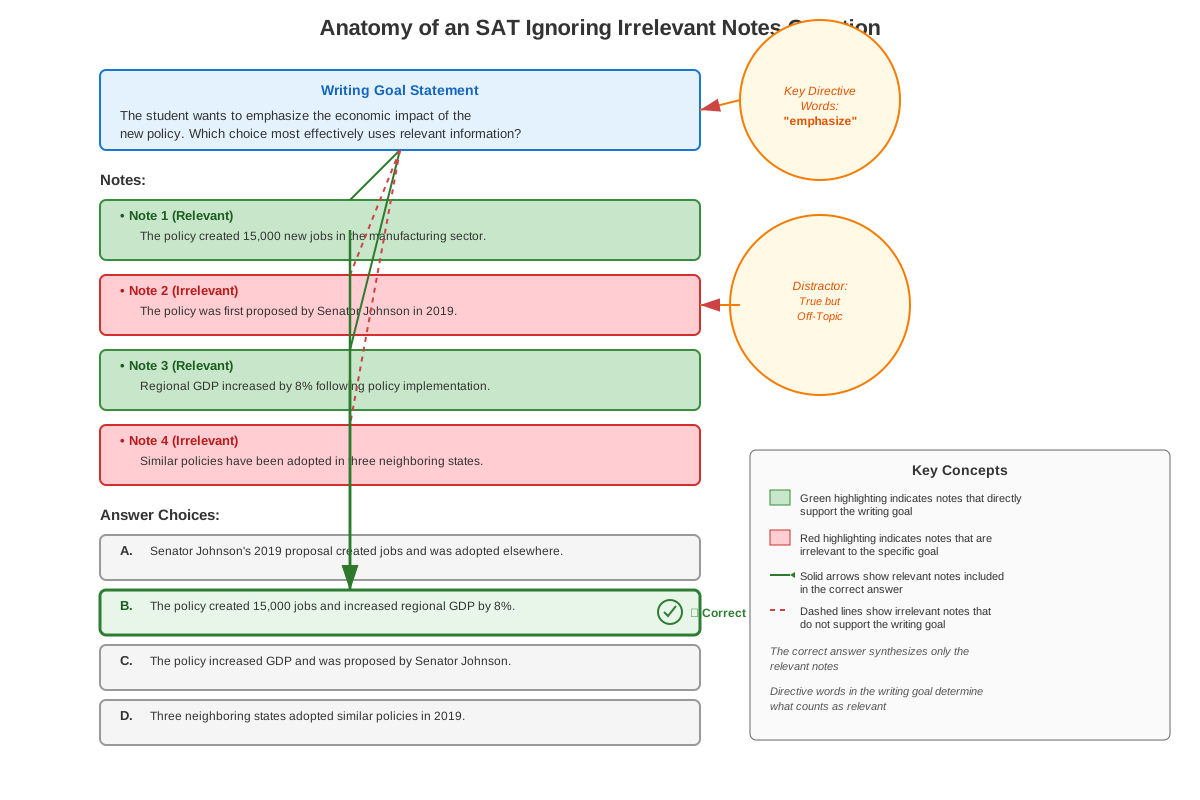
On the SAT, sat ignoring irrelevant notes questions present students with a brief writing goal followed by several bulleted notes containing various facts, observations, or data points. The task requires selecting the answer choice that best accomplishes the stated goal while excluding notes that are tangential, redundant, or off-topic. These questions assess not just reading comprehension but also rhetorical awareness—understanding how different pieces of information function within a specific communicative context. Students who master this skill demonstrate the kind of critical thinking that colleges value: the ability to evaluate relevance, maintain focus, and construct purposeful arguments.
Within the broader RW (Reading and Writing) section, ignoring irrelevant notes connects directly to other rhetorical synthesis skills, including identifying main ideas, understanding author's purpose, and recognizing effective transitions. This topic also reinforces the fundamental principle that effective writing is selective writing—not every true statement belongs in every piece of writing. The ability to filter information based on rhetorical purpose is foundational for success across multiple question types on the SAT and essential for college-level academic writing.
Learning Objectives
- [ ] Identify key features of ignoring irrelevant notes questions on the SAT
- [ ] Explain how ignoring irrelevant notes appears on the SAT and what makes a note relevant or irrelevant
- [ ] Apply ignoring irrelevant notes strategies to answer SAT-style questions accurately
- [ ] Analyze the relationship between a stated writing goal and the relevance of supporting notes
- [ ] Evaluate multiple notes simultaneously to determine which combination best fulfills a rhetorical purpose
- [ ] Distinguish between notes that are factually accurate but rhetorically irrelevant and those that directly support the writing goal
Prerequisites
- Basic reading comprehension: Understanding literal meaning of sentences and paragraphs is necessary to evaluate what information each note contains
- Understanding of main ideas vs. supporting details: Recognizing the difference between central claims and peripheral information helps identify which notes are essential
- Familiarity with rhetorical purpose: Knowing that writing serves specific goals (to inform, persuade, describe, etc.) provides the framework for judging relevance
- Basic synthesis skills: Combining information from multiple sources is the foundation upon which selective synthesis (ignoring irrelevant information) builds
Why This Topic Matters
In academic and professional contexts, writers constantly face the challenge of information overload. Research yields dozens of facts, but only a subset directly supports any given thesis or purpose. The ability to filter information based on relevance is what separates focused, persuasive writing from rambling, unfocused prose. This skill is particularly crucial in college, where students must synthesize research from multiple sources while maintaining a clear argumentative thread.
On the SAT, ignoring irrelevant notes questions appear with high frequency in the Reading and Writing section, typically comprising 2-4 questions per test. These questions are classified as medium difficulty but often trip up students who haven't developed systematic approaches to evaluating relevance. The College Board includes these questions because they directly assess college-readiness: the ability to make strategic choices about what information to include in academic writing.
These questions commonly appear in passages about scientific research, historical events, biographical information, or social phenomena. The notes provided might include background context, specific examples, statistical data, expert opinions, or comparative information. The challenge lies in the fact that all notes are typically factually accurate and related to the general topic—but only some directly address the specific writing goal stated in the question stem. Students must read the goal carefully, understand its precise requirements, and then systematically evaluate each note against those requirements.
Core Concepts
Understanding Rhetorical Purpose
The foundation of ignoring irrelevant notes is understanding that every piece of writing has a specific rhetorical purpose—a goal it aims to accomplish. On the SAT, this purpose is explicitly stated in the question stem, typically beginning with phrases like "The student wants to emphasize..." or "The student wants to explain..." or "The student wants to present a contrast between..." The rhetorical purpose acts as a filter: information that advances this specific purpose is relevant; information that doesn't is irrelevant, regardless of how interesting or accurate it might be.
For example, if the stated goal is "to emphasize the economic impact of a historical event," then notes about cultural changes or political figures would be irrelevant unless they directly connect to economic consequences. The key is matching the content of each note to the specific requirement stated in the goal, not just to the general topic.
Defining Relevance vs. Irrelevance
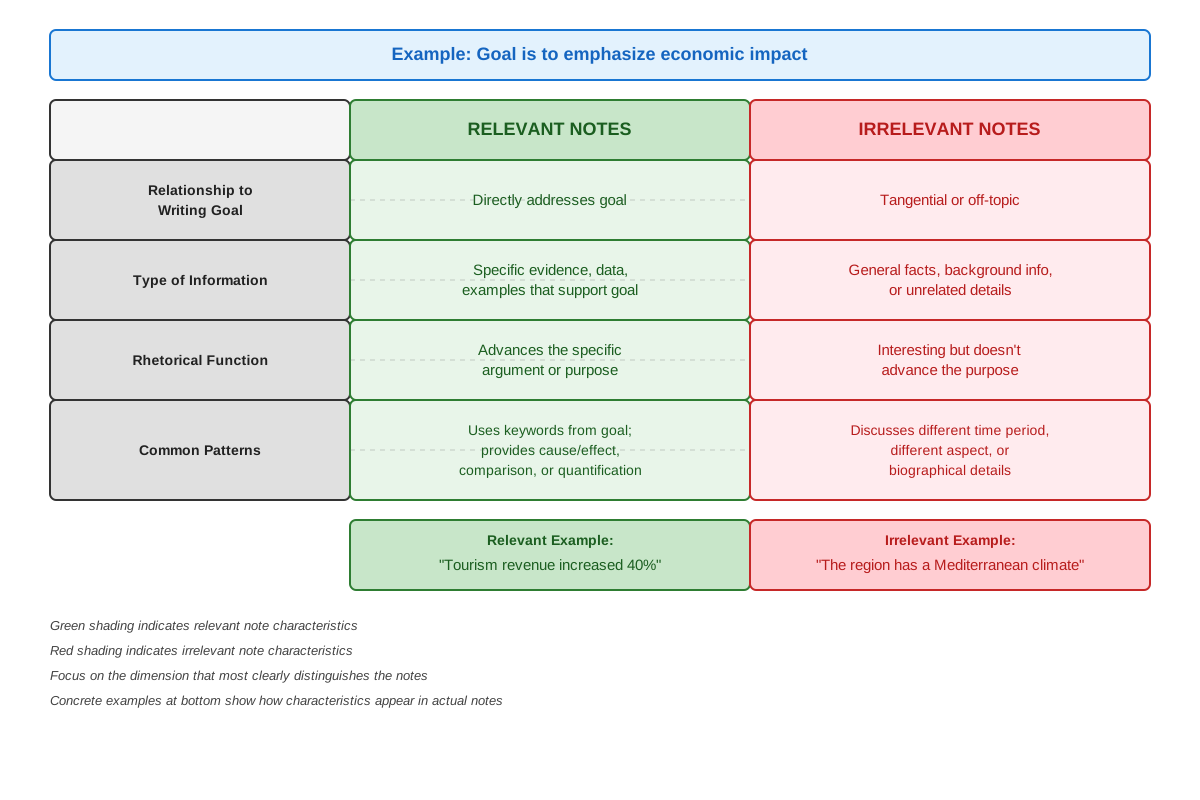
A relevant note directly supports, illustrates, or advances the stated writing goal. It provides information that a reader would need to understand the specific point being made. An irrelevant note, by contrast, might be:
- Tangentially related: Connected to the general topic but not to the specific aspect highlighted in the goal
- Too broad or general: Providing background information when specific evidence is needed
- Addressing a different aspect: Discussing a different dimension of the topic than what the goal specifies
- Redundant: Repeating information already conveyed by other notes without adding new relevant detail
The critical distinction is that irrelevance is context-dependent. A note that's irrelevant for one writing goal might be highly relevant for a different goal about the same topic. Students must evaluate each note specifically against the stated purpose, not against their general knowledge or interest in the topic.
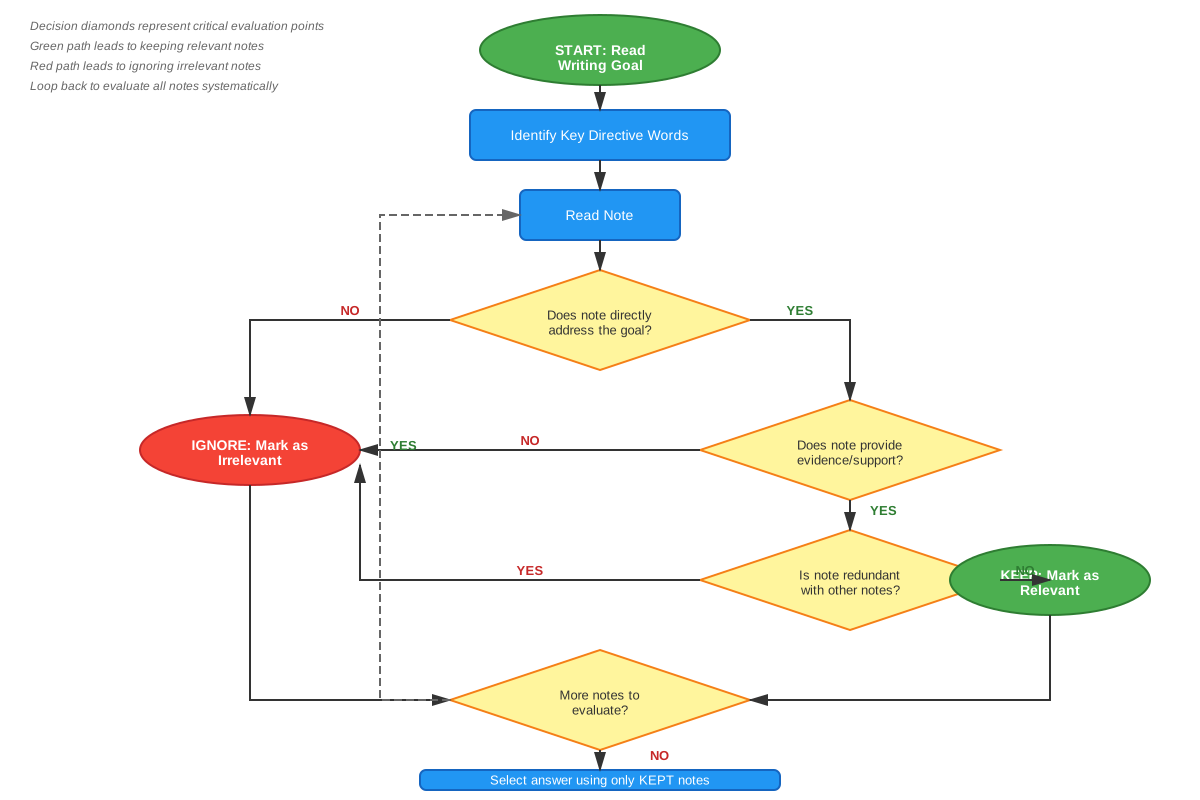
The Three-Step Evaluation Process
Successful students approach these questions systematically:
- Identify the precise writing goal: Read the question stem carefully, underlining or mentally noting the specific requirement (emphasize, explain, contrast, illustrate, etc.) and the specific aspect of the topic being addressed.
- Evaluate each note individually: For each bulleted note, ask: "Does this information directly help accomplish the stated goal?" If the answer is "not really" or "only indirectly," the note is likely irrelevant.
- Verify the combination: After identifying which notes seem relevant, check that the answer choice includes all relevant notes and excludes all irrelevant ones. Sometimes multiple notes are relevant, and the correct answer must include all of them.
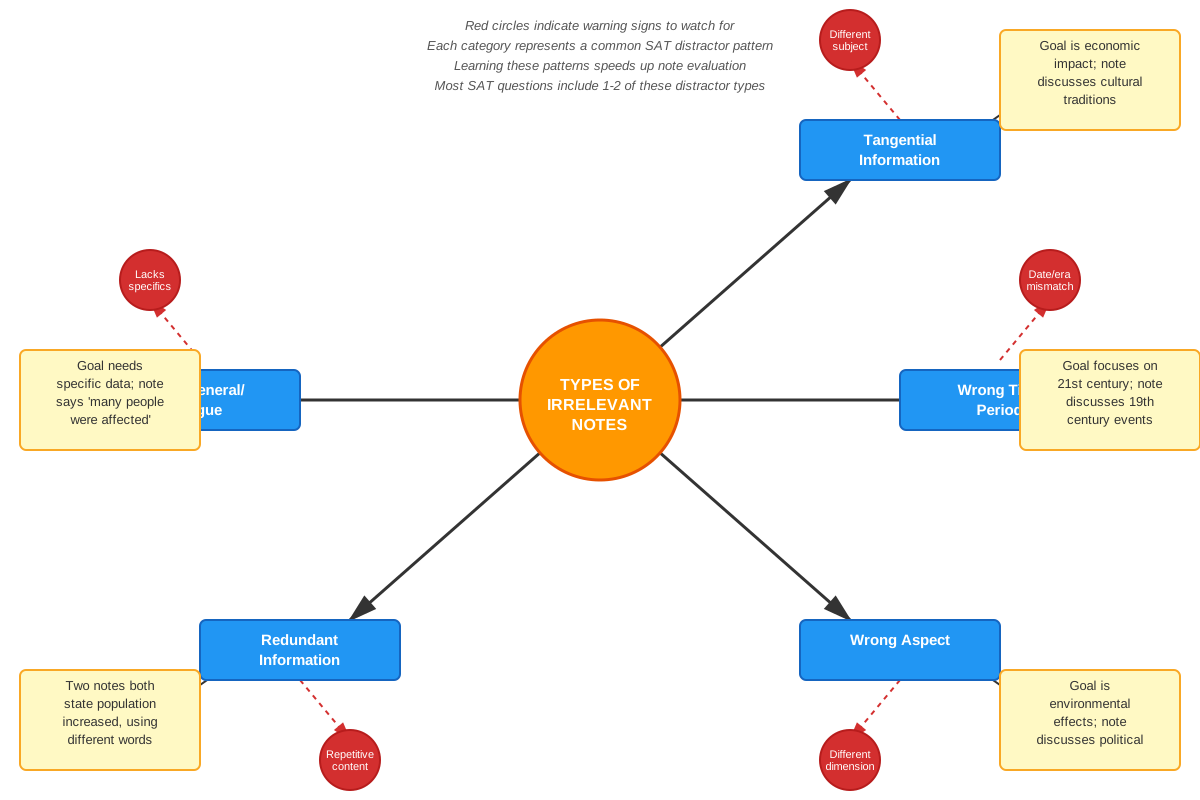
Common Types of Irrelevant Information
Understanding patterns in what makes notes irrelevant helps students recognize them quickly:
| Type of Irrelevant Note | Description | Example Context |
|---|---|---|
| Background context | General information about the topic that doesn't address the specific goal | When the goal is to explain a specific discovery, notes about the scientist's education |
| Different time period | Information from a different era than what the goal specifies | When discussing 20th-century impacts, notes about 18th-century origins |
| Different aspect | Information about a different dimension of the topic | When the goal is environmental impact, notes about social impact |
| Comparative information | Comparisons to other topics when the goal focuses on one specific subject | When discussing Species A, notes comparing Species B and C |
| Methodological details | Information about how research was conducted when the goal is about findings | When the goal is to state conclusions, notes about sample size or procedures |
Signal Words in Writing Goals
The question stem contains crucial signal words that specify exactly what type of information is relevant:
- "Emphasize": Requires strong, clear evidence of the specified characteristic; subtle or indirect evidence is insufficient
- "Explain": Requires information that clarifies how or why something occurs; mere description is insufficient
- "Illustrate": Requires concrete examples or specific instances; general statements are insufficient
- "Contrast": Requires information showing differences; similarities are irrelevant
- "Support the claim that": Requires evidence directly proving the stated claim; related but non-supporting information is irrelevant
Recognizing these signal words helps students understand precisely what the writing goal demands and therefore what makes a note relevant or irrelevant.
Multiple Relevant Notes
Some questions require synthesizing multiple relevant notes while excluding others. In these cases, students must:
- Identify all notes that contribute to the goal (there may be 2-3 relevant notes out of 4-5 total)
- Ensure the selected answer includes all relevant notes
- Verify that no irrelevant notes are included in the answer
The challenge is that partial answers—those including some but not all relevant notes, or including relevant notes plus irrelevant ones—are common wrong answer choices designed to trap students who don't evaluate all notes carefully.
Concept Relationships
The skill of ignoring irrelevant notes builds directly on fundamental reading comprehension abilities. Students must first understand what each note says (literal comprehension) before they can evaluate whether it serves the rhetorical purpose (critical analysis). This evaluation process connects to understanding main ideas versus supporting details: just as paragraphs contain both essential and peripheral information, collections of notes contain both relevant and irrelevant items.
The relationship flows as follows: Understanding rhetorical purpose → Defining relevance criteria → Evaluating individual notes → Selecting appropriate combination → Excluding irrelevant information. Each step depends on the previous one. If students misunderstand the rhetorical purpose, they'll apply the wrong relevance criteria and select inappropriate notes.
This topic also connects forward to other rhetorical synthesis skills tested on the SAT. The ability to ignore irrelevant notes is essentially the inverse of the ability to identify relevant supporting evidence—two sides of the same coin. Both skills require understanding how information functions within a specific rhetorical context. Additionally, this skill relates to transition questions (choosing appropriate connecting words) because both require understanding logical relationships between ideas and recognizing when information fits or doesn't fit within a particular context.
High-Yield Facts
⭐ The writing goal stated in the question stem is the only criterion for determining relevance—personal interest or general topic connection doesn't matter.
⭐ A note can be factually accurate and related to the general topic but still be irrelevant if it doesn't address the specific aspect mentioned in the goal.
⭐ Signal words like "emphasize," "explain," "illustrate," and "contrast" specify exactly what type of information is relevant and must be carefully noted.
⭐ Irrelevant notes often provide background context, discuss different time periods, or address different aspects of the topic than what the goal specifies.
⭐ The correct answer must include ALL relevant notes and exclude ALL irrelevant notes—partial combinations are wrong.
- Notes that are "interesting" or "related" but don't directly support the stated goal are irrelevant and must be excluded.
- Methodological details about research (sample sizes, procedures) are usually irrelevant when the goal is to state findings or conclusions.
- Comparative information about other subjects is irrelevant when the goal focuses on one specific subject.
- Redundant notes that repeat information without adding new relevant detail should be excluded.
- The most common trap answers include some relevant notes plus one irrelevant note, testing whether students evaluate all notes carefully.
Quick check — test yourself on Ignoring irrelevant notes so far.
Try Flashcards →Common Misconceptions
Misconception: All notes provided are relevant because they all relate to the general topic.
Correction: Notes are only relevant if they directly support the specific writing goal stated in the question, not just if they relate to the general topic. The SAT deliberately includes accurate, topic-related notes that don't serve the particular rhetorical purpose.
Misconception: Longer or more detailed notes are more likely to be relevant.
Correction: Length and detail don't determine relevance—only alignment with the stated goal matters. Sometimes brief notes are highly relevant while detailed notes are tangential.
Misconception: If a note is factually accurate, it should be included.
Correction: Accuracy is necessary but not sufficient for relevance. A note must be both accurate and directly supportive of the specific writing goal to be relevant.
Misconception: Background information is always relevant because it provides context.
Correction: Background information is only relevant if the writing goal specifically calls for context or if understanding the main point requires that background. Often, goals focus on specific aspects that don't require general background.
Misconception: If most of a note is relevant, the entire note should be included even if part of it is off-topic.
Correction: On the SAT, notes are evaluated as complete units. If a note contains both relevant and irrelevant information, students must judge whether the note as a whole serves the stated purpose. However, typically notes are either fully relevant or fully irrelevant to the specific goal.
Worked Examples
Example 1: Scientific Discovery
Question Stem: A student is writing about the discovery of penicillin. The student wants to emphasize the accidental nature of the discovery. Which notes should the student include?
Notes:
- Alexander Fleming discovered penicillin in 1928 while working at St. Mary's Hospital in London.
- Fleming noticed that a mold contaminating one of his bacterial cultures had killed the surrounding bacteria.
- Fleming had served as a medical officer during World War I, where he witnessed many soldiers die from infected wounds.
- The observation occurred when Fleming returned from vacation and found that a petri dish had been accidentally left open.
Analysis:
First, identify the precise writing goal: "emphasize the accidental nature of the discovery." This means relevant notes must show that the discovery happened by chance, not through deliberate experimentation.
Evaluate each note:
- Note 1: Provides when and where the discovery occurred but says nothing about whether it was accidental or intentional. Irrelevant.
- Note 2: Describes what Fleming observed (mold killing bacteria) but doesn't indicate whether this was planned or accidental. Irrelevant.
- Note 3: Provides background about Fleming's earlier career but doesn't relate to how the discovery happened. Irrelevant.
- Note 4: Explicitly states the observation occurred due to an accident (petri dish left open during vacation). Relevant.
Wait—let's reconsider Note 2. The word "contaminating" suggests the mold's presence was unintended, which supports the accidental nature. Relevant.
Correct answer: Notes 2 and 4. These notes work together to emphasize the accidental nature: the mold was a contaminant (unintended), and the situation arose because a dish was accidentally left open.
Connection to learning objectives: This example demonstrates how to identify the specific aspect of a topic that the writing goal addresses (accidental nature vs. general discovery facts) and how to distinguish between notes that provide general information versus notes that directly support the specific rhetorical purpose.
Example 2: Historical Impact
Question Stem: A student is writing about the economic impact of the California Gold Rush. The student wants to explain how the Gold Rush affected San Francisco's economy. Which notes should the student include?
Notes:
- The Gold Rush began in 1848 when gold was discovered at Sutter's Mill in Coloma, California.
- San Francisco's population grew from about 1,000 in 1848 to over 25,000 by 1850.
- The influx of prospectors created enormous demand for supplies, tools, and services in San Francisco, causing prices to skyrocket.
- Many prospectors came from as far away as China, Chile, and Europe, making California culturally diverse.
- Merchants and service providers in San Francisco often made more money than the miners themselves.
Analysis:
The writing goal specifies two key requirements: (1) economic impact (not cultural, demographic, or political), and (2) specifically San Francisco's economy (not California generally or the mining regions).
Evaluate each note:
- Note 1: Provides background about when and where the Gold Rush started but doesn't address economic impact on San Francisco. Irrelevant.
- Note 2: Shows population growth, which is demographic information. While population growth can affect economy, this note doesn't explicitly connect to economic impact. Borderline—likely irrelevant because it doesn't directly discuss economic effects.
- Note 3: Directly addresses economic impact (demand for supplies and services, rising prices) specifically in San Francisco. Relevant.
- Note 4: Discusses cultural diversity, not economic impact. Irrelevant.
- Note 5: Directly addresses economic impact (merchants making money) specifically in San Francisco. Relevant.
Correct answer: Notes 3 and 5. These notes directly explain economic effects on San Francisco's economy, while the other notes provide background, demographic, or cultural information that doesn't address the specific goal.
Connection to learning objectives: This example shows how to apply multiple filters simultaneously (economic + San Francisco) and how to recognize that related information (like population growth) isn't necessarily relevant if it doesn't directly address the specific aspect mentioned in the goal.
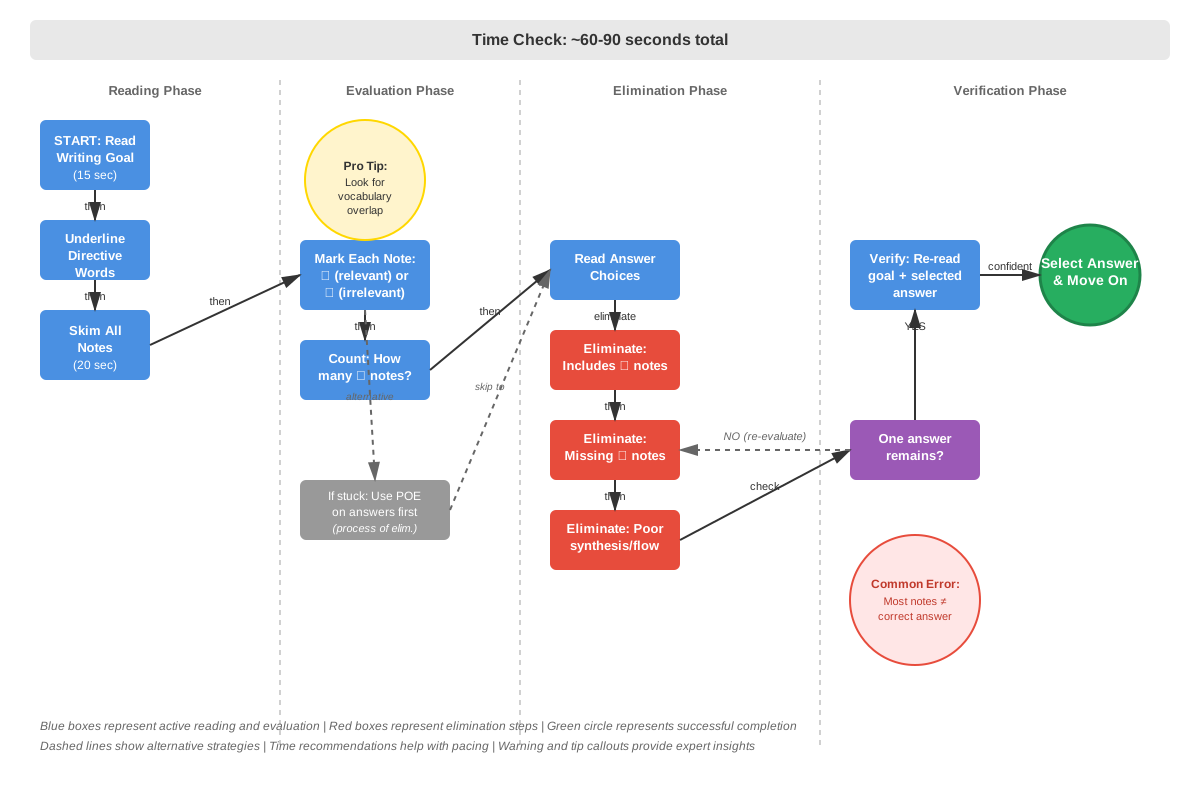
Exam Strategy
When approaching ignoring irrelevant notes questions on the SAT, follow this systematic process:
Step 1: Read and annotate the writing goal (15-20 seconds)
- Underline or mentally note the specific requirement (emphasize, explain, illustrate, etc.)
- Identify the specific aspect or characteristic being addressed
- Note any limiting factors (time period, location, type of impact, etc.)
Step 2: Quickly preview all notes (10 seconds)
- Get a sense of what information is available
- Notice which notes seem immediately relevant or irrelevant
Step 3: Evaluate each note systematically (30-40 seconds)
- For each note, ask: "Does this directly help accomplish the stated goal?"
- Mark relevant notes with a checkmark or plus sign
- Mark irrelevant notes with an X or minus sign
- When uncertain, ask: "If I were writing a paragraph with this goal, would I definitely need this information?"
Step 4: Match your evaluation to answer choices (10-15 seconds)
- Find the answer that includes all notes you marked relevant and excludes all notes you marked irrelevant
- If no answer matches perfectly, re-evaluate the notes you were uncertain about
Exam Tip: The most common trap answers include "almost right" combinations—they have most of the relevant notes but include one irrelevant note or exclude one relevant note. Always verify that your selected answer includes ALL relevant notes and ONLY relevant notes.
Trigger words to watch for in writing goals:
- "Emphasize" → need strong, clear evidence of the specified characteristic
- "Explain" → need information showing how or why, not just what
- "Illustrate" → need specific examples or concrete instances
- "Present a contrast" → need information showing differences
- "Support the claim" → need direct evidence proving the claim
Process of elimination tips:
- Eliminate answers that include notes providing only background context when the goal requires specific evidence
- Eliminate answers that include notes about different time periods, locations, or aspects than specified in the goal
- Eliminate answers that include comparative information when the goal focuses on a single subject
- When two answers seem close, identify the single note that differs between them and evaluate that note carefully against the goal
Time allocation: Spend approximately 75-90 seconds per question. These questions require careful reading but shouldn't consume excessive time. If you're spending more than 90 seconds, make your best judgment and move on—you can return if time permits.
Memory Techniques
GREED Acronym for evaluating notes:
- Goal: Does this note address the specific goal stated?
- Relevant: Is this information directly relevant, not just related?
- Exact: Does this note match the exact aspect (time, place, type) specified?
- Evidence: Does this note provide evidence for the specific claim or purpose?
- Direct: Is the connection direct, or does it require multiple inferential steps?
The Filter Visualization: Imagine the writing goal as a filter or sieve. Pour all the notes through it. Only notes that fit the exact shape of the filter (the specific requirements) pass through. Notes that are too big (too broad), too small (too specific to a different aspect), or the wrong shape (addressing different aspects) don't pass through and must be excluded.
The "So What?" Test: For each note, ask "So what does this tell me about [the specific aspect in the goal]?" If you can't answer that question directly, the note is likely irrelevant.
RED FLAG Mnemonic for common types of irrelevant notes:
- Redundant information
- Extraneous background
- Different aspect/time/place
- Foreign comparisons (to other subjects)
- Lacking connection to goal
- Adjacent but not aligned
- General when specific is needed
Summary
Ignoring irrelevant notes is a critical rhetorical synthesis skill that requires students to evaluate information based on specific writing goals rather than general topic relevance. The key principle is that relevance is context-dependent: a note is only relevant if it directly supports the particular rhetorical purpose stated in the question stem. Students must carefully read the writing goal to identify exactly what aspect of a topic is being addressed, then systematically evaluate each note against that specific criterion. Common types of irrelevant notes include background context, information about different time periods or aspects, comparative information about other subjects, and methodological details when findings are needed. Success requires distinguishing between notes that are factually accurate and generally related to the topic versus notes that directly advance the specific writing goal. The correct answer must include all relevant notes and exclude all irrelevant ones—partial combinations are incorrect. This skill mirrors real-world academic writing, where effective communication requires selecting only information that serves the immediate purpose while excluding tangential details.
Key Takeaways
- The writing goal stated in the question stem is the sole criterion for determining relevance—evaluate every note against this specific goal, not general topic connection
- Relevance is context-dependent: a note that's irrelevant for one goal might be relevant for a different goal about the same topic
- Signal words like "emphasize," "explain," "illustrate," and "contrast" specify exactly what type of information is needed
- Common irrelevant notes include background context, different time periods/aspects, comparative information, and methodological details when findings are needed
- The correct answer must include ALL relevant notes and exclude ALL irrelevant notes—partial combinations are trap answers
- Factual accuracy doesn't equal relevance; a note can be true and topic-related but still irrelevant to the specific writing goal
- Use systematic evaluation: identify the goal's requirements, evaluate each note individually, then verify the complete combination
Related Topics
Rhetorical Synthesis - Combining Information: After mastering which notes to exclude, students learn how to effectively combine relevant notes into coherent sentences, including choosing appropriate transitions and maintaining logical flow.
Main Idea and Supporting Details: Understanding the hierarchy of information in passages—distinguishing central claims from peripheral details—reinforces the same analytical skills used in ignoring irrelevant notes.
Author's Purpose and Tone: Recognizing what an author aims to accomplish in a passage connects directly to evaluating whether information serves a specific rhetorical purpose.
Evidence Selection in Argument Analysis: In other SAT question types, students must identify which evidence best supports a claim, which is the positive version of the skill practiced in ignoring irrelevant notes.
Mastering ignoring irrelevant notes provides the foundation for all rhetorical synthesis questions and strengthens overall critical reading and analytical writing abilities essential for college success.
Practice CTA
Now that you understand the principles of ignoring irrelevant notes, it's time to apply these strategies to practice questions. Work through the practice questions systematically, using the GREED acronym and three-step evaluation process. Pay special attention to questions where you're torn between two answer choices—these reveal opportunities to sharpen your ability to distinguish relevant from irrelevant information. Review the flashcards to reinforce the key concepts and common patterns of irrelevant notes. Remember, this skill improves dramatically with deliberate practice. Each question you analyze strengthens your ability to evaluate relevance quickly and accurately, building the rhetorical awareness that distinguishes top SAT scorers. You've got this!
Sign up free to keep reading
Create a free AnvayaPrep account to finish this SAT guide on Ignoring irrelevant notes — plus flashcards and practice questions.