Overview
Cause and effect structure is one of the most frequently tested organizational patterns in the SAT Reading and Writing section. This structural framework describes how authors arrange information to show relationships between events, phenomena, or ideas—specifically, how one thing (the cause) leads to or produces another thing (the effect). Understanding this pattern is crucial because approximately 15-20% of SAT reading passages employ cause-and-effect organization as their primary or secondary structure, and questions explicitly testing structural recognition appear in nearly every test administration.
The ability to identify and analyze sat cause and effect structure directly impacts performance on multiple question types in the rw section. Students who master this concept can more efficiently navigate complex scientific passages, historical analyses, and argumentative texts. When readers recognize that an author is explaining why something happened or what resulted from a particular event, they can predict information flow, identify main ideas more quickly, and eliminate incorrect answer choices that misrepresent these relationships.
Beyond isolated structure-identification questions, cause-and-effect recognition enhances overall reading comprehension. This organizational pattern connects to broader Reading and Writing skills including main idea identification, author's purpose analysis, and logical reasoning. Many inference questions, vocabulary-in-context items, and command-of-evidence questions become significantly easier when students understand the causal relationships an author has established. Mastering this topic creates a foundation for analyzing more complex rhetorical structures and strengthens critical thinking skills essential for college-level reading.
Learning Objectives
- [ ] Identify key features of cause and effect structure in SAT passages
- [ ] Explain how cause and effect structure appears on the SAT
- [ ] Apply cause and effect structure to answer SAT-style questions
- [ ] Distinguish between single-cause/single-effect and multiple-cause/multiple-effect relationships
- [ ] Recognize signal words and transitional phrases that indicate causal relationships
- [ ] Analyze how cause-and-effect organization supports an author's purpose
- [ ] Differentiate cause-and-effect structure from other organizational patterns (comparison, chronological, problem-solution)
Prerequisites
- Basic reading comprehension skills: Understanding literal meaning is necessary before analyzing organizational structure
- Familiarity with main idea identification: Recognizing the central point helps distinguish primary causal relationships from supporting details
- Knowledge of transition words: Understanding how connective words function aids in spotting structural signals
- Ability to identify topic sentences: Recognizing where authors introduce new ideas helps track cause-effect chains
Why This Topic Matters
Understanding cause-and-effect structure has immediate practical applications beyond standardized testing. In academic settings, students encounter this organizational pattern in science textbooks explaining natural phenomena, history texts analyzing historical events, and social science research discussing behavioral patterns. Professional writing—from business reports to medical literature—frequently employs causal analysis to explain outcomes and justify decisions.
On the SAT specifically, cause-and-effect questions appear with high frequency. Data from recent test administrations shows that 2-4 questions per test directly assess structural understanding, while an additional 5-8 questions become significantly easier when students recognize underlying causal relationships. The Reading and Writing section includes passages from natural sciences (explaining scientific processes), social sciences (analyzing societal trends), and humanities (exploring cultural developments)—all domains where cause-and-effect reasoning predominates.
Common manifestations in SAT passages include: scientific explanations of environmental changes and their impacts, historical analyses of events and their consequences, discussions of technological innovations and resulting societal shifts, and examinations of economic policies and their effects. Questions may ask students to identify the author's organizational pattern, determine what caused a specific outcome mentioned in the passage, predict likely effects based on described causes, or recognize how the structure supports the author's argument. Approximately 60% of natural science passages and 40% of social science passages employ cause-and-effect as a primary organizational strategy.
Core Concepts
Defining Cause and Effect Structure
Cause and effect structure is an organizational pattern in which an author arranges information to demonstrate how one event, action, or condition (the cause) produces or leads to another event, action, or condition (the effect). The cause represents the reason something happens, while the effect represents the result or consequence. This structure answers the fundamental questions "Why did this happen?" and "What happened as a result?"
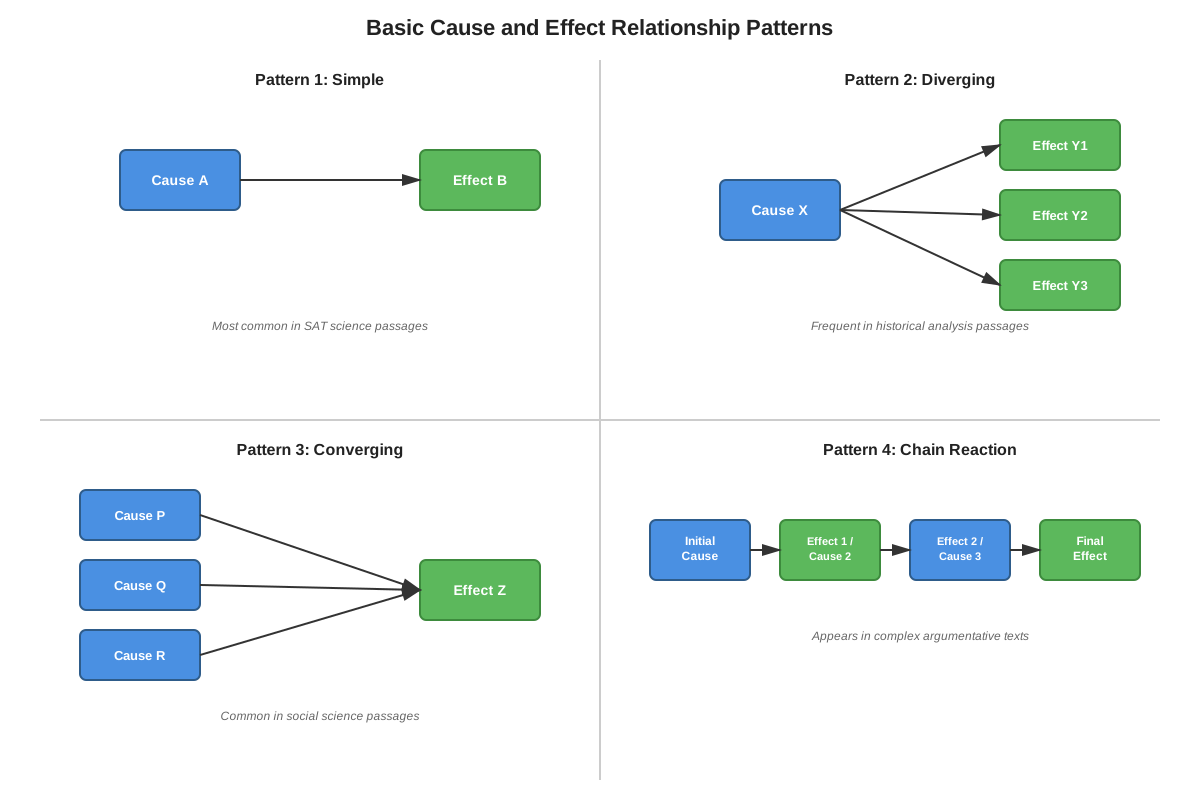
In SAT passages, this structure can manifest in several configurations. A single cause-single effect relationship presents one reason leading to one outcome (e.g., "The drought caused crop failure"). A single cause-multiple effects pattern shows how one event produces several consequences (e.g., "The invention of the printing press led to increased literacy, the spread of ideas, and the democratization of knowledge"). Conversely, a multiple causes-single effect structure demonstrates how several factors combine to produce one result (e.g., "Deforestation, industrial pollution, and agricultural runoff all contributed to the lake's degradation"). The most complex form, multiple causes-multiple effects, appears in sophisticated passages where several interrelated factors produce various outcomes.
Signal Words and Transitional Phrases
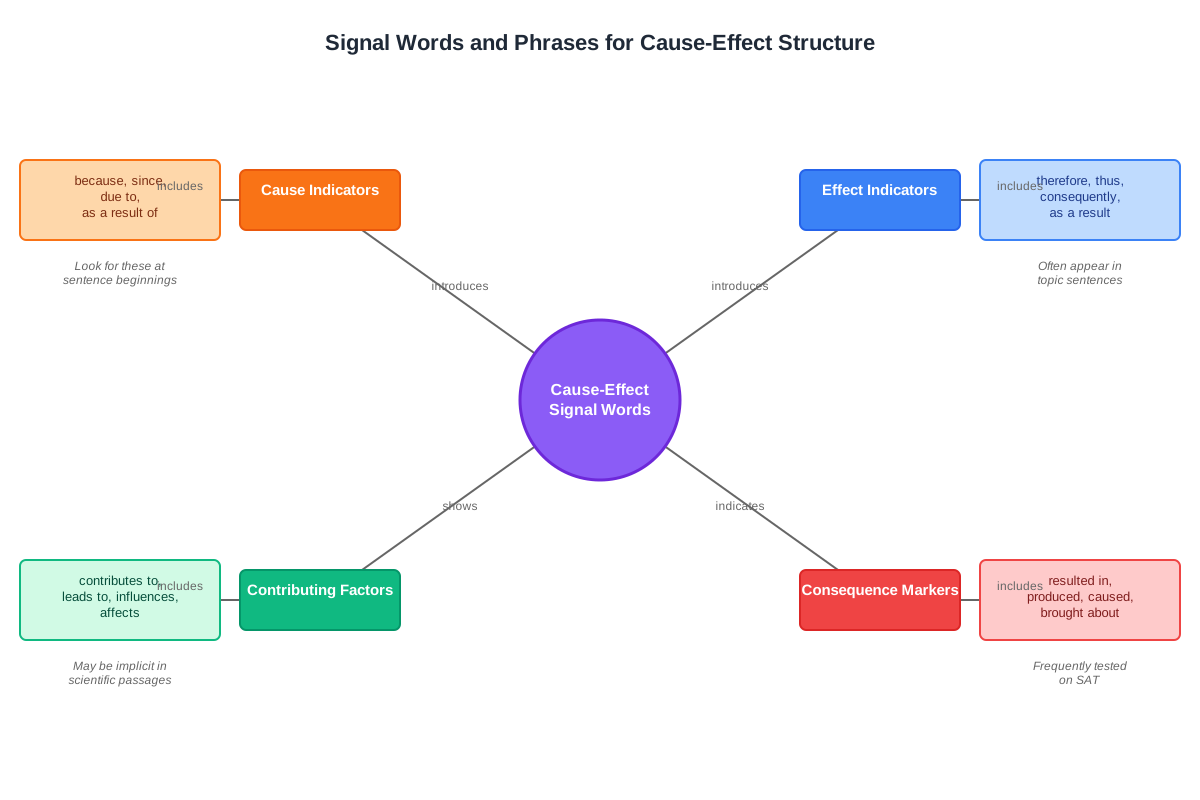
Recognizing linguistic markers is essential for identifying cause-and-effect structure. Signal words are specific terms that explicitly indicate causal relationships. These fall into several categories:
Cause indicators (words that introduce reasons):
- because, since, as, due to, owing to, on account of, for this reason, caused by, stems from, results from, is a consequence of, is attributed to
Effect indicators (words that introduce results):
- therefore, thus, consequently, as a result, accordingly, hence, so, leads to, produces, results in, brings about, gives rise to, causes, creates, generates, triggers
Conditional indicators (words suggesting potential cause-effect):
- if...then, when...then, unless, provided that, in the event that
Understanding these markers allows students to track causal chains even in complex passages. However, SAT passages sometimes present causal relationships without explicit signal words, requiring readers to infer connections from context and logical flow.
Structural Patterns in SAT Passages
Cause-and-effect organization can structure entire passages or individual paragraphs. Three primary patterns appear on the SAT:
Cause-to-Effect Pattern: The author begins by describing a cause or set of causes, then explains the resulting effects. This forward-moving structure is common in scientific explanations. For example, a passage might first describe increased atmospheric carbon dioxide (cause), then detail rising global temperatures, melting ice caps, and changing weather patterns (effects).
Effect-to-Cause Pattern: The author presents an effect or outcome first, then traces backward to explain the causes. This reverse structure often appears in historical analysis or problem-focused passages. A passage might begin by describing declining bee populations (effect), then explore pesticide use, habitat loss, and disease (causes).
Causal Chain Pattern: The author presents a sequence where each effect becomes the cause of the next event, creating a domino effect. This sophisticated structure appears in passages analyzing complex processes: Event A causes Event B, which causes Event C, which causes Event D. For instance, a passage might trace how agricultural expansion (A) led to deforestation (B), which caused soil erosion (C), which resulted in river sedimentation (D).
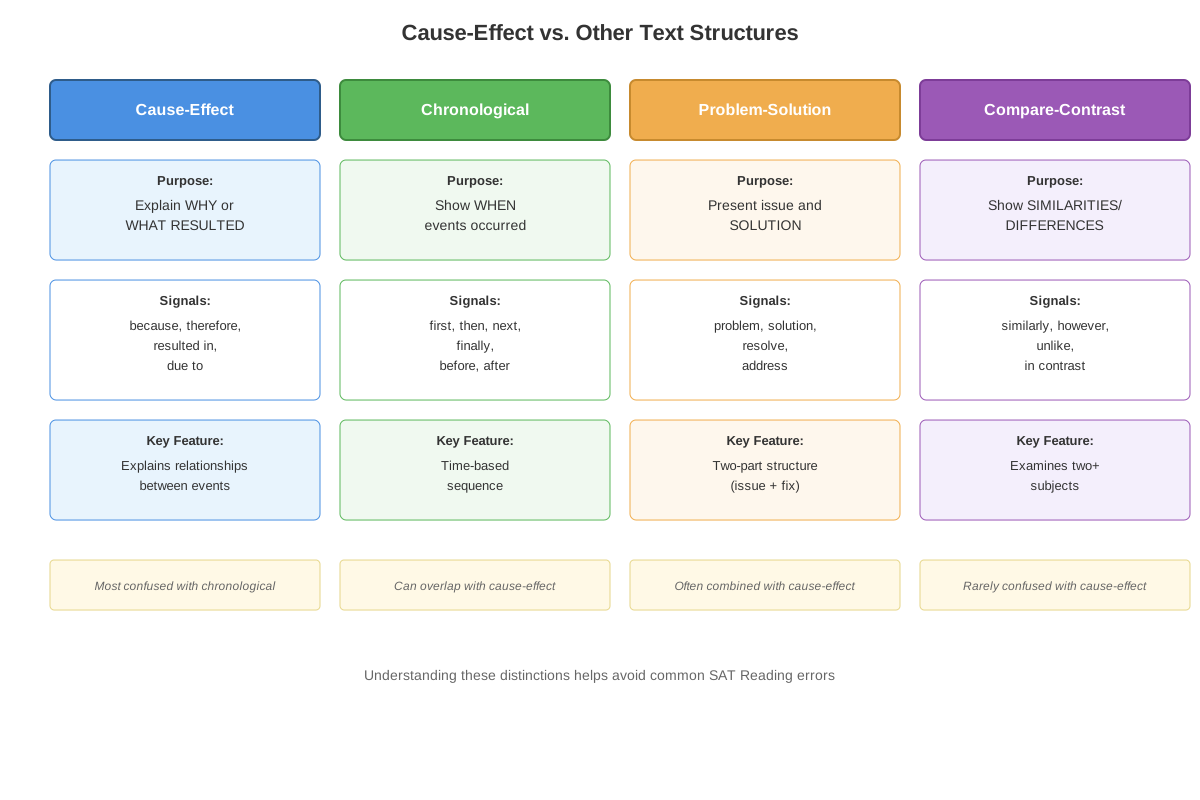
Distinguishing Cause-Effect from Other Structures
Students must differentiate cause-and-effect structure from similar organizational patterns:
| Structure Type | Primary Purpose | Key Question Answered | Common Signal Words |
|---|---|---|---|
| Cause-Effect | Show relationships between events | Why/What resulted? | because, therefore, consequently |
| Chronological | Present events in time order | When did this happen? | first, next, then, finally |
| Compare-Contrast | Show similarities/differences | How are these alike/different? | similarly, however, whereas, unlike |
| Problem-Solution | Present issue and resolution | How can this be fixed? | problem, solution, resolve, address |
While passages may combine multiple structures, recognizing the dominant pattern helps students navigate content efficiently and answer structure-focused questions accurately.
Implicit vs. Explicit Causal Relationships
Not all cause-and-effect relationships are stated directly. Explicit causal relationships use clear signal words and direct statements (e.g., "The earthquake caused widespread destruction"). Implicit causal relationships require readers to infer connections from context, even when signal words are absent. For example: "The region experienced a severe drought in 2020. By 2021, agricultural output had declined by 40%." The causal relationship is strongly implied but not explicitly stated.
SAT passages frequently test students' ability to recognize implicit causation, particularly in higher-difficulty questions. Understanding the logical connection between events, even without explicit markers, demonstrates sophisticated reading comprehension.
Concept Relationships
The concepts within cause-and-effect structure form an interconnected system. Signal words serve as the primary tool for identifying causal relationships, which then allows readers to recognize whether a passage employs cause-to-effect, effect-to-cause, or causal chain patterns. Understanding these structural patterns enables students to distinguish cause-effect organization from other structures like chronological or compare-contrast. This distinction is crucial because misidentifying structure leads to misunderstanding the author's purpose and main ideas.
The relationship map flows as follows:
Signal Word Recognition → Identification of Causal Relationships → Determination of Structural Pattern → Differentiation from Other Structures → Enhanced Comprehension of Author's Purpose
This topic connects to prerequisite knowledge of transition words and main idea identification. Recognizing transitions provides the foundation for spotting causal markers, while understanding main ideas helps students distinguish primary cause-effect relationships from supporting examples. The topic also relates to inference questions (requiring students to extend causal logic), author's purpose questions (understanding why an author chose causal organization), and command-of-evidence questions (identifying which textual evidence supports a causal claim).
Mastering cause-and-effect structure prepares students for more advanced topics including rhetorical analysis, argument evaluation, and synthesis of multiple sources—all skills tested in college-level coursework and advanced standardized exams.
High-Yield Facts
⭐ Cause-and-effect structure appears in 15-20% of SAT reading passages, making it one of the most frequently tested organizational patterns
⭐ Signal words like "because," "therefore," "consequently," and "as a result" are the most reliable indicators of cause-and-effect relationships
⭐ Not all causal relationships use explicit signal words; implicit causation requires inference from context and logical flow
⭐ A single cause can produce multiple effects, and multiple causes can combine to produce a single effect
⭐ Causal chains show sequences where each effect becomes the cause of the next event
- Cause-to-effect patterns move forward from reason to result, while effect-to-cause patterns work backward from result to reason
- Scientific passages most frequently employ cause-and-effect structure, particularly when explaining natural processes or experimental results
- Chronological structure describes when events occurred; cause-and-effect structure explains why events occurred
- Questions asking "What led to..." or "What resulted from..." directly test cause-and-effect comprehension
- Authors use cause-and-effect structure to explain phenomena, support arguments, or demonstrate relationships between concepts
Quick check — test yourself on Cause and effect structure so far.
Try Flashcards →Common Misconceptions
Misconception: Chronological order and cause-and-effect structure are the same thing. → Correction: Chronological structure simply presents events in time sequence without necessarily explaining why they occurred. Cause-and-effect structure specifically demonstrates how one event produces another. Events can occur in sequence without having a causal relationship. For example, "I ate breakfast, then drove to school" is chronological but not causal—eating breakfast didn't cause the drive to school.
Misconception: Every passage contains only one organizational structure. → Correction: SAT passages frequently combine multiple organizational patterns. A passage might use cause-and-effect as its primary structure while incorporating comparison, examples, or chronological elements in supporting paragraphs. Students should identify the dominant structure while recognizing secondary patterns.
Misconception: The cause always appears before the effect in the passage. → Correction: While causes logically precede effects in reality, authors can present information in any order. Effect-to-cause structure deliberately presents results first, then explains causes. Students must distinguish between logical causation (what actually caused what) and textual organization (how the author arranged information).
Misconception: Signal words always indicate cause-and-effect relationships. → Correction: Words like "since" and "as" can indicate causation or time, depending on context. "Since the Industrial Revolution" indicates time, while "Since temperatures increased" indicates causation. Students must analyze context rather than relying solely on signal words.
Misconception: Correlation always implies causation in SAT passages. → Correction: Sophisticated SAT passages sometimes present correlated events without causal relationships, or they explicitly discuss the difference between correlation and causation. Just because two events occur together doesn't mean one caused the other—both might result from a third factor, or the relationship might be coincidental.
Misconception: Cause-and-effect questions are always explicitly labeled. → Correction: While some questions directly ask about causes or effects, many questions test causal understanding indirectly through inference, main idea, or purpose questions. Recognizing underlying causal structure helps answer various question types, not just those explicitly mentioning cause and effect.
Worked Examples
Example 1: Identifying Structure in a Scientific Passage
Passage Excerpt:
"The introduction of zebra mussels into the Great Lakes ecosystem has had profound consequences. These invasive mollusks filter vast quantities of water, removing plankton that native fish species depend on for food. As a result, populations of native fish have declined significantly. Additionally, zebra mussels attach to water intake pipes, causing millions of dollars in damage to municipal water systems and power plants. Their sharp shells also accumulate on beaches, making them hazardous for swimmers. The economic and ecological impacts continue to mount as the mussels spread to new waterways."
Question: The passage primarily employs which organizational structure?
A) Chronological sequence
B) Compare and contrast
C) Cause and effect
D) Problem and solution
Solution Process:
Step 1: Identify the main topic and how information is arranged. The passage discusses zebra mussels (the cause) and their various impacts (the effects).
Step 2: Look for signal words. "Has had profound consequences," "as a result," and "causing" are explicit cause-and-effect markers.
Step 3: Analyze the information flow. The passage presents one cause (zebra mussel introduction) leading to multiple effects (native fish decline, infrastructure damage, beach hazards, economic impacts).
Step 4: Eliminate incorrect answers. Choice A is incorrect because the passage doesn't focus on when events occurred in sequence. Choice B is incorrect because the passage doesn't compare zebra mussels to anything else. Choice D is incorrect because while a problem is presented, no solution is offered.
Step 5: Confirm the correct answer. Choice C is correct because the passage's primary purpose is explaining how one event (zebra mussel introduction) caused multiple outcomes.
Connection to Learning Objectives: This example demonstrates identifying key features of cause-and-effect structure (single cause-multiple effects pattern) and applying this knowledge to answer SAT-style questions.
Example 2: Distinguishing Implicit Causation
Passage Excerpt:
"In the 1950s, American suburbs experienced unprecedented growth. The federal government had recently implemented policies making home mortgages more accessible to middle-class families. Simultaneously, the Interstate Highway System expanded, connecting urban centers to outlying areas. By 1960, suburban populations had increased by 47%, while many urban cores saw population decline."
Question: Based on the passage, which factor most directly contributed to suburban growth?
A) The decline of urban populations
B) Increased accessibility of home mortgages
C) The construction of the Interstate Highway System
D) Both B and C
Solution Process:
Step 1: Identify what the passage presents as causes versus effects. The passage mentions government mortgage policies and highway expansion, followed by suburban growth and urban decline.
Step 2: Recognize implicit causation. Although the passage doesn't use explicit signal words like "caused" or "resulted in," the temporal sequence and logical relationship suggest causation: policies were implemented, then growth occurred.
Step 3: Distinguish causes from effects. Suburban growth is the effect being explained. Urban decline is presented as occurring simultaneously with suburban growth, suggesting it's another effect rather than a cause.
Step 4: Evaluate each answer choice. Choice A incorrectly identifies an effect as a cause. Choices B and C both identify actual causes mentioned in the passage.
Step 5: Determine whether one or both factors are presented as causes. The passage presents both mortgage accessibility and highway expansion as contributing factors, using "simultaneously" to indicate they worked together.
Answer: D is correct because the passage implicitly presents both factors as causes of suburban growth, even without explicit signal words.
Connection to Learning Objectives: This example demonstrates recognizing implicit causal relationships, distinguishing between causes and effects, and identifying multiple-causes-single-effect patterns.
Exam Strategy
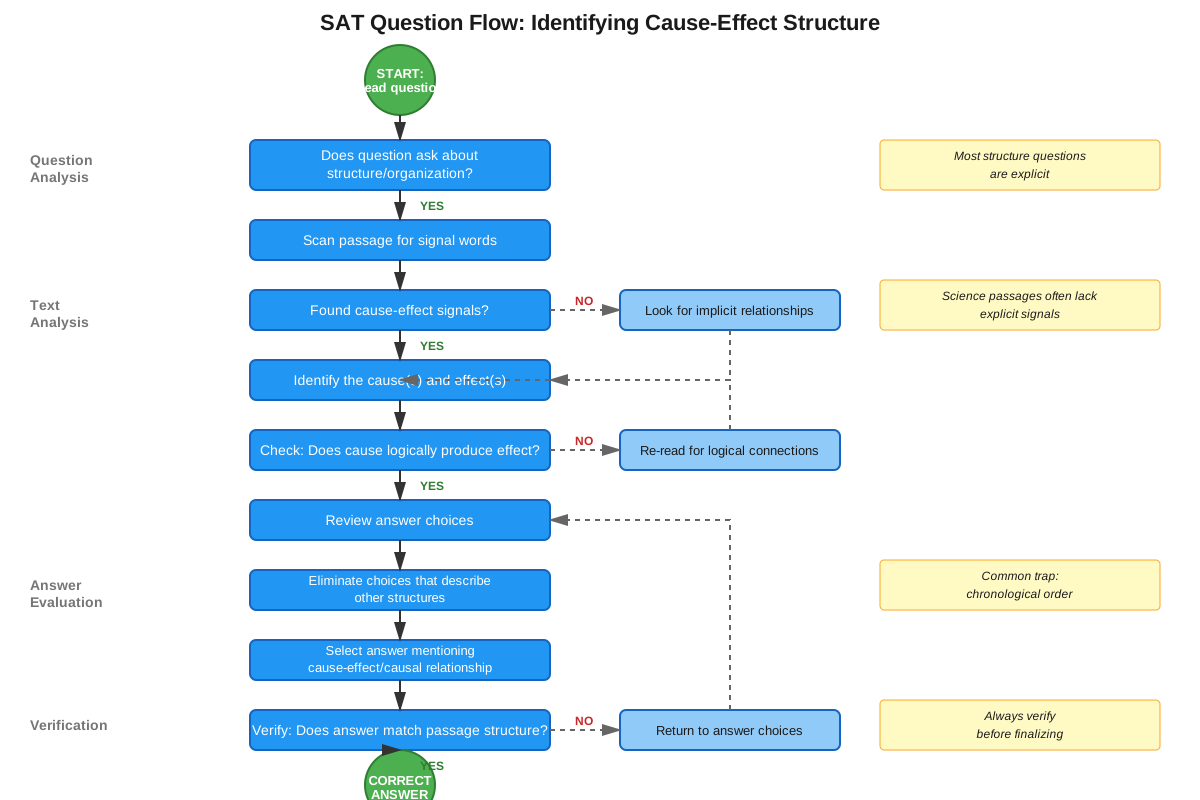
When approaching SAT questions involving cause-and-effect structure, employ this systematic process:
Step 1: Pre-read for structure signals. Before diving into detailed reading, scan the passage for signal words indicating causation. This 10-15 second preview helps activate your structural awareness and prepares you to track causal relationships as you read.
Step 2: Annotate causal relationships. As you read, mark causes with "C" and effects with "E" in the margin. Draw arrows showing the direction of causation. This active reading strategy prevents confusion when questions ask about complex causal chains.
Step 3: Distinguish temporal from causal. Watch for passages that present events in chronological order without establishing causation. Ask yourself: "Did Event A actually cause Event B, or did they just happen in sequence?" This distinction is crucial for avoiding trap answers.
Step 4: Map complex causal chains. When passages present multiple causes and effects, create a quick visual map: Cause 1 → Effect 1/Cause 2 → Effect 2. This clarifies relationships and prevents confusion about which factor caused which outcome.
Trigger words to watch for in questions:
- "What led to..." (asking for cause)
- "What resulted from..." (asking for effect)
- "The author organizes the passage by..." (asking for structure identification)
- "According to the passage, what caused..." (direct causation question)
- "Which factor contributed to..." (asking for cause, possibly among multiple factors)
Process-of-elimination tips:
- Eliminate answers that reverse cause and effect (presenting an effect as if it were a cause)
- Eliminate answers that confuse correlation with causation
- Eliminate answers that identify supporting details rather than primary causal relationships
- Watch for answers that are factually accurate but don't address the causal relationship the question asks about
Time allocation: Structure-identification questions typically require 30-45 seconds once you've read the passage. If you've annotated causal relationships during your initial reading, these questions become quick points. Don't spend more than 60 seconds on any single cause-and-effect question—if you're stuck, mark it and return after completing easier questions.
Exam Tip: When a question asks about the passage's organizational structure, the correct answer will describe how the majority of the passage is organized, not just one paragraph. Always consider the passage as a whole.
Memory Techniques
BECAUSE Mnemonic for remembering common cause signal words:
- Because
- Effect of
- Caused by
- As a result of
- Under the influence of
- Since
- Emanates from
TRACE Acronym for analyzing cause-and-effect passages:
- Trigger words: Identify signal words indicating causation
- Relationships: Map which events cause which outcomes
- Arrangement: Determine if the structure is cause-to-effect, effect-to-cause, or causal chain
- Connections: Understand how multiple causes or effects relate
- Eliminate: Remove answer choices that confuse causes with effects
Visualization Strategy: Picture cause-and-effect relationships as dominoes falling. The first domino (cause) knocks down subsequent dominoes (effects). In causal chains, each falling domino becomes the cause that knocks down the next. This mental image helps track complex sequences and prevents confusion about the direction of causation.
The "Why-What" Test: When reading a passage, repeatedly ask "Why did this happen?" (to identify causes) and "What happened as a result?" (to identify effects). This active questioning keeps you focused on causal relationships and prevents passive reading.
Summary
Cause-and-effect structure is a fundamental organizational pattern in SAT Reading and Writing passages, appearing in 15-20% of texts across scientific, historical, and social science domains. This structure demonstrates how one event, action, or condition produces or leads to another, answering the essential questions of why something happened and what resulted. Students must recognize both explicit causal relationships marked by signal words like "because," "therefore," and "consequently," as well as implicit relationships requiring inference from context. The structure manifests in several patterns: single cause-single effect, single cause-multiple effects, multiple causes-single effect, and complex causal chains where each effect becomes the next cause. Distinguishing cause-and-effect from chronological, compare-contrast, and problem-solution structures is essential for accurate comprehension and question answering. Mastery requires identifying signal words, mapping causal relationships, understanding both forward (cause-to-effect) and reverse (effect-to-cause) organizational patterns, and recognizing that passages often combine multiple structures. Success on SAT questions depends on distinguishing causes from effects, avoiding confusion between correlation and causation, and recognizing that effects can be presented before their causes in the text even though causes logically precede effects in reality.
Key Takeaways
- Cause-and-effect structure explains why events occur and what results from them, making it distinct from chronological structure which only shows when events occurred
- Signal words like "because," "therefore," "consequently," and "as a result" are primary indicators of causal relationships, but implicit causation without signal words also appears frequently
- A single cause can produce multiple effects, multiple causes can combine to produce a single effect, and causal chains can create sequences where each effect becomes the next cause
- Authors can present information in cause-to-effect order (forward), effect-to-cause order (reverse), or as complex causal chains, regardless of the logical sequence of events
- Recognizing cause-and-effect structure enhances performance on multiple question types including structure identification, inference, main idea, and author's purpose questions
- Always distinguish between what actually caused what (logical causation) versus how the author arranged information (textual organization)
- Annotating causal relationships while reading prevents confusion and speeds up question answering
Related Topics
Text Structure and Purpose - Compare and Contrast Structure: Understanding how authors organize information to show similarities and differences between concepts, which often appears alongside cause-and-effect in complex passages. Mastering cause-and-effect structure provides a foundation for distinguishing between these organizational patterns.
Text Structure and Purpose - Problem and Solution Structure: Learning how authors present issues and their resolutions, which frequently overlaps with cause-and-effect (problems are often effects of causes, and solutions create new effects). Cause-and-effect mastery enables better recognition of problem-solution patterns.
Inference and Evidence - Drawing Logical Conclusions: Developing skills to extend information beyond what's explicitly stated, which builds directly on understanding causal relationships. Recognizing cause-and-effect structure strengthens inference abilities.
Author's Purpose and Rhetoric - Analyzing Organizational Choices: Examining why authors choose specific structures to achieve their communicative goals. Understanding cause-and-effect structure is essential for analyzing how organizational choices support argumentative purposes.
Command of Evidence - Supporting Claims with Textual Evidence: Learning to identify which passage details support specific conclusions, which often involves tracing causal relationships. Cause-and-effect mastery improves evidence selection skills.
Practice CTA
Now that you've mastered the fundamentals of cause-and-effect structure, it's time to put your knowledge into action! Complete the practice questions to test your ability to identify causal relationships, distinguish causes from effects, and recognize organizational patterns in authentic SAT-style passages. Use the flashcards to reinforce signal words and key concepts until they become automatic. Remember: recognizing cause-and-effect structure isn't just about answering structure questions—it's a foundational skill that enhances your comprehension across all question types. Every passage you practice with strengthens your pattern recognition and builds the confidence you need for test day success. You've got this!
Sign up free to keep reading
Create a free AnvayaPrep account to finish this SAT guide on Cause and effect structure — plus flashcards and practice questions.