Overview
The general to specific structure is one of the most frequently tested organizational patterns in the SAT Reading and Writing section. This structural framework moves from broad, overarching statements to increasingly detailed, concrete information. Understanding this pattern is crucial because the SAT regularly asks students to identify how authors organize their ideas, recognize the function of specific sentences within a passage, and determine the most logical placement for new information.
On the SAT general to specific structure questions, students encounter passages where authors begin with universal claims, theoretical frameworks, or wide-ranging observations before narrowing their focus to particular examples, data points, or case studies. This organizational strategy appears across all content domains tested in the RW section—from scientific explanations and historical analyses to literary criticism and social science research. Recognizing this pattern allows test-takers to predict where information will appear, understand authorial intent, and quickly eliminate incorrect answer choices.
Mastering general to specific structure provides a foundation for understanding other organizational patterns tested on the SAT, including cause-and-effect relationships, comparison-contrast structures, and chronological sequences. This topic connects directly to questions about text structure, purpose, and logical flow—question types that collectively represent a significant portion of the Reading and Writing section. Students who can quickly identify this pattern gain a strategic advantage in both comprehension speed and accuracy.
Learning Objectives
- [ ] Identify key features of general to specific structure
- [ ] Explain how general to specific structure appears on the SAT
- [ ] Apply general to specific structure to answer SAT-style questions
- [ ] Distinguish general to specific structure from other organizational patterns
- [ ] Predict the logical placement of sentences based on general to specific progression
- [ ] Analyze how transitions signal movement from general to specific information
- [ ] Evaluate whether a passage follows a consistent general to specific pattern
Prerequisites
- Basic paragraph structure: Understanding topic sentences and supporting details is essential because general to specific structure operates at both the sentence and paragraph level
- Transition word recognition: Familiarity with transitional phrases helps identify when authors shift from broad claims to specific evidence
- Main idea identification: The ability to distinguish between central claims and supporting details enables recognition of the general-to-specific hierarchy
- Evidence evaluation: Understanding how examples support claims is necessary to recognize the relationship between general statements and specific illustrations
Why This Topic Matters
General to specific structure represents a fundamental organizing principle in academic and professional writing. Scientists use this pattern to move from hypotheses to experimental data, historians employ it to connect broad historical trends to specific events, and journalists apply it to frame particular stories within larger contexts. Recognizing this structure enhances reading comprehension across disciplines and improves students' own writing organization.
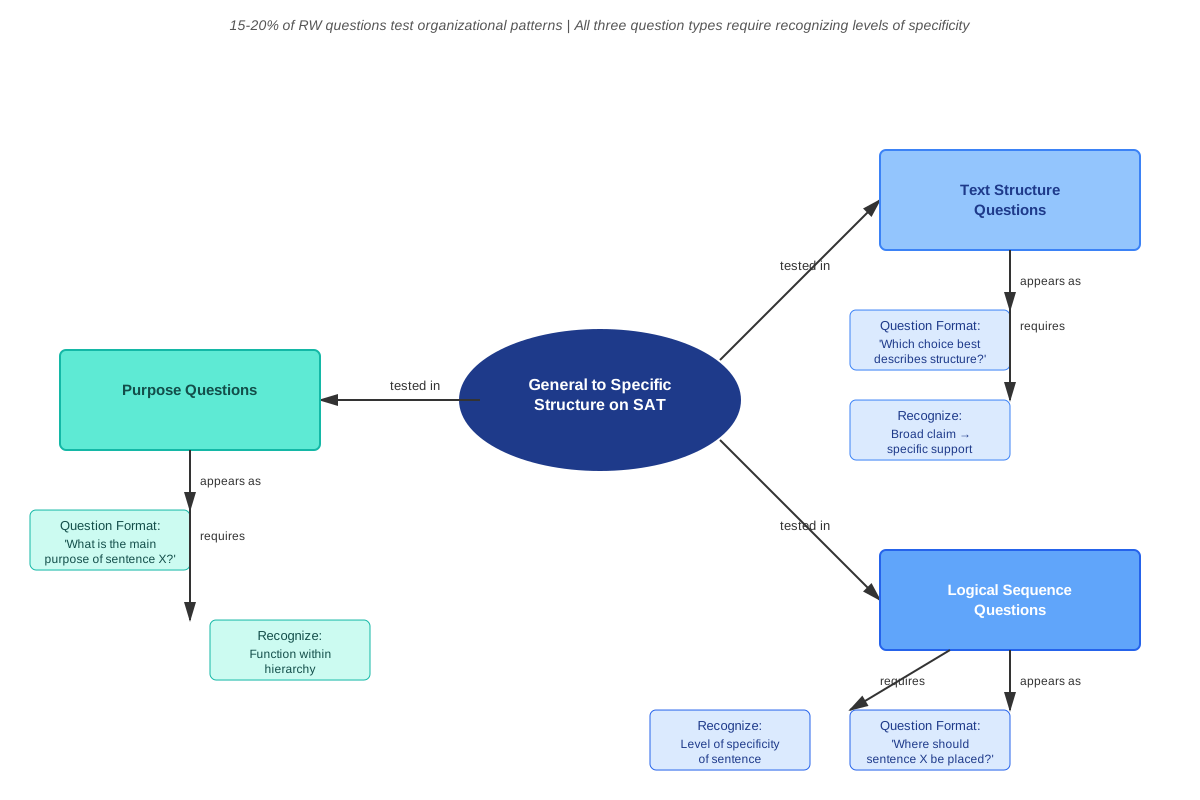
On the SAT, general to specific structure appears in approximately 15-20% of Reading and Writing questions, making it one of the highest-yield organizational patterns to master. Questions testing this concept typically fall into three categories: text structure questions that ask students to identify how a passage is organized, logical sequence questions that require determining where a sentence best fits, and purpose questions that assess understanding of why an author includes specific information. These question types appear consistently across all four Reading and Writing modules.
The SAT presents general to specific structure in various contexts: scientific passages explaining phenomena through progressively detailed mechanisms, historical texts moving from era-defining trends to individual events, argumentative essays progressing from thesis statements to supporting evidence, and literary analyses connecting universal themes to specific textual examples. This versatility makes the pattern essential for success across the entire Reading and Writing section.
Core Concepts
Defining General to Specific Structure
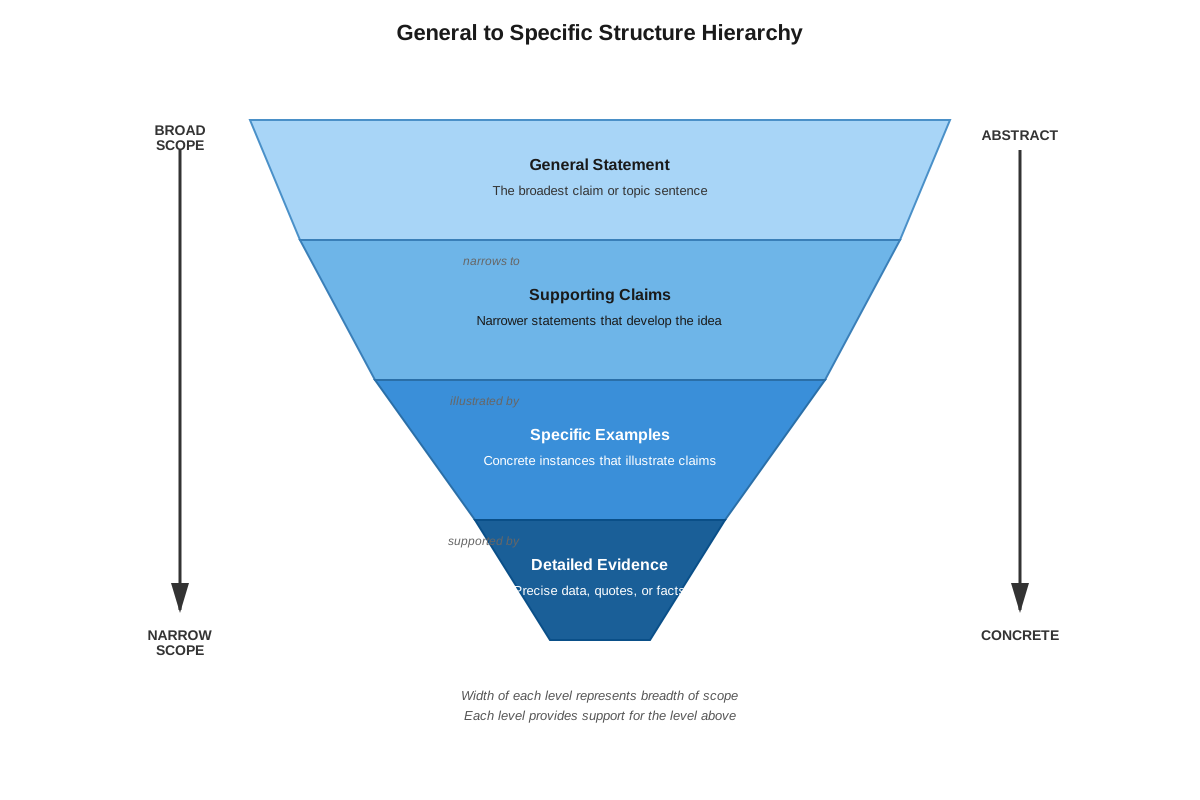
General to specific structure is an organizational pattern in which authors begin with broad, abstract, or universal statements and progressively narrow their focus to concrete, detailed, or particular information. The "general" component typically includes overarching claims, theoretical frameworks, category definitions, or widely applicable principles. The "specific" component comprises examples, data points, case studies, individual instances, or detailed explanations that illustrate, support, or elaborate on the general statement.
This structure operates on multiple levels simultaneously. At the paragraph level, a topic sentence presents a general claim while subsequent sentences provide specific support. At the passage level, opening paragraphs establish broad context while later paragraphs delve into particulars. Even within individual sentences, clauses can move from general to specific through the use of appositives, subordinate clauses, and explanatory phrases.
Characteristics of General Statements
General statements in this structure share several identifying features:
- Broad scope: They apply to entire categories, populations, or time periods rather than individual instances
- Abstract language: They use conceptual vocabulary rather than concrete, sensory details
- Universal or near-universal claims: They describe patterns, principles, or tendencies that hold across multiple cases
- Lack of specific evidence: They assert claims without providing detailed proof within the same sentence
Examples of general statements include: "Climate change affects ecosystems worldwide," "Renaissance artists revolutionized perspective techniques," or "Social media has transformed political communication."
Characteristics of Specific Statements
Specific statements provide the concrete details that support, illustrate, or explain general claims:
- Narrow scope: They focus on individual cases, particular examples, or limited contexts
- Concrete language: They include names, numbers, dates, locations, and sensory details
- Evidence-based: They present data, quotations, observations, or documented facts
- Illustrative function: They demonstrate or prove the validity of broader claims
Examples of specific statements include: "Arctic sea ice decreased by 13% per decade between 1979 and 2020," "Leonardo da Vinci's 'The Last Supper' employs one-point linear perspective," or "During the 2020 election, Twitter flagged over 300,000 tweets for misleading information."
Transition Markers in General to Specific Structure
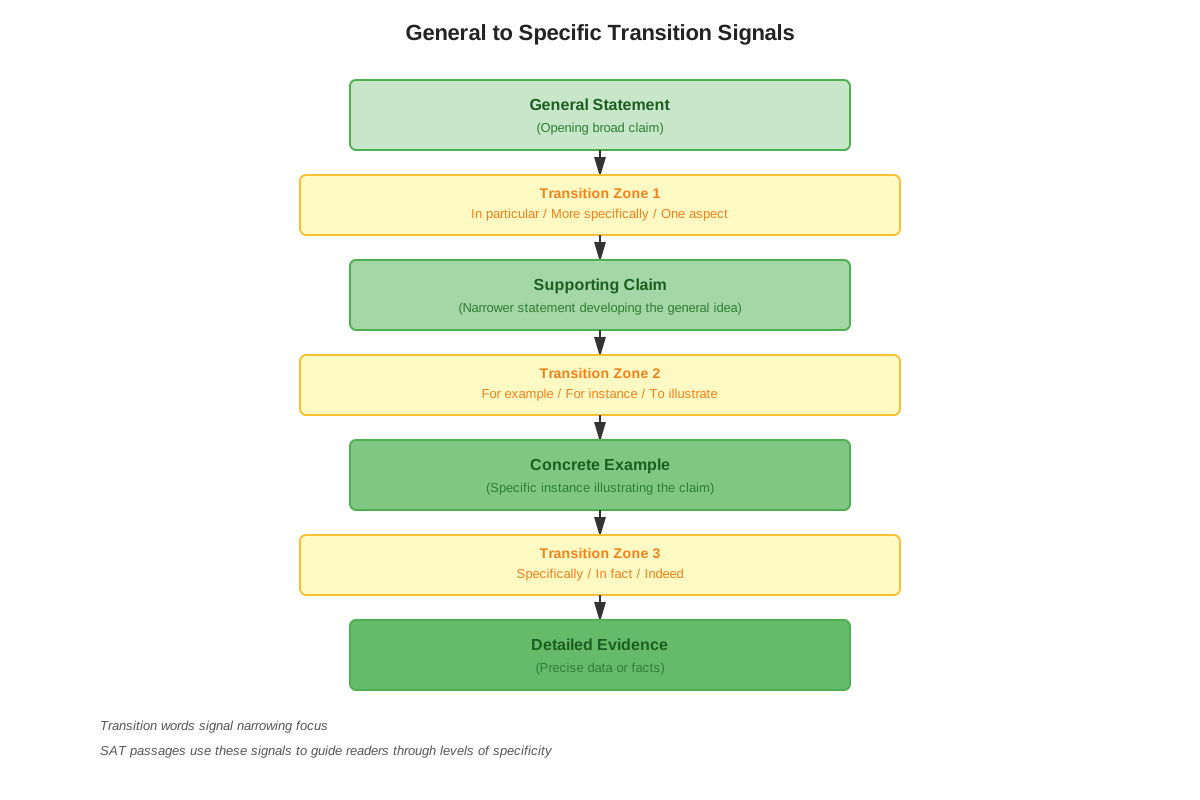
Authors use specific transitional devices to signal movement from general to specific information:
| Transition Type | Examples | Function |
|---|---|---|
| Exemplification | for example, for instance, such as, including | Introduces specific illustrations |
| Specification | specifically, in particular, namely, especially | Narrows focus to particular details |
| Elaboration | in fact, indeed, actually, to be precise | Provides more detailed information |
| Evidence introduction | according to, research shows, data indicates | Presents supporting documentation |
Recognizing these transitions helps readers anticipate structural shifts and understand the relationship between adjacent sentences.
Variations in General to Specific Patterns
While the basic pattern moves from broad to narrow, several variations appear on the SAT:
Simple general to specific: A single general statement followed by multiple specific examples or details. This is the most common pattern and appears frequently in scientific and historical passages.
Nested general to specific: Multiple levels of generality, where a general statement is followed by a moderately specific statement, which is then followed by highly specific details. This creates a hierarchical structure common in complex explanatory texts.
General-specific-general: A passage begins with a broad claim, narrows to specific evidence, then returns to a general conclusion or implication. This pattern appears in argumentative and analytical writing.
Multiple parallel specifics: A general statement is supported by several specific examples presented in parallel structure, each receiving equal emphasis. This pattern is common in comparative analyses.
Identifying the Pattern in SAT Passages
To recognize general to specific structure on the SAT, students should:
- Locate the broadest claim: Identify the sentence with the widest scope, most abstract language, or most universal application
- Find supporting details: Look for sentences containing examples, data, names, or concrete descriptions
- Trace the narrowing focus: Observe how each subsequent sentence becomes more specific than the previous one
- Verify the relationship: Confirm that specific statements actually support or illustrate the general claim rather than introducing new topics
The SAT often tests whether students can distinguish between a sentence that continues the general to specific progression and one that disrupts it by introducing unrelated information or reversing the pattern.
Concept Relationships
General to specific structure serves as a foundational concept that connects to multiple other organizational patterns and reading comprehension skills. The pattern directly relates to main idea identification because the general statement typically contains or closely relates to the passage's central claim, while specific details provide the supporting evidence that students must distinguish from the main point.
This structure also connects to purpose and function questions on the SAT. When students understand that a passage follows general to specific organization, they can more accurately determine why an author includes particular sentences—specific details serve to illustrate, prove, or clarify general claims. This relationship flows as: General claim → requires support → specific evidence → fulfills illustrative purpose.
The concept intersects with transition and coherence because effective general to specific writing requires clear signals when moving between levels of generality. Understanding this relationship helps students answer questions about logical sequence and sentence placement: Transition markers → signal structural shifts → indicate general-to-specific movement → determine logical sentence order.
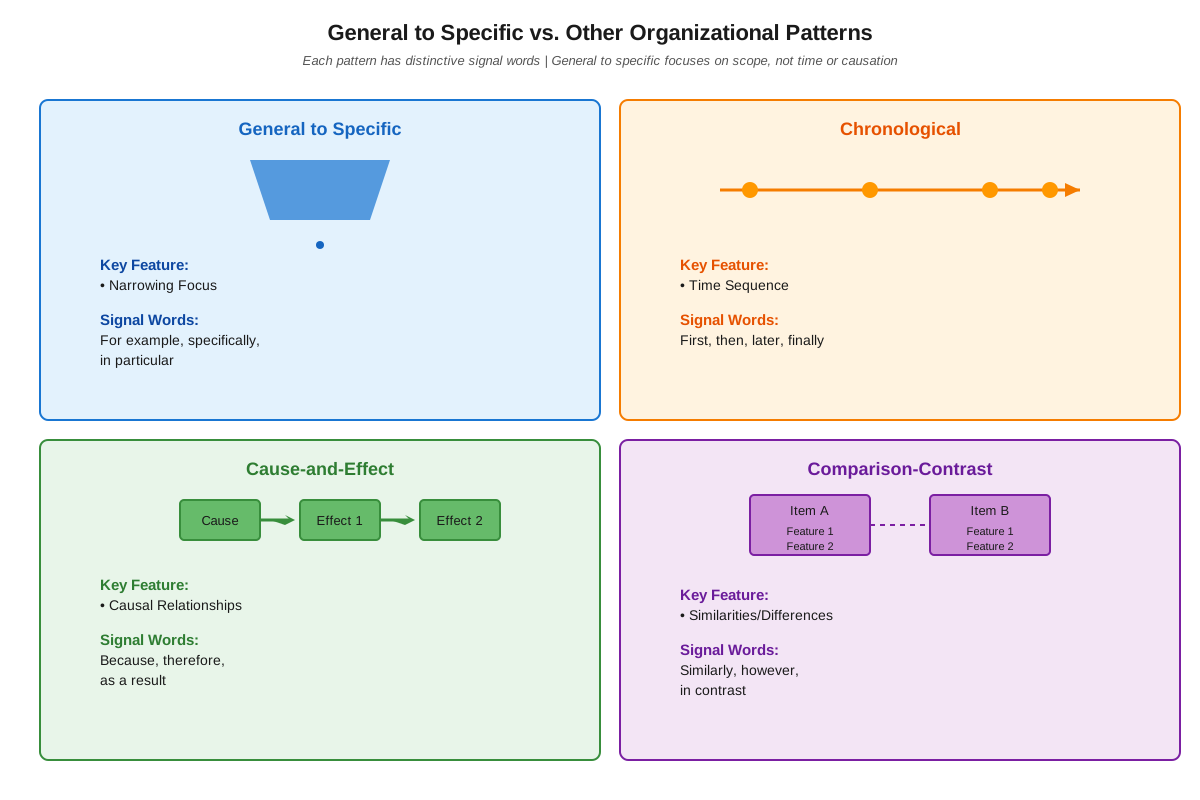
General to specific structure also relates to comparison-contrast and cause-and-effect patterns, as these organizational strategies often operate within a general to specific framework. An author might present a general claim about two phenomena (comparison) and then provide specific examples of their differences, or state a general causal principle before detailing specific instances where that cause produced particular effects.
High-Yield Facts
⭐ General to specific structure moves from broad, abstract claims to narrow, concrete details in a progressive narrowing of focus
⭐ The general statement typically appears first in a paragraph or passage, establishing the framework for subsequent specific information
⭐ Transition words like "for example," "specifically," "in particular," and "such as" signal movement from general to specific
⭐ Specific statements include concrete evidence: names, dates, numbers, locations, quotations, and detailed descriptions
⭐ On the SAT, questions about sentence placement often test whether students can maintain general to specific progression
- General statements use abstract vocabulary and apply to broad categories or populations
- Specific statements serve to illustrate, support, prove, or clarify general claims
- A passage can contain multiple levels of generality, creating nested general to specific structures
- Disrupting general to specific order typically makes a passage less coherent and logical
- Scientific passages frequently use general to specific structure to move from principles to experimental evidence
- The most specific information in a passage often appears near the end of paragraphs or sections
- General to specific structure can operate at the sentence, paragraph, and full-passage levels simultaneously
Quick check — test yourself on General to specific structure so far.
Try Flashcards →Common Misconceptions
Misconception: The first sentence of a passage is always the most general statement → Correction: While general statements often appear first, some passages begin with attention-grabbing specific details (an anecdote or striking fact) before presenting the general claim in the second or third sentence. Students must evaluate scope and abstraction level rather than relying solely on position.
Misconception: Longer sentences are more general than shorter sentences → Correction: Sentence length does not determine generality level. A brief sentence like "Climate change threatens biodiversity" is more general than a longer sentence containing specific data about particular species in defined locations. Scope and abstraction matter, not word count.
Misconception: Any example following a claim indicates general to specific structure → Correction: True general to specific structure requires that the specific information actually supports or illustrates the general claim. If an example introduces a new, unrelated topic rather than elaborating on the preceding claim, the passage does not follow general to specific organization.
Misconception: General to specific structure only appears in science passages → Correction: This organizational pattern appears across all content domains on the SAT, including literature, history, social science, and humanities passages. Any discipline that uses evidence to support claims employs general to specific structure.
Misconception: A passage must move continuously from most general to most specific → Correction: Many passages contain multiple general to specific sequences, with the pattern resetting at paragraph breaks. A new paragraph might return to a general level before narrowing to different specific details, creating a wave-like pattern rather than a single continuous progression.
Worked Examples
Example 1: Identifying Structure in a Science Passage
Passage: "Photosynthesis enables plants to convert light energy into chemical energy. During this process, chlorophyll molecules in plant cells absorb photons from sunlight. Specifically, chlorophyll a absorbs light most efficiently at wavelengths of 430 nm and 662 nm. In a 2019 study, researchers at Stanford University measured absorption rates in spinach leaves and found that chlorophyll a captured 89% of available photons at these wavelengths under controlled laboratory conditions."
Question: The passage primarily employs which organizational structure?
Analysis:
- Identify the broadest statement: The first sentence presents the most general claim—photosynthesis converts light to chemical energy. This applies to all photosynthetic organisms and describes the overall process.
- Trace the narrowing focus:
- Sentence 2 narrows to a specific mechanism (chlorophyll absorption)
- Sentence 3 further specifies to a particular type of chlorophyll and exact wavelengths
- Sentence 4 provides the most specific information: a particular study, specific researchers, defined conditions, and precise measurements
- Verify the relationship: Each sentence supports and elaborates on the previous one. The specific details about wavelengths and absorption rates illustrate how the general process of photosynthesis works.
Answer: The passage follows a clear general to specific structure, moving from universal principle → specific mechanism → particular molecule and measurements → individual research study with precise data.
Connection to Learning Objectives: This example demonstrates how to identify key features of general to specific structure (progressive narrowing, concrete details) and apply this knowledge to analyze passage organization.
Example 2: Determining Logical Sentence Placement
Passage with Missing Sentence: "Medieval European monasteries served as centers of learning and literacy. [WHERE DOES THIS SENTENCE GO?] Monks painstakingly copied manuscripts by hand, preserving classical texts that might otherwise have been lost. The monastery at Monte Cassino, for instance, housed over 1,000 manuscripts by the 11th century, including works by Virgil, Ovid, and Cicero."
Sentence to Place: "These institutions maintained libraries and scriptoria where texts were reproduced and studied."
Analysis:
- Identify the general to specific progression:
- Sentence 1 (most general): Monasteries as learning centers
- Sentence about libraries (moderately specific): Particular facilities within monasteries
- Sentence about monks copying (more specific): Specific activity
- Sentence about Monte Cassino (most specific): Individual example with numbers and names
- Determine appropriate generality level: The sentence about libraries and scriptoria is more specific than "centers of learning" but more general than the detailed description of manuscript copying. It bridges the gap between the broad claim and the concrete activities.
- Verify logical flow: Placing the sentence after the first sentence creates smooth progression: general function → specific facilities → specific activities → particular example.
Answer: The sentence should be placed immediately after the first sentence, maintaining the general to specific structure by progressively narrowing from broad institutional function to specific facilities to particular activities to individual case study.
Connection to Learning Objectives: This example shows how to apply general to specific structure to determine logical sentence placement and predict information flow based on organizational patterns.
Exam Strategy
When approaching SAT questions involving general to specific structure, employ this systematic process:
Step 1: Quickly scan for scope indicators. Look for abstract versus concrete language, broad versus narrow claims, and the presence of specific evidence markers (names, dates, numbers, locations). This initial scan takes 10-15 seconds but dramatically improves accuracy.
Step 2: Identify transition signals. Watch for phrases like "for example," "specifically," "in particular," "such as," and "including." These transitions almost always indicate movement from general to specific and help you predict what type of information follows.
Step 3: Map the generality hierarchy. For sentence placement questions, quickly rank the sentences from most general to most specific before attempting to determine order. This prevents the common error of placing specific details before the general claims they support.
Exam Tip: If a question asks where to place a sentence, eliminate any position that would put specific information before the general claim it illustrates. The SAT rarely rewards violations of general to specific progression.
Step 4: Verify supporting relationships. Ensure that specific statements actually support or illustrate the general claims rather than introducing tangential information. The SAT often includes wrong answers that contain specific details but don't maintain the logical connection to the general statement.
Trigger words to watch for in questions:
- "The passage is primarily organized by..." (structure identification)
- "Where should the following sentence be placed..." (logical sequence)
- "The author includes [specific detail] primarily to..." (purpose within structure)
- "Which sentence most logically completes the passage..." (maintaining structural pattern)
Time allocation: Spend no more than 60-75 seconds on structure questions. If you cannot identify the pattern within 30 seconds, use process of elimination based on transition words and scope indicators rather than trying to fully comprehend every detail.
Process of elimination strategy: For structure questions, eliminate answers that describe patterns inconsistent with the passage's opening and closing. If a passage begins with a general claim and ends with specific data, eliminate answers suggesting chronological order, comparison-contrast, or problem-solution structures.
Memory Techniques
The FUNNEL Mnemonic for remembering general to specific characteristics:
- From broad to narrow
- Universal claims first
- Narrowing focus progressively
- Names and numbers indicate specifics
- Examples follow general statements
- Logical support relationship required
Visualization Strategy: Picture an inverted pyramid or funnel. The wide top represents general, abstract claims that apply broadly. As you move down the funnel, the space narrows, representing increasingly specific, concrete details. When reading a passage, mentally place each sentence at the appropriate level of the funnel.
The "Zoom In" Technique: Think of general to specific structure like a camera zooming in on a subject. You start with a wide-angle shot showing the entire landscape (general claim), then zoom to a medium shot of a particular area (moderately specific), then close-up on specific details (highly specific). This metaphor helps remember that each level should be more detailed than the last.
Acronym for Transition Words - FINES:
- For example
- In particular
- Namely
- Especially
- Specifically
These five transitions account for the majority of general to specific signals on the SAT.
Summary
General to specific structure represents a fundamental organizational pattern in which authors progress from broad, abstract claims to narrow, concrete details. This pattern operates at multiple levels—sentence, paragraph, and passage—and appears across all content domains tested on the SAT Reading and Writing section. The structure is characterized by a progressive narrowing of focus, with general statements establishing frameworks or principles and specific statements providing supporting evidence through examples, data, quotations, and detailed descriptions. Transition words like "for example" and "specifically" signal movement between generality levels. On the SAT, this concept appears in structure identification questions, logical sequence questions, and purpose questions, collectively representing a significant portion of the exam. Success requires recognizing scope differences between statements, understanding supporting relationships, and maintaining logical progression when determining sentence placement. Students who master this pattern gain strategic advantages in reading comprehension speed, answer prediction, and elimination of incorrect choices.
Key Takeaways
- General to specific structure moves progressively from broad, abstract claims to narrow, concrete details through a systematic narrowing of focus
- Transition words like "for example," "specifically," and "in particular" reliably signal movement from general to specific information
- Specific statements contain concrete evidence markers: names, dates, numbers, locations, and detailed descriptions
- The SAT tests this concept through structure identification, sentence placement, and purpose questions across all content domains
- Maintaining general to specific progression requires that specific details actually support or illustrate the general claims they follow
- Quick identification of scope differences (abstract versus concrete, broad versus narrow) enables efficient question answering
- Understanding this pattern improves both reading comprehension and strategic elimination of incorrect answer choices
Related Topics
Cause and Effect Structure: Understanding how authors organize information around causal relationships builds on general to specific skills, as causal explanations often move from general principles to specific instances. Mastering general to specific structure provides the foundation for recognizing how causes (often stated generally) lead to effects (often described specifically).
Comparison and Contrast Structure: This organizational pattern frequently operates within a general to specific framework, where authors state general similarities or differences before providing specific examples. Students who understand general to specific progression can more easily identify the levels at which comparisons occur.
Problem and Solution Structure: This pattern typically presents problems generally before detailing specific solutions, making it a specialized application of general to specific organization. The skills developed in this topic transfer directly to problem-solution analysis.
Main Idea and Supporting Details: General to specific structure directly relates to distinguishing main ideas (general claims) from supporting details (specific evidence), a fundamental reading comprehension skill that appears throughout the SAT.
Rhetorical Purpose and Function: Understanding why authors include specific information requires recognizing its relationship to general claims, making general to specific structure essential for purpose questions.
Practice CTA
Now that you have mastered the core concepts of general to specific structure, reinforce your learning by attempting the practice questions designed specifically for this topic. These questions mirror actual SAT formats and difficulty levels, allowing you to apply your knowledge under test-like conditions. Additionally, use the flashcards to memorize key transition words, characteristics of general versus specific statements, and common question triggers. Consistent practice with these resources will transform your understanding into automatic recognition on test day, significantly improving both your speed and accuracy. Remember: recognizing organizational patterns is a skill that improves dramatically with deliberate practice—each question you attempt strengthens your ability to quickly identify structure and eliminate wrong answers. You have built a strong foundation; now apply it to achieve your target score.
Sign up free to keep reading
Create a free AnvayaPrep account to finish this SAT guide on General to specific structure — plus flashcards and practice questions.