Overview
The purpose of conclusion is a critical concept in SAT Reading and Writing (RW) that tests a student's ability to understand how authors use concluding sentences, paragraphs, or sections to achieve specific rhetorical goals. On the SAT, questions about conclusions assess whether students can identify what function a conclusion serves within a passage—whether it summarizes main points, offers a final perspective, suggests implications, or provides closure to an argument. Understanding the sat purpose of conclusion is essential because these questions appear regularly in the Text Structure and Purpose question category, which comprises a significant portion of the Reading and Writing section.
Conclusions serve as the final impression an author leaves with readers, and their purpose varies depending on the passage type and the author's intent. In argumentative texts, conclusions might reinforce a thesis or call readers to action. In informative passages, they might synthesize complex information or highlight the significance of findings. In narrative texts, conclusions often provide resolution or reflection. The SAT tests whether students can distinguish between these different functions and identify which purpose a specific conclusion serves within its context.
Mastering this topic connects directly to broader RW skills including understanding text structure, identifying author's purpose, and analyzing how different parts of a passage work together to create meaning. Students who excel at identifying the purpose of conclusions demonstrate sophisticated reading comprehension—they don't just understand what a text says, but how its parts function strategically to communicate ideas effectively. This skill translates to success on multiple SAT question types and reflects the kind of analytical reading required in college-level coursework.
Learning Objectives
- [ ] Identify key features of Purpose of conclusion
- [ ] Explain how Purpose of conclusion appears on the SAT
- [ ] Apply Purpose of conclusion to answer SAT-style questions
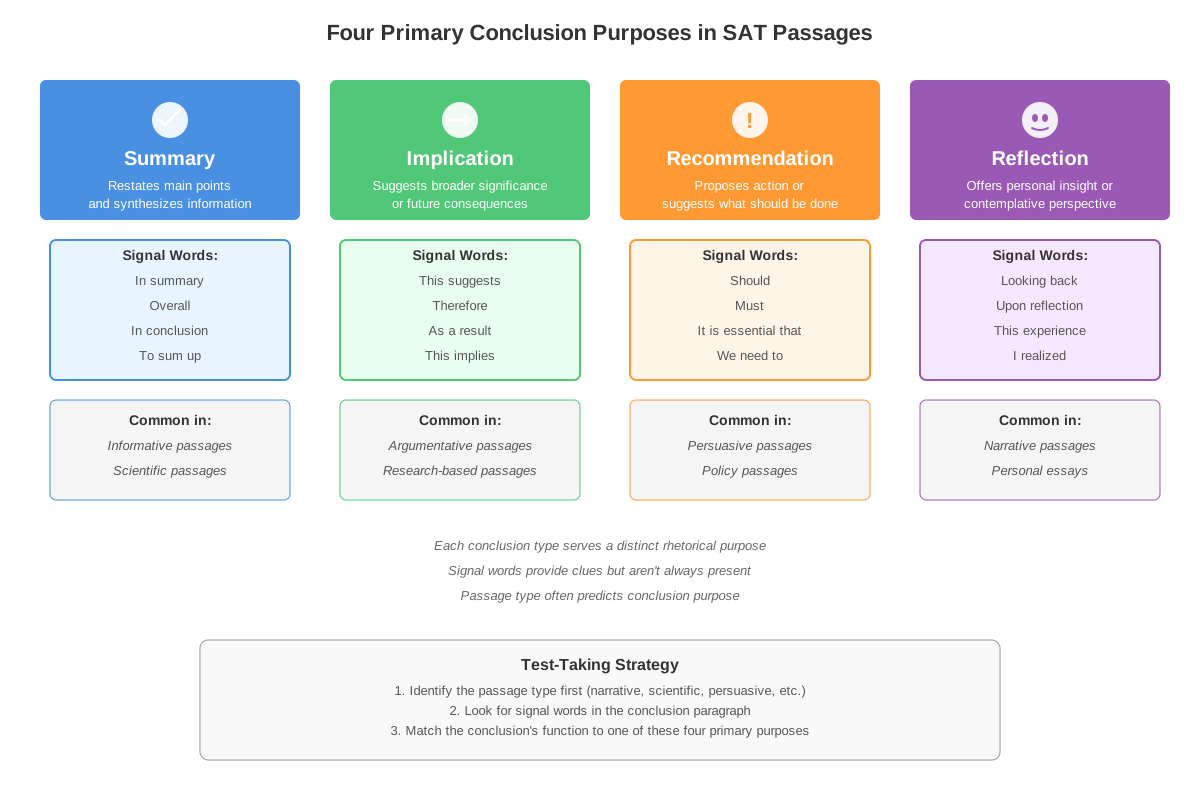
- [ ] Distinguish between different types of conclusion purposes (summary, implication, recommendation, reflection)
- [ ] Analyze the relationship between a conclusion and the preceding content in a passage
- [ ] Evaluate whether a proposed conclusion effectively fulfills a stated purpose
- [ ] Recognize signal words and phrases that indicate conclusion purpose
Prerequisites
- Basic paragraph structure: Understanding topic sentences, supporting details, and concluding sentences helps students recognize how conclusions function at both paragraph and passage levels
- Author's purpose fundamentals: Familiarity with why authors write (to inform, persuade, entertain, explain) provides the foundation for understanding why they conclude in specific ways
- Text structure awareness: Knowing common organizational patterns (cause-effect, compare-contrast, problem-solution) helps students predict what type of conclusion would logically follow
- Main idea identification: The ability to determine a passage's central point is essential because conclusions often relate directly to reinforcing or extending that main idea
Why This Topic Matters
Understanding the purpose of conclusions has real-world applications beyond standardized testing. In academic writing, professional communication, and everyday reading, recognizing how conclusions function helps readers extract maximum meaning from texts and evaluate the effectiveness of arguments. Students who master this skill become better writers themselves, learning to craft conclusions that serve clear rhetorical purposes rather than simply restating information.
On the SAT, questions about the purpose of conclusions appear with high frequency—typically 2-4 questions per test administration. These questions fall within the "Craft and Structure" category and specifically test the "Text Structure and Purpose" skill. They're considered medium-difficulty questions, meaning they separate average scorers from high scorers. Students aiming for scores above 650 on the Reading and Writing section must consistently answer these questions correctly.
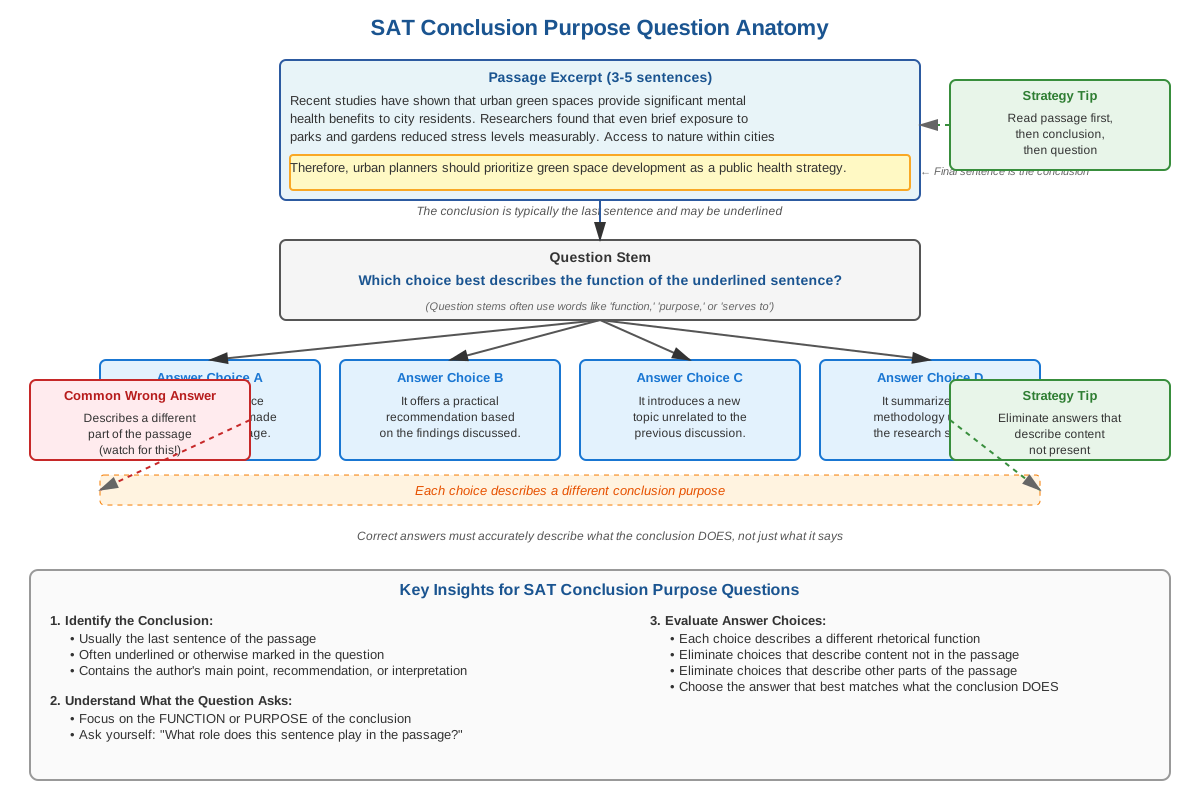
The SAT presents conclusion purpose questions in several common formats. Students might encounter a complete passage followed by a question asking what purpose the final paragraph serves. Alternatively, they might see a passage with a blank space where a conclusion should appear, then select which option best fulfills a stated purpose. Some questions present a conclusion and ask students to identify its primary function from among four choices. These questions appear across all passage types—literary narratives, social science articles, humanities essays, and scientific reports—making it essential to understand how conclusions function in diverse contexts.
Core Concepts
What Is a Conclusion?
A conclusion is the final section of a text—whether a sentence, paragraph, or series of paragraphs—that brings the author's discussion to a close. Unlike body paragraphs that develop ideas, conclusions serve specific ending functions. On the SAT, the term "conclusion" doesn't just mean "the last part" but rather refers to a purposeful ending that accomplishes something specific for the reader. Understanding that conclusions are functional rather than merely positional is crucial for SAT success.
Primary Purposes of Conclusions
Conclusions serve distinct rhetorical purposes, and the SAT tests whether students can identify which purpose a specific conclusion fulfills. The most common purposes include:
Summarizing Main Points
A summary conclusion restates or synthesizes the key ideas presented in the passage without introducing new information. This type of conclusion helps readers consolidate their understanding by reviewing what they've learned. Summary conclusions are particularly common in informative and explanatory texts where the author wants to ensure readers retain the most important points.
Characteristics of summary conclusions:
- Restate the thesis or main idea in different words
- Briefly mention key supporting points
- Use phrases like "in summary," "in conclusion," "overall," or "thus"
- Maintain focus on information already presented
- Provide no new evidence or examples
Suggesting Implications or Significance
An implication conclusion moves beyond what was explicitly discussed to suggest broader meanings, consequences, or applications. Rather than simply reviewing what was said, this type of conclusion answers the "so what?" question—why the information matters or what it means for a larger context. These conclusions are common in scientific and social science passages where research findings have broader applications.
Characteristics of implication conclusions:
- Extend ideas beyond the specific examples discussed
- Use phrases like "this suggests," "these findings indicate," "the implications are," or "this means that"
- Connect specific information to broader contexts
- May discuss future consequences or applications
- Answer why the topic matters
Making Recommendations or Calls to Action
A recommendation conclusion suggests what should be done based on the information presented. This purpose is most common in argumentative or persuasive passages where the author wants readers to think or act differently. These conclusions transform information into actionable guidance.
Characteristics of recommendation conclusions:
- Use imperative or suggestive language ("should," "must," "ought to")
- Propose specific actions or changes
- May address particular audiences (policymakers, researchers, general public)
- Build logically from the evidence presented
- Often appear in opinion pieces and policy discussions
Providing Reflection or Final Perspective
A reflective conclusion offers the author's personal insight, emotional response, or philosophical perspective on the topic. This purpose is most common in narrative and literary passages where the author's subjective experience matters. Reflective conclusions help readers understand the personal or emotional significance of events or ideas.
Characteristics of reflective conclusions:
- Include personal observations or feelings
- May use first-person perspective
- Offer wisdom or lessons learned
- Create emotional resonance
- Common in memoirs, personal essays, and literary narratives
Raising Questions or Suggesting Future Directions
A forward-looking conclusion identifies unanswered questions, areas for future research, or emerging issues related to the topic. Rather than providing closure, this type of conclusion opens up new avenues of thought. These conclusions are particularly common in academic and scientific writing where ongoing inquiry is valued.
Characteristics of forward-looking conclusions:
- Pose questions for consideration
- Identify gaps in current knowledge
- Suggest areas for future research
- Use phrases like "future studies should," "questions remain," or "further investigation"
- Acknowledge limitations while pointing forward
Identifying Conclusion Purpose on the SAT
The SAT tests conclusion purpose through specific question formats. Students must recognize these patterns:
| Question Format | What It's Asking | Strategy |
|---|---|---|
| "Which choice best describes the function of the underlined sentence?" | Identify what role the conclusion plays | Read the conclusion carefully and determine whether it summarizes, implies, recommends, reflects, or questions |
| "Which choice most logically completes the text?" | Select a conclusion that fulfills an implied purpose | Analyze what the passage needs based on its content and structure |
| "The writer wants to conclude the passage by [stated purpose]. Which choice best accomplishes this goal?" | Match a conclusion to a specific stated purpose | Eliminate options that don't fulfill the exact purpose stated |
| "What is the main purpose of the final paragraph?" | Identify the primary function among multiple possible functions | Focus on the dominant purpose, even if secondary purposes exist |
Analyzing Conclusion Effectiveness
Beyond identifying purpose, students must evaluate whether a conclusion effectively fulfills its intended purpose. An effective conclusion:
- Aligns with the passage's overall tone and style
- Connects logically to the preceding content
- Fulfills its purpose without introducing irrelevant information
- Maintains appropriate scope (neither too narrow nor too broad)
- Uses language that signals its purpose clearly
Ineffective conclusions might contradict earlier points, introduce completely new topics, fail to provide the closure or extension the passage needs, or use a tone inconsistent with the rest of the text.
Concept Relationships
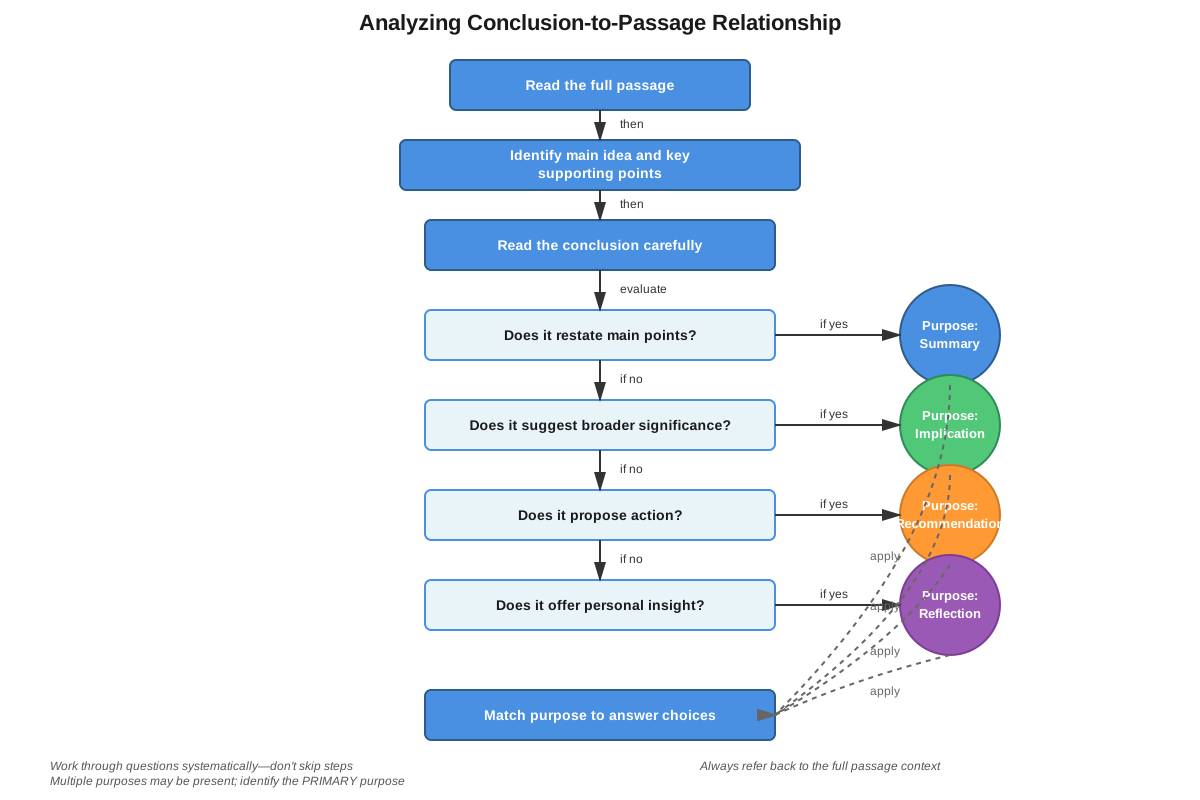
The purpose of conclusion concept connects intimately with other text structure and purpose skills. Understanding main idea is prerequisite to identifying conclusion purpose because conclusions often relate directly to the central point—either restating it, extending it, or reflecting on it. The relationship flows: Main Idea → Supporting Details → Conclusion Purpose.
Text structure determines what type of conclusion is most appropriate. A problem-solution structure naturally leads to recommendation conclusions, while a cause-effect structure might lead to implication conclusions. The relationship is: Text Structure → Appropriate Conclusion Type → Specific Conclusion Purpose.
Author's purpose (the overall reason for writing) influences conclusion purpose. An author writing to persuade will likely use recommendation or implication conclusions, while an author writing to inform might use summary conclusions. This creates the relationship: Overall Author's Purpose → Conclusion Purpose → Specific Conclusion Content.
Within the conclusion itself, signal words and transitions indicate purpose. Words like "therefore" and "thus" signal summary or logical consequence, while "should" and "must" signal recommendations. The relationship is: Signal Words → Indicated Purpose → Reader Understanding.
The concept also connects forward to more advanced skills like evaluating argument effectiveness and analyzing rhetorical choices. Understanding why an author chose a particular conclusion type helps students evaluate whether the author's overall argument succeeds. This creates the progression: Identify Conclusion Purpose → Evaluate Conclusion Effectiveness → Assess Overall Argument Quality.
High-Yield Facts
⭐ The SAT most commonly tests four conclusion purposes: summarizing, suggesting implications, making recommendations, and providing reflection.
⭐ Summary conclusions restate main points without adding new information, while implication conclusions extend ideas to broader contexts.
⭐ Signal words like "therefore," "thus," and "in conclusion" often indicate summary purposes, while "this suggests" and "the implications are" indicate implication purposes.
⭐ Questions asking "which choice best accomplishes this goal" require matching a conclusion to a specifically stated purpose, not identifying what purpose an existing conclusion serves.
⭐ The most effective conclusions maintain the same tone and style as the rest of the passage while fulfilling their specific purpose.
- Recommendation conclusions use modal verbs like "should," "must," "ought to," and "need to" to suggest actions.
- Reflective conclusions are most common in narrative and literary passages and often include personal observations or emotional responses.
- Forward-looking conclusions identify gaps, raise questions, or suggest future research directions rather than providing closure.
- An effective conclusion's scope matches the passage's scope—a passage about one specific study shouldn't conclude with sweeping generalizations about all humanity.
- The final sentence of a conclusion often contains the most concentrated expression of its purpose.
- Conclusions in scientific passages frequently suggest implications for future research or practical applications.
- Multiple-purpose conclusions exist, but SAT questions ask for the primary or main purpose.
- The position of a conclusion (final paragraph, final sentence, final section) doesn't change its functional purpose.
Quick check — test yourself on Purpose of conclusion so far.
Try Flashcards →Common Misconceptions
Misconception: All conclusions simply summarize what came before. → Correction: While summary is one common conclusion purpose, conclusions also suggest implications, make recommendations, provide reflection, or raise questions. The SAT specifically tests whether students can distinguish between these different purposes.
Misconception: The longest answer choice is usually correct for conclusion questions. → Correction: Conclusion purpose questions require functional analysis, not length assessment. The correct answer accurately describes what the conclusion does, regardless of length. Sometimes the most concise option is correct.
Misconception: If a conclusion mentions something from earlier in the passage, its purpose must be to summarize. → Correction: Conclusions that suggest implications or make recommendations often reference earlier content while extending beyond it. The key distinction is whether the conclusion merely restates information or uses that information to suggest something new.
Misconception: Reflective conclusions are always wrong answers because they're too subjective. → Correction: In narrative and literary passages, reflective conclusions are often correct. The SAT includes diverse passage types, and reflection is an appropriate conclusion purpose for personal narratives and literary texts.
Misconception: The purpose of a conclusion is always stated explicitly in the text. → Correction: Authors rarely announce "I will now summarize" or "This conclusion suggests implications." Students must infer purpose from the conclusion's content, language, and relationship to the preceding text.
Misconception: If a conclusion raises questions, it's ineffective because conclusions should provide answers. → Correction: Forward-looking conclusions that raise questions or identify areas for future research are legitimate and effective conclusion types, particularly in academic and scientific writing. The SAT recognizes this as a valid conclusion purpose.
Misconception: The correct answer will use the exact same words as the conclusion. → Correction: SAT answer choices typically paraphrase or describe the conclusion's function rather than quoting it directly. Students must understand the concept behind the words, not just match vocabulary.
Worked Examples
Example 1: Identifying Summary vs. Implication
Passage:
"The Mediterranean diet, rich in olive oil, fish, and vegetables, has been associated with numerous health benefits in multiple studies. Research conducted in Spain found that participants following this diet had 30% lower rates of cardiovascular disease. A separate Italian study showed improved cognitive function among elderly adherents. Greek researchers documented better weight management outcomes compared to low-fat diets. These consistent findings across diverse populations demonstrate the Mediterranean diet's effectiveness in promoting multiple aspects of health."
Question: What is the primary purpose of the final sentence?
Answer Choices:
A) To recommend that readers adopt the Mediterranean diet
B) To summarize the evidence presented and emphasize its significance
C) To suggest that future research should examine other dietary patterns
D) To reflect on the author's personal experience with the Mediterranean diet
Solution:
Step 1: Identify what the conclusion actually does
The final sentence ("These consistent findings...") refers back to the three studies mentioned (Spanish, Italian, Greek) and makes a statement about what they collectively demonstrate.
Step 2: Determine if new information is introduced
The conclusion doesn't introduce new studies or evidence. It synthesizes what was already presented.
Step 3: Analyze the language used
"These consistent findings" directly references the previous evidence. "Demonstrate" is a summary/synthesis word that draws a conclusion from evidence.
Step 4: Check for extension beyond the evidence
The conclusion states what the evidence shows but doesn't suggest what should be done about it, what future research is needed, or broader implications beyond health benefits.
Step 5: Evaluate each answer choice
- Choice A (Recommendation): The conclusion doesn't use "should" or suggest action. It states what research demonstrates, not what readers ought to do. Eliminate.
- Choice B (Summary): This matches our analysis. The conclusion synthesizes the three studies mentioned and emphasizes their collective significance ("consistent findings across diverse populations"). This is the answer.
- Choice C (Future research): No mention of future studies or gaps in knowledge. Eliminate.
- Choice D (Personal reflection): No first-person perspective or personal experience mentioned. Eliminate.
Answer: B
Connection to Learning Objectives: This example demonstrates how to identify key features of conclusion purpose (summary) and apply this knowledge to answer SAT-style questions by analyzing language and function.
Example 2: Selecting an Appropriate Conclusion
Passage:
"Urban gardens are transforming vacant lots in Detroit into productive green spaces. The Michigan Urban Farming Initiative has converted over 30 abandoned properties into community gardens since 2011. These gardens provide fresh produce to neighborhoods classified as food deserts, where grocery stores are scarce. Beyond nutrition, the gardens create gathering spaces where neighbors build relationships and share knowledge. Property values in blocks with community gardens have increased by an average of 9.4%, and crime rates have decreased by 13%. ___________"
Question: The writer wants to conclude by suggesting the broader implications of Detroit's urban garden success. Which choice best accomplishes this goal?
Answer Choices:
A) The Michigan Urban Farming Initiative began with just one garden and has grown steadily over the past decade.
B) Community gardens require ongoing maintenance, volunteer coordination, and sustainable funding sources.
C) Detroit's model demonstrates how cities nationwide could address food insecurity while revitalizing struggling neighborhoods.
D) Fresh vegetables from urban gardens taste better than produce shipped long distances to supermarkets.
Solution:
Step 1: Identify the stated purpose
The question explicitly states the conclusion should "suggest the broader implications" of the success described. This is an implication-type conclusion.
Step 2: Understand what "broader implications" means
The passage discusses Detroit specifically. Broader implications would extend these specific findings to larger contexts—other cities, general principles, wider applications.
Step 3: Evaluate each choice against the stated purpose
- Choice A: This provides historical background about the initiative's growth. It looks backward and stays focused on Detroit specifically. It doesn't suggest implications. Eliminate.
- Choice B: This discusses practical challenges of maintaining gardens. While relevant to the topic, it doesn't suggest implications of the success described. It shifts focus to difficulties rather than extending the positive outcomes. Eliminate.
- Choice C: This explicitly extends Detroit's specific success to a broader context ("cities nationwide"). It takes the specific benefits described (addressing food insecurity, revitalizing neighborhoods) and suggests they could apply elsewhere. The word "demonstrates" indicates that Detroit serves as a model with wider applicability. This matches the stated purpose perfectly. This is the answer.
- Choice D: This makes a claim about taste that wasn't discussed in the passage and doesn't extend the implications of the documented benefits (nutrition access, community building, property values, crime reduction). Eliminate.
Answer: C
Connection to Learning Objectives: This example shows how to evaluate whether a proposed conclusion effectively fulfills a stated purpose (suggesting implications) and demonstrates the difference between staying focused on specific content versus extending to broader contexts.
Exam Strategy
Approaching Conclusion Purpose Questions
Step 1: Read the entire passage or paragraph before the conclusion
Understanding what precedes the conclusion is essential for determining its purpose. Never read the conclusion in isolation.
Step 2: Identify the passage type
Scientific articles, personal narratives, argumentative essays, and informative texts favor different conclusion types. Use passage type as a clue.
Step 3: Read the conclusion carefully and ask "What does this DO?"
Focus on function, not just content. Ask: Does it restate? Extend? Recommend? Reflect? Question?
Step 4: Look for signal words
Certain words and phrases reliably indicate specific purposes:
- Summary signals: "in conclusion," "overall," "thus," "therefore," "in summary"
- Implication signals: "this suggests," "the implications are," "this indicates," "this means"
- Recommendation signals: "should," "must," "ought to," "need to," "it is essential"
- Reflection signals: "I realized," "this experience taught," "looking back"
- Forward-looking signals: "future research," "questions remain," "further investigation"
Step 5: For "complete the text" questions, predict before looking at choices
Based on the passage content and structure, predict what type of conclusion would be most appropriate. Then find the choice that matches your prediction.
Step 6: Eliminate answers that describe secondary rather than primary purposes
A conclusion might do multiple things, but SAT questions ask for the main or primary purpose. If a conclusion mostly summarizes but includes one forward-looking sentence, "summarize" is likely the correct answer.
Time Allocation
Spend approximately 60-90 seconds on conclusion purpose questions:
- 20-30 seconds reading/reviewing the passage
- 15-20 seconds analyzing the conclusion
- 25-40 seconds evaluating answer choices
These questions reward careful analysis more than speed. Rushing leads to confusing summary with implication or missing the stated purpose in "accomplish this goal" questions.
Process of Elimination Tips
Eliminate choices that:
- Describe content rather than function (e.g., "discusses vegetables" instead of "summarizes benefits")
- Identify purposes not present in the conclusion (e.g., "makes recommendations" when no "should" or action language appears)
- Are too narrow or too broad for the conclusion's actual scope
- Contradict the passage's tone (e.g., "reflects personally" in an objective scientific article)
- Focus on minor details rather than the conclusion's main function
Keep choices that:
- Accurately describe what the conclusion accomplishes
- Match the signal words and language used
- Align with the passage type and overall purpose
- Capture the primary function even if secondary purposes exist
Memory Techniques
The SIRRF Mnemonic
Remember the five main conclusion purposes with SIRRF:
- Summary: Restates main points
- Implication: Suggests broader meaning
- Recommendation: Proposes action
- Reflection: Offers personal insight
- Forward-looking: Raises questions for future
The Signal Word Sorting Strategy
Create mental categories for signal words:
"Looking Back" words (Summary): therefore, thus, in conclusion, overall, in summary
"Looking Out" words (Implication): suggests, indicates, implies, means, demonstrates
"Looking Forward" words (Future): future research, questions remain, further study
"Looking Inward" words (Reflection): I realized, taught me, experience showed
"Looking Ahead to Action" words (Recommendation): should, must, ought to, need to
The Purpose-Matching Visualization
Visualize conclusions as bridges:
- Summary bridges loop back to where you started (circular)
- Implication bridges extend to new territory (extending outward)
- Recommendation bridges point toward action (arrow forward)
- Reflection bridges go inward (toward the author)
- Forward-looking bridges are incomplete (showing more to come)
The "So What?" Test
For distinguishing summary from implication:
- If the conclusion just restates what was said: Summary
- If the conclusion answers "so what does this mean?": Implication
Summary
The purpose of conclusion is a high-yield SAT Reading and Writing concept that tests students' ability to identify what function a concluding section serves within a passage. Conclusions serve five primary purposes: summarizing main points, suggesting implications or broader significance, making recommendations or calls to action, providing personal reflection, and raising questions or suggesting future directions. The SAT tests this concept through questions that ask students to identify an existing conclusion's purpose or select a conclusion that fulfills a stated purpose. Success requires understanding that conclusions are functional elements that accomplish specific rhetorical goals, not merely "the last part" of a text. Students must analyze the language, signal words, and relationship to preceding content to determine purpose accurately. The most effective approach involves reading the full passage, identifying the passage type, analyzing what the conclusion actually does (not just what it says), and matching that function to the correct purpose category. Distinguishing between summary (restating what was said) and implication (extending to broader meaning) is particularly important, as these are frequently confused. Mastering this topic requires recognizing that different passage types favor different conclusion purposes and that the correct answer describes function rather than merely content.
Key Takeaways
- Conclusions serve specific rhetorical purposes: summarizing, suggesting implications, making recommendations, providing reflection, or raising questions for future consideration
- The SAT tests conclusion purpose through two main question types: identifying the purpose of an existing conclusion and selecting a conclusion that fulfills a stated purpose
- Signal words reliably indicate purpose: "therefore/thus" for summary, "this suggests/indicates" for implication, "should/must" for recommendation
- Summary conclusions restate information already presented, while implication conclusions extend ideas to broader contexts—this distinction is frequently tested
- Effective conclusions align with passage type, maintain consistent tone, and fulfill their purpose without introducing irrelevant information
- The primary purpose matters most when a conclusion serves multiple functions
- Passage type provides clues about likely conclusion purpose: scientific articles often suggest implications, argumentative essays often make recommendations, narratives often provide reflection
Related Topics
Main Idea and Supporting Details: Understanding how to identify a passage's central point and how details support it provides the foundation for recognizing how conclusions relate to and reinforce main ideas. Mastering conclusion purpose builds on main idea skills.
Text Structure and Organization: Different organizational patterns (problem-solution, cause-effect, compare-contrast) naturally lead to different conclusion types. Understanding text structure helps predict appropriate conclusion purposes.
Author's Purpose and Point of View: The overall reason an author writes (to inform, persuade, entertain) influences what type of conclusion they'll use. Connecting overall purpose to conclusion purpose deepens analytical reading skills.
Transitions and Cohesion: Signal words that indicate conclusion purpose are part of the broader category of transitional language that creates cohesion in texts. Understanding transitions enhances the ability to identify conclusion purpose quickly.
Rhetorical Analysis: Evaluating why an author chose a particular conclusion type and whether it effectively serves the passage's goals represents advanced rhetorical analysis, building on the foundation of identifying conclusion purpose.
Practice CTA
Now that you've mastered the core concepts of conclusion purpose, it's time to apply this knowledge! Work through the practice questions to test your ability to identify different conclusion purposes and select appropriate conclusions for stated purposes. The flashcards will help you memorize signal words and reinforce the distinctions between summary, implication, recommendation, reflection, and forward-looking conclusions. Remember: understanding conclusion purpose isn't just about memorizing definitions—it's about analyzing function and recognizing patterns. Each practice question you complete strengthens your ability to quickly and accurately identify what conclusions do, bringing you closer to your target SAT score. You've got this!
Sign up free to keep reading
Create a free AnvayaPrep account to finish this SAT guide on Purpose of conclusion — plus flashcards and practice questions.