Overview
The specific to general structure is one of the most frequently tested organizational patterns in the SAT Reading and Writing section. This structure begins with concrete details, examples, or observations and then moves toward a broader conclusion, principle, or generalization. Understanding this pattern is crucial because approximately 15-20% of SAT RW questions require students to identify how authors organize their ideas, and specific to general is among the top three most common structures tested.
In a specific to general passage, authors typically present particular instances, data points, anecdotes, or case studies before synthesizing these details into an overarching claim or universal statement. This inductive reasoning pattern mirrors scientific methodology and persuasive writing techniques, making it prevalent across various passage types on the SAT—from scientific research summaries to literary criticism and historical analyses. Recognizing this structure helps students predict where main ideas will appear (usually at the end), understand the function of supporting details, and answer questions about purpose and organization with confidence.
Mastering sat specific to general structure connects directly to other essential Reading and Writing skills, including identifying main ideas, understanding rhetorical purpose, and analyzing how authors develop arguments. This structural awareness also supports comprehension of transition words, logical flow, and the relationship between evidence and claims—all critical competencies for achieving high scores on the digital SAT.
Learning Objectives
- [ ] Identify key features of specific to general structure
- [ ] Explain how specific to general structure appears on the SAT
- [ ] Apply specific to general structure to answer SAT-style questions
- [ ] Distinguish specific to general structure from other organizational patterns (general to specific, chronological, compare-contrast)
- [ ] Predict the location of main ideas based on structural recognition
- [ ] Analyze the function of opening details in building toward a generalization
- [ ] Evaluate how transition words signal movement from specific to general
Prerequisites
- Basic paragraph structure: Understanding topic sentences, supporting details, and concluding statements provides the foundation for recognizing how ideas progress within a passage
- Main idea identification: The ability to distinguish between supporting details and central claims is essential because specific to general structure places the main idea at the end
- Evidence and claim relationships: Recognizing how examples support broader points helps students understand why authors present specific information before generalizations
- Transition word familiarity: Knowledge of words like "therefore," "thus," and "overall" signals the shift from specific details to general conclusions
Why This Topic Matters
In real-world communication, the specific to general structure appears everywhere—from scientific papers that present experimental data before drawing conclusions, to news articles that describe events before explaining their significance, to persuasive essays that accumulate evidence before stating a thesis. This organizational pattern reflects how humans naturally build understanding: observing particulars before forming universal principles.
On the SAT, specific to general structure appears in approximately 3-5 questions per test administration. These questions typically ask students to:
- Identify the overall structure of a passage
- Determine the main purpose of specific details
- Recognize where the central claim appears
- Understand why an author organized information in a particular sequence
- Select the best summary or conclusion
The structure appears most frequently in science passages (40% of occurrences), followed by social science passages (30%), humanities passages (20%), and literary passages (10%). Questions about this structure often carry significant weight because they test higher-order comprehension skills rather than simple recall. Students who can quickly identify this pattern gain a strategic advantage: they know to read carefully at the end for the main idea and understand that opening details serve as building blocks rather than distractors.
Core Concepts
Defining Specific to General Structure
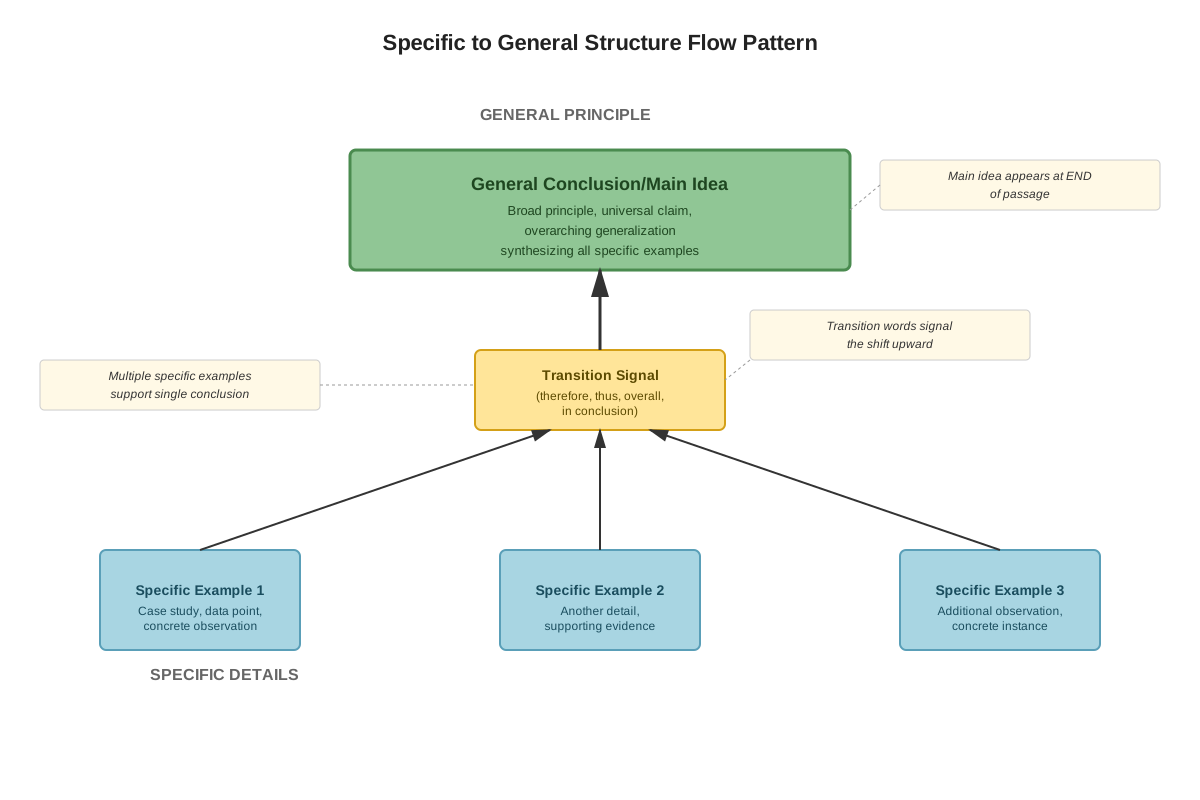
Specific to general structure is an organizational pattern where a passage or paragraph begins with particular examples, concrete details, individual cases, or narrow observations, then progresses toward a broader statement, universal principle, or overarching conclusion. This inductive approach moves from the particular to the universal, from the narrow to the wide, from the concrete to the abstract.
The structure typically contains three components:
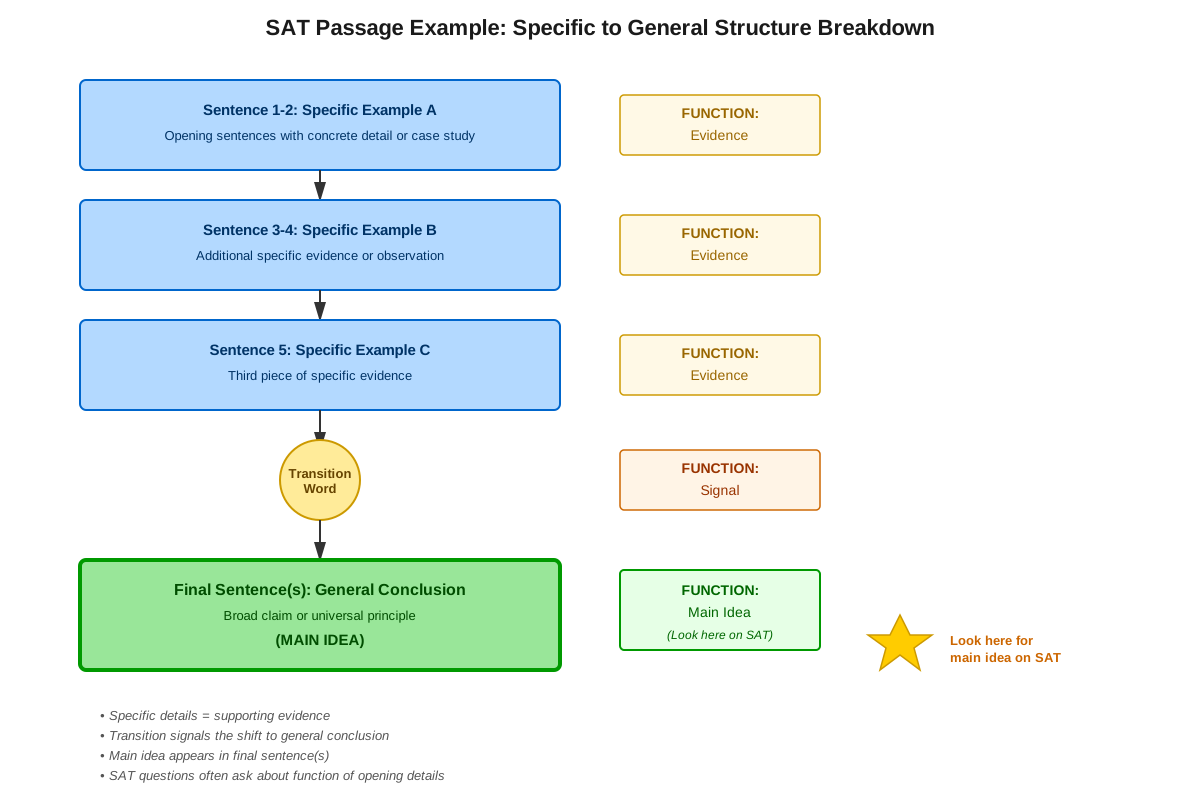
- Opening specifics: Concrete examples, data points, anecdotes, case studies, or particular observations
- Transitional movement: Words or phrases that signal the shift toward generalization
- Concluding generalization: A broad claim, universal principle, or overarching conclusion that encompasses the specific details
Structural Characteristics
The specific to general pattern exhibits several distinctive features that help students identify it:
| Feature | Description | Example Signal |
|---|---|---|
| Progressive broadening | Each sentence or section expands the scope of discussion | Moving from one species to all mammals to all animals |
| Accumulative evidence | Multiple specific examples build toward a single point | "In 1920... In 1935... In 1950... These decades demonstrate..." |
| Delayed thesis | Main claim appears in the final third of the passage | Last sentence begins with "Thus" or "Therefore" |
| Inductive reasoning | Logic moves from observations to conclusions | "After examining these cases, we can conclude..." |
| Synthesis language | Vocabulary that combines or summarizes | "Overall," "In sum," "These examples illustrate" |
The Movement Pattern
Understanding how ideas progress in specific to general structure is crucial for SAT success. The movement follows this pattern:
Narrow scope → Intermediate scope → Broad scope
For example:
- Narrow: "The monarch butterfly migrates 3,000 miles annually."
- Intermediate: "Several butterfly species undertake remarkable long-distance journeys."
- Broad: "Insect migration demonstrates sophisticated navigational capabilities previously attributed only to vertebrates."
This progression can occur within a single paragraph or across multiple paragraphs. On the SAT, recognizing this movement helps students anticipate where the author is heading and identify the passage's main purpose.
Common Transition Markers
Specific transition words and phrases signal the shift from specific details to general conclusions. These trigger words are high-yield for SAT questions:
Strong indicators of generalization:
- Therefore, thus, hence, consequently
- Overall, in general, broadly speaking
- This demonstrates/shows/reveals/illustrates that
- These examples suggest/indicate
- In sum, in conclusion, ultimately
- Such cases/instances/examples prove
Moderate indicators:
- Indeed, in fact (when synthesizing)
- Clearly, evidently (when drawing conclusions)
- This pattern, this trend
- More broadly, more generally
Functional Purpose of Components
Each part of the specific to general structure serves a distinct rhetorical purpose:
Opening specifics function to:
- Capture reader interest with concrete, relatable details
- Establish credibility through evidence
- Create a foundation for the broader claim
- Provide proof before assertion
Transitional elements function to:
- Signal the logical shift in scope
- Prepare readers for the main point
- Connect evidence to conclusion
- Guide comprehension
Concluding generalizations function to:
- State the main idea or thesis
- Synthesize the meaning of specific details
- Provide the "so what" answer
- Leave readers with the key takeaway
Variations in Complexity
The SAT presents specific to general structure in varying levels of complexity:
Simple version: One paragraph with 2-3 specific examples followed by a clear generalization
Moderate version: Multiple paragraphs where each presents specific details, culminating in a final paragraph that generalizes
Complex version: Nested structure where individual paragraphs move from specific to general, and the overall passage also follows this pattern
Hybrid version: Specific to general combined with other structures, such as starting with specifics, making a generalization, then providing more specifics as support
Concept Relationships
The specific to general structure connects intimately with several other Reading and Writing concepts. Understanding these relationships deepens comprehension and improves performance on multi-layered SAT questions.
Internal concept relationships:
Opening specifics → provide evidence for → Transitional markers → which signal → Concluding generalization
The specifics don't exist independently; they're carefully selected to support the eventual generalization. The transition markers serve as the bridge, making the logical connection explicit. The generalization derives its validity from the accumulated specifics.
Connection to main idea identification:
Specific to general structure → determines → Main idea location (typically at the end)
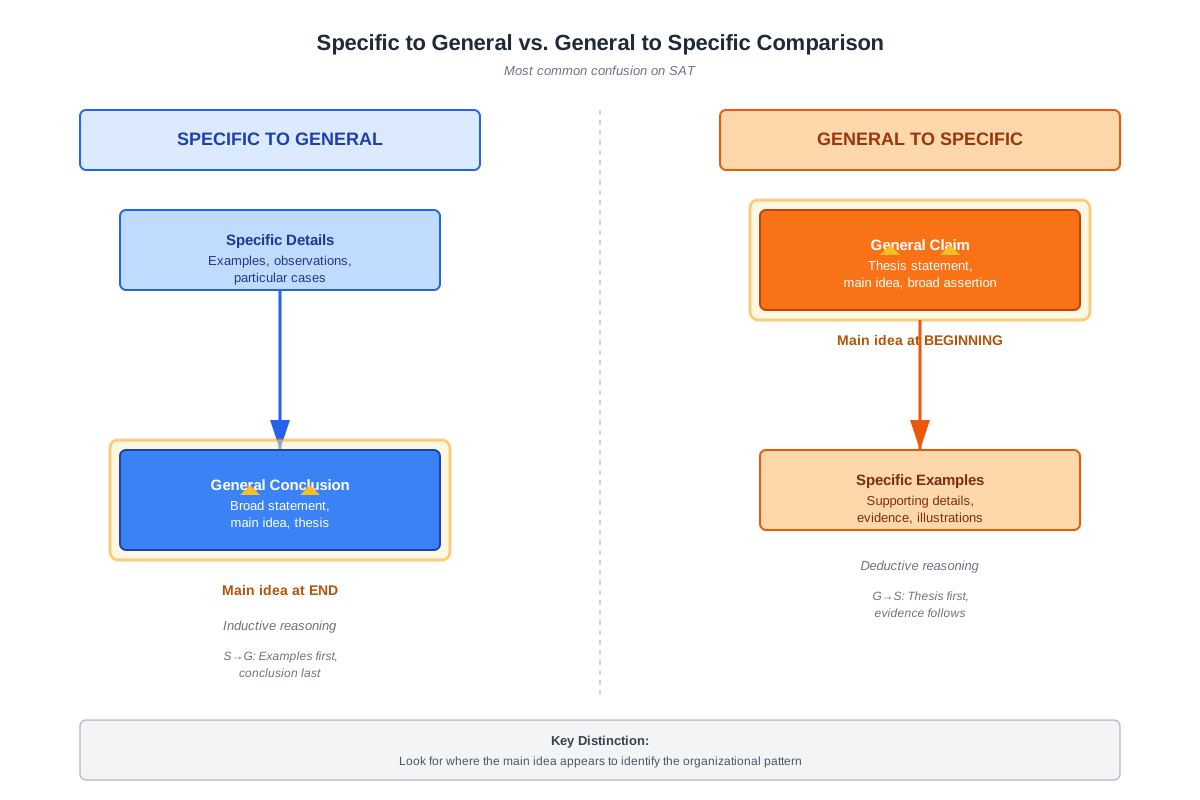
When students recognize this structure, they know to pay special attention to concluding sentences, where the main idea usually resides. This contrasts with general to specific structure, where the main idea appears at the beginning.
Connection to rhetorical purpose:
Author's purpose (to persuade/explain through evidence) → manifests as → Specific to general structure
Authors choose this structure when they want to build a case inductively, leading readers to a conclusion rather than asserting it upfront. Understanding this helps students answer "why did the author include this detail?" questions.
Connection to evidence and claims:
Evidence (specifics) → supports → Claim (generalization)
This structure makes the evidence-claim relationship explicit through organization. Each specific detail functions as evidence, and the generalization functions as the claim.
Connection to transition word usage:
Transition words → signal → Structural movement → which indicates → Relationship between ideas
Recognizing transition markers helps students identify not just that a passage uses specific to general structure, but precisely where the shift occurs.
High-Yield Facts
⭐ The main idea in specific to general structure typically appears in the last third of the passage, often in the final sentence or two.
⭐ Transition words like "therefore," "thus," "overall," and "these examples demonstrate" are strong signals of movement from specific to general.
⭐ Specific to general structure is most common in science passages on the SAT, appearing in approximately 40% of such passages.
⭐ Opening details in specific to general passages serve as evidence or examples, not as the main point—they build toward the generalization.
⭐ Questions asking "What is the main purpose of the passage?" require students to focus on the generalization, not the opening specifics.
- Specific to general structure reflects inductive reasoning, moving from observations to conclusions.
- This structure can appear within a single paragraph or across an entire passage.
- Authors use specific to general organization when they want to build credibility through evidence before making a claim.
- The SAT frequently asks students to identify the function of specific details within this structure—the answer is typically "to support/illustrate the generalization."
- Recognizing this structure helps with time management: students can skim opening details and read concluding sections more carefully.
- Specific to general passages often begin with anecdotes, case studies, statistics, or examples that seem narrow in scope.
- The generalization at the end should logically encompass all the specific details presented earlier.
- This structure is the opposite of general to specific (deductive) structure, where the main claim appears first.
Quick check — test yourself on Specific to general structure so far.
Try Flashcards →Common Misconceptions
Misconception: The first sentence of a passage always contains the main idea.
Correction: In specific to general structure, the main idea appears at the end, after specific details have been presented. Students must read through to the conclusion to identify the central claim.
Misconception: All the specific details in the opening are equally important and must be memorized.
Correction: The specific details serve a supporting function—understanding their collective purpose (building toward a generalization) matters more than memorizing each individual detail. Focus on how they relate to the concluding claim.
Misconception: Transition words like "therefore" always indicate a conclusion to the entire passage.
Correction: While "therefore" often signals a generalization, it might introduce an intermediate conclusion within a paragraph before the passage reaches its final, broadest generalization. Context determines scope.
Misconception: Specific to general structure only appears in science passages.
Correction: While most common in science passages, this structure appears across all passage types on the SAT, including humanities, social science, and even literary passages. Any passage that builds from examples to a principle uses this structure.
Misconception: If a passage starts with a specific example, the entire passage must follow specific to general structure.
Correction: Some passages use hybrid structures, starting with a specific example, then stating a general claim, then providing more specifics as support. Students must analyze the overall organizational pattern, not just the opening.
Misconception: The generalization at the end is always explicitly stated in one clear sentence.
Correction: Sometimes the generalization is implied across several sentences or requires synthesis of information from the concluding paragraph. Students must sometimes infer the broader principle from context.
Misconception: Specific to general structure is the same as chronological structure.
Correction: While both move forward in a sense, chronological structure organizes by time sequence, whereas specific to general organizes by scope (narrow to broad). A passage can be chronological without being specific to general, and vice versa.
Worked Examples
Example 1: Science Passage
Passage:
"In a 2019 study, researchers observed that crows in urban Tokyo learned to use passing cars to crack open nuts, placing them in crosswalks and waiting for traffic to do the work. Similarly, dolphins off the coast of Australia have been documented using marine sponges as tools to protect their snouts while foraging on the seafloor. Chimpanzees in Senegal fashion spears from branches to hunt smaller primates. These diverse examples from different species and environments demonstrate that tool use is not a uniquely human trait but rather a widespread cognitive adaptation that emerges when animals face complex survival challenges."
Question: Which choice best describes the overall structure of the text?
A) It presents a problem and then proposes multiple solutions.
B) It describes a phenomenon chronologically from past to present.
C) It provides specific examples before making a general claim.
D) It states a theory and then offers evidence that contradicts it.
Solution:
Step 1: Identify the opening content.
The passage begins with three specific examples: crows using cars, dolphins using sponges, and chimpanzees using spears. These are concrete, particular instances.
Step 2: Identify the concluding content.
The final sentence begins with "These diverse examples... demonstrate that," which is a clear transition to generalization. The conclusion makes a broad claim about tool use across species.
Step 3: Analyze the movement.
The passage moves from narrow (individual species behaviors) to broad (universal principle about tool use). This is classic specific to general structure.
Step 4: Eliminate incorrect answers.
- A is incorrect: No problem-solution structure exists.
- B is incorrect: The examples aren't organized chronologically; they're organized by type.
- D is incorrect: The evidence supports rather than contradicts the final claim.
Answer: C - The passage provides specific examples (crows, dolphins, chimpanzees) before making a general claim (tool use is widespread).
Connection to learning objectives: This example demonstrates how to identify key features of specific to general structure (opening specifics, transition marker "demonstrate that," concluding generalization) and apply this knowledge to answer SAT-style questions.
Example 2: Humanities Passage
Passage:
"When Virginia Woolf published 'Mrs. Dalloway' in 1925, critics noted her innovative use of stream-of-consciousness narration. James Joyce's 'Ulysses,' released three years earlier, had similarly experimented with representing characters' unfiltered thoughts. Marcel Proust's multi-volume 'In Search of Lost Time,' begun in 1913, pioneered techniques for depicting memory and consciousness. These modernist writers were responding to broader cultural shifts: the influence of Freudian psychology, which emphasized the unconscious mind; the trauma of World War I, which shattered faith in rational progress; and technological changes that accelerated the pace of life. Thus, the literary techniques of modernism emerged not from individual genius alone but from writers grappling with the profound transformations of early twentieth-century society."
Question: The author mentions Woolf, Joyce, and Proust primarily to:
A) Argue that these three writers were the most talented of their generation
B) Provide specific instances that illustrate a broader pattern in modernist literature
C) Contrast different approaches to stream-of-consciousness narration
D) Establish a chronological timeline of modernist literary development
Solution:
Step 1: Recognize the structure.
The passage opens with three specific writers and their works, then broadens to discuss "cultural shifts," and concludes with a generalization about modernism emerging from societal transformation.
Step 2: Identify the function of the specific examples.
Woolf, Joyce, and Proust are presented as examples before the passage explains the broader context ("These modernist writers were responding to...") and makes a general claim ("Thus, the literary techniques of modernism emerged...").
Step 3: Understand the relationship between specifics and generalization.
The three writers serve as concrete evidence for the concluding claim that modernist techniques resulted from societal changes, not just individual creativity.
Step 4: Evaluate answer choices.
- A is incorrect: The passage doesn't rank talent.
- C is incorrect: The passage doesn't contrast their approaches; it groups them together.
- D is incorrect: While dates are mentioned, chronology isn't the primary organizational principle.
Answer: B - The three writers are specific instances that illustrate the broader pattern explained in the generalization: modernist techniques emerged from societal transformation.
Connection to learning objectives: This example shows how understanding specific to general structure helps students determine the function of details (they support the generalization) and answer purpose questions correctly.
Exam Strategy
Recognition Strategy
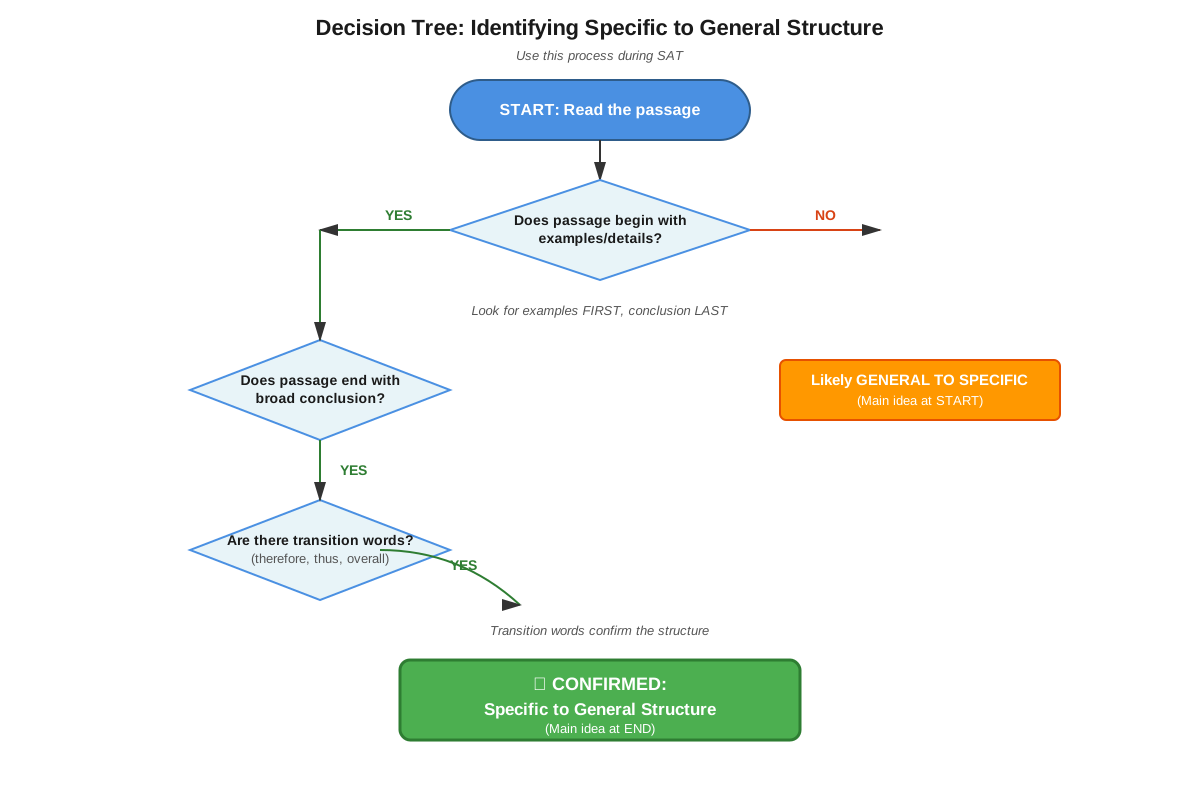
When approaching an SAT passage, quickly scan for structural clues:
- Read the first sentence and last sentence first: If the first sentence is concrete/narrow and the last sentence is abstract/broad, suspect specific to general structure.
- Look for transition markers: Words like "therefore," "thus," "these examples," and "overall" in the latter part of the passage confirm the structure.
- Count the examples: Multiple specific instances (2-4) in the opening strongly suggest specific to general organization.
Question-Answering Approach
For questions about main idea or purpose in specific to general passages:
Step 1: Locate the generalization (usually in the last third).
Step 2: Verify that opening details support this generalization.
Step 3: Choose the answer that reflects the generalization, not the specifics.
Exam Tip: If answer choices include both specific details from the opening and broader claims from the conclusion, the broader claim is almost always correct for "main purpose" questions in specific to general passages.
Trigger Words to Watch
In the question stem:
- "Overall structure of the text"
- "Main purpose of the passage"
- "Function of the example in lines X-Y"
- "Why does the author mention [specific detail]?"
In the passage:
- "Therefore," "thus," "hence" → generalization follows
- "For example," "for instance" → specifics follow
- "These cases," "such examples" → transition to generalization
- "Overall," "in general," "broadly" → generalization follows
Process of Elimination Tips
When eliminating wrong answers:
- Eliminate answers that focus only on opening specifics for main purpose questions—these are too narrow.
- Eliminate answers that mention structures not present (e.g., "chronological" when the passage isn't time-based).
- Eliminate answers that reverse the structure (e.g., "states a claim then provides examples" when the passage does the opposite).
- Keep answers that use words like "illustrate," "demonstrate," or "support" when describing the function of specifics.
Time Allocation
For passages with clear specific to general structure:
- Skim opening specifics (30 seconds): Understand what they're about without memorizing details.
- Read transitions carefully (15 seconds): Note where the shift occurs.
- Read the generalization slowly (30 seconds): This is where the main idea lives.
- Answer questions (2-3 minutes): Refer back to specifics only if questions ask about them directly.
This approach saves time because you're not trying to memorize every detail in the opening.
Memory Techniques
The Pyramid Mnemonic
Visualize specific to general structure as a pyramid building upward:
- Base (bottom): Specific examples (foundation)
- Middle: Transition words (support structure)
- Peak (top): General conclusion (the point you're building toward)
The base is wide (many specifics), and the peak is narrow (one generalization). This visual helps remember that you're building UP from many to one.
The STEM Acronym
For identifying specific to general structure, remember STEM:
- Specifics first (examples, cases, details)
- Transition words (therefore, thus, these examples)
- Expansion of scope (narrow to broad)
- Main idea at end (generalization concludes)
The "Detective Story" Analogy
Think of specific to general structure like a detective story:
- Clues (specific details) come first
- Investigation (transition/analysis) happens in the middle
- Solution (general conclusion) is revealed at the end
Just as you can't know whodunit until the end, you can't identify the main idea until you reach the generalization.
The Funnel Reversal
Many students learn that essays use a "funnel" (general to specific). For SAT passages with specific to general structure, remember the reverse funnel or inverted pyramid:
- Start narrow (specific)
- End wide (general)
This reversal helps distinguish the two structures.
Summary
Specific to general structure is a high-yield organizational pattern on the SAT Reading and Writing section, appearing in approximately 15-20% of structure and purpose questions. This inductive pattern begins with concrete examples, particular cases, or narrow observations, then progresses through transitional markers toward a broad conclusion or universal principle. The main idea in such passages appears at the end, making it essential for students to read through to the conclusion rather than assuming the first sentence contains the thesis. Key features include progressive broadening of scope, accumulative evidence, delayed thesis placement, and transition words like "therefore," "thus," and "these examples demonstrate." Understanding this structure helps students predict main idea location, determine the function of supporting details, and efficiently allocate reading time. The structure appears most frequently in science passages but occurs across all passage types. Mastery requires recognizing the three components (opening specifics, transitional movement, concluding generalization), understanding their functional relationships, and applying this knowledge to answer questions about overall structure, main purpose, and the function of specific details.
Key Takeaways
- Specific to general structure moves from narrow examples to broad conclusions, with the main idea appearing at the end of the passage.
- Transition words like "therefore," "thus," "overall," and "these examples demonstrate" signal the shift from specifics to generalization and are high-yield indicators on the SAT.
- Opening details in specific to general passages serve as evidence or support, not as the main point—their function is to build toward the generalization.
- This structure appears in approximately 15-20% of SAT Reading and Writing questions, most commonly in science passages but across all passage types.
- For "main purpose" questions in specific to general passages, choose answers that reflect the concluding generalization, not the opening specifics.
- Recognizing this structure improves time management: skim opening details and read concluding sections carefully where the main idea resides.
- The structure reflects inductive reasoning: observations lead to conclusions, evidence precedes claims, and particulars build toward universals.
Related Topics
General to Specific Structure: The inverse pattern where passages begin with a broad claim and then provide supporting details. Mastering specific to general structure makes it easier to recognize and distinguish this opposite organizational pattern.
Compare and Contrast Structure: Another common SAT organizational pattern that presents similarities and differences between two or more subjects. Understanding various structures helps students quickly categorize passages.
Rhetorical Purpose and Function: Analyzing why authors choose specific organizational patterns connects directly to understanding specific to general structure. This topic explores the strategic reasons behind structural choices.
Main Idea and Supporting Details: Specific to general structure makes the relationship between main ideas and supporting details explicit through organization, making this a natural progression for deeper study.
Transition Words and Logical Flow: The transition markers that signal movement from specific to general are part of a broader system of logical connectors that students should master for comprehensive SAT success.
Practice CTA
Now that you understand specific to general structure, it's time to apply this knowledge! Work through the practice questions to test your ability to identify this structure, determine the function of specific details, and answer SAT-style questions with confidence. The flashcards will help you memorize key transition words and structural features. Remember: recognizing this pattern quickly on test day gives you a strategic advantage, helping you predict where main ideas appear and how to approach questions efficiently. You've built a strong foundation—now practice will make it automatic!
Sign up free to keep reading
Create a free AnvayaPrep account to finish this SAT guide on Specific to general structure — plus flashcards and practice questions.