Overview
Technical vocabulary refers to specialized terms and precise language used within specific academic disciplines, professional fields, or subject areas. On the SAT Reading and Writing section (RW), students encounter passages from diverse domains—including science, social studies, humanities, and literature—each employing discipline-specific terminology that carries exact meanings within its context. Unlike general vocabulary that might have multiple interpretations, technical terms function as precise tools that experts use to communicate complex ideas efficiently and unambiguously.
Understanding sat technical vocabulary is essential because the College Board designs questions that test whether students can determine the meaning of specialized terms from context, recognize how these terms function within arguments, and distinguish between technical and everyday uses of words. Approximately 15-20% of SAT Reading and Writing questions directly or indirectly assess vocabulary comprehension, with technical vocabulary appearing prominently in science and social science passages. Students who master this skill gain significant advantages not only on the SAT but also in college-level coursework where discipline-specific language becomes the primary medium of instruction and assessment.
Technical vocabulary connects intimately to other Reading and Writing concepts, particularly context clues, author's purpose, and rhetorical analysis. When authors introduce technical terms, they often provide definitional context, examples, or explanatory frameworks that help readers understand specialized concepts. Recognizing these patterns enables students to decode unfamiliar terminology efficiently while maintaining reading comprehension and pace—critical skills for success on the time-constrained SAT.
Learning Objectives
- [ ] Identify key features of technical vocabulary in SAT passages
- [ ] Explain how technical vocabulary appears on the SAT across different question formats
- [ ] Apply technical vocabulary knowledge to answer SAT-style questions accurately
- [ ] Distinguish between technical and non-technical uses of the same word
- [ ] Use context clues to determine the precise meaning of unfamiliar technical terms
- [ ] Recognize common patterns in how authors introduce and define specialized terminology
- [ ] Evaluate answer choices that contain technical vocabulary for accuracy and appropriateness
Prerequisites
- Basic vocabulary skills: Understanding common words and their meanings provides the foundation for recognizing when terms shift into specialized usage
- Reading comprehension fundamentals: The ability to understand main ideas and supporting details enables students to extract meaning from context when encountering technical terms
- Familiarity with academic subjects: General knowledge of science, history, and humanities helps students recognize when vocabulary becomes discipline-specific
- Context clue strategies: Knowing how to use surrounding text to infer meaning is essential for decoding unfamiliar technical vocabulary
Why This Topic Matters
Technical vocabulary mastery directly impacts performance across multiple SAT question types. Students encounter technical terms in approximately 60-70% of SAT reading passages, particularly in science and social science selections. Questions may ask students to identify the most appropriate word to complete a sentence, determine what a technical term means in context, or select a word that maintains consistency with the passage's technical register. Missing these questions costs valuable points because they appear consistently across all test administrations.
Beyond the exam, technical vocabulary skills prove indispensable in academic and professional contexts. College courses across all disciplines—from biology and chemistry to economics and psychology—require students to learn and apply hundreds of specialized terms each semester. Professionals in every field use technical vocabulary to communicate precisely with colleagues, write reports, and engage with specialized literature. Students who develop strong technical vocabulary skills on the SAT build transferable competencies that serve them throughout their educational and career trajectories.
On the SAT, technical vocabulary appears in several characteristic ways: within science passages explaining research findings or experimental procedures, in social science texts discussing economic theories or psychological concepts, in historical documents using period-specific terminology, and in humanities passages analyzing artistic or philosophical ideas. The College Board intentionally selects passages that require students to engage with specialized language, testing whether they can navigate academic discourse at the college level.
Core Concepts
Defining Technical Vocabulary
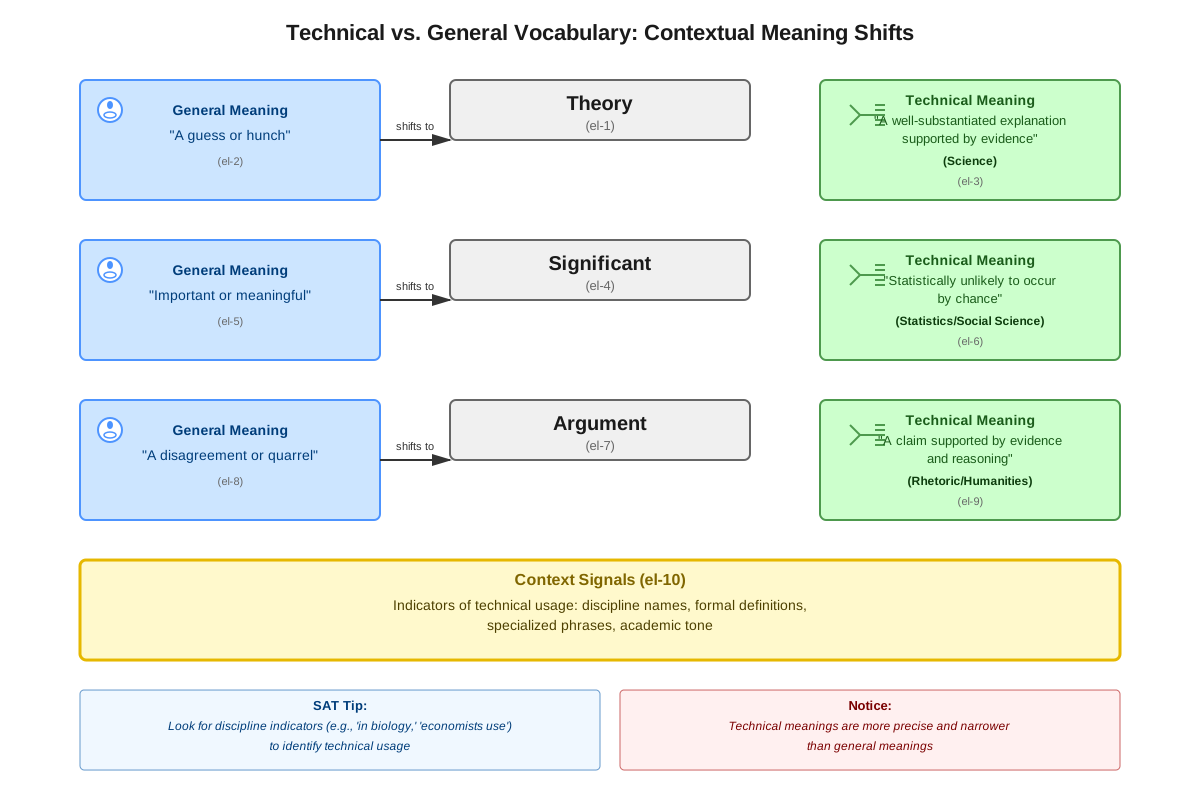
Technical vocabulary consists of words and phrases that carry specialized meanings within particular disciplines or fields of study. These terms differ from general vocabulary in three key ways: precision (they denote specific concepts with minimal ambiguity), context-dependency (their technical meaning applies primarily within their field), and expert usage (specialists employ them to communicate efficiently with other experts). For example, the word "culture" has a general meaning referring to shared customs and beliefs, but in biology, it specifically denotes the process of growing microorganisms in controlled conditions.
Technical terms fall into several categories. Pure technical terms exist almost exclusively within their discipline (e.g., "mitochondria," "photosynthesis," "alliteration"). Semi-technical terms have both general and specialized meanings (e.g., "depression" in psychology versus everyday sadness, "work" in physics versus general labor). Jargon refers to technical vocabulary that may seem unnecessarily complex to outsiders but serves important communicative functions within expert communities.
How Technical Vocabulary Functions in SAT Passages
The SAT presents technical vocabulary within authentic academic passages where authors use specialized terms naturally to explain concepts, present research, or develop arguments. Unlike vocabulary lists that students might memorize in isolation, SAT technical vocabulary always appears embedded in meaningful context. This design reflects the College Board's emphasis on assessing college-readiness skills rather than rote memorization.
Authors typically introduce technical vocabulary through several strategies. Direct definition occurs when writers explicitly state what a term means: "Photosynthesis, the process by which plants convert light energy into chemical energy, occurs primarily in leaf cells." Contextual definition provides meaning through surrounding explanation without formal definition: "The researcher observed the specimen's mitotic activity, noting how the cells divided and replicated their genetic material." Example-based clarification illustrates technical concepts through concrete instances: "Various catalysts, such as enzymes that speed up biological reactions or platinum that accelerates chemical processes in car exhaust systems, share the property of increasing reaction rates without being consumed."
Recognizing Technical Vocabulary Patterns
Certain linguistic markers signal the presence of technical vocabulary. Formal register indicates specialized discourse—technical passages typically avoid contractions, colloquialisms, and casual language. Definitional structures include phrases like "refers to," "is defined as," "means," "consists of," and "can be understood as." Appositive phrases (explanatory phrases set off by commas) often clarify technical terms: "The hippocampus, a brain structure crucial for memory formation, shows increased activity during learning tasks."
Etymological clues help decode technical vocabulary. Many scientific terms derive from Latin or Greek roots: "cardio-" (heart), "neuro-" (nerve), "geo-" (earth), "bio-" (life), "hydro-" (water). Recognizing these roots enables students to infer meanings of unfamiliar terms. For instance, "hydrophobic" combines "hydro" (water) and "phobic" (fearing/repelling), suggesting something that repels water.
Technical Vocabulary in Different Disciplines
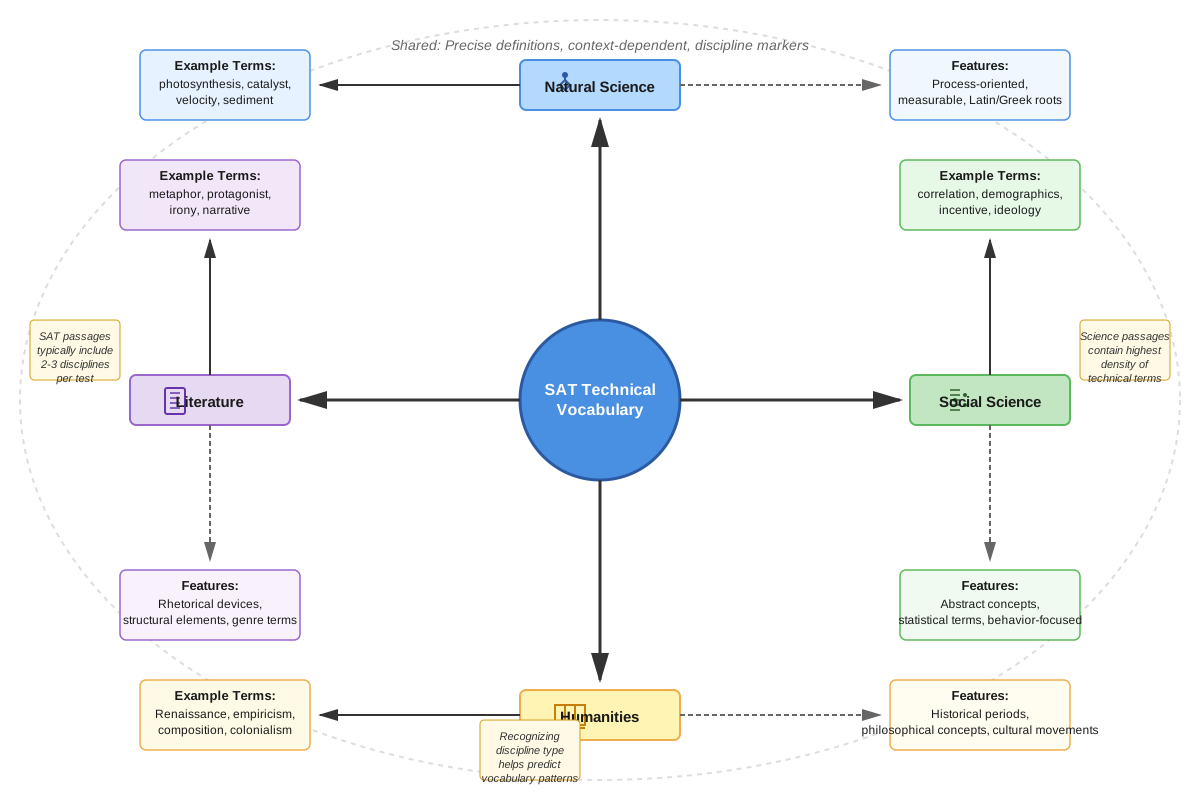
Each academic discipline employs characteristic technical vocabulary that reflects its methods and concerns:
| Discipline | Technical Vocabulary Characteristics | Example Terms |
|---|---|---|
| Natural Sciences | Precise, often derived from Latin/Greek, describes observable phenomena | catalyst, osmosis, mitochondria, photosynthesis |
| Social Sciences | Describes human behavior and social structures, may overlap with everyday language | demographics, correlation, socialization, infrastructure |
| Humanities | Analyzes cultural products and human expression | metaphor, composition, perspective, narrative voice |
| Mathematics | Highly precise, often symbolic, describes relationships and operations | coefficient, variable, proportion, exponential |
Understanding these disciplinary patterns helps students anticipate the type of technical vocabulary they'll encounter and activate relevant background knowledge.
Context Clues for Technical Vocabulary
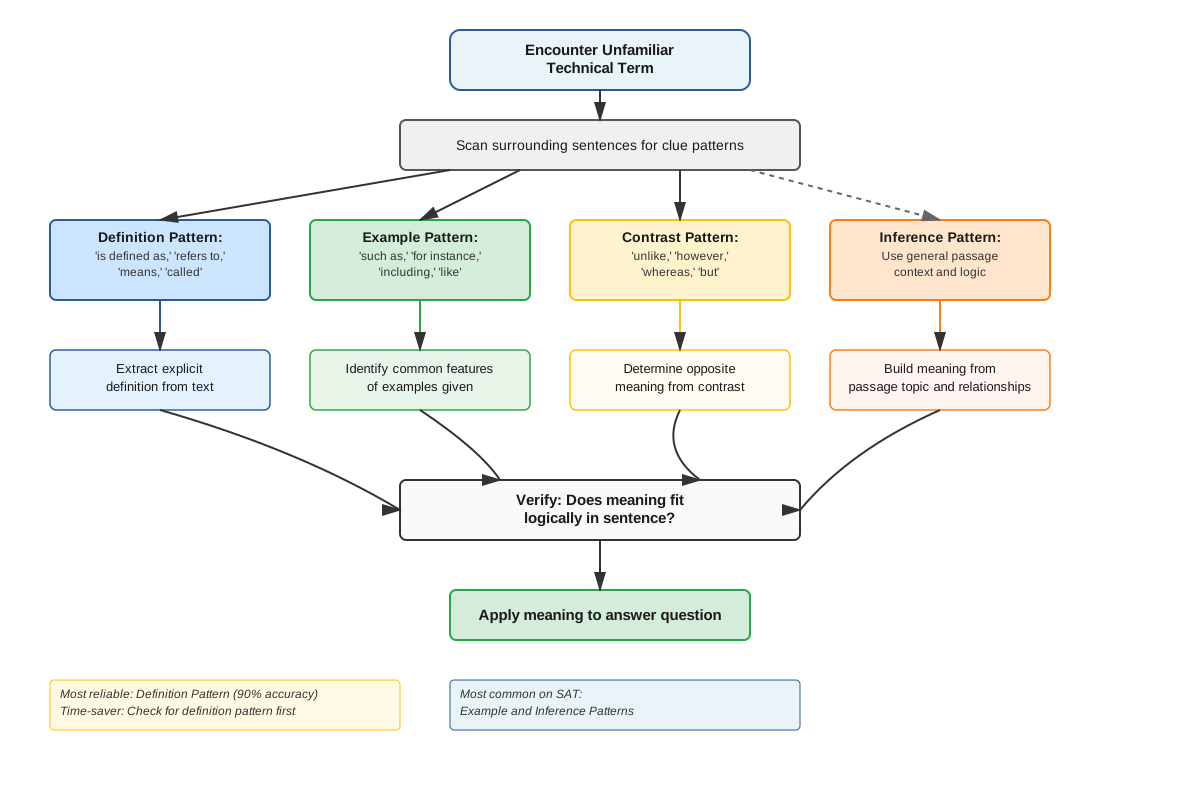
When encountering unfamiliar technical terms, students should employ systematic context analysis. Definitional context appears when authors explicitly explain terms. Example context provides instances that illustrate the concept. Contrast context defines terms by explaining what they're not or by presenting opposites. Inference context requires synthesizing information from multiple sentences to determine meaning.
Consider this passage: "Unlike exothermic reactions that release energy into their surroundings, endothermic reactions absorb energy from the environment, often causing a temperature decrease in the surrounding area." Even without knowing these terms, students can infer that "exothermic" means energy-releasing and "endothermic" means energy-absorbing through the contrast structure and explanatory details.
Technical Vocabulary Question Types
The SAT tests technical vocabulary through several question formats. Words in Context questions present a sentence from the passage with one word underlined, asking which word could replace it while maintaining meaning. Vocabulary in Context questions ask what a specific technical term means as used in the passage. Word choice questions require selecting the most appropriate technical term to complete a sentence based on context and meaning.
These questions assess whether students understand technical terms precisely rather than approximately. Answer choices often include words that seem plausible but carry subtly different meanings. For example, a question might ask whether "mitigate," "alleviate," "eliminate," or "exacerbate" best completes a sentence about reducing environmental damage. While several options relate to change, only "mitigate" and "alleviate" suggest reduction, and "mitigate" specifically means to make less severe—the precise technical meaning required.
Concept Relationships
Technical vocabulary mastery builds upon and connects to multiple Reading and Writing skills. Context clues serve as the primary tool for decoding unfamiliar technical terms, with students using definitional, example, contrast, and inference strategies to determine meanings. This relationship flows bidirectionally: strong context clue skills enable technical vocabulary comprehension, while practice with technical vocabulary strengthens general context analysis abilities.
Main idea comprehension depends on understanding technical vocabulary because specialized terms often carry the passage's central concepts. A science passage about cellular respiration cannot be understood without grasping terms like "mitochondria," "ATP," and "glucose metabolism." Conversely, understanding the passage's main idea helps students infer the meanings of unfamiliar technical terms by recognizing how they must function within the author's argument.
The relationship map flows as follows: Background knowledge → activates recognition of → Technical vocabulary → enables → Precise comprehension → supports → Accurate question answering → demonstrates → College readiness. Additionally, Context clues ↔ Technical vocabulary (bidirectional relationship), and Technical vocabulary → connects to → Author's purpose (authors choose technical terms deliberately to establish credibility and precision).
High-Yield Facts
⭐ Technical vocabulary appears in 60-70% of SAT reading passages, particularly in science and social science selections
⭐ The SAT tests whether students can determine technical term meanings from context rather than through memorization
⭐ Semi-technical terms—words with both general and specialized meanings—appear most frequently in SAT questions
⭐ Authors typically introduce technical vocabulary through direct definition, contextual explanation, or illustrative examples
⭐ Latin and Greek roots provide clues to technical vocabulary meanings across scientific disciplines
- Technical vocabulary questions often include answer choices with similar but not identical meanings, testing precision
- Discipline-specific patterns help predict the type of technical vocabulary that will appear in different passage types
- Formal register and definitional structures signal the presence of technical vocabulary
- Understanding technical vocabulary is essential for grasping main ideas in academic passages
- The SAT rewards students who can distinguish between technical and everyday uses of the same word
- Appositive phrases (explanatory phrases set off by commas) frequently clarify technical terms
- Technical vocabulary mastery correlates strongly with overall SAT Reading and Writing scores
- Context-based technical vocabulary questions cannot be answered correctly through memorization alone
- The College Board selects passages that reflect authentic college-level academic discourse
- Technical vocabulary skills transfer directly to college coursework across all disciplines
Quick check — test yourself on Technical vocabulary so far.
Try Flashcards →Common Misconceptions
Misconception: Technical vocabulary questions can be answered by memorizing word lists → Correction: The SAT specifically tests whether students can determine technical term meanings from context within passages. Memorized definitions often don't match how terms are used in specific contexts, and the test includes many semi-technical terms whose meanings shift based on discipline and usage.
Misconception: If a technical term is unfamiliar, the question cannot be answered correctly → Correction: The SAT is designed so that all necessary information to answer questions appears within the passage. Authors provide context clues—definitions, examples, contrasts, or explanations—that enable students to determine technical term meanings even when encountering them for the first time.
Misconception: Technical vocabulary only appears in science passages → Correction: While science passages contain high concentrations of technical terms, social science passages use specialized vocabulary from economics, psychology, and sociology; humanities passages employ technical terms from literary analysis and art criticism; and historical documents contain period-specific terminology that functions as technical vocabulary.
Misconception: The most complex-sounding answer choice is usually correct for technical vocabulary questions → Correction: The SAT often includes sophisticated-sounding words as incorrect answer choices to trap students who assume complexity equals correctness. The right answer precisely matches the context and meaning required by the passage, which may be a simpler term used accurately rather than a complex term used impressively.
Misconception: General knowledge of a subject is sufficient for understanding technical vocabulary in passages → Correction: While background knowledge helps, the SAT tests whether students can comprehend technical terms as they're specifically used within each passage. Authors may use familiar terms in specialized ways, or passages may present technical concepts that differ from students' prior understanding, requiring careful attention to context.
Worked Examples
Example 1: Science Passage with Technical Vocabulary
Passage excerpt: "The researchers observed that the catalyst significantly reduced the activation energy required for the reaction to proceed. By lowering this energy barrier, the catalyst enabled the reaction to occur at a much faster rate without being consumed in the process. This property makes catalysts invaluable in industrial applications where reaction speed directly impacts production efficiency."
Question: As used in the passage, "activation energy" most nearly refers to:
A) The total energy released during a chemical reaction
B) The minimum energy required for a reaction to begin
C) The energy stored in chemical bonds
D) The heat produced when substances combine
Solution Process:
Step 1: Identify the technical term and locate context clues. The term "activation energy" appears in a sentence explaining what a catalyst reduces.
Step 2: Analyze the surrounding explanation. The passage states the catalyst "reduced the activation energy required for the reaction to proceed" and describes this as an "energy barrier."
Step 3: Synthesize the context. The term is described as something that must be overcome for a reaction to happen ("required for the reaction to proceed") and as a "barrier" that, when lowered, allows reactions to occur faster.
Step 4: Evaluate answer choices against context:
- A) "Total energy released" doesn't match "barrier" or "required to proceed"
- B) "Minimum energy required to begin" perfectly matches "required for the reaction to proceed" and "barrier"
- C) "Energy stored in bonds" isn't described as a barrier to overcome
- D) "Heat produced" contradicts the idea of energy required (input vs. output)
Answer: B
Connection to learning objectives: This example demonstrates how to identify technical vocabulary features (specialized scientific term), recognize how it appears on the SAT (within explanatory context), and apply context analysis to answer questions correctly.
Example 2: Social Science Passage with Semi-Technical Vocabulary
Passage excerpt: "Economic models suggest that market equilibrium occurs when supply and demand reach a balance point where the quantity producers wish to sell exactly matches the quantity consumers wish to purchase. At this equilibrium price, the market clears with no surplus inventory and no unmet demand. Deviations from equilibrium create pressure that pushes prices back toward this stable point."
Question: Which choice best maintains the technical meaning established in the passage?
The concept of equilibrium is _______ to understanding how markets self-regulate through price adjustments.
A) peripheral
B) central
C) tangential
D) incidental
Solution Process:
Step 1: Understand the technical concept. "Equilibrium" is presented as the fundamental state where markets balance, with the passage explaining how markets naturally move toward this state.
Step 2: Analyze the passage's treatment of equilibrium. The author dedicates the entire excerpt to explaining equilibrium, describes it as the point where markets "clear," and explains that deviations create "pressure" pushing back toward equilibrium—suggesting it's a core concept.
Step 3: Determine what relationship the blank should express. The sentence asks about equilibrium's importance to understanding market self-regulation, a concept the passage presents as fundamental.
Step 4: Evaluate answer choices:
- A) "Peripheral" means marginal or secondary—contradicts the passage's emphasis
- B) "Central" means essential or fundamental—matches the passage's treatment
- C) "Tangential" means barely related—contradicts the direct connection shown
- D) "Incidental" means minor or coincidental—contradicts the passage's focus
Answer: B
Connection to learning objectives: This example shows how technical vocabulary extends beyond pure scientific terms to include semi-technical terms from social sciences, and demonstrates how understanding the passage's treatment of concepts guides accurate word choice.
Exam Strategy
When approaching SAT questions involving technical vocabulary, employ a systematic process. First, read the passage carefully, paying special attention to sentences surrounding technical terms. Authors almost always provide context clues within 1-2 sentences of introducing specialized vocabulary. Second, identify definitional structures like "refers to," "means," "is defined as," or appositive phrases that signal explanations.
Trigger words and phrases that indicate technical vocabulary include: "specifically," "technically," "in this context," "defined as," "known as," "termed," "called," and "refers to." When these appear, slow down and ensure full comprehension of the technical term being introduced. Additionally, watch for contrast markers like "unlike," "whereas," "however," and "in contrast," which often clarify technical terms by explaining what they're not.
For process-of-elimination, first remove answer choices that contradict information explicitly stated in the passage. Next, eliminate choices that use the technical term in a different discipline's context (e.g., "culture" as anthropological concept vs. biological process). Then remove options that are too broad or too narrow compared to how the passage uses the term. Finally, select the answer that most precisely matches the passage's specific usage.
Time allocation for technical vocabulary questions should be approximately 45-60 seconds per question. Spend 20-30 seconds locating and rereading the relevant passage section, 15-20 seconds analyzing context clues, and 10-15 seconds evaluating answer choices. If a question requires more time, mark it and return after completing easier questions—technical vocabulary questions often become clearer after engaging more deeply with the passage through other questions.
Exam Tip: When two answer choices seem equally plausible, reread the sentence with each option substituted. The correct answer will maintain the passage's meaning and tone precisely, while the incorrect option will create subtle inconsistencies or shift the meaning slightly.
Memory Techniques
ROOT WORD MNEMONIC - Remember common Latin and Greek roots with "BGHP Helps Science":
- Bio = life (biology, biosphere)
- Geo = earth (geology, geography)
- Hydro = water (hydrology, dehydrate)
- Photo = light (photosynthesis, photograph)
CONTEXT CLUE ACRONYM - Use "DICE" to remember context clue types:
- Definitional (direct explanation)
- Inference (synthesize from multiple clues)
- Contrast (explained by opposites)
- Example (illustrated through instances)
VISUALIZATION STRATEGY - When encountering technical vocabulary, create a mental image connecting the term to its definition. For "catalyst," visualize a bridge lowering to allow cars (reactions) to cross more easily without the bridge itself moving. For "equilibrium," picture a perfectly balanced scale. These visual anchors help retrieve meanings during the exam.
DISCIPLINE RECOGNITION - Remember that technical vocabulary patterns differ by field using "SSH-M":
- Science = Latin/Greek roots, observable phenomena
- Social science = behavior/society terms, overlap with everyday language
- Humanities = analysis/interpretation terms
- Math = precise relationships, often symbolic
SEMI-TECHNICAL ALERT - Create a mental flag for words that have both everyday and technical meanings. Common semi-technical terms include: culture, depression, work, energy, power, force, pressure, stress, field, medium, solution, and property. When these appear, always check whether the passage uses them technically or generally.
Summary
Technical vocabulary represents specialized terminology that carries precise meanings within academic disciplines, appearing prominently throughout SAT Reading and Writing passages. Success with technical vocabulary questions requires understanding that the SAT tests context-based comprehension rather than memorization, with authors consistently providing definitional clues, examples, contrasts, or explanations that enable students to determine unfamiliar term meanings. The key to mastering this topic lies in recognizing patterns—how authors introduce technical terms, how different disciplines employ specialized language, and how semi-technical words shift between general and specialized meanings. Students must develop systematic approaches: identifying context clues, analyzing definitional structures, recognizing etymological patterns, and evaluating answer choices for precision rather than complexity. Technical vocabulary connects intimately to broader reading comprehension skills, serving as both a component of understanding main ideas and a demonstration of college-readiness for academic discourse across all disciplines.
Key Takeaways
- Technical vocabulary questions test context-based comprehension, not memorization, with all necessary information provided within passages
- Authors introduce technical terms through predictable patterns: direct definition, contextual explanation, examples, and contrast structures
- Semi-technical terms (words with both general and specialized meanings) appear most frequently and require careful attention to context
- Latin and Greek roots provide valuable clues for decoding unfamiliar scientific and technical terminology
- Systematic context analysis using the DICE framework (Definitional, Inference, Contrast, Example) enables accurate determination of technical term meanings
- Answer choice evaluation should prioritize precision over complexity, with correct answers matching the passage's specific usage exactly
- Technical vocabulary mastery directly correlates with overall SAT performance and college readiness across all academic disciplines
Related Topics
Context Clues and Inference - Deepening skills in using surrounding text to determine word meanings enhances technical vocabulary comprehension and applies across all vocabulary question types on the SAT.
Author's Purpose and Tone - Understanding why authors choose specific technical vocabulary reveals how specialized language establishes credibility, precision, and appropriate register for academic discourse.
Main Idea and Supporting Details - Technical vocabulary often carries passages' central concepts, making vocabulary comprehension essential for identifying main ideas and understanding how details support arguments.
Rhetorical Analysis - Examining how authors use technical vocabulary strategically to achieve specific effects connects vocabulary skills to broader analytical reading competencies.
Domain-Specific Vocabulary in Science and Social Studies - Exploring technical vocabulary within specific disciplines builds background knowledge that accelerates comprehension of SAT passages from those fields.
Practice CTA
Now that you've mastered the core concepts of technical vocabulary, it's time to apply these strategies to authentic SAT questions. Complete the practice questions to reinforce your understanding of context clue analysis, technical term recognition, and precise answer choice evaluation. Use the flashcards to build familiarity with common technical vocabulary patterns and root words that appear frequently on the SAT. Remember: technical vocabulary mastery isn't about memorizing definitions—it's about developing systematic approaches to decode specialized language from context. Each practice question you complete strengthens these analytical skills and builds confidence for test day. You've got this!
Sign up free to keep reading
Create a free AnvayaPrep account to finish this SAT guide on Technical vocabulary — plus flashcards and practice questions.