Overview
Active voice is one of the most frequently tested grammatical concepts on the ACT English section, appearing in approximately 2-4 questions per test. Understanding active voice is essential because it directly impacts sentence clarity, conciseness, and effectiveness—three qualities the ACT consistently rewards. When a sentence uses active voice, the subject performs the action expressed by the verb, creating direct and powerful prose. In contrast, passive voice constructions often introduce unnecessary wordiness and ambiguity, both of which the ACT penalizes.
The ACT English section prioritizes clear, efficient communication, and ACT active voice questions test whether students can recognize when passive constructions weaken a sentence and when active voice would be more appropriate. These questions typically appear in the Rhetorical Skills subsection under Strategy questions, though they also connect to Usage/Mechanics questions about sentence structure. Students who master active voice gain a significant advantage because they can quickly identify wordy, awkward passive constructions and select the most direct alternative.
Active voice connects to broader English concepts including verb usage, sentence structure, conciseness, and style. It works hand-in-hand with parallel structure, modifier placement, and subject-verb agreement to create well-constructed sentences. Understanding active voice also enhances comprehension of tone and emphasis, as writers strategically choose voice to highlight specific sentence elements. For ACT success, recognizing when the test is evaluating voice—and knowing how to apply the active voice preference—is a high-yield skill that improves both accuracy and speed.
Learning Objectives
- [ ] Identify when Active voice is being tested on ACT questions
- [ ] Explain the core rule or strategy behind Active voice
- [ ] Apply Active voice to ACT-style questions accurately
- [ ] Distinguish between appropriate and inappropriate uses of passive voice
- [ ] Convert passive voice constructions to active voice efficiently
- [ ] Recognize trigger words and phrases that signal voice-related questions
- [ ] Evaluate whether active or passive voice better serves a sentence's purpose
Prerequisites
- Subject-verb agreement: Understanding how subjects and verbs must match in number and person is essential because active voice requires clear identification of who or what performs the action
- Basic sentence structure: Knowledge of subjects, verbs, and objects allows students to recognize the components that shift between active and passive constructions
- Verb tenses and forms: Familiarity with verb conjugations helps identify passive voice constructions, which typically use forms of "to be" plus past participles
- Parts of speech: Recognizing nouns, verbs, and prepositions enables students to analyze sentence structure and identify the agent performing actions
Why This Topic Matters
Active voice matters in real-world communication because it creates clearer, more direct, and more engaging writing. Professional writing, academic papers, journalism, and business communications all favor active voice because it eliminates ambiguity about who does what. Readers process active voice sentences more quickly and retain information better when the actor-action relationship is explicit. In scientific writing, grant proposals, and technical documentation, active voice reduces confusion and increases accountability by clearly stating who performed which actions.
On the ACT English section, active voice questions appear with high frequency—typically 2-4 times per test, representing approximately 3-5% of all English questions. These questions most commonly appear as Strategy questions asking students to choose the most effective or concise version of a sentence. The ACT consistently rewards active voice when it makes sentences clearer and more direct, though the test occasionally includes questions where passive voice is appropriate (such as when the actor is unknown or when emphasizing the action's recipient).
Active voice questions typically manifest in three ways on the ACT: (1) identifying unnecessarily wordy passive constructions that should be converted to active voice, (2) recognizing when a passive construction disrupts parallel structure or logical flow, and (3) evaluating whether a revision maintains the intended emphasis while improving clarity. The test often presents a passive voice sentence followed by four options, where the correct answer uses active voice to eliminate wordiness while preserving meaning. Understanding this pattern allows students to quickly identify and correctly answer these high-yield questions.
Core Concepts
Defining Active Voice
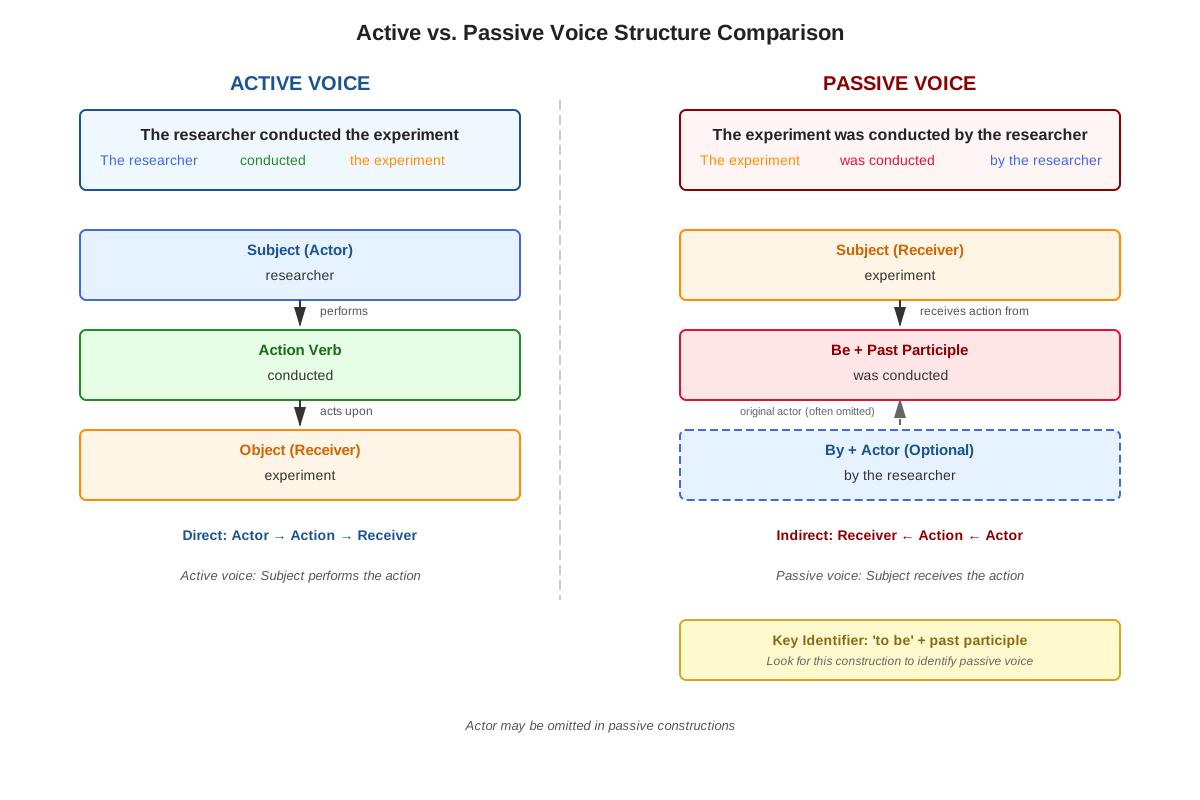
Active voice occurs when the subject of a sentence performs the action expressed by the verb. The basic structure follows the pattern: Subject → Verb → Object. In active voice, the grammatical subject is also the logical agent—the doer of the action. For example, "The scientist conducted the experiment" uses active voice because the subject (scientist) performs the action (conducted). This construction creates direct, clear sentences where readers immediately understand who does what.
The defining characteristic of active voice is this alignment between grammatical subject and logical agent. When analyzing sentences, students should ask: "Who or what is performing this action?" If the answer matches the grammatical subject, the sentence uses active voice. This straightforward relationship between subject and action makes active voice the default choice for clear communication.
Defining Passive Voice
Passive voice reverses the typical subject-action relationship by making the recipient of an action the grammatical subject. The structure follows: Object → "to be" verb + past participle → (optional) "by" + agent. For example, "The experiment was conducted by the scientist" uses passive voice because the grammatical subject (experiment) receives the action rather than performing it. The actual agent (scientist) appears in a prepositional phrase or may be omitted entirely.
Passive voice constructions always include a form of "to be" (is, are, was, were, been, being) combined with a past participle (the -ed or irregular past form of a verb). This combination is the grammatical signature of passive voice. Common passive constructions include "was written," "were discovered," "has been completed," and "is being reviewed." Recognizing this pattern allows students to quickly identify passive voice in ACT passages.
When Active Voice Is Preferred
The ACT strongly prefers active voice in most contexts because it creates concise, direct, and clear sentences. Active voice should be used when:
- The actor is known and important to the sentence's meaning
- Clarity and directness are priorities
- Reducing wordiness improves the sentence
- The sentence is part of a series using active voice (parallel structure)
- The emphasis should be on who performs the action
Consider this comparison:
| Passive Voice | Active Voice |
|---|---|
| The novel was written by Toni Morrison. (7 words) | Toni Morrison wrote the novel. (5 words) |
| The data were analyzed by the research team. (8 words) | The research team analyzed the data. (6 words) |
| Mistakes were made during the process. (6 words, agent unknown) | We made mistakes during the process. (6 words, agent clear) |
Active voice eliminates unnecessary words and clarifies who performs actions. On the ACT, when an answer choice converts passive to active voice while maintaining the sentence's meaning, that choice is typically correct.
When Passive Voice Is Acceptable
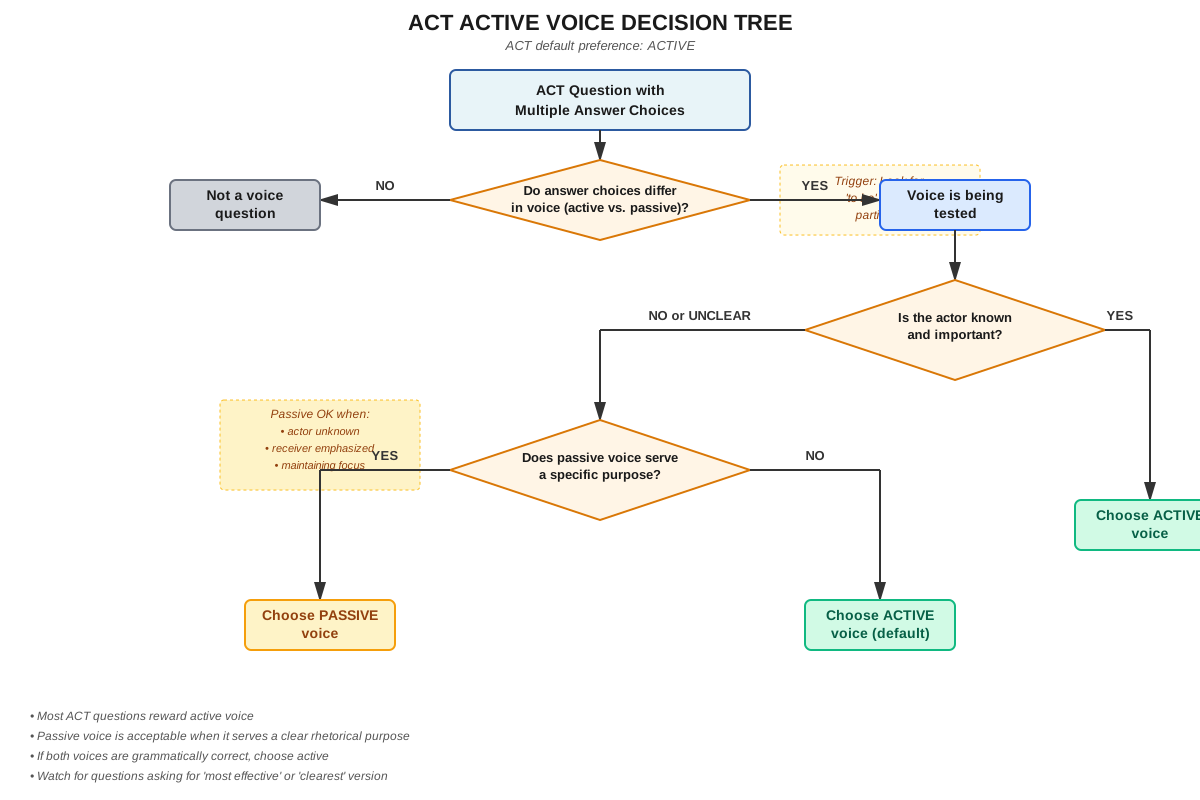
Despite the general preference for active voice, passive voice serves legitimate purposes and is sometimes the better choice. The ACT recognizes appropriate passive voice uses when:
- The actor is unknown or unimportant: "The building was constructed in 1887" (who built it may be irrelevant or unknown)
- Emphasis should be on the action's recipient: "President Lincoln was assassinated in 1865" (Lincoln is more important than the assassin in this context)
- Scientific or objective tone is required: "The samples were heated to 100°C" (standard scientific writing)
- The actor should be de-emphasized or hidden: "Errors were made in the calculation" (avoiding blame)
The key distinction is purpose. If passive voice serves a clear rhetorical purpose—emphasizing the right element, maintaining appropriate tone, or handling unknown information—it may be the correct choice. However, if passive voice simply makes a sentence wordier or less clear without any compensating benefit, active voice is preferred.
Converting Between Voices
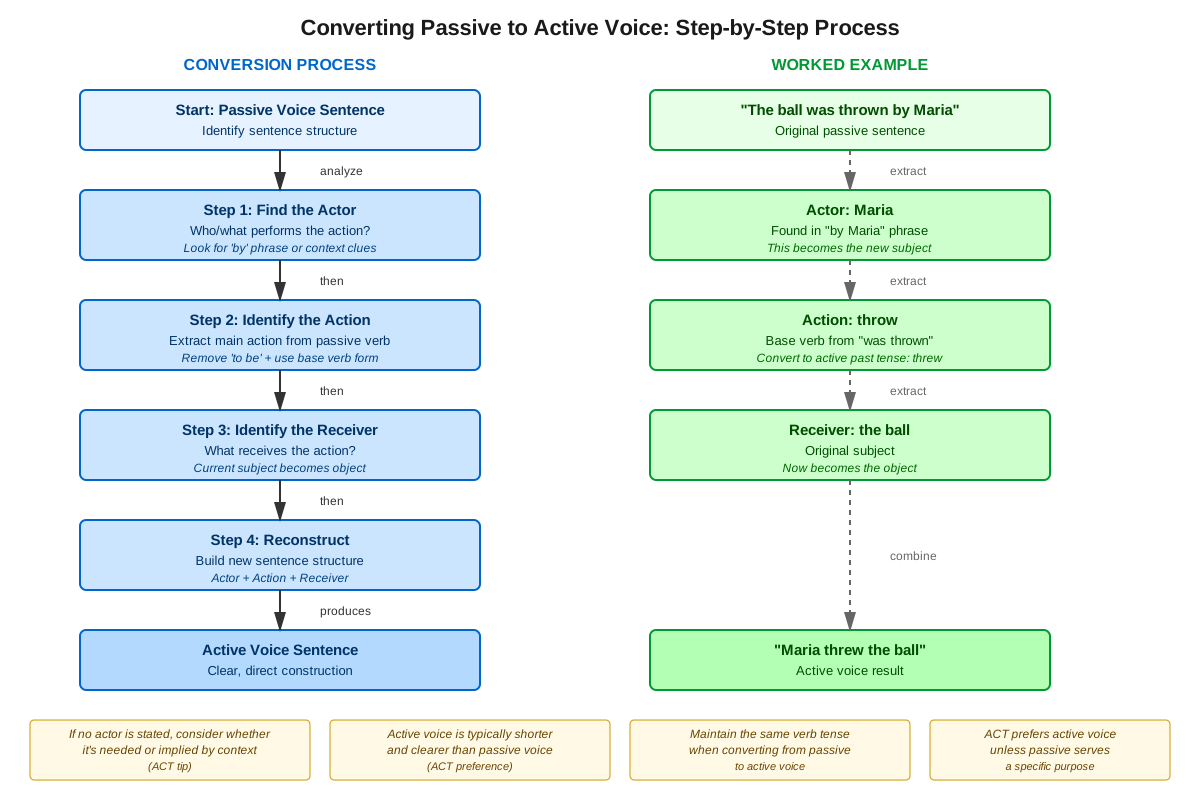
Converting passive voice to active voice requires identifying three elements: the action (verb), the recipient (grammatical subject in passive), and the agent (often in a "by" phrase or implied). The conversion process follows these steps:
- Identify the agent (who performs the action)
- Make the agent the grammatical subject
- Convert the "to be" + past participle to a simple verb form
- Make the former subject the direct object
Example conversion:
- Passive: "The championship was won by our team."
- Identify agent: our team
- Active: "Our team won the championship."
When the agent is missing in passive voice ("The championship was won"), students must determine whether the agent can be reasonably inferred or whether passive voice is appropriate because the agent is unknown or unimportant.
Recognizing Voice in Complex Sentences
Active and passive voice can appear in complex sentences with multiple clauses. Each clause has its own voice, and the ACT may test whether voices are appropriately matched or whether one clause should be revised. Consider: "After the data were collected by researchers, they analyzed the results." This sentence mixes passive voice (first clause) with active voice (second clause), creating an awkward shift. A better revision uses consistent active voice: "After researchers collected the data, they analyzed the results."
Students should analyze each clause independently to determine its voice, then evaluate whether the combination creates clarity or confusion. Parallel structure often requires consistent voice across related clauses or items in a series.
Concept Relationships
Active voice connects directly to several core English concepts tested on the ACT. The relationship between active voice and conciseness is fundamental: active voice typically reduces word count by eliminating unnecessary "to be" verbs and prepositional phrases. This connection means that questions testing conciseness often involve converting passive to active voice.
Active voice → enables → parallel structure when sentences or clauses list multiple actions. If one item uses active voice, parallel structure requires others to match. For example: "The committee reviewed applications, conducted interviews, and selected finalists" maintains parallel active voice structure.
Subject-verb agreement → supports → active voice identification because recognizing the true subject (the agent) helps students determine whether a sentence uses active or passive voice. When the grammatical subject doesn't perform the action, passive voice is likely present.
Active voice → influences → sentence clarity and emphasis by determining which sentence element receives focus. Active voice emphasizes the agent, while passive voice emphasizes the recipient. This relationship means voice choice affects meaning and tone.
The concept map flows: Subject-verb agreement → Active voice identification → Conciseness evaluation → Parallel structure check → Final answer selection. Understanding this progression helps students systematically approach voice-related questions.
Quick check — test yourself on Active voice so far.
Try Flashcards →High-Yield Facts
⭐ Active voice occurs when the grammatical subject performs the action expressed by the verb
⭐ Passive voice always includes a form of "to be" plus a past participle (was written, were discovered, has been completed)
⭐ The ACT prefers active voice when it makes sentences clearer, more direct, and more concise
⭐ Active voice typically uses fewer words than passive voice for the same meaning
⭐ Passive voice is acceptable when the actor is unknown, unimportant, or should be de-emphasized
- Converting passive to active voice requires identifying the agent and making it the grammatical subject
- Questions testing voice often appear as Strategy questions asking for the most effective or concise option
- Parallel structure may require consistent voice across multiple clauses or list items
- Passive voice without an identified agent ("Mistakes were made") often signals weak or evasive writing
- Scientific writing sometimes appropriately uses passive voice to maintain objective tone
- Active voice creates more engaging, dynamic prose that readers process more quickly
- The ACT may present a correct passive voice construction as a trap answer when testing other concepts
Common Misconceptions
Misconception: All passive voice is grammatically incorrect and should always be eliminated. → Correction: Passive voice is grammatically correct and sometimes preferable when the actor is unknown or when emphasis should be on the action's recipient. The ACT tests appropriate voice choice, not absolute rules.
Misconception: Any sentence containing "was" or "were" uses passive voice. → Correction: Forms of "to be" serve multiple functions. Passive voice specifically requires "to be" + past participle. "She was happy" uses "was" as a linking verb, not passive voice. "She was chosen" uses passive voice.
Misconception: Active voice always means the sentence is in present tense. → Correction: Active voice refers to the subject-action relationship, not verb tense. "The scientist conducted the experiment" (past tense, active voice) and "The scientist conducts experiments" (present tense, active voice) both use active voice.
Misconception: Longer sentences always use passive voice. → Correction: Sentence length doesn't determine voice. A long sentence can use active voice with multiple clauses, while a short sentence might use passive voice. Voice depends on the subject-action relationship, not word count.
Misconception: Converting to active voice always requires adding new information. → Correction: If the agent appears in a "by" phrase or can be inferred from context, no new information is needed. "The book was written by Morrison" converts to "Morrison wrote the book" using existing information.
Misconception: Passive voice sounds more formal and sophisticated, so it's better for academic writing. → Correction: While passive voice has appropriate uses in academic contexts, active voice generally creates clearer, more authoritative academic writing. Overusing passive voice makes writing vague and wordy, not sophisticated.
Worked Examples
Example 1: Identifying and Converting Passive Voice
Original Passage: "The discovery of penicillin was made by Alexander Fleming in 1928. This breakthrough was considered by scientists to be one of the most important medical advances of the twentieth century."
Question: Which of the following alternatives to the underlined portion would be MOST effective?
A. NO CHANGE
B. Alexander Fleming made the discovery of penicillin
C. Alexander Fleming discovered penicillin
D. The discovery of penicillin had been made by Alexander Fleming
Analysis:
Step 1: Identify the voice in the original. "Was made by Alexander Fleming" uses passive voice (was + past participle "made" + by + agent).
Step 2: Evaluate whether passive voice serves a purpose here. The agent (Fleming) is known and important, and the sentence would be clearer and more concise in active voice.
Step 3: Examine each option:
- Option A keeps the wordy passive construction (8 words for the underlined portion)
- Option B converts to active voice but retains the wordy noun phrase "made the discovery of" (7 words)
- Option C uses active voice with the most direct verb "discovered" (4 words: "Alexander Fleming discovered penicillin")
- Option D uses past perfect passive voice, making the sentence even more complex
Step 4: Apply the ACT's preference for conciseness and clarity. Option C eliminates unnecessary words while maintaining meaning and using active voice.
Answer: C. This choice demonstrates the core principle that active voice with direct verbs creates the clearest, most concise sentences.
Example 2: Recognizing Appropriate Passive Voice
Original Passage: "The ancient city was abandoned sometime during the third century. When archaeologists excavated the site, numerous artifacts were discovered that provided insights into daily life."
Question: Which choice most effectively maintains the sentence pattern already established in the passage?
F. NO CHANGE
G. archaeologists discovered numerous artifacts
H. numerous artifacts had been discovered by archaeologists
J. the discovery of numerous artifacts was made
Analysis:
Step 1: Analyze the context. The first sentence uses passive voice ("was abandoned") appropriately because who abandoned the city is unknown or unimportant.
Step 2: Examine the second sentence structure. It has two clauses: an active voice clause ("archaeologists excavated") and a passive voice clause ("artifacts were discovered").
Step 3: Consider the question's focus on "sentence pattern." The passage emphasizes what was found (artifacts) rather than who found them, maintaining focus on the city and its contents.
Step 4: Evaluate options:
- Option F maintains passive voice in the second clause, keeping emphasis on the artifacts
- Option G switches to active voice, shifting emphasis to the archaeologists
- Option H uses past perfect passive, creating unnecessary complexity
- Option J creates a wordy noun phrase construction
Step 5: Recognize that this question tests appropriate passive voice use. The passive construction keeps focus on the artifacts and maintains consistency with the passage's emphasis on the city rather than the researchers.
Answer: F. This example illustrates that passive voice is sometimes the correct choice when it maintains appropriate emphasis and consistency with the passage's focus.
Exam Strategy
When approaching ACT active voice questions, follow this systematic process:
Step 1: Identify voice-testing triggers. Watch for questions asking about "effectiveness," "clarity," "conciseness," or "best accomplishes the writer's goal." These often test voice. Also watch for underlined portions containing "was/were/been + past participle" or "by" phrases indicating agents.
Step 2: Determine the current voice. Ask: "Does the grammatical subject perform the action?" If yes, it's active voice. If no, it's passive voice. Look for the "to be" + past participle pattern.
Step 3: Evaluate whether voice change is needed. Consider:
- Is the agent known and important?
- Would active voice reduce wordiness?
- Does passive voice serve a clear purpose (unknown agent, appropriate emphasis)?
- Does voice match parallel structures in surrounding sentences?
Step 4: Apply the ACT's preference hierarchy:
- Active voice when it's clearer and more concise
- Passive voice when the agent is unknown or emphasis should be on the recipient
- Consistency with established sentence patterns in the passage
Step 5: Eliminate wrong answers systematically:
- Eliminate options that increase wordiness without benefit
- Eliminate options that change the sentence's meaning
- Eliminate options that create grammatical errors
- Choose the most direct, clear option among remaining choices
Exam Tip: If two answer choices both use active voice, the question probably isn't primarily testing voice—look for other differences like verb tense, parallel structure, or modifier placement.
Time allocation: Voice questions should take 20-30 seconds once you recognize the pattern. Spend 5 seconds identifying the voice, 10 seconds evaluating whether change is needed, and 10 seconds selecting the best option. Don't overthink—the ACT's preference for active voice is strong and consistent.
Common trap answers: Watch for options that convert to active voice but introduce new errors (verb tense shifts, subject-verb disagreement) or that use active voice but create awkward phrasing. The correct answer improves the sentence without creating new problems.
Memory Techniques
ACTIVE Acronym for when to use active voice:
- Agent is known
- Clarity is improved
- Terse (concise) writing preferred
- Important who performs action
- Verbose passive should be eliminated
- Emphasis on the doer
Passive Voice Identifier: Remember "BE + PAST = PASSIVE" (to BE verb + PAST participle = PASSIVE voice). If you see this combination, you've found passive voice.
The "By" Test: If you can add "by zombies" after the verb and the sentence still makes grammatical sense, it's passive voice. "The experiment was conducted (by zombies)" works grammatically, confirming passive voice. "The scientist conducted (by zombies)" doesn't work, confirming active voice.
Visualization Strategy: Picture active voice as a straight arrow from subject to object: Subject → Action → Object. Picture passive voice as a curved arrow that loops back: Object ← Action ← (by) Subject. The straight arrow (active) is more direct and efficient.
The Three-Question Method:
- Who/what does the action? (Find the agent)
- Is that agent the grammatical subject? (If yes → active; if no → passive)
- Should it be? (Apply ACT preferences)
Summary
Active voice, where the grammatical subject performs the action, is strongly preferred on the ACT English section because it creates clear, concise, and direct sentences. The test consistently rewards active voice constructions that eliminate wordiness and ambiguity, typically appearing in 2-4 questions per test. Students must recognize passive voice patterns (to be + past participle), understand when conversion to active voice improves sentences, and identify the less common situations where passive voice is appropriate—when the agent is unknown, unimportant, or should be de-emphasized. Mastering active voice requires systematic analysis: identify the current voice, evaluate whether the agent is known and important, apply the ACT's preference for directness and conciseness, and select the option that best balances clarity with appropriate emphasis. Success on voice questions directly impacts overall English scores because these questions test fundamental principles of effective writing that appear throughout the test.
Key Takeaways
- Active voice (subject performs action) is preferred on the ACT when it creates clearer, more concise sentences
- Passive voice always uses "to be" + past participle and can be identified by this grammatical pattern
- Convert passive to active voice by making the agent the grammatical subject and using a direct verb form
- Passive voice is acceptable when the agent is unknown, unimportant, or when emphasis should be on the action's recipient
- Voice questions often appear as Strategy questions asking for the most effective or concise option
- Active voice typically reduces word count and improves clarity compared to passive voice
- Systematic analysis (identify voice → evaluate purpose → apply ACT preferences) leads to correct answers efficiently
Related Topics
Conciseness and Wordiness: Active voice directly connects to eliminating redundancy and unnecessary words. Mastering active voice provides a foundation for recognizing other wordiness issues like redundant phrases and verbose constructions.
Parallel Structure: Consistent voice across parallel elements (lists, paired clauses) is essential for grammatical correctness. Understanding active voice enables recognition of parallelism errors involving voice shifts.
Subject-Verb Agreement: Identifying the true subject (the agent in active voice) strengthens subject-verb agreement skills, particularly in complex sentences with intervening phrases.
Verb Tenses and Forms: Active voice mastery requires understanding verb conjugations and recognizing how tenses function in both active and passive constructions, building toward more advanced verb usage questions.
Sentence Structure and Clarity: Active voice is one component of effective sentence construction. This foundation supports learning about modification, subordination, and sentence variety.
Practice CTA
Now that you understand the principles of active voice and how the ACT tests this concept, you're ready to apply these skills to practice questions. Work through the practice problems to reinforce your ability to identify passive voice, evaluate when conversion is appropriate, and select the most effective answer choices. Each practice question you complete strengthens your pattern recognition and builds the speed you need for test day. Remember: active voice questions are high-yield opportunities to earn points quickly once you master the systematic approach outlined in this guide. Your investment in practice now will pay dividends in your ACT English score!
Sign up free to keep reading
Create a free AnvayaPrep account to finish this ACT guide on Active voice — plus flashcards and practice questions.