Overview
Irregular verbs represent one of the most frequently tested grammar concepts on the ACT English section. Unlike regular verbs that follow predictable patterns when forming past tense and past participle forms (walk/walked/walked), irregular verbs change in unpredictable ways (swim/swam/swum). The ACT tests whether students can identify and correctly use these verb forms in context, particularly focusing on the distinction between simple past tense and past participle forms used with helping verbs.
Mastering irregular verbs is essential for ACT success because verb errors appear in approximately 15-20% of all English section questions. The test writers deliberately include sentences where the wrong form of an irregular verb sounds plausible to the ear, making this a high-yield area where careful study translates directly into points. Students who can quickly recognize ACT irregular verbs patterns and apply the correct forms gain a significant advantage, as these questions typically appear 3-5 times per test.
Understanding irregular verbs connects to broader grammar concepts including verb tense consistency, subject-verb agreement, and the proper use of helping verbs. This topic serves as a foundation for recognizing more complex verb structures and maintaining parallel construction in sentences. Strong command of irregular verb forms also supports reading comprehension, as students who automatically recognize correct verb usage can focus cognitive resources on understanding passage content rather than parsing grammatical structures.
Learning Objectives
- [ ] Identify when Irregular verbs is being tested in ACT English passages
- [ ] Explain the core rule or strategy behind Irregular verbs usage
- [ ] Apply Irregular verbs to ACT-style questions accurately
- [ ] Distinguish between simple past and past participle forms of common irregular verbs
- [ ] Recognize when helping verbs require past participle forms rather than simple past
- [ ] Evaluate answer choices by testing verb forms with appropriate helping verbs
- [ ] Correct irregular verb errors in context while maintaining sentence meaning
Prerequisites
- Regular verb conjugation patterns: Understanding how regular verbs form past tense with -ed endings provides the contrast needed to recognize irregular patterns
- Helping verbs (auxiliary verbs): Knowledge of has, have, had, is, are, was, were, been, and other auxiliaries is essential because they signal when past participle forms are required
- Basic verb tense concepts: Familiarity with present, past, and perfect tenses helps students understand when different irregular verb forms apply
- Subject-verb agreement fundamentals: Recognizing subjects and matching verbs appropriately ensures students can focus on form rather than agreement issues
Why This Topic Matters
Irregular verbs matter beyond standardized testing because they represent some of the most commonly used words in English. Verbs like "go," "do," "have," "see," "come," and "take" appear constantly in academic writing, professional communication, and everyday speech. Mastering these forms demonstrates language proficiency and prevents errors that can undermine credibility in college essays, scholarship applications, and workplace documents.
On the ACT specifically, irregular verb questions appear with remarkable consistency. Test analysis reveals that 3-5 questions per English section directly test irregular verb knowledge, with additional questions incorporating irregular verbs within broader grammar concepts. These questions typically appear as underlined portions where students must choose between different verb forms, making them highly predictable in format. The ACT favors testing approximately 30-40 high-frequency irregular verbs repeatedly, meaning focused study of these specific verbs yields disproportionate returns.
Common ACT presentation formats include sentences where the simple past form is incorrectly used where a past participle is needed (or vice versa), sentences mixing verb tenses inappropriately, and sentences where the verb form doesn't match the time frame established by context clues. The test also frequently includes distractors that sound correct in casual speech but are grammatically incorrect in formal writing, testing whether students rely on ear or knowledge of standard written English conventions.
Core Concepts
The Three Principal Parts of Irregular Verbs
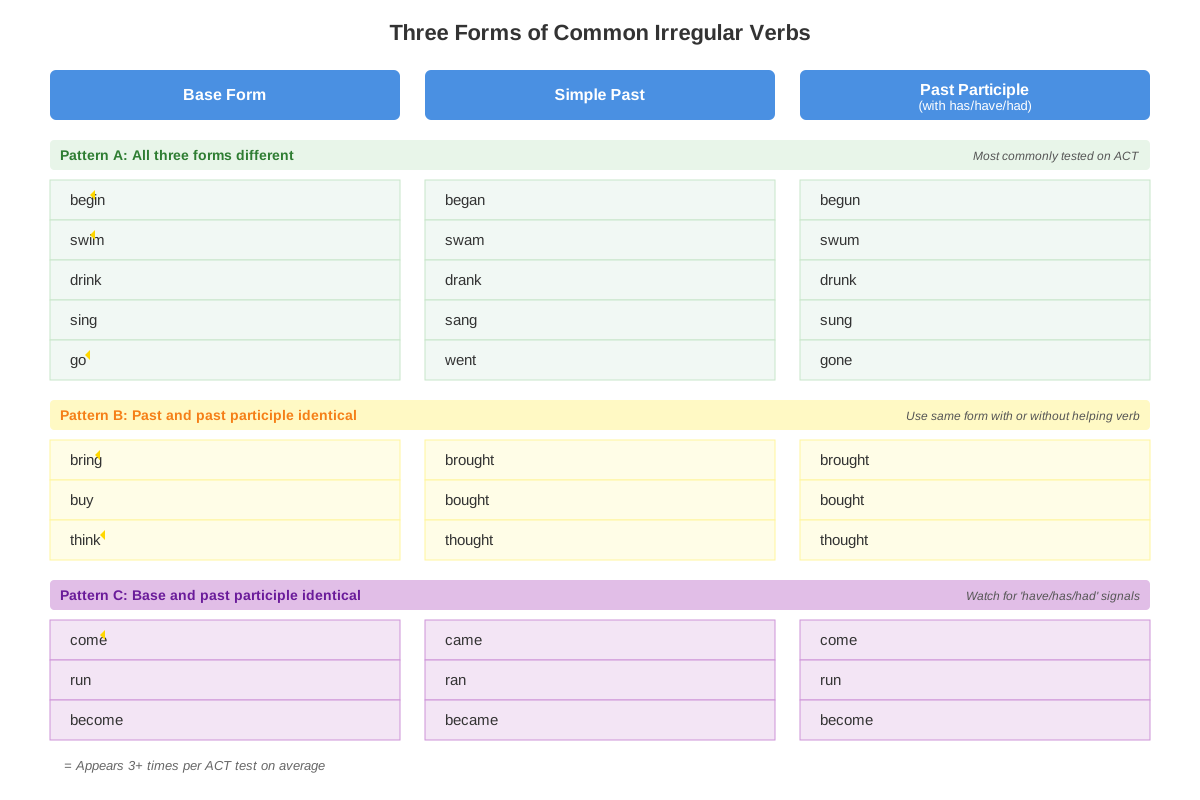
Every verb in English has three principal parts: the base form (present tense), the simple past form, and the past participle form. Regular verbs form both past tense and past participle by adding -ed to the base (talk/talked/talked). Irregular verbs, however, change in unpredictable ways that must be memorized.
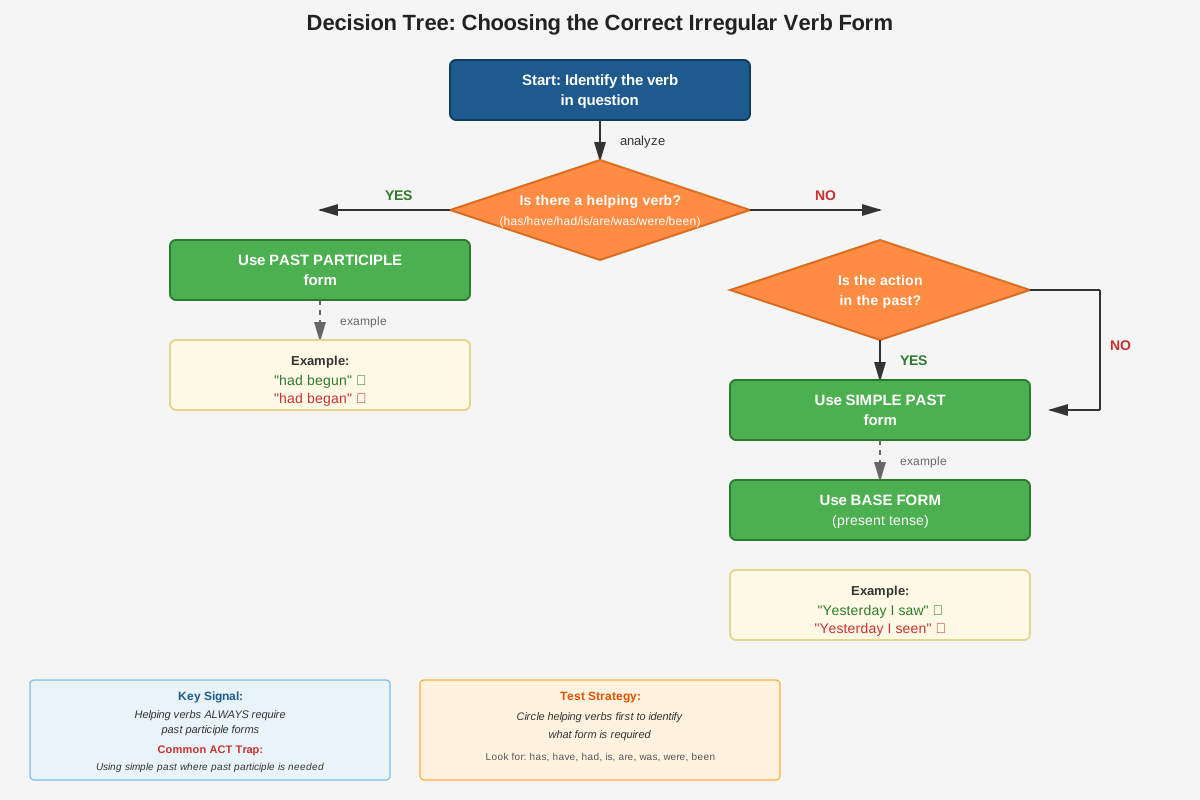
The base form appears with present tense subjects and after modal verbs (can, will, should, etc.). The simple past form stands alone to describe completed past actions. The past participle appears after helping verbs like has, have, had, is, are, was, were, been, and in passive voice constructions.
| Base Form | Simple Past | Past Participle | Example with Past Participle |
|---|---|---|---|
| begin | began | begun | The concert has begun. |
| drink | drank | drunk | She had drunk the water. |
| ring | rang | rung | The bell has rung. |
| sing | sang | sung | They have sung that song. |
| swim | swam | swum | He has swum across the lake. |
Identifying When Past Participle Forms Are Required
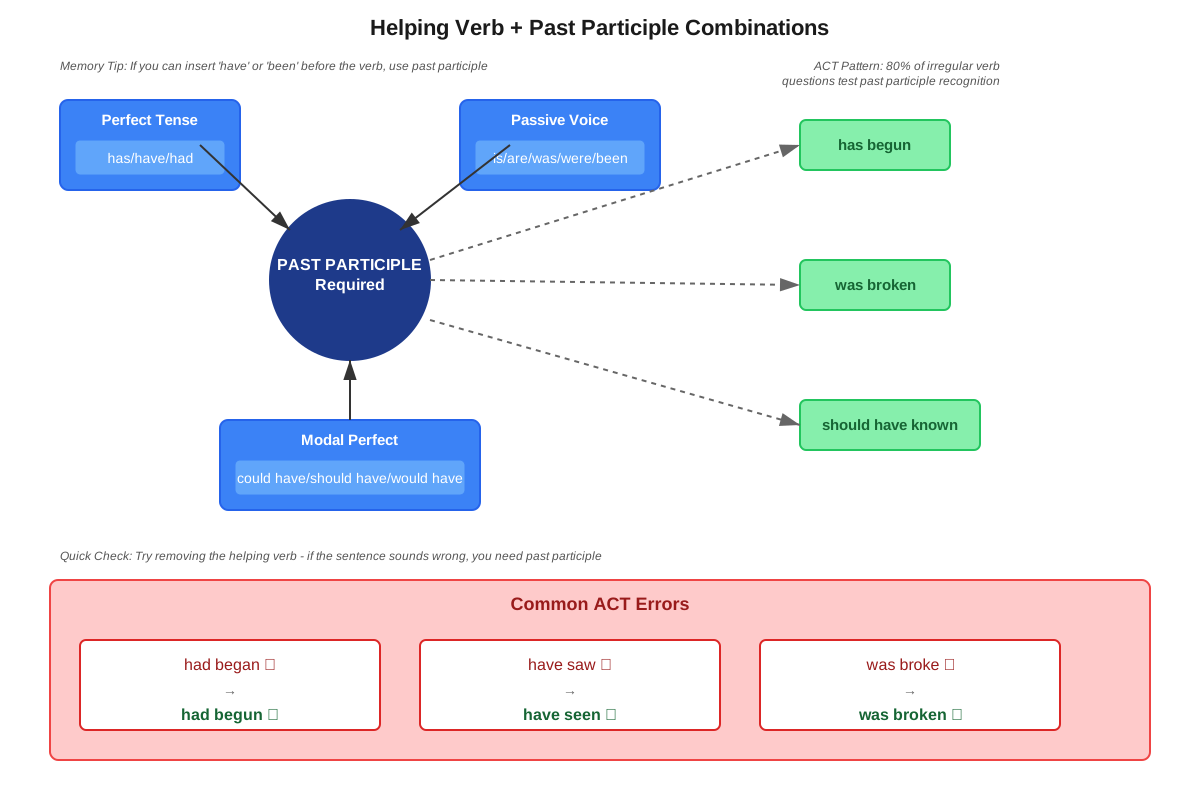
The most frequently tested irregular verb concept on the ACT involves recognizing when a past participle is needed rather than simple past. Past participles always appear with helping verbs, never standing alone. The key helping verbs that signal past participle usage are:
- Perfect tense helpers: has, have, had
- Passive voice helpers: is, are, was, were, am, be, been, being
- Modal perfects: could have, should have, would have, might have, must have
When students see these helping verbs in a sentence, the verb form that follows must be a past participle, not simple past. For example:
- Incorrect: "She has went to the store." (went is simple past)
- Correct: "She has gone to the store." (gone is past participle)
Common Irregular Verb Patterns
While irregular verbs don't follow a single rule, many fall into recognizable patterns that aid memorization:
Pattern 1: All three forms identical
- cost/cost/cost, cut/cut/cut, put/put/put, set/set/set, shut/shut/shut
Pattern 2: Simple past and past participle identical
- bring/brought/brought, buy/bought/bought, catch/caught/caught, teach/taught/taught, think/thought/thought
Pattern 3: Vowel progression (i → a → u)
- begin/began/begun, drink/drank/drunk, ring/rang/rung, shrink/shrank/shrunk, sing/sang/sung, sink/sank/sunk, spring/sprang/sprung, swim/swam/swum
Pattern 4: Base and past participle identical
- become/became/become, come/came/come, run/ran/run
Pattern 5: -en or -n ending on past participle
- break/broke/broken, choose/chose/chosen, freeze/froze/frozen, speak/spoke/spoken, steal/stole/stolen, write/wrote/written, drive/drove/driven, ride/rode/ridden, rise/rose/risen
High-Frequency ACT Irregular Verbs
The ACT repeatedly tests a core group of irregular verbs. These 30 verbs account for the vast majority of irregular verb questions:
Tier 1 (Most Frequently Tested):
- be/was, were/been
- do/did/done
- go/went/gone
- see/saw/seen
- come/came/come
- take/took/taken
- give/gave/given
- know/knew/known
- get/got/gotten (or got)
- make/made/made
Tier 2 (Regularly Tested):
- begin/began/begun
- break/broke/broken
- bring/brought/brought
- choose/chose/chosen
- drink/drank/drunk
- drive/drove/driven
- eat/ate/eaten
- fall/fell/fallen
- fly/flew/flown
- forget/forgot/forgotten
- grow/grew/grown
- ride/rode/ridden
- ring/rang/rung
- run/ran/run
- sing/sang/sung
- speak/spoke/spoken
- swim/swam/swum
- take/took/taken
- throw/threw/thrown
- write/wrote/written
The "Have/Has/Had" Test
A reliable strategy for determining correct irregular verb forms involves the "have test." When uncertain whether a verb form is correct, insert "have" before it. If the combination sounds correct, the form is a past participle. If it sounds wrong, the form is likely simple past.
- "have went" sounds wrong → went is simple past, not past participle
- "have gone" sounds right → gone is past participle
- "have saw" sounds wrong → saw is simple past
- "have seen" sounds right → seen is past participle
This test works because "have" is a helping verb that requires past participle forms. Students can use this mental check even when "have" doesn't appear in the actual sentence.
Lie/Lay and Sit/Set Confusion
Two irregular verb pairs cause particular confusion and appear frequently on the ACT:
Lie (to recline) vs. Lay (to place something)
- lie/lay/lain (intransitive—no direct object)
- lay/laid/laid (transitive—requires direct object)
Example: "I will lie down" (no object) vs. "I will lay the book down" (book is object)
Sit (to be seated) vs. Set (to place something)
- sit/sat/sat (intransitive—no direct object)
- set/set/set (transitive—requires direct object)
Example: "Please sit here" (no object) vs. "Please set the cup here" (cup is object)
The ACT tests whether students can distinguish these based on whether a direct object follows the verb.
Concept Relationships
Irregular verb mastery connects directly to several other grammar concepts tested on the ACT. Understanding these relationships helps students recognize how irregular verbs function within larger grammatical structures.
Irregular Verbs → Verb Tense Consistency: Once students identify the correct form of an irregular verb, they must ensure it maintains consistent tense with other verbs in the sentence or passage. A sentence beginning in past tense should continue in past tense unless a clear time shift occurs.
Helping Verbs → Irregular Verbs → Perfect Tenses: The relationship flows from recognizing helping verbs (has, have, had) to selecting past participle forms to correctly constructing perfect tenses (present perfect, past perfect, future perfect).
Subject-Verb Agreement → Irregular Verbs: While irregular verb form selection is distinct from agreement, the verb "to be" (was/were) requires both correct irregular form AND agreement with subject number. Singular subjects take "was," plural subjects take "were."
Irregular Verbs → Passive Voice: Past participles combine with forms of "be" to create passive constructions ("The ball was thrown," "The song has been sung"). Recognizing passive voice helps students identify when past participles are needed.
Active vs. Passive Voice → Transitive/Intransitive Verbs → Lie/Lay and Sit/Set: Understanding whether verbs take objects (transitive) or not (intransitive) is essential for the lie/lay and sit/set distinctions, which then connects to choosing correct irregular forms.
High-Yield Facts
⭐ Past participles always appear with helping verbs; simple past forms stand alone.
⭐ The most commonly tested helping verbs are has, have, had, and forms of "be" (is, are, was, were, been).
⭐ The verbs go/went/gone and see/saw/seen are among the most frequently tested irregular verbs on the ACT.
⭐ "Have went" and "have saw" are always incorrect; the correct forms are "have gone" and "have seen."
⭐ Lie/lay confusion: "lie" (recline) is intransitive; "lay" (place) is transitive and requires an object.
- The vowel pattern i → a → u appears in multiple irregular verbs (swim/swam/swum, begin/began/begun, ring/rang/rung).
- Many irregular verbs add -en or -n to form past participles (broken, chosen, driven, written, taken).
- Some irregular verbs have identical forms for all three principal parts (cut, put, set, shut, cost).
- The simple past of "lie" (to recline) is "lay," which creates confusion with "lay" (to place).
- "Got" and "gotten" are both acceptable past participles of "get" in American English, though "gotten" is more common.
- Modal verbs (could, should, would, might, must) followed by "have" require past participle forms.
- The verb "to be" is the most irregular verb in English with forms: am, is, are, was, were, been, being.
- "Drank" is simple past (I drank); "drunk" is past participle (I have drunk) and also functions as an adjective.
- When "being" appears as a helping verb, it requires a past participle (is being driven, was being written).
Quick check — test yourself on Irregular verbs so far.
Try Flashcards →Common Misconceptions
Misconception: Simple past and past participle forms are interchangeable.
Correction: These forms serve different grammatical functions. Simple past stands alone for completed actions (I went yesterday), while past participles require helping verbs (I have gone many times). Using simple past after helping verbs is incorrect.
Misconception: If a verb form sounds correct in casual speech, it's correct on the ACT.
Correction: The ACT tests formal written English, which differs from conversational usage. Many people say "I seen" or "he done" in casual speech, but standard written English requires "I saw/have seen" and "he did/has done."
Misconception: "Lay" and "lie" are interchangeable ways to say "recline."
Correction: "Lie" means to recline and is intransitive (no object). "Lay" means to place something and is transitive (requires object). "I'm going to lie down" is correct; "I'm going to lay down" is incorrect unless you're placing something down.
Misconception: Adding "have" to any past tense verb creates a correct sentence.
Correction: "Have" requires the past participle form specifically, not simple past. "I have went" is incorrect because "went" is simple past; "I have gone" is correct because "gone" is the past participle.
Misconception: All verbs ending in -ought or -aught follow the same pattern.
Correction: While many do (bring/brought, catch/caught, teach/taught), not all verbs with similar sounds follow this pattern. Each irregular verb must be learned individually.
Misconception: "Gotten" is incorrect or informal English.
Correction: "Gotten" is the standard American English past participle of "get." Both "have got" and "have gotten" are correct, though they can carry slightly different meanings ("have got" often implies possession; "have gotten" implies acquisition).
Misconception: The past participle always ends in -en or -n.
Correction: While many irregular verbs form past participles this way (broken, written, driven), many others do not (brought, caught, made, had). The -en/-n pattern is common but not universal.
Misconception: "Was" and "were" can be used interchangeably in past tense.
Correction: "Was" is used with singular subjects (I, he, she, it); "were" is used with plural subjects (we, you, they) and in subjunctive mood constructions. This combines irregular verb knowledge with subject-verb agreement.
Worked Examples
Example 1: Identifying Past Participle vs. Simple Past
ACT-Style Question:
"By the time the rescue team arrived, the hikers had already began/begun their descent down the mountain."
Step 1: Identify the helping verb
The sentence contains "had," which is a helping verb that signals perfect tense construction.
Step 2: Determine which form is needed
Helping verbs require past participle forms, not simple past forms. We need the past participle of "begin."
Step 3: Recall the three principal parts
- Base form: begin
- Simple past: began
- Past participle: begun
Step 4: Apply the "have test"
- "have began" sounds incorrect
- "have begun" sounds correct
Step 5: Select the correct answer
"Begun" is the past participle, which is required after "had." The correct sentence is: "By the time the rescue team arrived, the hikers had already begun their descent down the mountain."
Connection to Learning Objectives: This example demonstrates identifying when irregular verbs are tested (helping verb "had" signals the test), explaining the core rule (helping verbs require past participles), and applying the concept to select the correct answer.
Example 2: Lie/Lay Distinction
ACT-Style Question:
"After the long hike, Sarah decided to lay/lie down on the grass and rest for a few minutes."
Step 1: Determine if there's a direct object
Look at what follows the verb. "Down on the grass" is a prepositional phrase, not a direct object. There's nothing being placed.
Step 2: Choose between transitive and intransitive
Since there's no direct object, we need the intransitive verb "lie" (to recline), not the transitive verb "lay" (to place something).
Step 3: Verify with substitution
Try substituting "recline": "Sarah decided to recline down on the grass" makes sense.
Try substituting "place": "Sarah decided to place down on the grass" doesn't make sense without an object.
Step 4: Select the correct form
The correct answer is "lie": "After the long hike, Sarah decided to lie down on the grass and rest for a few minutes."
Additional consideration: If the sentence were "Sarah decided to lay her backpack down on the grass," then "lay" would be correct because "backpack" is the direct object being placed.
Connection to Learning Objectives: This example shows how to identify a specific type of irregular verb test (lie/lay confusion), apply the core strategy (checking for direct objects), and select the correct answer based on grammatical function.
Exam Strategy
Approaching Irregular Verb Questions
When encountering an underlined verb on the ACT English section, follow this systematic approach:
- Check for helping verbs immediately before the underlined portion: If you see has, have, had, is, are, was, were, been, or modal + have, you need a past participle, not simple past.
- Use the "have test": Mentally insert "have" before each answer choice. The one that sounds natural is likely the past participle. This works even when "have" isn't in the actual sentence.
- Look for time markers: Words like "yesterday," "last week," "already," "never," "ever," and "since" provide context clues about which tense and form are appropriate.
- Eliminate obviously wrong answers first: If an answer choice uses a verb form that doesn't exist (like "goed" or "bringed"), eliminate it immediately. Then focus on distinguishing between legitimate forms.
Trigger Words and Phrases
Watch for these signals that irregular verbs are being tested:
- Perfect tense indicators: "has/have/had" + verb, "never before," "already," "yet," "since," "for [time period]"
- Passive voice markers: "is/are/was/were" + verb, "by [agent]"
- Lie/lay context: "recline," "rest," "down," "place," "put," followed by object or no object
- Time sequence words: "after," "before," "by the time," "when," which often require perfect tenses
Process of Elimination Tips
- If you see a helping verb, immediately eliminate any simple past forms: In a question with "has went/gone/go," eliminate "went" (simple past) and "go" (present) immediately, leaving "gone" as correct.
- Trust grammar over sound: If an answer "sounds right" but violates the helping verb + past participle rule, it's wrong. The ACT deliberately includes answers that match casual speech patterns.
- Check all answer choices for verb form changes: Sometimes the difference between choices isn't just the verb form but also includes adding or removing helping verbs. Evaluate the complete verb phrase, not just the main verb.
- When stuck between two forms, check if both are real: Sometimes one answer choice uses a non-existent form. "Brang" isn't a word; "brought" is the only correct past form of "bring."
Time Allocation
Irregular verb questions should take 15-20 seconds each once you've mastered the patterns. They're among the faster grammar questions because they follow predictable rules. If you find yourself spending more than 30 seconds on an irregular verb question, make your best guess and move on—these questions don't require complex analysis, just pattern recognition and rule application.
Memory Techniques
The "I-A-U" Vowel Song
For verbs following the i → a → u pattern, create a rhythmic chant:
"I begin, A began, have beGUN"
"I drink, A drank, have DRUNK"
"I sing, A sang, have SUNG"
"I swim, A swam, have SWUM"
The rhythm helps cement the pattern, and grouping these verbs together reinforces that they follow the same structure.
The "Have Test" Mantra
Memorize: "When in doubt, add 'have' out." This reminds you to mentally test verb forms by adding "have" before them. If "have [verb]" sounds wrong, you're looking at simple past, not past participle.
Lie/Lay Hand Trick
Hold up your hand:
- Lie (intransitive): Make a fist—closed, complete, needs nothing else
- Lay (transitive): Open hand reaching—needs something to grab (an object)
This physical reminder helps distinguish between the intransitive verb (lie) that needs no object and the transitive verb (lay) that requires one.
The "EN-ding" Visualization
Picture a pen writing the letters "EN" at the end of words. Many past participles end in -en or -n: broken, chosen, driven, fallen, given, taken, written. Visualizing this pen helps recall that past participles often (though not always) have this ending.
Top 10 Troublemakers Acronym: "GSD-BCTL-WRS"
Memorize the most commonly tested irregular verbs with this acronym:
- Go (went/gone)
- See (saw/seen)
- Do (did/done)
- Begin (began/begun)
- Come (came/come)
- Take (took/taken)
- Lie (lay/lain)
- Write (wrote/written)
- Ring (rang/rung)
- Swim (swam/swum)
Focus extra attention on these verbs, as they appear most frequently on the ACT.
The "Three Columns" Mental Chart
Visualize a three-column chart in your mind:
TODAY | YESTERDAY | HAVE/HAS
swim  | swam      | swum
begin | began     | begun
drink | drank     | drunk
When you encounter an irregular verb, mentally place it in this chart to determine which form you need based on context.
Summary
Irregular verbs represent a high-yield, predictable area of ACT English testing that rewards focused study. The core principle is straightforward: irregular verbs have three principal parts (base, simple past, past participle) that change unpredictably and must be memorized. The most critical distinction for ACT success is recognizing when past participle forms are required—specifically, after helping verbs like has, have, had, and forms of "be." Simple past forms stand alone; past participles never do. The ACT repeatedly tests approximately 30-40 high-frequency irregular verbs, with go/went/gone, see/saw/seen, and begin/began/begun appearing most often. Students who master the "have test" (mentally inserting "have" before verb forms to identify past participles), recognize helping verbs as triggers for past participles, and memorize the principal parts of common irregular verbs can confidently answer these questions in 15-20 seconds each. Special attention to lie/lay and sit/set distinctions, which test whether verbs take direct objects, completes the essential knowledge base for this topic.
Key Takeaways
- Helping verbs (has, have, had, is, are, was, were, been) always require past participle forms, never simple past
- The "have test" reliably identifies past participles: if "have [verb]" sounds correct, you have the past participle form
- Go/went/gone and see/saw/seen are the most frequently tested irregular verbs on the ACT
- Lie (recline) is intransitive and takes no object; lay (place) is transitive and requires an object
- Many irregular verbs follow the i → a → u vowel pattern (swim/swam/swum) or add -en/-n for past participles (broken, written)
- Trust grammar rules over what "sounds right"—the ACT tests formal written English, not conversational usage
- Approximately 30-40 irregular verbs account for nearly all ACT irregular verb questions, making targeted memorization highly efficient
Related Topics
Verb Tense Consistency: Once irregular verb forms are mastered, the next step is ensuring all verbs in a sentence or passage maintain appropriate tense relationships. This builds on irregular verb knowledge by adding the dimension of time sequence and logical tense progression.
Subject-Verb Agreement: While distinct from irregular verb form selection, agreement becomes more complex with irregular verbs, particularly "to be" (was/were). Mastering irregular verbs provides the foundation for handling agreement with these challenging verbs.
Active and Passive Voice: Past participles combine with forms of "be" to create passive constructions. Understanding irregular verb forms is prerequisite to recognizing and correctly using passive voice, which the ACT tests for appropriateness and clarity.
Parallel Structure: When sentences contain lists or comparisons involving verbs, all verbs must maintain parallel form. Irregular verb mastery ensures students can maintain parallelism even with verbs that change unpredictably.
Verb Mood (Subjunctive): Advanced verb usage includes subjunctive mood, which uses specific verb forms (often irregular) to express wishes, hypotheticals, or demands. This builds on foundational irregular verb knowledge.
Practice CTA
Now that you've mastered the core concepts of irregular verbs, it's time to cement your knowledge through active practice. Complete the practice questions to test your ability to identify irregular verb errors, distinguish between simple past and past participle forms, and apply the strategies you've learned to ACT-style questions. Use the flashcards to drill the principal parts of high-frequency irregular verbs until recall becomes automatic. Remember: irregular verb questions are among the most predictable on the ACT—consistent practice with these 30-40 commonly tested verbs translates directly into points on test day. You've got this!
Sign up free to keep reading
Create a free AnvayaPrep account to finish this ACT guide on Irregular verbs — plus flashcards and practice questions.