Overview
The colon before explanation is one of the most frequently tested punctuation concepts on the ACT English section. This punctuation mark serves a specific and powerful function: it introduces explanatory material, lists, or elaborations that clarify or expand upon the independent clause that precedes it. Understanding when and how to use a colon correctly can immediately improve a student's performance on multiple questions per test, as the ACT consistently includes 2-4 questions directly testing colon usage in every administration.
Mastering the colon requires understanding its fundamental rule: a colon must follow a complete, independent clause (a sentence that could stand alone) and must introduce material that explains, illustrates, or elaborates on that clause. This distinguishes the colon from other punctuation marks like semicolons, commas, and dashes, each of which follows different grammatical rules. The ACT specifically tests whether students can identify when a colon is grammatically appropriate versus when it creates a sentence fragment or interrupts the natural flow of a sentence.
The ACT colon before explanation questions connect directly to broader concepts in sentence structure, including independent and dependent clauses, complete sentences, and the relationship between ideas. Students who master colon usage demonstrate sophisticated understanding of how sentences convey hierarchical relationships between main ideas and supporting details. This topic also relates closely to other punctuation concepts tested on the ACT, including semicolon usage, dash usage, and comma placement, making it a cornerstone skill for achieving a high English subscore.
Learning Objectives
- [ ] Identify when colon before explanation is being tested in ACT English passages
- [ ] Explain the core rule or strategy behind colon before explanation usage
- [ ] Apply colon before explanation to ACT-style questions accurately
- [ ] Distinguish between correct and incorrect colon placement based on clause independence
- [ ] Recognize the difference between colons, semicolons, and dashes in explanatory contexts
- [ ] Evaluate whether material following a colon appropriately explains or elaborates on the preceding clause
- [ ] Identify common ACT trap answers involving incorrect colon usage
Prerequisites
- Independent clauses: Understanding what constitutes a complete sentence is essential because colons must follow independent clauses
- Dependent clauses: Recognizing incomplete sentence structures helps identify when colons are incorrectly placed
- Basic punctuation marks: Familiarity with periods, commas, and semicolons provides context for when colons are the appropriate choice
- Subject-verb agreement: Ensures the clause before the colon is grammatically complete and can stand alone
- Sentence fragments: Knowing what makes a fragment helps avoid placing colons after incomplete thoughts
Why This Topic Matters
In professional and academic writing, the colon serves as a sophisticated tool for creating clear, hierarchical relationships between ideas. Writers use colons to signal that important explanatory information follows, helping readers anticipate and process complex information more effectively. This skill translates directly to college-level writing, research papers, business communications, and technical documentation where precision and clarity are paramount.
On the ACT English section, colon usage appears with remarkable consistency. Statistical analysis of released ACT tests shows that colon questions appear 2-4 times per test, making this a high-yield topic that can directly impact a student's score. These questions typically appear in the Punctuation category, which comprises approximately 13% of all ACT English questions. Given that each correct answer on the ACT English section contributes equally to the scaled score, mastering colon usage can add 2-4 points to a student's raw score, potentially raising the scaled score by 1-2 points.
The ACT tests colon usage in several predictable patterns. Most commonly, students encounter questions where they must choose between a colon, semicolon, comma, or dash to connect two parts of a sentence. The test also presents questions where a colon is incorrectly placed after a verb or preposition, interrupting the sentence's natural flow. Additionally, the ACT includes questions where students must recognize that a colon is appropriate before a list or explanation, even when other punctuation marks might seem acceptable. Understanding these patterns allows students to approach colon questions with confidence and systematic strategy.
Core Concepts
The Fundamental Colon Rule
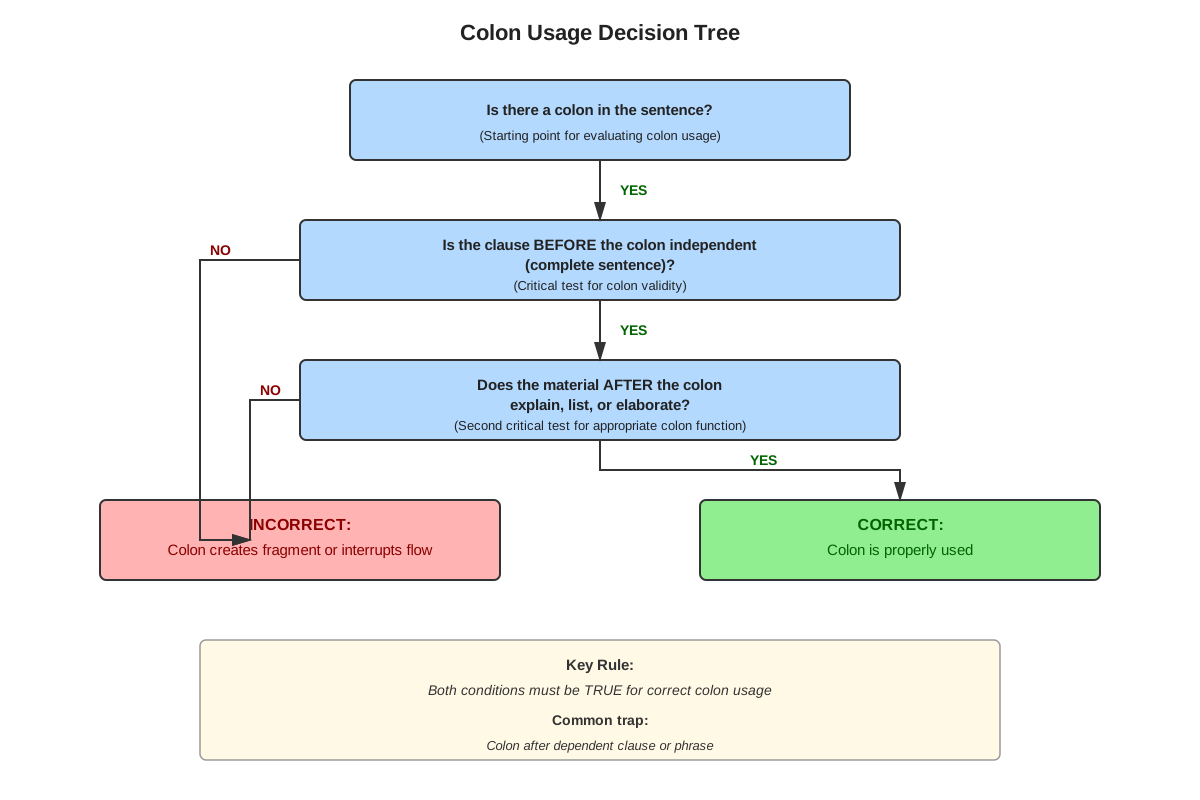
The colon before explanation follows one essential rule: a colon must be preceded by an independent clause (a complete sentence) and must introduce material that explains, elaborates on, or lists items related to that clause. This rule has two critical components that must both be satisfied for correct colon usage.
First, the material before the colon must be able to stand alone as a complete sentence. This means it must have a subject and a verb and express a complete thought. For example, "The scientist made an important discovery" is an independent clause because it contains a subject (scientist), a verb (made), and expresses a complete idea. This clause could be followed by a colon.
Second, the material after the colon must relate directly to the independent clause by explaining it, providing examples of it, or listing items mentioned in it. The relationship should be one of clarification or elaboration. For example: "The scientist made an important discovery: a new species of deep-sea fish that glows in complete darkness." The material after the colon explains what the discovery was.
What Can Follow a Colon
The material following a colon can take several forms, all of which serve explanatory or elaborative functions:
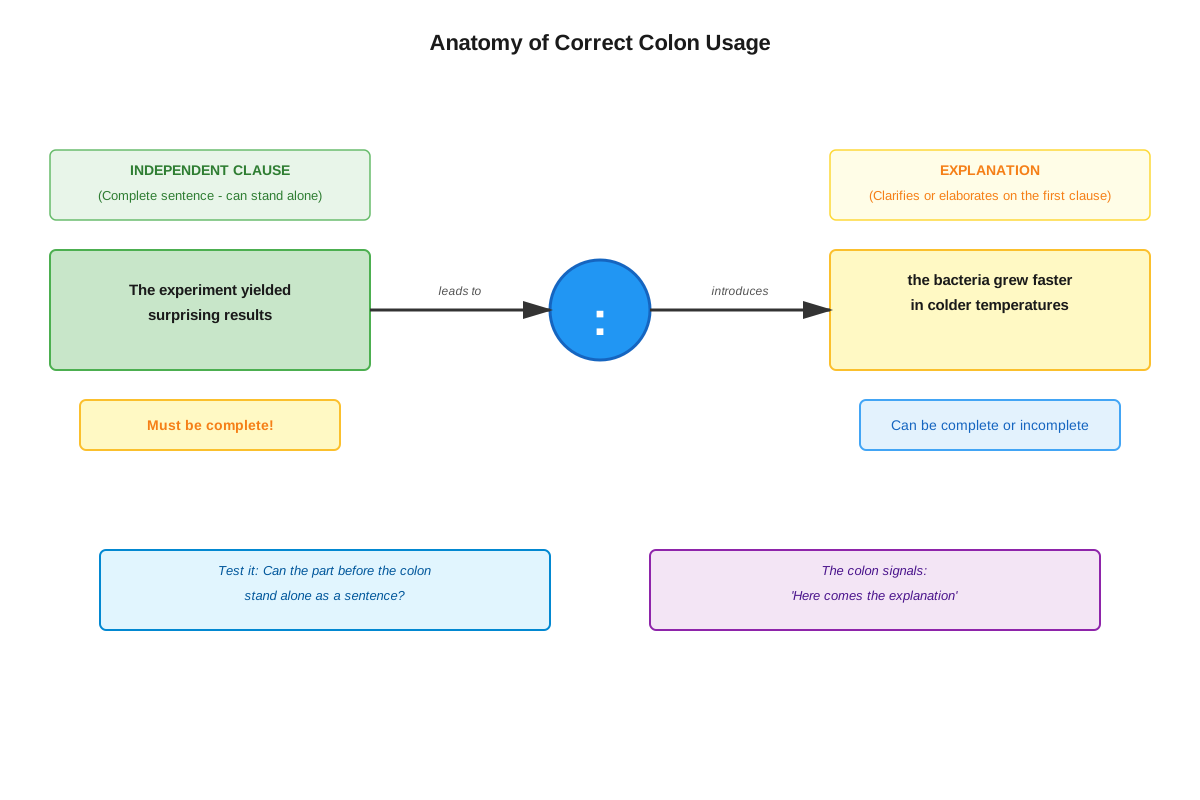
Complete sentence: "The experiment yielded surprising results: the plants grew faster in darkness than in light." The material after the colon is itself a complete sentence that explains the results.
Sentence fragment: "The recipe requires three ingredients: flour, sugar, and eggs." The material after the colon is not a complete sentence, but it explains what the ingredients are.
List: "The museum features four permanent exhibits: Ancient Egypt, Medieval Europe, Renaissance Art, and Modern Technology." The colon introduces a list that specifies the exhibits.
Single word or phrase: "The detective had one suspect: the butler." The colon introduces a single noun phrase that identifies the suspect.
The key principle is that whatever follows the colon must provide information that directly relates to and clarifies the independent clause before it.
The Independence Test
To determine whether a colon is correctly placed, apply the independence test: read the material before the colon and ask, "Could this stand alone as a complete sentence?" If the answer is yes, the colon might be appropriate (assuming the material after it is explanatory). If the answer is no, the colon is incorrect.
Consider these examples:
Correct: "The coach emphasized one principle: teamwork."
- Before colon: "The coach emphasized one principle" = independent clause ✓
- After colon: "teamwork" = explains what the principle is ✓
Incorrect: "The coach emphasized: teamwork and dedication."
- Before colon: "The coach emphasized" = not independent (emphasized what?) ✗
- This creates a sentence fragment before the colon
Incorrect: "The ingredients are: flour, sugar, and eggs."
- Before colon: "The ingredients are" = not independent (are what?) ✗
- The verb "are" requires a complement to complete the thought
Common Incorrect Placements
The ACT frequently tests several specific incorrect colon placements:
After a verb: Never place a colon directly after a verb when the verb requires an object or complement. "The winners were: John, Sarah, and Miguel" is incorrect because "were" needs a complement to complete the predicate. Correct version: "The winners were John, Sarah, and Miguel" (no colon) or "The committee announced the winners: John, Sarah, and Miguel" (colon after independent clause).
After a preposition: Never place a colon directly after a preposition. "The book is about: marine biology and oceanography" is incorrect because "about" is a preposition that requires an object. Correct version: "The book covers two subjects: marine biology and oceanography."
After "such as" or "including": These phrases already signal that examples follow, so a colon is redundant and incorrect. "The store sells many items, such as: books, magazines, and newspapers" is wrong. Correct version: "The store sells many items, such as books, magazines, and newspapers" (no colon).
Colon vs. Semicolon vs. Dash
Understanding the distinctions between these three punctuation marks is crucial for ACT success:
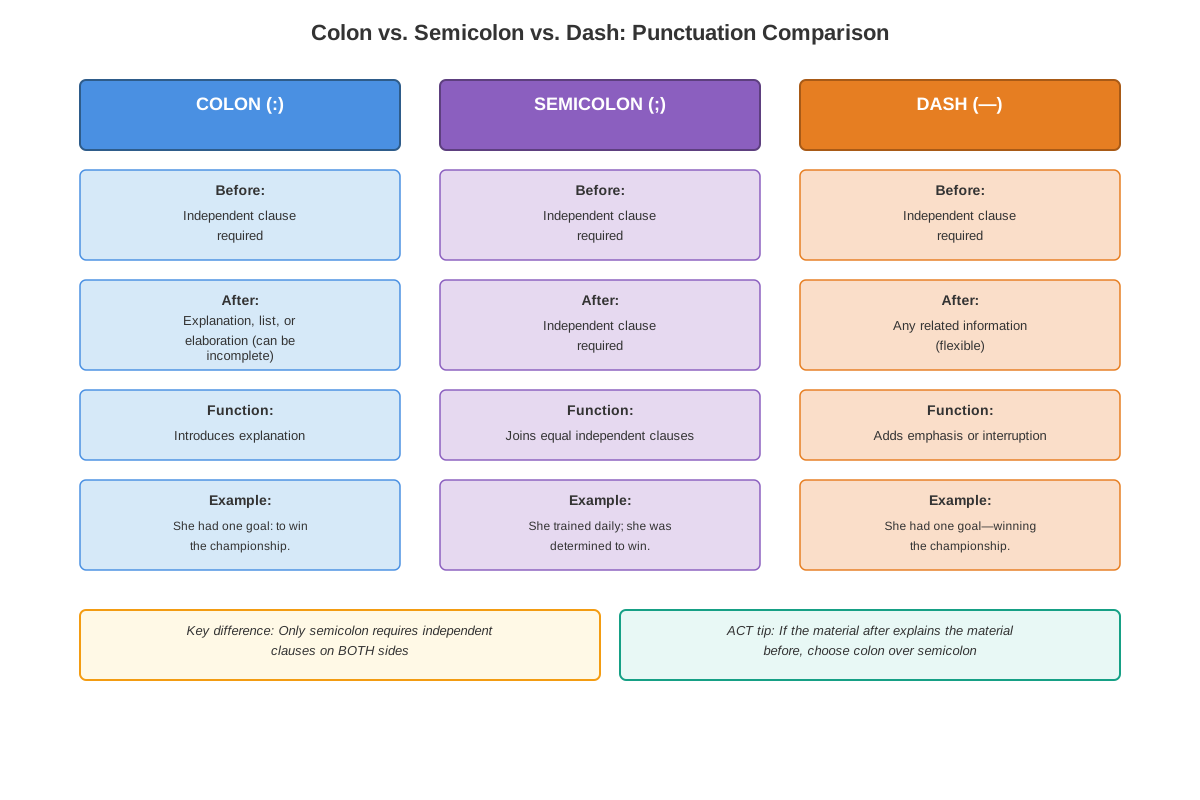
| Punctuation | Before | After | Function |
|---|---|---|---|
| Colon | Must be independent clause | Can be anything explanatory | Introduces explanation, list, or elaboration |
| Semicolon | Must be independent clause | Must be independent clause | Connects two related complete sentences |
| Dash | Can be anything | Can be anything | Adds emphasis or sets off information |
Colon example: "The solution was simple: add more water."
- Introduces an explanation of what the solution was
Semicolon example: "The solution was simple; we just needed to add more water."
- Connects two independent clauses that are closely related
Dash example: "The solution—adding more water—was simple."
- Sets off explanatory information with emphasis
The colon specifically signals a hierarchical relationship where the second part explains or specifies the first part. The semicolon treats both clauses as equal partners. The dash adds emphasis and can interrupt sentence flow.
The Explanatory Relationship
For a colon to be correct, the material after it must have a clear explanatory relationship to the material before it. This relationship can take several forms:
Specification: The second part specifies or identifies something mentioned in the first part. "She had one goal: winning the championship."
Elaboration: The second part provides more detailed information about the first part. "The house had a unique feature: a hidden room behind the bookshelf."
Listing: The second part lists items or examples referenced in the first part. "The course covers three topics: grammar, composition, and rhetoric."
Cause or reason: The second part explains why something in the first part is true. "The game was cancelled: heavy rain had flooded the field."
If the material after the colon does not clearly explain, specify, or elaborate on the material before it, the colon is likely incorrect, even if both parts are grammatically sound.
Concept Relationships
The colon before explanation concept connects directly to fundamental sentence structure principles. Independent clauses form the foundation of colon usage, as the material before a colon must always be a complete sentence. This requirement links colon usage to understanding subject-verb relationships and complete thoughts. Without mastery of what constitutes an independent clause, students cannot reliably identify correct colon placement.
The relationship flows as follows: Sentence structure knowledge → Independent clause identification → Colon placement evaluation → Correct punctuation choice. Each step depends on the previous one, creating a hierarchical understanding.
Colon usage also connects laterally to other punctuation concepts. Semicolons share the requirement that material before them must be independent, but they differ in requiring independence after them as well. Dashes can sometimes substitute for colons but serve different stylistic purposes and follow different grammatical rules. Commas never introduce explanations in the same way colons do, though they may separate items in a list that follows a colon.
The concept also relates to sentence variety and rhetorical effectiveness. Writers who understand colons can create more sophisticated sentence structures that clearly signal relationships between ideas. This connects to broader ACT English concepts of clarity, concision, and effective expression.
Finally, colon usage relates to list formatting and parallel structure. When a colon introduces a list, the items in that list should maintain parallel grammatical form, connecting colon usage to the ACT's testing of consistency and parallelism.
High-Yield Facts
⭐ A colon must always follow an independent clause (a complete sentence that can stand alone)
⭐ The material after a colon must explain, elaborate on, or list items related to the clause before it
⭐ Never place a colon directly after a verb when that verb requires an object or complement
⭐ Never place a colon directly after a preposition (such as "of," "about," "with," "for")
⭐ The ACT tests colon usage 2-4 times per test, making it a high-yield topic
- A colon can be followed by a complete sentence, a fragment, a list, or even a single word
- Colons and semicolons are not interchangeable; semicolons require independent clauses on both sides
- The phrase "such as" or "including" already signals examples, so no colon should follow these phrases
- Material after a colon does not need to be capitalized unless it is a proper noun or begins a complete sentence (though ACT rarely tests capitalization after colons)
- When choosing between a colon and a dash, remember that colons are more formal and specifically introduce explanations, while dashes add emphasis
- If you can replace a colon with the phrase "namely" or "that is," the colon is likely correct
- The most common ACT trap answer involves placing a colon after "is," "are," "was," or "were" when these verbs need complements
- A colon can introduce a quotation if the introduction is an independent clause: The teacher said one thing: "Study every day."
Quick check — test yourself on Colon before explanation so far.
Try Flashcards →Common Misconceptions
Misconception: A colon can be used whenever you want to introduce a list.
Correction: A colon can only introduce a list if it follows an independent clause. "The ingredients are: flour, sugar, eggs" is incorrect because "The ingredients are" is not a complete thought. Correct: "The recipe requires three ingredients: flour, sugar, and eggs."
Misconception: Colons and semicolons are interchangeable because they both connect parts of sentences.
Correction: Colons and semicolons serve different functions. A semicolon connects two independent clauses of equal importance. A colon introduces explanatory material and creates a hierarchical relationship where the second part explains the first. "I have one hobby: reading" (colon introduces explanation) vs. "I love reading; it relaxes me" (semicolon connects equal clauses).
Misconception: You should always capitalize the first word after a colon.
Correction: Capitalize after a colon only if what follows is a proper noun or a complete sentence (and even then, it's optional for sentences). The ACT rarely tests this, focusing instead on whether the colon itself is correctly placed. "The solution was obvious: Add more time" or "The solution was obvious: add more time" (both acceptable).
Misconception: If a sentence has explanatory material, it needs a colon.
Correction: A colon is only one way to introduce explanatory material, and it's only correct when it follows an independent clause. Other structures can introduce explanations without colons: "The reason for the delay was heavy traffic" (no colon needed because "was" requires a complement).
Misconception: A colon can follow "such as" or "including" to introduce examples.
Correction: The phrases "such as" and "including" already signal that examples follow, making a colon redundant and grammatically incorrect. "The store sells many items, such as books and magazines" is correct; "The store sells many items, such as: books and magazines" is wrong.
Misconception: The material after a colon must be shorter than the material before it.
Correction: Length is irrelevant to colon usage. What matters is that the material before the colon is an independent clause and the material after it is explanatory. "She made a decision: she would leave her job, move to a new city, start fresh, and pursue the career she had always dreamed about" is perfectly correct despite the long explanation after the colon.
Misconception: Dashes and colons are always interchangeable.
Correction: While dashes can sometimes substitute for colons, they serve different purposes and follow different rules. Dashes can interrupt a sentence and don't require an independent clause before them. Colons specifically introduce explanations and must follow independent clauses. "The answer—surprisingly—was no" (dashes set off interruption) vs. "The answer was clear: no" (colon introduces explanation).
Worked Examples
Example 1: Identifying Correct Colon Usage
Question: Which of the following sentences uses a colon correctly?
A) The museum features: ancient artifacts, modern art, and historical documents.
B) The museum features three collections: ancient artifacts, modern art, and historical documents.
C) The museum features three collections, such as: ancient artifacts, modern art, and historical documents.
D) The museum's collections include: ancient artifacts, modern art, and historical documents.
Step 1: Apply the independence test to each option
Option A: "The museum features" - This is not an independent clause. "Features" is a transitive verb that requires an object. Without an object, this is a fragment. ✗
Option B: "The museum features three collections" - This IS an independent clause. It has a subject (museum), a verb (features), and an object (three collections). It expresses a complete thought. ✓
Option C: "The museum features three collections, such as" - Even though the first part is independent, "such as" already signals examples, making the colon redundant and incorrect. ✗
Option D: "The museum's collections include" - This is not an independent clause. "Include" is a transitive verb requiring an object. Without an object, this is incomplete. ✗
Step 2: Check the explanatory relationship
In Option B, the material after the colon (ancient artifacts, modern art, and historical documents) directly explains what the three collections are. This is a proper explanatory relationship. ✓
Step 3: Verify the answer
Option B is correct. The colon follows an independent clause and introduces a list that explains what the three collections are.
Connection to learning objectives: This example demonstrates how to identify when colon usage is being tested (objective 1), apply the core rule about independent clauses (objective 2), and accurately select the correct answer in an ACT-style question (objective 3).
Example 2: Distinguishing Between Colon and Other Punctuation
Question: The scientist made an important discovery [blank] a new method for purifying water using only sunlight and common materials.
F) discovery:
G) discovery;
H) discovery,
J) discovery—
Step 1: Test for independent clause before the punctuation
"The scientist made an important discovery" - This is an independent clause with subject (scientist), verb (made), and object (discovery). It can stand alone. ✓
This means a colon is grammatically possible. Now we need to determine if it's the best choice.
Step 2: Analyze the relationship between the two parts
The material after the blank ("a new method for purifying water...") explains what the discovery was. This is a clear explanatory relationship where the second part specifies the first part.
Step 3: Evaluate each option
Option F (colon): A colon is appropriate here because it follows an independent clause and introduces an explanation of what the discovery was. ✓
Option G (semicolon): A semicolon requires an independent clause after it. "A new method for purifying water using only sunlight and common materials" is not an independent clause—it's a noun phrase without a verb. ✗
Option H (comma): A comma alone cannot connect an independent clause to an explanatory phrase in this way. This would create a comma splice or awkward construction. ✗
Option J (dash): A dash could work grammatically and would add emphasis, but the colon is more precise because it specifically signals an explanatory relationship. On the ACT, when both a colon and a dash are options and the relationship is clearly explanatory (not emphatic), the colon is typically preferred. The colon is the most precise choice. ✓ (but colon is better)
Step 4: Select the best answer
Option F (colon) is correct. It follows an independent clause and introduces material that explains what the discovery was, creating the precise relationship that colons are designed to signal.
Connection to learning objectives: This example shows how to distinguish between colons and other punctuation marks (objective 5), evaluate whether the material after the punctuation appropriately explains the preceding clause (objective 6), and apply the colon rule to ACT-style questions (objective 3).
Exam Strategy
When approaching ACT questions testing colon usage, follow this systematic process:
Step 1: Identify the question type. Colon questions typically appear as punctuation choices where you must select between a colon, semicolon, comma, dash, or no punctuation. Look for answer choices that include a colon—this signals that colon usage is being tested.
Step 2: Apply the independence test. Before evaluating whether a colon is correct, read the material before the proposed colon placement and ask: "Is this a complete sentence?" Cover up everything after the colon and see if what remains can stand alone. If it cannot, the colon is automatically wrong.
Step 3: Check for verb-colon and preposition-colon traps. The ACT loves to place colons directly after verbs (especially "is," "are," "was," "were") and prepositions. These are almost always incorrect. If you see a colon immediately after a verb or preposition, it's likely a trap answer.
Step 4: Verify the explanatory relationship. If the material before the colon is independent, check whether the material after it explains, specifies, or lists items related to the first part. Ask: "Does the second part answer 'what?' or 'which ones?' about something in the first part?"
Step 5: Compare to other punctuation options. If multiple punctuation marks seem possible, use these guidelines:
- Choose a colon when the relationship is explanatory and the material before is independent
- Choose a semicolon only when both parts are independent clauses
- Choose a dash when emphasis is needed or when the material before is not independent
- Choose a comma when the material after is not explanatory but rather additional information
Trigger words and phrases to watch for:
- "The following" or "as follows" (often correctly followed by a colon)
- "Such as" or "including" (should NOT be followed by a colon)
- "Is," "are," "was," "were" (usually should NOT be followed by a colon)
- Numbers indicating lists ("three reasons," "two factors") (often correctly followed by a colon)
Time allocation: Colon questions should take 15-20 seconds each. If you've applied the independence test and checked for common traps, you should be able to answer confidently. Don't overthink these questions—the rules are mechanical and consistent.
Process of elimination tips:
- Immediately eliminate any option with a colon after a verb or preposition
- Eliminate semicolons if the material after them is not an independent clause
- Eliminate colons if the material before them is not an independent clause
- When stuck between a colon and a dash, choose the colon if the relationship is clearly explanatory rather than emphatic
Exam Tip: If you can mentally insert "namely" or "that is" where the punctuation mark goes, and it makes sense, a colon is likely correct.
Memory Techniques
The "Complete Before, Explain After" Rule: Remember the acronym CBEA (Complete Before, Explain After). Before using a colon, the clause must be Complete; after the colon, the material must Explain.
The "Stand Alone" Test: Visualize a colon as a person standing alone. Just as a person can stand without support, the clause before a colon must be able to stand alone as a complete sentence. If it would fall over (be incomplete), the colon cannot be used.
The "Verb-Colon = Wrong" Shortcut: Create a mental image of a verb and a colon as two magnets that repel each other. When you see them directly next to each other (verb:), they push apart, signaling that this is wrong. This helps you quickly identify one of the most common ACT traps.
The "Colon = Spotlight" Visualization: Think of a colon as a spotlight that shines on explanatory information. The spotlight (colon) must be mounted on a complete platform (independent clause) to work properly. If the platform is incomplete, the spotlight falls and doesn't work.
The Three-Part Mnemonic: I.C.E.
- Independent clause before
- Colon in the middle
- Explanation after
The "Such As = No Colon" Rhyme: "When you see 'such as,' don't make a fuss—no colon needed, just trust in us." This silly rhyme helps remember that "such as" and "including" should never be followed by colons.
The Semicolon vs. Colon Memory Aid: "Semi = Same, Colon = Clarify". Semicolons connect clauses of the same type (both independent). Colons clarify by introducing explanations.
Summary
The colon before explanation is a high-yield ACT English topic that tests a specific, mechanical rule: a colon must follow an independent clause and must introduce material that explains, elaborates on, or lists items related to that clause. Success on colon questions requires mastering the independence test—the ability to determine whether the material before a colon can stand alone as a complete sentence. The ACT consistently tests this concept 2-4 times per exam, making it essential for score improvement. Common traps include placing colons after verbs that require complements, after prepositions, or after phrases like "such as" that already signal examples. Students must also distinguish colons from semicolons (which require independent clauses on both sides) and dashes (which add emphasis but follow different rules). The explanatory relationship between the material before and after the colon is crucial—the second part must specify, elaborate on, or list items mentioned in the first part. By applying systematic strategies like the independence test and recognizing trigger words, students can confidently and quickly answer colon questions, converting this high-frequency topic into reliable points on test day.
Key Takeaways
- A colon must always follow an independent clause (complete sentence) and introduce explanatory material
- Apply the independence test: cover the material after the colon and verify that what remains can stand alone
- Never place a colon directly after a verb that needs a complement (especially "is," "are," "was," "were")
- Never place a colon after prepositions or after "such as" and "including"
- Colons and semicolons are not interchangeable: semicolons require independent clauses on both sides, while colons introduce explanations
- The material after a colon must explain, specify, or list items related to the clause before it
- Colon questions appear 2-4 times per ACT, making this a high-yield topic worth mastering for immediate score improvement
Related Topics
Semicolon Usage: Understanding semicolons deepens colon mastery because both require independent clauses before them, but semicolons also require independence after them. Mastering the distinction between these two punctuation marks is essential for ACT success.
Independent and Dependent Clauses: This foundational topic underlies all colon usage. Strengthening clause identification skills directly improves colon question accuracy and builds toward mastering complex sentence structures.
Dash Usage: Dashes can sometimes substitute for colons but serve different stylistic purposes. Understanding when to choose a dash versus a colon refines punctuation skills and prepares students for nuanced ACT questions.
Comma Usage in Lists: When a colon introduces a list, commas often separate the items. Understanding how colons and commas work together in list structures is important for comprehensive punctuation mastery.
Sentence Structure and Variety: Mastering colons enables writers to create more sophisticated sentence structures, connecting to broader ACT English concepts of effective expression and rhetorical skills.
Practice CTA
Now that you've mastered the core concepts of colon usage, it's time to put your knowledge into action! Attempt the practice questions to reinforce these rules and build the automaticity you need for test day. Each practice question is designed to mirror actual ACT patterns, giving you realistic preparation. Don't forget to review the flashcards to cement the high-yield facts and rules in your memory. Remember: colon questions appear multiple times on every ACT, so mastering this topic translates directly into points on your score. You've got this—go practice with confidence!
Sign up free to keep reading
Create a free AnvayaPrep account to finish this ACT guide on Colon before explanation — plus flashcards and practice questions.