Overview
Redundancy is one of the most frequently tested concepts in the ACT English section, appearing in approximately 10-15% of all questions. Understanding redundancy is crucial because it directly tests a student's ability to recognize and eliminate unnecessary repetition in writing—a fundamental skill that separates clear, concise prose from wordy, inefficient communication. On the ACT, ACT redundancy questions assess whether students can identify when information is unnecessarily repeated, either through synonymous words, phrases that mean the same thing, or details already implied by context.
Redundancy questions typically appear within the Rhetorical Skills portion of the ACT English test, specifically under the subcategory of Economy of Style or Concision. These questions challenge students to choose the most concise option that maintains the original meaning without sacrificing clarity or necessary information. The ACT rewards students who can distinguish between helpful elaboration and wasteful repetition, making this topic essential for achieving a competitive score.
This topic connects closely to other rhetorical skills concepts such as wordiness, clarity, and precision. While redundancy specifically addresses unnecessary repetition, it shares the broader goal of effective communication with topics like sentence structure, transitions, and style. Mastering redundancy helps students develop an editorial eye that serves them well across all writing tasks, both on the ACT and in academic contexts beyond standardized testing.
Learning Objectives
- [ ] Identify when Redundancy is being tested in ACT English passages
- [ ] Explain the core rule or strategy behind Redundancy elimination
- [ ] Apply Redundancy principles to ACT-style questions accurately
- [ ] Distinguish between helpful elaboration and unnecessary repetition
- [ ] Recognize common redundant phrase patterns that appear on the ACT
- [ ] Evaluate answer choices to select the most concise option without losing meaning
- [ ] Identify implicit information that makes explicit statements redundant
Prerequisites
- Basic grammar and sentence structure: Understanding subject-verb relationships and how sentences convey meaning is essential for recognizing when information is repeated unnecessarily.
- Vocabulary knowledge: Recognizing synonyms and understanding word meanings helps identify when two different words or phrases express the same idea.
- Reading comprehension: The ability to extract meaning from context is necessary to determine when information is already implied and doesn't need explicit statement.
- Understanding of modifiers: Knowing how adjectives, adverbs, and phrases modify nouns and verbs helps identify when modifiers repeat information already present in the base word.
Why This Topic Matters
Redundancy matters in real-world writing because concise communication is more effective, professional, and reader-friendly. In academic papers, business communications, and professional writing, eliminating redundancy demonstrates respect for the reader's time and enhances credibility. Writers who master concision convey authority and clarity, while redundant writing appears amateurish and unfocused.
On the ACT English section, redundancy questions appear with high frequency—students can expect to encounter 3-6 redundancy questions per test. These questions typically present four answer choices where one option eliminates unnecessary repetition while the others contain various forms of redundancy. The question format usually involves underlined portions of text with alternatives, or asks students to choose between keeping or deleting certain phrases.
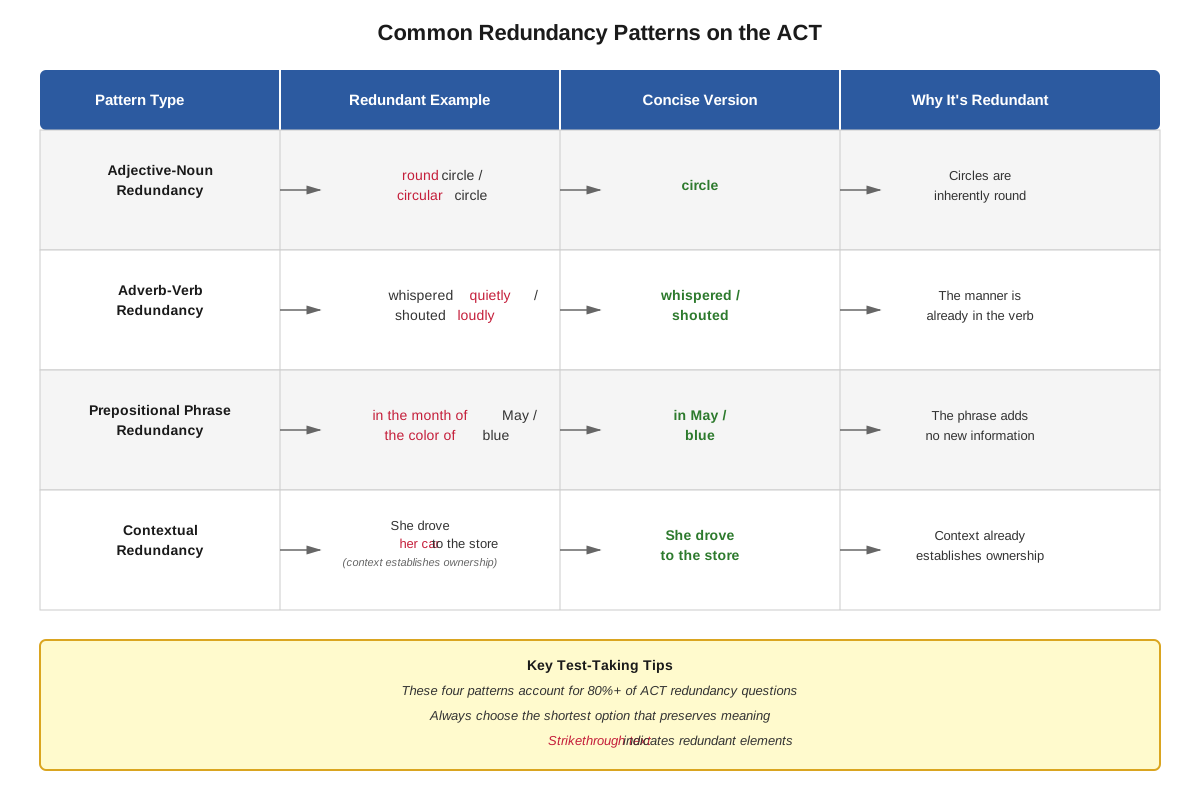
Common manifestations of redundancy on the ACT include: phrases where adjectives repeat noun meanings (e.g., "round circle"), adverbs that repeat verb meanings (e.g., "whispered quietly"), prepositional phrases that restate information (e.g., "in the month of May" instead of "in May"), and compound phrases where both elements mean the same thing (e.g., "each and every"). The test also frequently includes redundancy through context, where surrounding sentences already provide information that a phrase unnecessarily repeats.
Core Concepts
Definition of Redundancy
Redundancy occurs when writing includes words, phrases, or information that unnecessarily repeat meaning already expressed elsewhere in the sentence or passage. This repetition adds no new information, clarification, or emphasis—it simply restates what readers already know. Effective writing eliminates redundancy to achieve concision, the quality of expressing ideas in the fewest words necessary without sacrificing meaning or clarity.
The ACT tests redundancy because concise writing is a hallmark of skilled communication. The exam rewards students who can identify the leanest expression of an idea while maintaining grammatical correctness and complete meaning. Understanding redundancy requires recognizing three key principles: (1) words have inherent meanings that shouldn't be restated, (2) context often provides information that doesn't need explicit statement, and (3) more words don't equal better writing.
Types of Redundancy
Word-Level Redundancy
This occurs when modifiers repeat meanings already contained in the words they modify. Common examples include:
| Redundant Phrase | Why It's Redundant | Concise Version |
|---|---|---|
| advance planning | Planning inherently means doing something in advance | planning |
| past history | History refers to the past by definition | history |
| end result | Results come at the end | result |
| close proximity | Proximity means closeness | proximity |
| completely eliminate | Eliminate means to remove completely | eliminate |
| future plans | Plans are for the future | plans |
Phrase-Level Redundancy
This type involves longer constructions where multiple words or phrases express the same idea:
- "The reason why is because..." (uses three redundant causation indicators)
- "In my opinion, I think..." (both phrases indicate personal viewpoint)
- "Repeat again" (repeat already means to do again)
- "Revert back" (revert means to go back)
- "Added bonus" (a bonus is something added)
Contextual Redundancy
This sophisticated form of redundancy occurs when information stated explicitly is already clear from surrounding context. For example:
"The ancient pyramids were built in ancient times."
The word "ancient" in "ancient pyramids" already establishes the time period, making "in ancient times" redundant. The ACT frequently tests this type because it requires careful reading of the full sentence or paragraph.
The Core Rule: Eliminate Unnecessary Repetition
The fundamental strategy for handling redundancy questions follows a simple principle: choose the answer that conveys the complete meaning in the fewest words. However, this rule comes with an important caveat—never sacrifice clarity or necessary information for brevity. The goal is concision, not minimalism.
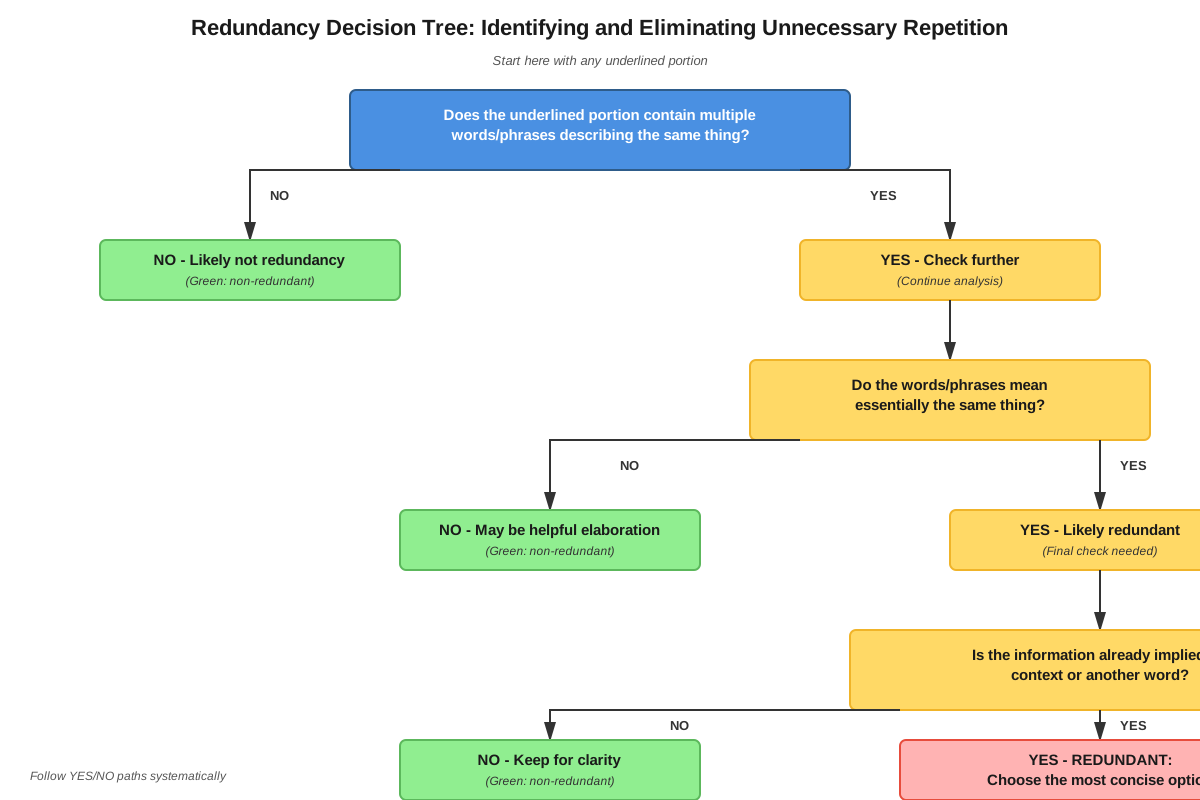
When evaluating answer choices, follow this decision tree:
- Identify the core meaning: What information must the sentence convey?
- Check each word's contribution: Does this word add new information or clarify meaning?
- Examine context: Is this information already stated or clearly implied elsewhere?
- Select the leanest option: Among grammatically correct choices that preserve meaning, choose the shortest.
Implicit vs. Explicit Information
A critical skill for redundancy questions involves recognizing when information is implicit (implied or understood from context) versus explicit (directly stated). The ACT often tests whether students understand that implicit information doesn't need explicit statement.
For example:
- "She nodded her head in agreement" → "She nodded in agreement" (nodding inherently involves the head)
- "He thought to himself" → "He thought" (thinking is an internal process)
- "The book was rectangular in shape" → "The book was rectangular" (rectangular describes shape)
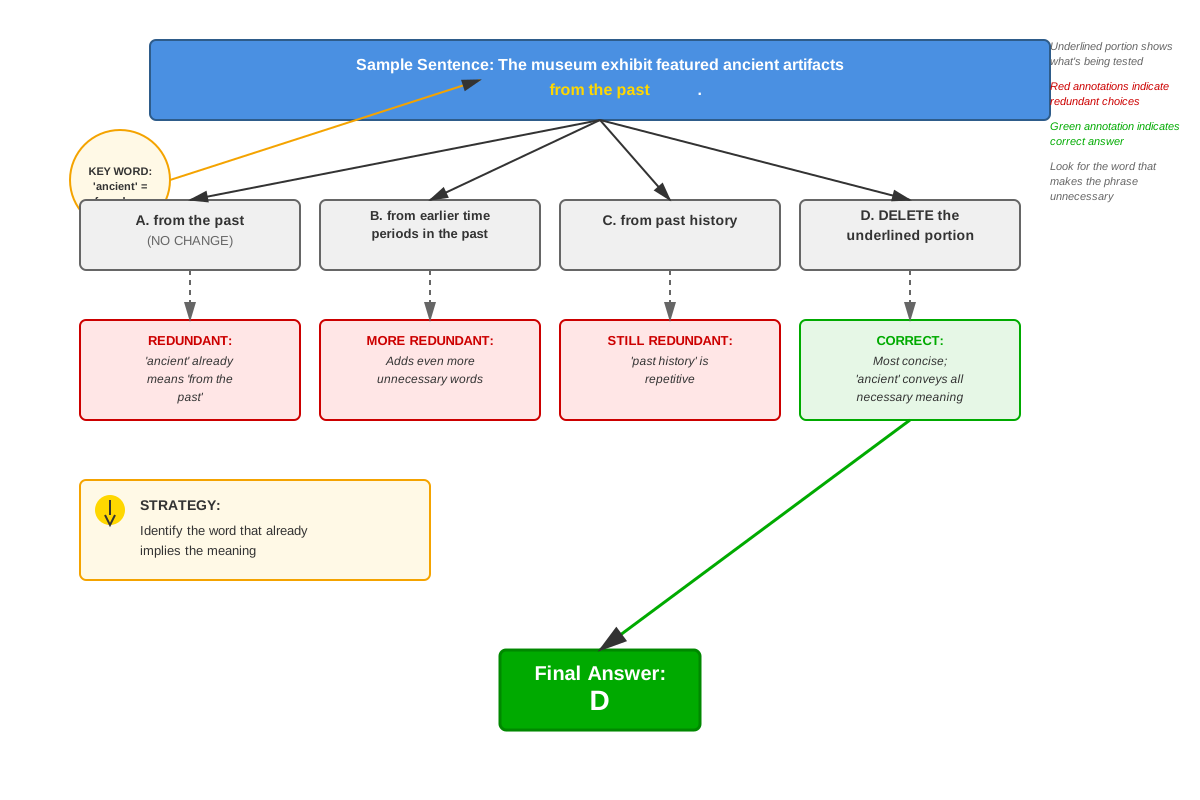
DELETE as an Answer Choice
Many ACT redundancy questions include "DELETE the underlined portion" as an answer choice. Students often hesitate to choose deletion, fearing it will create an incomplete sentence. However, deletion is frequently the correct answer for redundancy questions because the underlined portion adds nothing meaningful. When DELETE appears as an option, always consider whether the sentence remains complete and clear without the underlined portion.
Concept Relationships
Redundancy connects to several other ACT English concepts in important ways. At its core, redundancy is a subset of wordiness, the broader category of using more words than necessary. While all redundancy is wordiness, not all wordiness is redundancy—wordiness can also include unnecessarily complex constructions or verbose phrasing that doesn't technically repeat information.
The relationship flows as follows: Concision (the goal) ← achieved by eliminating ← Wordiness (the problem) ← which includes ← Redundancy (unnecessary repetition).
Redundancy also connects to context-based questions because identifying contextual redundancy requires reading beyond the immediate sentence to understand what information surrounding text provides. This links redundancy to reading comprehension skills.
Additionally, redundancy relates to style and tone questions because redundant writing often sounds informal or unsophisticated. The ability to recognize and eliminate redundancy contributes to achieving appropriate register and diction in formal writing.
Finally, redundancy connects to revision questions where students must decide whether to keep, delete, or revise portions of text. Understanding redundancy helps students make these decisions by evaluating whether text adds meaningful content.
High-Yield Facts
⭐ Redundancy questions appear 3-6 times per ACT English test, making them high-frequency question types.
⭐ The correct answer to redundancy questions is almost always the shortest option that maintains complete meaning.
⭐ "DELETE the underlined portion" is frequently the correct answer when the underlined text repeats information already present.
⭐ Adjectives that repeat noun meanings are redundant (e.g., "round circle," "blue in color," "tall skyscraper").
⭐ Phrases like "the reason is because," "past history," and "future plans" are classic redundant constructions tested repeatedly.
- Redundancy can occur within a single sentence or across multiple sentences in a paragraph.
- Context clues often make explicit statements unnecessary—always read the full sentence and surrounding sentences.
- Modifiers that restate inherent qualities of words they modify should be eliminated.
- Prepositional phrases often create redundancy (e.g., "in the month of May" vs. "in May").
- Compound phrases where both elements mean the same thing are redundant (e.g., "each and every," "various and sundry").
- Time-related redundancy is common: "8 a.m. in the morning," "annual yearly event," "past memories."
- The ACT never penalizes choosing the most concise grammatically correct option.
- Redundancy differs from repetition for emphasis—the ACT tests unnecessary repetition, not rhetorical devices.
- Numbers and measurements often create redundancy: "12 noon," "completely full," "totally unique."
- Verbs with redundant adverbs appear frequently: "whispered softly," "shouted loudly," "carefully scrutinize."
Quick check — test yourself on Redundancy so far.
Try Flashcards →Common Misconceptions
Misconception: Longer answers sound more sophisticated and are therefore better.
Correction: The ACT consistently rewards concision. Longer answers that repeat information demonstrate poor editing skills, not sophistication. The most effective writing conveys ideas clearly in the fewest words necessary.
Misconception: Choosing "DELETE" means the sentence will be incomplete or unclear.
Correction: The ACT only offers DELETE as an option when removing the text leaves a complete, clear sentence. If DELETE is an option, seriously consider it—it's often correct for redundancy questions.
Misconception: Redundancy only occurs when the exact same word appears twice.
Correction: Redundancy occurs when the same meaning is expressed twice, even using different words. "Past history" is redundant even though "past" and "history" are different words, because history inherently refers to the past.
Misconception: Adding more detail always improves writing.
Correction: Detail improves writing only when it adds new, relevant information. Restating information already present or implied clutters writing and frustrates readers. Quality detail enhances understanding; redundant detail wastes time.
Misconception: Context doesn't matter for redundancy questions—just look at the underlined portion.
Correction: Contextual redundancy is one of the most common types tested on the ACT. Always read the complete sentence and often the surrounding sentences to determine whether information is already provided elsewhere.
Misconception: Some redundancy is acceptable for emphasis or clarity.
Correction: While repetition can be a rhetorical device in some contexts, the ACT English section tests standard written English for academic and professional contexts, where redundancy is always considered an error. The test doesn't include questions where redundancy serves a legitimate stylistic purpose.
Worked Examples
Example 1: Word-Level Redundancy
Passage: "The students gathered together in the auditorium to hear the principal's announcement."
Question: Which choice best maintains the meaning while eliminating redundancy?
A) NO CHANGE
B) gathered in a group
C) gathered
D) gathered collectively
Solution:
Step 1: Identify the potential redundancy. The phrase "gathered together" is underlined, suggesting possible redundancy.
Step 2: Analyze the word meanings. "Gather" means to come together or assemble. The word "together" means in a group or collectively. Since "gather" already implies coming together, adding "together" repeats this meaning.
Step 3: Evaluate each answer choice:
- Choice A keeps "gathered together" (redundant)
- Choice B changes to "gathered in a group" (still redundant—gathering implies forming a group)
- Choice C uses only "gathered" (concise, complete meaning)
- Choice D uses "gathered collectively" (redundant—gathering is inherently collective)
Step 4: Select the most concise option that preserves meaning. Choice C eliminates the redundancy while maintaining the complete meaning of the sentence.
Answer: C
Connection to Learning Objectives: This example demonstrates identifying redundancy (Objective 1), applying the core rule of eliminating unnecessary repetition (Objective 2), and accurately selecting the correct answer (Objective 3).
Example 2: Contextual Redundancy
Passage: "Marie Curie was born in 1867. She was the first woman to win a Nobel Prize, an achievement she accomplished in 1903 when she won the Nobel Prize in Physics."
Question:
F) NO CHANGE
G) an achievement she accomplished in 1903.
H) which she won in 1903.
J) DELETE the underlined portion and end the sentence with a period after Prize.
Solution:
Step 1: Read the full context. The sentence already states "She was the first woman to win a Nobel Prize." The underlined portion provides additional information about when this occurred.
Step 2: Analyze what information each part provides:
- "an achievement she accomplished" restates that winning was an achievement (already clear)
- "in 1903" provides new information (the year)
- "when she won the Nobel Prize in Physics" repeats "won the Nobel Prize" from earlier in the sentence
Step 3: Evaluate each choice:
- Choice F keeps all the redundancy
- Choice G eliminates "when she won the Nobel Prize in Physics" but keeps the redundant "achievement she accomplished"
- Choice H keeps "which she won in 1903"—but "won" repeats the verb from "win a Nobel Prize"
- Choice J deletes everything, but this removes the valuable information about the year and specific prize
Step 4: Determine what information is essential. The year (1903) and the specific prize (Physics) add valuable new information. However, we need to express this without repeating "win/won."
Step 5: Re-evaluate. Actually, looking more carefully, the phrase "she was the first woman to win a Nobel Prize" already tells us she won. The underlined portion then says "when she won the Nobel Prize in Physics"—this repeats "won the Nobel Prize." Choice H ("which she won in 1903") still contains "won," repeating the verb. Choice G provides the year without repeating the verb "won."
Answer: G
Connection to Learning Objectives: This example shows how to identify contextual redundancy (Objective 1), distinguish between helpful elaboration (the year) and unnecessary repetition (restating that she won), and apply redundancy principles to complex questions (Objective 3).
Exam Strategy
Approaching Redundancy Questions
When you encounter a potential redundancy question on the ACT, follow this systematic approach:
Step 1: Identify the trigger. Redundancy questions often involve underlined portions that seem wordy or include phrases with similar meanings. Watch for answer choices that vary significantly in length—this often signals a redundancy question.
Step 2: Read the complete sentence and surrounding context. Never evaluate the underlined portion in isolation. Contextual redundancy requires understanding what information appears elsewhere.
Step 3: Ask the key question: "Does every word here add new information or necessary clarification?" If the answer is no, you're dealing with redundancy.
Step 4: Evaluate DELETE if it's an option. Read the sentence without the underlined portion. If it remains complete and clear, DELETE is likely correct.
Step 5: Among remaining choices, select the shortest option that preserves complete meaning.
Trigger Words and Phrases
Watch for these high-frequency redundant constructions:
Time redundancy: "a.m. in the morning," "p.m. in the evening," "12 noon," "12 midnight," "past memories," "advance planning," "future predictions"
Intensifier redundancy: "completely eliminate," "totally unique," "very essential," "absolutely necessary," "quite perfect"
Descriptive redundancy: "round circle," "square box," "blue in color," "large in size," "heavy in weight"
Action redundancy: "repeat again," "return back," "revert back," "continue on," "proceed forward"
Compound redundancy: "each and every," "first and foremost," "various and sundry," "full and complete"
Process of Elimination Tips
- Eliminate the longest option first if it contains obvious repetition. The ACT rarely makes the wordiest choice correct for redundancy questions.
- Eliminate choices that use synonyms for the same concept. If two different words in an answer choice mean essentially the same thing, that choice is likely wrong.
- Keep DELETE in contention longer than you might instinctively. Many students eliminate DELETE too quickly out of fear, but it's correct more often than most expect.
- Eliminate choices that restate information from elsewhere in the sentence. Cross-reference the answer choices with the non-underlined portions.
Time Allocation
Redundancy questions should be among your fastest questions—aim for 20-30 seconds per question. These questions test editing judgment rather than complex grammar rules, so trust your instinct for concise writing. If you find yourself spending more than 45 seconds on a redundancy question, make your best choice and move on. The straightforward nature of redundancy questions makes them excellent opportunities to bank time for more complex questions.
Memory Techniques
The "ADD" Mnemonic
When evaluating whether text is redundant, remember ADD:
- Already stated? (Is this information already in the sentence?)
- Definition included? (Does the word's definition already contain this meaning?)
- Delete and check? (Does the sentence work without it?)
The Concision Mantra
Memorize this principle: "Shortest correct answer wins." When stuck between two grammatically correct options on a redundancy question, the shorter one is almost always right.
Common Redundant Pairs Visualization
Picture these redundant pairs as "twins" that should be separated—you only need one:
- Past + History = REDUNDANT (history is always past)
- Future + Plans = REDUNDANT (plans are always future)
- Advance + Planning = REDUNDANT (planning is always advance)
- End + Result = REDUNDANT (results come at the end)
- Close + Proximity = REDUNDANT (proximity means closeness)
The "One Job" Rule
Every word should have "one job"—to convey specific information. If two words are doing the same job, fire one. Visualize your sentence as a workplace where redundant words are redundant employees—efficient writing keeps only essential staff.
Summary
Redundancy is a high-frequency ACT English topic that tests students' ability to recognize and eliminate unnecessary repetition in writing. The core principle is straightforward: effective writing conveys complete meaning in the fewest words necessary, without sacrificing clarity or essential information. Redundancy appears in three main forms—word-level (modifiers that repeat word meanings), phrase-level (multiple words expressing the same idea), and contextual (explicit statements of information already implied). Success on redundancy questions requires reading complete sentences and surrounding context, understanding implicit versus explicit information, and consistently choosing the most concise grammatically correct option. The ACT rewards students who recognize that "DELETE the underlined portion" is often correct and that shorter answers typically outperform longer ones when both preserve meaning. Mastering redundancy involves developing an editorial eye that distinguishes helpful elaboration from wasteful repetition, a skill that serves students well beyond standardized testing in all academic and professional writing contexts.
Key Takeaways
- Redundancy questions appear 3-6 times per ACT English test and reward the most concise correct answer
- The three types of redundancy are word-level, phrase-level, and contextual—all require elimination
- Always read complete sentences and surrounding context to identify information already stated or implied
- "DELETE the underlined portion" is frequently correct and should be seriously considered when offered
- Common redundant patterns include adjectives repeating noun meanings, adverbs repeating verb meanings, and phrases where both elements mean the same thing
- The core strategy is simple: choose the shortest option that preserves complete meaning and grammatical correctness
- Trust your instinct for concise writing—redundancy questions should be answered quickly (20-30 seconds)
Related Topics
Wordiness and Concision: While redundancy specifically addresses unnecessary repetition, the broader topic of wordiness includes other forms of verbose writing such as unnecessarily complex constructions and inflated phrases. Mastering redundancy provides a foundation for recognizing all forms of wordiness.
Style and Tone: Eliminating redundancy contributes to achieving appropriate style and tone in formal writing. Understanding how concision affects reader perception connects redundancy to broader rhetorical skills.
Sentence Structure and Clarity: Redundancy often intersects with sentence structure questions, particularly when deciding whether to combine or separate clauses. Clear sentence structure naturally reduces redundancy.
Transitions and Logical Flow: Sometimes what appears to be redundancy is actually necessary transition or connection between ideas. Understanding the distinction helps with both redundancy and transition questions.
Revision and Editing Strategies: Redundancy questions are essentially editing tasks. The skills developed here transfer directly to "keep or delete" questions and other revision-focused items on the ACT.
Practice CTA
Now that you've mastered the concepts behind redundancy, it's time to put your knowledge into action! Attempt the practice questions to reinforce your ability to identify and eliminate unnecessary repetition under test-like conditions. Use the flashcards to drill common redundant phrases until recognizing them becomes automatic. Remember, redundancy questions are high-yield opportunities to earn quick points—with practice, you'll develop the editorial instinct that makes these questions feel effortless. Every redundancy question you master brings you closer to your target ACT English score. Start practicing now to build the confidence and speed you need for test day success!
Sign up free to keep reading
Create a free AnvayaPrep account to finish this ACT guide on Redundancy — plus flashcards and practice questions.