Overview
Noun clauses are dependent clauses that function as nouns within a sentence, performing the same roles that single-word nouns or noun phrases can perform: subjects, objects, or complements. On the ACT English test, understanding noun clauses is crucial because questions frequently test whether students can identify proper clause structure, maintain grammatical consistency, and recognize when a clause is being used correctly in place of a noun. These clauses typically begin with words like "that," "what," "whatever," "who," "whoever," "whether," or "if," and they contain both a subject and a verb while functioning as a single grammatical unit.
The ACT English section regularly tests noun clauses in several contexts: subject-verb agreement questions where the noun clause serves as the subject, pronoun-antecedent agreement, sentence structure questions involving fragments or run-ons, and punctuation questions where students must determine whether commas or other marks are appropriate around these clauses. Mastering ACT noun clauses requires recognizing their structure, understanding their function within sentences, and applying proper grammatical rules to maintain sentence coherence.
This topic sits at the intersection of multiple English grammar concepts tested on the ACT. Noun clauses connect to broader sentence structure principles, including independent and dependent clause relationships, subject-verb agreement rules, and the hierarchy of grammatical functions. They also relate to parallelism, as noun clauses must maintain parallel structure when used in series, and to pronoun usage, since pronouns within noun clauses must agree with their antecedents. Understanding noun clauses provides a foundation for analyzing complex sentence structures and making informed decisions about sentence revision questions that constitute a significant portion of the ACT English test.
Learning Objectives
- [ ] Identify when Noun clauses is being tested
- [ ] Explain the core rule or strategy behind Noun clauses
- [ ] Apply Noun clauses to ACT-style questions accurately
- [ ] Distinguish noun clauses from other types of dependent clauses (adjective and adverb clauses)
- [ ] Recognize and correct subject-verb agreement errors when noun clauses function as subjects
- [ ] Evaluate proper punctuation usage with noun clauses in various sentence positions
- [ ] Analyze parallel structure requirements when multiple noun clauses appear in a sentence
Prerequisites
- Independent and dependent clauses: Understanding the difference between clauses that can stand alone and those that cannot is essential for recognizing noun clauses as dependent structures that function within larger sentences.
- Parts of speech (nouns specifically): Knowing what functions nouns perform in sentences (subject, direct object, indirect object, object of preposition, predicate nominative) allows students to identify when a clause is performing these same roles.
- Subject-verb agreement: Since noun clauses often serve as subjects, students must understand basic agreement rules to apply them correctly when the subject is an entire clause rather than a single word.
- Basic sentence structure: Familiarity with simple, compound, and complex sentences provides the framework for understanding how noun clauses fit into more sophisticated sentence constructions.
Why This Topic Matters
Noun clauses represent a sophisticated grammatical structure that appears throughout academic and professional writing. In real-world contexts, noun clauses allow writers to express complex ideas, embed questions within statements, and create nuanced arguments. For example, in academic writing, phrases like "What the research demonstrates is significant" or "The committee will consider whoever applies" use noun clauses to convey information efficiently and precisely. Professional communication relies heavily on noun clauses for reporting, analysis, and recommendation statements.
On the ACT English test, noun clause questions appear with notable frequency—approximately 3-5 questions per test directly or indirectly assess understanding of noun clauses. These questions typically appear in several formats: identifying sentence fragments where a noun clause has been incorrectly punctuated as a complete sentence, correcting subject-verb agreement when a noun clause serves as the subject, determining proper pronoun case within noun clauses, and evaluating whether transitions or conjunctions are appropriate when introducing noun clauses. The ACT also tests noun clauses through revision questions where students must choose between a noun clause and other grammatical structures to maintain parallel structure or achieve the most effective expression.
Common manifestations in ACT passages include: noun clauses as subjects of sentences (often testing singular verb agreement), noun clauses as direct objects following verbs like "believe," "think," "know," "understand," or "realize," noun clauses as objects of prepositions, and noun clauses as predicate nominatives following linking verbs. The test frequently presents incorrect answer choices that create fragments by separating noun clauses from their main clauses with periods or that introduce unnecessary punctuation within noun clause structures.
Core Concepts
Definition and Structure of Noun Clauses
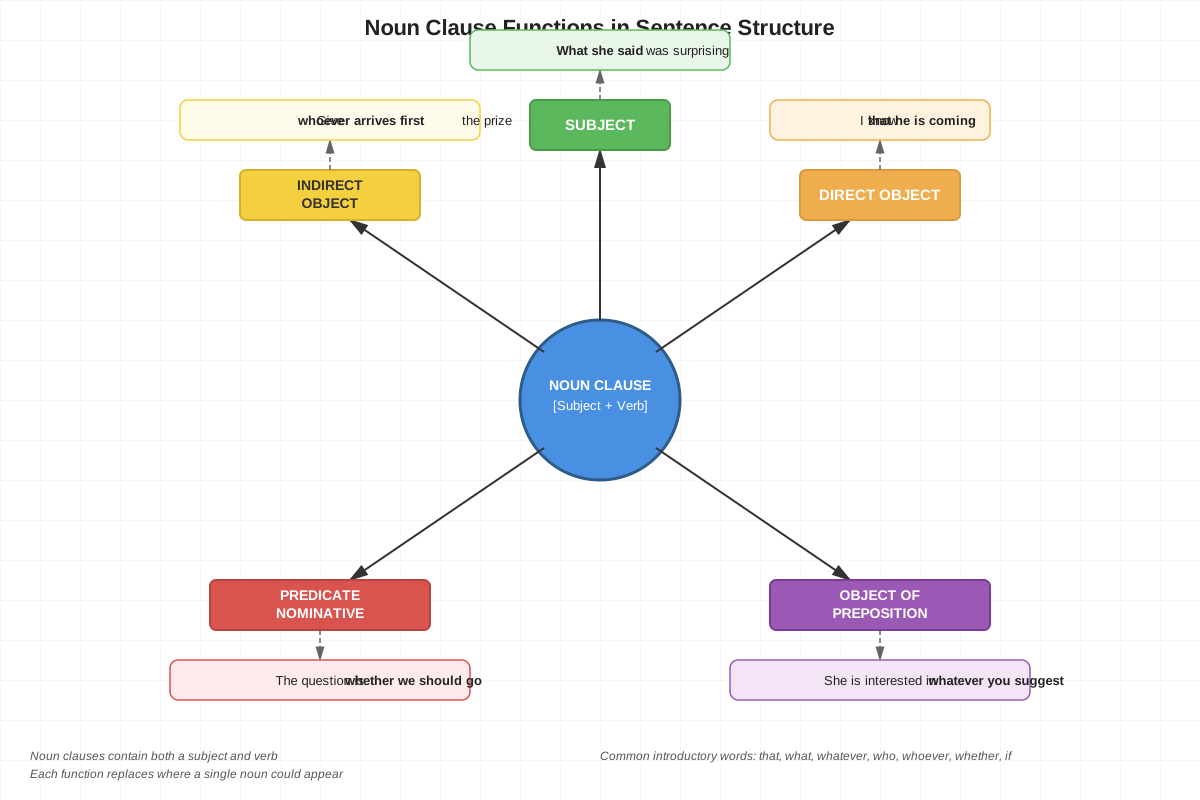
A noun clause is a dependent clause that functions as a noun within a sentence. Like all clauses, it contains a subject and a predicate (verb), but unlike independent clauses, it cannot stand alone as a complete sentence. Noun clauses perform the same grammatical functions as single-word nouns: they can serve as subjects, direct objects, indirect objects, objects of prepositions, predicate nominatives, or appositives.
Noun clauses typically begin with specific introductory words called subordinating conjunctions or relative pronouns:
- That: "That she arrived late surprised everyone."
- What/Whatever: "What you decide matters to us."
- Who/Whoever/Whom/Whomever: "Whoever finishes first wins the prize."
- Which/Whichever: "Whichever route you choose will work."
- When/Where/Why/How: "When the meeting starts is unclear."
- Whether/If: "Whether we attend depends on the weather."
The structure follows this pattern: [Introductory word] + [Subject] + [Verb] + [Additional elements]
Functions of Noun Clauses
Understanding the various functions noun clauses perform is essential for ACT success:
| Function | Example | Explanation |
|---|---|---|
| Subject | What she said made sense. | The entire clause acts as the subject of "made" |
| Direct Object | I know that he is coming. | The clause receives the action of "know" |
| Indirect Object | Give whoever arrives first the package. | The clause indicates to whom the action is done |
| Object of Preposition | Think about what you want. | The clause follows the preposition "about" |
| Predicate Nominative | The problem is that we're late. | The clause renames the subject after a linking verb |
| Appositive | The fact that she won surprised us. | The clause renames or explains "fact" |
Subject-Verb Agreement with Noun Clauses
When a noun clause functions as the subject of a sentence, it is treated as singular and requires a singular verb, regardless of any plural nouns that might appear within the clause itself. This is a high-yield ACT testing point.
Correct: "What the students need is more time." (The noun clause "What the students need" is singular, so it takes the singular verb "is")
Incorrect: "What the students need are more time." (Even though "students" is plural, the entire clause is singular)
This rule applies even when the noun clause contains multiple elements or complex structures. The ACT frequently tests this by placing plural nouns within the noun clause to distract from the singular nature of the clause as a whole.
Punctuation with Noun Clauses
Noun clauses generally require no internal punctuation separating them from the rest of the sentence because they are essential elements that complete the meaning of the sentence. This differs from some adjective clauses (which may be nonessential and require commas) and many adverb clauses (which often require commas when they begin sentences).
Key punctuation rules:
- No comma before noun clauses that function as direct objects: "She believes that success requires effort." (No comma before "that")
- No comma after noun clauses that function as subjects: "Whatever you decide will be fine." (No comma after "decide")
- No comma around noun clauses that function as predicate nominatives: "The truth is that we need help." (No comma before "that")
- Exception: When a noun clause is used as an appositive and provides additional, nonessential information, commas may be appropriate, but this is rare on the ACT.
Distinguishing Noun Clauses from Other Clause Types
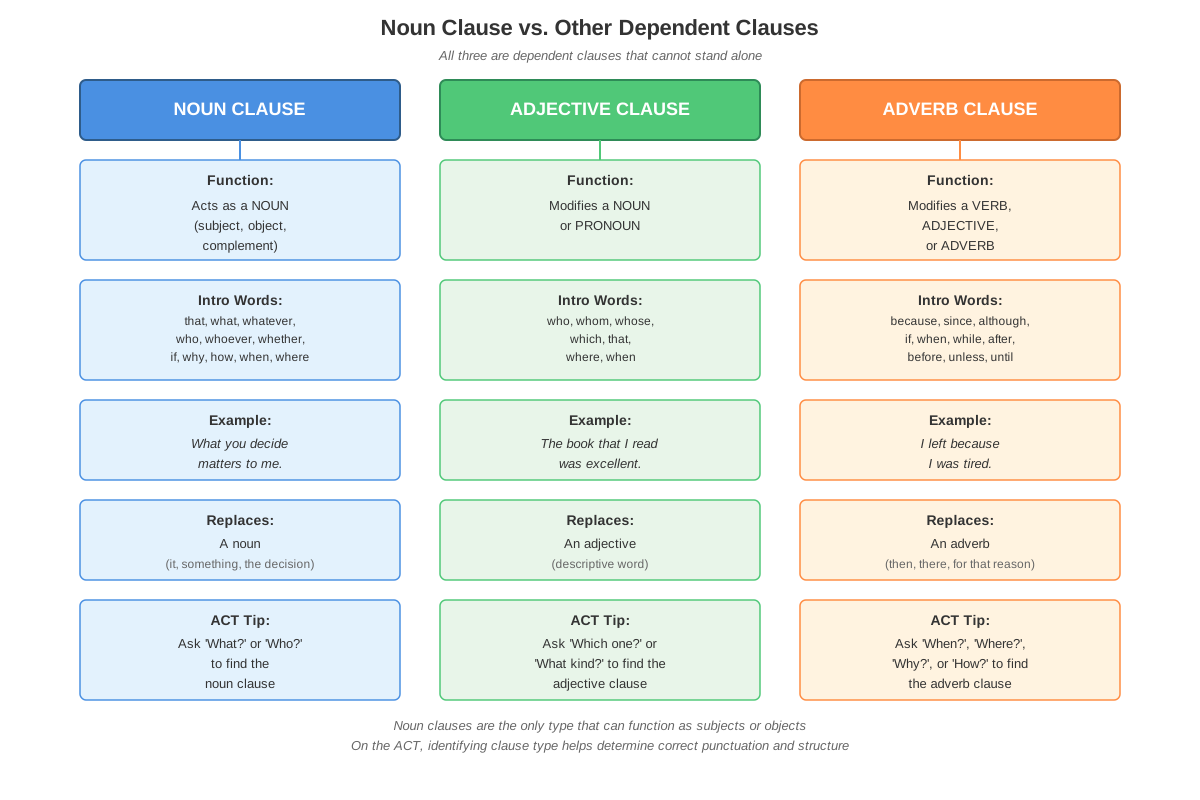
The ACT often tests whether students can distinguish noun clauses from adjective clauses and adverb clauses:
Noun Clause: Functions as a noun; can be replaced by "it," "something," or "someone"
- "I know what you mean." → "I know it."
Adjective Clause: Modifies a noun or pronoun; begins with relative pronouns (who, which, that) or relative adverbs (where, when)
- "The book that you recommended was excellent." (Modifies "book")
Adverb Clause: Modifies a verb, adjective, or adverb; answers questions like when, where, why, how, or under what conditions
- "She left because she was tired." (Modifies "left," explaining why)
The substitution test is particularly useful: if you can replace the clause with "it," "something," or "someone" and the sentence still makes grammatical sense, you have identified a noun clause.
Omission of "That"
In informal writing and speech, the word "that" is often omitted from noun clauses, particularly when the clause functions as a direct object. However, the ACT may test whether students recognize that the clause is still functioning as a noun clause even without the explicit marker.
With "that": "I think that she is correct."
Without "that": "I think she is correct."
Both sentences contain noun clauses functioning as direct objects of "think." The ACT may present questions where recognizing the implied noun clause is necessary for determining proper sentence structure or punctuation.
Concept Relationships
Noun clauses exist within a hierarchical relationship with broader sentence structure concepts. At the foundation, understanding independent clauses (complete sentences) is necessary before recognizing that dependent clauses cannot stand alone. Within dependent clauses, three types exist—noun, adjective, and adverb clauses—each performing different functions. Noun clauses specifically replace nouns, which connects directly to understanding parts of speech and their roles in sentences.
The relationship flows as follows: Parts of Speech → Nouns and their functions → Clauses as grammatical units → Dependent clauses → Noun clauses as noun substitutes
Noun clauses also connect intimately with subject-verb agreement because when they function as subjects, they require singular verbs. This relationship extends to pronoun-antecedent agreement when pronouns within noun clauses must agree with their referents. Additionally, noun clauses relate to parallel structure when multiple noun clauses appear in a series or when they must maintain consistency with other sentence elements.
The connection to punctuation rules is significant: understanding that noun clauses are essential elements (not set off by commas) relates to the broader principle of distinguishing essential from nonessential information. This connects to restrictive and nonrestrictive clauses, though noun clauses are almost always essential.
Finally, noun clauses relate to sentence variety and complexity. Writers use noun clauses to create more sophisticated sentences, which connects to style and tone questions on the ACT where students must evaluate whether a particular construction achieves the desired effect.
Quick check — test yourself on Noun clauses so far.
Try Flashcards →High-Yield Facts
⭐ Noun clauses function as nouns within sentences and can serve as subjects, objects, or complements.
⭐ When a noun clause serves as the subject of a sentence, it takes a singular verb, regardless of plural nouns within the clause.
⭐ Noun clauses typically begin with that, what, whatever, who, whoever, whether, if, when, where, why, or how.
⭐ Noun clauses are essential sentence elements and generally require no commas separating them from the rest of the sentence.
⭐ The substitution test (replacing the clause with "it" or "something") confirms whether a clause is functioning as a noun clause.
- Noun clauses can appear in any position where a noun can appear in a sentence.
- The word "that" can often be omitted from noun clauses functioning as direct objects without changing the grammatical structure.
- Noun clauses differ from adjective clauses (which modify nouns) and adverb clauses (which modify verbs, adjectives, or adverbs).
- Pronouns within noun clauses must be in the correct case (subjective, objective, or possessive) based on their function within the clause.
- Noun clauses cannot stand alone as complete sentences; they are always dependent structures.
- The ACT frequently tests noun clauses in subject position to assess subject-verb agreement understanding.
- Noun clauses introduced by "whether" or "if" often express indirect questions or alternatives.
Common Misconceptions
Misconception: Noun clauses beginning with "that" always require a comma before them.
Correction: Noun clauses are essential elements that complete sentence meaning and should not be separated from the main clause by commas. The word "that" introducing a noun clause does not signal a comma, unlike "that" in some adjective clause constructions.
Misconception: When a noun clause contains plural nouns, the main verb should be plural.
Correction: The noun clause as a whole functions as a singular unit, so it always takes a singular verb when serving as the subject, regardless of any plural nouns within the clause. "What the students want is more time" is correct, not "What the students want are more time."
Misconception: All clauses beginning with "that" are noun clauses.
Correction: The word "that" can introduce both noun clauses and adjective clauses. Noun clauses function as nouns (subjects, objects, complements), while adjective clauses modify nouns. Compare: "I know that she left" (noun clause, direct object) versus "The book that she recommended was good" (adjective clause, modifying "book").
Misconception: Noun clauses and noun phrases are the same thing.
Correction: Noun clauses contain both a subject and a verb, making them clauses. Noun phrases do not contain a subject-verb combination. "What she said" is a noun clause (contains subject "she" and verb "said"), while "her statement" is a noun phrase.
Misconception: You can separate a noun clause from the main sentence with a period to create two sentences.
Correction: Noun clauses are dependent structures that cannot stand alone. Separating them creates a sentence fragment. "That she arrived late" cannot stand alone; it must be part of a complete sentence like "That she arrived late surprised everyone."
Misconception: Noun clauses beginning with question words (who, what, when, where, why, how) require question marks.
Correction: When these words introduce noun clauses within statements, no question mark is needed because the overall sentence is not a question. "I wonder what she thinks" is a statement containing a noun clause, not a question requiring a question mark.
Worked Examples
Example 1: Subject-Verb Agreement with Noun Clauses
ACT-Style Question:
"What the researchers discovered during their extensive field studies in the Amazon rainforest (was/were) several previously unknown species of insects."
Step 1: Identify the subject
The subject of this sentence is the entire noun clause "What the researchers discovered during their extensive field studies in the Amazon rainforest." This clause functions as the subject of the sentence.
Step 2: Apply the noun clause subject rule
When a noun clause serves as the subject, it is treated as singular, regardless of any plural nouns within the clause. Even though "researchers," "studies," and "species" are plural, the noun clause as a whole is singular.
Step 3: Choose the correct verb
A singular subject requires a singular verb. Therefore, "was" is correct.
Step 4: Verify with substitution
Replace the noun clause with "it": "It was several previously unknown species of insects." This confirms the sentence structure is correct.
Answer: "was"
Connection to Learning Objectives: This example demonstrates identifying when noun clauses are being tested (subject-verb agreement context), explaining the core rule (noun clause subjects are singular), and applying the concept to an ACT-style question.
Example 2: Identifying and Punctuating Noun Clauses
ACT-Style Question:
"The committee will award the scholarship to, whoever submits the most compelling essay by the deadline."
Options:
A. NO CHANGE
B. to whoever submits
C. to, whomever submits
D. to; whoever submits
Step 1: Identify the grammatical structure
The phrase "whoever submits the most compelling essay by the deadline" is a noun clause functioning as the object of the preposition "to."
Step 2: Evaluate punctuation needs
Noun clauses are essential elements that should not be separated from the sentence by commas. The comma after "to" in the original sentence incorrectly separates the preposition from its object.
Step 3: Check pronoun case
Within the noun clause, we need the subjective case "whoever" (not "whomever") because it serves as the subject of the verb "submits" within the clause. The entire clause "whoever submits the most compelling essay" is the object of "to," but within the clause itself, "whoever" is the subject.
Step 4: Eliminate incorrect options
- Option A: Incorrect comma after "to"
- Option B: Correct—no comma, correct pronoun case
- Option C: Incorrect comma and wrong pronoun case
- Option D: Semicolon is inappropriate; it's used to separate independent clauses
Answer: B. "to whoever submits"
Connection to Learning Objectives: This example shows how to identify noun clause testing (punctuation and pronoun case), apply the rule that noun clauses don't require commas, and select the correct answer in an ACT-style question.
Exam Strategy
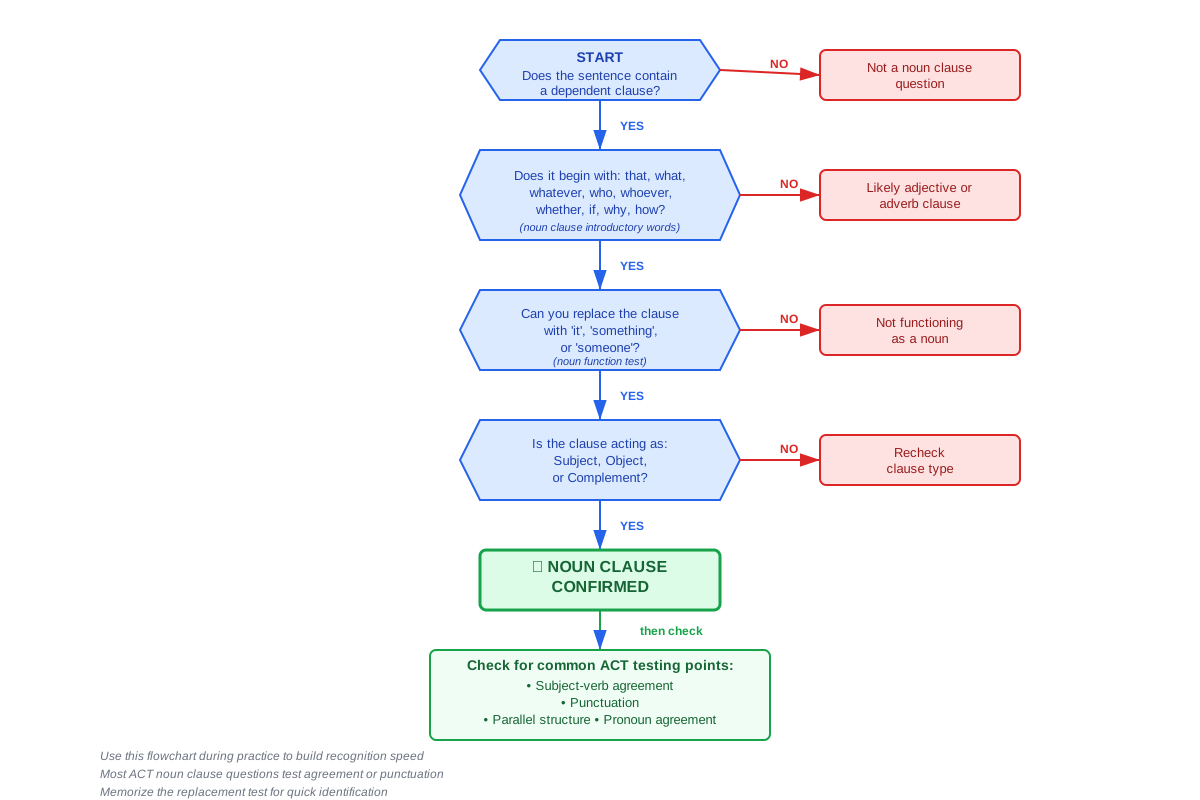
When approaching ACT questions involving noun clauses, follow this systematic process:
1. Identify potential noun clause markers: Look for words like "that," "what," "whatever," "who," "whoever," "whether," "if," "when," "where," "why," or "how" that might introduce noun clauses. These trigger words signal that a noun clause may be present.
2. Apply the substitution test: If you suspect a noun clause, try replacing it with "it," "something," or "someone." If the sentence still makes grammatical sense, you've confirmed a noun clause. This test helps distinguish noun clauses from other clause types.
3. Determine the clause's function: Identify whether the noun clause is serving as a subject, object, or complement. This determines which grammatical rules apply, particularly for subject-verb agreement questions.
4. Check for subject-verb agreement: If the noun clause is the subject, verify that the verb is singular. The ACT loves to place plural nouns within the clause to distract you, but the clause itself is always singular.
5. Evaluate punctuation: Look for unnecessary commas around or within noun clauses. Remember that noun clauses are essential elements and typically require no punctuation separating them from the main sentence.
Exam Tip: When you see a comma before "that" in an answer choice, it's almost always wrong if "that" is introducing a noun clause functioning as a direct object or subject complement.
Time allocation: Noun clause questions typically require 20-30 seconds to answer. If you're spending more time, you may be overthinking. Trust the substitution test and the singular subject rule.
Process of elimination strategies:
- Eliminate any answer choice that places a comma immediately before a noun clause functioning as a direct object
- Eliminate choices that use plural verbs when the noun clause is the subject
- Eliminate choices that create sentence fragments by separating the noun clause from the main clause
- Eliminate choices that use the wrong pronoun case within the noun clause
Common trigger phrases in questions:
- "Which choice maintains proper subject-verb agreement?"
- "Which choice correctly punctuates the sentence?"
- "Which choice avoids creating a sentence fragment?"
- "Which choice uses the correct pronoun case?"
Memory Techniques
NOUN Clause Functions Mnemonic: S-O-C-C-O-P
- Subject
- Object (direct)
- Complement (predicate nominative)
- Complement (object complement)
- Object (indirect)
- Prepositional object
Singular Subject Rule Visualization: Picture a noun clause as a single box, even if it contains multiple items inside. The box itself is one unit (singular), so it takes a singular verb. "What [box containing students, books, ideas] is important."
Substitution Test Acronym: I-S-S (It, Something, Someone)
Replace the suspected noun clause with one of these three words to confirm it's functioning as a noun.
Punctuation Rule Mnemonic: N-E-C (Noun clauses are Essential, no Commas)
Noun clauses are essential elements that complete sentence meaning, so they don't get set off by commas.
Introductory Words Memory Device: "That WHAT WHO questions WHETHER"
- That (most common)
- WHAT (what, whatever)
- WHO (who, whoever, whom, whomever)
- Questions (when, where, why, how)
- WHETHER (whether, if)
Case Selection Within Clauses: Use the "Cover and Check" method—cover everything except the noun clause, then determine what case the pronoun needs within its own clause, ignoring the function of the entire clause in the larger sentence.
Summary
Noun clauses are dependent clauses that function as nouns within sentences, performing roles such as subjects, objects, and complements. These clauses typically begin with subordinating conjunctions or relative pronouns like "that," "what," "who," "whether," or question words. On the ACT English test, noun clauses are tested primarily through subject-verb agreement questions (where noun clause subjects require singular verbs), punctuation questions (where noun clauses should not be separated by commas), and sentence structure questions (where noun clauses must remain connected to main clauses). The key to mastering noun clauses is recognizing their structure through introductory words, understanding that they function as singular units when serving as subjects, and knowing that they are essential elements requiring no internal punctuation. Students can identify noun clauses using the substitution test—replacing the clause with "it," "something," or "someone"—and should remember that these clauses cannot stand alone as complete sentences. Success on ACT noun clause questions requires distinguishing them from adjective and adverb clauses, applying proper subject-verb agreement rules, and avoiding unnecessary punctuation that would incorrectly separate these essential elements from the sentences they complete.
Key Takeaways
- Noun clauses function as nouns within sentences and can serve as subjects, objects, or complements in any position where a single-word noun could appear.
- When a noun clause serves as the subject of a sentence, it always takes a singular verb, regardless of any plural nouns contained within the clause itself.
- Noun clauses are essential sentence elements that typically require no commas separating them from the rest of the sentence.
- The substitution test (replacing the clause with "it," "something," or "someone") is the most reliable method for identifying noun clauses.
- Common introductory words for noun clauses include that, what, whatever, who, whoever, whether, if, when, where, why, and how.
- Noun clauses differ from adjective clauses (which modify nouns) and adverb clauses (which modify verbs, adjectives, or adverbs) in both function and punctuation requirements.
- On the ACT, noun clause questions most frequently test subject-verb agreement, punctuation, and the ability to avoid sentence fragments.
Related Topics
Adjective Clauses: After mastering noun clauses, students should study adjective clauses (also called relative clauses), which modify nouns and pronouns. Understanding the distinction between essential and nonessential adjective clauses builds on the punctuation principles learned with noun clauses.
Adverb Clauses: These dependent clauses modify verbs, adjectives, or adverbs and often require different punctuation rules than noun clauses. Mastering all three clause types provides comprehensive understanding of sentence structure.
Parallel Structure: When multiple noun clauses appear in a sentence or when noun clauses must be parallel with other grammatical structures, understanding parallelism becomes essential. This topic builds directly on noun clause knowledge.
Advanced Subject-Verb Agreement: Beyond basic noun clause subjects, students can explore more complex agreement scenarios involving compound subjects, inverted sentences, and collective nouns.
Pronoun Case: Understanding how pronouns function within noun clauses (subjective, objective, possessive) connects to broader pronoun usage principles tested throughout the ACT.
Practice CTA
Now that you've mastered the fundamentals of noun clauses, it's time to solidify your understanding through practice. Attempt the practice questions designed specifically for this topic, focusing on applying the substitution test, identifying subject-verb agreement issues, and evaluating punctuation choices. Use the flashcards to reinforce the introductory words that signal noun clauses and the key rules for their usage. Remember that consistent practice with ACT-style questions is the most effective way to build speed and accuracy. Each question you work through strengthens your ability to recognize noun clause patterns instantly on test day. You've built a strong foundation—now apply it with confidence!
Sign up free to keep reading
Create a free AnvayaPrep account to finish this ACT guide on Noun clauses — plus flashcards and practice questions.