Overview
Multi-step equations form the backbone of algebraic problem-solving on the ACT Math test. These equations require students to perform multiple operations—such as distributing, combining like terms, and applying inverse operations—to isolate the variable and find its value. Unlike simple one-step equations where a single operation reveals the answer, multi-step equations demand strategic thinking about the order of operations and the systematic application of algebraic principles. Mastering this skill is non-negotiable for ACT success, as these problems appear frequently throughout the test and serve as building blocks for more complex mathematical concepts.
The ACT Math section consistently features ACT multi-step equations in approximately 15-20% of algebra questions, making them one of the highest-yield topics for focused study. These equations appear both as standalone problems and embedded within word problems, geometry questions, and coordinate geometry scenarios. Students who can efficiently solve multi-step equations gain a significant advantage, as the time saved on these problems can be allocated to more challenging questions later in the test.
Understanding multi-step equations creates a foundation for virtually every advanced algebra topic tested on the ACT. From solving systems of equations to manipulating quadratic expressions, from working with rational equations to analyzing functions, the principles learned through multi-step equation solving transfer directly to more complex mathematical scenarios. This topic bridges the gap between basic arithmetic operations and sophisticated problem-solving, making it essential for students targeting scores in the upper ranges of the ACT Math section.
Learning Objectives
- [ ] Identify when Multi-step equations is being tested in ACT Math questions
- [ ] Explain the core rule or strategy behind Multi-step equations
- [ ] Apply Multi-step equations to ACT-style questions accurately
- [ ] Determine the most efficient sequence of operations to solve any multi-step equation
- [ ] Recognize and correct common algebraic errors that lead to incorrect solutions
- [ ] Solve multi-step equations containing fractions, decimals, and parentheses within 60-90 seconds
- [ ] Verify solutions by substituting answers back into original equations
Prerequisites
- Basic arithmetic operations: Addition, subtraction, multiplication, and division form the foundation for all algebraic manipulations
- Order of operations (PEMDAS): Understanding the sequence in which operations must be performed prevents errors when simplifying expressions
- Properties of equality: Knowledge that performing the same operation on both sides of an equation maintains equality is essential
- Combining like terms: The ability to simplify expressions by adding or subtracting similar variable terms streamlines the solving process
- Inverse operations: Understanding that addition/subtraction and multiplication/division are inverse pairs guides the isolation of variables
Why This Topic Matters
Multi-step equations represent real-world problem-solving scenarios where multiple factors interact simultaneously. Engineers use these equations to calculate load distributions across structures, financial analysts apply them to determine investment returns with multiple variables, and scientists employ them to model chemical reactions with multiple reactants. The logical thinking developed through solving multi-step equations transfers to countless professional and personal decision-making situations.
On the ACT Math test, multi-step equations appear in approximately 8-12 questions per exam, representing roughly 13-20% of the total Math section. These questions typically appear in the early-to-middle portion of the test (questions 10-40), though more complex variations can appear later. The ACT tests this concept through direct algebraic equations, word problems requiring equation setup and solution, and geometric problems where algebraic relationships must be solved. Questions may involve linear equations with variables on both sides, equations with parentheses requiring distribution, equations with fractions requiring common denominators, and equations embedded within real-world contexts.
The ACT specifically favors multi-step equations that test multiple skills simultaneously—a single question might require distributing negative signs, combining like terms, working with fractions, and checking for extraneous solutions. Students who master this topic not only secure these direct points but also build the algebraic fluency necessary for tackling systems of equations, quadratic equations, and function problems that appear later in the test.
Core Concepts
The Fundamental Principle of Equation Solving
The cornerstone of solving any equation is the Addition Property of Equality and the Multiplication Property of Equality. These properties state that performing the same operation on both sides of an equation preserves the equality. When solving multi-step equations, every manipulation must maintain this balance. The goal is always to isolate the variable on one side of the equation while keeping all constants on the other side.
Standard Solution Process
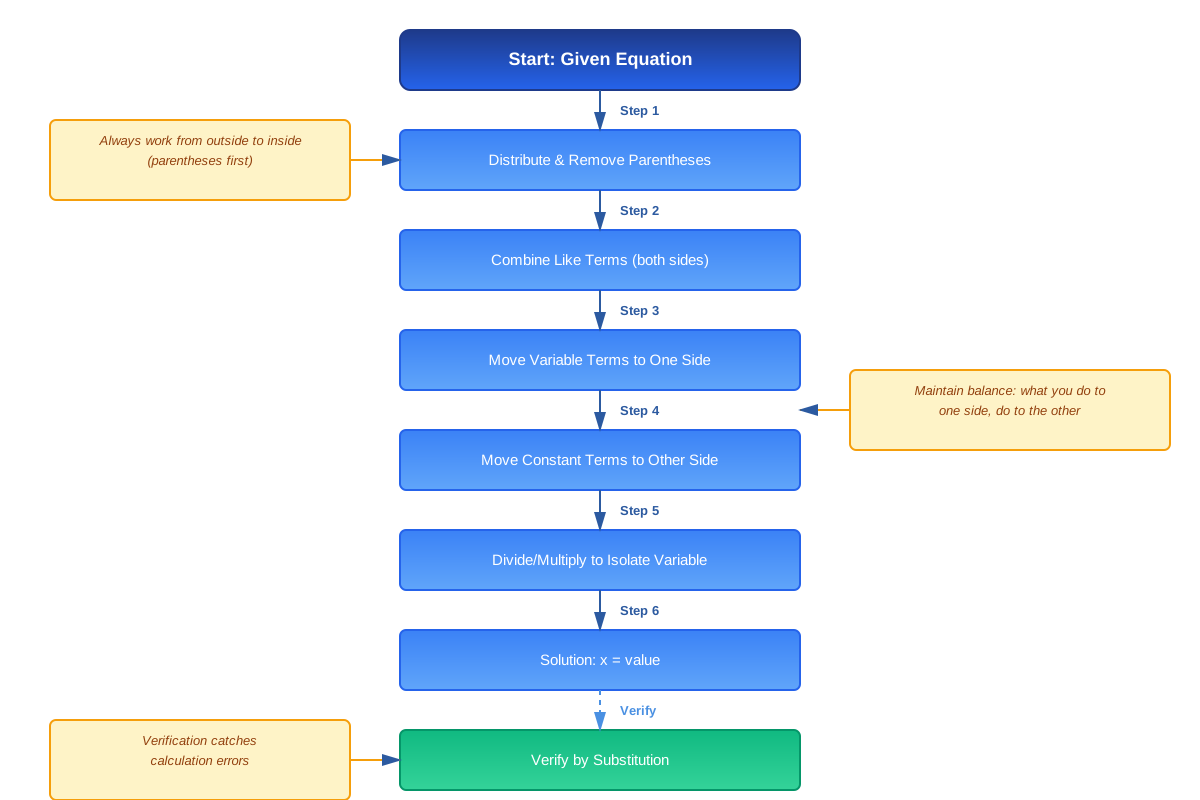
The systematic approach to solving multi-step equations follows a consistent sequence:
- Simplify both sides of the equation by removing parentheses (distributing) and combining like terms
- Move variable terms to one side of the equation using addition or subtraction
- Move constant terms to the opposite side using addition or subtraction
- Isolate the variable by using multiplication or division
- Verify the solution by substituting back into the original equation
This sequence, often remembered as "simplify, collect, isolate, verify," provides a reliable framework for approaching any multi-step equation.
Distributing and Removing Parentheses
When equations contain parentheses, the Distributive Property must be applied before other operations. The distributive property states that a(b + c) = ab + ac. This becomes particularly important when negative signs or coefficients appear before parentheses.
For example, in the equation 3(x + 4) = 21, distribute the 3 to get 3x + 12 = 21. When dealing with negative distribution, such as -(2x - 5), the result is -2x + 5, where both terms inside the parentheses are multiplied by -1.
Combining Like Terms
Like terms are terms that contain the same variable raised to the same power. Only like terms can be combined through addition or subtraction. For instance, 5x and 3x are like terms and combine to 8x, but 5x and 3x² are not like terms and cannot be combined.
When solving multi-step equations, combining like terms on each side of the equation before attempting to isolate the variable significantly simplifies the problem. Consider 2x + 5 + 3x = 20; combining 2x and 3x first yields 5x + 5 = 20, which is much easier to solve.
Variables on Both Sides
Many ACT multi-step equations feature variables on both sides of the equation. The strategy involves moving all variable terms to one side (typically the left) and all constant terms to the other side (typically the right). The choice of which side to collect variables on is arbitrary, but choosing the side that will result in a positive coefficient for the variable reduces errors.
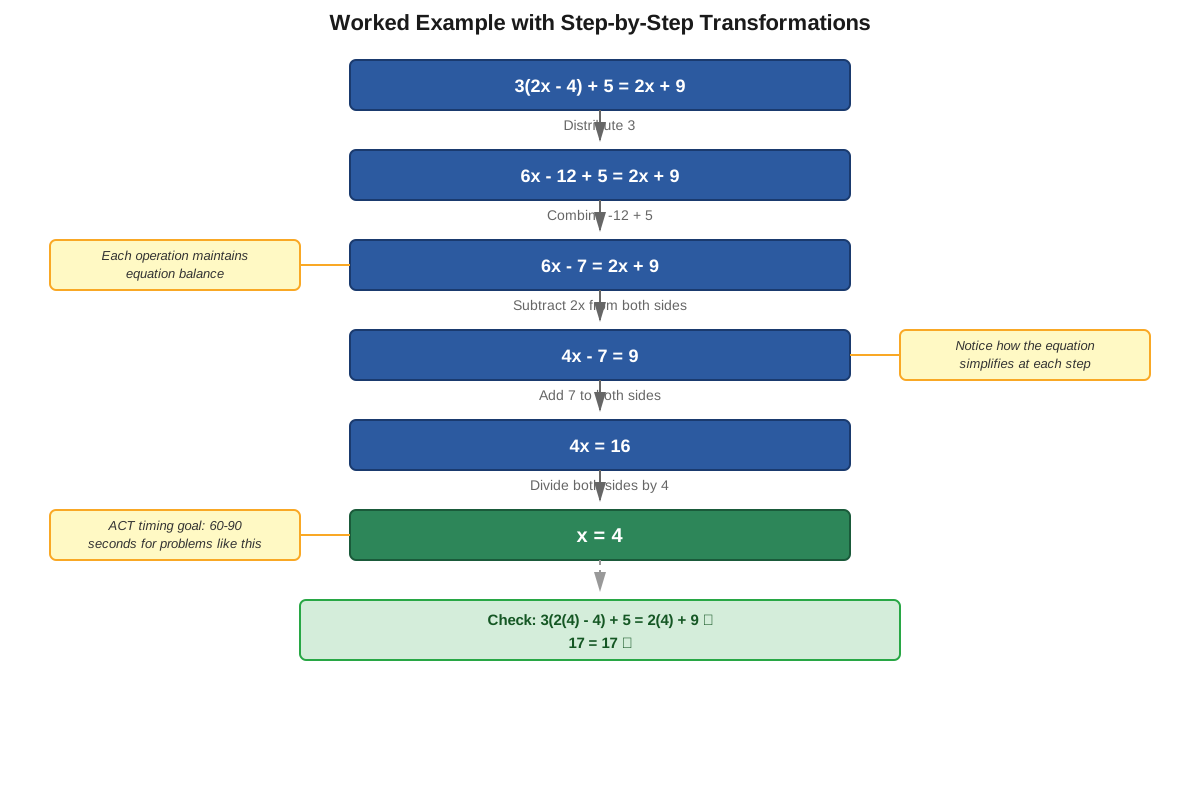
For example, in 5x - 3 = 2x + 9, subtract 2x from both sides to get 3x - 3 = 9, then add 3 to both sides to get 3x = 12, and finally divide by 3 to get x = 4.
Equations with Fractions
When fractional coefficients appear in multi-step equations, two approaches work effectively. The first method involves working with fractions throughout the solution process. The second, often more efficient method, involves multiplying every term in the equation by the least common denominator (LCD) to eliminate fractions entirely.
For example, with the equation (1/2)x + 3 = (1/4)x + 5, the LCD is 4. Multiplying every term by 4 yields 2x + 12 = x + 20, which is much simpler to solve.
Equations with Decimals
Decimal coefficients can be eliminated by multiplying all terms by an appropriate power of 10. For an equation like 0.5x + 0.3 = 0.2x + 0.9, multiplying every term by 10 yields 5x + 3 = 2x + 9, eliminating the decimals and simplifying the solution process.
Special Cases: No Solution and Infinite Solutions
Some multi-step equations result in statements that are always false (no solution) or always true (infinite solutions). When simplifying leads to a false statement like 5 = 3, the equation has no solution. When simplification leads to a true statement like 7 = 7, the equation has infinitely many solutions (the two sides of the equation are equivalent expressions).
Concept Relationships
The concepts within multi-step equations build upon each other in a hierarchical structure. The Distributive Property must be applied first when parentheses are present, which then enables combining like terms on each side of the equation. Once expressions are simplified, the process of moving variables to one side and constants to the other can proceed efficiently. Finally, isolating the variable through inverse operations completes the solution process.
Multi-step equations connect directly to prerequisite knowledge of basic arithmetic operations and order of operations, as these skills are applied repeatedly throughout the solution process. The properties of equality learned in basic algebra provide the theoretical justification for each manipulation performed.
Looking forward, multi-step equations serve as the foundation for systems of equations (where multiple multi-step equations must be solved simultaneously), quadratic equations (which often require multi-step processes to solve), rational equations (which reduce to multi-step equations after clearing denominators), and literal equations (where the same multi-step process is applied to solve for a variable in terms of other variables).
The relationship map flows as follows: Basic Operations → Properties of Equality → One-Step Equations → Multi-Step Equations → Systems of Equations / Quadratic Equations / Rational Equations → Advanced Algebra Topics.
High-Yield Facts
⭐ The goal of solving any multi-step equation is to isolate the variable on one side of the equation through inverse operations
⭐ Always simplify both sides of the equation completely before attempting to move terms across the equals sign
⭐ When distributing a negative sign or negative coefficient, the sign of every term inside the parentheses must change
⭐ Variables can be collected on either side of the equation, but choosing the side that keeps the coefficient positive reduces errors
⭐ Multiplying or dividing both sides of an equation by the same non-zero number maintains equality
- Combining like terms means adding or subtracting coefficients of identical variable terms
- The least common denominator method eliminates fractions and typically simplifies the solution process
- Checking solutions by substituting back into the original equation catches calculation errors
- When an equation simplifies to a false statement (like 0 = 5), the equation has no solution
- When an equation simplifies to a true statement (like 3 = 3), the equation has infinitely many solutions
- The order of operations must be reversed when solving equations: undo addition/subtraction before multiplication/division
- Equations with decimals can be simplified by multiplying all terms by an appropriate power of 10
- Every operation performed on one side of an equation must be performed on the other side to maintain equality
Quick check — test yourself on Multi-step equations so far.
Try Flashcards →Common Misconceptions
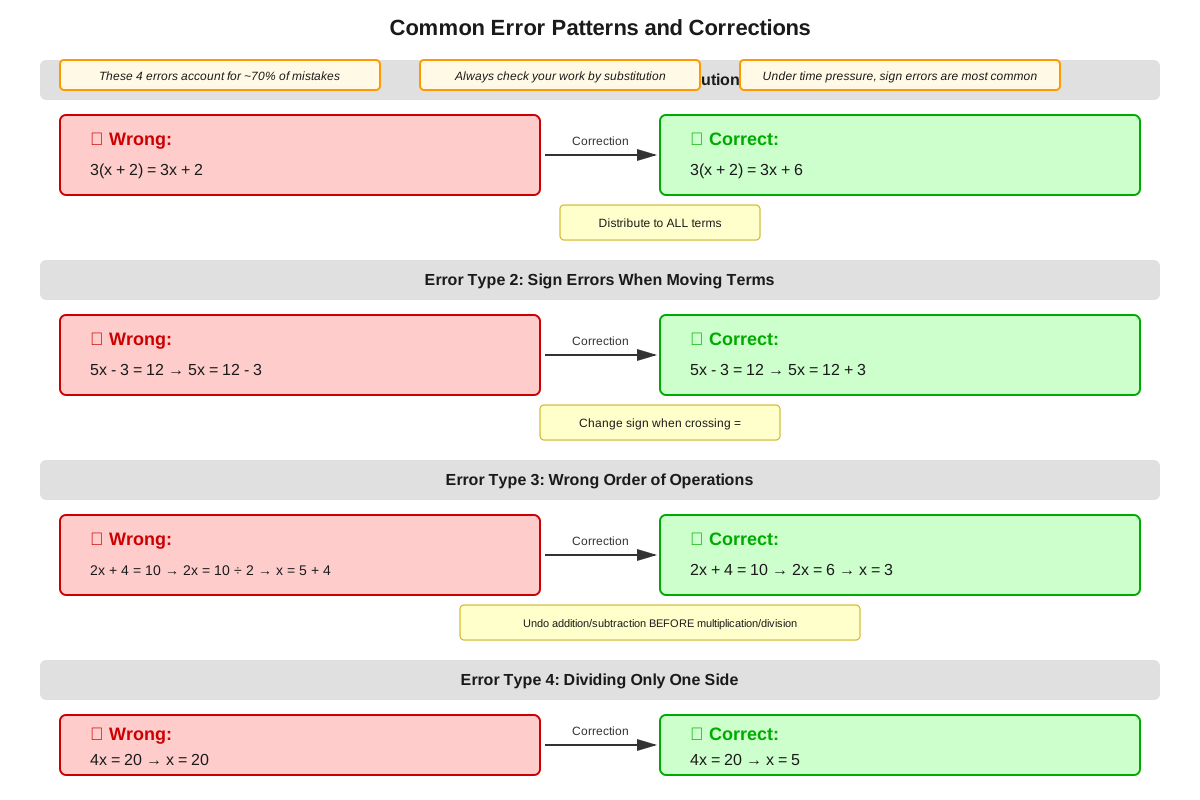
Misconception: When distributing a negative sign, only the first term inside the parentheses becomes negative → Correction: Every term inside the parentheses must have its sign changed when distributing a negative. For example, -(3x - 5) becomes -3x + 5, not -3x - 5.
Misconception: Like terms can be combined across the equals sign without moving them to the same side → Correction: Terms can only be combined when they are on the same side of the equation. To combine terms on opposite sides, one must be moved using addition or subtraction applied to both sides.
Misconception: When solving 2x = 10, dividing only the left side by 2 gives the answer → Correction: Both sides must be divided by 2 to maintain equality. The equation becomes 2x/2 = 10/2, which simplifies to x = 5.
Misconception: The equation 3(x + 2) = 3x + 2 has a solution → Correction: Distributing the left side gives 3x + 6 = 3x + 2. Subtracting 3x from both sides yields 6 = 2, which is false, so this equation has no solution.
Misconception: When moving a term to the other side of the equation, simply changing its sign is sufficient → Correction: While the result appears as if the sign changed, the actual operation is adding or subtracting the term from both sides. Understanding the underlying operation prevents errors in more complex equations.
Misconception: Fractions in equations must be converted to decimals before solving → Correction: Fractions can be eliminated by multiplying all terms by the least common denominator, which is typically more accurate and efficient than converting to decimals.
Misconception: The variable must always be isolated on the left side of the equation → Correction: The variable can be isolated on either side. The equation x = 5 and 5 = x are equivalent, though convention favors writing the variable first.
Worked Examples
Example 1: Equation with Distribution and Variables on Both Sides
Problem: Solve for x: 4(x - 3) + 2x = 5x + 6
Solution:
Step 1: Distribute the 4 on the left side
- 4(x - 3) + 2x = 5x + 6
- 4x - 12 + 2x = 5x + 6
Step 2: Combine like terms on the left side
- 4x + 2x - 12 = 5x + 6
- 6x - 12 = 5x + 6
Step 3: Move variable terms to the left by subtracting 5x from both sides
- 6x - 5x - 12 = 5x - 5x + 6
- x - 12 = 6
Step 4: Move constant terms to the right by adding 12 to both sides
- x - 12 + 12 = 6 + 12
- x = 18
Step 5: Verify by substituting x = 18 into the original equation
- Left side: 4(18 - 3) + 2(18) = 4(15) + 36 = 60 + 36 = 96
- Right side: 5(18) + 6 = 90 + 6 = 96
- Both sides equal 96, confirming x = 18 is correct
Connection to Learning Objectives: This example demonstrates the complete multi-step process including distribution, combining like terms, moving variables, and verification—addressing all core learning objectives.
Example 2: Equation with Fractions
Problem: Solve for x: (2/3)x + 5 = (1/2)x - 1
Solution:
Step 1: Identify the least common denominator (LCD) of 3 and 2, which is 6
Step 2: Multiply every term by 6 to eliminate fractions
- 6 · (2/3)x + 6 · 5 = 6 · (1/2)x + 6 · (-1)
- 4x + 30 = 3x - 6
Step 3: Move variable terms to the left by subtracting 3x from both sides
- 4x - 3x + 30 = 3x - 3x - 6
- x + 30 = -6
Step 4: Move constant terms to the right by subtracting 30 from both sides
- x + 30 - 30 = -6 - 30
- x = -36
Step 5: Verify by substituting x = -36 into the original equation
- Left side: (2/3)(-36) + 5 = -24 + 5 = -19
- Right side: (1/2)(-36) - 1 = -18 - 1 = -19
- Both sides equal -19, confirming x = -36 is correct
Connection to Learning Objectives: This example illustrates the efficient strategy of eliminating fractions using the LCD method, demonstrating mastery of equations with fractional coefficients and the verification process.
Exam Strategy
When approaching multi-step equations on the ACT Math test, time management is crucial. Allocate approximately 60-90 seconds per multi-step equation problem. If a problem requires more time, mark it and return after completing easier questions.
Trigger words and phrases that indicate multi-step equations include: "solve for x," "find the value of," "what is x when," "if the equation is true," and "determine the solution." Word problems containing phrases like "more than," "less than," "times as much," or "combined total" often require setting up and solving multi-step equations.
Process-of-elimination strategies work particularly well when answer choices are provided. Substitute each answer choice back into the original equation to verify which one makes the equation true. This "backsolving" approach can be faster than algebraic manipulation, especially when the algebra appears complex. Start with choice C (the middle value) when answer choices are arranged numerically, as this can help eliminate multiple choices efficiently.
Exam Tip: Always perform operations on both sides of the equation simultaneously. Write the operation between the two sides (like "+ 3" or "÷ 2") to maintain organization and reduce errors.
Watch for common traps in answer choices. The ACT often includes incorrect answers that result from common errors: forgetting to distribute to all terms, combining unlike terms, or making sign errors when moving terms. If an answer seems too easy or appears very early in the solution process, verify it carefully.
When equations contain fractions, quickly assess whether clearing denominators or working with fractions throughout will be more efficient. For simple fractions with small denominators, clearing fractions is almost always faster. For complex fractions or when only one term contains a fraction, working with fractions may be more efficient.
Time-saving techniques include recognizing when to collect variables on the right side instead of the left (when the right side has a larger coefficient), combining multiple steps mentally when possible, and using mental math for simple operations rather than writing every step.
Memory Techniques
DISC - Remember the solution sequence: Distribute, Isolate variables on one side, Simplify constants on the other, Check your answer.
"Keep the Balance" - Visualize an equation as a balanced scale. Whatever you do to one side, you must do to the other to keep it balanced. This mental image prevents the common error of operating on only one side.
"Opposite Operations" - To undo an operation, apply its opposite: addition ↔ subtraction, multiplication ↔ division. When isolating a variable, work backwards through the order of operations.
"PEMDAS Reversed" - When solving equations, reverse the order of operations: undo addition/subtraction first (opposite of MD), then undo multiplication/division (opposite of AS), then deal with exponents and parentheses.
The "Sign Change Illusion" - When moving terms across the equals sign, remember you're not actually changing the sign—you're adding or subtracting the term from both sides. The result looks like a sign change, but understanding the underlying operation prevents errors.
Fraction Elimination Chant - "Find the LCD, multiply through, fractions gone, easier to do." This simple rhythm helps remember the efficient process for handling fractional equations.
Summary
Multi-step equations represent a fundamental algebraic skill that appears frequently on the ACT Math test and serves as the foundation for more advanced mathematical concepts. Solving these equations requires a systematic approach: simplify both sides by distributing and combining like terms, move all variable terms to one side and all constants to the other, isolate the variable using inverse operations, and verify the solution. Success depends on maintaining the balance of equality by performing identical operations on both sides, correctly applying the distributive property (especially with negative signs), and recognizing special cases where equations have no solution or infinitely many solutions. The most efficient strategies involve eliminating fractions by multiplying by the LCD, choosing which side to collect variables on based on keeping coefficients positive, and checking answers by substitution. Mastery of multi-step equations not only secures direct points on the ACT but also builds the algebraic fluency necessary for tackling systems of equations, quadratic equations, and function problems throughout the Math section.
Key Takeaways
- Multi-step equations require systematic application of inverse operations while maintaining equality on both sides of the equation
- Always simplify both sides completely (distribute and combine like terms) before attempting to isolate the variable
- Distributing negative signs or coefficients changes the sign of every term inside the parentheses
- Eliminating fractions by multiplying all terms by the LCD typically simplifies the solution process significantly
- Verification by substituting the solution back into the original equation catches calculation errors and confirms correctness
- Variables can be collected on either side, but choosing the side that keeps coefficients positive reduces sign errors
- Special cases exist: equations that simplify to false statements have no solution, while those that simplify to true statements have infinite solutions
Related Topics
Systems of Linear Equations: Building on multi-step equation skills, systems require solving multiple equations simultaneously using substitution or elimination methods. Mastering multi-step equations makes the algebraic manipulation in systems much more manageable.
Quadratic Equations: These second-degree equations often require multi-step processes including factoring, completing the square, or applying the quadratic formula. The algebraic manipulation skills developed through multi-step equations transfer directly.
Literal Equations: These equations involve solving for one variable in terms of other variables (like solving A = πr² for r). The same multi-step process applies, but the answer contains variables rather than numbers.
Rational Equations: Equations containing algebraic fractions reduce to multi-step equations after clearing denominators. The skills learned here provide the foundation for this more advanced topic.
Linear Inequalities: The process for solving multi-step inequalities mirrors that of multi-step equations, with the additional consideration of reversing inequality signs when multiplying or dividing by negative numbers.
Practice CTA
Now that you've mastered the concepts, strategies, and techniques for solving multi-step equations, it's time to put your knowledge into action! Work through the practice questions to reinforce these skills and build the speed and accuracy needed for ACT success. Each problem you solve strengthens your algebraic foundation and increases your confidence. The flashcards will help you memorize key facts and strategies for quick recall during the exam. Remember, consistent practice transforms understanding into mastery—you've got this!
Sign up free to keep reading
Create a free AnvayaPrep account to finish this ACT guide on Multi-step equations — plus flashcards and practice questions.