Overview
The slope-intercept form of a linear equation is one of the most fundamental and frequently tested concepts in ACT Math. This algebraic representation, written as y = mx + b, provides a direct way to understand and graph linear relationships by immediately revealing both the rate of change (slope) and the starting point (y-intercept) of a line. Mastering this form is not merely about memorizing a formula—it's about developing the ability to quickly interpret, manipulate, and apply linear relationships in various contexts.
On the ACT, slope-intercept form appears in approximately 10-15% of all algebra questions, making it a high-yield topic that demands thorough understanding. Questions may ask students to identify the slope or y-intercept from an equation, convert between different forms of linear equations, write equations from graphs or word problems, or interpret the meaning of slope and y-intercept in real-world contexts. The beauty of this form lies in its transparency: unlike standard form or point-slope form, slope-intercept form allows immediate visual interpretation of a line's behavior.
Understanding slope-intercept form serves as a gateway to more advanced mathematical concepts tested on the ACT. It connects directly to systems of equations, inequalities, functions, and coordinate geometry. Students who master this topic gain a powerful tool for solving problems involving rates of change, making predictions, and analyzing relationships between variables—skills that appear throughout the entire mathematics section of the exam.
Learning Objectives
- [ ] Identify when slope-intercept form is being tested in ACT questions
- [ ] Explain the core rule or strategy behind slope-intercept form
- [ ] Apply slope-intercept form to ACT-style questions accurately
- [ ] Convert between slope-intercept form and other linear equation forms (standard form, point-slope form)
- [ ] Determine the equation of a line given specific information (two points, slope and point, graph, etc.)
- [ ] Interpret the real-world meaning of slope and y-intercept in context-based problems
- [ ] Graph linear equations efficiently using slope-intercept form
Prerequisites
- Basic algebraic manipulation: Ability to solve for variables, combine like terms, and work with fractions—essential for isolating y and converting between equation forms
- Coordinate plane understanding: Knowledge of x and y axes, ordered pairs, and plotting points—necessary for graphing lines and interpreting visual representations
- Slope concept: Understanding slope as rise over run and rate of change—forms the foundation for the "m" component in y = mx + b
- Equation solving: Proficiency in solving one-variable equations—required for finding intercepts and converting equation forms
Why This Topic Matters
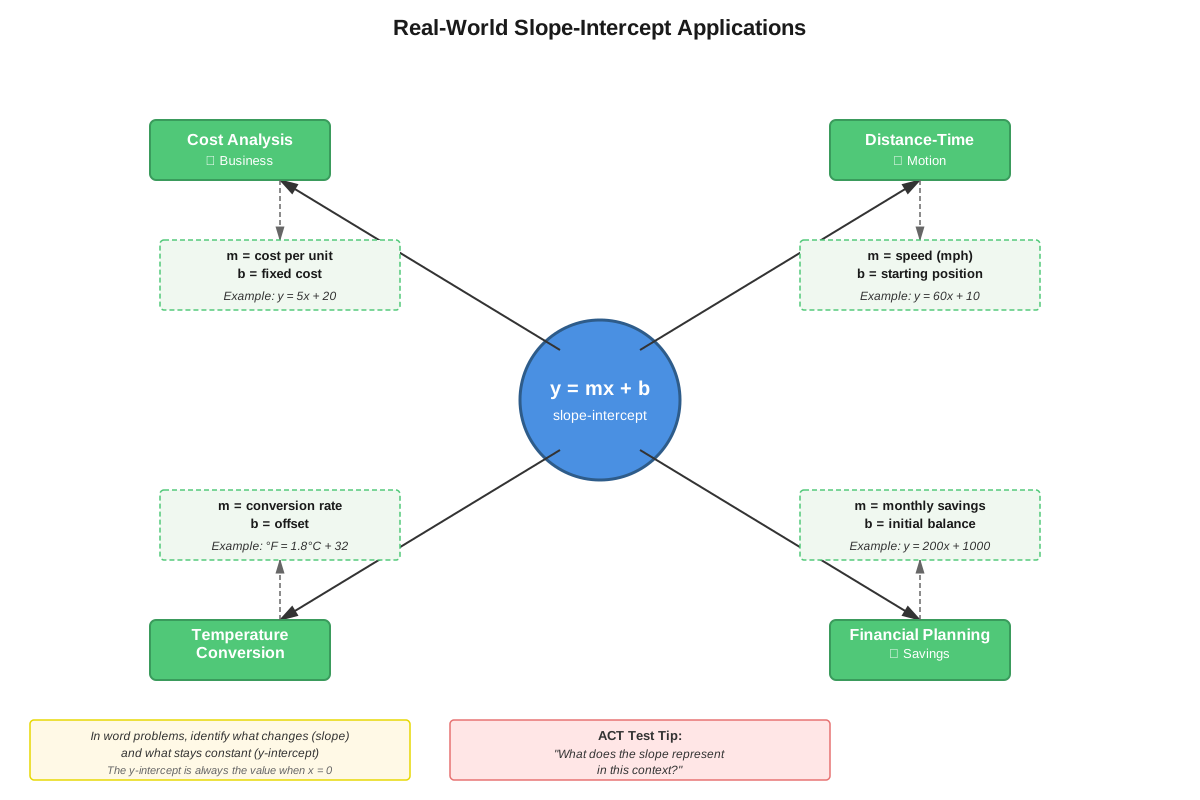
In real-world applications, slope-intercept form models countless practical situations. Business analysts use it to represent cost structures where b represents fixed costs and m represents variable costs per unit. Scientists employ it to describe linear relationships in experiments, such as temperature conversion (°F = 1.8°C + 32) or distance-time relationships for constant-speed motion. Financial planners use linear equations to project savings growth, calculate loan payments, and analyze investment returns over time.
On the ACT Math section, slope-intercept form appears in multiple question types across 4-6 questions per test. These include direct identification questions ("What is the slope of the line y = 3x - 7?"), conversion problems ("Write 2x + 3y = 12 in slope-intercept form"), graphing questions ("Which graph represents y = -½x + 4?"), and word problems requiring equation construction from verbal descriptions. The topic frequently appears in questions numbered 20-45, spanning medium to challenging difficulty levels.
The ACT particularly favors questions that combine slope-intercept form with real-world contexts. Students might encounter problems about phone plans (monthly fee plus per-minute charges), rental costs (base fee plus hourly rates), or scientific relationships. Additionally, the exam tests whether students can work backwards—given a graph or table, can they determine the equation? This bidirectional fluency separates high scorers from average performers.
Core Concepts
The Slope-Intercept Form Equation
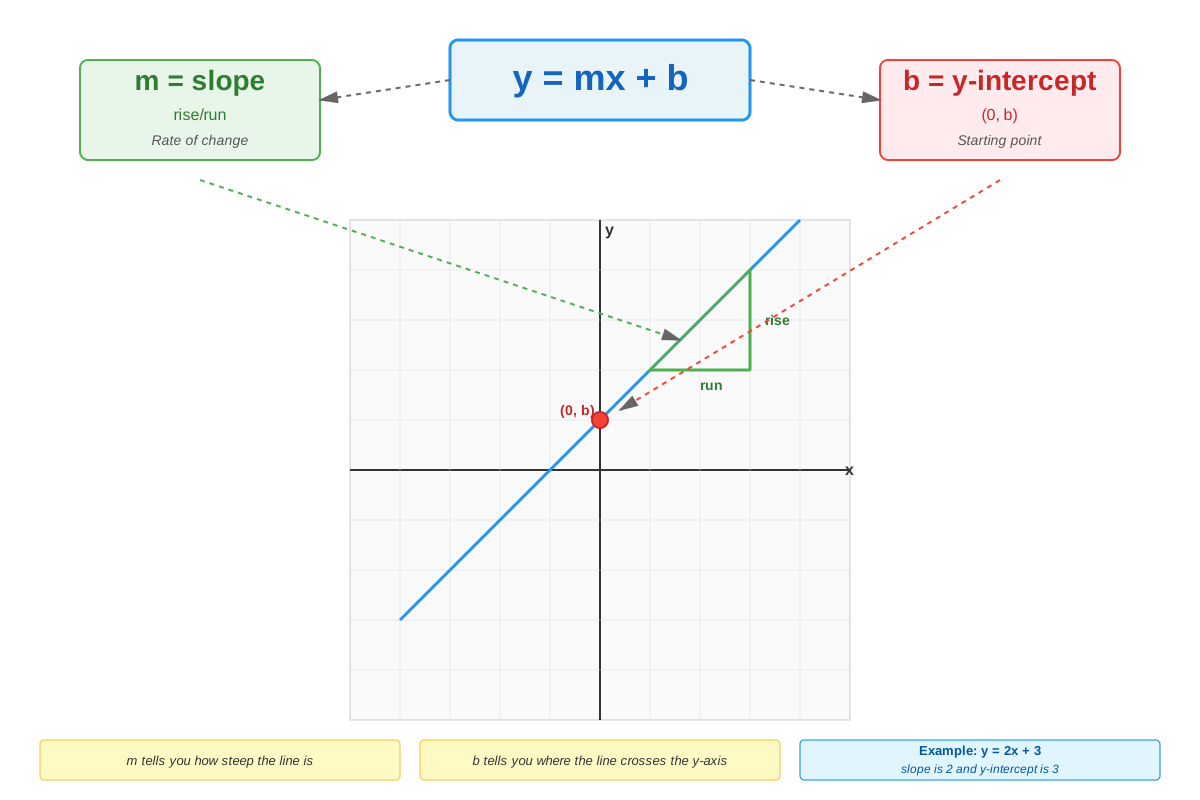
The slope-intercept form is expressed as:
y = mx + bWhere:
- y represents the dependent variable (output value)
- x represents the independent variable (input value)
- m represents the slope (rate of change)
- b represents the y-intercept (the y-value when x = 0)
This form is called "slope-intercept" because it explicitly displays both the slope (m) and the y-intercept (b) of the line. The equation is solved for y, making it immediately useful for graphing and analysis.
Understanding Slope (m)
The slope quantifies how steep a line is and in which direction it travels. Mathematically, slope represents the ratio of vertical change to horizontal change:
m = (change in y)/(change in x) = (y₂ - y₁)/(x₂ - x₁)Slope characteristics:
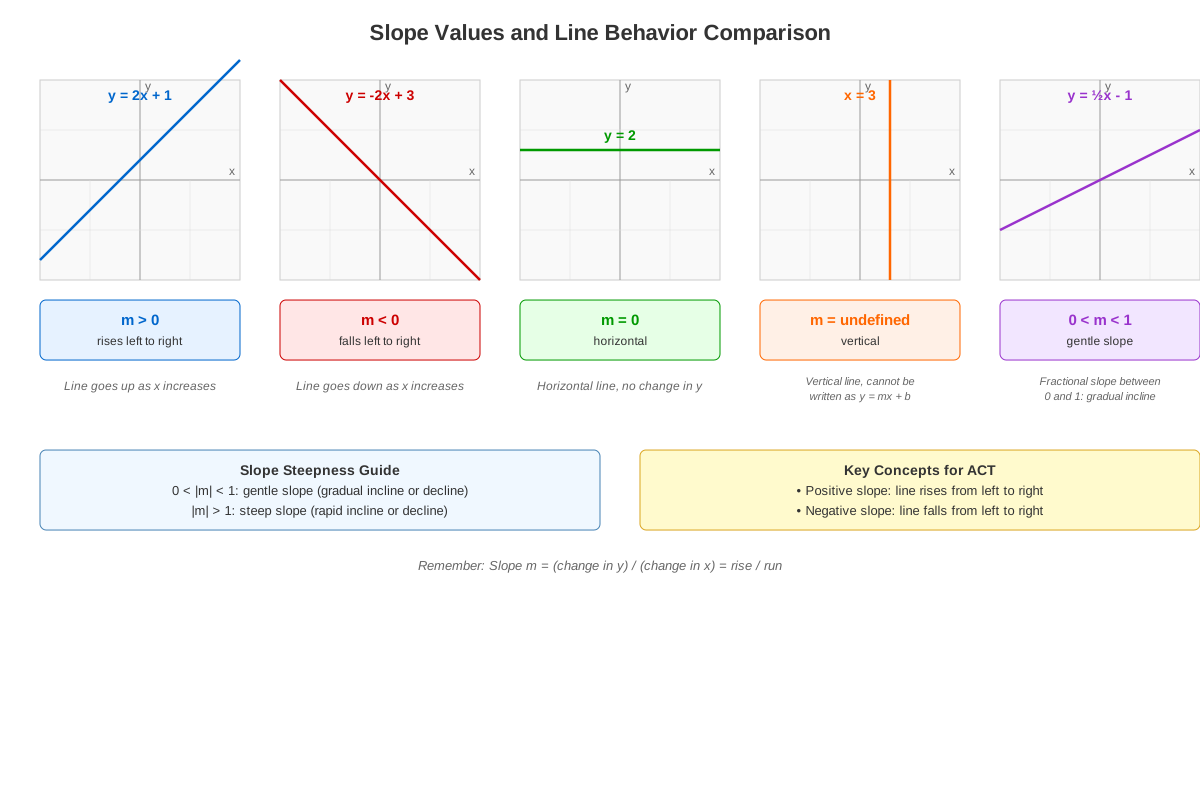
- Positive slope: Line rises from left to right (m > 0)
- Negative slope: Line falls from left to right (m < 0)
- Zero slope: Horizontal line (m = 0, equation becomes y = b)
- Undefined slope: Vertical line (cannot be written in slope-intercept form)
The slope tells us that for every 1-unit increase in x, the y-value changes by m units. For example, in y = 3x + 2, every time x increases by 1, y increases by 3. If the equation were y = -2x + 5, every 1-unit increase in x would result in a 2-unit decrease in y.
Understanding Y-Intercept (b)
The y-intercept is the point where the line crosses the y-axis. This occurs when x = 0, making the y-intercept easy to identify: simply substitute x = 0 into the equation, and y = b. Geometrically, the y-intercept is the coordinate point (0, b).
In real-world problems, the y-intercept often represents:
- Initial value or starting amount
- Fixed cost or base fee
- The value of the dependent variable when the independent variable is zero
For instance, in a phone plan equation y = 0.10x + 25, where x is minutes used and y is total cost, the y-intercept b = 25 represents the monthly base fee charged regardless of usage.
Graphing Using Slope-Intercept Form
Slope-intercept form makes graphing efficient through a two-step process:
- Plot the y-intercept: Mark the point (0, b) on the y-axis
- Use the slope to find additional points: From the y-intercept, move according to the slope ratio (rise/run)
For example, to graph y = (2/3)x - 1:
- Plot the y-intercept at (0, -1)
- From this point, rise 2 units and run 3 units right to reach (3, 1)
- Draw a line through these points
When the slope is negative, move down (negative rise) or left (negative run). For y = -4x + 3, from (0, 3), you could move down 4 and right 1, or up 4 and left 1.
Converting to Slope-Intercept Form
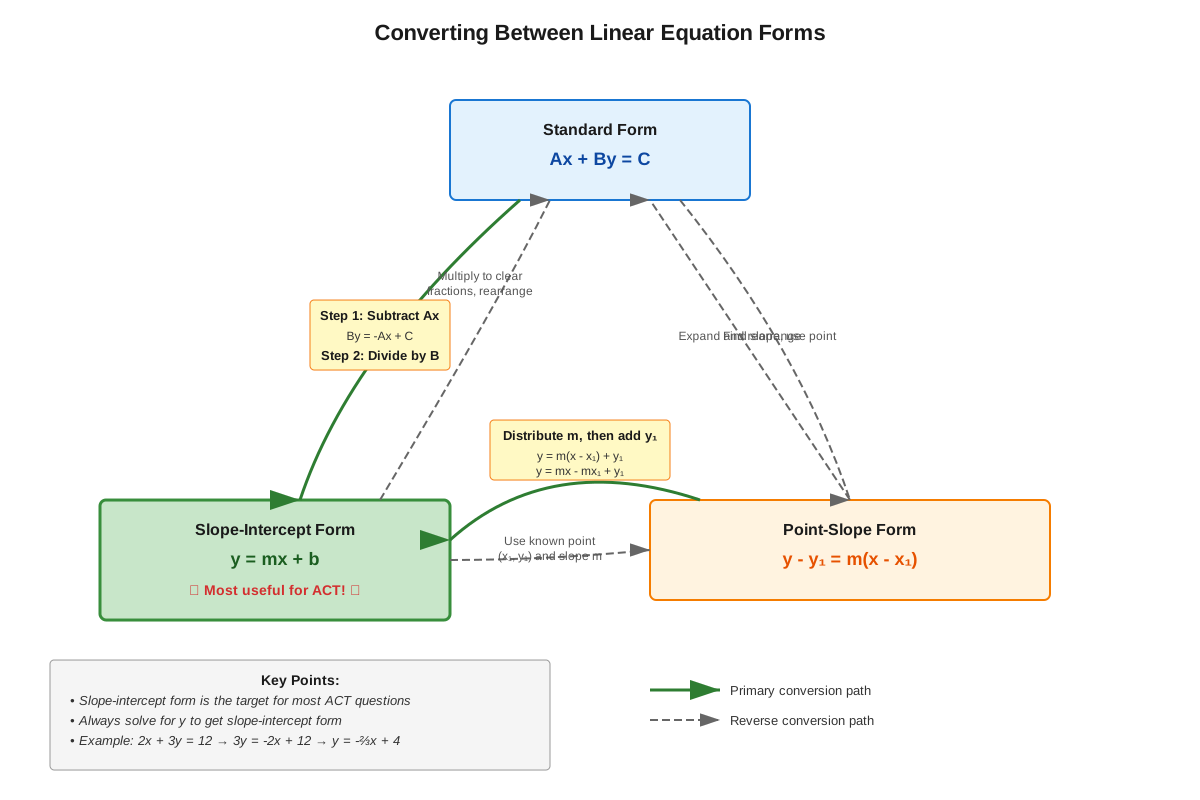
Many ACT questions provide equations in standard form (Ax + By = C) and require conversion to slope-intercept form. The process involves isolating y:
Steps for conversion:
- Move the x-term to the right side of the equation
- Divide every term by the coefficient of y
- Simplify to y = mx + b format
Example: Convert 3x + 2y = 8 to slope-intercept form
- Subtract 3x: 2y = -3x + 8
- Divide by 2: y = -3/2 x + 4
The slope is -3/2 and the y-intercept is 4.
Writing Equations from Given Information
The ACT frequently tests the ability to construct equations from various types of information:
| Given Information | Strategy |
|---|---|
| Slope and y-intercept | Direct substitution into y = mx + b |
| Slope and one point | Substitute m and the point coordinates, solve for b |
| Two points | Calculate slope using (y₂-y₁)/(x₂-x₁), then use either point to find b |
| Graph | Identify y-intercept visually, count rise/run for slope |
| Table of values | Find slope from any two points, identify or calculate b |
Example: Write the equation of a line with slope 4 passing through (2, 5)
- Start with y = 4x + b
- Substitute the point: 5 = 4(2) + b
- Solve: 5 = 8 + b, so b = -3
- Final equation: y = 4x - 3
Parallel and Perpendicular Lines
Understanding slope relationships helps solve comparison problems:
- Parallel lines: Have identical slopes (m₁ = m₂)
- Example: y = 2x + 3 and y = 2x - 5 are parallel
- Perpendicular lines: Have slopes that are negative reciprocals (m₁ × m₂ = -1)
- Example: y = 3x + 1 and y = -1/3 x + 7 are perpendicular
These relationships appear in ACT questions asking students to identify or write equations of lines with specific geometric relationships to given lines.
Concept Relationships
The components of slope-intercept form work together systematically. The slope (m) determines the line's direction and steepness → this combines with the y-intercept (b) to establish the line's exact position → together, they create a unique linear equation that can be graphed or analyzed.
Slope-intercept form connects to prerequisite knowledge of the coordinate plane by providing a method to translate algebraic equations into geometric representations. The concept of slope as rise over run builds directly on understanding coordinate pairs and how to measure distances between points. Basic algebra skills enable the manipulation required to convert between forms and solve for unknown values.
This topic serves as a foundation for more advanced concepts. Understanding slope-intercept form → enables work with systems of linear equations (where students must analyze multiple lines simultaneously) → which leads to linear inequalities (shading regions based on linear boundaries) → and ultimately connects to functions (where y = mx + b represents a linear function). The interpretation skills developed here transfer directly to analyzing rates of change in more complex scenarios and understanding direct variation relationships.
The relationship map: Coordinate Plane → Slope Calculation → Slope-Intercept Form → Graphing Lines → Systems of Equations → Linear Functions → Applied Problem Solving
Quick check — test yourself on Slope-intercept form so far.
Try Flashcards →High-Yield Facts
⭐ The slope-intercept form is y = mx + b, where m is the slope and b is the y-intercept
⭐ The y-intercept (b) is the y-coordinate where the line crosses the y-axis (when x = 0)
⭐ Positive slope means the line rises from left to right; negative slope means it falls
⭐ To convert from standard form (Ax + By = C) to slope-intercept form, isolate y by solving for it
⭐ Parallel lines have equal slopes; perpendicular lines have slopes that are negative reciprocals
- The slope represents the rate of change: how much y changes for each 1-unit change in x
- A horizontal line has slope m = 0 and equation y = b (no x-term)
- A vertical line has undefined slope and cannot be written in slope-intercept form (equation is x = a)
- To find the equation given two points, first calculate slope, then substitute one point to find b
- In word problems, the slope often represents a rate (cost per item, speed, growth rate) while the y-intercept represents an initial value or fixed amount
- The x-intercept can be found by setting y = 0 and solving for x in the slope-intercept equation
- Steeper lines have larger absolute values of slope (|m| is greater)
Common Misconceptions
Misconception: The slope is always the first number in the equation → Correction: The slope is the coefficient of x, which may not appear first if the equation isn't properly arranged. In y = 5 + 2x, the slope is 2, not 5. Always identify the coefficient multiplying x.
Misconception: The y-intercept is a single number → Correction: While b is a number, the y-intercept as a point is the coordinate (0, b). When asked for "the y-intercept," context determines whether to give b or (0, b), though ACT typically accepts the y-coordinate value.
Misconception: A line with equation y = 3x has no y-intercept → Correction: Every non-vertical line has a y-intercept. When no constant term appears, b = 0, meaning the line passes through the origin (0, 0). The equation is actually y = 3x + 0.
Misconception: Slope is always calculated as (x₂ - x₁)/(y₂ - y₁) → Correction: This reverses the correct formula. Slope is always rise over run: (y₂ - y₁)/(x₂ - x₁). The change in y goes in the numerator, change in x in the denominator.
Misconception: To find slope from an equation like 2y = 6x + 8, the slope is 6 → Correction: The equation must be in proper slope-intercept form (y = mx + b) first. Divide everything by 2 to get y = 3x + 4, revealing the slope is 3, not 6.
Misconception: Perpendicular lines have slopes that are opposite signs → Correction: Perpendicular lines have slopes that are negative reciprocals (flip and change sign). Lines with slopes 2 and -2 are not perpendicular; slopes 2 and -1/2 are perpendicular because 2 × (-1/2) = -1.
Misconception: In word problems, the larger number is always the slope → Correction: The slope represents rate of change, while the y-intercept represents initial value. A problem stating "a $50 membership fee plus $3 per visit" has slope m = 3 and y-intercept b = 50, not the reverse.
Worked Examples
Example 1: Converting and Interpreting
Problem: A phone company charges according to the equation 4x + 2y = 80, where x represents the number of text messages and y represents the total monthly cost in dollars. Write this equation in slope-intercept form and interpret the meaning of the slope and y-intercept.
Solution:
Step 1: Convert to slope-intercept form by isolating y
- Start with: 4x + 2y = 80
- Subtract 4x from both sides: 2y = -4x + 80
- Divide every term by 2: y = -2x + 40
Step 2: Identify components
- Slope (m) = -2
- Y-intercept (b) = 40
Step 3: Interpret in context
- The y-intercept of 40 means the base monthly cost is $40 when no text messages are sent (x = 0)
- The slope of -2 is unusual and suggests an error in the problem setup, as costs shouldn't decrease with more usage. However, mathematically, it means that for each additional text message, the cost decreases by $2, which might represent a credit system or rebate structure.
Connection to learning objectives: This problem tests the ability to convert between forms (standard to slope-intercept), identify components of the equation, and interpret their real-world meaning—all core ACT skills.
Example 2: Writing an Equation from Two Points
Problem: A line passes through the points (-3, 7) and (5, -1). Write the equation of this line in slope-intercept form.
Solution:
Step 1: Calculate the slope using the two points
- Formula: m = (y₂ - y₁)/(x₂ - x₁)
- Let (-3, 7) be point 1 and (5, -1) be point 2
- m = (-1 - 7)/(5 - (-3))
- m = -8/8
- m = -1
Step 2: Use the slope and one point to find b
- Start with y = mx + b
- Substitute m = -1: y = -1x + b or y = -x + b
- Use point (5, -1): -1 = -1(5) + b
- Solve: -1 = -5 + b
- Add 5 to both sides: b = 4
Step 3: Write the final equation
- y = -x + 4 or y = -1x + 4
Step 4: Verify using the other point (optional but recommended)
- Check with (-3, 7): y = -(-3) + 4 = 3 + 4 = 7 ✓
Connection to learning objectives: This demonstrates the complete process of constructing a slope-intercept equation from coordinate information, a frequent ACT question type that combines multiple skills.
Exam Strategy
When approaching ACT slope-intercept form questions, first identify what the question is asking: Are you finding slope or y-intercept? Converting forms? Writing an equation? Interpreting meaning? This classification determines your approach.
Trigger words and phrases to recognize:
- "Write in slope-intercept form" → Isolate y
- "What is the slope" → Identify the coefficient of x
- "Where does the line cross the y-axis" → Find b
- "Passes through" + two points → Calculate slope, then find b
- "Parallel to" → Use the same slope as the given line
- "Perpendicular to" → Use the negative reciprocal of the given slope
- "Initial value" or "starting amount" → This is the y-intercept
- "Rate of change" or "per unit" → This is the slope
Process-of-elimination strategies:
- If answer choices are equations, substitute a known point to eliminate wrong answers quickly
- For graphing questions, check the y-intercept first (easiest to verify visually), then eliminate answers with wrong slopes
- When converting forms, eliminate any answer where the coefficient of y isn't 1
- For word problems, identify which quantity is the rate (slope) versus initial value (y-intercept) to eliminate reversed answers
Time allocation advice:
Direct identification questions (finding m or b from an equation) should take 15-30 seconds. Conversion problems typically require 30-45 seconds. Writing equations from given information may take 45-90 seconds depending on complexity. Don't spend more than 90 seconds on any single slope-intercept problem—if stuck, mark it and return later. These questions are designed to be solved quickly once you recognize the pattern.
Exam Tip: Always write equations in proper y = mx + b form before identifying slope or y-intercept. Many wrong answers exploit students who identify coefficients from improperly arranged equations.
Memory Techniques
Mnemonic for slope-intercept form components: "You Must Xamine Both" reminds you that y = mx + b, with the order of variables and constants.
Slope direction memory: "Positive slopes Point Up" (as you move left to right). Conversely, negative slopes point down.
Parallel vs. Perpendicular: "Parallel lines are para-mount to being the same" (same slope). "Perpendicular lines flip and negate" (negative reciprocal).
Visualization strategy for y-intercept: Picture the y-axis as a "starting line" in a race. The y-intercept is where your line "starts" on this vertical starting line. This helps remember that b represents the initial value.
Slope as stairs: Visualize slope as climbing stairs. The numerator (rise) is how many steps up or down, the denominator (run) is how many steps forward. A slope of 3/4 means climb 3 steps up for every 4 steps forward.
Converting forms acronym - SIDE: Subtract the x-term, Isolate the y-term, Divide by y's coefficient, Express as y = mx + b.
Summary
Slope-intercept form (y = mx + b) is a fundamental representation of linear equations that explicitly displays both the slope (m) and y-intercept (b) of a line. The slope quantifies the rate of change—how much y changes for each unit change in x—while the y-intercept identifies where the line crosses the y-axis. This form is particularly valuable because it enables quick graphing, immediate interpretation of linear relationships, and efficient problem-solving. On the ACT, students must demonstrate fluency in multiple skills: identifying slope and y-intercept from equations, converting between equation forms (especially from standard form), writing equations from various types of given information, graphing lines, and interpreting the real-world meaning of m and b in context. Mastery requires understanding that parallel lines share identical slopes while perpendicular lines have slopes that are negative reciprocals. Success on ACT questions depends on recognizing trigger words, working systematically through conversions, and maintaining accuracy with algebraic manipulation.
Key Takeaways
- The slope-intercept form y = mx + b immediately reveals both the slope (m) and y-intercept (b) of a linear equation
- Slope represents rate of change (rise/run), while y-intercept represents the starting value when x = 0
- Converting from standard form requires isolating y through algebraic manipulation
- Parallel lines have equal slopes; perpendicular lines have slopes that are negative reciprocals (product = -1)
- Writing equations from given information requires calculating slope first, then using a point to determine b
- In real-world problems, identify which quantity represents a rate (slope) versus an initial amount (y-intercept)
- Always verify that equations are in proper y = mx + b form before identifying components
Related Topics
Systems of Linear Equations: Building on slope-intercept form, systems involve finding where two or more lines intersect. Understanding how to manipulate and graph equations in slope-intercept form makes solving systems by graphing or substitution significantly easier.
Linear Inequalities: These extend slope-intercept concepts to regions of the coordinate plane rather than single lines. The same graphing techniques apply, with additional consideration for boundary lines and shading.
Functions and Function Notation: Linear equations in slope-intercept form represent linear functions, where f(x) = mx + b. This connection bridges algebra and function concepts tested throughout the ACT.
Point-Slope Form: An alternative representation y - y₁ = m(x - x₁) that's particularly useful when given a point and slope. Understanding slope-intercept form makes converting between these forms straightforward.
Quadratic Functions: While more complex, quadratic functions build on the coordinate graphing and interpretation skills developed through linear equations, extending to parabolas rather than straight lines.
Practice CTA
Now that you've mastered the core concepts of slope-intercept form, it's time to solidify your understanding through active practice. Work through the practice questions to test your ability to identify, convert, and apply these concepts under exam-like conditions. Use the flashcards to reinforce quick recall of key definitions and formulas. Remember, the ACT rewards both accuracy and speed—consistent practice with these materials will build the automaticity you need to confidently tackle any slope-intercept question on test day. You've got this!
Sign up free to keep reading
Create a free AnvayaPrep account to finish this ACT guide on Slope-intercept form — plus flashcards and practice questions.