Overview
Radical equations are algebraic equations in which the variable appears under a radical symbol (most commonly a square root, but also cube roots or higher-order roots). These equations require specific solution techniques that differ from standard linear or quadratic equations. On the ACT Math test, radical equations represent a critical skill that bridges fundamental algebra with more advanced problem-solving, appearing in approximately 2-4 questions per exam administration.
Understanding how to solve ACT radical equations is essential because these problems test multiple mathematical competencies simultaneously: algebraic manipulation, the concept of inverse operations, domain restrictions, and the crucial skill of verifying solutions. The ACT frequently embeds radical equations within word problems, geometric contexts, or multi-step algebraic scenarios, making them high-yield topics that can significantly impact your score. Students who master radical equations demonstrate mathematical maturity and problem-solving flexibility that extends beyond memorized procedures.
The relationship between radical equations and other Math concepts is substantial. They connect directly to exponent rules (since radicals are fractional exponents), quadratic equations (which often result from solving radical equations), function composition, and domain/range concepts. Additionally, radical equations frequently appear alongside rational expressions and absolute value equations in the ACT's Preparing for Higher Math category, making them a cornerstone of the algebra content domain that comprises roughly 35-40% of the entire Math section.
Learning Objectives
- [ ] Identify when Radical equations is being tested
- [ ] Explain the core rule or strategy behind Radical equations
- [ ] Apply Radical equations to ACT-style questions accurately
- [ ] Isolate radical expressions systematically before eliminating the radical
- [ ] Verify all solutions by substituting back into the original equation to identify extraneous solutions
- [ ] Solve equations containing multiple radicals using strategic isolation techniques
- [ ] Recognize domain restrictions that limit valid solutions
Prerequisites
- Basic algebraic manipulation: Ability to add, subtract, multiply, and divide algebraic expressions; essential for isolating variables and simplifying equations
- Exponent rules: Understanding that radicals can be expressed as fractional exponents (√x = x^(1/2)); necessary for comprehending why squaring eliminates square roots
- Quadratic equations: Proficiency in solving equations like ax² + bx + c = 0 using factoring, completing the square, or the quadratic formula; required because squaring radical equations often produces quadratics
- Order of operations: Mastery of PEMDAS to correctly sequence solution steps and avoid algebraic errors
- Function evaluation: Ability to substitute values into expressions; critical for checking solutions
Why This Topic Matters
Radical equations appear in numerous real-world contexts, from physics formulas (such as calculating velocity from kinetic energy: v = √(2KE/m)) to engineering applications involving electrical circuits, pendulum periods, and geometric relationships. Financial calculations involving compound interest and growth rates also frequently employ radical expressions. Understanding how to manipulate and solve these equations provides practical problem-solving tools applicable across STEM fields and quantitative reasoning contexts.
On the ACT Math test, radical equations appear with high frequency and predictability. Expect 2-4 questions per exam that directly test radical equation solving, with additional questions incorporating radicals within broader algebraic contexts. These questions typically appear in positions 30-50 of the 60-question Math section, placing them in the medium-to-difficult range. The ACT tests radical equations through direct "solve for x" problems, word problems requiring equation setup, and questions asking students to identify equivalent expressions or verify solutions.
Common ACT question formats include: asking for the solution set of an equation containing one or two radicals; presenting a radical equation within a geometry problem (such as finding side lengths); embedding radical equations in real-world scenarios (distance, rate, time problems); and testing whether students can identify extraneous solutions. The ACT particularly favors questions where squaring both sides introduces extraneous solutions, as this tests conceptual understanding rather than mere procedural knowledge.
Core Concepts
Definition and Structure of Radical Equations
A radical equation is any equation containing a variable within a radical expression. The most common form involves square roots: √(expression) = value, but the ACT also tests cube roots and occasionally fourth roots. The fundamental challenge is that radicals cannot be directly manipulated using standard algebraic operations—the radical must first be eliminated through inverse operations.
The general form of a simple radical equation is:
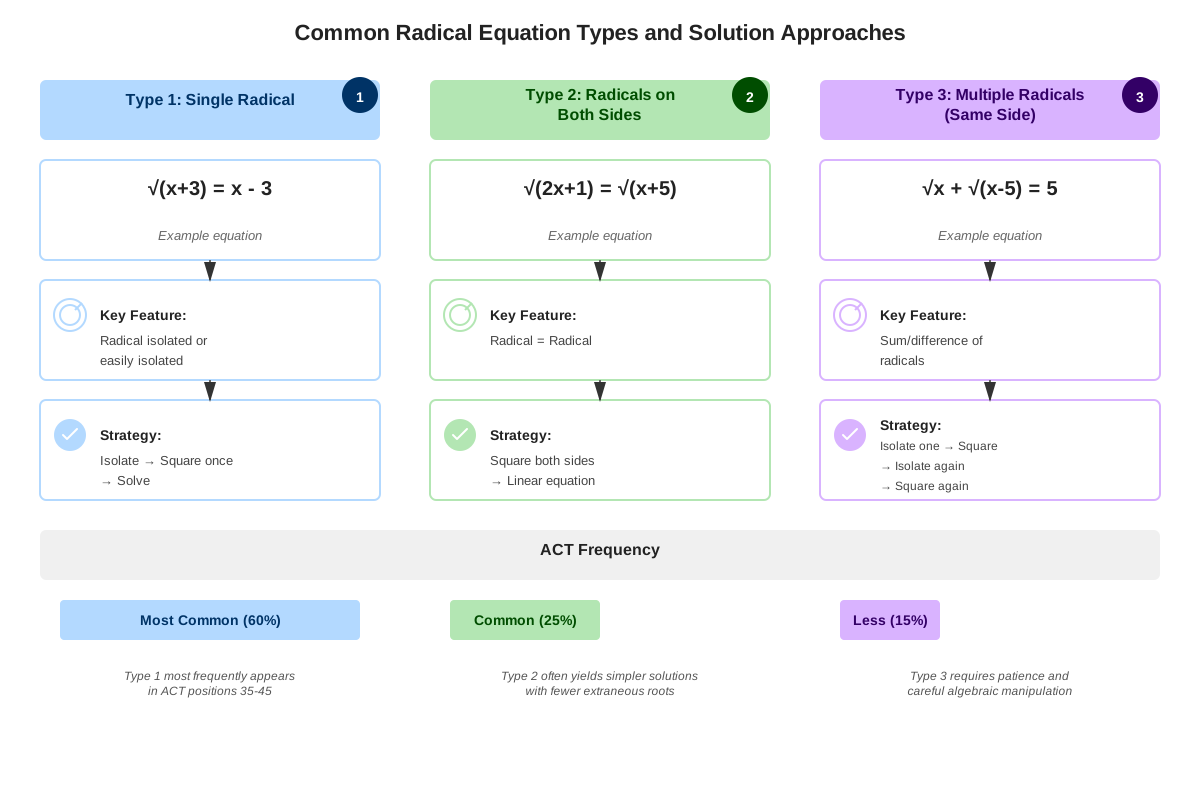
√(ax + b) = cMore complex forms include:
- Multiple radicals: √(x + 3) + √(x - 2) = 5
- Radicals on both sides: √(2x + 1) = √(x + 5)
- Nested radicals: √(√x + 3) = 2
- Combined with other operations: 2√(x - 1) + 5 = 13
The Isolation-and-Elimination Strategy
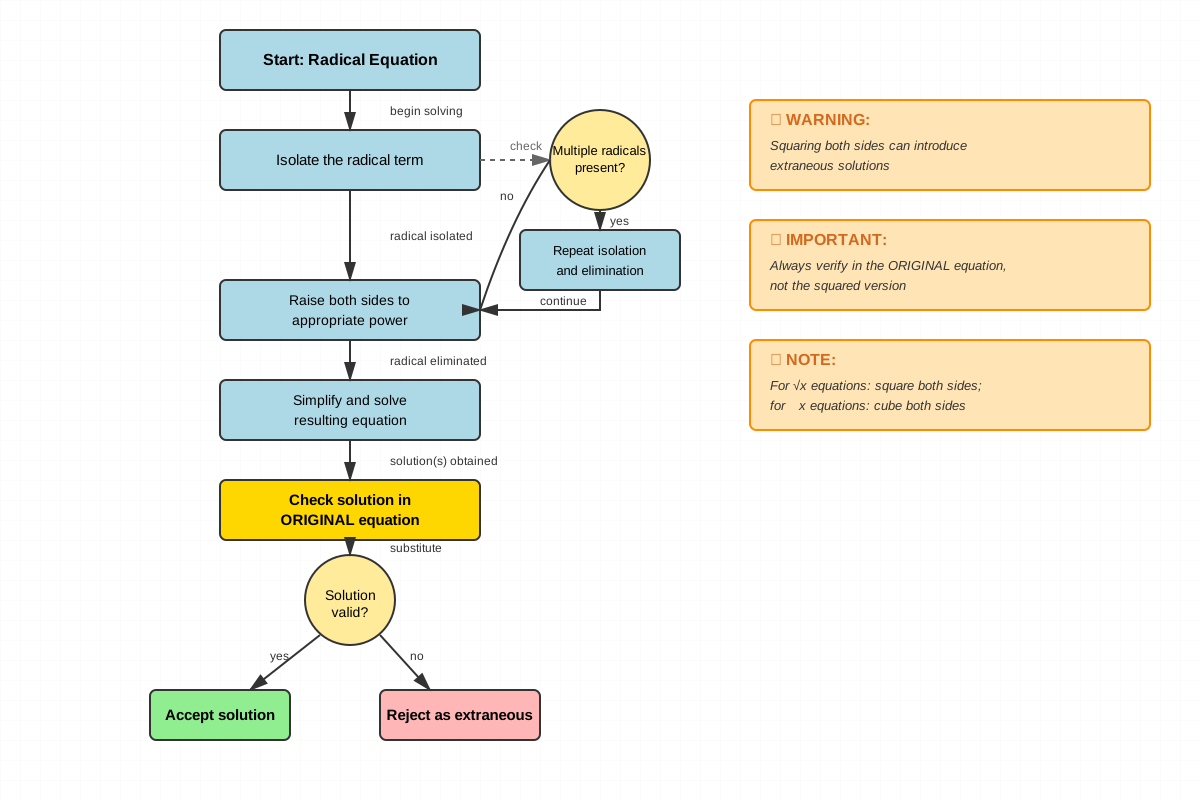
The core strategy for solving radical equations follows a systematic three-step process:
- Isolate the radical expression: Move all terms without radicals to one side of the equation, leaving the radical term alone on the other side
- Eliminate the radical: Raise both sides of the equation to the appropriate power (square both sides for square roots, cube both sides for cube roots)
- Solve the resulting equation: Use standard algebraic techniques to find the variable value(s)
This process works because raising both sides of an equation to the same power maintains equality—with one critical caveat that creates the need for solution verification.
The Extraneous Solution Problem
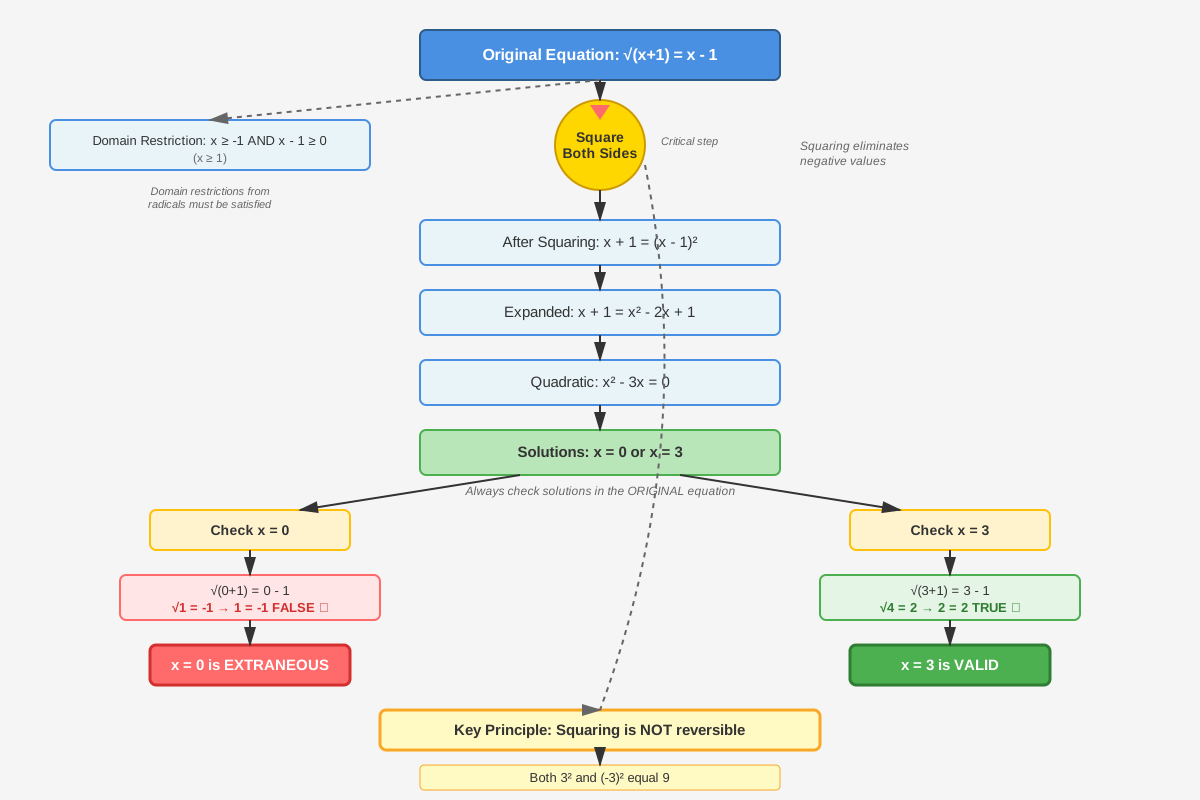
When both sides of an equation are squared, the operation is not reversible in all cases. Squaring can introduce solutions that satisfy the squared equation but not the original equation. These false solutions are called extraneous solutions.
Consider why this happens: If x = 3, then x² = 9. However, if x² = 9, then x could equal 3 OR -3. The squaring operation loses information about the sign. Similarly, √x is defined only for non-negative values when dealing with real numbers, but x² can be positive regardless of whether x is positive or negative.
Critical Rule: Every solution obtained from a radical equation MUST be checked by substituting it back into the original equation. Solutions that produce false statements (such as negative values under even-index radicals or incorrect numerical results) must be rejected.
Step-by-Step Solution Process
For a single radical equation:
- Isolate the radical term on one side of the equation
- Square both sides (or raise to the appropriate power)
- Simplify the resulting equation
- Solve using standard techniques (linear, quadratic, etc.)
- Check all solutions in the original equation
- Reject extraneous solutions and state the valid solution set
Example structure:
Original: √(2x + 3) = x - 3
Squared: 2x + 3 = (x - 3)²
Expanded: 2x + 3 = x² - 6x + 9
Rearranged: 0 = x² - 8x + 6
Equations with Multiple Radicals
When an equation contains two or more radical terms, the strategy requires modification:
- Isolate one radical on one side of the equation
- Square both sides (this may leave another radical in the equation)
- Isolate the remaining radical if one still exists
- Square again if necessary
- Solve the resulting equation
- Check all solutions rigorously (multiple squaring operations increase the likelihood of extraneous solutions)
The key insight: tackle one radical at a time, and be prepared to square multiple times. Each squaring operation potentially introduces extraneous solutions, making verification even more critical.
Domain Considerations
For square roots and even-index radicals, the expression under the radical (the radicand) must be non-negative for real number solutions. This creates implicit domain restrictions:
- For √(ax + b), the domain requires ax + b ≥ 0
- Solutions that violate this domain restriction are automatically extraneous
- Odd-index radicals (cube roots, fifth roots) have no such restriction since they're defined for all real numbers
Special Cases and Shortcuts
| Situation | Strategy | Example |
|---|---|---|
| Radicals on both sides | Square immediately without isolation | √(2x + 1) = √(x + 5) → 2x + 1 = x + 5 |
| Radical equals zero | Set radicand equal to zero | √(x - 4) = 0 → x - 4 = 0 |
| Radical equals negative number | No real solution (for even-index radicals) | √(x + 2) = -3 has no solution |
| Coefficient on radical | Isolate by dividing first | 3√x = 12 → √x = 4 |
Concept Relationships
The solution process for radical equations builds directly on algebraic manipulation skills, requiring fluent use of inverse operations and equation balancing. The isolation step connects to linear equation solving, while the elimination step relies on understanding exponent rules (specifically that (√x)² = x when x ≥ 0).
After squaring, radical equations frequently transform into quadratic equations, creating a direct pathway: Radical Equation → (squaring) → Quadratic Equation → (factoring/quadratic formula) → Solutions → (verification) → Valid Solutions. This sequence demonstrates how radical equations serve as a bridge between basic algebra and more advanced problem-solving.
The concept of extraneous solutions connects to domain and range understanding in functions. When we write y = √x, we implicitly restrict x ≥ 0 and y ≥ 0. Extraneous solutions often violate these restrictions, revealing why they cannot be valid.
Multiple radical equations relate to systems of equations thinking—when two radicals appear, we're essentially managing two constraints simultaneously. The strategic isolation of one radical before the other mirrors the substitution method in systems.
Textual relationship map:
Algebraic Manipulation → Isolation of Radical → Application of Inverse Operations (Squaring) →
Generation of Polynomial Equation → Solution via Factoring/Quadratic Formula →
Verification Against Original Equation → Identification of Valid vs. Extraneous Solutions
Quick check — test yourself on Radical equations so far.
Try Flashcards →High-Yield Facts
⭐ Always check solutions by substituting back into the original equation—extraneous solutions are the most commonly tested concept in ACT radical equations
⭐ Squaring both sides can introduce extraneous solutions that satisfy the squared equation but not the original
⭐ Isolate the radical term before squaring to avoid unnecessarily complex algebra
⭐ For even-index radicals (square roots, fourth roots), the radicand must be non-negative for real solutions
⭐ When a radical equals a negative number, there is no real solution (for even-index radicals)
- Squaring (√x)² yields x only when x ≥ 0; this domain restriction is critical
- Equations with two radicals may require squaring twice, increasing the likelihood of extraneous solutions
- When radicals appear on both sides with the same index, square immediately without additional isolation
- The solution x = 0 should always be checked carefully, as it often appears as an extraneous solution
- Cube roots and odd-index radicals are defined for all real numbers, including negatives
- If the squared equation produces no real solutions, the original equation has no real solutions
- Radical equations in word problems often involve geometric formulas (Pythagorean theorem, area formulas)
- The ACT rarely tests radicals with index higher than 3 (cube roots)
Common Misconceptions
Misconception: After squaring both sides, the solution process is complete and any answer obtained is valid.
Correction: Squaring can introduce extraneous solutions. Every solution must be verified in the original equation. A value that makes the squared equation true might make the original equation false.
Misconception: √(x²) always equals x.
Correction: √(x²) = |x|, not x. For example, if x = -3, then √((-3)²) = √9 = 3, not -3. This absolute value relationship is why extraneous solutions occur.
Misconception: When an equation has √(x + 3) = 5, you can square just the radical to get x + 3 = 5.
Correction: You must square both sides of the equation: (√(x + 3))² = 5², which gives x + 3 = 25. Squaring only one side violates the fundamental principle of maintaining equality.
Misconception: If a solution makes the radicand negative, it's still valid because you can have negative numbers under radicals.
Correction: For even-index radicals (square roots, fourth roots), negative radicands produce non-real (imaginary) numbers. On the ACT, which tests only real numbers, such solutions are extraneous and must be rejected.
Misconception: When solving √(x + 2) + 3 = 7, you should square both sides immediately.
Correction: First isolate the radical by subtracting 3 from both sides to get √(x + 2) = 4, then square both sides. Squaring before isolation creates the unnecessarily complex equation (√(x + 2) + 3)² = 49, which expands to include cross-terms.
Misconception: All radical equations have exactly one solution.
Correction: Radical equations can have zero, one, or two solutions (occasionally more for higher-degree equations). After squaring, you might get a quadratic with two solutions, but one or both might be extraneous.
Worked Examples
Example 1: Single Radical Equation with Extraneous Solution
Problem: Solve √(3x + 4) = x - 2
Solution:
Step 1: The radical is already isolated on the left side.
Step 2: Square both sides to eliminate the radical.
(√(3x + 4))² = (x - 2)²
3x + 4 = x² - 4x + 4
Step 3: Rearrange into standard quadratic form.
0 = x² - 4x - 3x + 4 - 4
0 = x² - 7x
Step 4: Factor and solve.
0 = x(x - 7)
x = 0 or x = 7
Step 5: Check both solutions in the original equation.
For x = 0:
√(3(0) + 4) = 0 - 2
√4 = -2
2 = -2  ✗ FALSE
x = 0 is extraneous.
For x = 7:
√(3(7) + 4) = 7 - 2
√(21 + 4) = 5
√25 = 5
5 = 5  ✓ TRUE
x = 7 is valid.
Answer: x = 7
Key Insight: This example demonstrates why verification is essential. The squaring process introduced x = 0 as a false solution. Notice that x = 0 produces a negative value on the right side, which cannot equal a square root (which must be non-negative).
Example 2: Equation with Two Radicals
Problem: Solve √(x + 7) - √(x - 5) = 2
Solution:
Step 1: Isolate one radical by adding √(x - 5) to both sides.
√(x + 7) = √(x - 5) + 2Step 2: Square both sides.
(√(x + 7))² = (√(x - 5) + 2)²
x + 7 = (√(x - 5))² + 2(√(x - 5))(2) + 2²
x + 7 = (x - 5) + 4√(x - 5) + 4
Step 3: Simplify and isolate the remaining radical.
x + 7 = x - 1 + 4√(x - 5)
8 = 4√(x - 5)
2 = √(x - 5)
Step 4: Square both sides again.
4 = x - 5
x = 9
Step 5: Check the solution in the original equation.
√(9 + 7) - √(9 - 5) = 2
√16 - √4 = 2
4 - 2 = 2
2 = 2 ✓ TRUEAnswer: x = 9
Key Insight: This problem required squaring twice because the first squaring operation still left a radical in the equation. The binomial expansion (a + b)² = a² + 2ab + b² was crucial in Step 2. This type of problem appears frequently on the ACT and tests both algebraic skill and persistence.
Exam Strategy
When approaching ACT radical equation questions, begin by quickly scanning for the number of radicals present. Single-radical problems typically take 45-60 seconds, while multiple-radical problems may require 90-120 seconds. Budget your time accordingly.
Trigger words and phrases that signal radical equations include: "solve for x," "find the value," "what is the solution," combined with visible radical symbols. Word problems might use phrases like "the square root of," "varies as the square root," or present formulas containing radical expressions. Geometry problems involving the Pythagorean theorem or distance formula often lead to radical equations.
Process-of-elimination strategies:
- Immediately eliminate answer choices that would make the radicand negative (for even-index radicals)
- If the equation shows a radical equal to a negative number, look for "no solution" or "no real solution" as the answer
- When answer choices are given, substitute them directly into the original equation rather than solving algebraically—this can be faster and avoids extraneous solutions
- Eliminate answers that are clearly too large or too small based on the structure of the equation
Step-by-step approach for ACT questions:
- Read the problem and identify all radicals (2-3 seconds)
- Determine if direct substitution of answer choices is faster than algebraic solving (5 seconds)
- If solving algebraically, isolate one radical completely before squaring (15-20 seconds)
- Square both sides and simplify carefully (20-30 seconds)
- Solve the resulting equation (15-20 seconds)
- Check your solution(s) in the original equation—this is non-negotiable (10-15 seconds per solution)
ACT Tip: If you're running short on time, answer choices allow you to work backward. Substitute each choice into the original equation until you find one that works. This guarantees you avoid extraneous solutions and can be faster than algebraic manipulation.
Time allocation: Allocate 60 seconds for straightforward single-radical problems and up to 2 minutes for complex multiple-radical problems. If a problem is taking longer, mark it and return after completing easier questions.
Memory Techniques
ISO-SQUARE-SOLVE-CHECK mnemonic for the solution process:
- Isolate the radical
- Square both sides
- Organize into standard form
- Solve the equation
- Question your solutions
- Use substitution
- Analyze for validity
- Reject extraneous solutions
- Express final answer
- CHECK in original equation
"SQUARE BEWARE, CHECK WITH CARE" reminds you that squaring introduces danger (extraneous solutions) and checking is essential.
Visualization strategy: Picture a radical as a locked box containing the variable. The isolation step moves everything else away from the box. Squaring is the key that opens the box. But some keys open boxes that were never really locked—those are extraneous solutions.
Domain reminder: "EVEN means NON-NEGATIVE" (even-index radicals require non-negative radicands)
The "Negative Radical Rule": Remember "Square roots can't be negative" by visualizing a square root symbol as a smile—smiles are positive, not negative.
Summary
Radical equations are algebraic equations containing variables under radical symbols, most commonly square roots. The fundamental solution strategy involves three essential steps: isolate the radical expression, eliminate the radical by raising both sides to the appropriate power, and solve the resulting equation using standard algebraic techniques. The critical fourth step—verification—distinguishes competent problem-solvers from those who make costly errors. Squaring both sides of an equation can introduce extraneous solutions that satisfy the squared equation but not the original, making substitution-based checking mandatory. For equations with multiple radicals, the process requires isolating and eliminating one radical at a time, potentially squaring multiple times. Domain restrictions for even-index radicals (radicands must be non-negative) provide an additional filter for identifying invalid solutions. On the ACT, radical equations appear in 2-4 questions per test, often embedded in word problems or geometric contexts, and frequently test whether students can identify and reject extraneous solutions. Mastery requires both procedural fluency and conceptual understanding of why the squaring operation creates the need for verification.
Key Takeaways
- Radical equations require a systematic four-step process: isolate, square, solve, and verify—never skip verification
- Squaring both sides can introduce extraneous solutions that must be identified and rejected through substitution into the original equation
- Always isolate the radical term before squaring to minimize algebraic complexity and reduce errors
- Even-index radicals impose domain restrictions: the radicand must be non-negative, automatically eliminating some potential solutions
- Multiple-radical equations require patience: isolate and eliminate one radical at a time, squaring as many times as necessary
- On the ACT, working backward from answer choices can be faster and more reliable than algebraic solving, especially under time pressure
- The most commonly tested concept is extraneous solutions—expect the ACT to present problems where one of two solutions is invalid
Related Topics
Rational Exponents: Radical equations connect directly to expressions using fractional exponents (√x = x^(1/2)). Mastering radical equations provides the foundation for manipulating and solving equations with rational exponents, which appear in advanced algebra and precalculus contexts.
Quadratic Equations: Since squaring radical equations often produces quadratics, strengthening quadratic-solving skills (factoring, completing the square, quadratic formula) directly improves radical equation performance.
Absolute Value Equations: Like radical equations, absolute value equations can produce extraneous solutions and require verification. The conceptual understanding developed through radical equations transfers to this related topic.
Function Composition and Inverse Functions: Understanding that squaring and taking square roots are inverse operations connects to the broader concept of function inverses, important for precalculus and calculus preparation.
Domain and Range: The restrictions on radical expressions (even-index radicals require non-negative radicands) exemplify domain concepts that extend throughout function analysis and graphing.
Practice CTA
Now that you've mastered the core concepts, strategies, and common pitfalls of radical equations, it's time to solidify your understanding through active practice. Attempt the practice questions designed specifically for this topic, focusing on applying the ISO-SQUARE-SOLVE-CHECK process systematically. Use the flashcards to reinforce high-yield facts and build automatic recall of key concepts like extraneous solution identification and domain restrictions. Remember: the difference between knowing how to solve radical equations and actually solving them correctly under test conditions is practice. Each problem you work through builds the pattern recognition and procedural fluency that will make these questions feel routine on test day. You've got this—start practicing!
Sign up free to keep reading
Create a free AnvayaPrep account to finish this ACT guide on Radical equations — plus flashcards and practice questions.