Overview
The standard form of a line represents one of the most fundamental algebraic concepts tested on the ACT Math section. This form, expressed as Ax + By = C (where A, B, and C are integers and A is typically non-negative), provides a powerful way to represent linear relationships that differs from the more commonly taught slope-intercept form. Understanding this representation is crucial because the ACT frequently presents linear equations in standard form and expects students to manipulate, interpret, and convert between different forms efficiently.
Mastery of the ACT standard form of a line extends beyond simple recognition. Students must be able to extract meaningful information such as intercepts, determine parallel and perpendicular relationships, and convert between forms under time pressure. This topic appears in approximately 3-5 questions per ACT Math test, making it a high-yield area for score improvement. The questions range from straightforward identification problems to multi-step applications involving systems of equations, graphing, and real-world modeling scenarios.
The standard form connects deeply to broader algebraic concepts including coordinate geometry, systems of equations, and function analysis. It serves as a bridge between basic linear equations and more complex topics like linear programming and optimization. Students who master standard form gain flexibility in problem-solving, as they can choose the most efficient representation for any given situation—a critical skill for maximizing speed and accuracy on the ACT.
Learning Objectives
- [ ] Identify when Standard form of a line is being tested in ACT questions
- [ ] Explain the core rule or strategy behind Standard form of a line
- [ ] Apply Standard form of a line to ACT-style questions accurately
- [ ] Convert between standard form and slope-intercept form fluently
- [ ] Extract x-intercepts and y-intercepts directly from standard form equations
- [ ] Determine whether two lines in standard form are parallel or perpendicular
- [ ] Write equations of lines in standard form given various initial conditions
Prerequisites
- Slope-intercept form (y = mx + b): Understanding this form provides the foundation for converting between different linear representations and recognizing when standard form offers advantages
- Basic algebraic manipulation: Skills in solving equations, combining like terms, and isolating variables are essential for converting forms and solving for intercepts
- Coordinate plane fundamentals: Knowledge of plotting points, understanding axes, and interpreting intercepts enables visualization of lines represented in standard form
- Integer properties: Recognizing factors, multiples, and greatest common divisors helps simplify standard form equations to their conventional representation
Why This Topic Matters
In real-world applications, standard form naturally represents many practical situations. Budget constraints (3x + 5y = 100, where x and y represent quantities of items with different costs), resource allocation problems, and mixture scenarios all emerge naturally in standard form. Engineers and economists frequently use this representation because it clearly displays the relationship between multiple variables without privileging one as dependent.
On the ACT Math section, standard form appears in 8-12% of algebra questions, translating to 3-5 questions per test. These questions typically fall into several categories: direct conversion between forms (30% of standard form questions), finding intercepts (25%), writing equations given conditions (20%), identifying parallel or perpendicular lines (15%), and application problems (10%). The ACT deliberately tests standard form because it assesses deeper understanding beyond memorized formulas—students must demonstrate conceptual flexibility and algebraic fluency.
The exam commonly embeds standard form in multi-step problems where recognizing the form quickly saves valuable time. For instance, a question might present a system of equations with one equation in standard form and another in slope-intercept form, testing whether students can work efficiently with mixed representations. Additionally, coordinate geometry problems often provide line equations in standard form when asking about intersections, distances, or geometric properties, making this topic a gateway to higher-level problem-solving.
Core Concepts
Definition and Structure of Standard Form
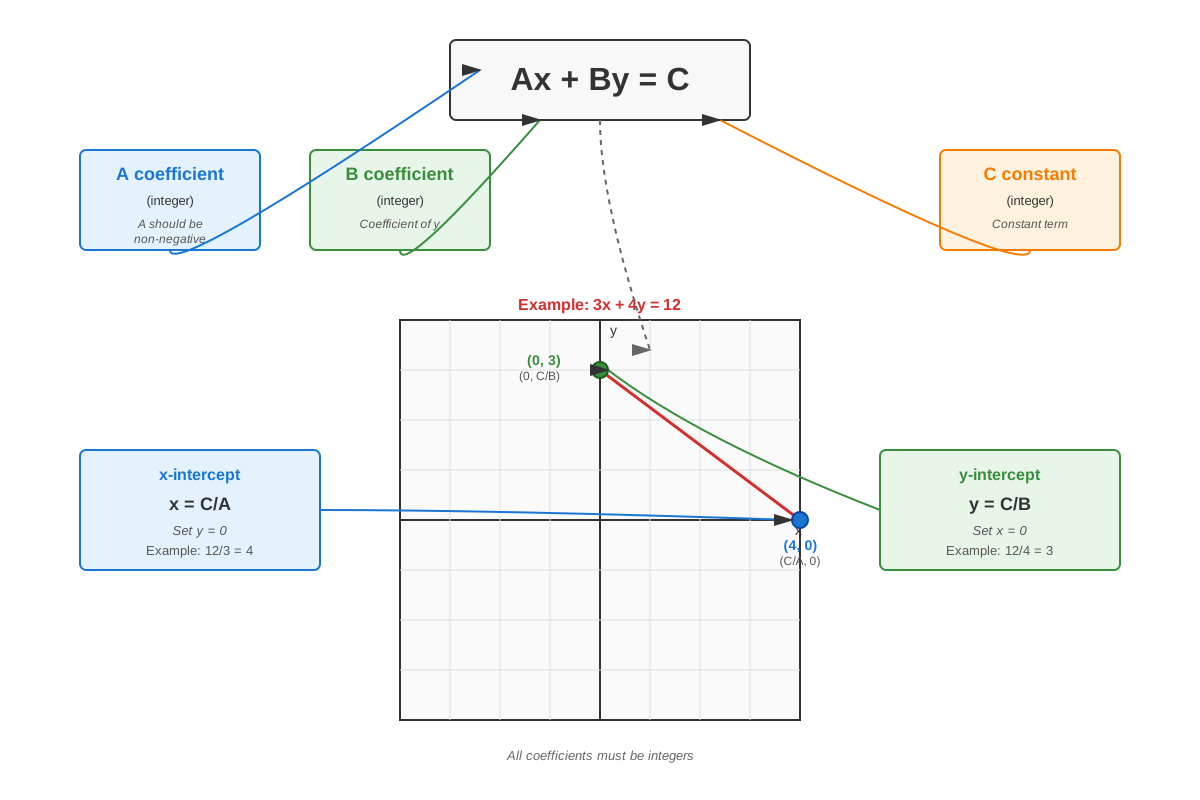
The standard form of a line is written as Ax + By = C, where A, B, and C are real numbers. By convention, these values are typically integers, A is non-negative (A ≥ 0), and the equation is simplified so that A, B, and C share no common factors other than 1. When A = 0, the line is horizontal; when B = 0, the line is vertical. This representation treats x and y symmetrically, unlike slope-intercept form which isolates y.
For example, 3x + 4y = 12 is in proper standard form: all coefficients are integers, A is positive, and the greatest common divisor of 3, 4, and 12 is 1. The equation -2x + 5y = 10 should be rewritten as 2x - 5y = -10 to satisfy the convention that A ≥ 0. Similarly, 6x + 9y = 15 should be simplified to 2x + 3y = 5 by dividing all terms by the common factor of 3.
Converting from Slope-Intercept to Standard Form
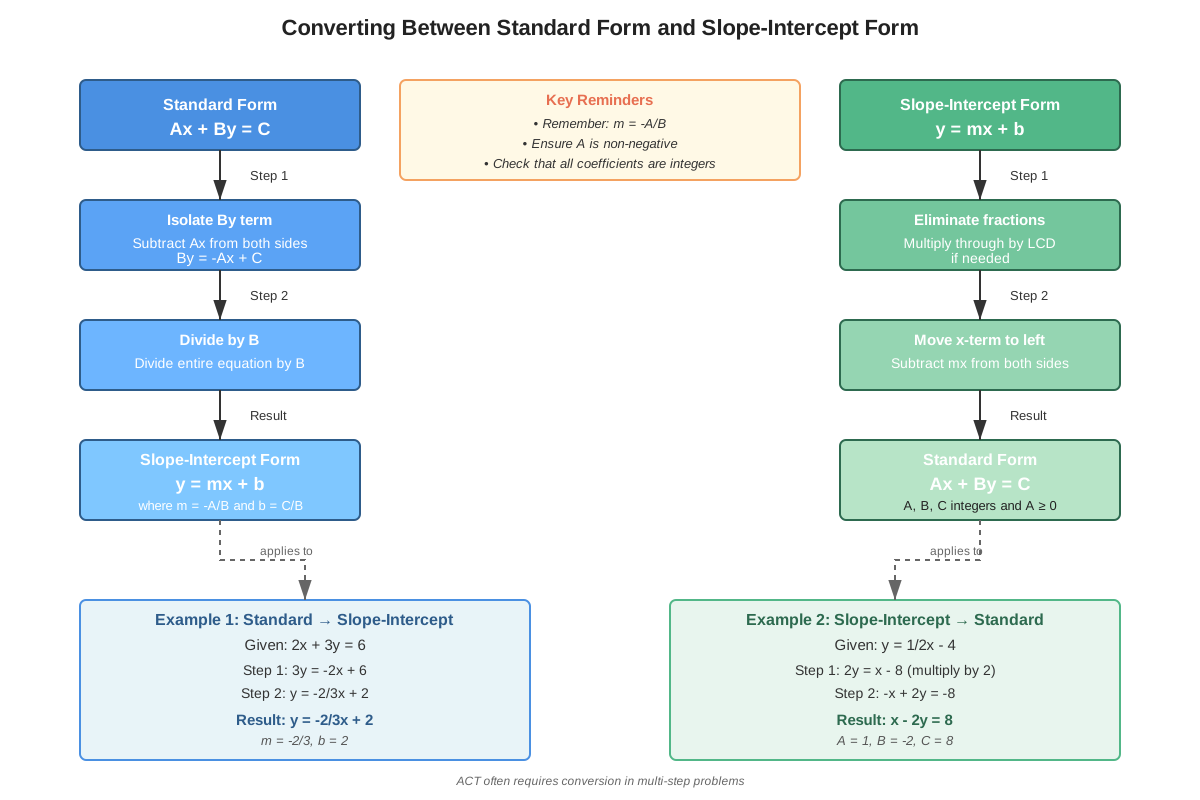
Starting with slope-intercept form y = mx + b, conversion to standard form requires moving all variable terms to one side. The process involves:
- Subtract mx from both sides: -mx + y = b
- Multiply through by -1 if needed to make A positive: mx - y = -b
- Clear any fractions by multiplying all terms by the least common denominator
- Simplify by dividing out common factors
For example, converting y = (2/3)x + 4:
- Subtract (2/3)x: -(2/3)x + y = 4
- Multiply by 3 to clear fractions: -2x + 3y = 12
- Multiply by -1 to make A positive: 2x - 3y = -12
Converting from Standard Form to Slope-Intercept Form
To convert Ax + By = C to y = mx + b, isolate y:
- Subtract Ax from both sides: By = -Ax + C
- Divide everything by B: y = (-A/B)x + (C/B)
The slope is m = -A/B and the y-intercept is b = C/B. For example, converting 5x + 2y = 10:
- Subtract 5x: 2y = -5x + 10
- Divide by 2: y = (-5/2)x + 5
The slope is -5/2 and the y-intercept is 5.
Finding Intercepts from Standard Form
Standard form provides a direct method for finding intercepts without conversion:
X-intercept: Set y = 0 and solve for x
- From Ax + By = C, substitute y = 0: Ax = C, so x = C/A
- The x-intercept point is (C/A, 0)
Y-intercept: Set x = 0 and solve for y
- From Ax + By = C, substitute x = 0: By = C, so y = C/B
- The y-intercept point is (0, C/B)
For 3x + 4y = 12:
- X-intercept: 3x = 12, so x = 4, giving point (4, 0)
- Y-intercept: 4y = 12, so y = 3, giving point (0, 3)
Parallel and Perpendicular Lines in Standard Form
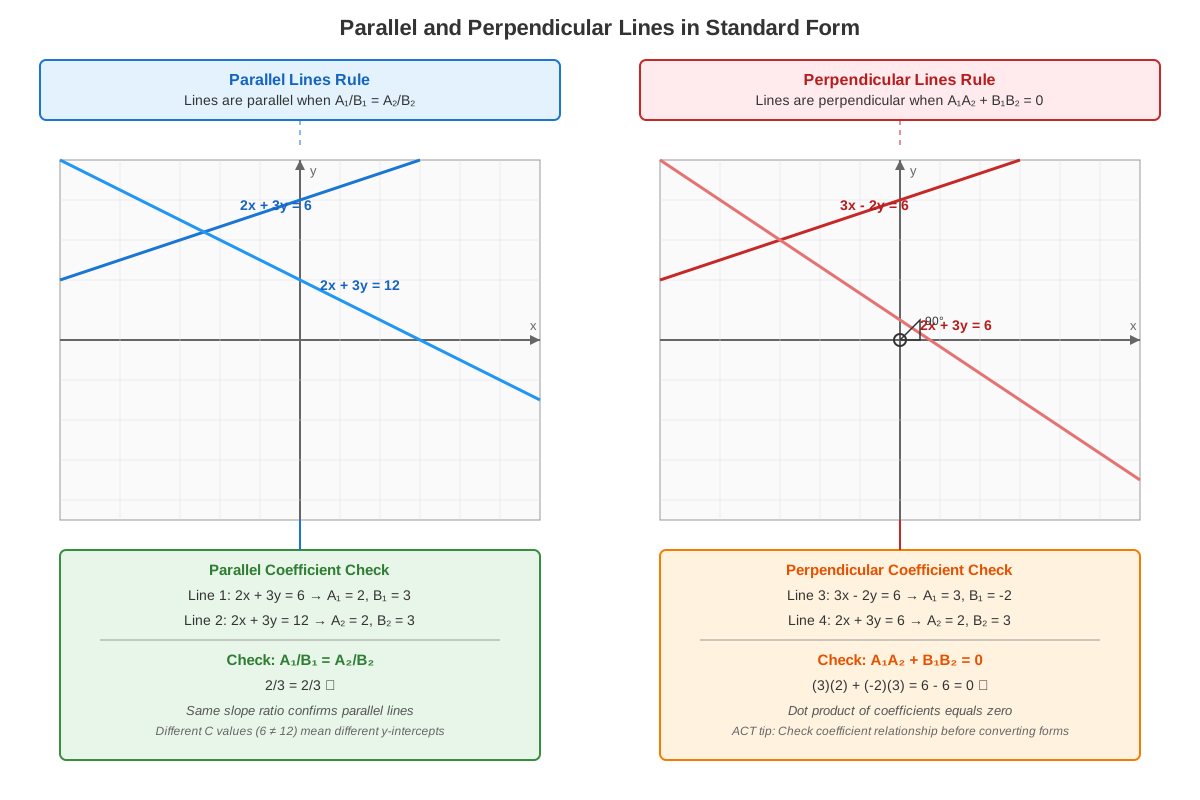
Two lines in standard form are parallel if they have the same slope. For lines A₁x + B₁y = C₁ and A₂x + B₂y = C₂:
- Parallel when: A₁/B₁ = A₂/B₂ (or equivalently, A₁B₂ = A₂B₁)
Two lines are perpendicular if their slopes are negative reciprocals. For the same lines:
- Perpendicular when: (A₁/B₁) × (A₂/B₂) = -1, which simplifies to A₁A₂ + B₁B₂ = 0
For example, 2x + 3y = 6 and 4x + 6y = 12 are parallel because 2/3 = 4/6. The lines 3x + 4y = 12 and 4x - 3y = 6 are perpendicular because (3)(4) + (4)(-3) = 12 - 12 = 0.
Writing Equations in Standard Form
Given specific conditions, constructing a standard form equation follows systematic approaches:
Given two points (x₁, y₁) and (x₂, y₂):
- Find slope: m = (y₂ - y₁)/(x₂ - x₁)
- Use point-slope form: y - y₁ = m(x - x₁)
- Convert to standard form by clearing fractions and rearranging
Given slope m and a point (x₁, y₁):
- Write y - y₁ = m(x - x₁)
- Expand and rearrange to standard form
Given intercepts:
The intercept form x/a + y/b = 1 (where a is the x-intercept and b is the y-intercept) can be converted by multiplying through by ab to get bx + ay = ab.
Concept Relationships
The standard form of a line serves as a central hub connecting multiple algebraic concepts. Standard form → leads to → slope-intercept form through algebraic manipulation (isolating y), demonstrating the equivalence of different representations. Conversely, slope-intercept form → converts to → standard form by eliminating fractions and rearranging terms, showing that the same line can be expressed multiple ways depending on the problem context.
Intercepts → derive directly from → standard form through simple substitution (setting one variable to zero), making this form particularly efficient for graphing and analyzing linear relationships. The relationship standard form → reveals → parallel and perpendicular relationships through coefficient comparison, connecting to geometric properties of lines without requiring explicit slope calculation.
Systems of equations → often utilize → standard form because it facilitates elimination methods, where matching coefficients allows for efficient variable elimination. This connects to matrices and linear algebra, where standard form naturally translates to augmented matrix representation. Additionally, linear programming → requires → standard form for constraint equations, bridging algebra to optimization applications.
The prerequisite knowledge of coordinate geometry → supports → standard form interpretation by providing the visual framework for understanding what the equation represents graphically. Similarly, algebraic manipulation skills → enable → form conversion and simplification, making fluency with basic algebra essential for working efficiently with standard form.
Quick check — test yourself on Standard form of a line so far.
Try Flashcards →High-Yield Facts
⭐ Standard form is written as Ax + By = C where A, B, and C are integers, A ≥ 0, and gcd(A, B, C) = 1
⭐ The x-intercept of Ax + By = C is found by setting y = 0, giving x = C/A
⭐ The y-intercept of Ax + By = C is found by setting x = 0, giving y = C/B
⭐ The slope of a line in standard form Ax + By = C is m = -A/B
⭐ Two lines A₁x + B₁y = C₁ and A₂x + B₂y = C₂ are parallel when A₁B₂ = A₂B₁
- Two lines in standard form are perpendicular when A₁A₂ + B₁B₂ = 0
- Vertical lines (x = k) are in standard form with B = 0: 1x + 0y = k
- Horizontal lines (y = k) are in standard form with A = 0: 0x + 1y = k
- Converting from y = mx + b to standard form: multiply to clear fractions, then rearrange to -mx + y = b or mx - y = -b
- Standard form is preferred for systems of equations when using the elimination method
- The equation Ax + By = C represents a line in all cases except when A = B = 0
- Multiplying an entire standard form equation by a non-zero constant produces an equivalent equation representing the same line
Common Misconceptions
Misconception: The coefficients in standard form can be any real numbers, including fractions and decimals.
Correction: By convention, standard form uses integer coefficients with no common factors. While fractional coefficients technically represent the same line, proper standard form requires clearing fractions by multiplying through by the least common denominator.
Misconception: In standard form Ax + By = C, the coefficient A must always be positive.
Correction: The convention is that A should be non-negative (A ≥ 0), meaning A can be zero (for horizontal lines). When A would be negative, multiply the entire equation by -1 to make it non-negative.
Misconception: The slope of a line in standard form Ax + By = C is A/B.
Correction: The slope is -A/B (negative A divided by B). Students often forget the negative sign, which comes from isolating y: By = -Ax + C, so y = (-A/B)x + C/B.
Misconception: To find the x-intercept, substitute x = 0 into the equation.
Correction: To find the x-intercept, substitute y = 0 (not x = 0). The x-intercept is where the line crosses the x-axis, which occurs when the y-coordinate equals zero. Similarly, the y-intercept requires setting x = 0.
Misconception: Two lines with the same A and B coefficients are always the same line.
Correction: Lines with the same A and B coefficients are parallel (they have the same slope), but they are only the same line if C is also proportional. For example, 2x + 3y = 6 and 2x + 3y = 12 are parallel but distinct lines.
Misconception: Standard form cannot represent vertical or horizontal lines.
Correction: Standard form handles these special cases naturally. Vertical lines have the form x = k (or 1x + 0y = k), and horizontal lines have the form y = k (or 0x + 1y = k). These are valid standard form equations where either B = 0 or A = 0.
Worked Examples
Example 1: Converting and Finding Intercepts
Problem: Convert the equation y = -3/4x + 6 to standard form, then find both intercepts.
Solution:
Step 1: Start with y = -3/4x + 6
Step 2: Add 3/4x to both sides: 3/4x + y = 6
Step 3: Clear the fraction by multiplying everything by 4: 3x + 4y = 24
Step 4: Verify this is proper standard form: A = 3 (positive), B = 4, C = 24, and gcd(3, 4, 24) = 1. ✓
Step 5: Find the x-intercept by setting y = 0:
- 3x + 4(0) = 24
- 3x = 24
- x = 8
- X-intercept: (8, 0)
Step 6: Find the y-intercept by setting x = 0:
- 3(0) + 4y = 24
- 4y = 24
- y = 6
- Y-intercept: (0, 6)
Connection to Learning Objectives: This example demonstrates conversion from slope-intercept to standard form (Objective 4) and extracting intercepts directly from standard form (Objective 5), both essential skills for ACT questions.
Example 2: Determining Parallel and Perpendicular Lines
Problem: Given the line 6x - 8y = 24, write the equation in standard form of: (a) a parallel line passing through (2, -3), and (b) a perpendicular line passing through (2, -3).
Solution:
First, simplify the given line: 6x - 8y = 24 divides by 2 to give 3x - 4y = 12
(a) Parallel line:
Step 1: Parallel lines have the same A and B coefficients, so the form is 3x - 4y = C
Step 2: Find C by substituting the point (2, -3):
- 3(2) - 4(-3) = C
- 6 + 12 = C
- C = 18
Step 3: The parallel line is 3x - 4y = 18
Verification: Both lines have slope m = -3/(-4) = 3/4 ✓
(b) Perpendicular line:
Step 1: For perpendicular lines, if the original is Ax + By = C, the perpendicular form swaps and negates: Bx + Ay = C' (or -Bx - Ay = C')
Step 2: From 3x - 4y = 12, we get A = 3, B = -4
Step 3: Perpendicular form: -4x - 3y = C' or 4x + 3y = C'
Step 4: Find C' using point (2, -3):
- 4(2) + 3(-3) = C'
- 8 - 9 = C'
- C' = -1
Step 5: The perpendicular line is 4x + 3y = -1
Verification: Original slope = 3/4, perpendicular slope = -4/3, and (3/4)(-4/3) = -1 ✓
Connection to Learning Objectives: This example applies standard form to determine geometric relationships (Objective 6) and write equations given conditions (Objective 7), demonstrating the practical problem-solving applications tested on the ACT.
Exam Strategy
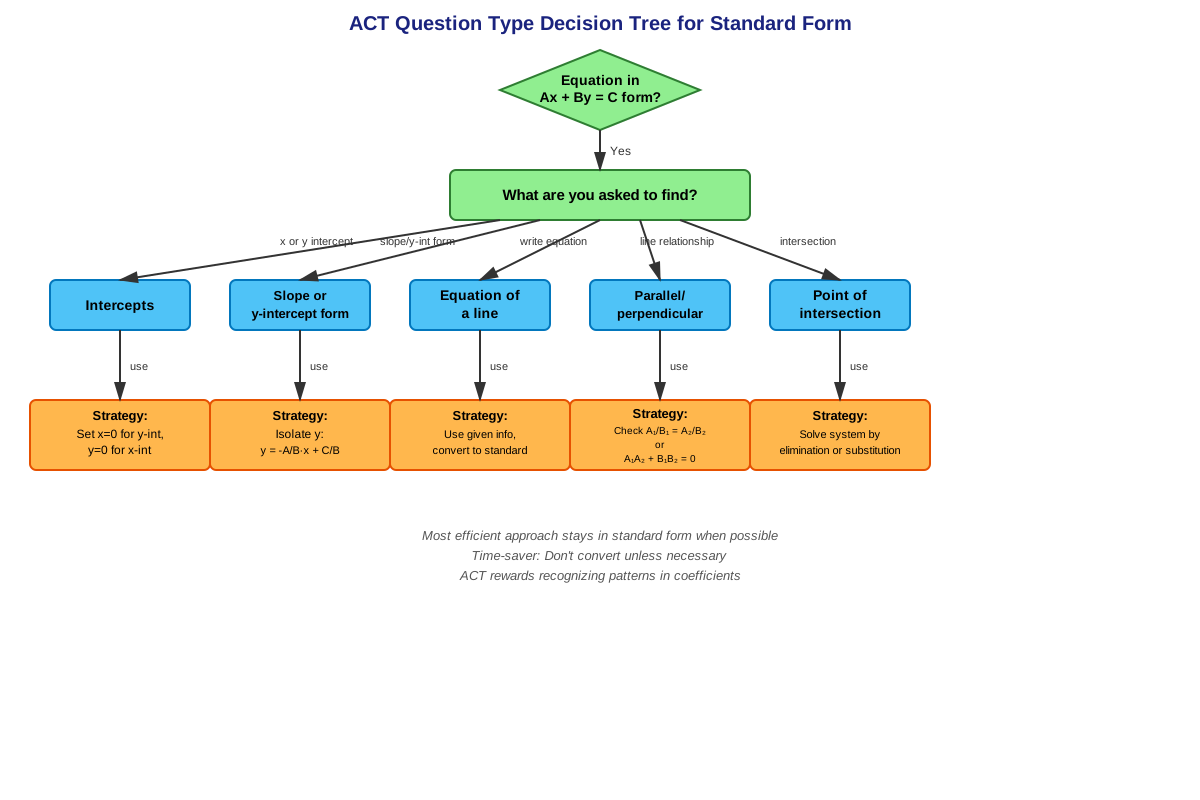
When approaching ACT questions involving standard form, first identify the form by looking for equations with both x and y terms on the same side of the equals sign, opposite a constant. Trigger phrases include "write in standard form," "find the x-intercept," "which equation is parallel to," and "the line passes through points."
Time-saving recognition patterns: If a question asks for intercepts and the equation is already in standard form, do NOT convert to slope-intercept form first—this wastes precious seconds. Instead, use direct substitution (y = 0 for x-intercept, x = 0 for y-intercept). Conversely, if asked for the slope and the equation is in standard form, quickly extract it using m = -A/B rather than fully converting.
Process of elimination strategies: When answer choices present equations in standard form, check whether A is non-negative and coefficients are integers without common factors. The ACT often includes "trap" answers that represent the same line but aren't in proper standard form. Additionally, if asked which line is parallel to a given line, eliminate any answer where the ratio A/B differs from the original.
Multi-step problem approach: For complex questions involving standard form:
- Identify what form the given information is in
- Determine what form the answer requires
- Decide whether conversion is necessary or if you can work directly
- Perform the most efficient calculation path
- Verify your answer makes sense (positive A, integer coefficients, etc.)
Time allocation: Standard form questions typically require 45-60 seconds. If you find yourself exceeding 90 seconds, you may be using an inefficient method—consider whether direct substitution or coefficient comparison would be faster than full conversion.
ACT Tip: When writing equations in standard form, always perform a final check: Are all coefficients integers? Is A non-negative? Are there common factors to divide out? These quick verifications prevent careless errors that cost points.
Memory Techniques
Mnemonic for Standard Form Structure: "Always Be Counting" reminds you of the Ax + By = C structure, with A coming first (alphabetically before B).
Intercept Memory Device: "X-intercept needs Y to be Zero" and "Y-intercept needs X to be Zero" (where Z represents zero). The letter you're finding requires the other letter to be zero.
Slope Sign Reminder: "Negative Attitude Brings Slope" reminds you that slope = Negative A over B (m = -A/B). The negative sign is crucial and often forgotten.
Parallel vs. Perpendicular:
- Parallel = "Product Preserves" → A₁B₂ = A₂B₁ (the products are equal)
- Perpendicular = "Product Produces Zero" → A₁A₂ + B₁B₂ = 0 (the sum equals zero)
Conversion Visualization: Picture standard form as a "balanced scale" with variables on one side and the constant on the other. Converting to slope-intercept form means "tipping the scale" to isolate y on one side.
Form Preference Acronym: "SEE Intercepts Straight" reminds you that Standard form lets you SEE Intercepts Straight away without conversion.
Summary
The standard form of a line, expressed as Ax + By = C with integer coefficients where A ≥ 0, represents a fundamental algebraic concept that appears frequently on the ACT Math section. This form provides unique advantages for finding intercepts directly, identifying parallel and perpendicular relationships through coefficient comparison, and solving systems of equations efficiently. Mastery requires fluency in converting between standard form and slope-intercept form, extracting key information (slope = -A/B, x-intercept = C/A, y-intercept = C/B), and writing equations in proper standard form given various conditions. Success on ACT questions demands recognizing when standard form offers computational advantages over other representations, avoiding common pitfalls like sign errors and improper simplification, and applying efficient problem-solving strategies under time pressure. Students who develop flexibility in working with multiple forms of linear equations gain significant advantages in both speed and accuracy across numerous algebra and coordinate geometry questions.
Key Takeaways
- Standard form Ax + By = C uses integer coefficients with A ≥ 0 and no common factors among A, B, and C
- Intercepts are found directly: x-intercept = C/A (when y = 0), y-intercept = C/B (when x = 0)
- The slope of a line in standard form is m = -A/B (remember the negative sign)
- Parallel lines in standard form have proportional A and B coefficients (A₁B₂ = A₂B₁)
- Perpendicular lines satisfy A₁A₂ + B₁B₂ = 0
- Converting between forms requires systematic algebraic manipulation: clear fractions, rearrange terms, and simplify
- Standard form appears in 3-5 ACT questions per test, making it a high-yield topic for focused study
Related Topics
Slope-Intercept Form (y = mx + b): Understanding the relationship between standard form and slope-intercept form enables flexible problem-solving and efficient form selection based on question requirements.
Point-Slope Form: This form serves as an intermediate step when writing equations given specific conditions, often converting to standard form as the final answer.
Systems of Linear Equations: Standard form is particularly useful for the elimination method, making this topic essential preparation for more complex algebraic problem-solving.
Linear Inequalities: The concepts of standard form extend naturally to inequalities (Ax + By ≤ C), which appear in optimization and constraint problems on the ACT.
Distance and Midpoint Formulas: These coordinate geometry topics frequently combine with standard form equations in multi-step ACT problems involving geometric properties of lines.
Practice CTA
Now that you've mastered the core concepts of standard form, it's time to solidify your understanding through active practice. Attempt the practice questions to test your ability to identify, convert, and apply standard form under exam-like conditions. Use the flashcards to reinforce key formulas and relationships until they become automatic. Remember: the difference between knowing these concepts and scoring points on test day lies in repeated, focused practice. Each problem you solve builds the speed and confidence you need to excel on the ACT Math section. You've got this—now prove it through practice!
Sign up free to keep reading
Create a free AnvayaPrep account to finish this ACT guide on Standard form of a line — plus flashcards and practice questions.