Overview
Multiples represent one of the most fundamental yet frequently tested concepts in the ACT Math section. A multiple of a number is the product of that number and any integer. For example, the multiples of 5 are 5, 10, 15, 20, and so on. While this concept may seem elementary, the ACT consistently incorporates multiples into problems involving divisibility, least common multiples, patterns, sequences, and word problems. Understanding multiples is essential not only for direct questions but also for solving complex problems that require recognizing numerical relationships and patterns.
The ACT Math section tests multiples in various contexts, from straightforward identification problems to more sophisticated applications involving multiple constraints. Students who master this topic gain a significant advantage because ACT multiples questions often appear in the first 30 questions of the 60-question Math section, making them crucial for building confidence and momentum. Additionally, multiples serve as a gateway concept that connects to divisibility rules, factors, prime factorization, and modular arithmetic—all of which appear regularly on the exam.
The relationship between multiples and other mathematical concepts is extensive. Multiples connect directly to factors (if a is a multiple of b, then b is a factor of a), greatest common divisors, least common multiples, and arithmetic sequences. They also underpin more advanced topics like solving systems of linear equations with integer constraints, understanding periodic functions, and working with ratios and proportions. A solid grasp of multiples enables students to approach these related topics with greater confidence and efficiency.
Learning Objectives
- [ ] Identify when Multiples is being tested in ACT Math questions
- [ ] Explain the core rule or strategy behind Multiples
- [ ] Apply Multiples to ACT-style questions accurately
- [ ] Determine the least common multiple (LCM) of two or more numbers efficiently
- [ ] Recognize patterns in sequences involving multiples
- [ ] Solve word problems that require finding common multiples under specific constraints
- [ ] Distinguish between multiples and factors in problem contexts
Prerequisites
- Basic multiplication and division: Essential for generating multiples and understanding the relationship between multiplication and multiples
- Integer properties: Understanding positive and negative integers helps recognize that multiples extend in both directions on the number line
- Divisibility concepts: Knowing when one number divides evenly into another is fundamental to identifying multiples
- Prime numbers: Familiarity with primes aids in finding least common multiples through prime factorization
Why This Topic Matters
In real-world applications, multiples appear constantly in scheduling problems (finding when two events coincide), measurement conversions (determining equivalent quantities), music theory (harmonic frequencies), and computer science (memory allocation and data structures). Understanding multiples enables practical problem-solving in situations involving periodic events, such as determining when two buses with different schedules will arrive at a stop simultaneously, or calculating how many packages of different-sized items to purchase to have equal quantities.
On the ACT Math section, multiples appear in approximately 3-5 questions per exam, representing roughly 5-8% of the total Math score. These questions typically appear in several formats: direct identification problems ("Which of the following is a multiple of 7?"), least common multiple calculations, word problems involving periodic events, and problems requiring students to find numbers satisfying multiple divisibility conditions. The topic frequently appears in questions numbered 15-35, placing it in the medium difficulty range where most students can gain or lose significant points.
The ACT commonly embeds multiples in word problems about scheduling, patterns, and sequences. For example, a question might ask when two machines with different cycle times will complete their cycles simultaneously, or how many items must be purchased to create equal groups. Multiples also appear in coordinate geometry (finding lattice points), number theory problems (finding integers satisfying multiple conditions), and even in some probability questions involving equally likely outcomes.
Core Concepts
Definition of Multiples
A multiple of a number n is any product of n and an integer. Mathematically, if m is a multiple of n, then m = n × k, where k is an integer. The set of multiples for any positive integer extends infinitely in both the positive and negative directions. For instance, the multiples of 3 include: ..., -9, -6, -3, 0, 3, 6, 9, 12, 15, ...
Every positive integer has infinitely many multiples, and every integer is a multiple of itself (since n = n × 1) and a multiple of 1 (since n = 1 × n). Zero is a multiple of every integer because 0 = n × 0 for any n. This special property of zero occasionally appears in ACT questions designed to test careful reasoning.
Identifying Multiples
To determine whether number A is a multiple of number B, divide A by B. If the result is an integer (with no remainder), then A is a multiple of B. Equivalently, B must divide evenly into A. For example, 42 is a multiple of 7 because 42 ÷ 7 = 6 (an integer), but 42 is not a multiple of 8 because 42 ÷ 8 = 5.25 (not an integer).
The ACT frequently tests this concept by providing a list of numbers and asking which are multiples of a given value, or by asking students to identify the smallest or largest multiple within a certain range. Quick divisibility rules become invaluable here: a number is a multiple of 2 if it's even, a multiple of 5 if it ends in 0 or 5, and a multiple of 3 if the sum of its digits is divisible by 3.
Common Multiples
A common multiple of two or more numbers is a number that is a multiple of all the given numbers. For example, 24 is a common multiple of 3, 4, and 6 because 24 = 3 × 8 = 4 × 6 = 6 × 4. Any set of positive integers has infinitely many common multiples, but the ACT typically focuses on finding the smallest positive common multiple.
Least Common Multiple (LCM)
The least common multiple (LCM) of two or more numbers is the smallest positive integer that is a multiple of all the given numbers. The LCM is crucial for solving problems involving synchronization, equivalent fractions, and periodic events. There are two primary methods for finding the LCM:
Method 1: Listing Multiples
List the multiples of each number until finding the smallest number that appears in all lists.
Example: Find LCM(6, 8)
- Multiples of 6: 6, 12, 18, 24, 30, 36...
- Multiples of 8: 8, 16, 24, 32, 40...
- LCM(6, 8) = 24
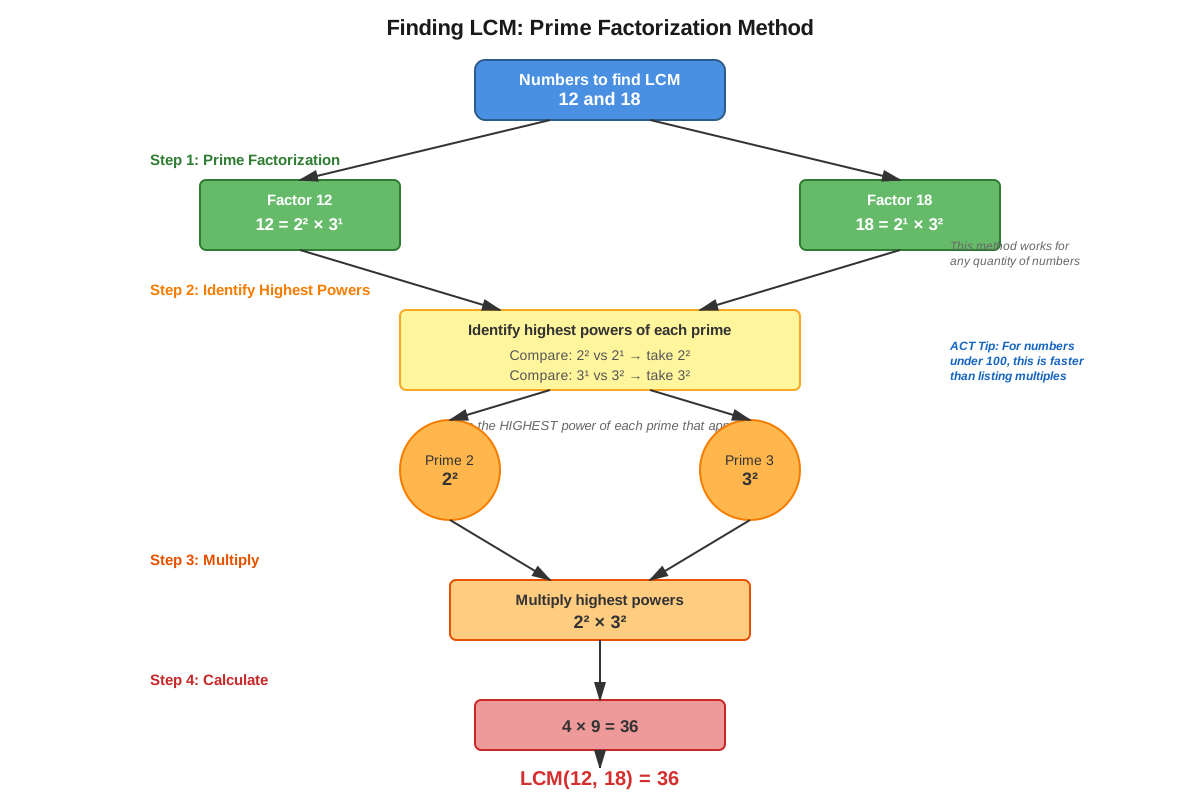
Method 2: Prime Factorization
Express each number as a product of prime factors, then take the highest power of each prime that appears.
Example: Find LCM(12, 18)
- 12 = 2² × 3
- 18 = 2 × 3²
- LCM = 2² × 3² = 4 × 9 = 36
The prime factorization method is generally faster for larger numbers and is the preferred approach for ACT questions involving three or more numbers.
Relationship Between LCM and GCF
For any two positive integers a and b, there exists an important relationship:
LCM(a, b) × GCF(a, b) = a × bThis formula allows students to find the LCM quickly if they know the greatest common factor (GCF), or vice versa. This relationship appears occasionally on the ACT in problems that provide one value and ask for the other.
Multiples in Arithmetic Sequences
An arithmetic sequence where the first term is a multiple of n and the common difference is also a multiple of n will consist entirely of multiples of n. For example, the sequence 15, 21, 27, 33, ... (first term 15, common difference 6) consists entirely of multiples of 3 because both 15 and 6 are multiples of 3. The ACT uses this property in sequence problems that ask students to identify patterns or find specific terms.
Properties of Multiples
| Property | Description | Example |
|---|---|---|
| Closure under addition | The sum of two multiples of n is also a multiple of n | 12 + 18 = 30 (all multiples of 6) |
| Closure under subtraction | The difference of two multiples of n is also a multiple of n | 35 - 14 = 21 (all multiples of 7) |
| Closure under multiplication | The product of a multiple of n and any integer is a multiple of n | 15 × 4 = 60 (15 is a multiple of 5, so is 60) |
| Transitivity | If a is a multiple of b, and b is a multiple of c, then a is a multiple of c | 36 is a multiple of 12, 12 is a multiple of 4, so 36 is a multiple of 4 |
Concept Relationships
The concepts within the topic of multiples form an interconnected web of relationships. Basic multiple identification serves as the foundation, leading directly to common multiples, which in turn leads to the more specific concept of the least common multiple (LCM). Understanding the properties of multiples (closure under addition, subtraction, and multiplication) enables students to solve complex problems involving multiple operations and constraints.
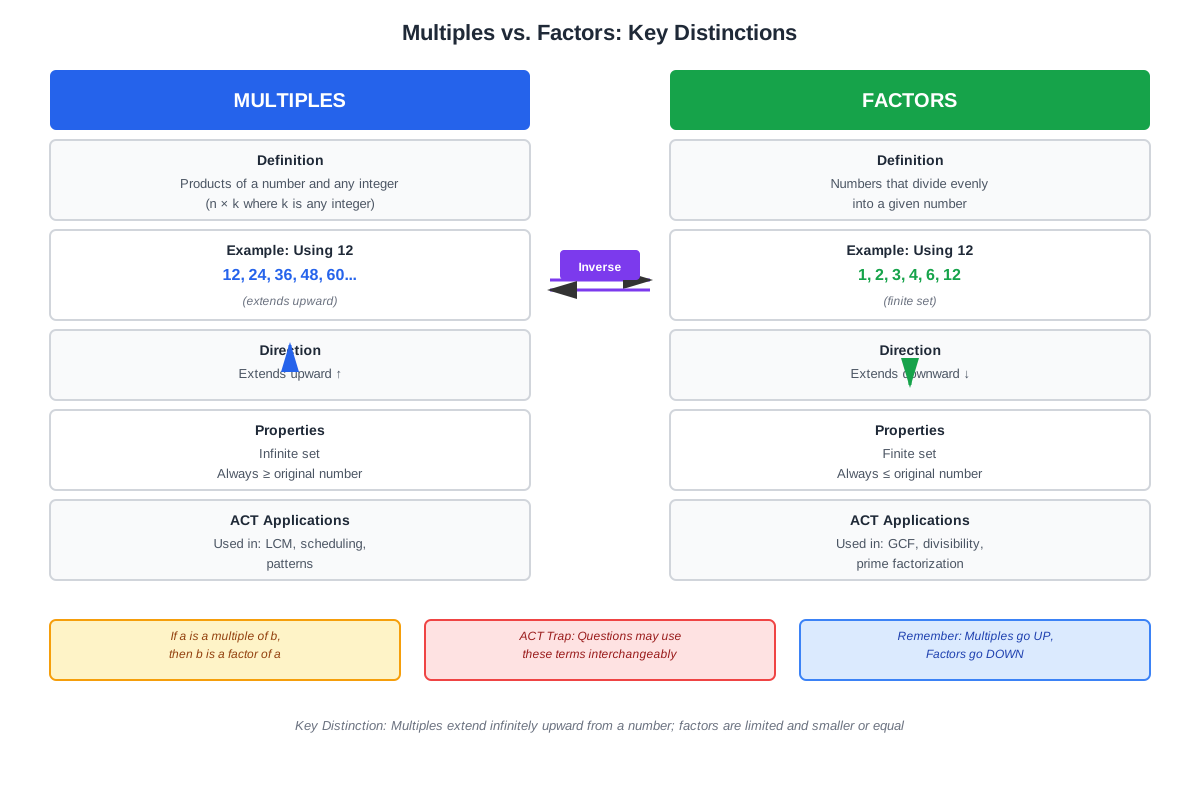
The relationship between multiples and factors is inverse: if A is a multiple of B, then B is a factor of A. This bidirectional relationship means that mastering multiples simultaneously strengthens understanding of factorization. The LCM connects to the GCF (greatest common factor) through the formula LCM(a,b) × GCF(a,b) = a × b, creating a bridge between two seemingly separate concepts.
Multiples also connect to prerequisite topics: divisibility rules provide shortcuts for identifying multiples, prime factorization offers an efficient method for finding LCMs, and integer properties ensure students understand that multiples extend infinitely in both directions. Looking forward, multiples enable progression to modular arithmetic, rational expressions (finding common denominators), and periodic functions in trigonometry.
The conceptual flow can be mapped as: Basic Multiplication → Multiples → Common Multiples → LCM → Applications in Word Problems → Advanced Number Theory. Each step builds upon the previous, creating a scaffold for increasingly sophisticated mathematical reasoning.
Quick check — test yourself on Multiples so far.
Try Flashcards →High-Yield Facts
⭐ A multiple of n is any number that can be expressed as n × k, where k is an integer
⭐ The least common multiple (LCM) of two numbers can be found by listing multiples or using prime factorization
⭐ Every integer is a multiple of 1 and a multiple of itself
⭐ Zero is a multiple of every integer
⭐ The sum or difference of two multiples of n is also a multiple of n
- If a is a multiple of b, and b is a multiple of c, then a is a multiple of c (transitivity)
- The product of any multiple of n and any integer is also a multiple of n
- For two numbers a and b: LCM(a, b) × GCF(a, b) = a × b
- The LCM of two prime numbers is their product
- The LCM of two numbers is always greater than or equal to the larger of the two numbers
- Common multiples of two numbers form an arithmetic sequence with first term equal to their LCM
- If two numbers have no common factors other than 1 (are coprime), their LCM equals their product
Common Misconceptions
Misconception: Multiples are always larger than the original number → Correction: Multiples include the number itself (n = n × 1), zero (0 = n × 0), and negative multiples (n × negative integers). The complete set of multiples extends infinitely in both directions.
Misconception: The LCM of two numbers is always their product → Correction: The LCM equals the product only when the two numbers share no common factors other than 1 (are coprime). For example, LCM(6, 8) = 24, not 48, because 6 and 8 share the common factor 2.
Misconception: Multiples and factors are the same thing → Correction: These are inverse relationships. If 20 is a multiple of 5, then 5 is a factor of 20. Multiples are typically larger than or equal to the original number, while factors are smaller than or equal to it.
Misconception: The smallest multiple of a positive number is 0 → Correction: While 0 is technically a multiple of every number, when the ACT asks for the "smallest multiple" or "least common multiple," it refers to the smallest positive multiple. Context matters in interpreting questions.
Misconception: To find the LCM of three numbers, find the LCM of two, then find the LCM of that result with the third → Correction: While this method works, it's often inefficient. Using prime factorization and taking the highest power of each prime factor that appears in any of the numbers is faster and less error-prone.
Misconception: If a number is a multiple of 6, it must be a multiple of 12 → Correction: Being a multiple of 6 means the number is divisible by both 2 and 3, but not necessarily by 4. A number must be divisible by 4 and 3 to be a multiple of 12. For example, 18 is a multiple of 6 but not of 12.
Worked Examples
Example 1: Finding LCM in a Scheduling Problem
Problem: A bakery makes croissants every 12 minutes and bagels every 18 minutes. If both items are made at 6:00 AM, at what time will they next be made simultaneously?
Solution:
Step 1: Recognize this as an LCM problem. We need to find when both cycles coincide, which occurs at the least common multiple of their periods.
Step 2: Find LCM(12, 18) using prime factorization.
- 12 = 2² × 3
- 18 = 2 × 3²
Step 3: Take the highest power of each prime factor.
- Highest power of 2: 2²
- Highest power of 3: 3²
- LCM = 2² × 3² = 4 × 9 = 36
Step 4: Interpret the result. Both items will be made together every 36 minutes.
Step 5: Add 36 minutes to 6:00 AM.
- 6:00 AM + 36 minutes = 6:36 AM
Answer: 6:36 AM
Connection to Learning Objectives: This problem demonstrates identifying when multiples are being tested (periodic events), applying the core strategy (finding LCM), and accurately solving an ACT-style word problem.
Example 2: Multiple Constraints Problem
Problem: What is the smallest positive integer that is a multiple of 8, leaves a remainder of 3 when divided by 5, and is less than 100?
Solution:
Step 1: List multiples of 8 (the most restrictive condition): 8, 16, 24, 32, 40, 48, 56, 64, 72, 80, 88, 96...
Step 2: Test each multiple to see which leaves a remainder of 3 when divided by 5.
- 8 ÷ 5 = 1 R 3 ✓
- Check if there's a smaller one? No, 8 is the first multiple of 8.
Step 3: Verify the answer meets all conditions.
- Is 8 a multiple of 8? Yes (8 = 8 × 1)
- Does 8 leave remainder 3 when divided by 5? Yes (8 = 5 × 1 + 3)
- Is 8 less than 100? Yes
Answer: 8
Alternative approach: Since we need a multiple of 8 that leaves remainder 3 when divided by 5, we can express this as 8k = 5m + 3 for integers k and m. Testing k = 1: 8(1) = 8 = 5(1) + 3 ✓
Connection to Learning Objectives: This problem requires recognizing multiple constraints involving multiples, applying systematic testing strategies, and demonstrating accuracy in ACT-style problems with multiple conditions.
Exam Strategy
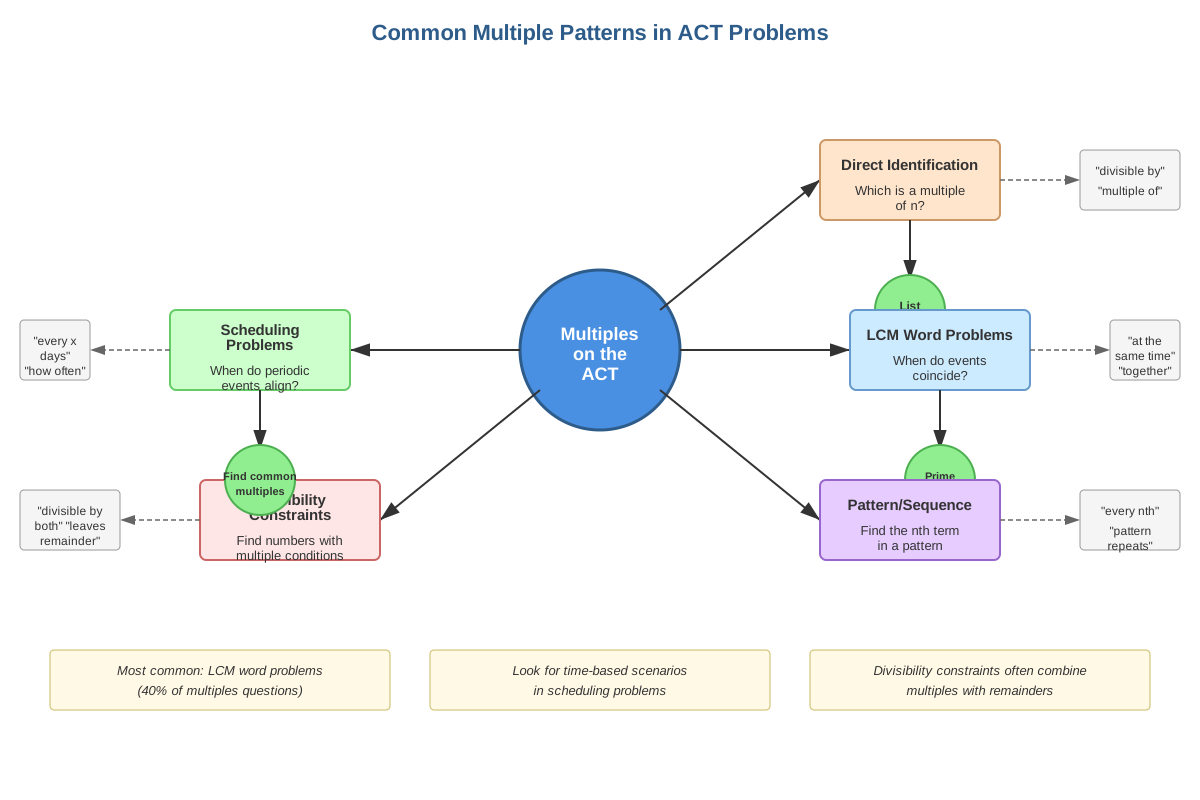
When approaching ACT multiples questions, begin by identifying trigger words and phrases: "multiple of," "divisible by," "every," "both," "simultaneously," "coincide," and "least common multiple." These signals indicate that the problem involves multiples and may require finding the LCM or identifying common multiples.
Exam Tip: If a question asks about two events happening "at the same time" or "together," immediately think LCM. If it asks about dividing items into equal groups with no remainder, think common multiples.
For time efficiency, memorize common LCMs that appear frequently on the ACT:
- LCM(2, 3) = 6
- LCM(4, 6) = 12
- LCM(3, 5) = 15
- LCM(6, 8) = 24
- LCM(12, 18) = 36
When using process of elimination, test answer choices by dividing them by the given numbers. If the division results in a non-integer, eliminate that choice immediately. For questions asking for the "smallest" or "least" multiple, start testing from the smallest answer choice; for "largest," start from the largest.
Allocate approximately 45-60 seconds for straightforward multiple identification problems and 90-120 seconds for LCM word problems. If a problem requires finding the LCM of three or more numbers, use prime factorization rather than listing multiples—it's faster and more reliable under time pressure.
Watch for trap answers that provide the product of two numbers instead of their LCM, or that give a common multiple that isn't the least common multiple. The ACT frequently includes these as distractors for students who rush or misunderstand the question.
Memory Techniques
Mnemonic for LCM Prime Factorization Method: "Highest Powers Produce LCM" (HPP-L)
- Highest: Take the highest power of each prime
- Powers: Look at the exponents in the prime factorization
- Produce: Multiply these highest powers together
- LCM: This gives you the Least Common Multiple
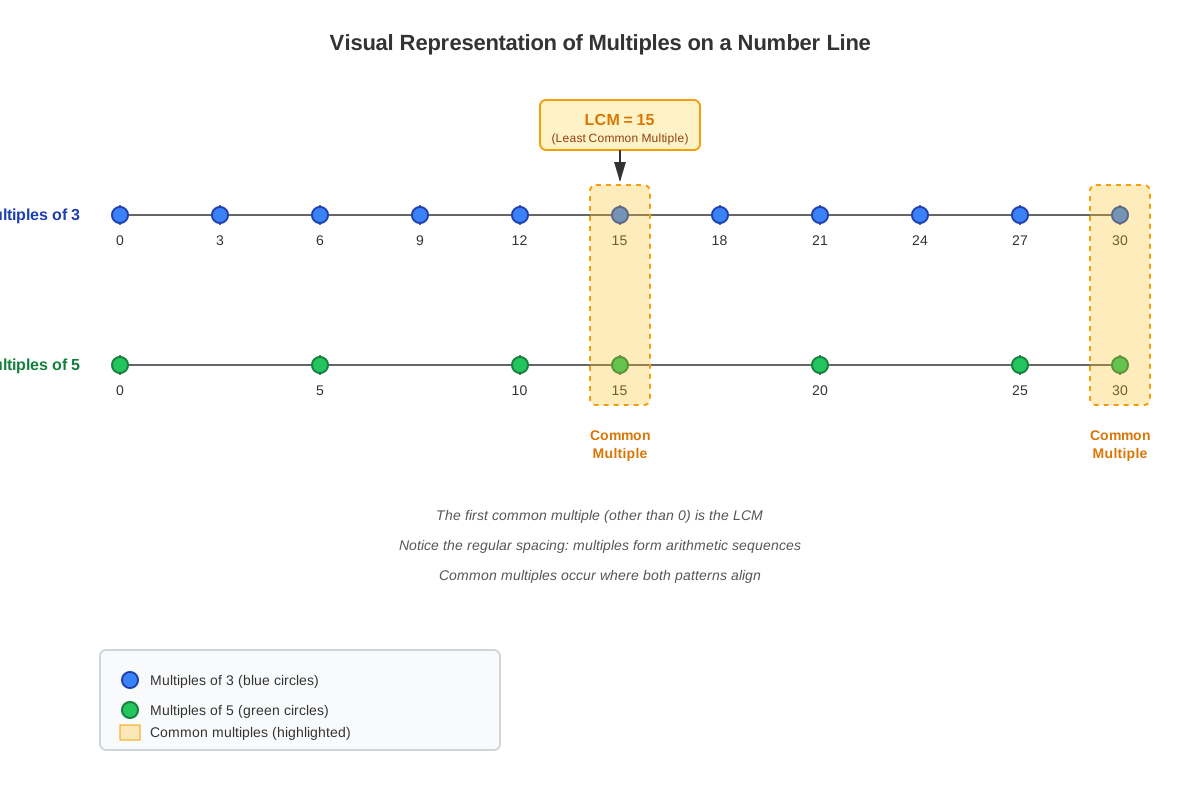
Visualization Strategy: Picture multiples as evenly spaced stepping stones extending infinitely in both directions from zero. The distance between stones equals the original number. Common multiples are stones where two different paths intersect, and the LCM is the first intersection point after zero.
Acronym for Multiple Properties: "MAST"
- Multiplication: Product of a multiple and any integer is a multiple
- Addition: Sum of multiples is a multiple
- Subtraction: Difference of multiples is a multiple
- Transitivity: Multiple of a multiple is a multiple
Memory Aid for LCM vs. GCF: LCM is Large (takes the highest powers), GCF is Grab the smallest (takes the lowest powers). Both use prime factorization, but LCM builds up while GCF breaks down.
Summary
Multiples represent products of a number and any integer, forming an infinite set that extends in both positive and negative directions. The ACT tests multiples through direct identification, least common multiple calculations, and word problems involving periodic events or synchronization. Mastering multiples requires understanding their properties (closure under addition, subtraction, and multiplication), recognizing the inverse relationship with factors, and efficiently calculating the LCM using either listing or prime factorization methods. The LCM represents the smallest positive integer divisible by all given numbers and appears frequently in scheduling problems, pattern recognition, and problems with multiple divisibility constraints. Success on ACT multiples questions depends on recognizing trigger words, applying systematic strategies, and understanding the relationship between LCM and GCF. Students who internalize these concepts and practice identifying when multiples are being tested will confidently handle the 3-5 questions per exam that directly or indirectly assess this foundational number theory topic.
Key Takeaways
- A multiple of n equals n × k for any integer k; every number is a multiple of itself and of 1
- The least common multiple (LCM) is the smallest positive integer divisible by all given numbers
- Use prime factorization for LCM by taking the highest power of each prime factor that appears
- The sum, difference, or product of multiples of n is also a multiple of n
- LCM(a, b) × GCF(a, b) = a × b provides a shortcut when one value is known
- Zero is a multiple of every integer, but "smallest multiple" on the ACT means smallest positive multiple
- Recognize LCM problems through trigger words: "simultaneously," "coincide," "both," "every"
Related Topics
Factors and Divisibility: Understanding factors (numbers that divide evenly into another) is the inverse of understanding multiples. Mastering multiples enables quick progression to factorization, prime factorization, and divisibility rules—all high-yield ACT topics.
Greatest Common Factor (GCF): The GCF represents the largest number that divides evenly into two or more numbers. The relationship between LCM and GCF (their product equals the product of the original numbers) makes these topics complementary.
Arithmetic Sequences: Sequences with a constant difference between terms often involve multiples. Understanding multiples helps identify patterns and find specific terms in arithmetic progressions.
Modular Arithmetic: Advanced number theory involving remainders builds directly on multiple concepts. Students who master multiples find modular arithmetic more intuitive and accessible.
Rational Expressions and Fractions: Finding common denominators when adding or subtracting fractions requires finding the LCM of the denominators, making multiples essential for algebra success.
Practice CTA
Now that you've mastered the core concepts, properties, and strategies for multiples, it's time to solidify your understanding through practice. Attempt the practice questions to test your ability to identify when multiples are being tested, apply the LCM calculation methods efficiently, and solve ACT-style word problems with confidence. Use the flashcards to reinforce high-yield facts and ensure you can recall key properties under time pressure. Remember: consistent practice with immediate feedback is the most effective way to transform understanding into exam-day performance. You've built a strong foundation—now prove it to yourself through deliberate practice!
Sign up free to keep reading
Create a free AnvayaPrep account to finish this ACT guide on Multiples — plus flashcards and practice questions.