Overview
The mode is one of the three fundamental measures of central tendency in statistics, alongside mean and median. On the ACT Math test, understanding mode is essential for success in the Statistics and Probability content area, which comprises approximately 8-12% of all math questions. While mode may seem straightforward—it's simply the value that appears most frequently in a dataset—the ACT mode questions often incorporate twists that test deeper conceptual understanding rather than simple identification.
Mode questions on the ACT frequently appear in contexts that require students to analyze data sets, interpret frequency distributions, work with bimodal or multimodal distributions, or determine missing values that would create specific modal characteristics. These questions may be presented as straightforward data analysis problems, embedded within word problems about real-world scenarios, or integrated with other statistical concepts like mean and median. The ability to quickly identify when mode is being tested and apply the appropriate strategy can save valuable time during the exam.
Understanding mode also builds foundational knowledge for more advanced statistical concepts and connects to broader mathematical reasoning skills. Mode relates to frequency analysis, probability distributions, and data interpretation—all critical skills for both the ACT and real-world quantitative reasoning. Unlike mean and median, mode is the only measure of central tendency that can be used with categorical (non-numerical) data, making it uniquely important in certain problem contexts. Mastering mode ensures students can confidently tackle any central tendency question and recognize when mode provides more meaningful information than other measures.
Learning Objectives
- [ ] Identify when Mode is being tested in ACT questions
- [ ] Explain the core rule or strategy behind Mode
- [ ] Apply Mode to ACT-style questions accurately
- [ ] Distinguish between unimodal, bimodal, multimodal, and no-mode datasets
- [ ] Determine missing values that would create or change the mode of a dataset
- [ ] Compare and contrast mode with mean and median to select the most appropriate measure
- [ ] Analyze frequency distributions and histograms to identify modal values
Prerequisites
- Basic arithmetic operations: Required for counting frequencies and comparing values within datasets
- Understanding of data sets and lists: Necessary to organize and analyze collections of numerical values
- Familiarity with mean and median: Provides context for understanding mode as one of three measures of central tendency
- Reading and interpreting tables and graphs: Essential for extracting data from visual representations commonly used in ACT questions
Why This Topic Matters
Mode has significant real-world applications across numerous fields. In business, mode identifies the most popular product size, the most common customer complaint, or the typical transaction amount. In education, teachers use mode to determine the most frequent test score. In manufacturing, mode helps identify the most common defect type. In social sciences, mode reveals the most common response in survey data, particularly for categorical variables like favorite color or preferred brand. Unlike mean, mode isn't affected by extreme outliers, making it valuable when analyzing skewed distributions.
On the ACT Math test, mode appears in approximately 2-4 questions per exam, making it a high-yield topic relative to its conceptual simplicity. Mode questions typically appear in several formats: direct identification from a list of numbers, determination from frequency tables or histograms, word problems requiring mode calculation, and complex problems asking students to find missing values that would result in a specific mode. The ACT particularly favors questions that combine mode with other statistical concepts or require students to manipulate datasets to achieve desired modal properties.
Common ACT question types include: identifying the mode from a dataset presented in a word problem context; determining which value, when added to a dataset, would change or create the mode; comparing mode with mean and median to analyze data distribution; and interpreting frequency distributions or bar graphs to identify modal categories. The ACT also tests whether students understand that datasets can have no mode, one mode, or multiple modes—a conceptual distinction that separates prepared students from those with superficial understanding.
Core Concepts
Definition of Mode
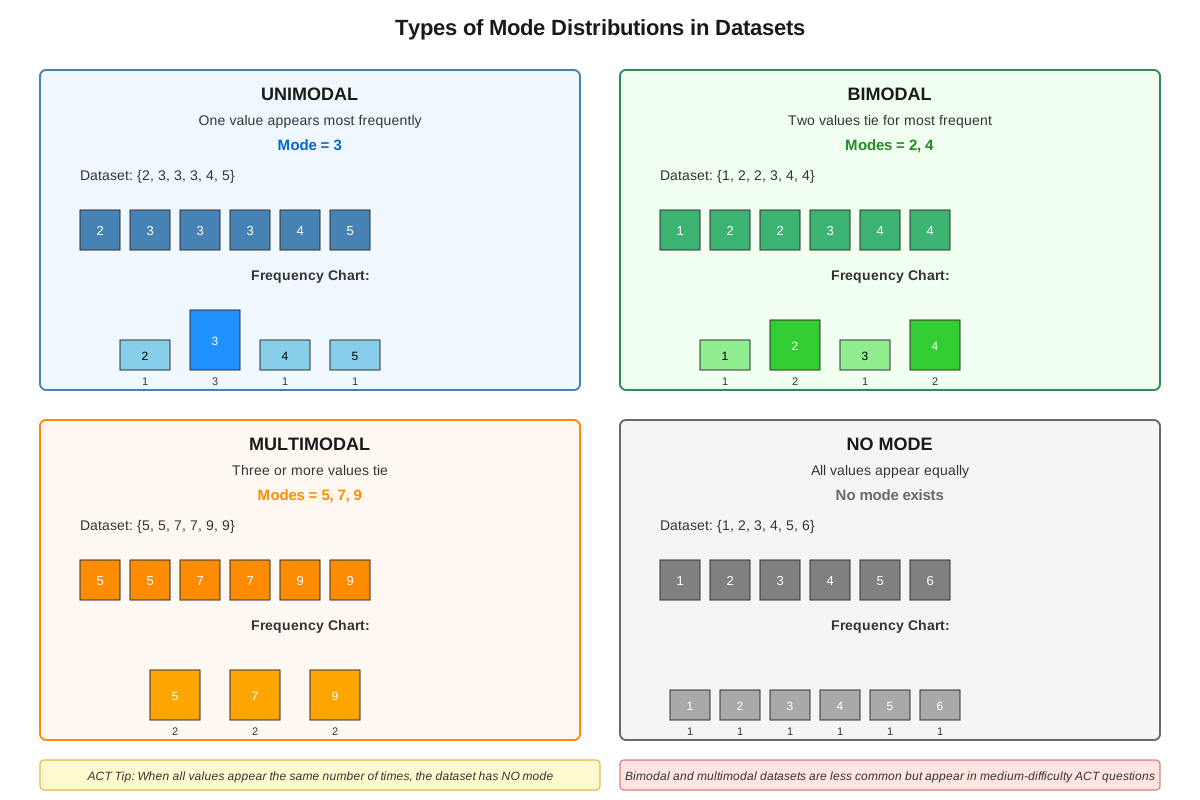
The mode is the value that appears most frequently in a dataset. It represents the most common or typical value in terms of occurrence rather than mathematical average. To find the mode, count how many times each value appears in the dataset and identify which value has the highest frequency. Unlike mean and median, which always produce a single numerical result, a dataset can have one mode (unimodal), two modes (bimodal), multiple modes (multimodal), or no mode at all.
For example, in the dataset {3, 7, 7, 9, 12, 7, 15}, the number 7 appears three times while all other values appear once. Therefore, the mode is 7. The mode provides information about which value is most typical in terms of frequency, which can differ significantly from the arithmetic average (mean) or middle value (median).
Types of Modal Distributions
Understanding the different types of modal distributions is crucial for ACT success:
| Distribution Type | Definition | Example Dataset | Number of Modes |
|---|---|---|---|
| Unimodal | One value appears most frequently | {2, 3, 3, 3, 5, 7, 9} | 1 (mode = 3) |
| Bimodal | Two values tie for highest frequency | {1, 2, 2, 4, 5, 5, 8} | 2 (modes = 2 and 5) |
| Multimodal | Three or more values tie for highest frequency | {1, 1, 3, 3, 5, 5, 7} | 3 (modes = 1, 3, and 5) |
| No Mode | All values appear with equal frequency | {2, 4, 6, 8, 10} | 0 (no mode) |
The ACT frequently tests whether students recognize that datasets can have multiple modes or no mode. A common trap involves datasets where all values appear exactly once—many students incorrectly identify the smallest or largest value as the mode, when in fact there is no mode.
Finding Mode in Different Data Formats
From a Simple List: Organize the data in ascending order (optional but helpful), count the frequency of each value, and identify the value(s) with the highest frequency. For the dataset {15, 22, 18, 22, 15, 22, 19}, organizing gives {15, 15, 18, 19, 22, 22, 22}, making it clear that 22 appears three times and is the mode.
From a Frequency Table: Frequency tables explicitly show how many times each value occurs. Simply identify the value associated with the highest frequency count.
| Value | Frequency |
|---|---|
| 10 | 3 |
| 15 | 7 |
| 20 | 4 |
| 25 | 2 |
In this table, 15 has the highest frequency (7), so the mode is 15.
From a Histogram or Bar Graph: The mode corresponds to the tallest bar in the graph, representing the category or value with the highest frequency. On the ACT, carefully read axis labels to determine what value the tallest bar represents.
From a Stem-and-Leaf Plot: Count how many times each complete value appears across all stems. The value appearing most frequently is the mode.
Mode with Categorical Data
Mode is the only measure of central tendency that can be applied to categorical (non-numerical) data. For example, if surveying favorite ice cream flavors yields: {chocolate, vanilla, chocolate, strawberry, chocolate, vanilla, chocolate}, the mode is chocolate because it appears most frequently. The ACT occasionally includes questions involving categorical data where mode is the only appropriate measure—recognizing this distinguishes strong students from those who attempt to calculate mean or median for non-numerical data.
Determining Missing Values
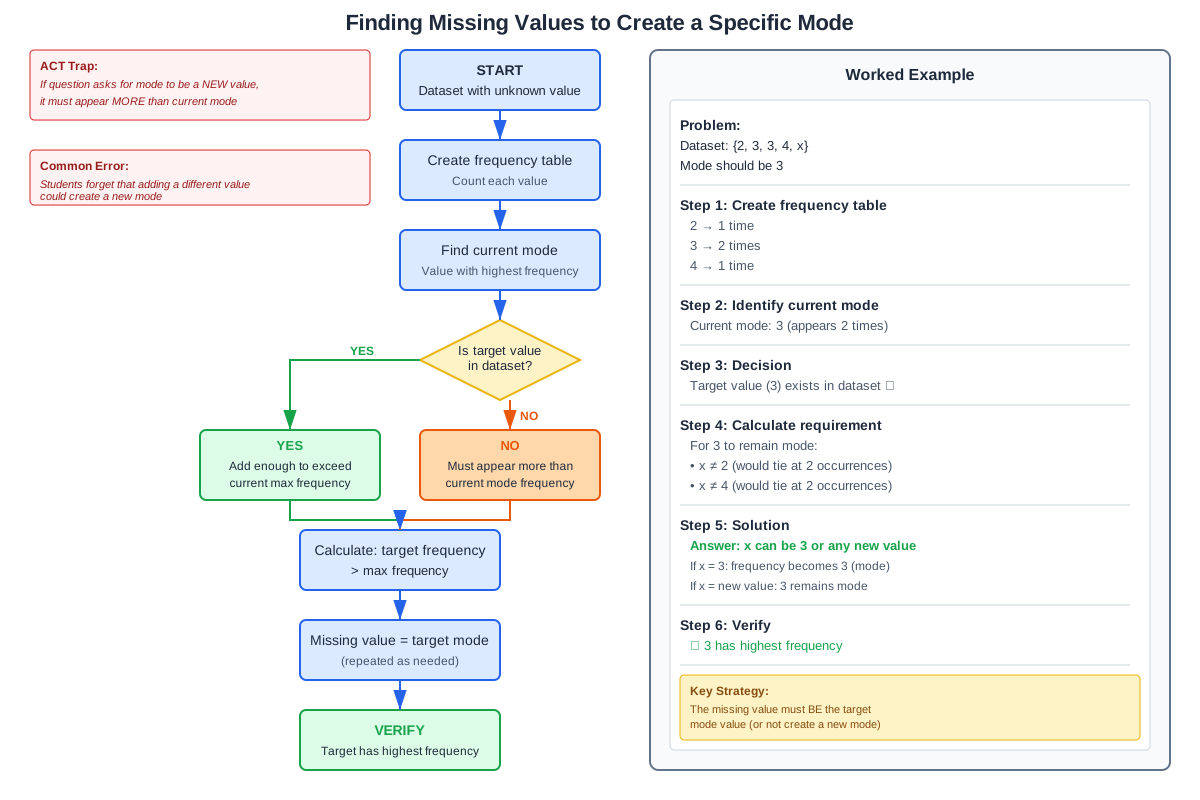
A sophisticated ACT question type asks students to determine what value, when added to a dataset, would create a specific mode or change the existing mode. This requires understanding that:
- To create a new mode, add a value that already exists in the dataset, increasing its frequency to exceed all others
- To maintain the current mode, add any value that doesn't increase another value's frequency beyond the current mode's frequency
- To create a bimodal distribution, add a value that brings another value's frequency equal to the current mode's frequency
For example, given the dataset {4, 5, 5, 7, 8, 8, 8, 9}, the mode is 8 (appears three times). If the question asks what value would create a bimodal distribution, the answer would be 5 (bringing its frequency to three) or any value that appears twice (4, 7, or 9 would need to appear one more time, but since we're adding one value, we'd add 5 to make both 5 and 8 appear three times).
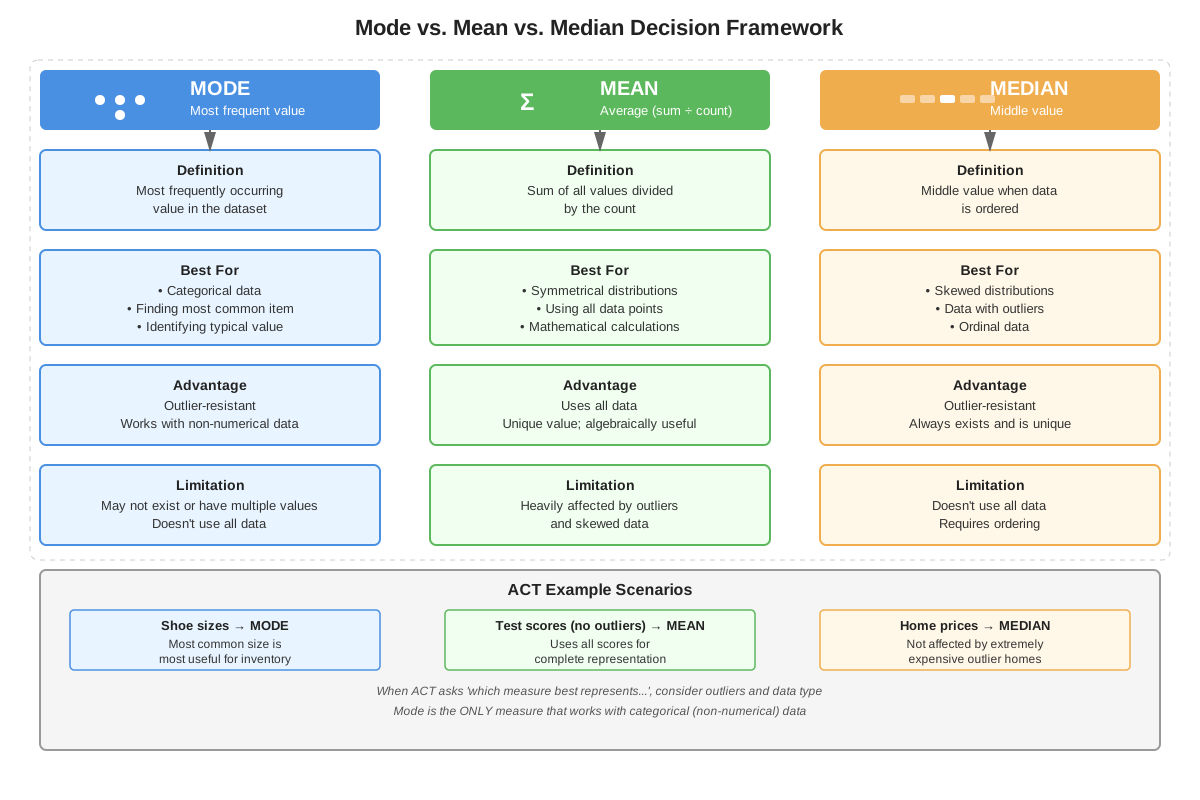
Mode Compared to Mean and Median
Understanding when mode is more appropriate than mean or median is essential:
- Mode is best for identifying the most typical or common value, especially with categorical data or when the most frequent occurrence matters more than numerical average
- Mean is best for datasets without extreme outliers when you need the arithmetic average
- Median is best for skewed distributions with outliers, as it represents the middle value
Consider home prices in a neighborhood: {$150,000, $155,000, $160,000, $158,000, $2,500,000}. The mean ($624,400) is distorted by the mansion, the median ($158,000) represents the middle value, but if most homes cluster around certain price points, the mode would identify the most common price range. The ACT tests whether students can select the most appropriate measure for a given context.
Concept Relationships
The concept of mode connects fundamentally to frequency analysis—mode cannot exist without understanding how often values occur. This frequency counting skill underlies mode identification and extends to creating frequency distributions and histograms. Mode → requires → frequency counting → enables → frequency distribution creation.
Mode relates directly to its sibling concepts, mean and median, as the three measures of central tendency. Together, these three measures provide complementary information about datasets: mean shows arithmetic average, median shows positional center, and mode shows frequency-based typicality. Understanding all three → enables → comprehensive data analysis → supports → informed statistical decision-making.
The concept of data distribution shape connects to mode through the relationship between central tendency measures. In symmetric distributions, mean, median, and mode are approximately equal. In right-skewed distributions, mode < median < mean. In left-skewed distributions, mean < median < mode. This relationship: distribution shape → determines → relative positions of mean, median, and mode → helps → identify distribution characteristics.
Mode also connects to probability concepts because the modal value is the outcome with the highest probability of occurrence in a dataset. This relationship: mode identification → reveals → most probable outcome → connects to → basic probability reasoning.
Finally, mode relates to data representation through various formats (lists, tables, graphs). The skill of extracting mode from different representations: data format recognition → requires → appropriate extraction strategy → yields → mode identification → demonstrates → data literacy.
High-Yield Facts
⭐ The mode is the value that appears most frequently in a dataset—count occurrences to identify it
⭐ A dataset can have no mode if all values appear with equal frequency—don't assume every dataset has a mode
⭐ A dataset can have multiple modes (bimodal or multimodal) if two or more values tie for highest frequency—all tied values are modes
⭐ Mode is the only measure of central tendency applicable to categorical data—use mode for non-numerical data like colors or categories
⭐ In a frequency table, the mode corresponds to the value with the highest frequency count—look for the largest number in the frequency column
- Mode is not affected by extreme outliers, unlike mean, making it useful for skewed distributions
- In a histogram, the mode corresponds to the tallest bar or the category with the highest frequency
- To change a dataset's mode, add a value that increases another value's frequency to exceed the current mode's frequency
- When all values in a dataset appear exactly once, there is no mode, not multiple modes
- The mode may not be near the center of the dataset numerically—it's determined solely by frequency
- Adding the mode value to a dataset maintains it as the mode (increases its frequency further)
- Mode can be used with ordinal data (ranked categories) as well as nominal data (unranked categories)
- In bimodal distributions, both modes are equally valid—don't choose just one
- The mode is the simplest measure of central tendency to calculate—no arithmetic operations required
- For continuous data grouped into intervals, the modal class is the interval with the highest frequency
Quick check — test yourself on Mode so far.
Try Flashcards →Common Misconceptions
Misconception: The mode is always the middle value or the average of the dataset.
Correction: Mode is determined solely by frequency of occurrence, not by position or arithmetic calculation. The mode is whichever value appears most often, regardless of its numerical position. Mean is the arithmetic average, and median is the middle value—these are completely different concepts.
Misconception: Every dataset must have exactly one mode.
Correction: Datasets can have no mode (all values appear equally), one mode (unimodal), two modes (bimodal), or many modes (multimodal). When all values appear with the same frequency, there is no mode. When two or more values tie for highest frequency, all tied values are modes.
Misconception: When all values appear once, the smallest or largest value is the mode.
Correction: When all values appear with equal frequency (including once each), the dataset has no mode. Mode requires one or more values to appear more frequently than others. Equal frequency means no value is "most common."
Misconception: You can calculate mode by adding values and dividing, similar to mean.
Correction: Mode requires no arithmetic operations—only counting. Simply count how many times each value appears and identify which value(s) have the highest count. There is no formula involving addition or division.
Misconception: The mode must be one of the larger values in the dataset.
Correction: The mode is determined by frequency, not magnitude. The smallest value in a dataset can be the mode if it appears most frequently. For example, in {1, 1, 1, 50, 75, 100}, the mode is 1 despite being the smallest value.
Misconception: Mode and median are the same thing.
Correction: Mode is the most frequent value, while median is the middle value when data is ordered. In the dataset {2, 3, 3, 3, 10}, the mode is 3 (most frequent) but the median is also 3 (middle value)—they happen to coincide here, but in {1, 2, 2, 2, 5, 8, 9}, the mode is 2 while the median is also 2. However, in {1, 2, 2, 2, 5, 8, 9, 10}, the mode is 2 but the median is 3.5 (average of 2 and 5).
Misconception: Adding any value to a dataset will change the mode.
Correction: Adding a value only changes the mode if it increases another value's frequency to exceed the current mode's frequency, or if it creates a tie. Adding a new unique value or adding the current mode value maintains the existing mode.
Misconception: Mode can only be used with numerical data.
Correction: Mode is the only measure of central tendency that works with categorical data. You can find the mode of colors, names, categories, or any type of data where you can count occurrences. Mean and median require numerical data, but mode does not.
Worked Examples
Example 1: Identifying Mode and Understanding Distribution Types
Problem: A teacher records the number of books read by students during summer break: {3, 5, 2, 5, 7, 5, 3, 8, 5, 2, 6, 5}. What is the mode? If one student who read 3 books changes their count to 5 books, what type of distribution results?
Solution:
Step 1: Organize the data to see frequencies more clearly:
{2, 2, 3, 3, 5, 5, 5, 5, 5, 6, 7, 8}
Step 2: Count the frequency of each value:
- 2 appears 2 times
- 3 appears 2 times
- 5 appears 5 times
- 6 appears 1 time
- 7 appears 1 time
- 8 appears 1 time
Step 3: Identify the mode:
The value 5 appears most frequently (5 times), so the mode is 5. This is a unimodal distribution.
Step 4: Analyze the change:
If one student changes from 3 books to 5 books, the new dataset becomes:
{2, 2, 3, 5, 5, 5, 5, 5, 5, 6, 7, 8}
Now 5 appears 6 times while all other values appear less frequently. The mode remains 5, and the distribution remains unimodal.
Connection to Learning Objectives: This example demonstrates identifying mode from a dataset (Objective 1), applying the core strategy of counting frequencies (Objective 2), and distinguishing distribution types (Objective 4).
Example 2: Determining Missing Values to Create Specific Modal Properties
Problem: A dataset contains the test scores: {72, 78, 78, 85, 85, 92, 95}. The teacher will add one more score to the dataset.
(a) What score should be added to make the dataset bimodal?
(b) What score should be added to make 85 the only mode?
(c) What score could be added without changing the current modal properties?
Solution:
Step 1: Analyze the current distribution:
- 72 appears 1 time
- 78 appears 2 times
- 85 appears 2 times
- 92 appears 1 time
- 95 appears 1 time
Currently, the dataset is bimodal with modes at 78 and 85 (both appear twice).
Step 2: Answer part (a):
The dataset is already bimodal, so adding any value that doesn't change the frequency relationship maintains this property. Adding 72, 92, or 95 (bringing any of these to 2 occurrences) would create a trimodal distribution. Adding any new value (like 80) would maintain the bimodal distribution. However, if the question asks what would create a bimodal distribution from a different starting point, we'd need to match the highest frequency.
Better interpretation: If the dataset were currently unimodal, to make it bimodal, we'd add a value that brings another value's frequency equal to the mode's frequency.
Step 3: Answer part (b):
To make 85 the only mode, we need 85 to appear more frequently than 78. Adding another 85 would make it appear 3 times while 78 appears only 2 times, making 85 the sole mode.
Step 4: Answer part (c):
To maintain the current bimodal distribution (78 and 85 both appearing twice), add any value that appears 0 or 1 time currently: 72, 92, 95, or any new value not in the dataset. This keeps 78 and 85 tied at the highest frequency of 2.
Connection to Learning Objectives: This example demonstrates determining missing values that create or change mode (Objective 5), applying mode strategies to complex scenarios (Objective 3), and distinguishing between distribution types (Objective 4).
Exam Strategy
Recognizing Mode Questions: Watch for trigger phrases like "most common," "most frequent," "appears most often," "typical value," or direct mentions of "mode." Questions asking about categorical data (favorite color, most popular choice) almost always require mode. If a question presents a frequency table or histogram and asks about the most common value, mode is being tested.
Systematic Approach:
- Organize the data: If given an unordered list, quickly write values in order or make tick marks to count frequencies
- Count systematically: Don't rely on visual scanning—actually count each value's occurrences
- Check for ties: Before selecting an answer, verify no other value has equal frequency
- Consider "no mode": If all values appear equally, the answer is "no mode" or "cannot be determined"—don't force an answer
Process of Elimination Tips:
- Eliminate any answer choice that doesn't actually appear in the dataset (common distractor)
- Eliminate the mean or median if they're offered as mode answers—these are different concepts
- If the question asks for mode and offers "all values are modes," check if all values truly have equal frequency
- For "which value would create/change the mode" questions, eliminate values that wouldn't affect frequency relationships
Time Management: Mode questions should take 30-60 seconds maximum. If you're spending more time, you're likely overcomplicating. Mode requires counting, not complex calculations. If a question seems to require extensive computation, reread to ensure you're not confusing mode with mean.
Common Traps to Avoid:
- Don't confuse mode with median (middle value) or mean (average)
- Don't assume the largest or smallest value is the mode
- Don't overlook that multiple modes can exist
- Don't forget that "no mode" is a valid answer
- Don't miscalculate when working with frequency tables—the mode is the value, not the frequency count itself
Visual Data Strategy: For histograms and bar graphs, the mode corresponds to the tallest bar. However, carefully read what the bar represents—sometimes the x-axis shows ranges or categories rather than specific values. Identify what value or category the tallest bar represents, not just its height.
Memory Techniques
"MODE = MOST": Remember that MODE and MOST both start with "MO." The mode is the value that appears MOST often. This simple connection helps distinguish mode from mean and median.
"Frequency First": Before identifying mode, always count frequencies. The acronym F.I.M. helps remember the process:
- Frequency: Count how often each value appears
- Identify: Find the highest frequency
- Mode: The value(s) with highest frequency
"The Popular Kid": Visualize mode as the "most popular" value in the dataset—the one that shows up to the party most often. Just as a popular kid appears at many events, the mode appears most frequently in the data.
"No Tie, One Guy; Tie, Multiple Fly": This rhyme helps remember distribution types:
- If there's no tie in frequency (one value appears most), there's one mode
- If there's a tie (multiple values share highest frequency), multiple modes exist
- If everyone ties (all equal frequency), no mode exists
Visual Memory: Picture a bar graph where one bar towers above the others—that's the mode. If two bars are equally tall and highest, that's bimodal. If all bars are the same height, there's no mode.
Categorical Connection: Remember "Mode = Categories OK" because mode is the only measure that works with categorical data. Mean and median need numbers, but mode just needs countable occurrences.
Summary
Mode is the value that appears most frequently in a dataset, making it the measure of central tendency based on occurrence rather than calculation. Unlike mean and median, mode requires only counting frequencies—no arithmetic operations. Datasets can have one mode (unimodal), multiple modes (bimodal or multimodal), or no mode when all values appear equally. Mode is unique among central tendency measures because it applies to categorical data, making it essential for analyzing non-numerical information. On the ACT, mode questions test whether students can identify the most frequent value from various data formats (lists, frequency tables, histograms), determine missing values that would create specific modal properties, and distinguish mode from mean and median. Success requires systematic frequency counting, recognition that multiple modes or no mode are valid possibilities, and understanding that mode represents typicality by occurrence frequency. The key to mastering mode is remembering that it's always about which value appears most often—nothing more complex than counting.
Key Takeaways
- Mode is the most frequently occurring value in a dataset, determined solely by counting occurrences, not by arithmetic calculation
- Datasets can have zero, one, or multiple modes—don't assume every dataset has exactly one mode
- Mode is the only measure of central tendency that works with categorical data, making it essential for non-numerical analysis
- In frequency tables and histograms, the mode corresponds to the highest frequency or tallest bar—always verify what the value represents, not just the frequency count
- To change a dataset's mode, add a value that increases another value's frequency beyond the current mode's frequency
- Mode is not affected by extreme outliers, making it useful for skewed distributions where mean would be distorted
- Systematic counting is essential—organize data and count carefully rather than relying on visual estimation to avoid errors
Related Topics
Mean (Arithmetic Average): Understanding mean alongside mode provides comprehensive knowledge of central tendency measures. Mean is calculated by summing all values and dividing by the count, and comparing mean to mode helps identify distribution skewness. Mastering mode provides the foundation for understanding when mean is more or less appropriate than mode.
Median (Middle Value): Median represents the middle value when data is ordered, complementing mode's frequency-based approach. Together, mean, median, and mode provide complete central tendency analysis. Understanding mode first makes median easier to distinguish and apply appropriately.
Range and Measures of Spread: While mode describes central tendency, range and standard deviation describe data spread. Combining mode with spread measures provides fuller dataset characterization. Mode mastery enables progression to more sophisticated statistical analysis.
Frequency Distributions and Histograms: These visual representations explicitly show the frequencies that determine mode. Understanding mode deepens comprehension of frequency distributions and enables quick visual mode identification from graphs.
Probability and Expected Value: Mode connects to probability as the outcome with highest occurrence frequency. This relationship bridges descriptive statistics (mode) and inferential statistics (probability), enabling progression to more advanced statistical reasoning.
Practice CTA
Now that you've mastered the concept of mode, it's time to solidify your understanding through practice! Attempt the practice questions to apply these strategies to ACT-style problems, and use the flashcards to reinforce key definitions and concepts. Remember, mode questions are high-yield on the ACT and should be quick points—with systematic counting and awareness of common traps, you can confidently tackle any mode question in under a minute. Your preparation today translates directly to points on test day!
Sign up free to keep reading
Create a free AnvayaPrep account to finish this ACT guide on Mode — plus flashcards and practice questions.