Overview
Overlapping events represent one of the most frequently tested concepts in the Statistics and Probability section of the ACT Math test. This topic deals with situations where two or more events can occur simultaneously or share common outcomes, requiring students to carefully account for these shared elements when calculating probabilities. Unlike mutually exclusive events (where events cannot happen at the same time), overlapping events create scenarios where outcomes belong to multiple categories, demanding a more sophisticated approach to probability calculations.
Understanding overlapping events is essential for ACT success because these questions appear regularly on every test administration, often disguised within word problems involving surveys, Venn diagrams, or real-world scenarios. Students who master this topic gain the ability to recognize when outcomes are being counted multiple times and know how to adjust their calculations accordingly. The ACT frequently tests this concept through questions about student participation in multiple activities, characteristics of populations with shared traits, or card and dice problems where outcomes satisfy multiple conditions.
This topic connects fundamentally to basic probability principles, set theory, and logical reasoning. Mastery of overlapping events builds directly upon understanding of simple probability, complementary events, and the addition rule. Furthermore, this knowledge serves as a foundation for more advanced statistical concepts and prepares students for the type of analytical thinking required in college-level mathematics and data science courses.
Learning Objectives
- [ ] Identify when Overlapping events is being tested in ACT questions
- [ ] Explain the core rule or strategy behind Overlapping events
- [ ] Apply Overlapping events to ACT-style questions accurately
- [ ] Calculate probabilities using the Addition Rule for overlapping events
- [ ] Construct and interpret Venn diagrams to visualize overlapping event scenarios
- [ ] Distinguish between overlapping and mutually exclusive events in problem contexts
- [ ] Solve multi-step problems involving three or more overlapping events
Prerequisites
- Basic probability concepts: Understanding how to calculate simple probabilities as favorable outcomes divided by total outcomes is essential for building toward overlapping event calculations
- Set notation and terminology: Familiarity with unions, intersections, and basic set operations helps interpret overlapping event problems correctly
- Fractions and percentages: Converting between these forms and performing arithmetic operations is necessary for probability calculations
- Logical reasoning: The ability to categorize outcomes and recognize when elements belong to multiple groups underlies all overlapping event problems
Why This Topic Matters
In real-world applications, overlapping events appear constantly in data analysis, medical research, marketing surveys, and risk assessment. When a company analyzes customer demographics, they must account for customers who fit multiple categories (such as being both "frequent buyers" and "premium members"). Medical researchers studying disease risk factors must carefully calculate probabilities when patients have multiple risk factors simultaneously. Survey analysts regularly work with data where respondents select multiple options, creating natural overlaps that require proper mathematical treatment.
On the ACT Math test, overlapping events questions appear with remarkable consistency—typically 1-2 questions per test administration, making this a high-yield topic for focused study. These questions usually appear in the latter half of the 60-question Math section, often positioned between questions 35-50, where medium-to-difficult probability problems cluster. The ACT tests this concept through various formats: Venn diagram problems (most common), survey result interpretations, card/dice probability scenarios with compound conditions, and word problems involving group memberships.
The exam frequently presents overlapping events in disguised forms, such as asking "how many students play both sports?" or "what is the probability of drawing a card that is either red or a face card?" Students who recognize these trigger phrases and understand the underlying mathematics gain significant advantages in both accuracy and speed.
Core Concepts
The Addition Rule for Overlapping Events
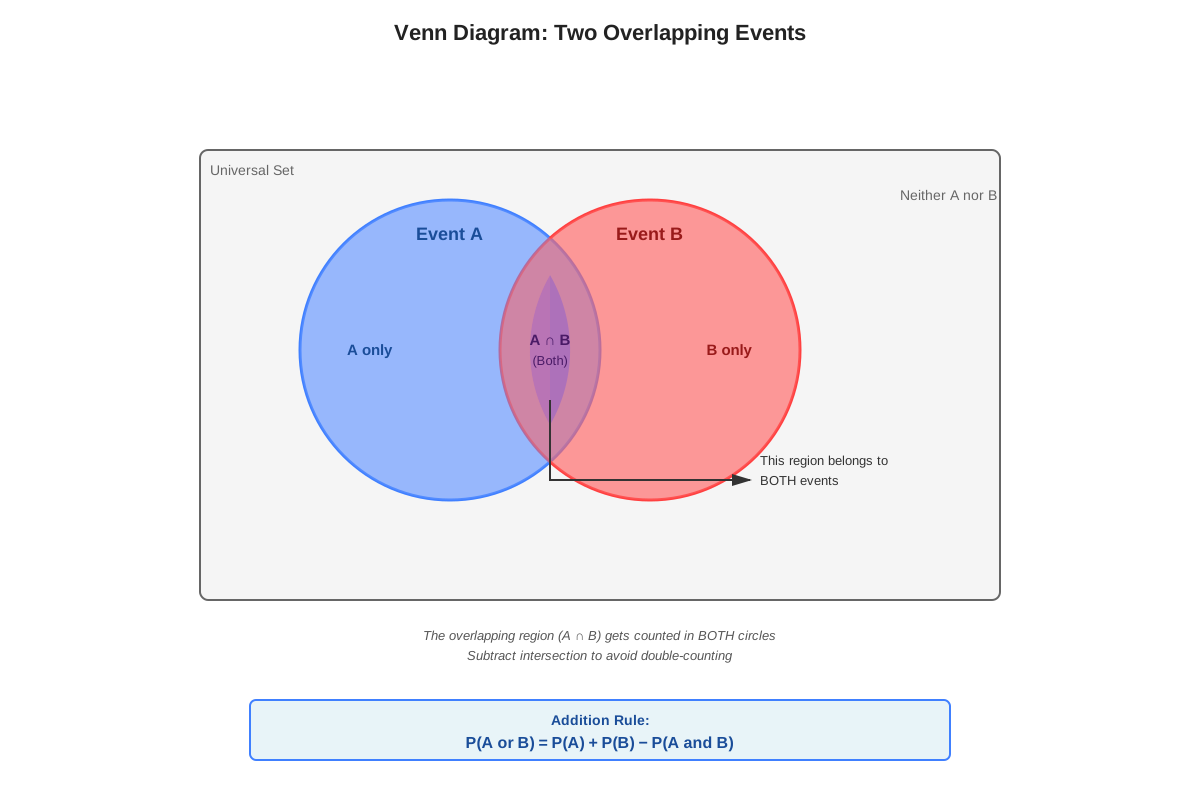
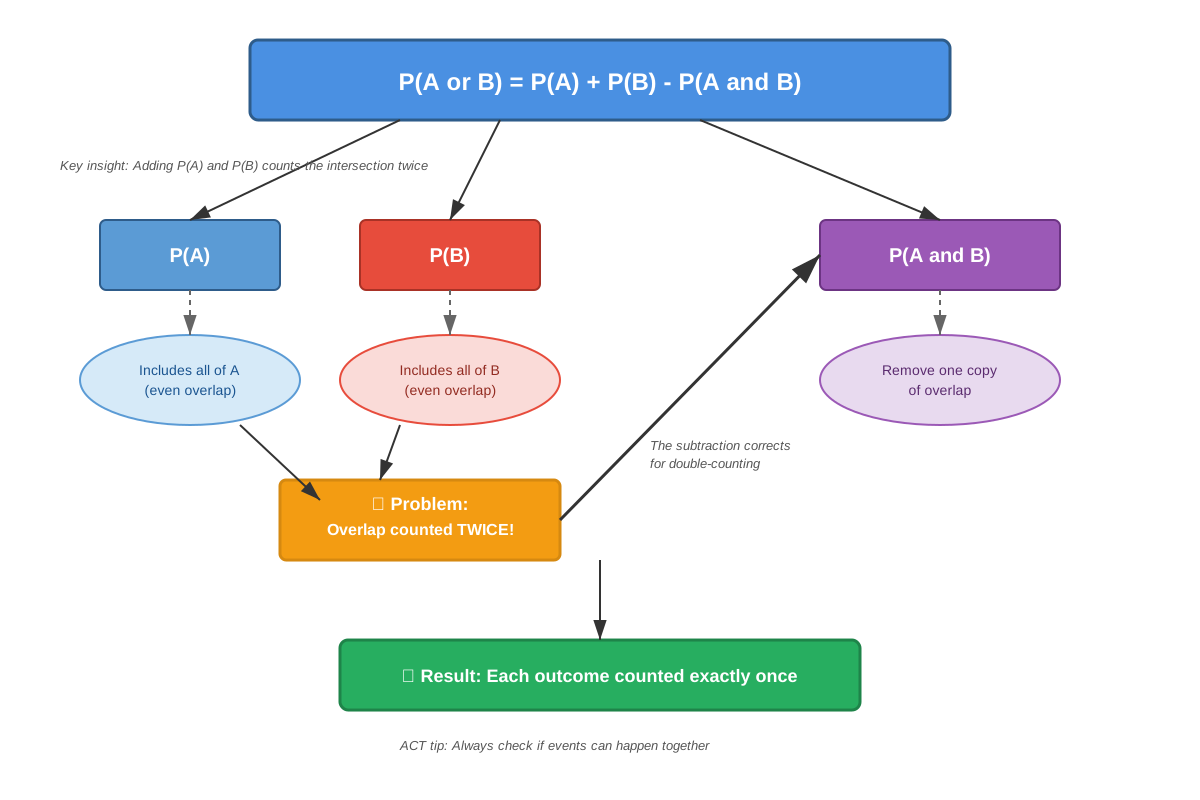
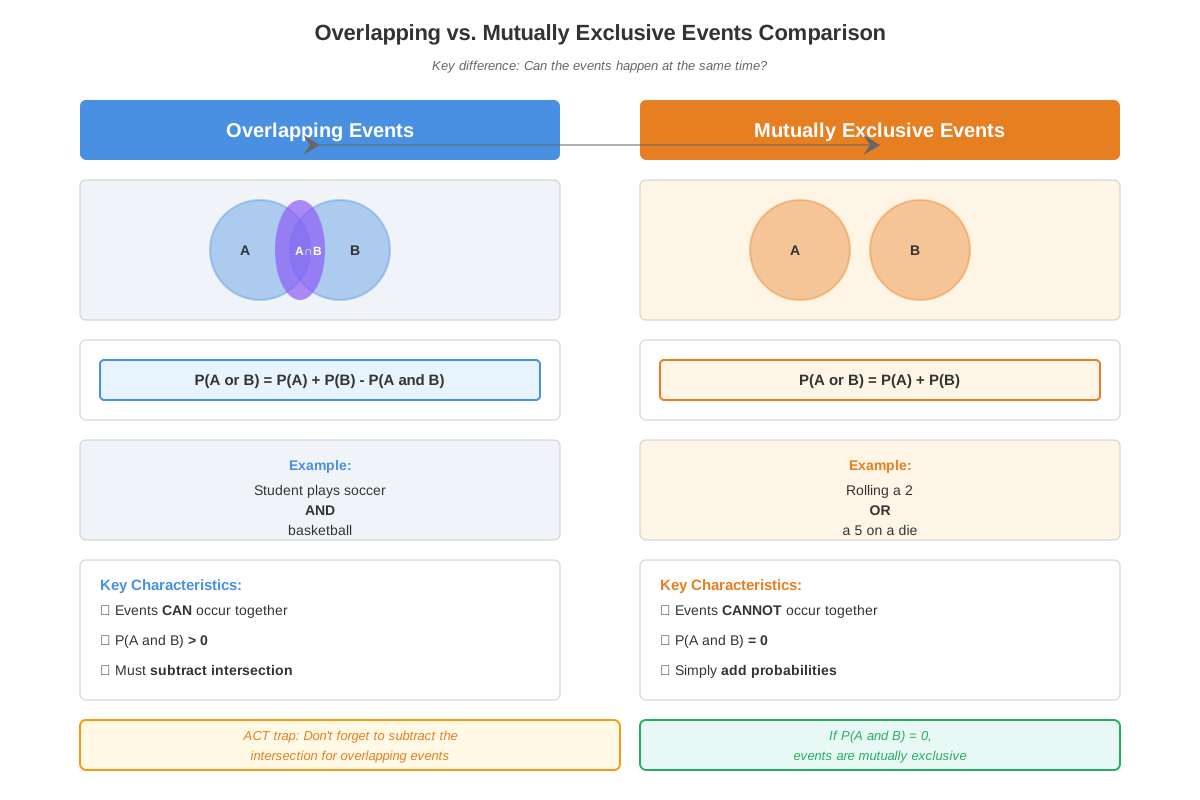
The fundamental principle governing overlapping events is the Addition Rule for Probability. When calculating the probability that either event A or event B occurs (denoted as P(A or B) or P(A ∪ B)), students must account for outcomes that belong to both events to avoid double-counting.
The formula is:
P(A or B) = P(A) + P(B) - P(A and B)The subtraction of P(A and B) is crucial because when we add P(A) and P(B), we count the overlapping outcomes twice—once in each probability. Subtracting P(A and B) once corrects this overcount, ensuring each outcome is counted exactly once.
Example: In a deck of 52 cards, what is the probability of drawing either a heart or a face card?
- P(heart) = 13/52
- P(face card) = 12/52
- P(heart AND face card) = 3/52 (Jack, Queen, King of hearts)
- P(heart OR face card) = 13/52 + 12/52 - 3/52 = 22/52 = 11/26
Venn Diagrams for Visualizing Overlaps
Venn diagrams provide the most intuitive visual representation of ACT overlapping events problems. These diagrams use overlapping circles to show relationships between sets, with the overlapping region representing outcomes that belong to both events.
A standard two-circle Venn diagram contains four distinct regions:
- Elements only in Set A (A but not B)
- Elements only in Set B (B but not A)
- Elements in both A and B (the intersection)
- Elements in neither A nor B (outside both circles)
When solving ACT problems with Venn diagrams, always start by filling in the intersection (the overlap) first, then work outward to the exclusive regions. This prevents calculation errors and ensures all elements are properly accounted for.
The Complement Approach
Sometimes the easiest path to solving overlapping event problems involves calculating the complement—finding the probability of what doesn't happen, then subtracting from 1. This strategy proves particularly useful when the overlap is complex or when the problem asks for "at least one" condition.
P(A or B) = 1 - P(neither A nor B)This approach simplifies calculations when finding P(neither A nor B) is straightforward, which often occurs in ACT problems involving multiple conditions.
Three-Event Overlaps
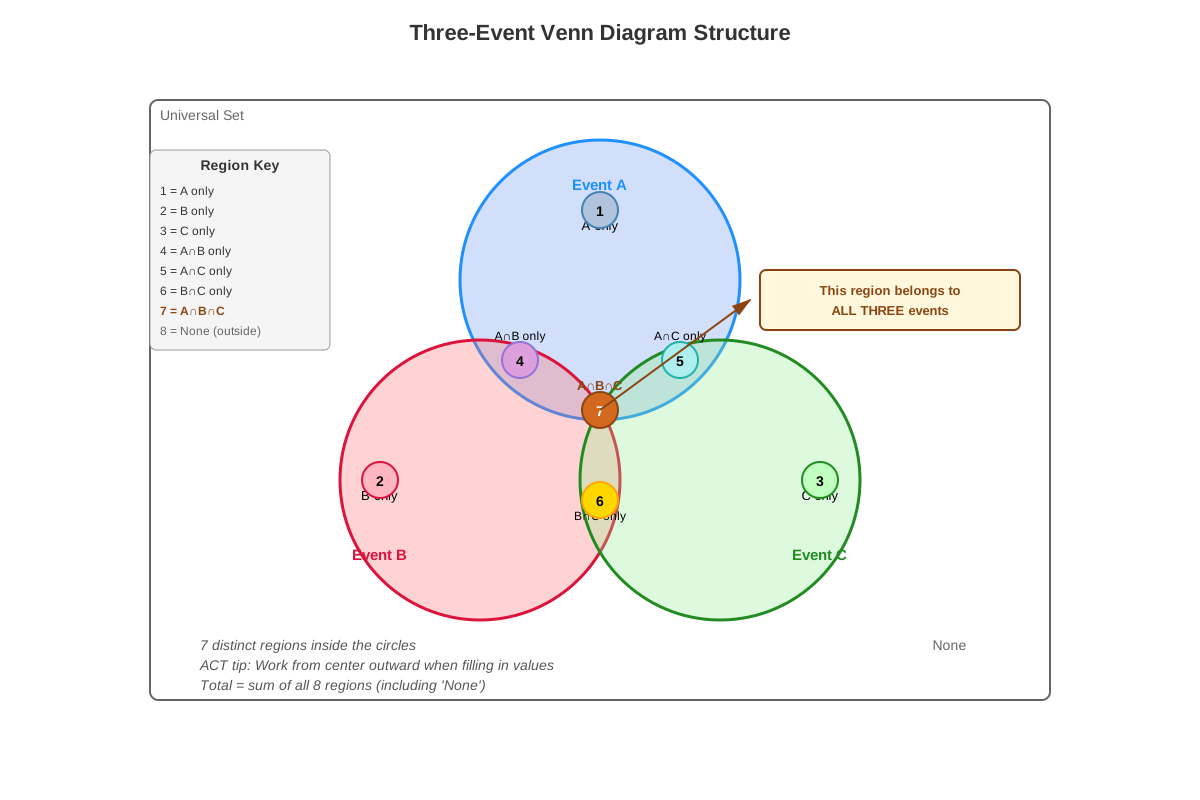
While less common, the ACT occasionally tests overlapping events with three sets. The Addition Rule extends to:
P(A or B or C) = P(A) + P(B) + P(C) - P(A and B) - P(A and C) - P(B and C) + P(A and B and C)The logic follows the same principle: add all individual probabilities, subtract the two-way overlaps (which were counted twice), then add back the three-way overlap (which was subtracted too many times).
Counting vs. Probability
ACT questions may ask for either counts (how many elements) or probabilities (what fraction). The relationship is:
Probability = (Count of favorable outcomes) / (Total count)Always identify whether the question asks for a count or a probability, as this determines the final answer format. Many students correctly calculate counts but forget to convert to probability when required.
Survey and Population Problems
A common ACT scenario presents survey data where respondents can select multiple options. For example: "In a class of 30 students, 18 play basketball, 15 play soccer, and 8 play both sports. How many play neither?"
The solution strategy:
- Identify the total population (30)
- Find those playing only basketball: 18 - 8 = 10
- Find those playing only soccer: 15 - 8 = 7
- Find those playing at least one sport: 10 + 8 + 7 = 25
- Find those playing neither: 30 - 25 = 5
Concept Relationships
The concepts within overlapping events form a hierarchical structure where understanding flows from basic to complex applications. The Addition Rule serves as the foundational principle → which manifests visually through Venn diagrams → which can be solved using either direct calculation or complement approaches → and extends to three-event scenarios for advanced problems.
Overlapping events connect backward to prerequisite topics through basic probability (providing the framework for calculating individual event probabilities) and set theory (supplying the language of unions and intersections). The topic connects forward to conditional probability, where overlapping events become the foundation for understanding how one event affects another's probability.
Within the broader ACT Math curriculum, overlapping events relate to counting principles and combinations (determining total outcomes), logical reasoning (categorizing outcomes correctly), and data interpretation (analyzing survey results and statistical information). Students who master overlapping events develop analytical skills that transfer to geometry problems involving overlapping regions and algebra problems requiring systems thinking.
High-Yield Facts
⭐ The Addition Rule formula P(A or B) = P(A) + P(B) - P(A and B) is the single most important equation for overlapping events
⭐ Always fill in the intersection (overlap) region of a Venn diagram first, then work outward to exclusive regions
⭐ When a problem states "at least one," consider using the complement: P(at least one) = 1 - P(none)
⭐ The phrase "either...or" in probability typically means "A or B or both" (inclusive or), requiring the Addition Rule
⭐ In survey problems, the sum of all Venn diagram regions must equal the total population given
- Mutually exclusive events have P(A and B) = 0, making them a special case where the Addition Rule simplifies to P(A or B) = P(A) + P(B)
- When converting between counts and probabilities, always divide by the same total population
- Three-event Venn diagrams contain seven distinct regions (three exclusive, three two-way overlaps, one three-way overlap)
- The intersection (A and B) is always less than or equal to either individual event probability
- ACT problems often provide information about totals and overlaps, requiring students to work backward to find exclusive regions
Quick check — test yourself on Overlapping events so far.
Try Flashcards →Common Misconceptions
Misconception: When calculating P(A or B), simply add P(A) + P(B) without any adjustment → Correction: This double-counts the overlap. Always subtract P(A and B) to correct for outcomes counted twice, unless the events are mutually exclusive.
Misconception: "Or" in probability means "one or the other but not both" (exclusive or) → Correction: In probability and on the ACT, "or" is inclusive, meaning "A or B or both." The Addition Rule accounts for all three possibilities.
Misconception: The overlap region in a Venn diagram equals the sum of the two circles → Correction: The overlap is typically much smaller and represents only outcomes belonging to both sets simultaneously. It must be given or calculated separately.
Misconception: When given "18 play basketball and 8 play both sports," the 8 is separate from the 18 → Correction: The 8 students who play both are included within the 18 who play basketball. To find those playing only basketball, subtract: 18 - 8 = 10.
Misconception: All probability problems with two events involve overlapping events → Correction: Events can be mutually exclusive (cannot happen simultaneously), independent (one doesn't affect the other), or overlapping. Identifying the relationship is crucial for selecting the correct formula.
Misconception: P(A and B) equals P(A) × P(B) for all overlapping events → Correction: This multiplication rule only applies to independent events. For overlapping events, P(A and B) must be given or calculated from the context, not assumed to be the product.
Worked Examples
Example 1: Classic Venn Diagram Problem
Problem: At Central High School, 120 students were surveyed about their participation in extracurricular activities. 75 students participate in sports, 60 students participate in music programs, and 30 students participate in both sports and music. How many students participate in neither sports nor music?
Solution:
Step 1: Identify what we know
- Total students: 120
- Sports (S): 75
- Music (M): 60
- Both sports and music (S ∩ M): 30
Step 2: Draw a Venn diagram mentally or on paper with two overlapping circles
Step 3: Fill in the intersection first
- Students in both: 30
Step 4: Calculate exclusive regions
- Students in sports only: 75 - 30 = 45
- Students in music only: 60 - 30 = 15
Step 5: Find students in at least one activity
- At least one: 45 + 30 + 15 = 90
Step 6: Calculate students in neither
- Neither: 120 - 90 = 30
Answer: 30 students participate in neither sports nor music
Connection to Learning Objectives: This problem demonstrates identifying overlapping events (students can be in both activities), applying the core strategy (working from intersection outward), and accurately solving an ACT-style question.
Example 2: Card Probability with Overlapping Conditions
Problem: A standard deck of 52 cards contains 4 suits (hearts, diamonds, clubs, spades) with 13 cards each. Hearts and diamonds are red; clubs and spades are black. Each suit contains one ace. What is the probability of drawing a card that is either red or an ace?
Solution:
Step 1: Identify the events
- Event A: Drawing a red card
- Event B: Drawing an ace
- We need P(A or B)
Step 2: Calculate individual probabilities
- P(red card) = 26/52 (13 hearts + 13 diamonds)
- P(ace) = 4/52 (one ace per suit)
Step 3: Identify the overlap
- P(red AND ace) = 2/52 (ace of hearts and ace of diamonds)
Step 4: Apply the Addition Rule
- P(red OR ace) = P(red) + P(ace) - P(red AND ace)
- P(red OR ace) = 26/52 + 4/52 - 2/52
- P(red OR ace) = 28/52 = 7/13
Answer: 7/13
Alternative approach using complement:
- Cards that are neither red nor an ace: black non-aces
- Black non-aces: 24 cards (26 black cards - 2 black aces)
- P(neither red nor ace) = 24/52
- P(red or ace) = 1 - 24/52 = 28/52 = 7/13
Connection to Learning Objectives: This demonstrates recognizing overlapping events in a probability context, explaining the Addition Rule strategy, and showing multiple solution approaches that ACT students should master.
Exam Strategy
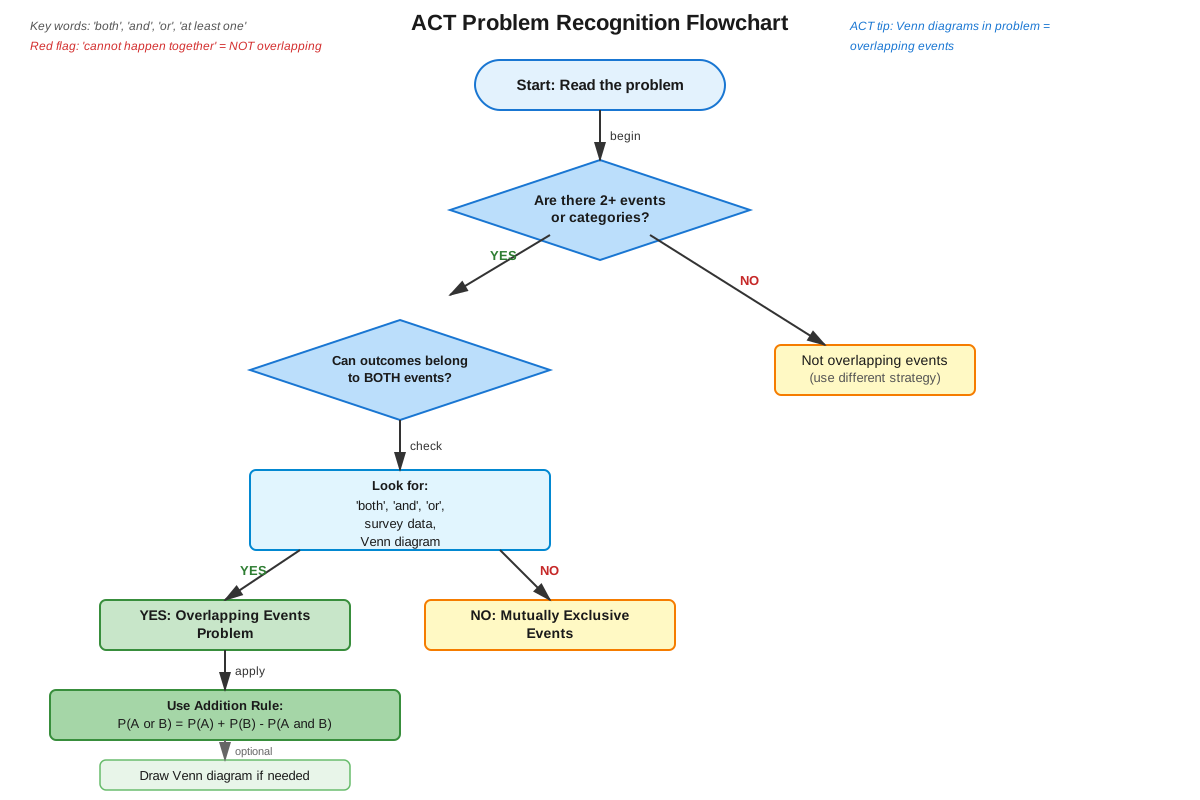
When approaching ACT overlapping events questions, follow this systematic process:
Step 1: Identify the question type
Look for trigger phrases: "either...or," "at least one," "both," survey data with multiple categories, or Venn diagram visuals. These signal overlapping events.
Step 2: Determine what's being asked
Clarify whether the question wants a count (how many) or a probability (what fraction). This affects your final answer format.
Step 3: Organize the information
For Venn diagram problems, quickly sketch the diagram and label all known values. For probability problems, list P(A), P(B), and P(A and B) if given.
Step 4: Start with the overlap
Always identify or calculate the intersection first. This prevents the most common error—double-counting overlapping outcomes.
Step 5: Choose your approach
Decide between direct calculation (Addition Rule) or complement (1 - P(neither)). Use complement when "at least one" appears or when finding "neither" is simpler.
Time allocation: Overlapping events problems typically require 60-90 seconds. If you're spending more than 2 minutes, you may be overcomplicating the solution. Consider the complement approach or re-read the problem for a simpler interpretation.
Process of elimination tips:
- Eliminate answers that exceed the total population in counting problems
- Eliminate probabilities greater than 1 or less than 0
- If you added P(A) + P(B) without subtracting overlap, eliminate that answer—it's too large
- Check if the answer makes logical sense: should more or fewer outcomes satisfy the condition?
Common trap answers: The ACT often includes P(A) + P(B) as a distractor (the result without subtracting overlap). Also watch for answers that represent only the intersection when the question asks for the union.
Memory Techniques
SOAP Mnemonic for Addition Rule:
- Sum the probabilities (P(A) + P(B))
- Overlap must be found (identify P(A and B))
- Adjust by subtracting (subtract the overlap once)
- Probability is your answer
Venn Diagram Filling Order - "Inside Out":
Remember to work from the Intersection Outward To Exteriors (IOTE)
- Intersection (both)
- Only A region
- Then only B region
- Exterior (neither)
"Either-Or" Visualization:
When you see "either A or B," visualize two overlapping circles. Your answer includes everything inside at least one circle. The word "either" doesn't exclude "both"—think of it as "either one, or the other, or both."
The Double-Count Check:
Before finalizing any overlapping events answer, ask: "Did I count anything twice?" If you simply added without subtracting overlap, you double-counted.
Complement Trigger - "At Least":
Whenever you see "at least one," think "1 minus none." This phrase is your signal to consider the complement approach: P(at least one) = 1 - P(none).
Summary
Overlapping events represent a critical ACT Math topic where two or more events can occur simultaneously, requiring careful accounting to avoid double-counting shared outcomes. The Addition Rule—P(A or B) = P(A) + P(B) - P(A and B)—serves as the fundamental formula, with the subtraction term correcting for outcomes counted in both events. Venn diagrams provide the primary visualization tool, and successful students always fill in the intersection first before calculating exclusive regions. The complement approach offers an alternative strategy, particularly useful for "at least one" problems. ACT questions test this concept through survey data, card/dice probabilities, and population problems where individuals belong to multiple categories. Distinguishing overlapping events from mutually exclusive events (where P(A and B) = 0) is essential for selecting the correct solution method. Mastery requires recognizing trigger phrases, organizing information systematically, and choosing between direct calculation and complement approaches based on problem structure.
Key Takeaways
- The Addition Rule P(A or B) = P(A) + P(B) - P(A and B) is essential for all overlapping event calculations and must be memorized
- Always identify and work with the intersection (overlap) first in Venn diagram problems to prevent double-counting errors
- "Or" in probability is inclusive (meaning "A or B or both"), not exclusive, requiring the Addition Rule application
- The complement approach P(at least one) = 1 - P(none) often simplifies complex overlapping event problems
- In survey problems, verify that all Venn diagram regions sum to the total population as a check for accuracy
- Distinguish between counting problems (answer is a whole number) and probability problems (answer is a fraction or decimal)
- Overlapping events appear 1-2 times per ACT test, making this a high-yield topic worth thorough preparation
Related Topics
Mutually Exclusive Events: Understanding when events cannot occur simultaneously helps students recognize when the Addition Rule simplifies to P(A or B) = P(A) + P(B), contrasting with overlapping events where subtraction is necessary.
Conditional Probability: Building on overlapping events, conditional probability explores how the occurrence of one event affects another's probability, using the intersection concepts developed here.
Independent Events: While overlapping events can occur together, independent events have no influence on each other's occurrence, requiring different calculation methods (multiplication rule).
Counting Principles and Combinations: These topics provide the foundation for determining total outcomes and favorable outcomes in complex probability scenarios involving overlaps.
Set Theory: The mathematical framework underlying overlapping events, including unions, intersections, and complements, extends to more advanced mathematical reasoning.
Practice CTA
Now that you've mastered the core concepts of overlapping events, it's time to solidify your understanding through active practice. Attempt the practice questions designed specifically for this topic, focusing on recognizing trigger phrases and applying the Addition Rule systematically. Use the flashcards to reinforce the key formulas and strategies until they become automatic. Remember, overlapping events questions appear consistently on every ACT administration—your investment in mastering this topic will directly translate to points on test day. Approach each practice problem methodically, and review any mistakes to understand where your reasoning diverged from the correct path. You've got this!
Sign up free to keep reading
Create a free AnvayaPrep account to finish this ACT guide on Overlapping events — plus flashcards and practice questions.