Overview
Rhetorical purpose refers to the reason an author includes specific words, phrases, sentences, paragraphs, or structural elements in a passage. On the ACT Reading test, understanding rhetorical purpose means recognizing why an author made particular choices rather than simply what the text says. These questions ask students to step into the author's shoes and analyze the function of textual elements—whether to emphasize a point, provide evidence, create contrast, establish tone, or achieve another specific effect. Mastering rhetorical purpose questions is essential because they appear consistently across all four passage types (Literary Narrative/Prose Fiction, Social Science, Humanities, and Natural Science) and typically account for 15-20% of all Reading questions.
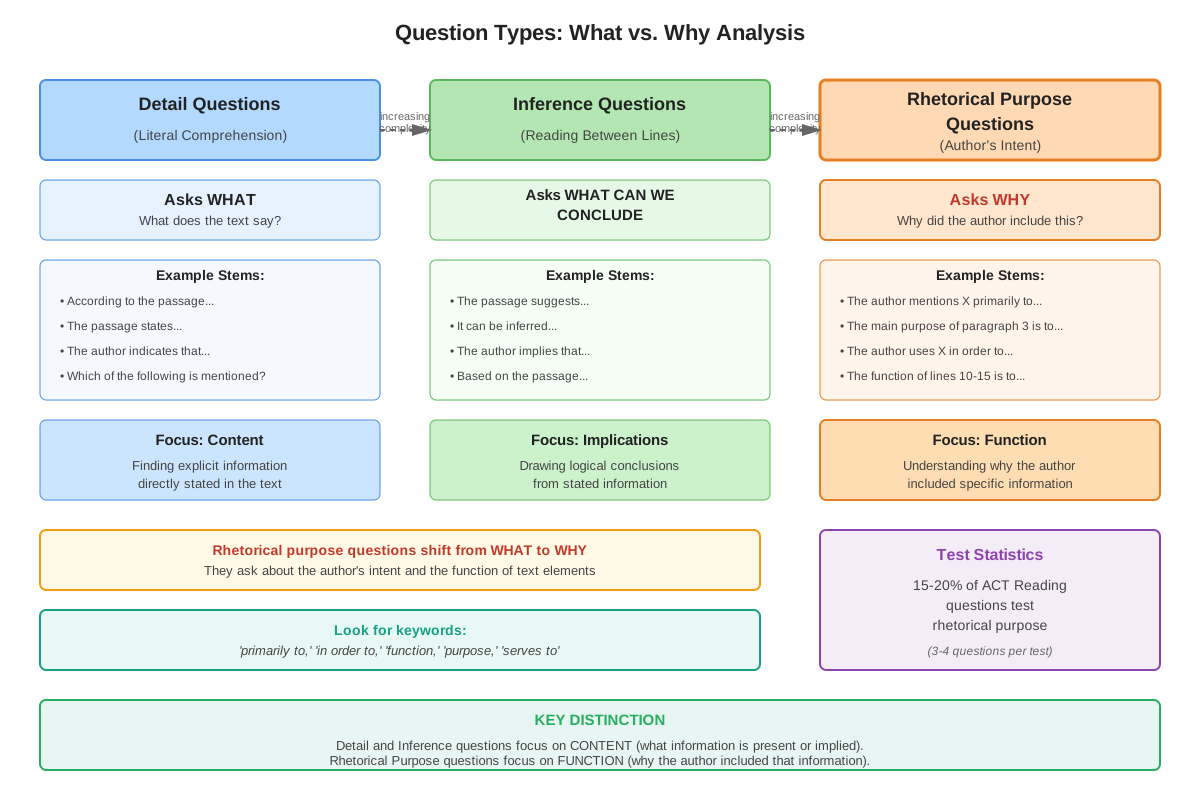
The concept of ACT rhetorical purpose extends beyond simple comprehension to analytical thinking. While detail questions ask "what does the passage say?" and inference questions ask "what can we conclude?", rhetorical purpose questions ask "why did the author include this?" or "what function does this serve?" This distinction is crucial: students must shift from passive reading to active analysis of authorial intent and textual structure. These questions often use phrases like "the author mentions X primarily to," "the main purpose of the third paragraph is to," or "the author uses the example of Y in order to."
Understanding rhetorical purpose connects directly to other critical Reading skills, particularly main idea identification, tone analysis, and structural organization. When students can identify why each component exists within a passage, they develop a more sophisticated understanding of how arguments are constructed, how narratives unfold, and how authors guide readers toward specific conclusions. This skill also reinforces the relationship between supporting details and central claims, helping students distinguish between what information is presented and what role that information plays in the author's overall communication strategy.
Learning Objectives
- [ ] Identify when Rhetorical purpose is being tested in ACT Reading questions
- [ ] Explain the core rule or strategy behind Rhetorical purpose analysis
- [ ] Apply Rhetorical purpose concepts to ACT-style questions accurately
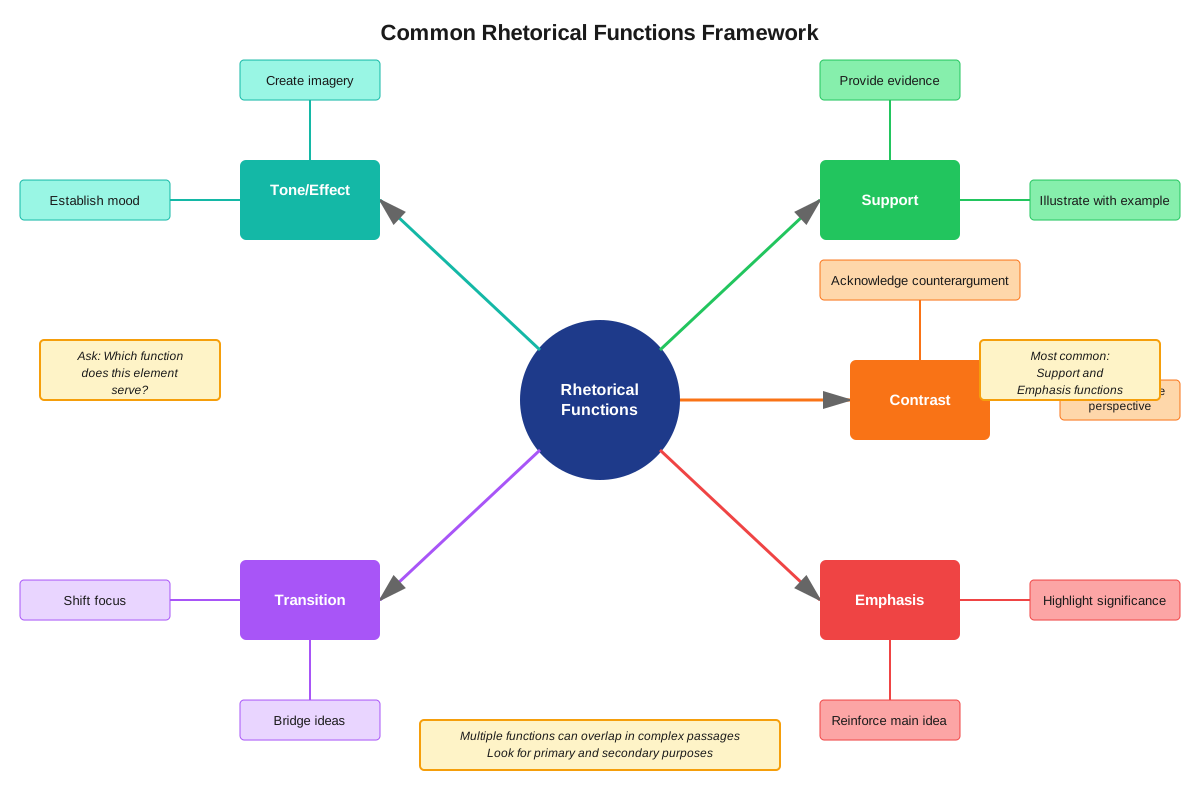
- [ ] Distinguish between different types of rhetorical functions (emphasis, contrast, support, transition, etc.)
- [ ] Analyze the relationship between specific textual elements and the author's broader argumentative or narrative goals
- [ ] Evaluate answer choices by eliminating options that describe content rather than function
- [ ] Recognize common rhetorical patterns across different passage types and genres
Prerequisites
- Basic reading comprehension: Understanding literal meaning is necessary before analyzing why that meaning was communicated in a particular way
- Paragraph structure awareness: Recognizing topic sentences, supporting details, and transitions helps identify how individual elements function within larger units
- Main idea identification: Knowing the passage's central purpose provides context for understanding why specific details or examples were included
- Vocabulary in context: Understanding what words and phrases mean enables analysis of why the author chose those particular expressions
Why This Topic Matters
Rhetorical purpose questions test a sophisticated reading skill that extends far beyond the ACT. In college coursework, students must constantly analyze how authors construct arguments, support claims, and organize information. In professional contexts, understanding rhetorical purpose enables critical evaluation of persuasive communications, from marketing materials to policy documents. This analytical skill helps readers become more discerning consumers of information, recognizing when they're being persuaded, informed, entertained, or manipulated.
On the ACT Reading test, rhetorical purpose questions appear with remarkable consistency. Students can expect approximately 6-8 rhetorical purpose questions per test, distributed across all four passages. These questions carry the same weight as all other Reading questions (one point each), but they often prove more challenging than straightforward detail questions because they require deeper analysis. The ACT frequently tests rhetorical purpose through questions about paragraph function, the role of specific examples, the purpose of quotations, and the effect of descriptive language or structural choices.
Common manifestations of rhetorical purpose questions include: analyzing why an author begins or ends a passage in a particular way; determining the function of an anecdote, statistic, or expert quotation; identifying the purpose of a shift in tone or perspective; explaining why the author includes a contrasting viewpoint; and recognizing how specific details support broader claims. These questions appear in predictable formats but require flexible thinking because the specific rhetorical functions vary widely depending on passage content and genre.
Core Concepts
Understanding Rhetorical Function vs. Content
The fundamental distinction in rhetorical purpose analysis separates what a passage says from why it says it. Content refers to the information, facts, events, or ideas presented in the text. Function refers to the role that information plays in achieving the author's goals. For example, if a passage states "The experiment yielded unexpected results, contradicting the prevailing theory," the content is that results contradicted a theory. The function might be to introduce a problem that the rest of the passage will explore, to establish the significance of new research, or to create tension in the narrative.
ACT rhetorical purpose questions consistently focus on function rather than content. A correct answer will describe what a textual element does (supports, contrasts, emphasizes, illustrates, introduces, transitions, qualifies, etc.) rather than simply restating what it says. This distinction trips up many students who select answer choices that accurately summarize content but fail to identify the rhetorical function. Training yourself to ask "Why did the author include this?" rather than "What does this say?" is the single most important strategy for these questions.
Common Rhetorical Functions
Understanding the typical purposes authors employ helps students recognize patterns and predict correct answers. The following table outlines the most frequently tested rhetorical functions on the ACT:
| Rhetorical Function | Description | Common Trigger Phrases |
|---|---|---|
| Support/Evidence | Provides proof, examples, or data to back up a claim | "to illustrate," "to demonstrate," "to provide evidence for" |
| Contrast/Counterpoint | Presents an opposing view or different perspective | "to contrast with," "to acknowledge an alternative," "to present a counterargument" |
| Emphasis | Highlights or reinforces an important point | "to stress," "to underscore," "to draw attention to" |
| Transition | Connects ideas or shifts between topics | "to shift focus from," "to bridge," "to move from" |
| Introduction | Establishes context, background, or sets up what follows | "to establish," "to provide context for," "to introduce" |
| Qualification | Limits, modifies, or adds nuance to a claim | "to acknowledge limitations," "to refine," "to add complexity to" |
| Conclusion | Summarizes, synthesizes, or provides closure | "to reinforce," "to bring together," "to conclude" |
Analyzing Paragraph-Level Purpose
Many ACT rhetorical purpose questions ask about the function of an entire paragraph. To answer these effectively, students must identify the paragraph's main idea and then determine how that idea relates to the passage's overall structure and argument. A paragraph might serve to introduce a topic, provide historical background, present a case study, offer a contrasting perspective, describe a process, or transition between major sections.
The key strategy involves reading the paragraph's first and last sentences carefully, as these often signal the paragraph's primary function. Then, consider what came before and what comes after. Does this paragraph set up information that follows? Does it provide evidence for a claim made earlier? Does it shift the discussion in a new direction? Understanding the paragraph's position within the passage's logical flow reveals its rhetorical purpose.
The Role of Examples and Anecdotes
Authors frequently use specific examples, anecdotes, case studies, or illustrations to make abstract concepts concrete or to provide evidence for general claims. When the ACT asks about the purpose of a specific example, the correct answer typically relates to how that example supports or illuminates a broader point rather than focusing on the example's specific content.
For instance, if a passage about climate change includes a detailed description of coral reef bleaching, the rhetorical purpose isn't simply "to describe coral reefs" but rather "to illustrate the tangible effects of rising ocean temperatures" or "to provide a specific example of ecosystem disruption." The example serves the larger argument; it doesn't exist for its own sake.
Quotations and Expert Testimony
When passages include direct quotations from experts, historical figures, or other sources, the ACT often asks why the author included that quotation. Common purposes include: lending authority or credibility to a claim, providing firsthand perspective, illustrating a particular viewpoint, or adding emotional impact. The key is recognizing that the author chose to quote rather than paraphrase for a specific reason—usually to preserve the original speaker's voice, authority, or particular phrasing.
Structural and Stylistic Choices
Rhetorical purpose extends to how authors structure passages and choose language. Questions might ask why an author begins with a personal anecdote (to engage readers, to establish relatability, to introduce a theme through concrete experience), why a passage ends with a question (to encourage reflection, to acknowledge uncertainty, to prompt further inquiry), or why the author uses vivid descriptive language (to create atmosphere, to emphasize sensory experience, to evoke emotional response).
Understanding these choices requires recognizing that every authorial decision serves a purpose. The ACT rewards students who can identify these purposes by connecting specific textual features to broader communicative goals.
Concept Relationships
Rhetorical purpose analysis builds directly on main idea identification—students must understand the passage's central argument or narrative arc before they can determine how individual elements support that purpose. The relationship flows: Main Idea → Rhetorical Purpose of Parts → Supporting Details. Each component serves the whole, and understanding the whole illuminates the function of each part.
Paragraph structure awareness enables rhetorical purpose analysis by helping students recognize how information is organized. Topic sentences often signal a paragraph's function, while transitions between paragraphs reveal how sections relate to each other. This structural understanding creates a framework: Structure → Function → Purpose.
The connection to tone and style analysis is bidirectional. Understanding why an author chose particular language (rhetorical purpose) helps identify tone, while recognizing tone helps explain why certain stylistic choices were made. For example, identifying a sarcastic tone helps explain why the author included an exaggerated example—the purpose is to mock or criticize through overstatement.
Rhetorical purpose also connects forward to synthesis and evaluation skills. Once students can identify why individual elements exist, they can better evaluate the effectiveness of an author's argument, recognize persuasive techniques, and synthesize information from multiple sources by understanding how different authors use evidence and structure to achieve their goals.
The relationship map: Prerequisites (Comprehension + Structure) → Rhetorical Purpose Analysis → Advanced Skills (Evaluation + Synthesis). Mastering rhetorical purpose sits at the crucial middle stage, transforming basic understanding into sophisticated analysis.
Quick check — test yourself on Rhetorical purpose so far.
Try Flashcards →High-Yield Facts
⭐ Rhetorical purpose questions ask "why" the author included something, not "what" the text says
⭐ Correct answers describe function (supports, contrasts, emphasizes) rather than content
⭐ Approximately 6-8 rhetorical purpose questions appear on each ACT Reading test
⭐ Common question stems include "primarily to," "mainly serves to," "the purpose of," and "the author mentions X in order to"
⭐ The most frequently tested rhetorical functions are: support/evidence, contrast, emphasis, and introduction
- Paragraph-level purpose questions require understanding how the paragraph fits into the passage's overall structure
- Examples and anecdotes typically serve to illustrate broader points or provide concrete evidence for abstract claims
- Quotations are usually included to add authority, preserve original voice, or provide firsthand perspective
- The first and last sentences of a paragraph often signal its rhetorical function
- Wrong answers frequently restate content accurately but fail to identify the actual rhetorical purpose
- Rhetorical purpose questions appear across all four passage types with equal frequency
- Understanding the passage's main idea is essential for determining the purpose of supporting elements
- Transition words and phrases (however, for example, in contrast) often signal rhetorical function
- Authors' structural choices (beginning with anecdote, ending with question) serve specific rhetorical purposes
- The same content can serve different rhetorical purposes depending on context and placement
Common Misconceptions
Misconception: Rhetorical purpose questions are just asking what a section of text says.
Correction: These questions specifically ask why the author included that content—what function it serves in the passage's structure or argument. An answer that merely summarizes content without identifying function is incorrect, even if the summary is accurate.
Misconception: The correct answer will always use the same words or phrases from the passage.
Correction: Correct answers describe function using analytical language (supports, contrasts, illustrates) that often doesn't appear in the passage itself. Students must translate from the passage's content to functional description.
Misconception: If an answer choice is true according to the passage, it must be correct.
Correction: Many wrong answers contain accurate statements about passage content but don't answer the specific question about rhetorical purpose. Truth alone doesn't make an answer correct; it must address the function being tested.
Misconception: Rhetorical purpose questions are subjective and based on opinion.
Correction: These questions have objectively correct answers based on textual evidence and logical analysis of how elements function within the passage structure. The ACT tests recognizable rhetorical patterns, not personal interpretation.
Misconception: You need to read the entire passage carefully to answer rhetorical purpose questions.
Correction: While understanding the main idea is important, rhetorical purpose questions often require focused analysis of specific sections and their relationship to surrounding context. Strategic reading of the referenced section plus the sentences before and after is usually sufficient.
Misconception: All examples serve the same purpose—to provide evidence.
Correction: While providing evidence is common, examples can serve multiple purposes: illustrating abstract concepts, creating emotional impact, providing contrast, showing change over time, or demonstrating complexity. The specific purpose depends on context.
Worked Examples
Example 1: Paragraph Function Question
Passage Context: A Natural Science passage discusses the discovery of exoplanets. The second paragraph describes the historical difficulty of detecting planets outside our solar system, mentioning that stars are millions of times brighter than planets and that early telescopes lacked sufficient sensitivity. The third paragraph then introduces the transit method, explaining how astronomers detect planets by measuring tiny decreases in starlight when planets pass in front of their stars.
Question: The main purpose of the second paragraph is to:
A) Describe the characteristics of exoplanets and their stars
B) Explain why exoplanet detection remained challenging until recently
C) Compare different types of telescopes used in astronomy
D) Argue that exoplanet research is more important than other astronomical studies
Analysis:
First, identify what the paragraph says: It discusses historical difficulties in detecting exoplanets, mentioning brightness differences and telescope limitations.
Next, determine what the paragraph does in context: It comes before a paragraph introducing a solution (the transit method). This positioning suggests the second paragraph establishes a problem that the third paragraph solves.
Evaluate each answer:
- A describes content (characteristics) but not function. The paragraph mentions these details, but that's not its purpose.
- B identifies function—explaining why something was challenging. This matches the problem-establishing role.
- C focuses on telescope comparison, which is mentioned only briefly as supporting detail, not the main purpose.
- D makes an argument about importance that doesn't appear in the paragraph.
Correct Answer: B
The paragraph's rhetorical purpose is to establish the challenge that makes the subsequent solution (transit method) significant and impressive. It provides context that helps readers understand why the discovery method discussed next represents an important breakthrough.
Example 2: Example Purpose Question
Passage Context: A Humanities passage discusses the influence of jazz on American culture. After explaining jazz's musical innovations, the passage states: "Jazz's influence extended far beyond music. The Harlem Renaissance, for instance, saw jazz rhythms and improvisational spirit infuse poetry, visual arts, and literature. Langston Hughes's poetry captured jazz's syncopation in verse, while Aaron Douglas's paintings incorporated the movement and energy of jazz performances."
Question: The author mentions Langston Hughes and Aaron Douglas primarily to:
A) Identify the most important artists of the Harlem Renaissance
B) Demonstrate that jazz influenced multiple artistic disciplines
C) Compare the techniques used in poetry and visual arts
D) Explain how jazz musicians collaborated with other artists
Analysis:
Identify the claim these examples support: The sentence immediately before states "Jazz's influence extended far beyond music" and mentions how jazz infused poetry, visual arts, and literature.
Determine the examples' function: Hughes (poet) and Douglas (painter) are specific instances of the broader claim about jazz influencing multiple art forms.
Evaluate each answer:
- A makes a claim about importance that the passage doesn't support. The examples aren't presented as "most important."
- B correctly identifies the function—these examples demonstrate (provide evidence for) the claim about jazz's cross-disciplinary influence.
- C focuses on comparison between poetry and painting, which isn't the passage's purpose in mentioning these artists.
- D introduces the idea of collaboration, which isn't mentioned or implied.
Correct Answer: B
The rhetorical purpose of mentioning these specific artists is to provide concrete evidence that jazz influenced multiple artistic disciplines, making the abstract claim tangible through specific examples. The examples serve the broader argument about jazz's cultural reach.
Exam Strategy
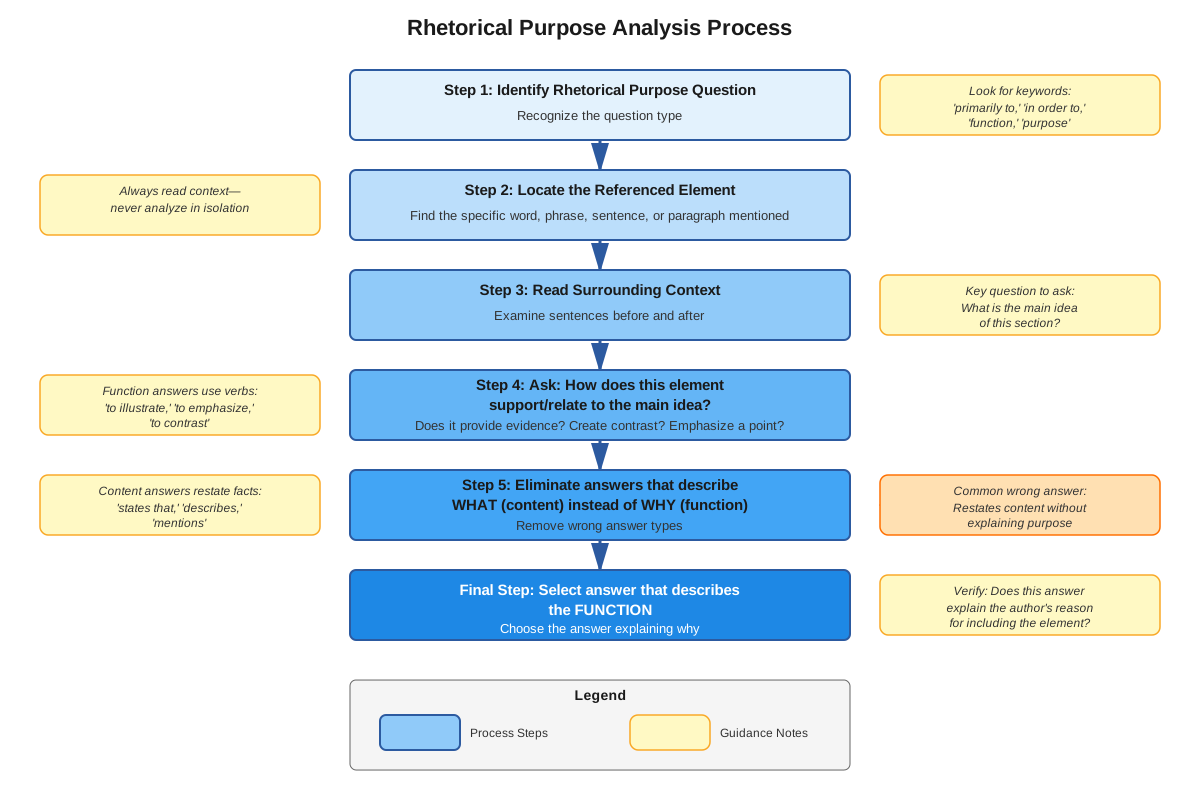
When approaching ACT rhetorical purpose questions, follow this systematic process:
Step 1: Identify the Question Type
Look for trigger phrases: "primarily to," "mainly serves to," "the purpose of," "in order to," "the function of," or "the author mentions X to." These signal rhetorical purpose questions requiring functional analysis rather than content summary.
Step 2: Locate and Read Strategically
Find the referenced text (word, phrase, sentence, or paragraph). Read it carefully, but don't stop there. Read the sentence before and the sentence after to understand context. For paragraph-level questions, note the paragraph's position in the passage structure.
Step 3: Ask "Why?" Not "What?"
Consciously shift your thinking from content to function. Ask yourself: "Why did the author include this? What role does it play? How does it relate to the main idea or surrounding text?" Avoid simply summarizing what the text says.
Step 4: Predict the Function
Before looking at answer choices, predict the rhetorical purpose in your own words. Common functions include: supports a claim, provides an example, creates contrast, introduces a topic, emphasizes a point, acknowledges a counterargument, or transitions between ideas.
Step 5: Eliminate Content-Only Answers
Cross out any answer choice that merely restates what the text says without identifying its function. These are the most common wrong answers and often appear tempting because they're accurate summaries.
Step 6: Match Function Words
Look for answer choices using functional language: "illustrate," "demonstrate," "contrast," "emphasize," "support," "introduce," "acknowledge," etc. These words signal answers focused on purpose rather than content.
Exam Tip: If you're stuck between two answers, choose the one that better connects to the passage's main idea or the paragraph's central point. Rhetorical purpose always serves the larger communicative goal.
Time Management: Rhetorical purpose questions typically require 30-45 seconds each. They demand more analysis than detail questions but less than complex inference questions. Don't rush, but don't overthink—the correct answer should feel logically connected to the passage's structure and purpose.
Common Trap Answers:
- Answers that are true but don't address the specific function being tested
- Answers that focus on minor details rather than the primary purpose
- Answers that describe content without identifying function
- Answers that make claims too broad or too narrow for the referenced text
Memory Techniques
The "WIFE" Acronym for Common Functions:
- Why (always ask why the author included something)
- Illustrate (examples illustrate broader points)
- Function over facts (focus on what text does, not what it says)
- Evidence (many elements serve to support claims with evidence)
The "Purpose Pyramid" Visualization:
Imagine a pyramid with the main idea at the top. Every paragraph, example, and detail sits below, supporting that peak. When asked about rhetorical purpose, visualize how the questioned element connects upward to support the main idea. This mental image reinforces that purpose is about function within the larger structure.
The "Director's Commentary" Technique:
As you read, imagine the author providing commentary like a film director: "I included this example to show..." or "This paragraph serves to contrast..." This mental habit trains you to think about authorial choices and purposes automatically.
Function Verb List (memorize these common purpose descriptors):
- Support, illustrate, demonstrate, exemplify
- Contrast, compare, distinguish, differentiate
- Emphasize, stress, highlight, underscore
- Introduce, establish, present, set up
- Transition, shift, bridge, connect
- Qualify, limit, refine, add nuance
- Conclude, synthesize, reinforce, summarize
The "Before-During-After" Memory Aid:
For paragraph purpose questions, remember to check three positions: what comes BEFORE (context), what happens DURING (content), and what comes AFTER (consequence). This three-part check ensures you understand the paragraph's structural role.
Summary
Rhetorical purpose questions test the ability to analyze why authors make specific choices rather than simply understanding what texts say. These questions appear consistently on the ACT Reading test, accounting for approximately 15-20% of all questions across all passage types. Success requires distinguishing between content (what is said) and function (why it's said), recognizing common rhetorical patterns like providing evidence, creating contrast, or emphasizing key points, and connecting individual textual elements to the passage's overall structure and main idea. The most critical strategy involves asking "Why did the author include this?" and eliminating answer choices that merely summarize content without identifying function. Students must understand that rhetorical purpose questions have objectively correct answers based on textual evidence and logical analysis of how elements work within the passage's architecture. Mastering this skill requires practice in reading strategically, analyzing authorial intent, and recognizing the relationship between parts and wholes in written communication.
Key Takeaways
- Rhetorical purpose questions ask "why" authors included specific elements, focusing on function rather than content
- Correct answers use functional language (supports, contrasts, illustrates) rather than content summary
- The most common rhetorical functions are providing evidence, creating contrast, emphasizing points, and introducing topics
- Always read the sentence before and after the referenced text to understand context and purpose
- Eliminate answer choices that accurately describe content but fail to identify the rhetorical function
- Understanding the passage's main idea is essential for determining how individual elements serve the overall purpose
- Approximately 6-8 rhetorical purpose questions appear on each ACT Reading test across all passage types
Related Topics
Main Idea and Theme: Understanding a passage's central purpose provides the framework for analyzing how individual elements serve that purpose. Mastering rhetorical purpose deepens main idea analysis by revealing how authors construct and support their central claims.
Text Structure and Organization: Recognizing how passages are organized (chronological, compare-contrast, problem-solution, cause-effect) helps predict the rhetorical function of different sections and transitions.
Author's Tone and Attitude: Analyzing why authors choose specific language and examples connects directly to understanding tone. Rhetorical purpose skills enable more sophisticated tone analysis.
Supporting Details and Evidence: Understanding how details function as evidence or illustration is a direct application of rhetorical purpose analysis, helping students distinguish between major claims and supporting information.
Inference and Implication: Both skills require reading beyond literal meaning, but rhetorical purpose focuses on authorial intent while inference focuses on logical conclusions. Mastering both creates comprehensive analytical ability.
Practice CTA
Now that you understand the core concepts and strategies for analyzing rhetorical purpose, it's time to apply these skills to actual ACT-style questions. The practice questions and flashcards will help you recognize question patterns, practice the systematic approach outlined in this guide, and build the automatic thinking habits that lead to quick, accurate answers on test day. Remember: rhetorical purpose analysis is a skill that improves dramatically with focused practice. Each question you work through strengthens your ability to distinguish content from function and recognize authorial intent. Approach the practice materials with confidence—you now have the conceptual framework and strategic tools to excel on these high-yield questions!
Sign up free to keep reading
Create a free AnvayaPrep account to finish this ACT guide on Rhetorical purpose — plus flashcards and practice questions.