Overview
Character motivation is one of the most frequently tested concepts in the ACT Reading section, appearing in nearly every prose fiction and literary narrative passage. Understanding why characters behave the way they do forms the foundation for interpreting plot developments, predicting outcomes, and analyzing relationships between characters. The ACT consistently asks students to infer motivations from textual evidence, distinguish between stated and implied reasons for actions, and connect character decisions to broader themes within passages.
Mastering ACT character motivation questions requires more than surface-level reading comprehension. Students must develop the ability to read between the lines, synthesizing explicit statements with implicit clues such as dialogue tone, internal thoughts, behavioral patterns, and contextual circumstances. These questions often appear as "Why does the character..." or "The character's actions suggest that..." prompts, requiring students to move beyond literal comprehension into analytical interpretation.
Character motivation connects intimately with other Key Ideas and Details concepts, including main idea identification, supporting detail recognition, and cause-and-effect relationships. When students understand what drives characters, they can better comprehend plot structure, thematic development, and the author's purpose. This topic also bridges to Craft and Structure questions about point of view and narrative technique, as authors reveal motivations through various literary devices. Strong performance on character motivation questions typically correlates with higher overall Reading scores, making this a high-yield area for focused study.
Learning Objectives
- [ ] Identify when Character motivation is being tested in ACT Reading questions
- [ ] Explain the core rule or strategy behind Character motivation analysis
- [ ] Apply Character motivation concepts to ACT-style questions accurately
- [ ] Distinguish between explicit and implicit character motivations in passages
- [ ] Synthesize multiple textual clues to infer complex or conflicting motivations
- [ ] Evaluate answer choices by matching them against specific textual evidence
- [ ] Recognize common motivation patterns in different character archetypes
Prerequisites
- Basic reading comprehension: Understanding literal meaning of sentences and paragraphs is essential before analyzing deeper motivations
- Vocabulary knowledge: Recognizing emotion words, action verbs, and descriptive language helps identify motivational clues
- Cause-and-effect relationships: Character motivations are fundamentally about why (cause) characters do what they do (effect)
- Context clues: Students must already know how to use surrounding information to understand unclear passages
Why This Topic Matters
Character motivation questions appear in approximately 3-5 questions per ACT Reading test, making them among the most reliable question types students will encounter. In prose fiction passages (which appear in every ACT Reading section), motivation questions typically comprise 30-40% of all passage-specific questions. These questions also frequently appear in humanities passages when discussing historical figures, artists, or cultural movements.
Beyond exam performance, understanding character motivation develops critical thinking skills applicable to literature analysis, psychology, history, and even everyday social interactions. The ability to infer why people act as they do—based on limited information—translates directly to workplace communication, conflict resolution, and empathetic understanding.
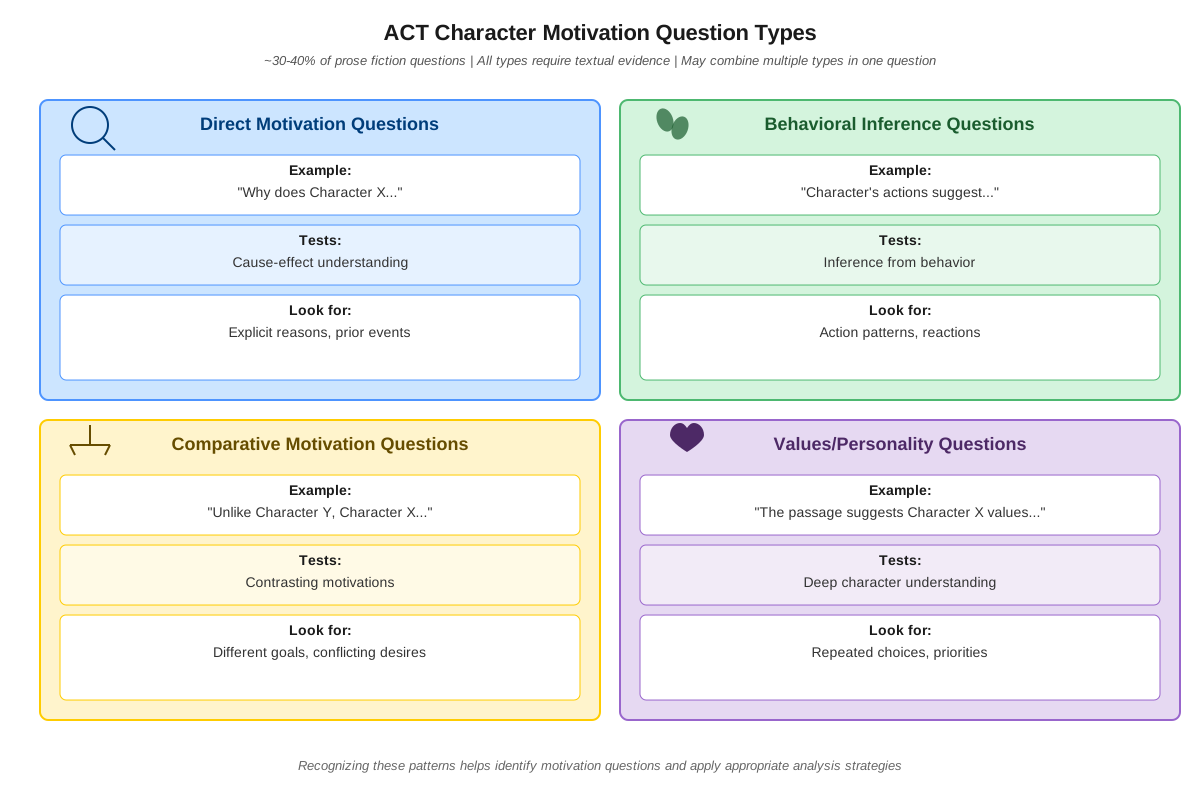
On the ACT, character motivation appears in several distinct formats: direct questions about why a character performs an action, questions about what a character's behavior reveals about their personality or values, questions comparing motivations of multiple characters, and questions asking students to predict future behavior based on established motivations. The test writers deliberately include answer choices that confuse stated motivations with implied ones, or that present plausible-sounding but textually unsupported explanations. Recognizing these patterns is crucial for consistent accuracy.
Core Concepts
Defining Character Motivation
Character motivation refers to the underlying reasons, desires, needs, fears, or goals that drive a character to think, feel, speak, or act in particular ways. Motivations can be conscious (the character is aware of why they're acting) or unconscious (the character acts without full awareness of their true reasons). On the ACT, students must identify these driving forces by analyzing textual evidence rather than making assumptions based on personal experience or general knowledge.
Motivations exist on a spectrum from simple to complex. Simple motivations involve a single, clear desire (a character wants to win a competition). Complex motivations involve multiple, sometimes conflicting desires (a character wants to win but also fears disappointing a parent if they fail). The ACT increasingly tests complex motivations at the medium to difficult level, requiring students to hold multiple possibilities in mind while evaluating evidence.
Explicit vs. Implicit Motivations
Explicit motivations are directly stated in the text. The narrator or character explicitly tells the reader why something is happening. For example: "Sarah studied late into the night because she desperately wanted to earn her father's approval." The motivation (earning approval) is clearly stated.
Implicit motivations must be inferred from indirect evidence such as actions, dialogue, thoughts, reactions, or contextual clues. For example: "Sarah studied late into the night, remembering her father's disappointed face when she brought home her last report card." Here, the motivation isn't stated but can be inferred from the memory and behavior.
The ACT heavily favors implicit motivation questions because they test higher-order thinking skills. Students must become comfortable making reasonable inferences while staying grounded in textual evidence. The key distinction: explicit motivations require recognition and comprehension, while implicit motivations require inference and analysis.
Types of Character Motivations
| Motivation Type | Description | ACT Example |
|---|---|---|
| Survival/Safety | Basic needs, physical security, avoiding harm | Character flees dangerous situation, seeks shelter |
| Love/Belonging | Relationships, acceptance, connection | Character tries to impress someone, seeks friendship |
| Achievement | Success, recognition, mastery | Character practices skill, competes, studies |
| Power/Control | Influence, autonomy, dominance | Character makes decisions for others, resists authority |
| Moral/Ethical | Doing right, justice, principles | Character stands up for beliefs despite consequences |
| Fear/Avoidance | Preventing negative outcomes | Character lies to avoid punishment, procrastinates |
| Curiosity/Growth | Learning, understanding, self-improvement | Character explores, asks questions, takes risks |
Understanding these categories helps students quickly categorize potential motivations when analyzing passages. Most ACT characters are motivated by 2-3 of these simultaneously, creating realistic complexity.
Textual Evidence for Motivation
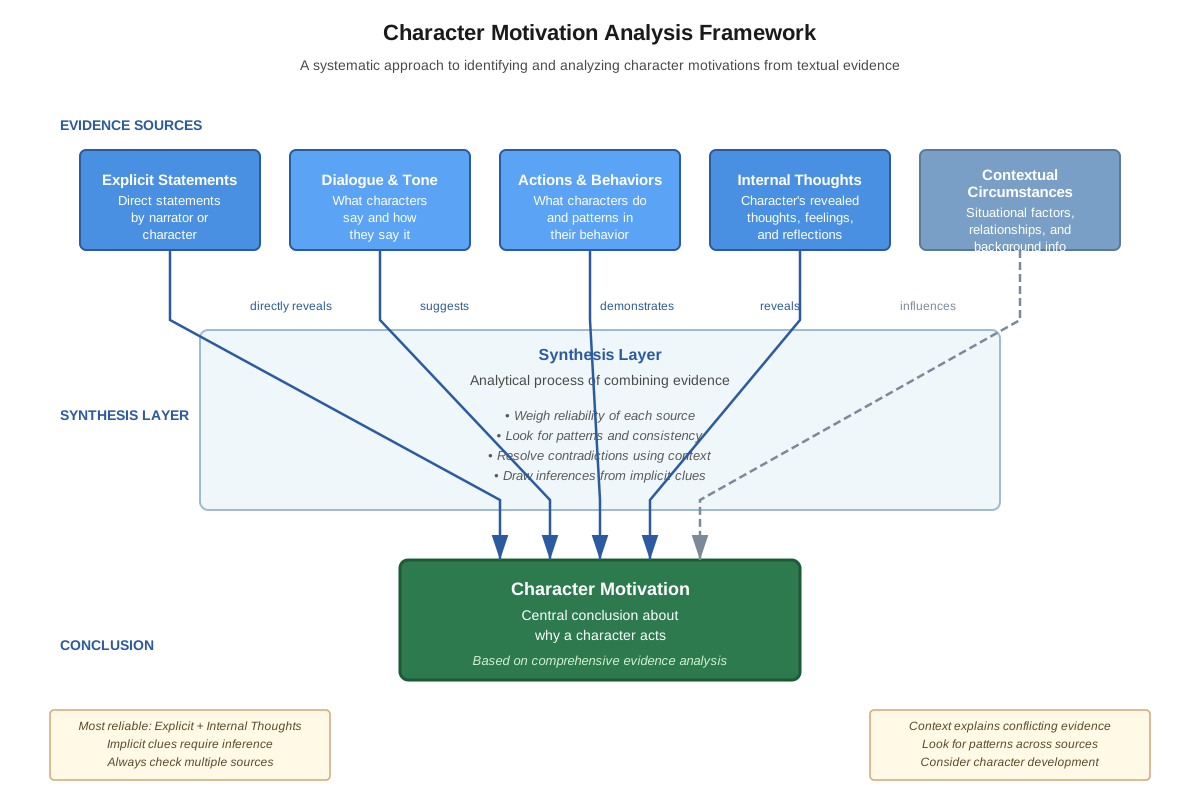
The ACT requires students to support motivation inferences with specific textual evidence. Key evidence types include:
- Direct statements: Character or narrator explicitly states the motivation
- Internal thoughts: Character's mental reflections reveal desires or fears
- Dialogue: What characters say (and how they say it) reveals priorities
- Actions and reactions: Behavior patterns suggest underlying drives
- Backstory and context: Past experiences explain current motivations
- Emotional responses: Feelings indicate what matters to the character
- Choices and sacrifices: What characters give up reveals what they value more
Strong ACT readers develop a habit of marking these evidence types while reading, creating a mental catalog they can reference when answering questions. The test consistently rewards students who can point to specific lines or paragraphs supporting their answer choice.
Conflicting and Evolving Motivations
Advanced ACT passages often present characters with conflicting motivations—simultaneous desires that pull in different directions. For example, a character might want both independence from family and continued family approval. These conflicts create internal tension and drive plot development.
Evolving motivations change throughout a passage as characters gain new information, experience consequences, or undergo personal growth. A character might begin motivated by revenge but shift toward forgiveness after a key interaction. The ACT tests whether students can track these changes and identify what caused the shift.
When encountering questions about conflicting or evolving motivations, students should:
- Identify the specific moment in the passage the question references
- Look for transition words or shifts in tone indicating change
- Consider what new information or experience prompted the evolution
- Eliminate answer choices that only capture one aspect of a complex motivation
Concept Relationships
Character motivation serves as the central hub connecting multiple reading comprehension skills. Textual evidence (supporting details) provides the raw material from which motivations are inferred. Cause-and-effect relationships structure how motivations lead to actions, which produce consequences, which may alter future motivations. Main idea and theme often emerge from examining what characters want and whether they achieve it.
The relationship flows: Context and backstory → Character motivation → Actions and decisions → Plot consequences → Theme development. Understanding this chain helps students see how motivation questions connect to seemingly unrelated questions about plot or theme.
Character motivation also relates closely to point of view and narrator reliability. First-person narrators may misunderstand their own motivations or deliberately mislead readers. Third-person limited narrators reveal one character's motivations while leaving others ambiguous. Recognizing these narrative techniques helps students evaluate the reliability of motivational evidence.
Within the topic itself, explicit motivations often serve as surface-level explanations that mask deeper implicit motivations. For example, a character might explicitly state they're studying to pass a test (explicit) while implicitly seeking parental approval (implicit). The ACT frequently asks students to identify this deeper layer.
High-Yield Facts
⭐ Character motivation questions appear in 3-5 questions per ACT Reading test, making them one of the most common question types
⭐ Implicit motivations (requiring inference) are tested more frequently than explicit motivations (directly stated)
⭐ The correct answer to motivation questions must be supported by specific textual evidence, not general assumptions
⭐ Characters often have multiple simultaneous motivations, and the ACT tests whether students can identify the primary or most relevant one
⭐ Motivation questions frequently use trigger phrases like "primarily motivated by," "suggests that," "in order to," and "because"
- Wrong answer choices often present plausible motivations that aren't supported by the specific passage
- Emotional responses (fear, joy, anger) are strong indicators of underlying motivations
- Actions that seem irrational or surprising usually signal complex or conflicting motivations worth examining
- Dialogue tone and word choice reveal motivations as much as the literal content of what's said
- Characters' motivations often parallel or contrast with other characters' motivations in the same passage
- Backstory and memories frequently explain present-moment motivations
- The ACT rarely tests motivations that require outside knowledge of psychology or human behavior beyond common sense
Quick check — test yourself on Character motivation so far.
Try Flashcards →Common Misconceptions
Misconception: Character motivation is the same as character personality or traits.
Correction: Motivation refers specifically to why a character acts, not what kind of person they are. A kind person (trait) might be motivated by guilt, love, or duty (motivations). The ACT tests the driving force behind actions, not static personality descriptions.
Misconception: The most obvious or first-mentioned reason is always the correct motivation.
Correction: The ACT frequently presents surface-level explanations that mask deeper motivations. Students must read carefully to distinguish between what a character claims motivates them and what the text suggests actually drives their behavior.
Misconception: Students should rely on personal experience to determine what would motivate a character.
Correction: ACT motivation questions must be answered based solely on textual evidence from the passage. What would motivate the student or people they know is irrelevant; only what the passage indicates matters.
Misconception: If a motivation isn't explicitly stated, it can't be the correct answer.
Correction: The majority of ACT motivation questions require inference from implicit clues. Students must become comfortable making evidence-based inferences rather than only selecting explicitly stated information.
Misconception: Characters have only one motivation for their actions.
Correction: Real and realistic characters typically have multiple, sometimes conflicting motivations. The ACT often asks for the "primary" or "main" motivation, acknowledging that others exist but asking students to identify the most significant one based on textual emphasis.
Misconception: Motivation questions are subjective and multiple answers could be correct.
Correction: While motivation analysis involves interpretation, ACT questions are designed with one objectively best answer supported by the strongest textual evidence. Students who feel multiple answers work usually haven't carefully evaluated the evidence for each option.
Worked Examples
Example 1: Implicit Motivation in Prose Fiction
Passage excerpt: "Marcus stood at the edge of the diving board, his toes curled over the rough surface. Below, his teammates shouted encouragement, but their voices seemed distant, muffled. He'd watched them all execute perfect dives, one after another, their bodies slicing cleanly into the water. His own practice dives had been adequate—never spectacular, but adequate. Coach Reynolds stood with his clipboard, checking his watch. Marcus thought of his older brother's trophy case, gleaming in the hallway at home, and took a breath."
Question: Marcus hesitates on the diving board primarily because he:
A) fears the physical danger of diving
B) feels pressure to match his brother's athletic achievements
C) lacks confidence in his diving technique
D) wants to impress Coach Reynolds
Analysis:
Let's evaluate each answer against textual evidence:
Option A (fears physical danger): Nothing in the passage suggests fear of injury. Marcus has done practice dives before, indicating comfort with the physical act. This is unsupported.
Option B (pressure to match brother): The passage mentions Marcus thinking of his brother's trophy case at the crucial moment of hesitation. This memory is strategically placed to show what's occupying his mind. The brother's achievements are "gleaming," suggesting they're impressive and prominent. This is strongly supported.
Option C (lacks confidence in technique): While Marcus notes his dives are "adequate—never spectacular," this seems like a symptom rather than the root cause. The passage emphasizes the brother's trophies more than technical concerns. This is partially supported but not primary.
Option D (wants to impress Coach): The coach is mentioned only as checking his watch, with no indication of Marcus's feelings about him. This is unsupported as a primary motivation.
Correct Answer: B. The textual evidence most strongly supports that Marcus's hesitation stems from comparison with his brother's achievements. The strategic placement of this memory at the moment of decision reveals it as the primary motivation. This demonstrates how the ACT uses implicit clues (what a character thinks about at crucial moments) to reveal deeper motivations.
Example 2: Evolving Motivation
Passage excerpt: "When Elena first volunteered at the community center, she'd done it for the required service hours—forty hours to graduate, a box to check off. She'd resented every minute of that first week, watching the clock, counting down. But then she'd met Mrs. Chen, who came every Tuesday to practice English, carrying a worn notebook filled with vocabulary words in careful handwriting. Mrs. Chen's determination reminded Elena of her own grandmother's stories about immigrating. By the third week, Elena arrived early, staying late to help Mrs. Chen with pronunciation. She'd stopped logging her hours two weeks ago."
Question: The passage suggests that Elena's motivation for volunteering shifts from:
A) obligation to genuine interest
B) self-interest to community service
C) academic requirement to career preparation
D) reluctance to enthusiasm
Analysis:
Option A (obligation to genuine interest): The passage clearly shows Elena beginning with "required service hours" (obligation) and ending with stopping logging hours while arriving early and staying late (genuine interest). The Mrs. Chen relationship catalyzes this change. Strongly supported.
Option B (self-interest to community service): While this captures some truth, it's less precise than Option A. The passage emphasizes Elena's emotional shift more than a philosophical change from self to community. Partially supported but less specific.
Option C (academic requirement to career preparation): Nothing suggests Elena is preparing for a career. This introduces information not in the passage. Unsupported.
Option D (reluctance to enthusiasm): This is tempting and captures the emotional shift. However, "genuine interest" (Option A) is more precise than "enthusiasm" and better matches the textual evidence of sustained, voluntary engagement. Option A is more complete.
Correct Answer: A. This question tests whether students can track motivation evolution across a passage and identify both the starting and ending points accurately. The key evidence includes the explicit statement about required hours, the resentment, the turning point with Mrs. Chen, and the behavioral changes (arriving early, staying late, stopping logging). This demonstrates how the ACT tests complex motivation changes over time.
Exam Strategy
Identifying Motivation Questions
Watch for these trigger phrases that signal motivation questions:
- "primarily motivated by"
- "suggests that [character] wants/desires/hopes"
- "in order to"
- "because"
- "[character's] actions reveal"
- "the reason [character] does X is"
- "what drives [character] to"
When you spot these phrases, immediately shift into motivation-analysis mode: you'll need to identify the "why" behind actions, not just the "what."
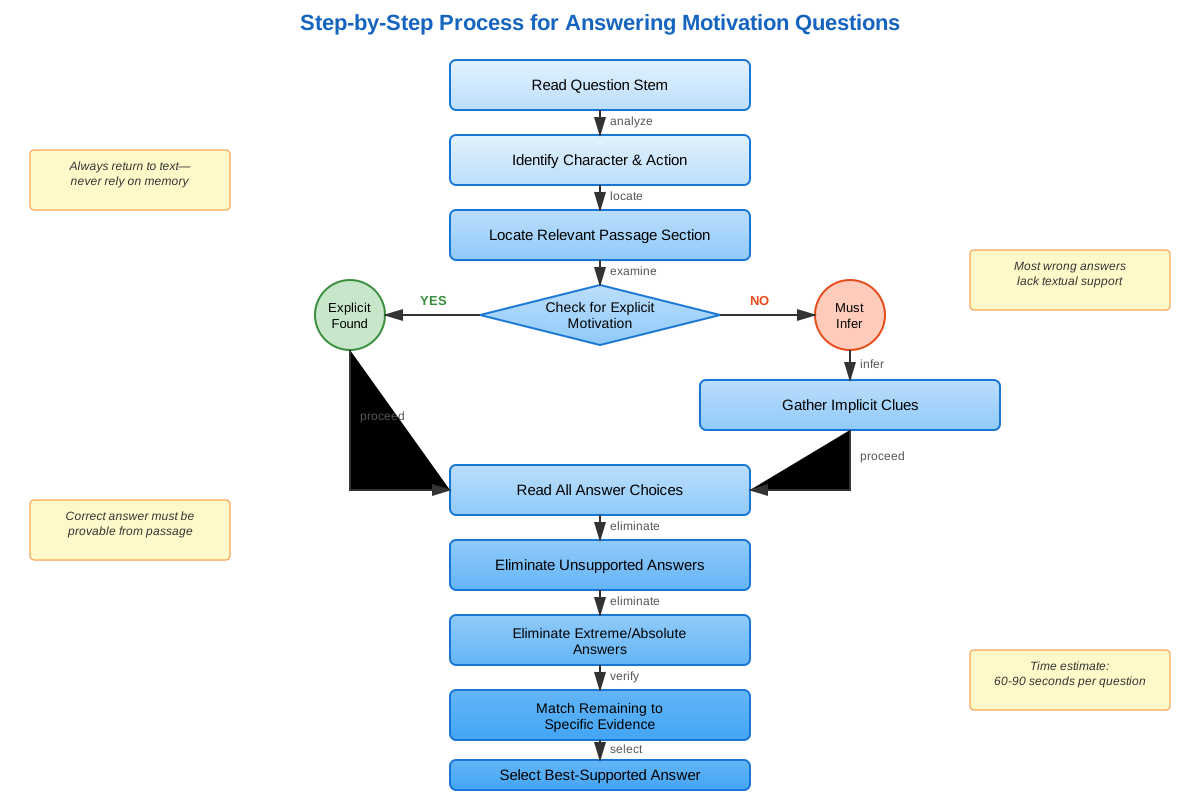
Step-by-Step Approach
- Locate the relevant passage section: Find where the action or behavior in question occurs
- Identify explicit statements: Check if the character or narrator directly states the motivation
- Gather implicit evidence: If no explicit statement exists, collect surrounding clues (thoughts, emotions, context, dialogue)
- Consider timing: What happens immediately before the action? This often reveals motivation
- Evaluate each answer choice: Match each option against your evidence, eliminating those without textual support
- Choose the best-supported answer: Select the option with the strongest, most specific textual evidence
Process of Elimination Tips
Eliminate answers that:
- Require outside knowledge or assumptions not in the passage
- Confuse effect with cause (describing what happens rather than why)
- Are contradicted by any part of the passage
- Describe personality traits rather than motivations
- Use extreme language ("only," "always," "never") unless the passage supports it
Keep answers that:
- Can be supported by specific lines or paragraphs
- Align with the character's established patterns and values
- Account for the context and timing of the action
- Match the emotional tone of the passage
Time Management
Motivation questions typically require 45-60 seconds to answer accurately. They're worth the time investment because they're high-yield and predictable. If you're stuck between two answers, return to the passage and find the specific evidence for each—don't rely on memory or gut feeling. The 15-20 seconds spent verifying will improve accuracy significantly.
Exam Tip: When the question asks for the "primary" or "main" motivation, acknowledge that multiple motivations may exist. Your job is to identify which one the passage emphasizes most through repetition, placement, or explicit statement.
Memory Techniques
MOTIVATE - A mnemonic for analyzing character motivation:
- Mark the action or behavior in question
- Observe what happens immediately before and after
- Thoughts: Check for internal reflections
- Identify emotional responses
- Verify with specific textual evidence
- Analyze dialogue and word choice
- Track changes or patterns
- Eliminate unsupported options
The "Why Chain": When analyzing motivation, ask "why" three times:
- Why did the character do this? (surface answer)
- Why does that matter to them? (deeper answer)
- Why does that drive their behavior? (root motivation)
This technique helps students move from surface-level to deep-level understanding.
Visualization Strategy: Picture the character at a crossroads, with different paths representing different motivations. Which path does the textual evidence point them toward most strongly? This mental image helps students evaluate competing motivations.
The Evidence Test: For each answer choice, ask "Can I point to a specific sentence or paragraph that supports this?" If you can't, it's likely wrong. This simple test prevents students from selecting plausible-sounding but unsupported answers.
Summary
Character motivation questions test students' ability to identify why characters think, feel, and act as they do, based on textual evidence rather than assumptions. These questions appear 3-5 times per ACT Reading test and require distinguishing between explicit (directly stated) and implicit (inferred) motivations. Success depends on gathering multiple types of evidence—including internal thoughts, dialogue, actions, emotional responses, and contextual clues—and matching this evidence against answer choices. The ACT frequently tests complex scenarios involving multiple or conflicting motivations, requiring students to identify the primary driving force. Strong performance requires moving beyond surface-level reading to analytical interpretation while remaining grounded in specific textual support. Students must avoid common pitfalls like relying on personal experience, confusing personality with motivation, or selecting the first plausible answer without verification. Mastering character motivation improves performance across multiple question types and correlates with higher overall Reading scores.
Key Takeaways
- Character motivation questions are among the most common and predictable on the ACT Reading test, appearing 3-5 times per exam
- Implicit motivations (requiring inference) are tested more frequently than explicit motivations and require synthesizing multiple textual clues
- The correct answer must always be supported by specific textual evidence, not general assumptions about human behavior
- Characters often have multiple simultaneous motivations; identify the primary one by evaluating which receives the most textual emphasis
- Use the MOTIVATE mnemonic to systematically analyze motivation questions and avoid rushing to conclusions
- Eliminate answer choices that lack textual support, confuse cause with effect, or require outside knowledge
- Track motivation evolution throughout passages, noting what causes characters to change their desires or goals
Related Topics
Point of View and Narrator Reliability: Understanding who tells the story and how reliable they are directly impacts how students evaluate character motivations. First-person narrators may misunderstand their own motivations, while third-person narrators may reveal or conceal different characters' inner thoughts.
Theme and Main Idea: Character motivations often embody or illustrate the passage's central themes. Mastering motivation analysis enables deeper understanding of what the author wants to communicate.
Cause and Effect Relationships: Motivations are causes that lead to actions (effects), which become causes for new effects. Understanding this chain strengthens both motivation analysis and plot comprehension.
Supporting Details and Textual Evidence: The skill of identifying and evaluating textual evidence applies directly to motivation questions, where students must support inferences with specific passage references.
Practice CTA
Now that you've mastered the core concepts of character motivation, it's time to apply this knowledge to ACT-style practice questions. The flashcards will help you memorize key concepts and trigger phrases, while the practice questions will develop your ability to analyze passages under timed conditions. Remember: character motivation questions are highly predictable and teachable—consistent practice with these strategies will translate directly to points on test day. Approach each practice question systematically using the MOTIVATE framework, and always verify your answers with specific textual evidence. You've got this!
Sign up free to keep reading
Create a free AnvayaPrep account to finish this ACT guide on Character motivation — plus flashcards and practice questions.