Overview
The ACT Science section frequently presents students with Conflicting Viewpoints passages, where two or more scientists, students, or hypotheses present different explanations for the same phenomenon. A critical skill for success on these passages is identifying the underlying assumptions in viewpoints—the unstated beliefs, premises, or conditions that each perspective takes for granted. These assumptions form the foundation upon which each argument is built, and recognizing them is essential for understanding why different scientists reach different conclusions from the same data.
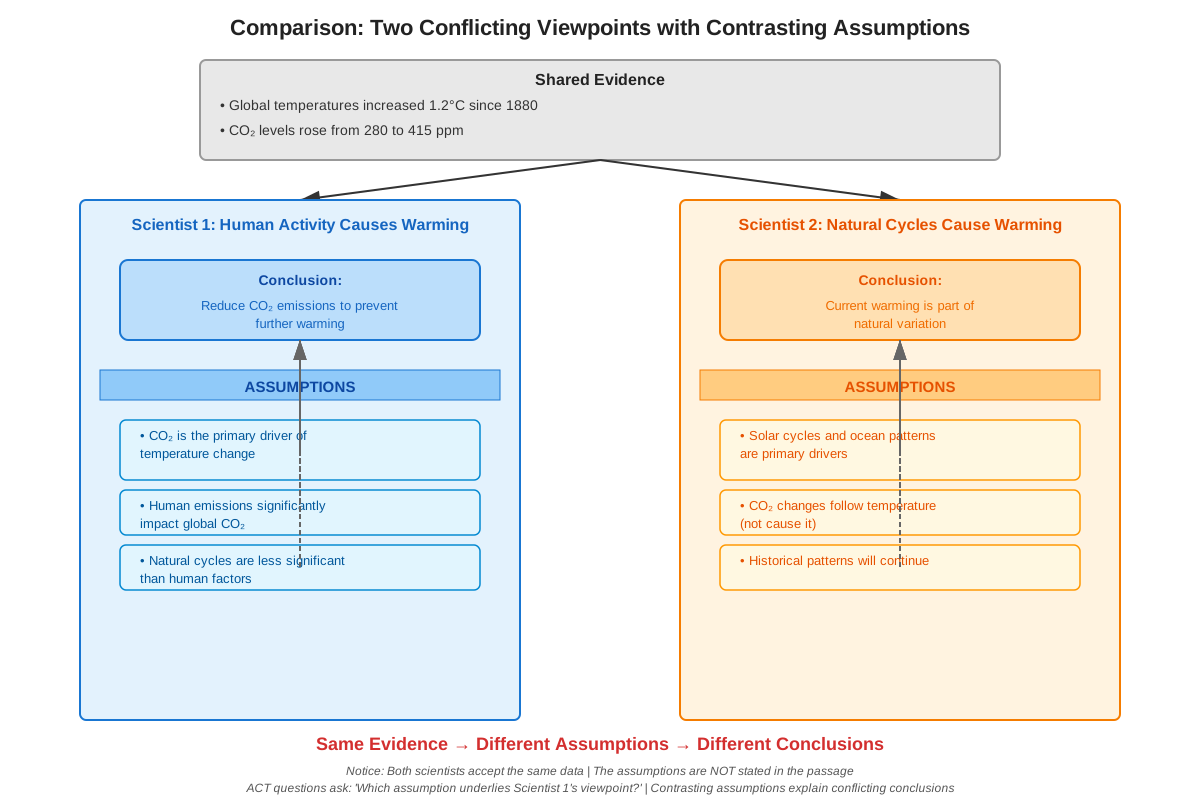
Understanding ACT assumptions in viewpoints is not merely about reading comprehension; it requires analytical thinking that bridges the gap between what is explicitly stated and what is implicitly believed. When a scientist proposes that increased carbon dioxide levels cause global temperature rise, they assume a causal relationship exists and that other variables are either controlled or less significant. When another scientist disputes this, they may assume different mechanisms are more important or that correlation does not imply causation. The ACT tests whether students can identify these foundational beliefs that aren't directly stated in the passage.
This topic is essential because approximately 15-20% of ACT Science questions directly or indirectly test the ability to identify assumptions, making it one of the highest-yield skills for the Conflicting Viewpoints passage type. Mastering this skill connects to broader critical thinking abilities tested throughout the ACT, including evaluating evidence quality, understanding experimental design, and distinguishing between correlation and causation. Students who excel at identifying assumptions can more effectively compare viewpoints, predict what evidence would support or weaken each position, and answer synthesis questions that require understanding the logical structure of scientific arguments.
Learning Objectives
- [ ] Identify when Assumptions in viewpoints is being tested
- [ ] Explain the core rule or strategy behind Assumptions in viewpoints
- [ ] Apply Assumptions in viewpoints to ACT-style questions accurately
- [ ] Distinguish between explicit statements and implicit assumptions within scientific arguments
- [ ] Evaluate which assumptions are most critical to the validity of each viewpoint
- [ ] Predict what evidence would challenge or support specific assumptions in conflicting viewpoints
Prerequisites
- Basic reading comprehension: Understanding scientific passages requires the ability to extract main ideas and supporting details from complex text
- Scientific method fundamentals: Recognizing hypotheses, evidence, and conclusions helps distinguish between what is proven and what is assumed
- Logical reasoning skills: Identifying assumptions requires understanding how premises lead to conclusions in an argument structure
- Familiarity with ACT Science passage types: Knowing that Conflicting Viewpoints passages differ from Data Representation and Research Summaries helps set appropriate expectations
Why This Topic Matters
In real-world science, assumptions underpin every theory, experiment, and conclusion. Scientists must recognize their own assumptions to design valid experiments and must identify others' assumptions to evaluate competing theories. When medical researchers assume that animal models accurately predict human responses, or when climate scientists assume that past patterns will continue, these assumptions shape entire research programs. Understanding assumptions is fundamental to scientific literacy and critical evaluation of claims encountered in daily life, from news articles to product advertisements.
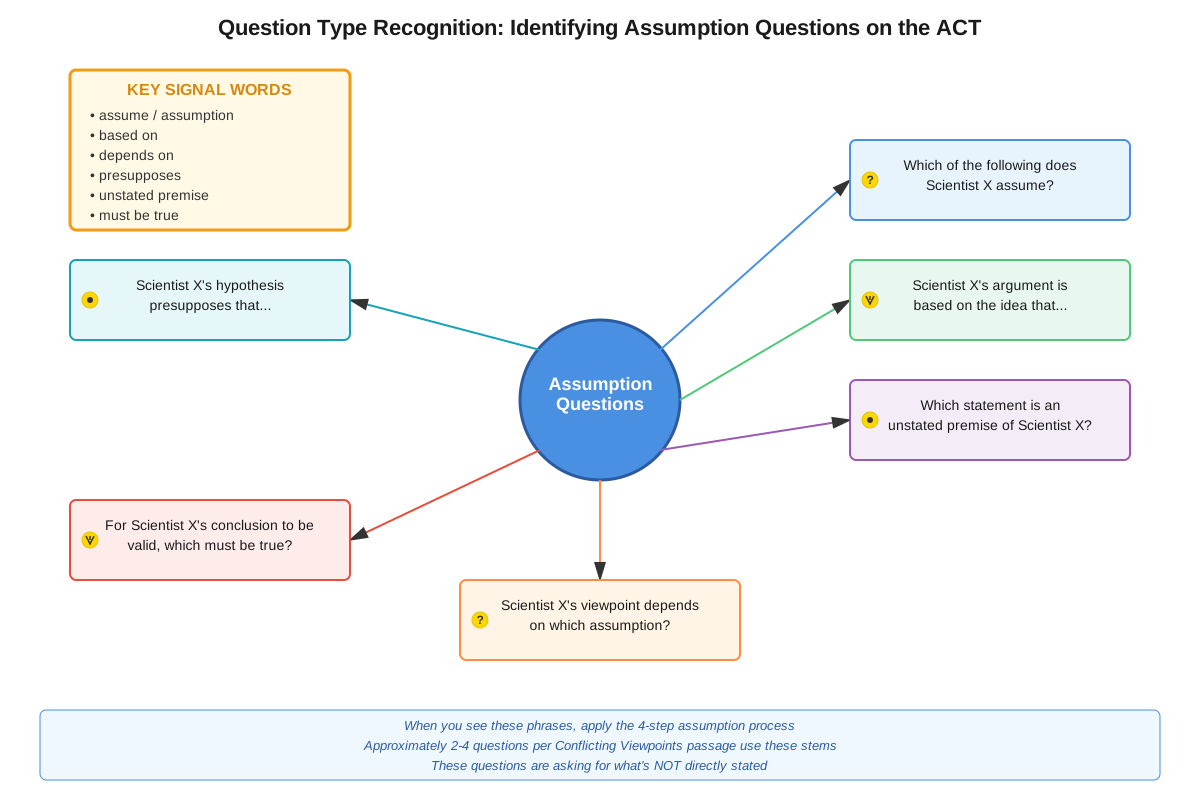
On the ACT Science section, assumptions in viewpoints appears in approximately 6-7 passages per test, with the Conflicting Viewpoints passage being guaranteed. Within this passage type, 2-4 questions typically require identifying or evaluating assumptions. These questions often appear as:
- "Which of the following is an assumption underlying Scientist 1's hypothesis?"
- "Both scientists assume that..."
- "Scientist 2's argument depends on which of the following being true?"
- "Which assumption, if false, would most weaken Viewpoint A?"
The ACT specifically tests this skill because it represents higher-order thinking beyond simple data interpretation. Questions about assumptions typically carry the same point value as easier questions, making them high-yield targets for score improvement. Students who master this topic gain a significant advantage, as these questions often separate mid-range scorers from those achieving composite scores of 30+.
Core Concepts
What Are Assumptions in Scientific Viewpoints?
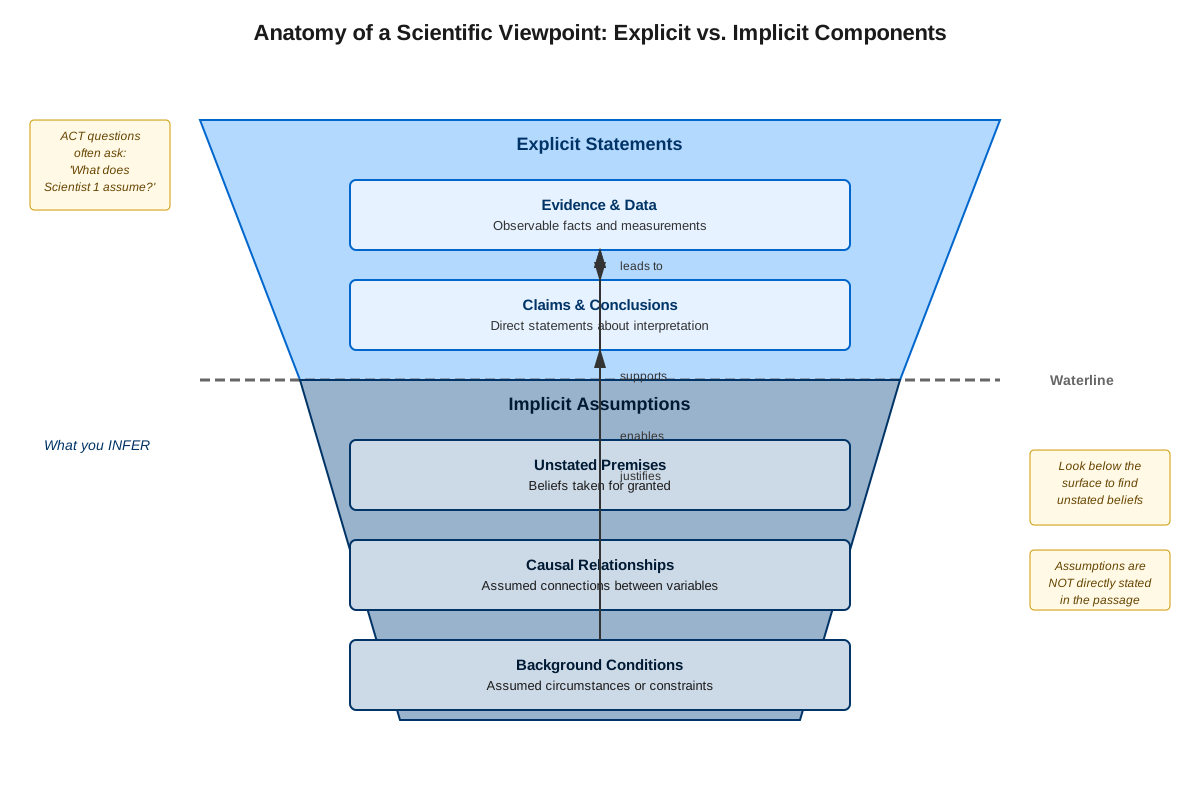
An assumption is an unstated premise or belief that must be true for an argument or hypothesis to be valid. In scientific contexts, assumptions are the foundational conditions, relationships, or facts that a scientist accepts without explicit proof within their argument. Unlike evidence (which is stated and supported) or conclusions (which are explicitly drawn), assumptions operate in the background, forming the logical bridge between evidence and conclusions.
For example, if a scientist argues that "increasing exercise duration improves cardiovascular health because longer workouts burn more calories," several assumptions underlie this viewpoint:
- Calorie burning is the primary mechanism by which exercise improves cardiovascular health
- The relationship between exercise duration and calorie burning is linear or positive
- Other factors (diet, genetics, sleep) are either constant or less significant
- The definition of "cardiovascular health" is agreed upon and measurable
The ACT tests whether students can identify these unstated premises that make the argument work.
Types of Assumptions Commonly Tested
Causal Assumptions: These involve believing that one factor causes another, rather than merely correlating with it. When Scientist A claims that "increased UV radiation causes higher mutation rates," they assume UV radiation has a direct causal mechanism, not just a coincidental relationship.
Methodological Assumptions: These relate to experimental design and measurement validity. A scientist comparing two groups assumes that the groups are comparable, that measurement tools are accurate, and that confounding variables are controlled.
Scope Assumptions: These involve the range or limits of applicability. When a scientist generalizes from laboratory conditions to natural environments, they assume the findings transfer across contexts.
Temporal Assumptions: These relate to time-based relationships. Arguments about trends assume that past patterns will continue, or that the time scale of observation is appropriate for the phenomenon studied.
How to Identify Assumptions in ACT Passages
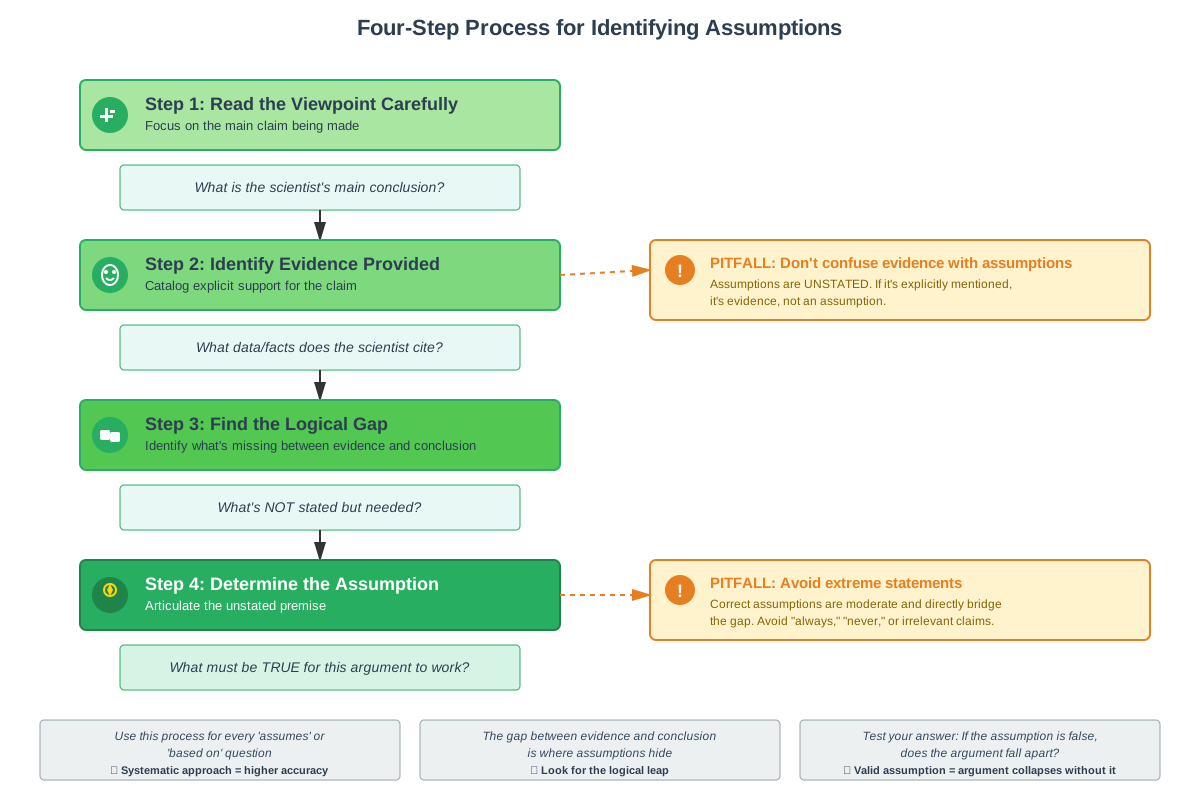
The systematic approach to identifying assumptions involves four key steps:
- Identify the conclusion: What is the scientist ultimately arguing or claiming?
- Identify the evidence: What data, observations, or facts does the scientist present?
- Find the gap: What logical leap exists between the evidence and conclusion?
- Articulate the assumption: What must be true to bridge this gap?
Consider this example: "Scientist 1 argues that the dinosaur extinction was caused by an asteroid impact because iridium levels in rock layers from 65 million years ago are elevated, and iridium is rare on Earth but common in asteroids."
- Conclusion: Asteroid impact caused dinosaur extinction
- Evidence: Elevated iridium in 65-million-year-old rocks; iridium is rare on Earth but common in asteroids
- Gap: How does iridium presence prove asteroid impact caused extinction (not just that an impact occurred)?
- Assumptions:
- The iridium came from an asteroid (not volcanic activity or other sources)
- The timing of iridium deposition coincides with extinction
- The asteroid impact was large enough to cause mass extinction
- No other simultaneous events caused the extinction
Distinguishing Assumptions from Explicit Statements
A critical skill is recognizing what is stated versus what is assumed. The ACT often includes answer choices that restate explicit information from the passage, testing whether students can distinguish these from actual assumptions.
| Feature | Explicit Statement | Assumption |
|---|---|---|
| Presence in text | Directly stated in passage | Not stated; must be inferred |
| Function | Provides evidence or conclusion | Bridges evidence to conclusion |
| Testability | Often supported by data in passage | Taken as given without proof |
| Question format | "According to the passage..." | "Which assumption underlies..." |
Shared vs. Unique Assumptions
The ACT frequently asks about assumptions that both scientists share versus those unique to one viewpoint. Shared assumptions often relate to:
- Basic scientific principles (laws of physics, chemistry)
- Measurement validity (instruments work correctly)
- Definitional agreements (what terms mean)
- Background facts about the system being studied
Unique assumptions typically involve:
- Specific causal mechanisms
- Relative importance of different factors
- Interpretation of ambiguous evidence
- Scope of applicability
For example, two scientists debating climate change might both assume that temperature measurements are accurate (shared) but differ in assuming whether human activity is the primary driver (unique).
Evaluating Assumption Strength
Not all assumptions are equally important to an argument. Critical assumptions are those that, if false, would completely invalidate the conclusion. Supporting assumptions strengthen the argument but aren't absolutely necessary. The ACT often asks which assumption is "most important" or which, "if false, would most weaken" the viewpoint.
To evaluate assumption strength, ask:
- Does the entire argument collapse without this assumption?
- Are there alternative explanations if this assumption is false?
- How directly does this assumption connect evidence to conclusion?
Concept Relationships
The skill of identifying assumptions in viewpoints builds directly on fundamental reading comprehension and logical reasoning. Students must first understand the explicit content of each viewpoint (what is stated) before they can identify what is unstated but necessary (assumptions). This skill connects to evaluating evidence quality, as assumptions often relate to whether evidence is sufficient, relevant, or properly interpreted.
Within the Conflicting Viewpoints passage structure, assumption identification enables several other skills:
- Comparing viewpoints → requires understanding the different assumptions underlying each perspective
- Predicting supporting evidence → depends on knowing what assumptions need validation
- Identifying weaknesses → involves recognizing which assumptions are most questionable
The relationship flow works as follows:
Read passage → Identify explicit claims → Recognize gaps in logic → Articulate assumptions → Evaluate assumption validity → Compare assumptions across viewpoints → Answer synthesis questions
This topic also connects to experimental design concepts, as assumptions in viewpoints often mirror assumptions in experimental methodology (control of variables, validity of measurements, generalizability of results). Understanding assumptions prepares students for more advanced critical thinking tasks, including evaluating whether new evidence supports or contradicts a viewpoint.
Quick check — test yourself on Assumptions in viewpoints so far.
Try Flashcards →High-Yield Facts
⭐ Assumptions are unstated premises that must be true for an argument to be valid; they are never explicitly written in the passage
⭐ The most common assumption questions ask "Which of the following is an assumption underlying [Scientist X's] viewpoint?" or "Both scientists assume that..."
⭐ To identify an assumption, find the logical gap between the evidence presented and the conclusion drawn
⭐ Shared assumptions between conflicting viewpoints typically involve basic facts, measurement validity, or definitional agreements
⭐ Critical assumptions, if proven false, would completely invalidate the conclusion; supporting assumptions merely strengthen it
- Causal assumptions (X causes Y) are among the most frequently tested assumption types on the ACT
- Assumptions about scope and generalizability often appear when scientists extrapolate from specific conditions to broader contexts
- Methodological assumptions relate to experimental design, measurement accuracy, and control of variables
- Temporal assumptions involve beliefs about time-based relationships, trends, or the stability of conditions
- Wrong answer choices often include explicit statements from the passage rather than actual assumptions
- Questions asking what would "weaken" or "strengthen" a viewpoint are testing understanding of underlying assumptions
- The ACT never requires outside scientific knowledge to identify assumptions; all necessary information is in the passage
Common Misconceptions
Misconception: Assumptions are the same as conclusions or main claims of each viewpoint.
Correction: Conclusions are explicitly stated outcomes that scientists argue for, while assumptions are unstated premises that support those conclusions. If it's written directly in the passage as what the scientist believes, it's a conclusion, not an assumption.
Misconception: Both scientists in a Conflicting Viewpoints passage assume completely different things with no overlap.
Correction: Scientists often share fundamental assumptions about measurement validity, basic scientific principles, or definitional terms. The ACT frequently tests recognition of these shared assumptions, which form common ground despite disagreement on specific mechanisms or interpretations.
Misconception: Any statement not explicitly in the passage is an assumption.
Correction: Assumptions must be logically necessary for the argument to work. Random unstated facts or irrelevant information are not assumptions. An assumption must bridge the gap between evidence and conclusion for that specific viewpoint.
Misconception: Identifying assumptions requires advanced scientific knowledge beyond what's in the passage.
Correction: The ACT Science section never requires outside content knowledge to identify assumptions. All necessary information to recognize what must be assumed is contained within the passage itself. The skill being tested is logical reasoning, not scientific expertise.
Misconception: If a scientist provides evidence for something, they're not assuming it.
Correction: Scientists can provide evidence for some claims while still making assumptions about how to interpret that evidence, what it means, or what other conditions are true. For example, providing temperature data doesn't eliminate assumptions about measurement accuracy or about what temperature changes indicate.
Misconception: Assumptions are always wrong or problematic.
Correction: Assumptions are a normal and necessary part of scientific reasoning. Scientists must make reasonable assumptions to develop testable hypotheses. The goal is to recognize assumptions, not to assume they're invalid. Some assumptions are well-justified; others may be questionable.
Worked Examples
Example 1: Identifying a Unique Assumption
Passage Context: Two scientists debate why a particular lake's fish population declined. Scientist 1 argues that increased water temperature from climate change reduced oxygen levels, harming fish. Scientist 2 argues that agricultural runoff introduced toxins that directly poisoned fish.
Question: Which of the following is an assumption underlying Scientist 1's viewpoint but NOT Scientist 2's?
A) The fish population has actually declined
B) Temperature and oxygen levels are inversely related
C) The lake's water composition has changed
D) Fish health can be affected by environmental factors
Solution Process:
Step 1: Identify Scientist 1's argument structure
- Evidence: Water temperature increased
- Conclusion: Fish population declined due to reduced oxygen
- Gap: How does temperature increase lead to oxygen decrease?
Step 2: Articulate Scientist 1's assumptions
- Temperature increase causes oxygen decrease (inverse relationship)
- Oxygen levels are critical to fish survival
- No other factors are more important
Step 3: Check each answer against both scientists
- A) Both scientists must assume the decline occurred (shared assumption)
- B) Scientist 1's argument requires this temperature-oxygen relationship; Scientist 2's toxin argument doesn't depend on it (unique to Scientist 1)
- C) Both scientists assume water composition changed (temperature or toxins) (shared assumption)
- D) Both scientists assume environmental factors affect fish (shared assumption)
Answer: B
This question tests the ability to distinguish unique assumptions from shared ones. The inverse relationship between temperature and oxygen is the logical bridge that makes Scientist 1's argument work, but Scientist 2's argument about toxins doesn't require this relationship at all.
Example 2: Identifying a Critical Assumption
Passage Context: A scientist argues that ancient cave paintings in Europe were created by Neanderthals rather than modern humans because the paintings date to 65,000 years ago, and modern humans didn't arrive in Europe until 45,000 years ago.
Question: The scientist's argument depends on which of the following assumptions?
A) Cave paintings are an important form of artistic expression
B) Neanderthals and modern humans never coexisted in Europe
C) No other hominin species capable of creating art existed in Europe 65,000 years ago
D) The dating method used is accurate
Solution Process:
Step 1: Identify the argument structure
- Evidence: Paintings date to 65,000 years ago; modern humans arrived 45,000 years ago
- Conclusion: Neanderthals created the paintings
- Gap: Why must it be Neanderthals specifically?
Step 2: Test each assumption by negation (if false, does the argument collapse?)
- A) If paintings aren't important, the argument still works (not critical)
- B) If they coexisted, the argument still works because modern humans weren't there at 65,000 years ago (not critical)
- C) If another species existed and could create art, they might have made the paintings instead of Neanderthals (argument collapses—critical assumption)
- D) If dating is inaccurate, the timeline evidence fails (critical assumption)
Step 3: Choose the most direct assumption
Both C and D are critical, but D is more fundamental—without accurate dating, the entire timeline argument fails. However, C is more specific to the conclusion about Neanderthals specifically.
Answer: C or D (both are defensible; ACT would typically make one clearly more critical)
This example demonstrates how to evaluate assumption strength by testing what happens if the assumption is false. Critical assumptions cause the entire argument to collapse when negated.
Exam Strategy
Recognizing Assumption Questions
The ACT uses specific trigger phrases to signal assumption questions. Watch for:
- "Which of the following is an assumption..."
- "The argument depends on..."
- "Both scientists assume that..."
- "Which must be true for [Scientist X's] conclusion to be valid?"
- "If which of the following were false, [Viewpoint Y] would be weakened?"
Exam Tip: When you see these phrases, immediately shift from reading for explicit information to analyzing logical structure. Your task is to find what's NOT stated but must be true.
The Gap-Finding Strategy
- Underline the conclusion of the viewpoint in question (usually the main claim)
- Circle the key evidence supporting that conclusion
- Draw an arrow between evidence and conclusion
- Ask: "What must be true to make this logical leap valid?"
- Eliminate answers that are explicitly stated in the passage
Process of Elimination Tactics
Eliminate explicit statements first: If an answer choice restates something directly from the passage, it cannot be an assumption. Cross it out immediately.
Eliminate irrelevant information: Assumptions must be logically necessary for the specific argument. If an answer choice is true but doesn't connect the evidence to the conclusion, eliminate it.
For "both scientists assume" questions: Eliminate any answer that only one scientist's argument requires. The correct answer must be necessary for both viewpoints.
Use the negation test: For remaining answers, imagine each is false. The correct assumption, when negated, should make the argument fall apart or become much weaker.
Time Management
Assumption questions typically take 45-60 seconds—slightly longer than straightforward data interpretation questions. Budget accordingly:
- 15 seconds: Identify what the question is asking and locate the relevant viewpoint
- 20 seconds: Analyze the argument structure and identify the gap
- 20 seconds: Evaluate answer choices using elimination strategies
- 5 seconds: Confirm and bubble
Don't spend more than 75 seconds on any single assumption question. If stuck, use the elimination strategies to narrow to two choices, make your best guess, and move on.
Memory Techniques
The CAGE Method for Identifying Assumptions:
- Conclusion: What is the scientist claiming?
- Argument: What evidence supports this?
- Gap: What's missing between evidence and conclusion?
- Express: State what must be true to bridge the gap
The "MUST BE TRUE" Test: When evaluating whether something is an assumption, ask "MUST this BE TRUE for the argument to work?" If the answer is yes, it's likely an assumption. If the argument could still work without it, it's not.
Shared vs. Unique Visualization: Picture two overlapping circles (Venn diagram). Shared assumptions go in the overlap; unique assumptions go in the non-overlapping portions. This helps organize your thinking for "both scientists assume" questions.
The Negation Shortcut: Remember "NOT = KNOT"—if making the statement NOT true ties the argument in a KNOT (makes it fall apart), it's a critical assumption.
Summary
Identifying assumptions in viewpoints is a critical skill for ACT Science success, particularly in Conflicting Viewpoints passages. Assumptions are unstated premises that must be true for a scientific argument to be valid—they form the logical bridge between evidence and conclusions. The key to mastering this skill is recognizing the gap between what is explicitly stated and what must be implicitly believed for the argument to work. Students must distinguish assumptions from explicit statements, recognize shared versus unique assumptions across viewpoints, and evaluate which assumptions are most critical to each argument's validity. The systematic approach involves identifying the conclusion, recognizing the supporting evidence, finding the logical gap, and articulating what must be true to bridge that gap. Success on assumption questions requires careful reading, logical analysis, and strategic use of elimination techniques, particularly removing answer choices that restate explicit information or present irrelevant facts.
Key Takeaways
- Assumptions are never explicitly stated in the passage; they are unstated premises necessary for arguments to be valid
- Find assumptions by identifying the logical gap between evidence and conclusions in each viewpoint
- Shared assumptions involve basic facts, measurement validity, or definitions; unique assumptions involve specific mechanisms or interpretations
- Critical assumptions, when proven false, completely invalidate the conclusion; this is tested through "weaken" questions
- Eliminate answer choices that restate explicit information from the passage—these cannot be assumptions
- Use the negation test: if making a statement false destroys the argument, it's a critical assumption
- Budget 45-60 seconds per assumption question and use systematic elimination strategies to improve accuracy
Related Topics
Evaluating Evidence Quality: Understanding assumptions enables deeper evaluation of whether evidence actually supports conclusions or whether unstated premises are doing the logical work.
Experimental Design and Controls: Assumptions in viewpoints mirror assumptions in experimental methodology, particularly regarding variable control and measurement validity.
Distinguishing Correlation from Causation: Many assumptions involve causal relationships; mastering assumption identification helps recognize when causation is assumed versus proven.
Synthesis Questions in Conflicting Viewpoints: Advanced questions asking how new evidence affects multiple viewpoints require understanding each viewpoint's underlying assumptions.
Logical Reasoning in Reading Section: The skill of identifying assumptions transfers directly to ACT Reading, particularly in passages presenting arguments or debates.
Practice CTA
Now that you understand how to identify and evaluate assumptions in viewpoints, it's time to apply these strategies to real ACT-style questions. The practice questions and flashcards will help you recognize the specific question formats, refine your gap-finding technique, and build speed with elimination strategies. Remember: assumption questions are high-yield opportunities to demonstrate critical thinking skills that separate good scores from great scores. Each practice question you complete strengthens your ability to see beyond what's written to what must be true—a skill that will serve you not just on test day, but in evaluating arguments and claims throughout your academic and professional life. You've got this!
Sign up free to keep reading
Create a free AnvayaPrep account to finish this ACT guide on Assumptions in viewpoints — plus flashcards and practice questions.