Overview
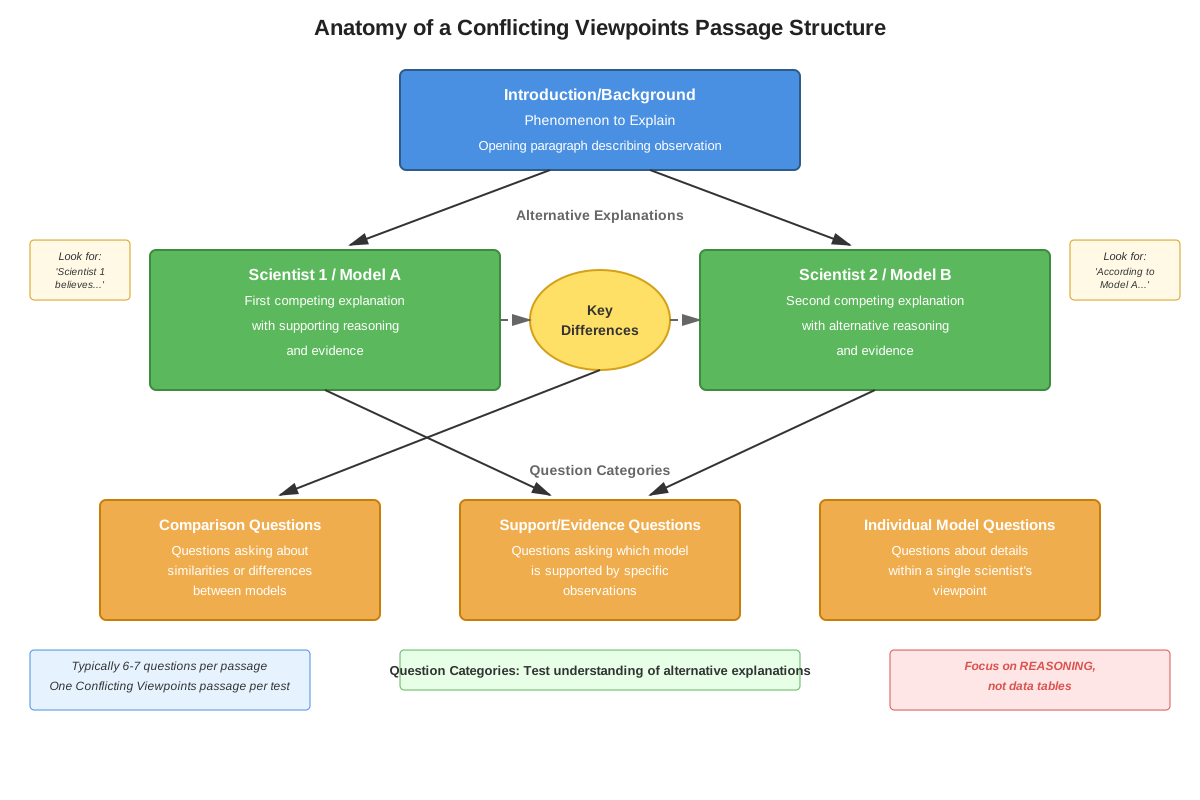
Model comparison is a critical skill tested in the ACT Science section, specifically within the Conflicting Viewpoints passage type. This question format requires students to analyze, contrast, and evaluate two or more competing scientific explanations, hypotheses, or theories about the same phenomenon. Unlike Data Representation or Research Summaries passages that focus on interpreting experimental results, Conflicting Viewpoints passages present multiple perspectives from different scientists or schools of thought, each offering distinct explanations for observed phenomena.
Understanding ACT model comparison is essential because it represents approximately 15-20% of the Science section and typically appears as one complete passage with 6-7 questions. These passages assess higher-order thinking skills including analysis, synthesis, and evaluation rather than simple data interpretation. Students must identify key differences between models, recognize supporting evidence for each viewpoint, determine which model better explains specific observations, and understand the logical structure of scientific argumentation. Mastery of model comparison directly impacts overall Science scores because these questions often challenge students who excel at data interpretation but struggle with conceptual reasoning.
Model comparison connects to broader scientific literacy by mirroring how real scientific discourse operates. Scientists regularly propose competing theories, debate evidence, and refine models based on new observations. This topic builds upon fundamental skills in reading comprehension, logical reasoning, and evidence evaluation while preparing students for the analytical thinking required in college-level science courses. The ability to compare models also reinforces understanding of the scientific method, hypothesis testing, and the provisional nature of scientific knowledge.
Learning Objectives
- [ ] Identify when Model comparison is being tested in ACT Science passages
- [ ] Explain the core rule or strategy behind Model comparison questions
- [ ] Apply Model comparison techniques to ACT-style questions accurately
- [ ] Distinguish between similarities and differences across multiple scientific models
- [ ] Evaluate which model is better supported by specific evidence or observations
- [ ] Synthesize information from multiple viewpoints to answer complex comparison questions
- [ ] Recognize the logical structure and reasoning patterns within each competing model
Prerequisites
- Reading comprehension skills: Essential for understanding complex scientific arguments presented in paragraph form rather than data tables
- Basic scientific vocabulary: Necessary to follow discussions across various scientific disciplines (biology, chemistry, physics, earth science)
- Understanding of hypothesis and theory: Required to recognize that models are explanatory frameworks rather than established facts
- Logical reasoning ability: Needed to follow cause-and-effect relationships and identify supporting versus contradicting evidence
Why This Topic Matters
Model comparison represents a unique and high-stakes component of the ACT Science test. Unlike other passage types that emphasize graph reading and numerical interpretation, Conflicting Viewpoints passages assess conceptual understanding and critical thinking. This skill directly translates to college success, where students must evaluate competing theories in textbooks, research papers, and classroom discussions. Scientists regularly engage in model comparison when choosing between alternative explanations for phenomena ranging from climate change mechanisms to disease pathology.
On the ACT, model comparison appears in exactly one passage per test, consistently comprising 6-7 questions worth approximately 10-12% of the total Science score. These questions frequently prove challenging because they require sustained attention to dense text and careful tracking of multiple perspectives simultaneously. Students who master model comparison gain a significant competitive advantage, as these questions often differentiate between mid-range and top-tier scores.
Common manifestations in ACT passages include: debates about evolutionary mechanisms, competing theories about geological formations, alternative explanations for astronomical observations, different models of atomic or molecular behavior, and contrasting hypotheses about ecological relationships. Questions typically ask students to identify points of agreement or disagreement, determine which scientist would support a given statement, predict how new evidence would affect each model, or recognize assumptions underlying each viewpoint. The passage structure usually presents 2-3 distinct perspectives labeled as "Scientist 1," "Scientist 2," etc., or "Hypothesis A," "Hypothesis B," with each viewpoint occupying 1-3 paragraphs of explanatory text.
Core Concepts
Understanding Scientific Models
A scientific model is an explanatory framework that describes how or why a phenomenon occurs. Models organize observations into coherent patterns, make predictions about future observations, and provide mechanisms that connect causes to effects. In ACT Conflicting Viewpoints passages, models are not simply different opinions but structured arguments supported by evidence and reasoning. Each model typically includes: (1) a central claim or thesis, (2) supporting evidence or observations, (3) explanatory mechanisms, and (4) predictions or implications.
Models differ from simple hypotheses in their scope and complexity. While a hypothesis might predict a single relationship, a model explains multiple interconnected aspects of a phenomenon. For example, rather than simply hypothesizing "Species A evolved from Species B," a complete evolutionary model would explain the environmental pressures, genetic mechanisms, time scales, and intermediate forms involved in the transition.
The Structure of Conflicting Viewpoints Passages
ACT Conflicting Viewpoints passages follow a predictable structure that students can leverage for efficient reading. The passage begins with an introductory paragraph providing background information about the phenomenon under discussion. This introduction establishes common ground—facts or observations that all scientists agree upon. Following the introduction, each viewpoint is presented in separate, clearly labeled sections.
Each viewpoint section contains:
- A thesis statement identifying the model's main claim
- Supporting evidence drawn from observations, experiments, or established scientific principles
- Explanatory mechanisms describing how the model accounts for observations
- Sometimes predictions or implications that would follow if the model is correct
Understanding this structure allows students to read strategically, identifying the core claim of each model before getting lost in supporting details.
Key Differences vs. Similarities
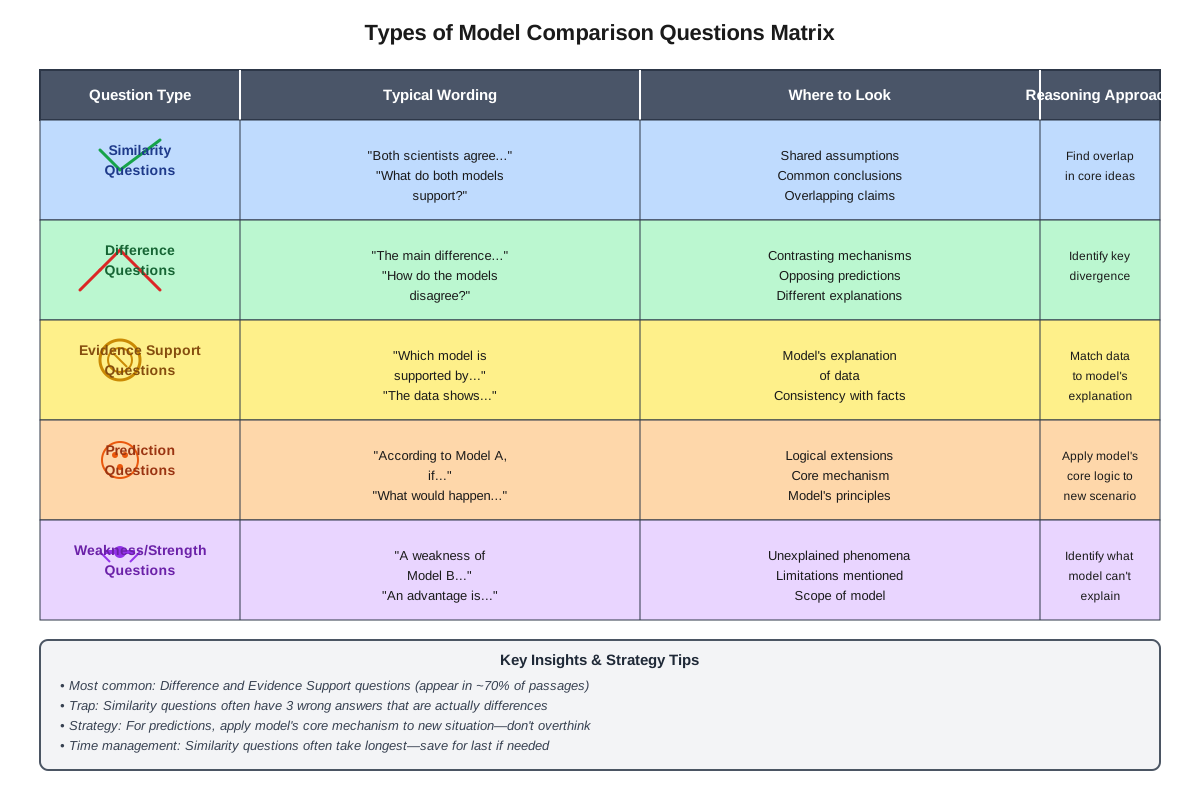
The most fundamental skill in model comparison is distinguishing what models share from what separates them. Models in ACT passages always agree on some basic facts (usually presented in the introduction) but diverge on interpretation, mechanism, or implications. Questions frequently test whether students can identify these points of convergence and divergence.
| Aspect | Similarities | Differences |
|---|---|---|
| Observations | Models typically agree on what has been observed | Models disagree on what observations mean |
| Mechanisms | May share some basic processes | Propose different causal pathways or explanations |
| Predictions | Rarely overlap in predictions | Usually make distinct, testable predictions |
| Assumptions | May share foundational assumptions | Often differ in key underlying assumptions |
For example, two models explaining dinosaur extinction might both agree that dinosaurs disappeared approximately 65 million years ago (shared observation) but disagree on whether an asteroid impact or volcanic activity caused the extinction (different mechanisms).
Evidence Evaluation
A critical component of model comparison involves determining which model is better supported by specific pieces of evidence. ACT questions often present new information and ask which scientist's viewpoint is strengthened or weakened. This requires understanding not just what each model claims but what types of evidence would support or contradict those claims.
Evidence can relate to models in several ways:
- Supporting evidence: Observations that the model predicts or explains
- Contradicting evidence: Observations inconsistent with the model's predictions
- Neutral evidence: Observations that don't clearly favor one model over another
- Distinguishing evidence: Observations that support one model while contradicting another
Students must recognize that evidence supporting Model A doesn't automatically contradict Model B unless the models make mutually exclusive predictions. Similarly, evidence contradicting Model A doesn't necessarily support Model B—both models could be incorrect.
Logical Reasoning Patterns
Each model in a Conflicting Viewpoints passage follows internal logic connecting premises to conclusions. Recognizing these reasoning patterns helps students predict what each scientist would say about new scenarios. Common logical structures include:
- Causal reasoning: If X causes Y, then when X increases, Y should increase
- Analogical reasoning: If phenomenon A works this way, similar phenomenon B likely works similarly
- Deductive reasoning: If the general principle is true, then this specific case should follow
- Inductive reasoning: Since we've observed this pattern repeatedly, it likely represents a general rule
Questions may ask students to extend a model's logic to new situations, requiring recognition of the underlying reasoning pattern rather than simple recall of stated information.
Assumptions and Limitations
Every scientific model rests on assumptions—unstated premises that must be true for the model to work. Identifying these assumptions is crucial for model comparison because models often differ primarily in their foundational assumptions rather than their surface-level claims. ACT questions sometimes ask students to identify what a scientist must be assuming or what would undermine a model's foundation.
Common types of assumptions include:
- Assumptions about time scales (processes occur quickly vs. slowly)
- Assumptions about mechanisms (one process dominates vs. multiple processes contribute)
- Assumptions about conditions (factors remain constant vs. vary)
- Assumptions about relationships (linear vs. non-linear, direct vs. indirect)
Recognizing limitations—what a model cannot explain or where it breaks down—also distinguishes sophisticated from superficial understanding.
Concept Relationships
The concepts within model comparison form an interconnected hierarchy. Understanding scientific models (the foundation) enables recognition of passage structure, which facilitates identification of key differences versus similarities. This comparative analysis then supports evidence evaluation, as students can only determine which evidence supports which model after clearly understanding what each model claims. Logical reasoning patterns and assumptions represent deeper analytical layers that build upon surface-level comparison.
The relationship flows: Model Structure → Comparative Analysis → Evidence Evaluation → Logical Extension
Model comparison connects to prerequisite reading comprehension skills by requiring students to extract main ideas and supporting details from dense text. It extends basic scientific method understanding by showing how scientists develop and test competing explanations. The topic also relates to data interpretation skills tested elsewhere in ACT Science, as students must sometimes evaluate whether data presented in tables or graphs supports one model over another.
Within the broader Conflicting Viewpoints unit, model comparison serves as the foundational skill upon which all other question types depend. Students cannot identify points of agreement, evaluate new evidence, or synthesize viewpoints without first mastering basic model comparison techniques.
Quick check — test yourself on Model comparison so far.
Try Flashcards →High-Yield Facts
⭐ Conflicting Viewpoints passages always appear exactly once per ACT Science test with 6-7 questions
⭐ The introduction paragraph contains information that ALL models agree upon—this shared foundation never appears in comparison questions
⭐ Models differ primarily in mechanisms (how/why something happens) rather than observations (what happens)
⭐ Questions asking "According to Scientist 1..." require information only from that scientist's section—don't mix viewpoints
⭐ When new evidence is presented, evaluate it against each model's predictions independently before comparing
- Models can both be partially correct or both be wrong—they aren't necessarily mutually exclusive
- The longest or most detailed model isn't automatically the correct one on the ACT
- Points of disagreement between models are more likely to be tested than points of agreement
- If a question asks what would "weaken" a model, look for evidence contradicting its core mechanism, not peripheral details
- Scientists in ACT passages never change their minds or acknowledge the other viewpoint as superior
Common Misconceptions
Misconception: The passage introduction represents one of the competing models → Correction: The introduction provides background information and shared observations that all models accept as true; the competing models appear in labeled sections after the introduction
Misconception: If evidence supports Model A, it must contradict Model B → Correction: Evidence can support one model without contradicting another unless the models make mutually exclusive predictions about that specific observation
Misconception: The "correct" model is the one that sounds most scientific or uses more technical terminology → Correction: ACT passages present models as equally valid alternatives; questions test comprehension and comparison skills, not which model is objectively true
Misconception: Students must understand all scientific details to answer questions correctly → Correction: Most questions can be answered by tracking logical relationships and comparing claims, even without deep content knowledge of the scientific topic
Misconception: Models that agree on some points must be similar overall → Correction: Models can share numerous observations or minor details while differing fundamentally on the central mechanism or explanation
Misconception: Longer, more detailed explanations indicate stronger models → Correction: Passage length reflects ACT test design, not model validity; shorter models can be equally well-supported
Misconception: Students should read all viewpoints completely before looking at questions → Correction: Strategic reading involves understanding the passage structure first, then referring back to specific sections as questions require
Worked Examples
Example 1: Identifying Model Differences
Passage Setup: Two scientists debate why certain bird species migrate long distances.
Scientist 1: Birds migrate primarily in response to temperature changes. As temperatures drop in autumn, food sources become scarce, triggering physiological changes that initiate migration. Birds return in spring when temperatures rise and food becomes abundant again. This explains why migration timing varies by latitude—birds in colder regions migrate earlier than those in warmer regions.
Scientist 2: Birds migrate primarily in response to day length (photoperiod) rather than temperature. Decreasing daylight hours in autumn trigger hormonal changes that initiate migration, while increasing daylight in spring triggers return migration. This explains why migration timing is remarkably consistent year-to-year despite temperature variations. Temperature affects food availability but doesn't directly trigger migration.
Question: The two scientists would most likely agree that:
A) Temperature directly triggers migration
B) Food availability affects bird populations
C) Day length varies by latitude
D) Migration timing is consistent year-to-year
Solution Process:
- Identify what both scientists explicitly state or would accept as true
- Scientist 1 mentions food scarcity; Scientist 2 mentions food availability
- Both acknowledge food as relevant to migration (even though they disagree on whether it triggers migration)
- Evaluate each answer:
- A: Only Scientist 1 claims this—point of disagreement
- B: Both mention food in relation to migration—potential agreement
- C: True but not discussed by either scientist
- D: Only Scientist 2 claims this—point of disagreement
Answer: B
Connection to Learning Objectives: This example demonstrates identifying when model comparison is tested (comparing explicit claims) and applying comparison strategy (finding overlap vs. divergence).
Example 2: Evaluating New Evidence
Passage Setup: (Using the same migration passage above)
Question: Researchers discover that birds kept in controlled laboratory conditions with constant temperature but varying light cycles still show migration-related physiological changes corresponding to day length changes. This finding would most strengthen the viewpoint of:
A) Scientist 1 only
B) Scientist 2 only
C) Both scientists
D) Neither scientist
Solution Process:
- Identify what the new evidence shows: Migration changes occur with day length variation even when temperature is constant
- Determine what each model predicts:
- Scientist 1's model: Temperature changes trigger migration, so constant temperature should prevent migration changes
- Scientist 2's model: Day length triggers migration, so day length changes should cause migration changes regardless of temperature
- Evaluate consistency:
- Evidence contradicts Scientist 1's prediction (migration occurs without temperature change)
- Evidence supports Scientist 2's prediction (day length alone triggers changes)
- The evidence specifically strengthens Scientist 2 by showing day length is sufficient without temperature changes
Answer: B
Connection to Learning Objectives: This example shows how to evaluate evidence against model predictions and determine which model is better supported by specific observations.
Exam Strategy
When approaching Conflicting Viewpoints passages, employ this systematic strategy:
Before Reading Questions:
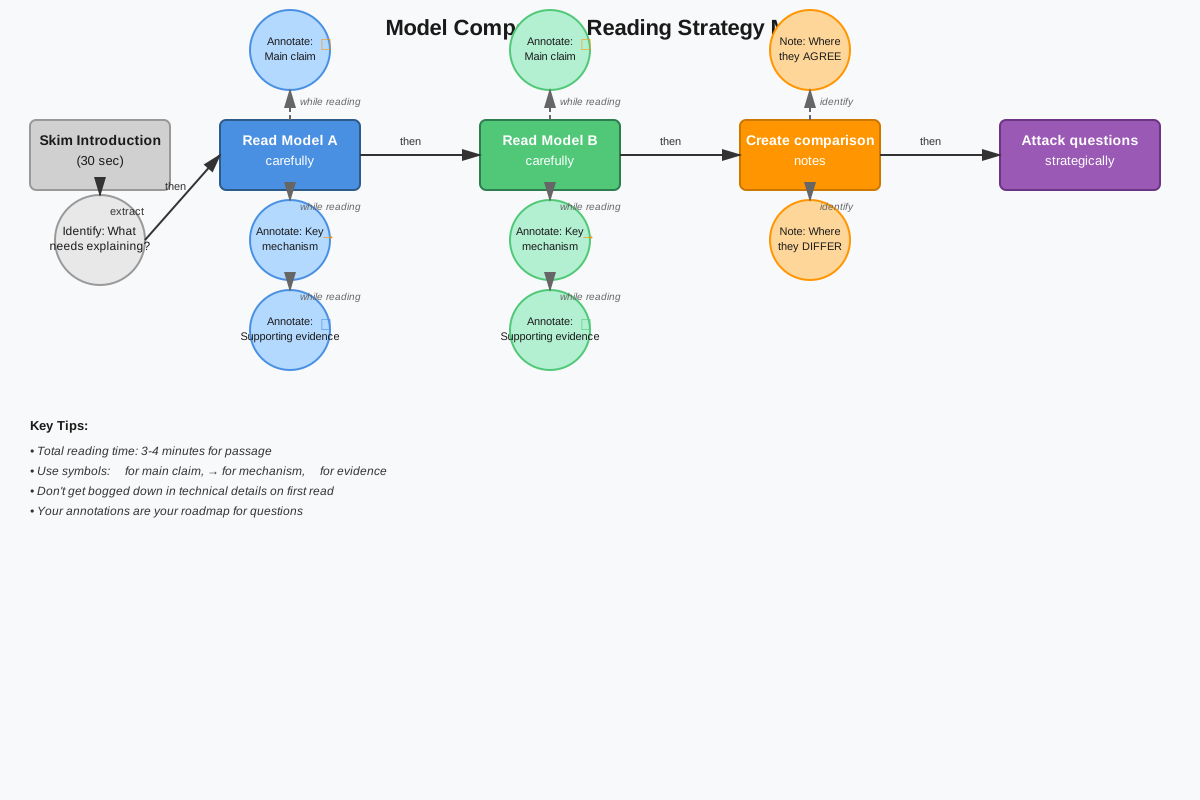
- Read the introduction carefully to identify shared background information (30-45 seconds)
- Identify how many models/viewpoints are presented (usually 2-3)
- For each viewpoint, read only the first sentence or two to grasp the main claim
- Create a mental or written note of each model's core thesis
While Answering Questions:
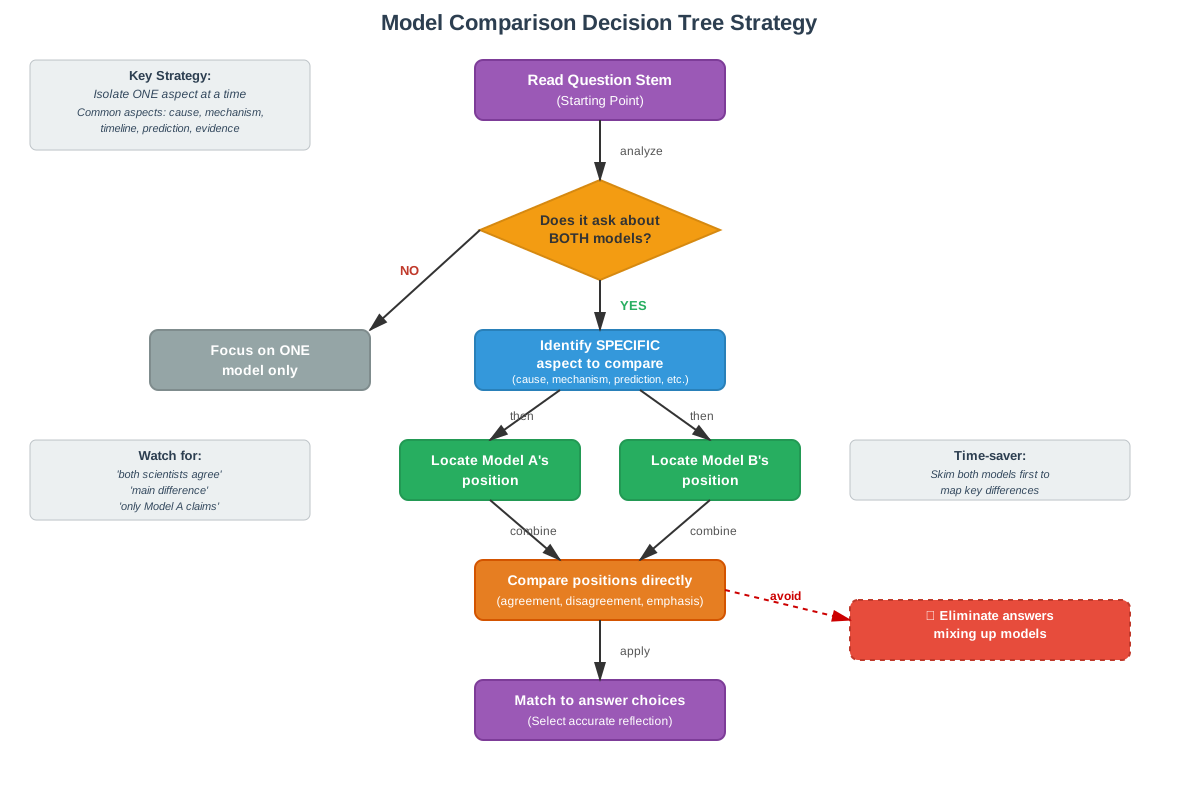
- Trigger phrases to watch for: "According to Scientist X" (requires information only from that viewpoint), "Both scientists would agree" (requires finding overlap), "differs from" or "in contrast to" (requires identifying specific differences), "would most strengthen/weaken" (requires evaluating evidence against predictions)
- Use the passage labels (Scientist 1, Scientist 2, etc.) to quickly locate relevant sections
- For comparison questions, create a quick two-column mental comparison of what each model says about the specific aspect being tested
- Eliminate answers that mix viewpoints when the question asks about a single scientist
- For evidence evaluation questions, ask: "What would this model predict?" before looking at answer choices
Process of Elimination Tips:
- Eliminate answers containing information not mentioned in the relevant viewpoint section
- Eliminate answers that confuse which scientist holds which position
- For agreement questions, eliminate anything that only one scientist explicitly states
- For disagreement questions, eliminate anything both scientists would accept
Time Allocation:
Spend approximately 6-7 minutes total on the Conflicting Viewpoints passage (similar to other passage types). Allocate 2-3 minutes for initial reading and 4-5 minutes for questions. Don't get bogged down trying to understand every scientific detail—focus on tracking claims and comparisons.
Exam Tip: If you're struggling with a complex scientific concept in the passage, remember that ACT questions test comparison skills, not content mastery. You can often answer correctly by tracking "Scientist 1 says X, Scientist 2 says Y" without fully understanding the science behind X and Y.
Memory Techniques
DICE Method for approaching each viewpoint:
- Determine the main claim (thesis)
- Identify supporting evidence
- Compare to other viewpoints
- Evaluate predictions and implications
SAME vs. DIFFERENT framework:
- Shared observations (introduction)
- Agreed-upon facts
- Mechanism differences (primary source of disagreement)
- Evidence evaluation
- Distinct predictions
- Incompatible explanations
- Fundamental assumptions
- Future implications
- Explanatory mechanisms
- Reasoning patterns
- Evidence interpretation
- New scenario responses
- Testable differences
Visualization Strategy: Picture each model as a separate building. The foundation (shared observations) is the same for all buildings, but the structures above (mechanisms, predictions) differ. Questions ask you to compare architectural features, not judge which building is "better."
The "Two Columns" Technique: For any comparison question, mentally create two columns labeled with each scientist/model. Fill in what each says about the specific topic being tested. The answer becomes clear when you can see the comparison visually.
Summary
Model comparison is the cornerstone skill for ACT Science Conflicting Viewpoints passages, requiring students to analyze, contrast, and evaluate competing scientific explanations. Success depends on recognizing passage structure (shared introduction followed by distinct viewpoints), identifying core claims versus supporting details, distinguishing points of agreement from disagreement, and evaluating how evidence relates to each model's predictions. Rather than requiring deep scientific content knowledge, these questions assess logical reasoning and comparative analysis skills. Students must track what each model claims independently, avoid mixing viewpoints, and systematically evaluate new evidence against each model's predictions. The key to mastery is recognizing that models differ primarily in mechanisms and explanations rather than basic observations, and that evidence supporting one model doesn't automatically contradict another unless they make mutually exclusive predictions. Strategic reading—focusing on main claims before details—combined with systematic comparison techniques enables efficient and accurate question answering.
Key Takeaways
- Conflicting Viewpoints passages test comparison and evaluation skills, not scientific content mastery
- The introduction contains shared information that all models accept; disagreements appear in labeled viewpoint sections
- Models primarily differ in mechanisms (how/why) rather than observations (what)
- Evaluate new evidence by determining what each model predicts, then checking consistency
- Questions asking "According to Scientist X" require information only from that scientist's section
- Points of disagreement are tested more frequently than points of agreement
- Strategic reading involves identifying main claims first, then referring to details as questions require
Related Topics
Hypothesis Testing and Experimental Design: Understanding how scientists test competing models through controlled experiments builds directly on model comparison skills. Students learn how evidence is generated to distinguish between alternative explanations.
Data Interpretation in Research Summaries: While Conflicting Viewpoints emphasizes conceptual comparison, Research Summaries passages often present data that could support multiple interpretations, requiring similar comparative evaluation skills.
Scientific Method and Theory Development: Model comparison illustrates how science progresses through competing explanations, refinement based on evidence, and eventual consensus—core aspects of scientific methodology.
Critical Reading in Natural Sciences: The analytical reading skills developed through model comparison transfer directly to college science courses where textbooks and papers present competing theories and evolving understanding.
Mastering model comparison provides the foundation for understanding scientific discourse and prepares students for the analytical thinking required in advanced science coursework.
Practice CTA
Now that you've mastered the concepts and strategies for ACT model comparison, it's time to put your knowledge into action! Complete the practice questions to reinforce your understanding and build confidence with this high-yield topic. Work through the flashcards to cement key concepts and strategies in your memory. Remember, model comparison questions offer an excellent opportunity to demonstrate your analytical thinking skills—approach them systematically, and you'll see your Science score improve. You've got this!
Sign up free to keep reading
Create a free AnvayaPrep account to finish this ACT guide on Model comparison — plus flashcards and practice questions.