Overview
In scientific research and experimentation, the ability to isolate cause-and-effect relationships depends critically on controlling all variables except the one being tested. Control variables (also called controlled variables or constants) are factors in an experiment that are deliberately kept the same across all experimental groups to ensure that any observed differences in results can be attributed solely to the independent variable being manipulated. Understanding control variables is fundamental to interpreting scientific data and evaluating experimental design—skills that are heavily tested on the ACT Science section.
The ACT Science test frequently assesses whether students can identify which variables were controlled in an experiment, recognize when proper controls are missing, and understand why controlling certain variables is essential for drawing valid conclusions. Questions about ACT control variables appear across all passage types—Data Representation, Research Summaries, and Conflicting Viewpoints—making this concept one of the highest-yield topics for exam preparation. Students who master control variables gain a significant advantage because these questions often serve as "giveaway" points when approached systematically.
Control variables form the foundation of the scientific method and connect directly to other critical Science concepts including independent variables, dependent variables, experimental design, and data validity. Without proper control of variables, experiments cannot establish causation, only correlation. This topic bridges the gap between understanding individual data points and evaluating the quality and reliability of entire experimental procedures—a skill that distinguishes high-scoring students from average performers on the ACT.
Learning Objectives
- [ ] Identify when Control variables is being tested in ACT Science passages
- [ ] Explain the core rule or strategy behind Control variables in experimental design
- [ ] Apply Control variables concepts to ACT-style questions accurately
- [ ] Distinguish between independent variables, dependent variables, and control variables in any experimental setup
- [ ] Evaluate whether an experiment has adequate controls to support its conclusions
- [ ] Predict how changing a control variable would affect experimental validity
- [ ] Recognize common ACT question stems that test control variable understanding
Prerequisites
- Basic understanding of variables: Students must know that variables are factors that can change or be changed in an experiment; this knowledge allows recognition of which factors need controlling
- Familiarity with experimental structure: Understanding that experiments typically have a setup, procedure, and results section helps locate where control variables are described
- Reading comprehension of scientific passages: The ability to extract key information from dense scientific text is necessary to identify what was kept constant
- Basic data interpretation: Recognizing patterns in tables and graphs helps students see when uncontrolled variables might be affecting results
Why This Topic Matters
Control variables represent one of the most practical applications of scientific thinking in everyday life. From evaluating medical studies to understanding product testing claims, the ability to identify what was and wasn't controlled determines whether conclusions are trustworthy. In pharmaceutical research, for example, control variables like patient age, dosage timing, and environmental conditions must remain constant to determine if a drug truly works. In agricultural studies, soil type, water amount, and sunlight exposure must be controlled to assess fertilizer effectiveness.
On the ACT Science test, control variable questions appear in approximately 15-20% of all Science passages, making them one of the most frequently tested concepts. These questions typically appear as direct identification questions ("Which variable was held constant?"), comparison questions ("What was the same in both experiments?"), or evaluation questions ("What should have been controlled?"). The ACT particularly favors testing control variables in Research Summary passages, where multiple experiments or trials are described, but they also appear regularly in Data Representation passages when comparing different data sets.
Common ACT question formats include: asking students to identify which factor was kept the same across trials; determining what additional variable should have been controlled; recognizing which variable's lack of control invalidates a conclusion; and comparing two experiments to find their controlled variables. The test writers often include distractors that list the independent or dependent variables, testing whether students can distinguish between what changes and what stays constant. Because these questions are highly formulaic, students who understand the underlying principles can answer them quickly and accurately, saving time for more complex questions.
Core Concepts
Definition and Purpose of Control Variables
Control variables are all the factors in an experiment that researchers intentionally keep constant across all experimental groups or trials. Unlike the independent variable (which the experimenter deliberately changes) or the dependent variable (which changes in response), control variables must remain unchanged to ensure that any observed effects on the dependent variable are caused solely by changes in the independent variable, not by other factors.
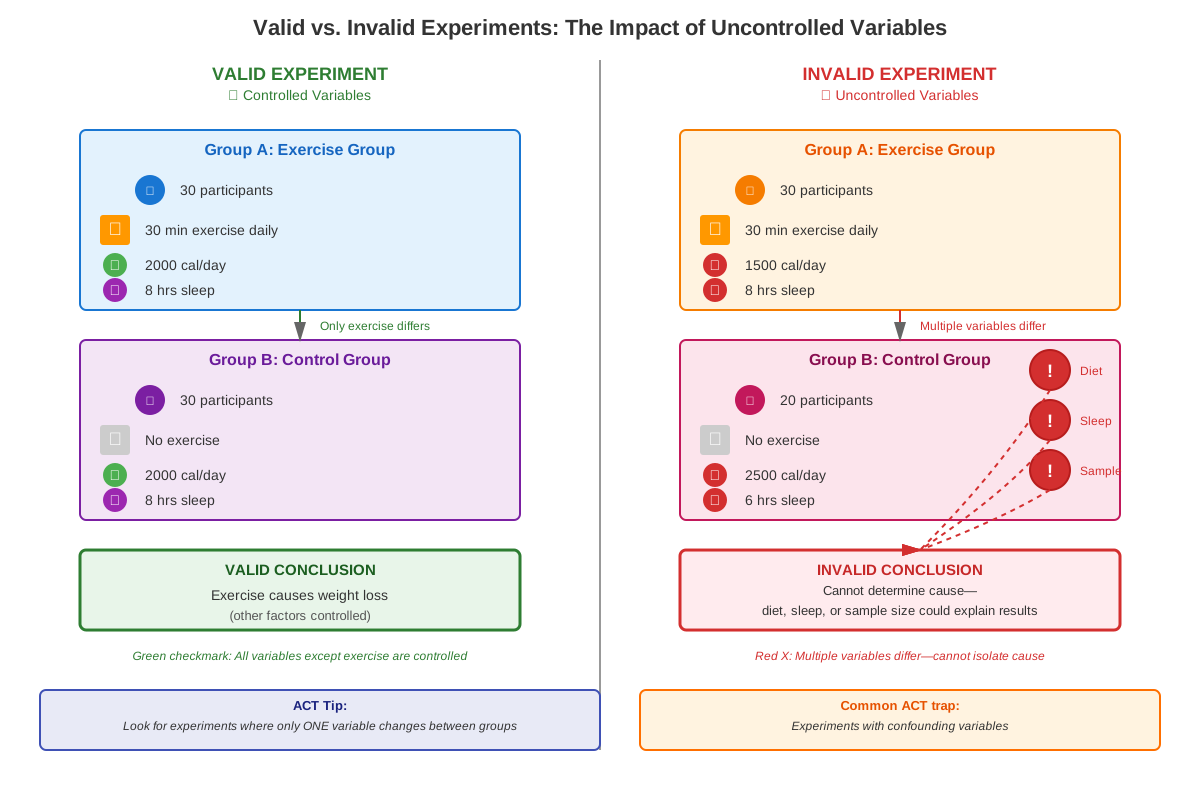
The primary purpose of controlling variables is to establish a fair test—a comparison where only one factor differs at a time. Without proper controls, experiments suffer from confounding variables (uncontrolled factors that could influence results), making it impossible to determine true cause-and-effect relationships. For example, if testing whether fertilizer type affects plant growth, but some plants receive more sunlight than others, the sunlight becomes a confounding variable that invalidates the results.
Identifying Control Variables in Experiments
Control variables can be identified by asking: "What factors could potentially affect the outcome but are being kept the same?" In ACT passages, control variables are typically mentioned in the experimental procedure or methods section, often with phrases like "all plants received," "each trial used," "maintained at," or "kept constant at."
Common categories of control variables include:
- Environmental conditions: temperature, humidity, pressure, light intensity
- Material properties: concentration, volume, mass, purity, source
- Timing factors: duration of exposure, time of day, frequency of measurement
- Subject characteristics: age, size, species, health status
- Equipment and methods: measuring instruments, preparation techniques, observation methods
The Relationship Between Variable Types
Understanding how control variables relate to other variable types is essential for ACT success:
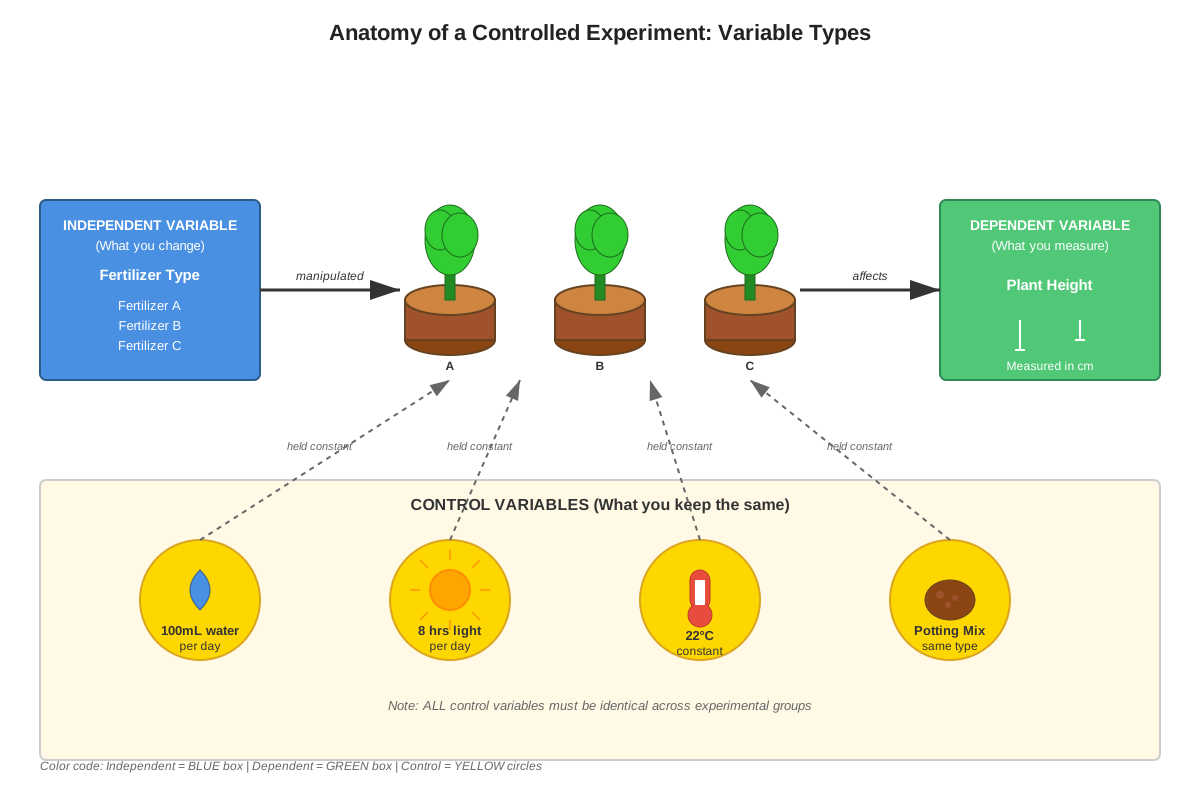
| Variable Type | Definition | Role in Experiment | Example (Plant Growth Study) |
|---|---|---|---|
| Independent Variable | Factor deliberately changed by experimenter | Cause being tested | Type of fertilizer |
| Dependent Variable | Factor measured as outcome | Effect being observed | Plant height after 4 weeks |
| Control Variables | Factors kept constant | Ensure fair comparison | Water amount, sunlight, temperature, soil type, pot size |
The relationship flows as: Independent Variable → affects → Dependent Variable, while Control Variables → remain constant → to isolate this relationship.
Multiple Trials and Control Variables
When experiments include multiple trials or groups, control variables must remain consistent across all of them. The ACT frequently tests this by presenting experiments with several trials and asking what was the same in all trials. Students must recognize that:
- Each trial may have a different value for the independent variable
- Each trial will likely show different results for the dependent variable
- All trials must share the same control variables for valid comparison
For example, if Experiment 1 tests fertilizer at 20°C and Experiment 2 tests fertilizer at 30°C, temperature is NOT a control variable—it's a second independent variable, creating a more complex experimental design.
Control Groups vs. Control Variables
Students often confuse control groups with control variables, but they serve different purposes:
- A control group is a baseline group that receives no treatment or a standard treatment, used for comparison
- Control variables are factors kept constant across ALL groups, including the control group
In a drug study, the control group receives a placebo, while control variables include factors like dosage timing, patient diet, and measurement methods—kept the same for both the control group and experimental groups.
Evaluating Experimental Design
ACT questions often ask students to evaluate whether an experiment was properly designed. Key evaluation criteria include:
- Sufficient controls: Were all relevant variables that could affect the outcome controlled?
- Appropriate controls: Were the right variables chosen to be controlled?
- Consistent controls: Were control variables maintained at the same level throughout?
- Documented controls: Is it clear from the description what was controlled?
An experiment with inadequate controls cannot support strong conclusions, even if the data appears convincing. The ACT tests whether students recognize this limitation.
Concept Relationships
Control variables exist within a hierarchical relationship of experimental design concepts. At the foundation level, understanding variables as changeable factors enables recognition of control variables as the subset that must remain unchanged. This understanding directly supports the ability to identify independent variables (what changes) and dependent variables (what's measured), creating a complete picture of experimental structure.
The relationship flows: Scientific Question → Hypothesis → Experimental Design → Variable Identification (Independent, Dependent, Control) → Data Collection → Valid Conclusions. Control variables serve as the critical link that allows the chain to progress from data collection to valid conclusions. Without proper controls, the chain breaks, and conclusions become unreliable.
Control variables connect to data interpretation because recognizing what was controlled helps explain patterns in data tables and graphs. If two data sets show different trends, checking whether control variables were the same determines if the comparison is valid. This concept also relates to experimental validity—experiments with proper controls have high internal validity (accurate cause-effect relationships), while those with poor controls suffer from confounding variables.
The concept extends to comparative analysis in Conflicting Viewpoints passages, where different scientists may disagree about which variables should be controlled or whether controls were adequate. Understanding control variables enables students to evaluate the strength of each scientist's argument based on experimental design quality.
High-Yield Facts
⭐ Control variables are factors deliberately kept constant across all experimental groups or trials to ensure fair comparison
⭐ The independent variable is changed by the experimenter; the dependent variable is measured as the outcome; control variables remain unchanged
⭐ Common control variables include temperature, time, concentration, volume, mass, and environmental conditions
⭐ If a factor that could affect results is not controlled, it becomes a confounding variable that invalidates conclusions
⭐ ACT questions often ask "What was kept the same in all trials?" or "Which factor was held constant?"
- Control variables appear in the methods/procedure section of experimental descriptions, often with phrases like "maintained at" or "each received"
- Multiple experiments can be compared only if they share the same control variables
- The more control variables properly maintained, the more reliable the experimental conclusions
- Lack of adequate controls is a valid criticism of experimental design on the ACT
- Control groups (baseline groups) and control variables (constant factors) are different concepts that both contribute to experimental validity
Quick check — test yourself on Control variables so far.
Try Flashcards →Common Misconceptions
Misconception: The control variable is the same as the control group → Correction: A control group is a baseline comparison group that receives no treatment, while control variables are factors kept constant across ALL groups including the control group. An experiment can have control variables without having a control group.
Misconception: The independent variable can also be a control variable → Correction: By definition, the independent variable is what the experimenter changes, so it cannot simultaneously be controlled (kept constant). These are mutually exclusive categories. What changes cannot be what stays the same.
Misconception: Only one or two factors need to be controlled in an experiment → Correction: ALL factors that could potentially affect the dependent variable must be controlled except the independent variable. Experiments typically have many control variables—often 5-10 or more—to ensure validity.
Misconception: If something isn't mentioned in the passage, it wasn't controlled → Correction: ACT passages often don't explicitly list every control variable due to space constraints. Students must use scientific reasoning to infer what would logically need to be controlled, though questions typically focus on explicitly stated controls.
Misconception: Control variables are less important than independent and dependent variables → Correction: Control variables are equally critical to experimental design. Without proper controls, the relationship between independent and dependent variables cannot be reliably determined, making the entire experiment invalid regardless of how well the other variables are chosen.
Worked Examples
Example 1: Identifying Control Variables in a Plant Growth Experiment
Passage Summary: A scientist conducted an experiment to test whether different wavelengths of light affect tomato plant growth. She placed 20 tomato seedlings of the same age and size into identical pots with the same soil mixture. She divided them into four groups of 5 plants each. Group 1 received red light, Group 2 received blue light, Group 3 received green light, and Group 4 received white light. All groups were exposed to light for 12 hours per day at the same intensity. Each plant received 100 mL of water daily. After 30 days, she measured the height of each plant.
Question: Which of the following was a control variable in this experiment?
- A) Wavelength of light
- B) Plant height after 30 days
- C) Amount of water given daily
- D) Number of groups tested
Solution Process:
Step 1: Identify the independent variable (what the experimenter changed)
- The scientist deliberately changed the wavelength of light across groups
- Therefore, wavelength is the independent variable, not a control variable
- Eliminate choice A
Step 2: Identify the dependent variable (what was measured as the outcome)
- Plant height after 30 days was measured as the result
- This is the dependent variable, not a control variable
- Eliminate choice B
Step 3: Identify what was kept constant across all groups
- Amount of water: "Each plant received 100 mL of water daily" (same for all)
- Duration of light exposure: "12 hours per day" (same for all)
- Light intensity: "at the same intensity" (same for all)
- Soil type: "same soil mixture" (same for all)
- Plant age and size: "same age and size" (same for all)
- Pot type: "identical pots" (same for all)
Step 4: Evaluate remaining choices
- Choice C (amount of water) was explicitly kept constant at 100 mL daily
- Choice D (number of groups) is not a variable that affects plant growth; it's an experimental design choice
Answer: C
Connection to Learning Objectives: This example demonstrates how to identify control variables by distinguishing them from independent variables (what changes) and dependent variables (what's measured), then recognizing what was kept constant.
Example 2: Evaluating Experimental Design for Adequate Controls
Passage Summary: Two students investigated whether caffeine affects reaction time. Student 1 tested 10 participants in the morning, giving 5 of them caffeinated coffee and 5 decaffeinated coffee, then measuring their reaction time on a computer test. Student 2 tested 10 different participants in the afternoon, giving 5 of them caffeinated soda and 5 water, then measuring their reaction time on the same computer test.
Question: Which of the following represents a problem with comparing the results of Student 1 and Student 2?
- A) They used different numbers of participants
- B) They tested at different times of day
- C) They measured the same dependent variable
- D) They both included a control group
Solution Process:
Step 1: Identify what should be controlled when comparing two experiments
- For valid comparison, both experiments should have the same control variables
- Any difference in conditions could affect results and prevent valid comparison
Step 2: Analyze what was the same between experiments
- Both tested 10 participants (same sample size)
- Both used 5 participants per group (same group size)
- Both measured reaction time (same dependent variable)
- Both included a no-caffeine control group
Step 3: Analyze what was different between experiments
- Student 1 tested in the morning; Student 2 tested in the afternoon
- Time of day affects reaction time (people are more alert at different times)
- This is an uncontrolled variable that could confound results
- Student 1 used coffee; Student 2 used soda (different caffeine delivery methods)
- This is another uncontrolled variable
Step 4: Evaluate answer choices
- Choice A: Same number of participants (10 each), so this is NOT a problem
- Choice B: Different times of day is an uncontrolled variable that affects reaction time—this IS a problem
- Choice C: Measuring the same dependent variable is necessary for comparison, not a problem
- Choice D: Both having control groups strengthens the design, not a problem
Answer: B
Connection to Learning Objectives: This example shows how to evaluate experimental design by identifying when control variables are inadequate, recognizing that uncontrolled variables (like time of day) prevent valid comparison between experiments.
Exam Strategy
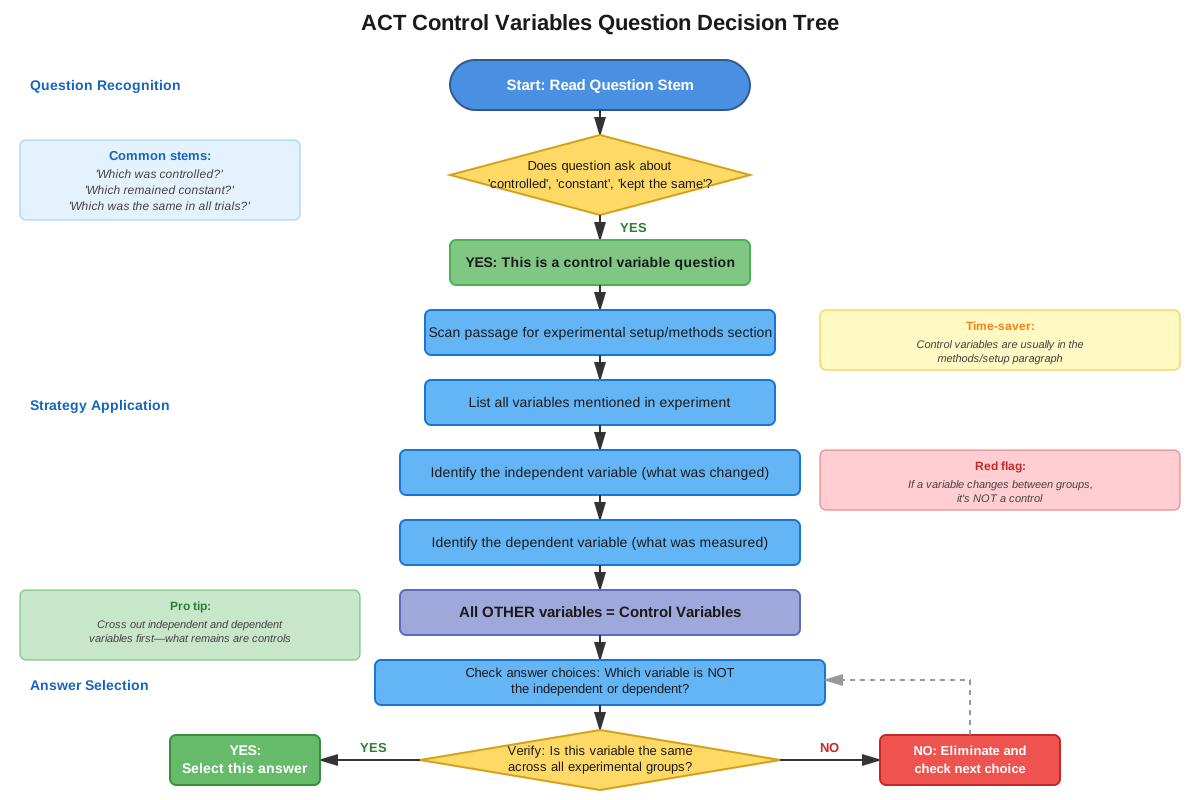
When approaching ACT Science questions about control variables, follow this systematic process:
Step 1: Identify the question type
Look for trigger phrases that signal control variable questions:
- "Which was held constant?"
- "What was the same in all trials?"
- "Which factor was controlled?"
- "What did NOT vary between experiments?"
- "Which remained unchanged?"
Step 2: Locate the methods section
Control variables are almost always described in the experimental procedure or methods section, typically in the first paragraph of Research Summary passages. Scan for phrases like "all received," "each was given," "maintained at," "kept at," or "identical."
Step 3: Eliminate wrong answer types
Use process of elimination by recognizing what control variables are NOT:
- NOT the independent variable (what the experimenter changed)
- NOT the dependent variable (what was measured as results)
- NOT the hypothesis or conclusion
- NOT the number of trials or groups (these are design choices, not variables)
Step 4: Verify constancy across all groups
The correct answer must be something that was the same for ALL experimental groups or trials. If it varied between any groups, it's not a control variable. Check each answer choice against all trials mentioned.
Exam Tip: When stuck between two answers, ask "Could this factor affect the outcome?" If yes, and it was kept the same, it's likely a control variable. If no (like the number of groups), it's probably not the answer.
Time allocation: Control variable questions are typically quick-answer questions that should take 20-30 seconds once you've read the passage. Don't overthink them—the answer is usually explicitly stated in the passage. If you find yourself spending more than 45 seconds, mark it and return later.
Common trap answers: The ACT frequently includes the independent variable as a distractor because students confuse "the variable being tested" with "control variables." Always eliminate what was deliberately changed first.
Memory Techniques
Mnemonic for Variable Types: "I Do Control"
- I = Independent variable (what I change)
- Do = Dependent variable (what Does change in response)
- Control = Control variables (what I Control to keep constant)
Visualization Strategy: The Fair Race Analogy
Imagine an experiment as a race where you want to test if different shoes (independent variable) affect running speed (dependent variable). For a fair race, you must control: same track, same distance, same weather, same starting time, same runners' training level. If the track is different for each runner, you can't tell if shoe type or track type affected speed. This mental image helps remember that control variables create "fair" comparisons.
Acronym for Common Control Variables: "TEMP-VCE"
- Temperature
- Environment (light, humidity, pressure)
- Mass/amount
- Procedure/method
- Volume
- Concentration
- Equipment used
The "Same Game" Technique
When reading an ACT passage, play the "same game"—circle or mentally note every time the passage says "same," "identical," "each," or "all." These words almost always indicate control variables. This active reading strategy helps you quickly locate control variables when questions ask about them.
Summary
Control variables are factors deliberately kept constant throughout an experiment to ensure that observed changes in the dependent variable result solely from manipulations of the independent variable, not from other influences. Mastering control variables requires understanding three distinct variable types: independent (what's changed), dependent (what's measured), and control (what's kept constant). On the ACT Science test, control variable questions appear frequently across all passage types, typically asking students to identify what was held constant, evaluate whether controls were adequate, or recognize how uncontrolled variables affect validity. Success requires systematic reading of experimental procedures to locate explicitly stated controls, understanding that multiple factors must be controlled simultaneously, and distinguishing control variables from control groups. The ability to quickly identify control variables not only provides easy points on direct identification questions but also enables deeper evaluation of experimental design quality and data interpretation validity—skills that elevate performance across the entire Science section.
Key Takeaways
- Control variables are factors kept constant across all experimental groups to ensure fair comparison and valid cause-effect conclusions
- The three variable types serve distinct roles: independent (changed by experimenter), dependent (measured outcome), control (kept constant)
- ACT questions test control variables through identification questions, comparison questions, and experimental design evaluation questions
- Common control variables include temperature, time, concentration, volume, mass, environmental conditions, and procedural methods
- Uncontrolled variables that could affect results become confounding variables that invalidate experimental conclusions
- Control variables are typically described in the methods section with phrases like "maintained at," "each received," or "kept constant"
- Distinguishing control variables from independent/dependent variables and from control groups is essential for ACT success
Related Topics
Independent and Dependent Variables: Understanding how to identify what the experimenter manipulates (independent) and what they measure (dependent) complements control variable knowledge, completing the picture of experimental structure. Mastering control variables makes identifying these other variable types easier through process of elimination.
Experimental Design and Scientific Method: Control variables are one component of broader experimental design principles including hypothesis formation, sample size, replication, and randomization. Strong control variable understanding provides the foundation for evaluating overall experimental quality.
Confounding Variables and Validity: When control variables are inadequate, confounding variables emerge that threaten experimental validity. This advanced topic builds directly on control variable concepts to explain why some experiments produce unreliable results.
Data Interpretation and Graph Analysis: Recognizing which variables were controlled helps explain patterns in data tables and graphs, particularly when comparing multiple data sets or identifying anomalous results that might indicate control failures.
Conflicting Viewpoints Analysis: In passages where scientists disagree, arguments often center on whether adequate controls were used or which variables should have been controlled, making control variable mastery essential for evaluating competing scientific claims.
Practice CTA
Now that you've mastered the fundamentals of control variables, it's time to cement your understanding through active practice. The concepts you've learned—identifying what's kept constant, distinguishing variable types, and evaluating experimental design—become automatic only through repeated application to real ACT-style questions. Challenge yourself with the practice questions and flashcards designed specifically for this topic. Each question you work through strengthens your pattern recognition and speeds up your response time, transforming control variables from a concept you understand into points you consistently earn on test day. Remember: control variable questions are among the most predictable and high-yield on the ACT Science section—master them, and you've secured a reliable source of quick points that boost your overall score!
Sign up free to keep reading
Create a free AnvayaPrep account to finish this ACT guide on Control variables — plus flashcards and practice questions.