Overview
Direct relationships represent one of the most fundamental and frequently tested concepts in the ACT Science section, particularly within Data Representation passages. A direct relationship exists when two variables change in the same direction: as one variable increases, the other also increases, or as one decreases, the other decreases proportionally. This concept forms the backbone of data interpretation skills that students must master to excel on the ACT Science test.
Understanding ACT direct relationships is essential because approximately 30-40% of Data Representation questions require students to identify, interpret, or predict outcomes based on direct relationships between variables. These questions appear across all scientific disciplines tested on the ACT—biology, chemistry, physics, and Earth/space sciences. Students who can quickly recognize direct relationships in graphs, tables, and experimental descriptions gain a significant advantage in both accuracy and time management during the exam.
Direct relationships connect to broader scientific reasoning skills including pattern recognition, data analysis, and predictive modeling. They serve as the foundation for understanding more complex relationships such as inverse relationships, exponential growth, and multivariate interactions. Mastery of direct relationships enables students to approach ACT Science passages with confidence, knowing they can extract meaningful conclusions from data presentations regardless of the specific scientific content being tested.
Learning Objectives
- [ ] Identify when Direct relationships is being tested in ACT Science passages
- [ ] Explain the core rule or strategy behind Direct relationships
- [ ] Apply Direct relationships to ACT-style questions accurately
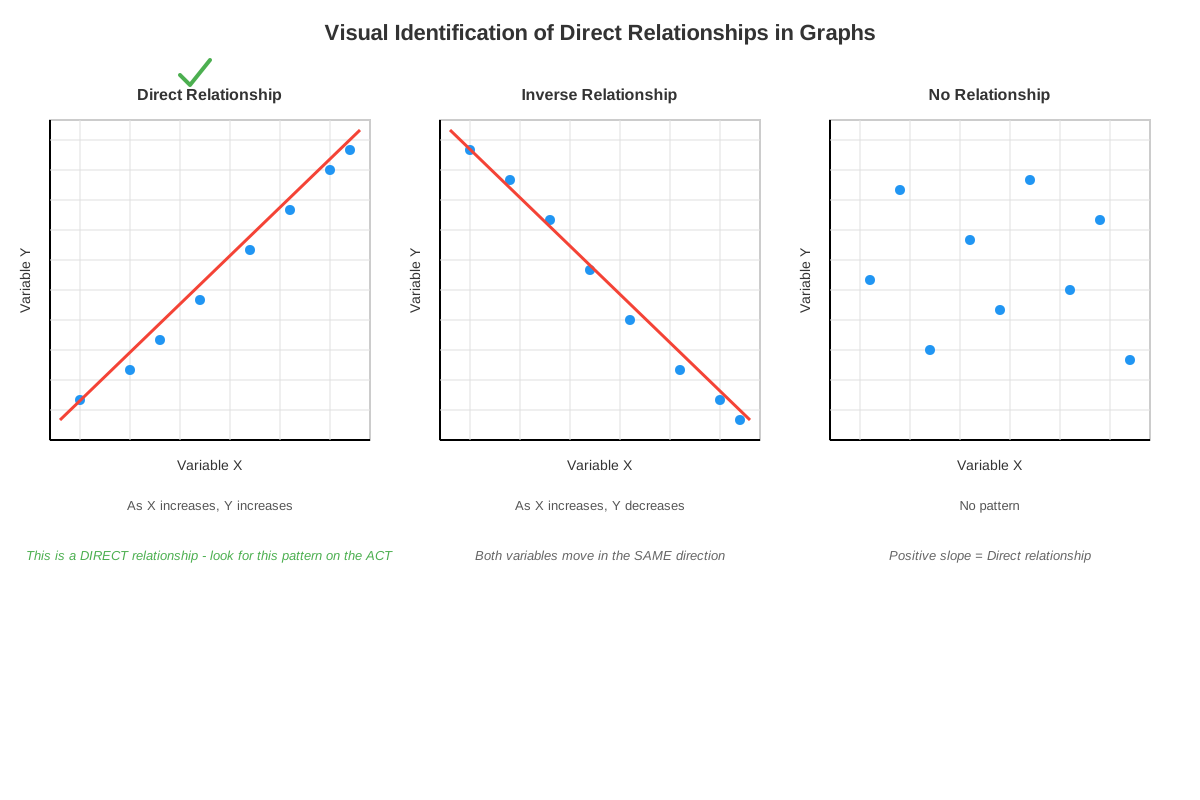
- [ ] Distinguish between direct relationships and other relationship types (inverse, no relationship) in graphical data
- [ ] Predict values of dependent variables based on direct relationship patterns
- [ ] Interpret the strength of direct relationships from scatter plots and line graphs
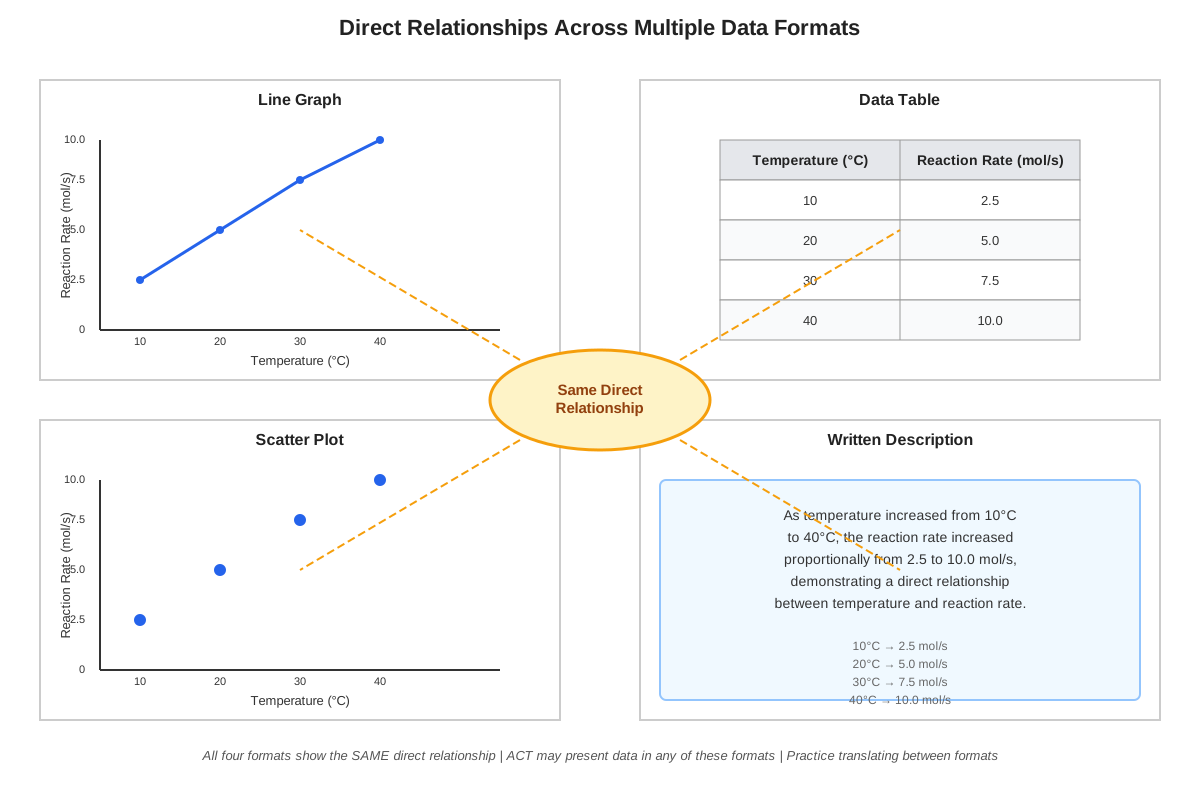
- [ ] Translate direct relationships between different data representation formats (graphs to tables, descriptions to graphs)
Prerequisites
- Basic graph reading skills: Understanding x-axis and y-axis orientation is essential for identifying how variables change relative to each other
- Variable identification: Recognizing independent and dependent variables allows students to determine which variable is being manipulated and which responds
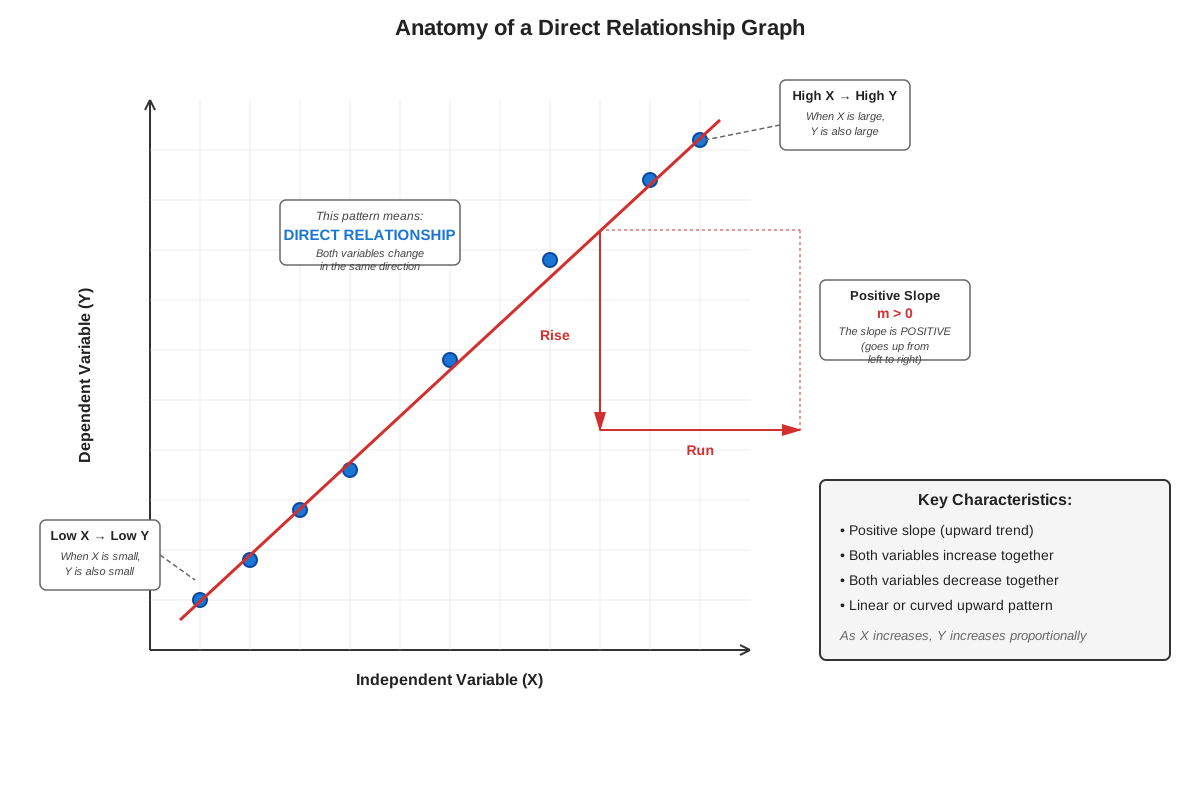
- Slope concept: Familiarity with positive slope helps students visualize the upward trend characteristic of direct relationships
- Data table interpretation: Reading rows and columns systematically enables extraction of numerical patterns that reveal relationships
Why This Topic Matters
Direct relationships appear in countless real-world scenarios that make them both practically relevant and academically important. Scientists use direct relationships to understand phenomena such as the relationship between temperature and molecular motion, the connection between exercise duration and calories burned, or the correlation between fertilizer amount and crop yield. Medical researchers rely on identifying direct relationships to establish connections between dosage and therapeutic effect, while environmental scientists track direct relationships between carbon emissions and atmospheric CO₂ concentrations.
On the ACT Science test, direct relationships appear in approximately 4-6 questions per exam, making them one of the highest-yield topics for focused study. These questions typically appear in Data Representation passages (which constitute 30-40% of the Science section) but also emerge in Research Summaries passages when students must interpret experimental results. The ACT tests direct relationships through multiple question formats: identifying trends from graphs, predicting values beyond the data range (extrapolation), comparing multiple data sets, and selecting graphs that match described relationships.
Common ACT passage presentations include line graphs showing positive slopes, scatter plots with upward trends, data tables with parallel increases in column values, and written descriptions of experimental observations. Students encounter direct relationships when analyzing how plant growth responds to sunlight exposure, how reaction rates change with temperature increases, how distance traveled relates to time elapsed, or how population size correlates with resource availability. The ability to quickly recognize these patterns separates high-scoring students from those who struggle with time management and accuracy.
Core Concepts
Definition of Direct Relationships
A direct relationship (also called a positive relationship or positive correlation) exists between two variables when they change in the same direction at a consistent or predictable rate. Mathematically, this means that as the independent variable (x) increases, the dependent variable (y) also increases, and as x decreases, y also decreases. The relationship can be linear (forming a straight line) or nonlinear (forming a curve), but the defining characteristic remains the same-direction change.
The simplest form of a direct relationship follows the equation y = kx, where k is a positive constant representing the rate of change. However, ACT Science passages present direct relationships in various forms, including y = mx + b (linear with y-intercept), exponential growth patterns, and logarithmic relationships. Students need not calculate exact equations but must recognize the consistent same-direction pattern.
Visual Identification in Graphs
Line graphs and scatter plots provide the clearest visual representation of direct relationships. On a standard Cartesian coordinate system, a direct relationship appears as data points or a line that moves upward from left to right, creating a positive slope. The steepness of this slope indicates the strength of the relationship: steeper slopes represent stronger direct relationships where small changes in the independent variable produce large changes in the dependent variable.
Key visual markers include:
- Upward trending lines or curves
- Data points clustering along an upward path
- Consistent spacing between data points moving diagonally upward
- No downward segments or reversals in direction
Students should practice scanning graphs quickly to identify the overall trend direction before reading specific values. This skill saves valuable time during the exam and prevents errors caused by focusing on minor fluctuations rather than overall patterns.
Recognition in Data Tables
Data tables present direct relationships through parallel changes in numerical values. When examining a table, students should compare how values in different columns or rows change together. A direct relationship exists when:
| Independent Variable | Dependent Variable |
|---|---|
| 10 | 25 |
| 20 | 50 |
| 30 | 75 |
| 40 | 100 |
In this example, as the independent variable doubles from 10 to 20, the dependent variable also doubles from 25 to 50. This proportional increase continues throughout the table, confirming a direct relationship. Students should look for consistent patterns: if one column increases while another also increases, a direct relationship likely exists.
Strength and Consistency
Not all direct relationships demonstrate the same strength or consistency. Strong direct relationships show tight clustering of data points around a trend line with minimal scatter, indicating that the relationship is highly predictable. Weak direct relationships display more scatter, with data points spread widely around the general upward trend, suggesting other variables may also influence the dependent variable.
The ACT frequently tests students' ability to distinguish between strong and weak relationships by presenting multiple graphs and asking which shows the strongest correlation. Students should evaluate:
- How closely data points follow a single line or curve
- The amount of vertical spread at any given x-value
- Whether outliers significantly deviate from the trend
- The consistency of the rate of change across the data range
Direct Relationships vs. Other Patterns
Understanding what direct relationships are NOT helps students avoid common errors. An inverse relationship shows opposite-direction changes (one variable increases while the other decreases), appearing as a downward-sloping line. No relationship (zero correlation) appears as randomly scattered points with no discernible pattern or as a horizontal line indicating the dependent variable doesn't change regardless of the independent variable.
| Relationship Type | Visual Pattern | Example |
|---|---|---|
| Direct | Upward slope | Temperature vs. molecular speed |
| Inverse | Downward slope | Altitude vs. air pressure |
| No relationship | Horizontal or random scatter | Shoe size vs. test scores |
Extrapolation and Prediction
Once a direct relationship is established, students can predict values beyond the measured data range through extrapolation. If a graph shows that variable Y equals 10 when X equals 5, and Y equals 20 when X equals 10, the direct relationship suggests Y would equal 30 when X equals 15 (assuming the relationship continues linearly). The ACT frequently asks students to identify what would happen if an experiment continued beyond the measured range or what value would occur at an unmeasured point.
Caution is necessary with extrapolation because relationships may change outside the measured range. However, for ACT purposes, students should assume established patterns continue unless the passage explicitly states otherwise or the question asks about limitations of the data.
Concept Relationships
Direct relationships serve as the foundation for understanding all types of variable interactions in scientific data. The concept connects directly to slope analysis, as the positive slope of a line graph mathematically represents a direct relationship. This connection extends to rate of change concepts, where the steepness of the relationship indicates how rapidly the dependent variable responds to changes in the independent variable.
The relationship map flows as follows:
Variable Identification → Data Collection → Pattern Recognition → Relationship Classification (Direct, Inverse, or None) → Prediction and Application
Direct relationships contrast with inverse relationships, and understanding both types simultaneously strengthens pattern recognition skills. When students can quickly distinguish between these opposite patterns, they can eliminate incorrect answer choices more efficiently. Additionally, direct relationships often appear alongside control variables in experimental design, as scientists manipulate one variable while holding others constant to isolate direct effects.
More complex concepts build upon direct relationships, including multivariate analysis (where multiple direct relationships exist simultaneously), threshold effects (where direct relationships only occur within certain ranges), and correlation versus causation (understanding that direct relationships don't necessarily prove one variable causes changes in another). Mastering basic direct relationships enables students to tackle these advanced concepts with confidence.
Quick check — test yourself on Direct relationships so far.
Try Flashcards →High-Yield Facts
⭐ A direct relationship means both variables change in the SAME direction—both increase together or both decrease together
⭐ On graphs, direct relationships appear as upward-sloping lines or curves moving from left to right
⭐ In data tables, direct relationships show parallel increases or decreases in column/row values
⭐ The steeper the upward slope, the stronger the direct relationship between variables
⭐ Direct relationships allow prediction of values beyond the measured data range through extrapolation
- Direct relationships can be linear (straight line) or nonlinear (curved) as long as the same-direction pattern continues
- Scatter plots with tight clustering around an upward trend indicate strong direct relationships
- Multiple direct relationships can exist simultaneously in complex experiments with several variables
- The ACT never requires calculating exact equations; pattern recognition is sufficient
- Direct relationships appear most frequently in Data Representation passages but also occur in Research Summaries
- Temperature-dependent phenomena often demonstrate direct relationships (higher temperature → faster reactions)
- Time-series data frequently shows direct relationships (more time → more distance, growth, or accumulation)
Common Misconceptions
Misconception: A direct relationship must form a perfectly straight line → Correction: Direct relationships can be curved or nonlinear as long as both variables consistently change in the same direction. Exponential growth curves and logarithmic patterns are still direct relationships.
Misconception: If data points don't fall exactly on a line, no direct relationship exists → Correction: Real experimental data always contains some scatter due to measurement error and uncontrolled variables. A general upward trend with scattered points still indicates a direct relationship, just a weaker one.
Misconception: Direct relationships prove causation → Correction: Correlation does not equal causation. Two variables can show a direct relationship without one causing the other; both might be influenced by a third variable, or the relationship might be coincidental.
Misconception: All positive numbers indicate a direct relationship → Correction: The sign of the numbers doesn't determine the relationship type; the pattern of change does. Both variables could have negative values and still show a direct relationship if they increase or decrease together.
Misconception: Direct relationships must have a constant rate of change → Correction: While linear direct relationships have constant rates of change, many direct relationships accelerate or decelerate. The key is same-direction change, not constant rate.
Misconception: A horizontal line shows a direct relationship because it's not going down → Correction: A horizontal line indicates NO relationship because the dependent variable doesn't change regardless of the independent variable. Direct relationships require both variables to change.
Worked Examples
Example 1: Graph Interpretation
Question: A scientist measured the growth of bacteria colonies at different temperatures. The graph below shows the results (described): At 10°C, colony diameter is 2mm; at 20°C, diameter is 5mm; at 30°C, diameter is 8mm; at 40°C, diameter is 11mm. What type of relationship exists between temperature and colony diameter?
Solution Process:
Step 1: Identify the variables
- Independent variable: Temperature (°C)
- Dependent variable: Colony diameter (mm)
Step 2: Examine the pattern of change
- From 10°C to 20°C: temperature increases by 10°C, diameter increases by 3mm
- From 20°C to 30°C: temperature increases by 10°C, diameter increases by 3mm
- From 30°C to 40°C: temperature increases by 10°C, diameter increases by 3mm
Step 3: Classify the relationship
- Both variables increase together consistently
- The pattern shows same-direction change
- This is a direct relationship
Step 4: Verify with prediction
- If the pattern continues, at 50°C the diameter should be approximately 14mm (11 + 3)
- This prediction follows logically from the established direct relationship
Answer: A direct relationship exists between temperature and bacterial colony diameter. As temperature increases, colony diameter increases proportionally.
Connection to Learning Objectives: This example demonstrates identification of direct relationships from numerical data and application of the core concept to predict future values.
Example 2: Multiple Graph Comparison
Question: Four experiments measured different variable pairs. Which experiment shows the STRONGEST direct relationship?
- Experiment A: Points scattered widely around an upward-sloping line
- Experiment B: Points tightly clustered along an upward-sloping line
- Experiment C: Points forming a horizontal line
- Experiment D: Points tightly clustered along a downward-sloping line
Solution Process:
Step 1: Eliminate non-direct relationships
- Experiment C shows no relationship (horizontal line) → eliminate
- Experiment D shows an inverse relationship (downward slope) → eliminate
Step 2: Compare remaining direct relationships
- Both Experiments A and B show upward slopes (direct relationships)
- Experiment A has wide scatter → weak direct relationship
- Experiment B has tight clustering → strong direct relationship
Step 3: Apply the strength criterion
- Strength is determined by how closely data points follow the trend
- Tighter clustering = stronger, more predictable relationship
- Experiment B demonstrates the highest predictability
Answer: Experiment B shows the strongest direct relationship because data points cluster tightly along the upward trend, indicating high predictability and minimal influence from other variables.
Connection to Learning Objectives: This example requires distinguishing between relationship types, evaluating relationship strength, and applying strategic thinking to eliminate incorrect answers efficiently.
Exam Strategy
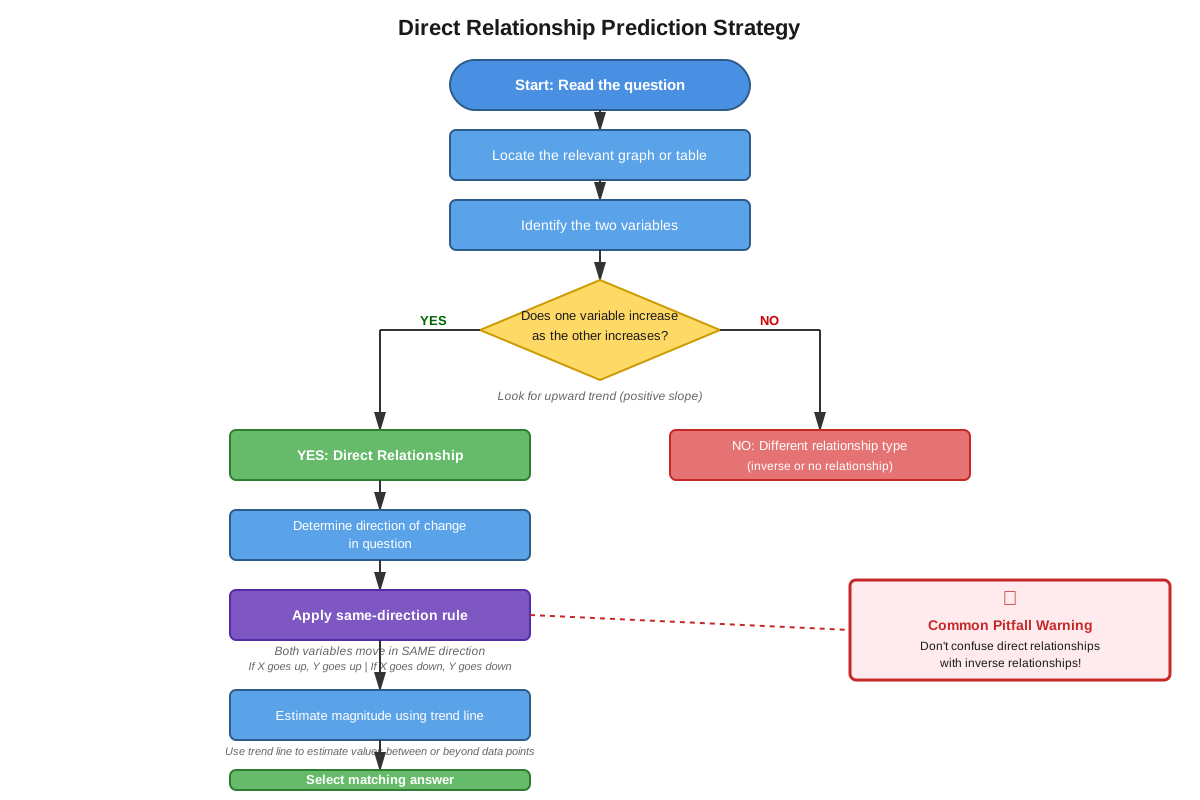
When approaching ACT Science questions involving direct relationships, follow this systematic process:
Step 1: Quickly scan the data presentation (5-10 seconds)
Look for overall patterns before reading specific values. Train your eyes to identify upward trends, downward trends, or no pattern immediately. This prevents getting lost in details and provides context for specific questions.
Step 2: Identify trigger words in questions
Watch for phrases that signal direct relationship questions:
- "As X increases, what happens to Y?"
- "Which graph shows a positive correlation?"
- "If the trend continues..."
- "Based on the data, predict..."
- "Which variables change in the same direction?"
Step 3: Use process of elimination strategically
For multiple-choice questions, eliminate answers that describe inverse relationships or no relationships first. This immediately narrows options and increases accuracy even if you're uncertain about the correct answer.
Step 4: Verify with two data points
Don't rely on a single comparison. Check at least two intervals to confirm the pattern continues consistently. This prevents errors from anomalous data points or misreading values.
Exam Tip: If a question asks about relationships but the passage seems complex, ignore the scientific jargon and focus purely on whether numbers go up together or not. The ACT tests data interpretation skills, not content knowledge.
Time Allocation: Spend no more than 30-45 seconds per direct relationship question. These are typically straightforward pattern recognition tasks that shouldn't consume excessive time. If you find yourself calculating or overthinking, step back and look at the big picture pattern.
Common Trap Answers: The ACT often includes answers that correctly identify a relationship exists but misclassify it as inverse instead of direct (or vice versa). Always verify the direction of change before selecting your answer.
Memory Techniques
SAME Mnemonic: For direct relationships, remember "SAME"
- Same direction
- Ascending together (or descending together)
- Moves upward on graphs
- Equal pattern of change
The Escalator Visualization: Picture two people on parallel escalators moving in the same direction. As one person goes up, the other also goes up. This visual reinforces that direct relationships involve synchronized, same-direction movement.
The "Friends" Analogy: Direct relationships are like good friends—they stick together and go in the same direction. When one succeeds (increases), the other celebrates and succeeds too. Inverse relationships are like a seesaw—when one goes up, the other must go down.
Hand Gesture Technique: When reviewing graphs, physically trace the trend with your finger or pencil. An upward motion reinforces the direct relationship pattern and engages kinesthetic memory. This technique is especially helpful during practice sessions.
Number Pattern Recognition: Create a simple mental template: "10→20, 5→10" (both doubled). When you see this same-direction doubling or proportional change in tables, immediately recognize it as a direct relationship signature.
Summary
Direct relationships represent one of the most fundamental and frequently tested concepts in ACT Science, appearing in approximately 30-40% of Data Representation questions. A direct relationship exists when two variables change in the same direction—as one increases, the other increases, or as one decreases, the other decreases. These relationships appear visually as upward-sloping lines or curves on graphs and as parallel increases or decreases in data table values. The strength of a direct relationship is indicated by how tightly data points cluster around the trend line, with tighter clustering representing stronger, more predictable relationships. Students must distinguish direct relationships from inverse relationships (opposite-direction changes) and no relationships (random scatter or horizontal lines). Mastery of direct relationships enables accurate prediction of values beyond measured ranges through extrapolation and provides the foundation for understanding more complex variable interactions. Success on ACT direct relationship questions requires quick pattern recognition, systematic data analysis, and strategic elimination of incorrect answer choices based on relationship type and direction.
Key Takeaways
- Direct relationships occur when both variables change in the same direction—both increase together or both decrease together
- Visual identification is straightforward: upward-sloping lines or curves on graphs indicate direct relationships
- Relationship strength is determined by data point clustering—tighter clustering means stronger, more predictable relationships
- Direct relationships enable prediction beyond measured data ranges through pattern extrapolation
- The ACT tests direct relationships through multiple formats: graphs, tables, written descriptions, and prediction questions
- Quick pattern recognition saves time—scan for overall trends before analyzing specific values
- Distinguish direct relationships from inverse relationships (opposite directions) and no relationships (no pattern) to eliminate wrong answers efficiently
Related Topics
Inverse Relationships: Understanding how variables change in opposite directions provides the complementary skill to direct relationship recognition, enabling complete mastery of variable interaction patterns.
Scatter Plots and Correlation: Deeper analysis of data point distribution and correlation coefficients builds upon basic direct relationship recognition to evaluate relationship strength quantitatively.
Linear vs. Nonlinear Relationships: Distinguishing between straight-line and curved direct relationships prepares students for more complex data interpretation in Research Summaries passages.
Experimental Design and Variables: Understanding how scientists manipulate independent variables to observe effects on dependent variables provides context for why direct relationships appear in experimental data.
Data Extrapolation and Interpolation: Advanced prediction techniques extend basic direct relationship skills to estimate values both beyond and within measured data ranges.
Practice CTA
Now that you've mastered the core concepts of direct relationships, it's time to solidify your understanding through active practice. Complete the practice questions to test your ability to identify, analyze, and apply direct relationships in ACT-style scenarios. Use the flashcards to reinforce key definitions and visual patterns until recognition becomes automatic. Remember, the difference between knowing about direct relationships and scoring points on the ACT comes from repeated, focused practice. Each question you work through builds the pattern recognition speed and accuracy that will serve you on test day. You've built the foundation—now strengthen it through application!
Sign up free to keep reading
Create a free AnvayaPrep account to finish this ACT guide on Direct relationships — plus flashcards and practice questions.