Overview
Inverse relationships represent one of the most frequently tested concepts in the ACT Science section, appearing in approximately 15-20% of all data representation questions. An inverse relationship describes a pattern where one variable increases while another variable decreases in a predictable, proportional manner. Understanding this fundamental relationship is essential for interpreting graphs, tables, and experimental data that appear throughout the ACT Science test.
The ability to recognize and analyze inverse relationships extends beyond simple pattern recognition. Students must interpret various data formats—including scatter plots, line graphs, and data tables—to identify when two variables move in opposite directions. This skill becomes particularly critical when the ACT presents complex multi-variable experiments where several relationships exist simultaneously, requiring test-takers to isolate and identify the specific inverse relationship being tested.
Mastery of inverse relationships serves as a foundation for understanding more complex scientific principles tested on the ACT, including chemical equilibrium, population dynamics, physical laws (such as Boyle's Law relating pressure and volume), and ecological relationships. This topic bridges mathematical reasoning with scientific interpretation, making it a high-yield area for score improvement across multiple question types in the Data Representation section.
Learning Objectives
- [ ] Identify when inverse relationships are being tested in ACT Science passages
- [ ] Explain the core rule or strategy behind inverse relationships
- [ ] Apply inverse relationships to ACT-style questions accurately
- [ ] Distinguish between inverse relationships and direct relationships in complex data sets
- [ ] Predict values for unmeasured data points using inverse relationship patterns
- [ ] Analyze graphs and tables to quantify the strength of inverse relationships
- [ ] Evaluate whether a relationship is truly inverse or merely coincidental correlation
Prerequisites
- Basic graphing skills: Understanding x-axis and y-axis orientation is essential for interpreting how variables relate to each other visually
- Proportional reasoning: Recognizing when changes in one quantity correspond to changes in another forms the basis for identifying relationship patterns
- Data table interpretation: Reading rows and columns accurately allows students to track how variables change together across multiple trials
- Slope concepts: Understanding positive versus negative trends helps distinguish inverse relationships from direct relationships on graphs
Why This Topic Matters
Inverse relationships appear throughout natural phenomena and scientific principles. In chemistry, concentration and reaction rate often display inverse patterns; in physics, the relationship between wavelength and frequency demonstrates perfect inverse proportionality; in ecology, predator-prey populations frequently show inverse cycling patterns. Recognizing these relationships allows scientists to make predictions, design experiments, and understand fundamental natural laws.
On the ACT Science test, inverse relationships appear in 3-5 questions per exam, making this a high-frequency, high-impact topic. Questions typically appear in the Data Representation passages (which comprise 30-40% of the Science section), though they also emerge in Research Summaries when comparing experimental results. The ACT tests this concept through multiple question formats: identifying trends from graphs, predicting values beyond measured ranges, comparing multiple variables simultaneously, and selecting statements that accurately describe observed patterns.
Common ACT presentations include scatter plots showing negative correlations, line graphs with downward slopes, data tables where one column increases while another decreases, and multi-panel figures requiring students to compare trends across different experimental conditions. The test frequently combines inverse relationships with other concepts, such as asking students to identify which of several variables shows an inverse pattern with the independent variable, or determining at what point an inverse relationship changes or breaks down.
Core Concepts
Definition and Mathematical Foundation
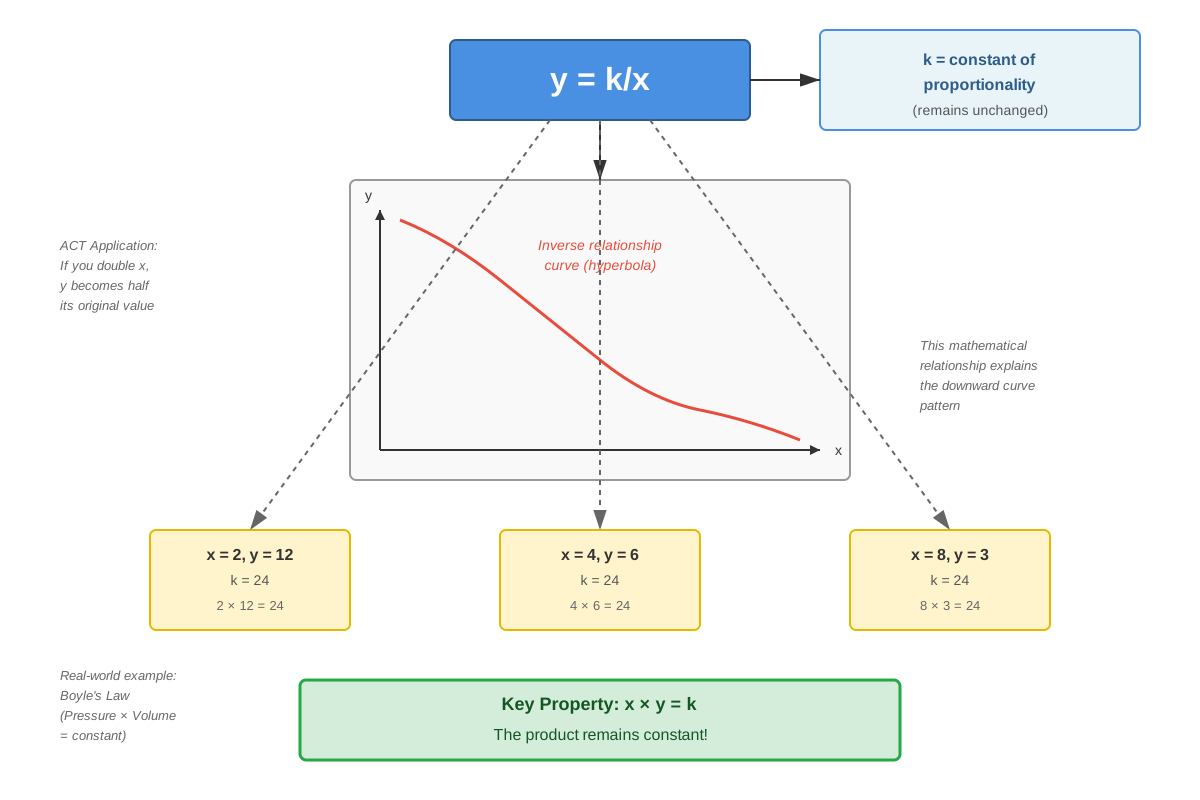
An inverse relationship (also called a negative correlation or indirect relationship) exists when two variables change in opposite directions: as one variable increases, the other decreases. Mathematically, this can be expressed as a negative correlation coefficient or, in cases of perfect inverse proportionality, as the equation:
y = k/xwhere k is a constant. However, not all inverse relationships follow perfect mathematical proportionality—many show general inverse trends without strict mathematical formulas.
The key characteristic distinguishing ACT inverse relationships from other patterns is consistency: the inverse pattern must hold across the entire data range presented. A single data point moving contrary to the overall trend does not negate an inverse relationship, but the general pattern must show opposing directional changes.
Visual Recognition in Graphs
Graphs provide the most immediate visual representation of inverse relationships. On a standard Cartesian coordinate system:
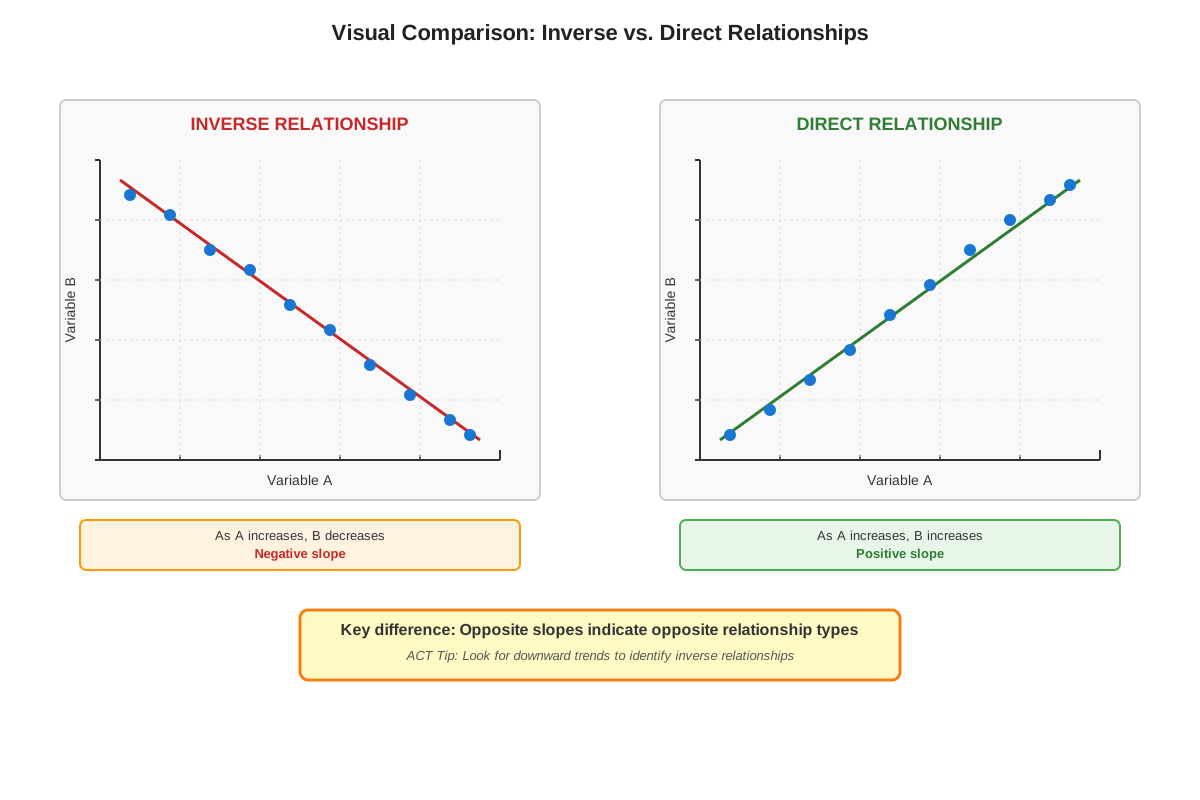
- Downward-sloping lines indicate inverse relationships between x-axis and y-axis variables
- Negative slopes (moving from upper-left to lower-right) signal that increases in the independent variable correspond to decreases in the dependent variable
- Curved decreasing functions (hyperbolic curves) represent inverse proportional relationships where the product of the two variables remains constant
The ACT frequently presents scatter plots where data points cluster around a downward trend line. Students must recognize that perfect alignment is not required—the overall pattern determines the relationship type. Even with data scatter, if the general trend moves downward from left to right, an inverse relationship exists.
Identifying Inverse Relationships in Data Tables
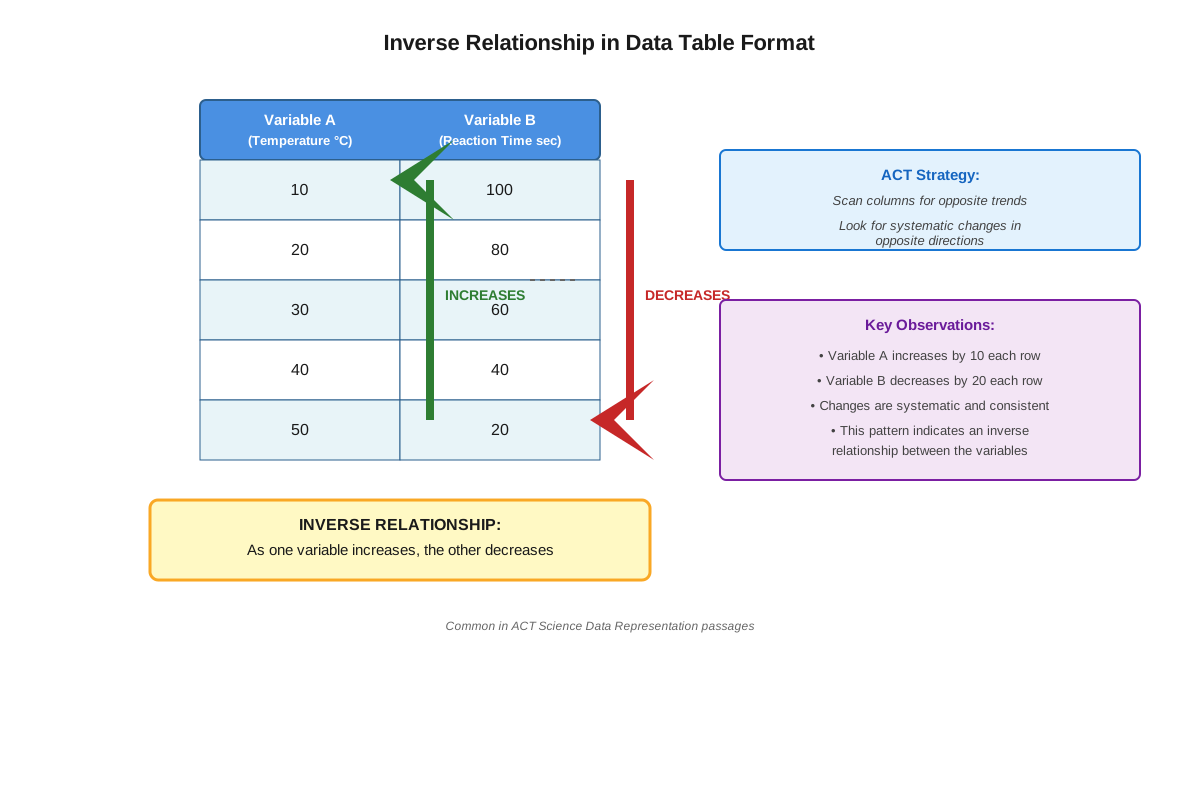
Data tables require more analytical processing than graphs because the relationship is not immediately visual. To identify inverse relationships in tables:
- Locate the independent variable (typically in the leftmost column or top row)
- Track changes in the dependent variable as the independent variable changes
- Compare directional changes: if the independent variable increases while the dependent variable decreases (or vice versa), an inverse relationship exists
- Verify consistency: check that the pattern holds across all data points
| Temperature (°C) | Dissolved Oxygen (mg/L) |
|---|---|
| 10 | 11.3 |
| 20 | 9.1 |
| 30 | 7.5 |
| 40 | 6.4 |
In this example, as temperature increases, dissolved oxygen decreases—a clear inverse relationship commonly tested on the ACT.
Distinguishing Inverse from Direct Relationships
The ACT frequently includes distractor answer choices that confuse inverse and direct relationships. A direct relationship (positive correlation) shows both variables moving in the same direction—both increasing or both decreasing together.
| Relationship Type | Direction Pattern | Graph Appearance | Example |
|---|---|---|---|
| Inverse | Opposite directions | Downward slope | Pressure vs. Volume |
| Direct | Same direction | Upward slope | Temperature vs. Volume |
| No relationship | Random pattern | Scattered points | Shoe size vs. Test score |
Students must carefully read which variable is being compared to which, as complex passages may contain multiple relationships simultaneously—some inverse, some direct, and some showing no correlation.
Strength of Inverse Relationships
Not all inverse relationships demonstrate the same strength. The ACT may test understanding of relationship strength through questions about correlation:
- Strong inverse relationships: Data points cluster tightly around a downward trend line; changes in one variable reliably predict changes in the other
- Weak inverse relationships: General downward trend exists, but with substantial scatter; predictions are less reliable
- Perfect inverse proportionality: The mathematical product of the two variables remains constant (xy = k)
Understanding relationship strength helps students evaluate the reliability of predictions and select answer choices that appropriately qualify statements (e.g., "generally decreases" versus "always decreases").
Context-Dependent Inverse Relationships
Some inverse relationships exist only within specific ranges or under particular conditions. The ACT tests this nuance by presenting data where:
- An inverse relationship holds up to a certain point, then plateaus
- Multiple factors influence the dependent variable, creating apparent exceptions
- The relationship reverses under different experimental conditions
Students must read passage context carefully to understand whether a relationship is universally inverse or conditionally inverse within the experimental parameters.
Concept Relationships
Inverse relationships connect directly to fundamental mathematical concepts of slope and correlation. The negative slope of a line graphing an inverse relationship quantifies how rapidly one variable decreases as the other increases. This mathematical foundation enables students to move beyond simple pattern recognition to quantitative analysis.
Within the broader Data Representation unit, inverse relationships represent one category in a taxonomy of variable relationships. The progression flows: No relationship → Weak correlation → Strong correlation, with correlations subdividing into Direct relationships and Inverse relationships. Mastering inverse relationships requires first understanding what constitutes a relationship between variables (distinguishing pattern from randomness), then categorizing the relationship type.
Inverse relationships also connect to experimental design concepts tested in Research Summaries passages. When scientists manipulate an independent variable and observe inverse changes in a dependent variable, this suggests a causal mechanism that the ACT may ask students to identify or explain. The relationship map flows: Experimental manipulation → Inverse relationship observation → Mechanistic hypothesis → Prediction testing.
The concept extends to more advanced topics like limiting factors (where an inverse relationship breaks down at extreme values) and equilibrium systems (where inverse relationships between opposing processes create stable states). Understanding basic inverse relationships provides the foundation for interpreting these more complex scientific scenarios.
High-Yield Facts
⭐ An inverse relationship means one variable increases while the other decreases—this is the fundamental definition tested most frequently
⭐ Downward-sloping lines on graphs always indicate inverse relationships between the x-axis and y-axis variables
⭐ In data tables, compare the direction of change: if one column's values increase while another's decrease, an inverse relationship exists
⭐ The ACT uses terms like "as X increases, Y decreases" or "negatively correlated" to describe inverse relationships in answer choices
⭐ Perfect inverse proportionality means the product of the two variables remains constant (xy = k), though not all inverse relationships are perfectly proportional
- Inverse relationships can be linear (straight downward line) or nonlinear (curved downward pattern)
- Strong inverse relationships show data points clustering tightly around the trend line; weak inverse relationships show more scatter
- Multiple variables can be measured simultaneously, with some showing inverse relationships and others showing direct relationships to the same independent variable
- The strength of an inverse relationship does not change its classification—weak and strong inverse relationships are both still inverse
- Inverse relationships may exist only within certain ranges; always check whether the pattern holds across all presented data
Quick check — test yourself on Inverse relationships so far.
Try Flashcards →Common Misconceptions
Misconception: Any downward pattern in data represents an inverse relationship → Correction: An inverse relationship specifically describes the relationship between two variables; a single variable decreasing over time is simply a decreasing trend, not an inverse relationship unless compared to another increasing variable
Misconception: Inverse relationships must follow the mathematical formula y = k/x → Correction: While some inverse relationships show perfect inverse proportionality, many inverse relationships on the ACT show general inverse trends without strict mathematical formulas; any consistent pattern of opposite directional changes qualifies as inverse
Misconception: If one data point doesn't fit the pattern, no inverse relationship exists → Correction: Real experimental data contains variability and measurement error; an inverse relationship is determined by the overall trend, not by every single data point perfectly aligning
Misconception: "Inverse" and "reverse" mean the same thing on the ACT → Correction: "Inverse relationship" describes opposing directional changes between variables, while "reverse" typically means going backward or opposite in a single direction; these terms have distinct meanings in scientific contexts
Misconception: Correlation proves causation in inverse relationships → Correction: Observing an inverse relationship between two variables does not prove that changes in one variable cause changes in the other; correlation describes pattern, while causation requires experimental evidence of mechanism
Misconception: The steeper the downward slope, the stronger the inverse relationship → Correction: Slope steepness indicates the rate of change, not relationship strength; relationship strength is determined by how closely data points cluster around the trend line (correlation coefficient), not by the slope magnitude
Worked Examples
Example 1: Graph Interpretation
Question: The graph below shows the relationship between altitude and air pressure. Based on the data, which statement best describes the relationship between these variables?
Air Pressure (kPa)
100 |  •
 80 |    •
 60 |      •
 40 |        •
 20 |          •
  0 |____________
    0  2  4  6  8
    Altitude (km)
Answer choices:
A) As altitude increases, air pressure increases
B) As altitude increases, air pressure decreases
C) Altitude and air pressure are not related
D) Air pressure remains constant regardless of altitude
Solution Process:
Step 1: Identify the variables. The independent variable (x-axis) is altitude, and the dependent variable (y-axis) is air pressure.
Step 2: Examine the directional pattern. Moving from left to right (increasing altitude), the data points move downward (decreasing air pressure).
Step 3: Classify the relationship. Since one variable increases while the other decreases, this demonstrates an inverse relationship.
Step 4: Evaluate answer choices. Choice B correctly describes the inverse relationship using the standard phrasing "as X increases, Y decreases."
Answer: B
Connection to learning objectives: This example demonstrates identifying when inverse relationships are being tested (Learning Objective 1) and applying the core recognition strategy of tracking directional changes (Learning Objective 2).
Example 2: Data Table Analysis with Multiple Variables
Question: Scientists measured three variables during an experiment on plant growth. The data are shown below:
| Light Intensity (lumens) | Plant Height (cm) | Root Length (cm) | Leaf Count |
|---|---|---|---|
| 100 | 12 | 8 | 6 |
| 200 | 18 | 7 | 9 |
| 300 | 24 | 6 | 12 |
| 400 | 30 | 5 | 15 |
Which variable shows an inverse relationship with light intensity?
Answer choices:
A) Plant height only
B) Root length only
C) Leaf count only
D) Both plant height and leaf count
Solution Process:
Step 1: Identify the independent variable. Light intensity is being manipulated (increasing from 100 to 400 lumens).
Step 2: Analyze each dependent variable separately:
- Plant height: 12 → 18 → 24 → 30 (increasing as light increases) = direct relationship
- Root length: 8 → 7 → 6 → 5 (decreasing as light increases) = inverse relationship
- Leaf count: 6 → 9 → 12 → 15 (increasing as light increases) = direct relationship
Step 3: Identify which variable moves opposite to light intensity. Only root length decreases while light intensity increases.
Step 4: Select the correct answer. Choice B correctly identifies root length as the only variable showing an inverse relationship.
Answer: B
Connection to learning objectives: This example demonstrates distinguishing inverse relationships from direct relationships in complex data sets (Learning Objective 4) and applying inverse relationship concepts to ACT-style questions with multiple variables (Learning Objective 3).
Exam Strategy
Recognition Triggers
Watch for these trigger words and phrases that signal inverse relationship questions:
- "As X increases, what happens to Y?"
- "Which variable decreases when..."
- "Negatively correlated"
- "Inversely related"
- "Opposite direction"
- "Decreases with increasing..."
When you see these phrases, immediately look for opposing directional changes in the data.
Systematic Approach
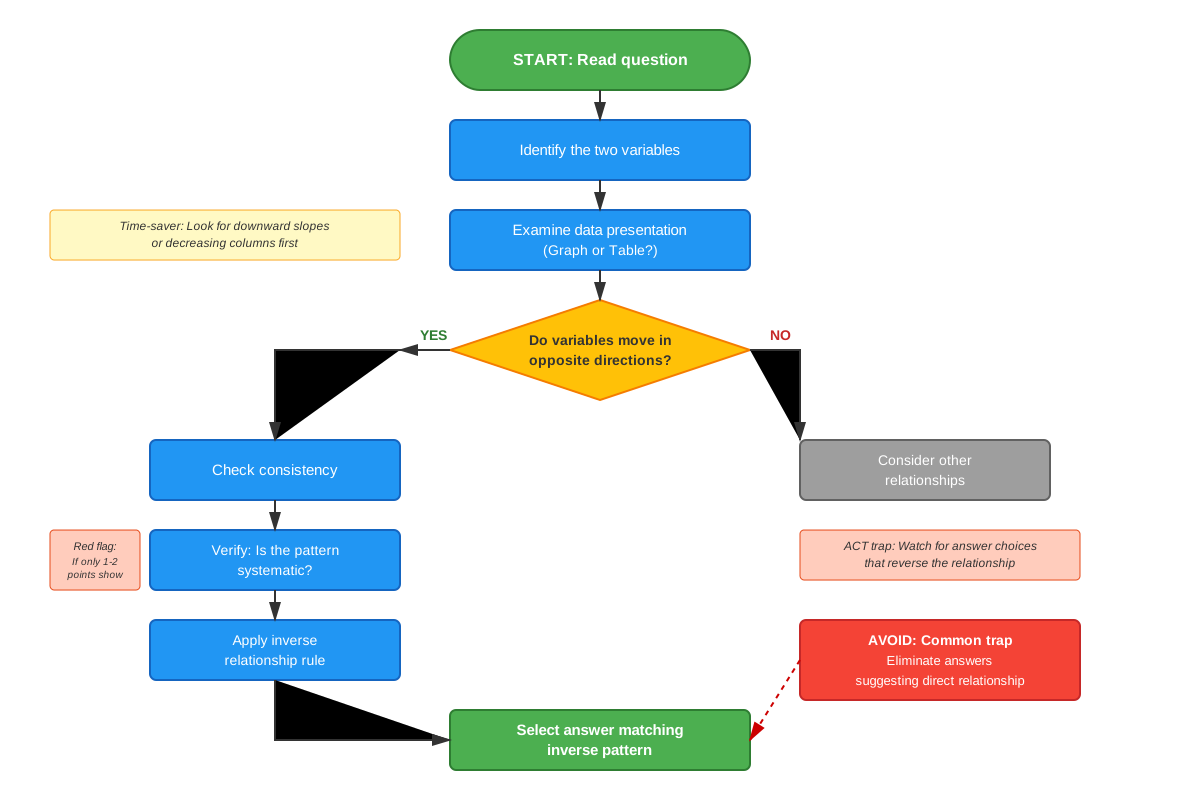
Use this four-step process for all inverse relationship questions:
- Identify variables: Determine which two variables the question asks about
- Track directions: Note whether each variable increases, decreases, or stays constant
- Compare patterns: Determine if the directional changes are opposite (inverse), same (direct), or unrelated
- Verify consistency: Check that the pattern holds across all data points presented
Process of Elimination
When answer choices describe relationships:
- Eliminate choices that reverse the relationship (stating direct when the data shows inverse)
- Eliminate absolute statements ("always," "never") if any data point contradicts them
- Eliminate choices that confuse which variable is independent versus dependent
- Keep choices that appropriately qualify the relationship ("generally," "tends to") when data shows scatter
Time Management
Inverse relationship questions typically require 30-45 seconds each:
- 10 seconds: Read the question and identify the variables being compared
- 15-20 seconds: Analyze the data (graph or table) to determine the relationship
- 10-15 seconds: Evaluate answer choices and select the best option
If a question requires more than one minute, mark it and return after completing easier questions. Most inverse relationship questions are straightforward pattern recognition that should not consume excessive time.
Common Traps
The ACT frequently includes these trap answer choices:
- Reversed relationships: Stating the relationship backward (e.g., "Y increases as X increases" when the data shows the opposite)
- Confused variables: Describing the relationship between the wrong pair of variables in multi-variable passages
- Overgeneralization: Claiming a relationship is stronger or more consistent than the data supports
- Mechanism confusion: Confusing correlation with causation or adding explanatory mechanisms not supported by the data
Memory Techniques
The "Seesaw Mnemonic"
Visualize a seesaw or teeter-totter: when one side goes UP, the other goes DOWN. This physical image reinforces that inverse relationships involve opposite directional changes. When you see data or graphs, mentally place the variables on opposite ends of a seesaw.
The "DIDO" Acronym
Direct = In the same Direction, Opposite = inverse
This helps distinguish direct from inverse relationships quickly during the exam.
The "Slope Sign" Rule
Negative slope = Inverse relationship
Positive slope = Direct relationship
Visualize a minus sign (−) for inverse and a plus sign (+) for direct. This mathematical connection helps with graph interpretation.
The "Column Chase" Technique
For data tables, use your finger or pencil to "chase" down columns:
- If your finger moves down one column and up another = inverse
- If your finger moves down both columns or up both columns = direct
This kinesthetic technique helps visual learners track directional changes.
The "Opposite Day" Visualization
When analyzing inverse relationships, think "opposite day"—whatever happens to one variable, the opposite happens to the other. This simple mental frame helps quickly categorize relationships during time pressure.
Summary
Inverse relationships represent a fundamental pattern in scientific data where one variable increases while another decreases. Recognizing these relationships requires systematic analysis of graphs and tables to identify opposing directional changes between variables. On the ACT Science test, inverse relationships appear frequently in Data Representation passages, typically presented through downward-sloping graphs or data tables showing opposite trends. Success requires distinguishing inverse relationships from direct relationships, understanding that relationship strength varies, and recognizing that not all inverse relationships follow perfect mathematical proportionality. Students must track which variables are being compared, verify that the inverse pattern holds consistently across the data range, and select answer choices that accurately describe the observed relationship without overgeneralizing or confusing correlation with causation. Mastering inverse relationships provides a foundation for understanding more complex scientific principles and significantly improves performance on 15-20% of ACT Science questions.
Key Takeaways
- Inverse relationships occur when one variable increases while another decreases—this opposing directional change is the defining characteristic
- Downward-sloping graphs always indicate inverse relationships between the plotted variables, regardless of whether the slope is steep or gradual
- In data tables, systematically compare directional changes by tracking whether values in different columns move in opposite directions
- The ACT tests inverse relationships through multiple formats: graph interpretation, table analysis, prediction questions, and relationship comparison across multiple variables
- Strong inverse relationships show tight clustering around the trend line, while weak inverse relationships show more scatter but still maintain the overall opposing pattern
- Watch for trigger phrases like "as X increases," "negatively correlated," and "inversely related" to quickly identify when inverse relationships are being tested
- Distinguish correlation from causation—observing an inverse relationship does not prove that one variable causes changes in the other without additional experimental evidence
Related Topics
Direct Relationships: Understanding how variables change in the same direction provides the contrasting pattern to inverse relationships, enabling students to categorize all correlation types accurately.
Correlation Strength and Scatter Plots: Analyzing how tightly data points cluster around trend lines builds on inverse relationship recognition to evaluate prediction reliability and relationship strength.
Experimental Variables and Controls: Identifying independent and dependent variables in research designs connects to determining which variable changes cause inverse relationships in dependent variables.
Mathematical Proportionality: Exploring perfect inverse proportionality (xy = k) extends basic inverse relationship concepts into quantitative analysis and mathematical modeling.
Limiting Factors and Threshold Effects: Understanding when inverse relationships break down or change at extreme values represents advanced application of relationship analysis in complex systems.
Practice CTA
Now that you understand inverse relationships, it's time to solidify your mastery through active practice. Complete the practice questions to test your ability to identify inverse relationships in various data formats, and use the flashcards to reinforce key concepts and trigger phrases. Remember, recognizing inverse relationships quickly and accurately can earn you multiple points on every ACT Science test—this is a high-yield skill worth perfecting. Approach each practice question systematically using the four-step process outlined in the Exam Strategy section, and track which question types give you the most difficulty so you can focus your review efficiently. You've got this!
Sign up free to keep reading
Create a free AnvayaPrep account to finish this ACT guide on Inverse relationships — plus flashcards and practice questions.