Overview
Outliers in data represent one of the most frequently tested concepts in the ACT Science section, particularly within Data Representation passages. An outlier is a data point that differs significantly from other observations in a dataset—it stands apart from the general pattern or trend. Understanding how to identify, interpret, and reason about outliers is crucial for success on the ACT because these anomalous values often form the basis of questions that test critical thinking and data analysis skills. Students who can quickly spot outliers and understand their potential impact on experimental conclusions gain a significant advantage in both accuracy and timing.
The ACT Science test regularly presents tables, graphs, and charts containing data points that don't conform to expected patterns. Questions may ask students to identify which data point is anomalous, explain why a particular value might be considered an outlier, or predict how removing an outlier would affect statistical measures like mean or median. These questions assess whether students can move beyond simple data reading to engage in higher-order analysis—a skill that distinguishes top scorers from average performers.
Within the broader context of Data Representation, outliers connect to fundamental concepts of experimental design, measurement error, data quality, and statistical analysis. Recognizing outliers requires understanding normal data patterns, trends, and relationships between variables. This topic bridges descriptive statistics, graphical interpretation, and scientific reasoning, making it a cornerstone skill that supports performance across multiple question types in the Science section.
Learning Objectives
- [ ] Identify when Outliers in data is being tested in ACT Science passages
- [ ] Explain the core rule or strategy behind Outliers in data recognition and analysis
- [ ] Apply Outliers in data concepts to ACT-style questions accurately
- [ ] Distinguish between true outliers and natural data variation in experimental results
- [ ] Evaluate the potential causes of outliers in scientific contexts
- [ ] Predict how outliers affect measures of central tendency and data interpretation
- [ ] Determine appropriate responses to outliers in experimental analysis
Prerequisites
- Basic statistical measures (mean, median, mode): Understanding these measures is essential because outliers affect them differently, and ACT questions often test this relationship
- Reading and interpreting graphs and tables: Outliers must first be identified visually or numerically within data presentations, requiring fundamental data literacy
- Understanding trends and patterns in data: Recognizing what constitutes "normal" behavior in a dataset is necessary before identifying deviations from that norm
- Basic scientific method and experimental design: Context about how data is collected helps determine whether an outlier represents error or genuine phenomenon
Why This Topic Matters
In real-world scientific research, outliers in data can represent either measurement errors that should be investigated or genuine discoveries that challenge existing theories. Medical researchers might identify an outlier patient response that leads to understanding rare side effects. Environmental scientists might spot outlier readings that signal equipment malfunction or an actual pollution event. Climate researchers have used outlier temperature readings to identify heat waves and climate anomalies. The ability to recognize and appropriately interpret outliers is fundamental to scientific literacy and critical thinking.
On the ACT Science test, outlier-related questions appear with high frequency—approximately 15-20% of Data Representation passages include at least one question involving outlier identification or interpretation. These questions typically appear in the medium-to-difficult range, making them important differentiators for students aiming for scores above 28. The test makers favor outlier questions because they efficiently assess multiple skills: data reading, pattern recognition, statistical reasoning, and scientific judgment.
Common question formats include: identifying which data point doesn't fit the pattern, explaining why a value might be anomalous, predicting how removing an outlier would change calculated averages, determining whether an outlier supports or contradicts a hypothesis, and selecting which experimental factor might have caused an outlier. These questions appear across all science content areas (biology, chemistry, physics, Earth science) because outlier analysis is a universal scientific skill rather than content-specific knowledge.
Core Concepts
Definition and Characteristics of Outliers
An outlier is a data point that lies an abnormal distance from other values in a dataset. More specifically, act outliers in data questions focus on values that deviate significantly from the established pattern, trend, or expected range of observations. Outliers can be identified through several methods: visual inspection of graphs where they appear separated from clusters, numerical analysis where they fall far from the mean, or contextual evaluation where they contradict theoretical predictions.
Outliers possess several key characteristics that make them identifiable:
- They deviate substantially from the central tendency of the data
- They don't follow the same trend or relationship as other data points
- They often appear isolated when data is plotted graphically
- They may represent extreme values at either end of the data range
- They can occur in any variable (independent, dependent, or both)
Types of Outliers
Understanding different outlier categories helps in both identification and interpretation:
| Outlier Type | Description | ACT Example |
|---|---|---|
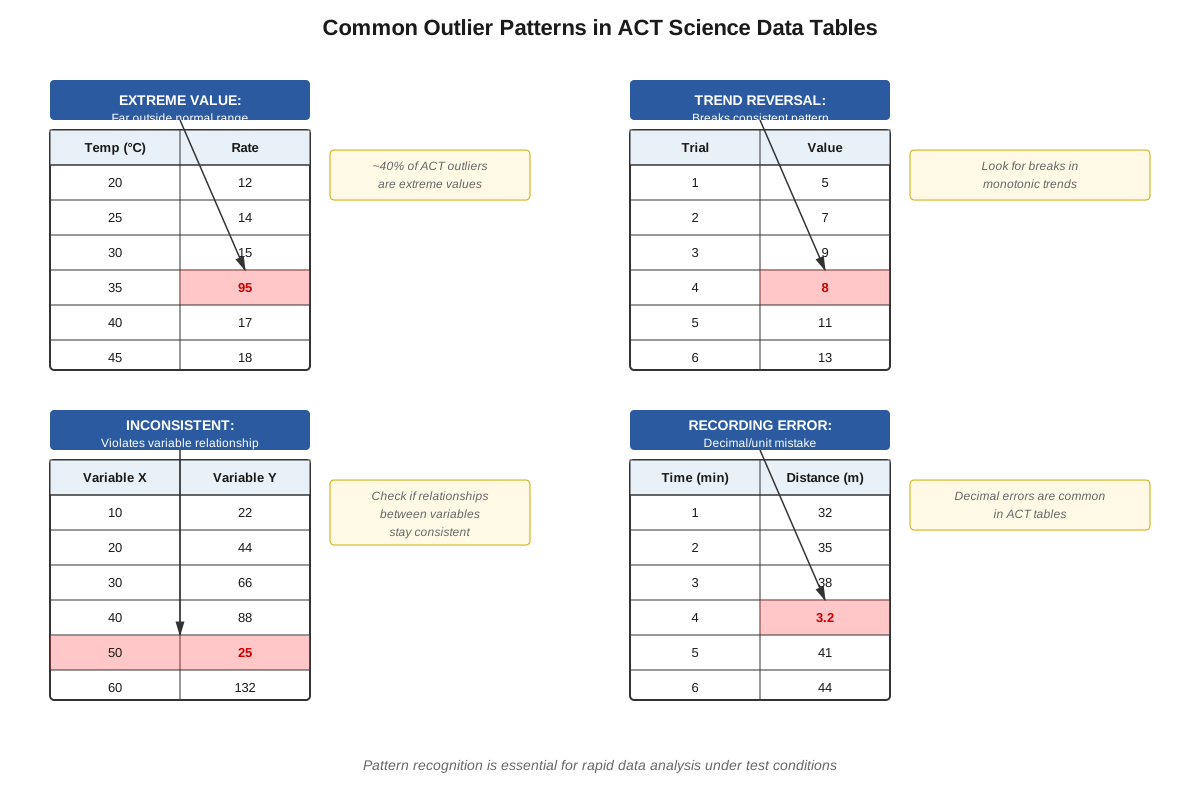
| Point outlier | Single data point deviates from others | One temperature reading of 95°C when all others range 20-25°C |
| Contextual outlier | Value is anomalous only in specific context | High pollen count in winter (normal in spring) |
| Collective outlier | Group of points together deviate from pattern | Three consecutive readings all elevated while others are consistent |
Causes of Outliers
The ACT frequently tests understanding of why outliers occur. Recognizing potential causes helps answer questions about experimental validity and data interpretation:
- Measurement error: Equipment malfunction, calibration issues, or human error in recording
- Experimental error: Contamination, improper procedure, or uncontrolled variables
- Natural variation: Genuine extreme values within the population being studied
- Data entry error: Transcription mistakes or decimal point errors
- Population heterogeneity: Sample includes members from different populations
- Rare events: Legitimate but infrequent occurrences that represent real phenomena
Visual Identification of Outliers
On the ACT, most outlier questions involve graphical data. Students must quickly scan plots to identify anomalous points:
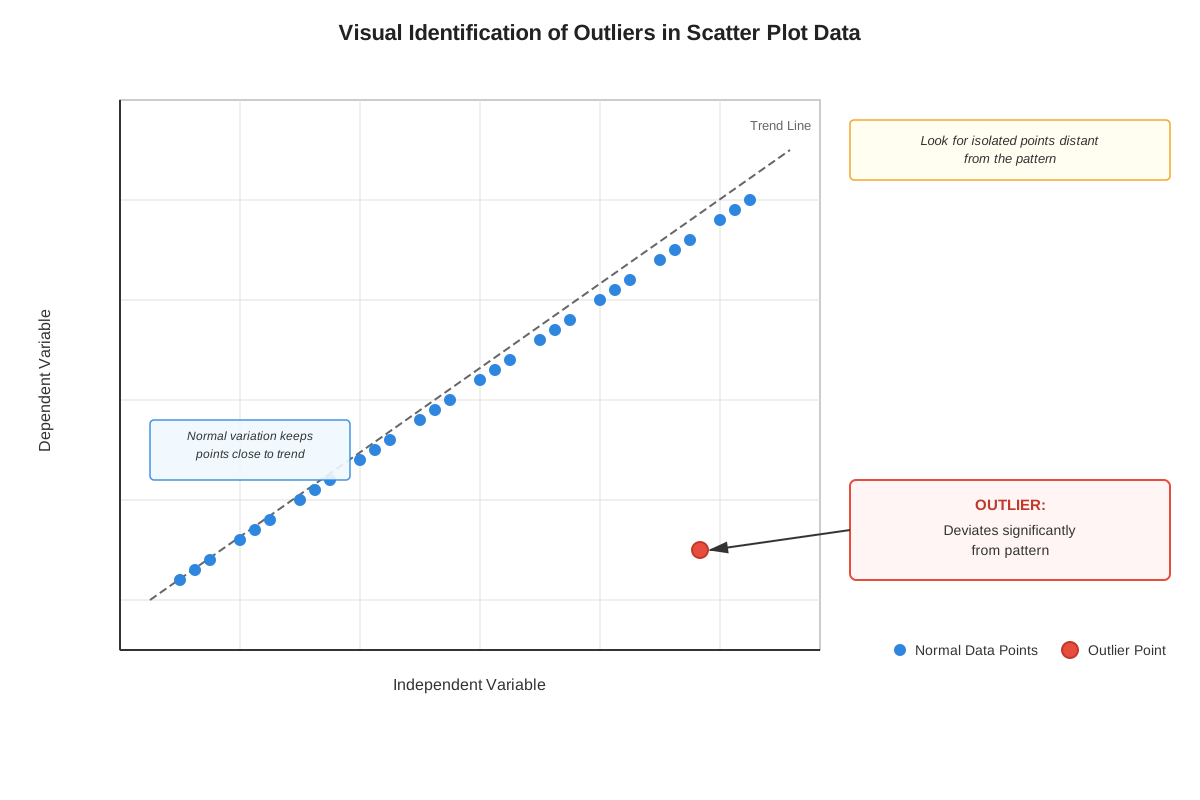
In scatter plots: Look for points that don't follow the general correlation pattern. If most points show a positive linear relationship, a point far above or below the trend line is an outlier.
In line graphs: Identify values where the line shows an unexpected spike or dip that doesn't match the overall trend. A sudden jump followed by return to the previous pattern often indicates an outlier.
In bar graphs: Spot bars that are dramatically taller or shorter than surrounding bars, especially when other bars show consistent heights or gradual changes.
In tables: Scan columns for values that are much larger or smaller than others, or that break an otherwise consistent pattern of increase or decrease.
Statistical Impact of Outliers
Understanding how outliers affect statistical measures is crucial for ACT questions:
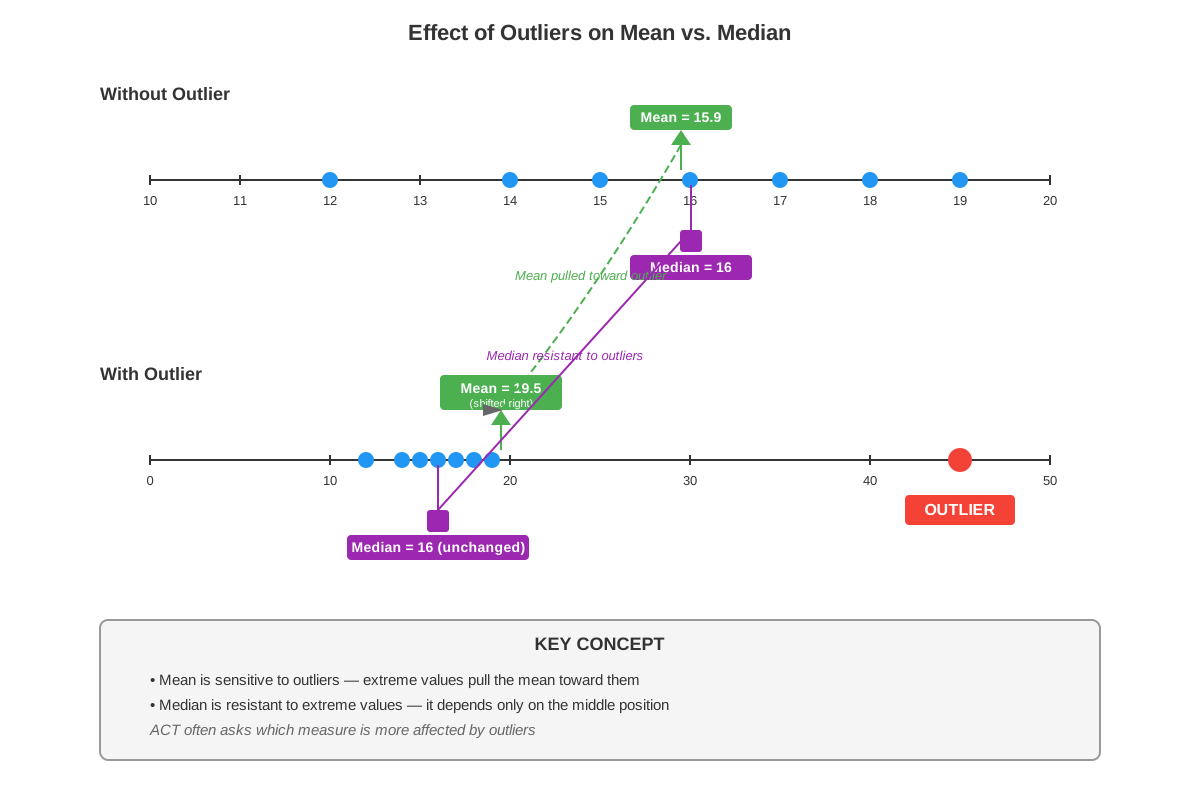
Effect on mean: Outliers strongly influence the mean because every value contributes to the calculation. A single extreme value can pull the mean substantially toward it. For example, if nine students score 85-90 on a test and one scores 20, the mean drops to approximately 78, not representing the typical performance.
Effect on median: The median is resistant to outliers because it depends only on the middle value(s), not on how extreme the outliers are. In the test score example above, the median would remain around 87-88.
Effect on range: Outliers directly determine the range when they represent the minimum or maximum values, potentially making variability appear much larger than typical.
Effect on correlation: In bivariate data, outliers can either strengthen, weaken, or reverse the apparent correlation between variables, depending on their position relative to the trend.
Outlier Detection Strategies
For ACT purposes, students should employ these rapid detection methods:
- The 1.5 × IQR rule: Values more than 1.5 times the interquartile range above the third quartile or below the first quartile are potential outliers (rarely calculated explicitly on ACT, but understanding the concept helps)
- Visual clustering: If most data points form a tight group and one sits far away, it's likely an outlier
- Trend deviation: In data showing a clear pattern, any point that significantly breaks the pattern warrants attention
- Magnitude comparison: Values that are 2-3 times larger or smaller than typical values often qualify as outliers
Appropriate Responses to Outliers
The ACT may test understanding of how scientists should handle outliers:
Investigation first: Before discarding outliers, researchers should investigate potential causes. Was there equipment malfunction? Was the procedure followed correctly?
Context matters: In some fields, outliers represent the most interesting data (e.g., discovering a new species with unusual characteristics). In others, they indicate problems (e.g., quality control in manufacturing).
Statistical reporting: Responsible scientists report outliers and explain how they were handled rather than silently removing them.
Replication: Repeating measurements or experiments helps determine whether an outlier is reproducible (suggesting a real phenomenon) or random (suggesting error).
Concept Relationships
The concept of outliers in data sits at the intersection of multiple analytical skills tested on the ACT Science section. Understanding outliers requires first mastering basic data reading and pattern recognition → which enables identification of normal trends → which then allows recognition of deviations from those trends (outliers) → which finally supports evaluation of data quality and experimental validity.
Outliers connect directly to measures of central tendency (prerequisite knowledge): recognizing that outliers exist leads to understanding why median is sometimes preferred over mean → which connects to broader statistical reasoning → which supports interpretation of experimental results. This relationship flows bidirectionally: understanding how outliers affect statistics also helps identify which values are outliers.
The relationship between outliers and experimental design is particularly important: proper experimental controls minimize outliers caused by confounding variables → while replication helps distinguish true outliers from random variation → which connects to the scientific method's emphasis on reproducibility. When students see an outlier in ACT data, they should mentally trace back to possible experimental causes.
Outliers also relate to graphical interpretation skills: trend lines and best-fit lines (related topics) are calculated to minimize distance from most points → which means outliers appear far from these lines → which makes visual identification possible. Understanding correlation strength (related topic) requires recognizing how outliers can distort apparent relationships between variables.
High-Yield Facts
⭐ An outlier is a data point that deviates significantly from the overall pattern or trend in a dataset
⭐ Outliers have a strong effect on the mean but minimal effect on the median
⭐ Visual identification of outliers involves looking for isolated points, unexpected spikes, or values that break established trends
⭐ Common causes of outliers include measurement error, equipment malfunction, data entry mistakes, and genuine rare events
⭐ On the ACT, outlier questions often ask which data point doesn't fit the pattern or how removing an outlier would affect calculations
- Outliers can occur in any type of data presentation: tables, scatter plots, line graphs, or bar charts
- A single outlier can dramatically change the range of a dataset
- In scatter plots, outliers appear far from the trend line that fits most other points
- Scientists should investigate outliers before deciding whether to exclude them from analysis
- Outliers may represent the most scientifically interesting data points in some experiments
- The presence of multiple outliers might indicate systematic error rather than random variation
- Contextual outliers are normal in some conditions but anomalous in others
- Replication helps determine whether an outlier is reproducible or represents random error
- Outliers can either strengthen or weaken the apparent correlation between two variables
- On the ACT, questions about outliers test both identification skills and understanding of their impact on data interpretation
Quick check — test yourself on Outliers in data so far.
Try Flashcards →Common Misconceptions
Misconception: All extreme values are outliers that should be removed from data analysis.
Correction: Extreme values are only outliers if they deviate from the pattern in a way that suggests error or a different population. Some extreme values represent genuine variation and are important to retain. The decision to exclude outliers requires investigation of their cause, not automatic removal based solely on magnitude.
Misconception: Outliers always indicate mistakes or errors in data collection.
Correction: While outliers can result from errors, they may also represent rare but real phenomena, natural variation in populations, or important discoveries. For example, an outlier patient response might reveal a previously unknown drug interaction. Scientists must investigate outliers rather than assuming they're errors.
Misconception: The mean and median are equally affected by outliers.
Correction: The mean is strongly influenced by outliers because it incorporates the value of every data point in its calculation. The median is resistant to outliers because it depends only on the middle value(s), regardless of how extreme the outliers are. This difference is frequently tested on the ACT.
Misconception: If one data point looks different from others, it's definitely an outlier.
Correction: True outliers must deviate significantly from the pattern, not just appear slightly different. Natural variation means not all points will be identical. A point is only an outlier if it falls far outside the expected range or clearly breaks an established trend. Small deviations are normal data scatter.
Misconception: Outliers only occur at the extreme high or low ends of data ranges.
Correction: While outliers often represent extreme values, they can also occur in the middle of a range if they break a pattern. For example, in time-series data showing steady increase, a sudden drop to a middle-range value could be an outlier even though it's not the minimum value.
Misconception: On the ACT, identifying outliers requires complex statistical calculations.
Correction: ACT outlier questions rely on visual pattern recognition and basic reasoning rather than formal statistical tests. Students should look for points that obviously don't fit the pattern, not calculate standard deviations or interquartile ranges. The test assesses conceptual understanding, not computational statistics.
Worked Examples
Example 1: Identifying Outliers in Tabular Data
Question: A student measured the time required for a chemical reaction at different temperatures. The results are shown below:
| Temperature (°C) | Time (seconds) |
|---|---|
| 20 | 45 |
| 30 | 32 |
| 40 | 24 |
| 50 | 18 |
| 60 | 89 |
| 70 | 11 |
Which temperature produced an outlier result, and what might explain this?
Solution Process:
Step 1: Identify the pattern in the data. Looking at the table, as temperature increases from 20°C to 70°C, we expect a consistent trend. Let's examine the time values: 45, 32, 24, 18, 89, 11.
Step 2: Recognize the expected trend. In most chemical reactions, higher temperatures increase reaction rates, meaning shorter reaction times. The data shows: 20°C→45s, 30°C→32s, 40°C→24s, 50°C→18s, suggesting a decreasing pattern (as temperature increases, time decreases).
Step 3: Identify the deviation. At 60°C, the time jumps to 89 seconds—dramatically higher than the 18 seconds at 50°C and inconsistent with the decreasing trend. At 70°C, the time returns to 11 seconds, continuing the expected pattern.
Step 4: Confirm the outlier. The value at 60°C (89 seconds) is the outlier because it:
- Breaks the decreasing trend
- Is approximately 5 times larger than the adjacent value at 50°C
- Is approximately 8 times larger than the adjacent value at 70°C
- Doesn't fit the inverse relationship between temperature and time
Step 5: Consider possible explanations. Potential causes include:
- Measurement error (stopwatch started late or stopped late)
- Contamination at that specific temperature
- Equipment malfunction during that trial
- Data recording error (perhaps 8.9 seconds was recorded as 89 seconds)
Answer: The 60°C trial produced an outlier (89 seconds). This likely represents measurement or recording error because it contradicts the established inverse relationship between temperature and reaction time.
Connection to Learning Objectives: This example demonstrates identifying when outliers are being tested (recognizing the anomalous value), explaining the core strategy (comparing to established patterns), and applying the concept to ACT-style data.
Example 2: Analyzing Outlier Impact on Statistics
Question: Scientists measured the wingspan of 10 butterflies of the same species (in cm): 8.2, 8.5, 8.3, 8.7, 8.4, 8.6, 8.5, 8.4, 12.1, 8.5. If the outlier is removed from the dataset, how would this affect the mean and median?
Solution Process:
Step 1: Identify the outlier. Examining the data: 8.2, 8.5, 8.3, 8.7, 8.4, 8.6, 8.5, 8.4, 12.1, 8.5. Nine values cluster tightly between 8.2-8.7 cm, while one value (12.1 cm) is approximately 3.5 cm larger than the others. The 12.1 cm measurement is clearly the outlier.
Step 2: Calculate the original mean.
Sum of all values: 8.2 + 8.5 + 8.3 + 8.7 + 8.4 + 8.6 + 8.5 + 8.4 + 12.1 + 8.5 = 86.2 cm
Mean = 86.2 ÷ 10 = 8.62 cm
Step 3: Calculate the original median.
Ordered data: 8.2, 8.3, 8.4, 8.4, 8.5, 8.5, 8.5, 8.6, 8.7, 12.1
With 10 values, median = average of 5th and 6th values = (8.5 + 8.5) ÷ 2 = 8.5 cm
Step 4: Calculate the new mean without the outlier.
Sum without 12.1: 86.2 - 12.1 = 74.1 cm
New mean = 74.1 ÷ 9 = 8.23 cm
Step 5: Calculate the new median without the outlier.
Ordered data without outlier: 8.2, 8.3, 8.4, 8.4, 8.5, 8.5, 8.5, 8.6, 8.7
With 9 values, median = 5th value = 8.5 cm
Step 6: Compare the changes.
- Mean decreased from 8.62 cm to 8.23 cm (change of 0.39 cm, or about 4.5%)
- Median remained at 8.5 cm (no change)
Answer: Removing the outlier would decrease the mean by approximately 0.4 cm but would not change the median. This demonstrates that the mean is sensitive to outliers while the median is resistant to them.
Connection to Learning Objectives: This example shows how to evaluate the impact of outliers on statistical measures, a key skill for ACT questions that ask about data manipulation or interpretation. It reinforces the core concept that outliers disproportionately affect means compared to medians.
Exam Strategy
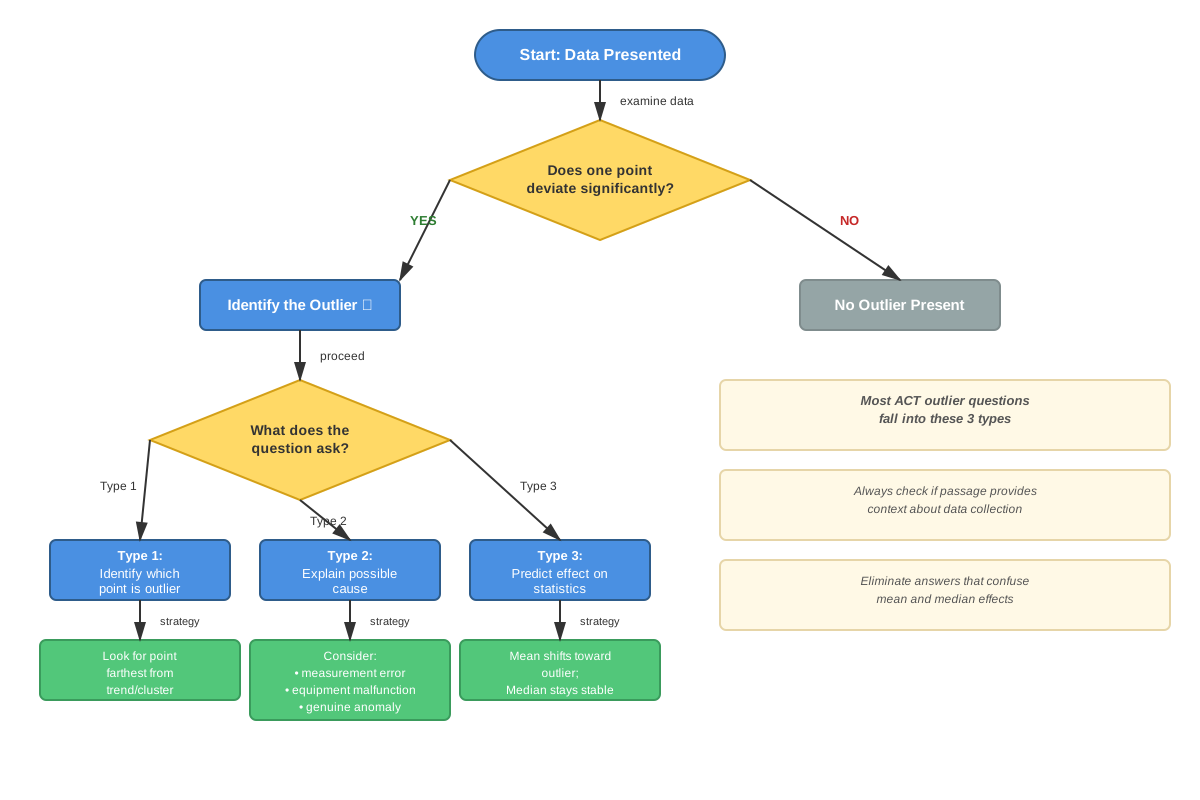
When approaching ACT outliers in data questions, employ this systematic strategy:
Recognition triggers: Watch for these phrases that signal outlier questions:
- "Which data point does NOT follow the pattern..."
- "Which result is most likely due to experimental error..."
- "If the [specific value] were removed, how would the [mean/median] change..."
- "Which measurement is inconsistent with..."
- "The data point at [location] most likely represents..."
Visual scanning technique: For graphical data, spend 5-10 seconds scanning the entire graph before reading the question. Train your eyes to spot:
- Points that sit alone, away from clusters
- Unexpected spikes or dips in line graphs
- Bars that are dramatically different in height
- Points far from trend lines
Pattern establishment first: Before identifying outliers, quickly determine what the "normal" pattern is. Ask yourself: "Is this data increasing, decreasing, staying constant, or showing a curve?" Only after establishing the expected pattern can you identify deviations.
Process of elimination for outlier identification: When asked which data point is an outlier:
- Eliminate any points that clearly follow the trend
- Eliminate points that cluster with others
- Focus on remaining isolated or pattern-breaking points
- Verify your choice by confirming it significantly deviates from the pattern
Statistical impact questions: When asked how removing an outlier affects statistics:
- If the question asks about the mean, the answer will almost always show a change (mean is sensitive)
- If the question asks about the median, the answer will often show no change or minimal change (median is resistant)
- If the question asks about range, removing an extreme outlier will decrease the range
Time management: Outlier questions typically require 30-45 seconds. Don't spend time on complex calculations—the ACT tests conceptual understanding. If you find yourself doing extensive math, you're probably overthinking.
Context clues: Pay attention to the experimental description. If the passage mentions "one trial was interrupted" or "equipment was recalibrated after Trial 3," these hints often point to which data point might be an outlier.
Confidence in visual judgment: Trust your visual pattern recognition. If a point looks obviously different from others, it probably is the outlier. The ACT doesn't use subtle outliers that require statistical software to detect.
Memory Techniques
OUTLIER acronym for identification:
- Obviously different from others
- Unexpected given the trend
- Trend-breaking value
- Located away from clusters
- Isolated on graphs
- Extreme compared to range
- Requires investigation
Mean vs. Median memory device: "Mean Moves with outliers, Median Maintains position" - The repeated M sound helps remember that mean changes while median stays stable.
Visual memory technique: Picture a group of students standing in height order, all between 5'2" and 5'8", with one person who is 6'10". That tall person is the outlier—obviously different, standing apart from the group. This mental image reinforces what outliers look like in data.
The "Sore Thumb" rule: An outlier "sticks out like a sore thumb" - if you have to squint or calculate extensively to find it, it's probably not the outlier the ACT is asking about. True ACT outliers are visually obvious.
Cause categories - "MEND":
- Measurement error
- Experimental error
- Natural variation
- Data entry error
This helps remember the main categories of outlier causes for questions asking about explanations.
Summary
Outliers in data represent values that deviate significantly from the established pattern, trend, or expected range in a dataset. On the ACT Science test, identifying and interpreting outliers is a high-yield skill that appears frequently across Data Representation passages. Students must be able to visually spot outliers in graphs and tables by recognizing points that sit isolated from clusters, break established trends, or show unexpected spikes or dips. Understanding that outliers can result from measurement error, equipment malfunction, data entry mistakes, or genuine rare phenomena is crucial for answering questions about experimental validity. The most important statistical concept is that outliers strongly affect the mean (pulling it toward the extreme value) but have minimal impact on the median (which remains stable). ACT questions typically test outlier identification through visual pattern recognition rather than complex calculations, making rapid scanning and trend recognition the key skills. Students should approach these questions by first establishing what the normal pattern is, then identifying which point breaks that pattern, and finally considering the implications for data interpretation or statistical measures.
Key Takeaways
- Outliers are data points that deviate significantly from the overall pattern or trend, appearing isolated on graphs or breaking established sequences in tables
- Visual identification is the primary skill: scan for points far from clusters, unexpected spikes/dips, or values that don't follow the trend line
- Mean is sensitive to outliers; median is resistant: removing an outlier typically changes the mean substantially but leaves the median unchanged or minimally affected
- Common outlier causes include measurement error, equipment malfunction, data entry mistakes, and genuine rare events—understanding these helps answer interpretation questions
- ACT outlier questions rely on pattern recognition, not complex statistics: if you're doing extensive calculations, you're overthinking the problem
- Context matters: read experimental descriptions for clues about which trials might have been compromised or which measurements might be unreliable
- Outliers aren't always errors: some represent important discoveries or natural variation, so appropriate scientific response involves investigation before exclusion
Related Topics
Measures of Central Tendency and Variability: Deepening understanding of mean, median, mode, range, and standard deviation builds directly on outlier concepts, as these measures respond differently to anomalous values. Mastering outliers enables more sophisticated statistical interpretation.
Trend Analysis and Line of Best Fit: Learning to draw and interpret trend lines requires understanding how outliers can distort apparent relationships between variables. Outlier mastery supports more accurate correlation assessment.
Experimental Design and Controls: Understanding how proper experimental design minimizes outliers through controls, replication, and standardization connects data analysis to the scientific method. This progression moves from identifying outliers to preventing them.
Data Quality and Measurement Error: Exploring systematic versus random error, precision versus accuracy, and error propagation builds on outlier recognition by explaining why anomalous values occur and how to minimize them.
Statistical Hypothesis Testing: Advanced statistical concepts like confidence intervals and significance testing rely on understanding how outliers affect data distributions and whether observed differences are meaningful or due to chance.
Practice CTA
Now that you've mastered the core concepts of outliers in data, it's time to put your knowledge into action! Work through the practice questions to test your ability to identify outliers quickly, interpret their impact on statistical measures, and apply strategic thinking to ACT-style scenarios. Use the flashcards to reinforce key definitions and relationships until recognizing outliers becomes second nature. Remember: outlier questions are high-yield opportunities to demonstrate your analytical skills and boost your Science score. Every practice question you complete builds the pattern recognition speed and confidence you need for test day success. You've got this!
Sign up free to keep reading
Create a free AnvayaPrep account to finish this ACT guide on Outliers in data — plus flashcards and practice questions.