Overview
Percent change in data is a fundamental quantitative skill tested extensively throughout the ACT Science section. This concept requires students to calculate, interpret, and compare how values increase or decrease relative to their original measurements. Unlike simple subtraction that shows absolute change, percent change provides a standardized way to understand the magnitude of change regardless of the units or scale of measurement involved.
The ACT Science test frequently embeds percent change calculations within data representation passages, research summaries, and conflicting viewpoints sections. Students encounter this concept when analyzing graphs, tables, and experimental results where they must determine how much a variable has increased or decreased as a percentage of its initial value. Mastery of act percent change in data is essential because these questions appear in approximately 15-20% of all ACT Science passages, making it one of the highest-yield quantitative skills for test preparation.
Understanding percent change connects directly to broader scientific literacy skills including data interpretation, experimental analysis, and trend recognition. This topic serves as a bridge between basic mathematical operations and sophisticated scientific reasoning, enabling students to make meaningful comparisons across different scales, units, and experimental conditions. The ability to quickly and accurately calculate percent change often determines whether students can answer multiple questions within a single passage, making it a critical skill for achieving competitive scores in the Science section.
Learning Objectives
- [ ] Identify when Percent change in data is being tested in ACT Science passages
- [ ] Explain the core rule or strategy behind Percent change in data calculations
- [ ] Apply Percent change in data to ACT-style questions accurately
- [ ] Distinguish between percent change and absolute change in experimental contexts
- [ ] Calculate percent increase and percent decrease using the standard formula
- [ ] Interpret percent change values in the context of scientific data and trends
- [ ] Recognize common trap answers related to percent change calculations
Prerequisites
- Basic percentage calculations: Understanding how to convert between decimals, fractions, and percentages is essential for executing percent change formulas correctly
- Order of operations: Proper sequencing of mathematical operations ensures accurate calculation of numerators and denominators in percent change formulas
- Reading data from tables and graphs: Extracting accurate initial and final values from visual representations is the first step in any percent change problem
- Basic algebra: Manipulating equations and solving for unknown variables allows students to work backward from percent change to find missing values
Why This Topic Matters
Percent change represents one of the most practical mathematical concepts in scientific analysis. Researchers use percent change to compare treatment effects, population growth rates, chemical reaction yields, and countless other phenomena where the magnitude of change matters more than absolute numbers. In medicine, percent change helps clinicians assess whether a patient's blood pressure decreased by a clinically significant amount. In environmental science, percent change quantifies how much pollution levels have risen or fallen over time.
On the ACT Science test, percent change questions appear in approximately 3-5 questions per exam, distributed across multiple passage types. These questions typically carry the same point value as other questions but often take less time to answer when students have mastered the formula and calculation process. The ACT specifically tests percent change in contexts including:
- Population studies: Changes in organism populations over time or across different environments
- Chemical concentrations: Increases or decreases in reactant or product amounts during experiments
- Physical measurements: Changes in temperature, pressure, volume, or other quantitative variables
- Rate comparisons: How quickly different processes occur relative to baseline measurements
- Experimental outcomes: Comparing control groups to treatment groups in terms of percentage differences
The ACT favors questions where students must extract values from complex tables or graphs, perform the calculation, and then select the answer that matches their computed result. Occasionally, questions ask students to identify which variable showed the greatest or smallest percent change, requiring multiple calculations and comparisons.
Core Concepts
The Percent Change Formula
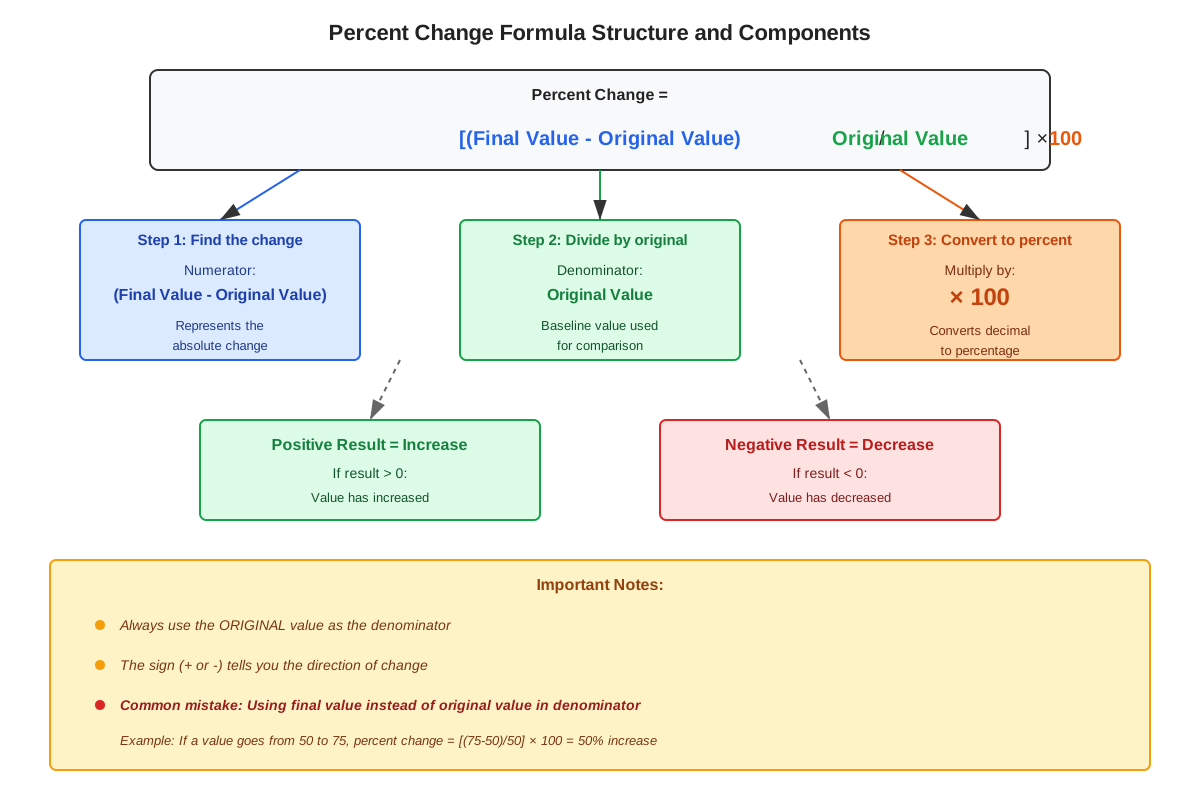
The fundamental formula for percent change in data is:
Percent Change = ((Final Value - Initial Value) / Initial Value) × 100This formula calculates how much a quantity has changed relative to where it started. The numerator represents the absolute change (the raw difference between final and initial values), while the denominator standardizes this change by comparing it to the original value. Multiplying by 100 converts the decimal result into a percentage.
Key components:
- Initial Value: The starting measurement, baseline, or original data point
- Final Value: The ending measurement or data point after change has occurred
- Absolute Change: Final Value minus Initial Value (can be positive or negative)
Percent Increase vs. Percent Decrease
The sign of the result determines whether the change represents an increase or decrease:
| Scenario | Calculation Result | Interpretation |
|---|---|---|
| Final > Initial | Positive percentage | Percent increase |
| Final < Initial | Negative percentage | Percent decrease |
| Final = Initial | Zero | No change |
When reporting percent decrease, the ACT typically expects the absolute value with the word "decrease" rather than a negative sign. For example, if a population drops from 500 to 400 organisms, the calculation yields -20%, but the answer would be stated as "a 20% decrease."
Identifying Percent Change Questions
The ACT Science section signals percent change questions through specific language patterns:
- "By what percent did [variable] increase/decrease?"
- "What was the percent change in [measurement]?"
- "Which variable showed the greatest percent increase?"
- "The [quantity] changed by approximately what percent?"
- "Compared to [initial condition], [final condition] represents what percent change?"
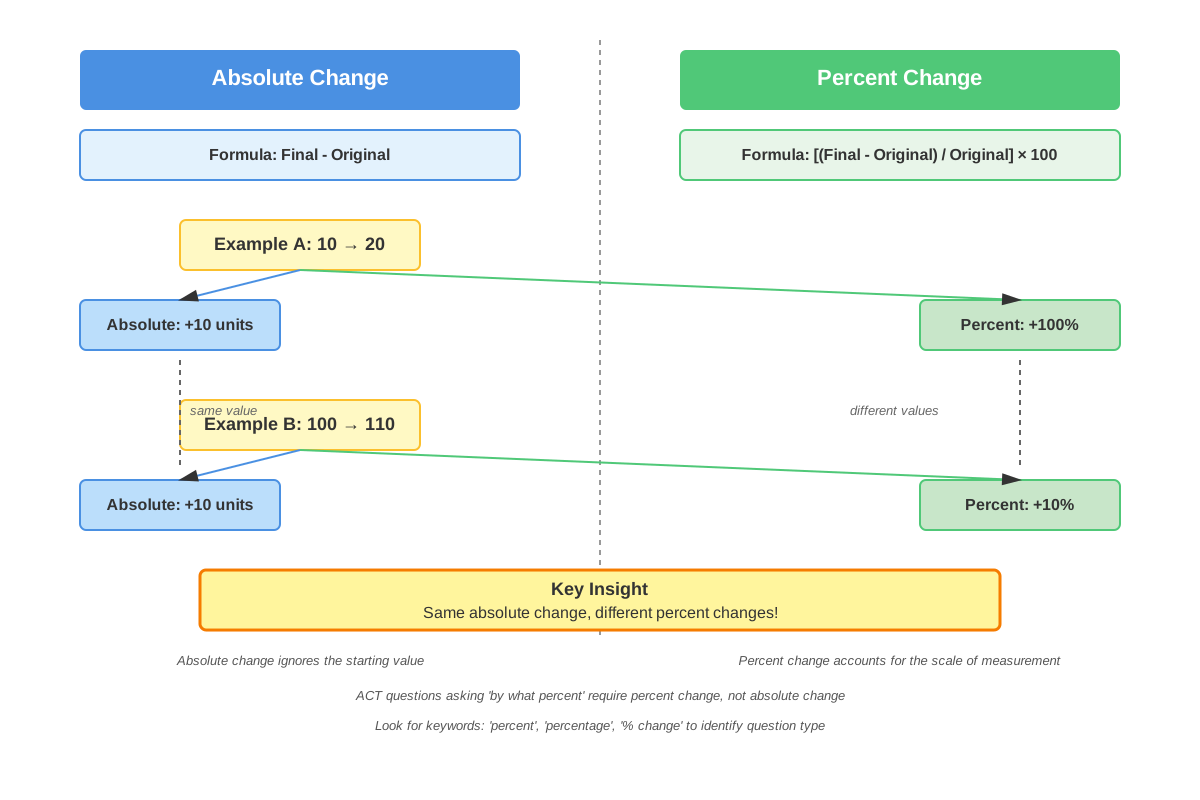
These trigger phrases indicate that students must locate two values, apply the percent change formula, and calculate the result. Unlike questions asking for absolute change ("How much did X increase?"), percent change questions always require division by the initial value.
Working with Different Data Formats
ACT Science passages present data in multiple formats, each requiring slightly different extraction strategies:
Tables: Locate the row and column corresponding to the initial condition, note the value, then find the final condition's value in the same measurement column. Ensure both values use the same units.
Line graphs: Identify the initial point (often at time zero or the leftmost position) and the final point (often at the end of the time series or rightmost position). Read values carefully from the y-axis, estimating between gridlines when necessary.
Bar graphs: Compare the heights of bars representing initial and final conditions. Pay attention to whether the y-axis starts at zero, as this affects visual perception but not calculations.
Scatter plots: Less common for percent change questions, but when they appear, identify specific data points marked in the question stem and extract their coordinates.
Multi-Step Percent Change Problems
Some ACT questions require calculating percent change for multiple variables and then comparing results:
- Identify all relevant variables mentioned in the question
- Extract initial and final values for each variable from the data representation
- Calculate percent change for each variable separately
- Compare results to determine which showed the greatest/smallest change or which meets a specific criterion
These questions test both computational accuracy and organizational skills, as students must track multiple calculations simultaneously.
Percent Change with Negative Numbers
When initial or final values are negative (common in temperature data or financial contexts), the formula remains the same, but students must carefully handle negative signs:
- If temperature changes from -10°C to -5°C, the calculation is: ((-5) - (-10)) / (-10) × 100 = 5 / (-10) × 100 = -50%
- This negative result indicates a 50% decrease in the magnitude of the negative value (the temperature became less negative, which represents warming)
The ACT occasionally includes these scenarios to test careful mathematical reasoning rather than formula memorization.
Approximation Strategies
The ACT Science section allows calculator use, but efficient students develop approximation skills for quick elimination of obviously incorrect answers:
- Round initial values to nearby convenient numbers (e.g., 487 becomes 500)
- Estimate the absolute change before dividing
- Recognize benchmark percentages: 50% means doubling or halving, 100% means doubling, 25% means one-quarter change
These strategies help students eliminate 2-3 answer choices quickly, then calculate precisely only if needed to distinguish between remaining options.
Concept Relationships
Percent change serves as a quantitative tool that connects to virtually every other data representation skill in ACT Science. The concept builds directly on basic percentage calculations and data extraction from visual representations, combining these prerequisites into a single analytical operation.
The relationship flow follows this pattern:
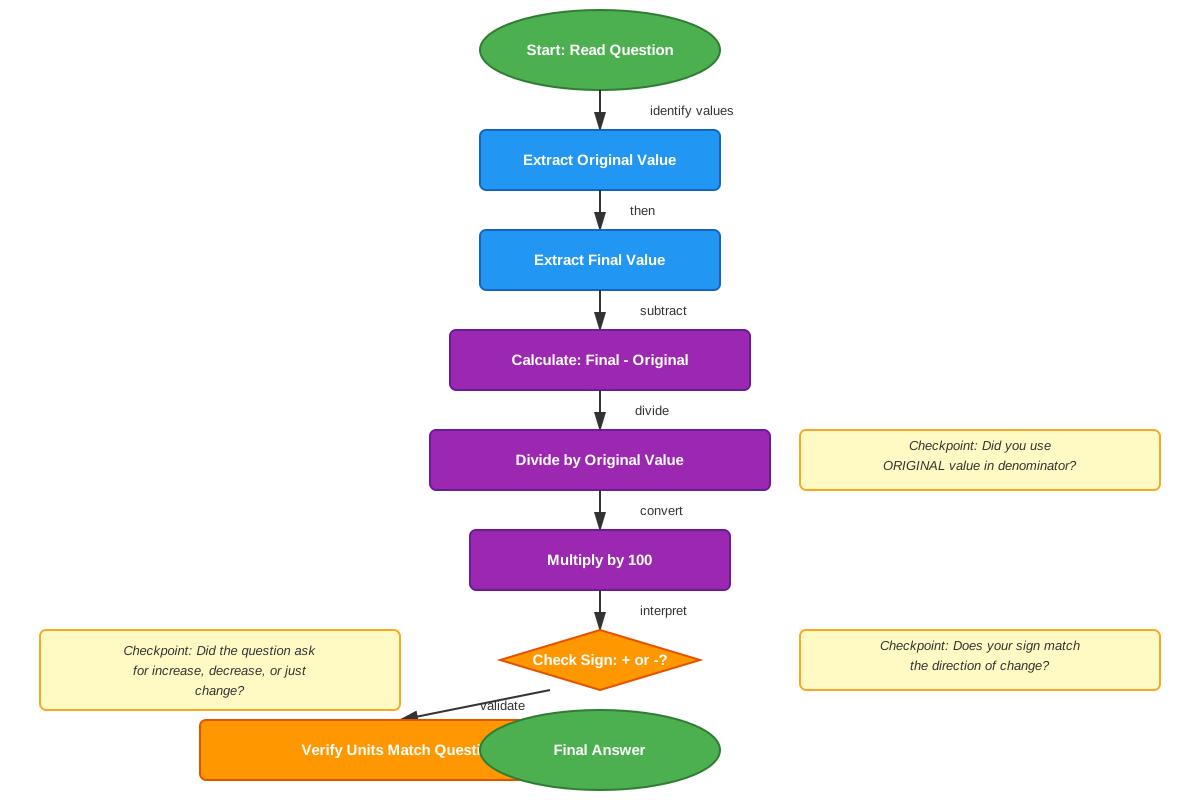
Data Extraction → Absolute Change Calculation → Standardization by Initial Value → Percent Change Result → Scientific Interpretation
Percent change enables meaningful comparisons between variables measured in different units or at different scales. For example, comparing a temperature change of 5°C to a pressure change of 10 kPa would be meaningless without standardization—but comparing a 25% temperature increase to a 15% pressure increase provides actionable insight.
This concept also connects forward to more advanced topics including rate of change, trend analysis, and proportional reasoning. Students who master percent change find it easier to interpret slope in graphs (which represents rate of change) and to understand exponential growth patterns (where percent change remains constant even as absolute change increases).
Within a single ACT passage, percent change often appears alongside questions about direct relationships, inverse relationships, and variable identification, creating a comprehensive assessment of data interpretation skills.
Quick check — test yourself on Percent change in data so far.
Try Flashcards →High-Yield Facts
⭐ The percent change formula is: ((Final - Initial) / Initial) × 100
⭐ Always divide by the initial value, never the final value
⭐ Positive results indicate increases; negative results indicate decreases
⭐ Percent change standardizes comparisons across different scales and units
⭐ The ACT typically presents percent change questions in data representation and research summary passages
- Percent change differs from percentage points (the difference between two percentages)
- A 100% increase means the value doubled (final = 2 × initial)
- A 50% decrease means the value halved (final = 0.5 × initial)
- When comparing multiple percent changes, calculate each separately before comparing
- Percent change can exceed 100% when values more than double
- The order matters: percent change from A to B differs from percent change from B to A
- Reading values incorrectly from graphs is the most common source of errors
- The ACT answer choices often include the result of dividing by the final value instead of initial value as a distractor
Common Misconceptions
Misconception: Percent change and absolute change are the same thing.
Correction: Absolute change is simply Final - Initial, while percent change divides this difference by the initial value and multiplies by 100. A change of 10 units could represent a 10% change, 50% change, or 1% change depending on the initial value.
Misconception: Always divide by the larger number when calculating percent change.
Correction: Always divide by the initial value regardless of whether it's larger or smaller than the final value. The initial value represents the baseline for comparison.
Misconception: A negative percent change means the calculation was done incorrectly.
Correction: Negative percent changes are valid and indicate decreases. The ACT may present the answer as "a 20% decrease" rather than "-20%" but both represent the same concept.
Misconception: If a value increases by 50% then decreases by 50%, it returns to the original value.
Correction: These operations are not symmetric. If a value of 100 increases by 50% to 150, then decreases by 50%, it becomes 75 (not 100). Each percent change uses a different initial value.
Misconception: Percent change between two percentages is calculated the same way as percent change between regular numbers.
Correction: While the formula is the same, the interpretation differs. If unemployment rises from 5% to 8%, that's a 60% increase in the unemployment rate, not a 3 percentage point increase.
Misconception: The units of measurement affect percent change calculations.
Correction: Percent change is unitless because the units cancel out during division. A 20% increase in temperature is 20% whether measured in Celsius, Fahrenheit, or Kelvin (though the absolute values differ).
Worked Examples
Example 1: Population Change in Bacterial Culture
Question: A bacterial culture contained 2,400 cells at the beginning of an experiment. After 6 hours of growth, the culture contained 3,600 cells. What was the percent increase in the bacterial population?
Solution:
Step 1: Identify the initial and final values
- Initial Value = 2,400 cells
- Final Value = 3,600 cells
Step 2: Apply the percent change formula
Percent Change = ((Final - Initial) / Initial) × 100
Percent Change = ((3,600 - 2,400) / 2,400) × 100
Step 3: Calculate the numerator (absolute change)
3,600 - 2,400 = 1,200Step 4: Divide by the initial value
1,200 / 2,400 = 0.5Step 5: Multiply by 100 to convert to percentage
0.5 × 100 = 50%Answer: The bacterial population increased by 50%.
Connection to Learning Objectives: This example demonstrates the core application of the percent change formula to biological data, a common ACT Science context. The positive result correctly indicates an increase, and the calculation follows the standard procedure of dividing by the initial value.
Example 2: Temperature Decrease in Chemical Reaction
Question: During an endothermic reaction, the temperature of a solution decreased from 25°C to 18°C. What was the percent change in temperature?
Solution:
Step 1: Identify the initial and final values
- Initial Value = 25°C
- Final Value = 18°C
Step 2: Apply the percent change formula
Percent Change = ((18 - 25) / 25) × 100Step 3: Calculate the numerator
18 - 25 = -7Step 4: Divide by the initial value
-7 / 25 = -0.28Step 5: Multiply by 100
-0.28 × 100 = -28%Answer: The temperature decreased by 28% (or there was a -28% change in temperature).
Connection to Learning Objectives: This example illustrates how to handle decreases, which produce negative results. The ACT would likely phrase the correct answer as "decreased by 28%" rather than showing the negative sign. This example also demonstrates percent change in a chemistry context with temperature data.
Common Trap Answer: Students who divide by the final value (18) instead of the initial value (25) would calculate -7/18 × 100 = -38.9%, which would likely appear as a distractor answer choice.
Exam Strategy
Systematic Approach to Percent Change Questions
- Identify the question type: Look for keywords like "percent change," "percent increase," or "percent decrease"
- Locate the data source: Determine which table, graph, or figure contains the relevant values
- Extract values carefully: Write down the initial and final values with their units to avoid confusion
- Apply the formula: Use ((Final - Initial) / Initial) × 100 without shortcuts
- Check the sign: Verify whether the result should be positive (increase) or negative (decrease)
- Match to answer choices: Select the answer that matches your calculation, paying attention to whether the question asks for the absolute value
Trigger Words and Phrases
Watch for these specific phrases that signal percent change questions:
- "What was the percent change..."
- "By what percent did..."
- "The percent increase/decrease..."
- "Which showed the greatest percent change..."
- "Approximately what percent..."
Distinguish these from absolute change questions:
- "How much did..." (absolute change)
- "What was the difference..." (absolute change)
- "By how many units..." (absolute change)
Process of Elimination Tips
Eliminate answers that:
- Show the wrong direction (increase vs. decrease)
- Represent the absolute change rather than percent change
- Result from dividing by the final value instead of initial value
- Exceed 100% when the final value is less than double the initial value
- Are negative when the question asks for "percent decrease" (ACT typically wants the absolute value)
Time Allocation
Percent change questions typically require 30-45 seconds when approached systematically:
- 10 seconds: Identify question type and locate data
- 15 seconds: Extract values and set up calculation
- 15 seconds: Calculate and verify
- 5 seconds: Match to answer choices
If a question requires multiple percent change calculations for comparison, allocate 60-90 seconds total. Use approximation to eliminate obviously incorrect answers before calculating precisely.
Calculator Efficiency
- Enter the entire formula as a single calculation: ((final - initial) / initial) × 100
- Use parentheses to ensure correct order of operations
- Double-check that you're dividing by the initial value
- Round final answers to match the precision of answer choices (usually whole numbers or one decimal place)
Memory Techniques
The "FIN-IN" Mnemonic
Final minus INitial, divided by INitial
This reminds students that "IN" (initial) appears twice in the formula—once in the numerator (subtracted from final) and once as the denominator.
The "Baseline Rule"
Always divide by the baseline (initial value). The baseline is where you started, and percent change measures how far you've moved from that starting point.
Visual Formula Memory
Picture a fraction:
  (Final - Initial)
  ─────────────────  × 100
      Initial
The initial value "supports" the change (it's on the bottom), while the change itself sits on top.
The "Direction Check"
After calculating, ask: "Did the value go UP or DOWN?"
- UP = positive percent = increase
- DOWN = negative percent = decrease
This simple check catches sign errors before selecting an answer.
The "Double Check"
A 100% increase means doubling. Use this benchmark to verify reasonableness:
- If your answer is 100% but the value didn't double, recalculate
- If the value more than doubled but your answer is less than 100%, recalculate
Summary
Percent change in data represents a critical quantitative skill for ACT Science success, appearing in 15-20% of passages across multiple scientific contexts. The core formula—((Final - Initial) / Initial) × 100—standardizes comparisons by expressing change relative to the starting value rather than as an absolute difference. Mastery requires three distinct competencies: accurately extracting initial and final values from tables and graphs, correctly applying the formula with proper attention to which value serves as the denominator, and interpreting results in context to distinguish increases from decreases. The ACT tests this concept through direct calculation questions, comparison questions requiring multiple calculations, and interpretation questions where percent change provides insight into experimental outcomes. Students who systematically identify question triggers, carefully track initial versus final values, and verify the direction of change before selecting answers consistently perform well on these high-yield questions.
Key Takeaways
- The percent change formula always divides by the initial value: ((Final - Initial) / Initial) × 100
- Positive results indicate increases; negative results indicate decreases
- Percent change standardizes comparisons across different scales, units, and magnitudes
- Carefully extract values from data representations before calculating to avoid the most common errors
- The ACT frequently includes distractor answers that result from dividing by the final value instead of the initial value
- Percent change questions appear in approximately 3-5 questions per ACT Science test, making them high-yield for focused preparation
- Use approximation to eliminate obviously incorrect answers before performing precise calculations
Related Topics
Absolute Change and Difference Calculations: Understanding how to calculate simple differences between values provides the foundation for the numerator in percent change formulas. Mastering percent change makes it easier to distinguish when questions ask for absolute versus relative change.
Rate of Change and Slope: Percent change over time connects directly to rate calculations and graph slope interpretation. Students who understand percent change can more easily grasp how quickly variables change in experimental contexts.
Proportional Reasoning: Percent change represents one application of proportional thinking. This foundation supports more complex ratio and proportion problems throughout the ACT Science section.
Data Interpretation from Multiple Representations: Percent change questions require extracting accurate values from tables, graphs, and charts. Strengthening these extraction skills improves performance across all quantitative ACT Science questions.
Scientific Notation and Order of Magnitude: When working with very large or very small numbers, percent change calculations may involve scientific notation, connecting these mathematical skills to practical data analysis.
Practice CTA
Now that you've mastered the concepts, formulas, and strategies for percent change in data, it's time to solidify your understanding through active practice. Complete the practice questions to test your ability to identify percent change questions, apply the formula accurately, and avoid common traps. Use the flashcards to reinforce the formula, key terminology, and trigger phrases until they become automatic. Remember: percent change questions are high-yield and highly predictable—consistent practice with these problems will directly translate to points on test day. You've built the foundation; now strengthen it through repetition and application!
Sign up free to keep reading
Create a free AnvayaPrep account to finish this ACT guide on Percent change in data — plus flashcards and practice questions.