Overview
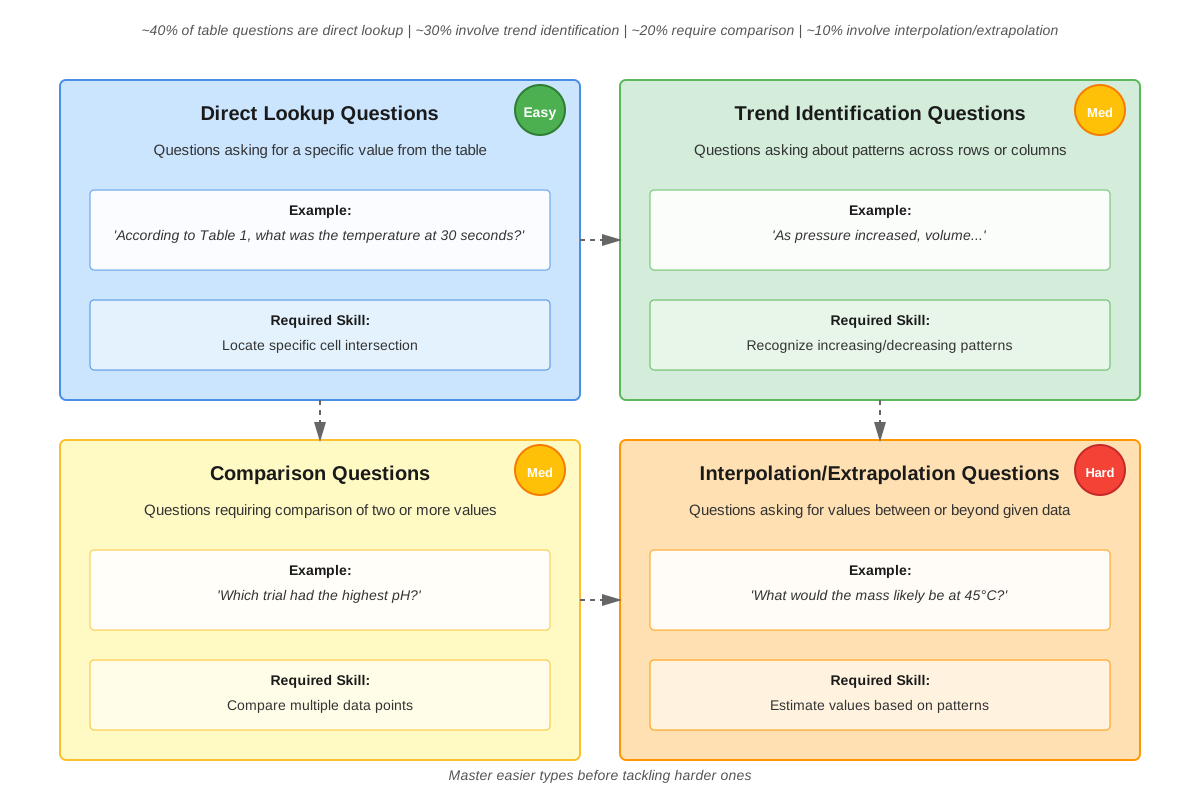
Reading tables is a fundamental skill tested extensively throughout the ACT Science section, appearing in approximately 40% of all passages. Tables present organized data in rows and columns, allowing researchers to display multiple variables and their relationships in a compact, structured format. On the ACT, students must quickly extract specific values, identify trends, compare data points, and draw conclusions from tabular information under strict time constraints.
Mastering ACT reading tables is essential because it forms the foundation for success in Data Representation passages, which constitute roughly one-third of the Science test. Unlike graphs that show visual trends, tables require students to systematically scan rows and columns, understand units of measurement, and mentally process numerical relationships. The ACT frequently combines table-reading skills with other competencies such as interpolation, extrapolation, and pattern recognition. Students who can efficiently navigate tables gain a significant advantage, as these questions are typically among the most straightforward when approached with proper technique.
This topic connects directly to broader scientific literacy and data analysis skills. Tables appear alongside graphs, experimental descriptions, and research summaries throughout the Science section. Understanding how to read tables efficiently enables students to tackle complex passages that integrate multiple data representations, compare experimental conditions, and evaluate hypotheses. The ability to quickly locate information in tables also supports success in Research Summaries and Conflicting Viewpoints passages, where tabular data often provides crucial evidence for answering questions about experimental design and scientific reasoning.
Learning Objectives
- [ ] Identify when Reading tables is being tested in ACT Science passages
- [ ] Explain the core rule or strategy behind Reading tables
- [ ] Apply Reading tables to ACT-style questions accurately
- [ ] Locate specific data points within complex tables containing multiple variables
- [ ] Identify trends and patterns across rows and columns in tabular data
- [ ] Compare values from different sections of a table to draw valid conclusions
- [ ] Interpret units, column headers, and row labels to understand what data represents
Prerequisites
- Basic mathematical operations: Students must perform simple calculations, comparisons, and recognize numerical patterns in data sets
- Understanding of scientific units: Familiarity with common measurements (meters, grams, seconds, degrees) helps interpret what table values represent
- Reading comprehension skills: The ability to understand labels, headers, and brief descriptions that accompany tables is essential for accurate data extraction
Why This Topic Matters
Tables are ubiquitous in scientific research and real-world applications. Scientists use tables to organize experimental results, compare treatment groups, track changes over time, and present complex datasets in accessible formats. In fields ranging from medicine to environmental science, professionals must interpret tabular data daily to make informed decisions, identify trends, and communicate findings effectively.
On the ACT Science test, table-reading questions appear in approximately 15-18 of the 40 questions across the six or seven passages. Data Representation passages, which feature prominently in the exam, rely heavily on tables as their primary information source. These questions typically ask students to locate specific values, identify relationships between variables, determine which variable was manipulated, or predict values based on existing patterns. The ACT intentionally designs tables with varying complexity—some contain just two or three columns, while others present six or more variables with multiple rows of data.
Common table formats on the ACT include: experimental results showing how one variable changes as another is manipulated; comparative data across different conditions, locations, or time periods; classification tables organizing organisms, materials, or phenomena by characteristics; and summary tables presenting statistical measures like means, ranges, or percentages. Questions often require students to cross-reference information from multiple rows or columns, making systematic scanning techniques essential for accuracy and speed.
Core Concepts
Structure and Components of Tables
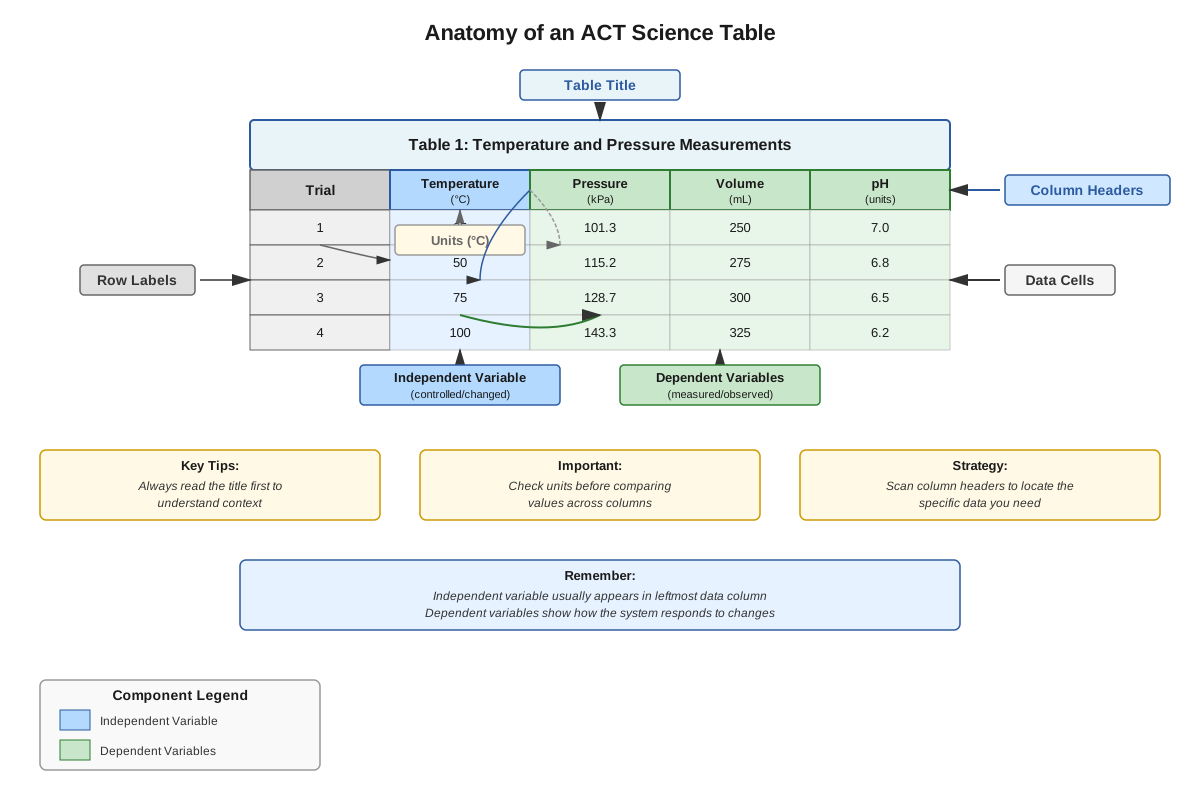
A table consists of organized data arranged in rows (horizontal) and columns (vertical), with each intersection called a cell containing a specific data point. Every well-constructed table includes several critical components that students must identify immediately. The table title appears at the top and describes what data the table contains, often indicating the experiment or phenomenon being studied. Column headers run across the top row and identify what each vertical column represents, including the variable name and its units of measurement. Row labels appear in the leftmost column and identify what each horizontal row represents, such as trial numbers, time points, or experimental conditions.
Understanding independent and dependent variables within tables is crucial. The independent variable (what researchers manipulate or control) typically appears in the leftmost column or top row, while dependent variables (what researchers measure) occupy the remaining columns. For example, if a table shows how plant height changes at different temperatures, temperature would be the independent variable in the first column, and plant height measurements would be dependent variables in subsequent columns.
Units of measurement appear either in column headers (e.g., "Temperature (°C)") or in a separate row beneath headers. Students must pay careful attention to units because the ACT often includes answer choices with correct numbers but incorrect units, or questions requiring unit conversions. Common units include metric measurements (meters, grams, liters), time units (seconds, minutes, hours), temperature scales (Celsius, Fahrenheit, Kelvin), and percentages or ratios.
Systematic Scanning Techniques
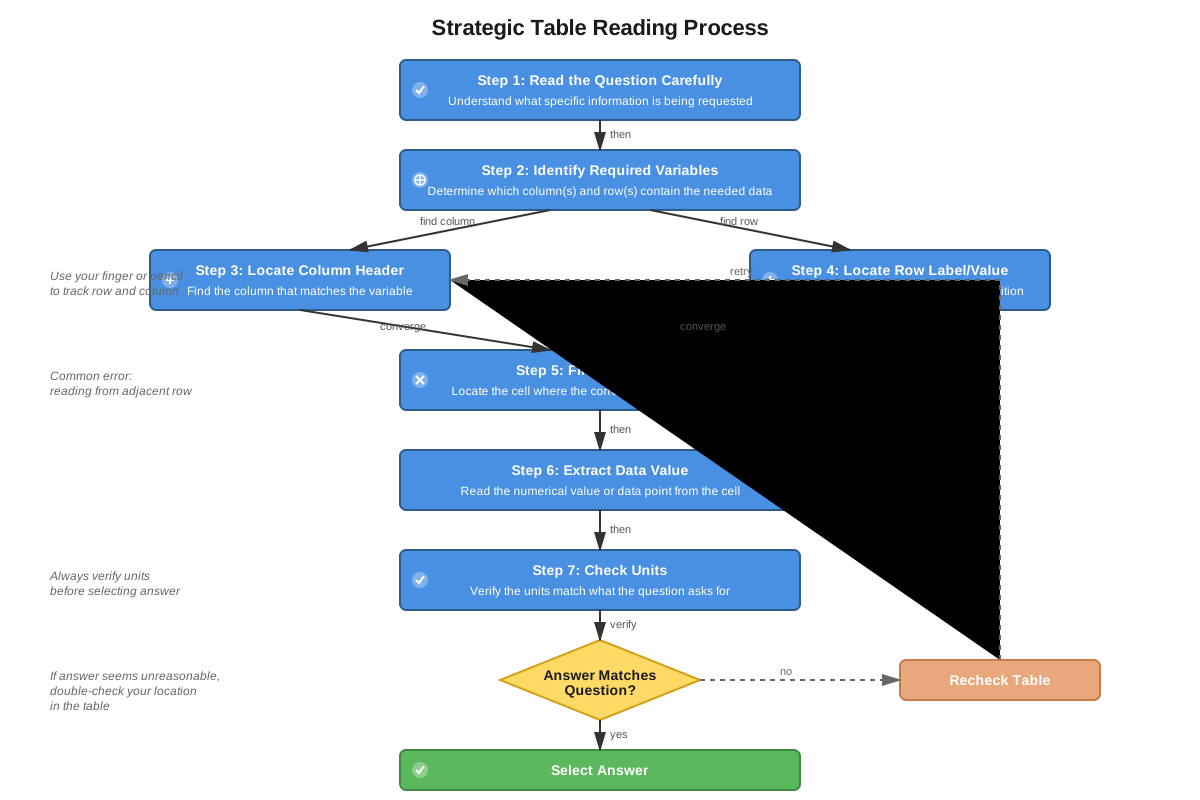
Efficient table reading requires a methodical approach rather than random searching. The column-first method works best when questions ask about a specific variable: locate the relevant column header first, then scan down that column to find the needed value. Conversely, the row-first method is optimal when questions reference a specific condition or trial: find the appropriate row label, then scan across to the relevant column.
The finger-tracking technique dramatically improves accuracy, especially with large tables. Students should use their pencil or finger to trace from the row label to the column header, ensuring they read from the correct cell. This prevents the common error of reading from an adjacent row or column, which the ACT exploits by including these incorrect values as distractor answer choices.
When tables contain many rows, identifying patterns becomes essential. Students should quickly scan for trends: Are values increasing or decreasing? Do they change linearly or exponentially? Are there any outliers or unexpected values? Recognizing these patterns helps answer questions about relationships between variables without examining every single data point.
Interpreting Relationships and Trends
Tables reveal relationships between variables that students must identify and describe. A direct relationship (positive correlation) occurs when both variables increase together or decrease together. For example, if temperature increases from 10°C to 30°C while reaction rate increases from 5 mL/min to 25 mL/min, the variables show a direct relationship. An inverse relationship (negative correlation) occurs when one variable increases while the other decreases, such as altitude increasing while air pressure decreases.
Interpolation involves estimating values between two data points in a table. If a table shows that at 20°C the value is 15 and at 30°C the value is 25, students might need to estimate the value at 25°C (approximately 20, assuming a linear relationship). Extrapolation extends patterns beyond the table's data range. If values increase consistently from 10 to 40 across four trials, students might predict the next trial would yield approximately 50.
Comparing Data Across Conditions
Many ACT questions require comparing values from different parts of a table. Within-column comparisons examine how values change as you move down a single column, revealing how one variable affects another. Within-row comparisons examine how values change across a row, showing how different dependent variables respond to the same condition. Cross-table comparisons occur when passages present multiple tables, requiring students to synthesize information from different data sets.
When comparing values, students should note both the magnitude of differences and the direction of change. A question might ask "Under which condition was the value greatest?" requiring identification of the maximum value, or "How much did the value change between Trial 1 and Trial 4?" requiring subtraction of specific data points.
Common Table Formats on the ACT
Time-series tables show how variables change over time, with time typically in the leftmost column and measured variables in subsequent columns. These tables test students' ability to identify temporal trends and rates of change. Comparative tables present data from different experimental groups, locations, or conditions side-by-side, allowing direct comparison. Classification tables organize items by characteristics, often using yes/no, present/absent, or categorical descriptors rather than numerical values. Summary statistics tables present calculated values like means, medians, ranges, or standard deviations rather than raw data points.
Concept Relationships
The skill of reading tables serves as a foundation for more complex data analysis tasks throughout the ACT Science section. Reading tables → Identifying trends represents the first level of analysis, where students move from simply locating values to recognizing patterns. This progression then leads to Identifying trends → Making predictions, where established patterns enable extrapolation beyond the given data.
Tables often appear alongside other data representations, creating the relationship: Reading tables ↔ Reading graphs, where students must integrate information from both formats to answer questions. Some passages present the same data in multiple formats, testing whether students can recognize equivalent information across representations.
The connection Reading tables → Understanding experimental design emerges because tables organize data according to experimental structure. The independent variable's placement, the number of trials, and the variables measured all reflect the experiment's design. This understanding then supports Understanding experimental design → Evaluating hypotheses, as students use tabular evidence to determine which scientific explanations the data supports.
Within the broader Data Representation unit, reading tables connects to interpreting graphs, understanding scales and units, and analyzing scientific data. These skills collectively enable students to tackle Research Summaries passages, where experimental results appear in various formats, and Conflicting Viewpoints passages, where scientists cite data to support different interpretations.
Quick check — test yourself on Reading tables so far.
Try Flashcards →High-Yield Facts
⭐ Tables organize data in rows (horizontal) and columns (vertical), with the independent variable typically in the leftmost column
⭐ Column headers identify what each column represents and include units of measurement
⭐ The ACT frequently includes incorrect answer choices with values from adjacent rows or columns to test careful reading
⭐ Direct relationships show both variables increasing or decreasing together; inverse relationships show one increasing while the other decreases
⭐ Always check units in column headers before selecting an answer, as the ACT may present correct numbers with wrong units
- Row labels in the leftmost column identify experimental conditions, time points, or trial numbers
- Tables with multiple dependent variables allow comparison of how different factors respond to the same conditions
- Interpolation estimates values between given data points; extrapolation extends patterns beyond the table's range
- The largest and smallest values in a column often appear in answer choices, requiring careful identification of which is requested
- When tables show data from multiple trials or experiments, questions often ask for comparisons across these different conditions
⭐ Systematic scanning (locate row first, then column, or vice versa) prevents reading errors in complex tables
- Tables may present calculated values (means, percentages) rather than raw measurements
- Some tables use symbols, abbreviations, or codes that require reference to a key or legend
- Questions asking "according to the table" require answers based solely on presented data, not outside knowledge
- The number of significant figures in table values indicates measurement precision and should match answer choices
Common Misconceptions
Misconception: The first column always contains the independent variable.
Correction: While the independent variable typically appears in the leftmost column, some tables place it in the top row as column headers, with dependent variables in subsequent rows. Always read the table structure carefully to identify which variable was manipulated versus measured.
Misconception: All relationships in tables are linear and proportional.
Correction: Variables may show non-linear relationships, exponential growth, logarithmic patterns, or no clear relationship at all. Students must examine the actual values rather than assuming a simple proportional relationship exists.
Misconception: Values can be read quickly without checking row and column labels each time.
Correction: The ACT deliberately designs tables where adjacent cells contain similar values, and answer choices include these "off-by-one-row" or "off-by-one-column" distractors. Every data point requires verification of both its row and column position.
Misconception: Units don't matter if the number is correct.
Correction: The ACT frequently tests unit awareness by providing answer choices with correct numerical values but incorrect units (e.g., 25 cm vs. 25 m, or 30°C vs. 30°F). Always verify that both the number and unit match what the question asks.
Misconception: Empty cells or dashes in tables mean zero.
Correction: Empty cells, dashes, or "N/A" typically indicate that no measurement was taken, the measurement was impossible under those conditions, or the data is not applicable—not that the value equals zero. These distinctions matter when questions ask about data availability or experimental design.
Misconception: Tables with more rows and columns are always harder.
Correction: Table difficulty depends more on what the question asks than on table size. A large table with a straightforward "locate this value" question may be easier than a small table requiring complex comparisons or pattern recognition. Focus on the question type rather than being intimidated by table dimensions.
Worked Examples
Example 1: Locating and Comparing Values
Passage Context: A table shows the results of an experiment measuring plant growth under different light conditions.
| Light Intensity (lumens) | Day 7 Height (cm) | Day 14 Height (cm) | Day 21 Height (cm) |
|---|---|---|---|
| 100 | 3.2 | 5.8 | 8.1 |
| 200 | 4.1 | 7.9 | 11.3 |
| 300 | 4.8 | 9.2 | 13.7 |
| 400 | 5.0 | 9.8 | 14.2 |
Question: According to the table, what was the height of the plant at 200 lumens on Day 14?
Solution Process:
- Identify what the question asks: a specific height value at a particular light intensity and time point
- Locate the independent variable (Light Intensity) in the leftmost column
- Find the row for 200 lumens (second data row)
- Locate the dependent variable column (Day 14 Height)
- Trace from the 200 lumens row across to the Day 14 Height column
- Read the value at the intersection: 7.9 cm
Answer: 7.9 cm
Learning Objective Connection: This demonstrates applying reading tables to locate specific data points accurately, using systematic scanning techniques.
Example 2: Identifying Trends and Relationships
Passage Context: Using the same table from Example 1.
Question: Based on the table, as light intensity increased from 100 to 400 lumens, the plant height on Day 21:
A. decreased consistently
B. increased consistently
C. remained constant
D. increased then decreased
Solution Process:
- Identify what the question asks: the relationship between light intensity (independent variable) and Day 21 height (dependent variable)
- Locate the Day 21 Height column (rightmost column)
- Read values from top to bottom: 8.1, 11.3, 13.7, 14.2
- Analyze the pattern: each value is larger than the previous one
- Determine the relationship type: values increase as light intensity increases (direct relationship)
- Note that the rate of increase slows at higher intensities (8.1→11.3 is +3.2, but 13.7→14.2 is only +0.5), but the trend remains consistently upward
- Eliminate answer choices: A (decreased) is wrong, C (constant) is wrong, D (increased then decreased) is wrong
Answer: B (increased consistently)
Learning Objective Connection: This demonstrates identifying trends in tabular data and explaining the relationship between variables, a core strategy for reading tables on the ACT.
Exam Strategy
When approaching ACT Science questions involving tables, implement this systematic process: First, read the question stem completely before looking at the table to understand exactly what information you need. This prevents wasting time scanning irrelevant data. Second, identify whether the question asks for a specific value, a comparison, a trend, or a prediction—each requires a different approach.
Trigger words that indicate table-reading questions include: "according to the table," "based on the data," "the table shows," "what was the value," "which trial," "at what temperature," and "under which condition." These phrases signal that the answer exists directly in the table without requiring outside knowledge or complex calculations.
For value-location questions, use the two-step verification method: locate the correct row, then locate the correct column, and verify you're reading from the intersection. Place your pencil on the row label and slide it across to the correct column to prevent reading from adjacent cells. Always check that the units in your answer match the units in the column header.
For comparison questions, identify all relevant values first, then perform the comparison. If asked "which condition produced the highest value," scan the entire relevant column to find the maximum before checking answer choices. Don't assume the first or last value is the answer—the ACT often places extreme values in the middle of tables.
For trend questions, examine at least three consecutive data points to confirm a pattern. A single increase doesn't establish an increasing trend; verify the pattern continues. Watch for questions asking about "consistent" trends versus "overall" trends, as some tables show minor fluctuations within a general pattern.
Time management: Allocate approximately 30-45 seconds per table-reading question. If a table appears complex, tackle simpler questions first to build confidence and secure quick points. Mark questions requiring extensive calculation or multiple table references for review if time permits.
Process of elimination works powerfully with table questions. If a question asks for a value at "300°C," immediately eliminate any answer choice that doesn't match the units in the table. If the table shows values ranging from 10-50, eliminate answer choices outside this range unless the question explicitly asks for extrapolation.
Memory Techniques
CHART - A mnemonic for systematic table reading:
- Column headers first (identify what each column represents)
- Horizontal scanning (read across rows carefully)
- Always check units (verify measurements match the question)
- Row labels matter (confirm you're in the correct row)
- Trace with your pencil (prevent reading from wrong cells)
"Row then Column, Column then Row" - This rhythmic phrase reminds students that either scanning method works, but consistency prevents errors. Choose one approach per question and stick with it.
The "Unit Check" visualization: Picture a stop sign appearing next to every answer choice, reminding you to verify units before selecting. This mental image helps prevent the common error of choosing correct numbers with wrong units.
"Independent Left, Dependent Right" - While not universal, this phrase helps students quickly identify typical table organization, with the manipulated variable on the left and measured variables to the right.
The "Finger Bridge" technique: Visualize building a bridge from the row label to the column header, with your finger as the bridge. The data point where your bridge lands is your answer. This kinesthetic memory aid reinforces the two-dimensional navigation required for accurate table reading.
Summary
Reading tables is a high-yield skill for ACT Science success, appearing in approximately 40% of passages and forming the foundation for Data Representation questions. Tables organize experimental data in rows and columns, with column headers identifying variables and units, and row labels indicating conditions or time points. Mastery requires systematic scanning techniques—locating the correct row and column before reading values—and careful attention to units of measurement. The ACT tests table-reading skills through questions asking students to locate specific values, identify trends and relationships between variables, compare data across conditions, and make predictions through interpolation or extrapolation. Success depends on methodical approaches rather than speed-reading: verify row and column positions, check units against answer choices, and use finger-tracking to prevent reading from adjacent cells. Understanding whether relationships are direct (both variables increase together) or inverse (one increases while the other decreases) enables students to answer trend questions confidently. The most common errors—reading from wrong rows or columns, ignoring units, and assuming linear relationships—can be avoided through deliberate verification steps and recognition that the ACT deliberately includes these mistakes as distractor answer choices.
Key Takeaways
- Tables present organized data in rows and columns; always identify column headers (with units) and row labels before attempting to locate values
- Use systematic scanning: locate either the row or column first, then trace to the intersection to find the correct data point
- The ACT includes distractor answers with values from adjacent rows or columns; finger-tracking prevents these careless errors
- Units of measurement are critical—verify that both the number and unit in your answer match what the question requests
- Direct relationships show variables changing in the same direction; inverse relationships show variables changing in opposite directions
- Interpolation estimates values between data points; extrapolation extends patterns beyond the table's range
- Questions with trigger phrases like "according to the table" require answers based solely on presented data, not outside scientific knowledge
Related Topics
Reading Graphs and Charts: After mastering tables, students should develop parallel skills for extracting information from line graphs, bar charts, and scatter plots, which often appear alongside tables in Data Representation passages.
Understanding Experimental Design: Table structure reflects experimental design choices; learning to identify independent variables, dependent variables, controls, and trials enhances both table-reading accuracy and Research Summaries performance.
Interpolation and Extrapolation: These mathematical techniques for estimating values beyond given data points build directly on table-reading skills and appear frequently in higher-difficulty ACT Science questions.
Comparing Multiple Data Representations: Advanced passages present the same information in multiple formats (tables, graphs, diagrams); mastering tables enables students to synthesize information across representations efficiently.
Scientific Notation and Significant Figures: Tables often present very large or very small numbers in scientific notation; understanding this notation and recognizing significant figures improves accuracy when reading and comparing values.
Practice CTA
Now that you understand the core strategies for reading tables on the ACT Science section, it's time to apply these techniques to realistic practice questions. Work through the accompanying practice problems, focusing on systematic scanning, unit verification, and trend identification. Use the finger-tracking technique on every question to build this habit before test day. Review the flashcards to reinforce key concepts like direct versus inverse relationships and the components of well-structured tables. Remember: table-reading questions are among the most straightforward on the ACT when approached methodically—master this skill to secure quick points and build confidence for more complex passages. Your systematic approach to tables will translate directly to higher scores on test day!
Sign up free to keep reading
Create a free AnvayaPrep account to finish this ACT guide on Reading tables — plus flashcards and practice questions.