Overview
Predicting experimental outcomes is a critical skill tested extensively in the ACT Science section, particularly within Research Summaries passages. This competency requires students to extrapolate beyond the data explicitly presented in experiments and make logical inferences about what would happen under modified conditions, with different variables, or in extended scenarios. Unlike simple data interpretation, which asks students to read values directly from graphs or tables, predicting outcomes demands a deeper understanding of experimental relationships, trends, and underlying scientific principles.
The ACT Science test allocates approximately 40% of its questions to Research Summaries passages, and within these passages, prediction questions represent one of the highest-frequency question types. These questions assess whether students can identify patterns in experimental data, understand cause-and-effect relationships between variables, and apply these relationships to novel situations. Mastery of ACT predicting experimental outcomes questions separates high-scoring students from average performers because it requires both analytical thinking and scientific reasoning rather than mere data lookup skills.
This topic connects fundamentally to other Science concepts including experimental design, variable relationships, data interpretation, and scientific reasoning. Students who excel at predicting outcomes demonstrate they understand not just what happened in an experiment, but why it happened and what the underlying mechanisms suggest about untested scenarios. This skill forms the bridge between passive data observation and active scientific thinking—the hallmark of advanced scientific literacy that the ACT seeks to measure.
Learning Objectives
- [ ] Identify when Predicting experimental outcomes is being tested in ACT Science passages
- [ ] Explain the core rule or strategy behind Predicting experimental outcomes
- [ ] Apply Predicting experimental outcomes to ACT-style questions accurately
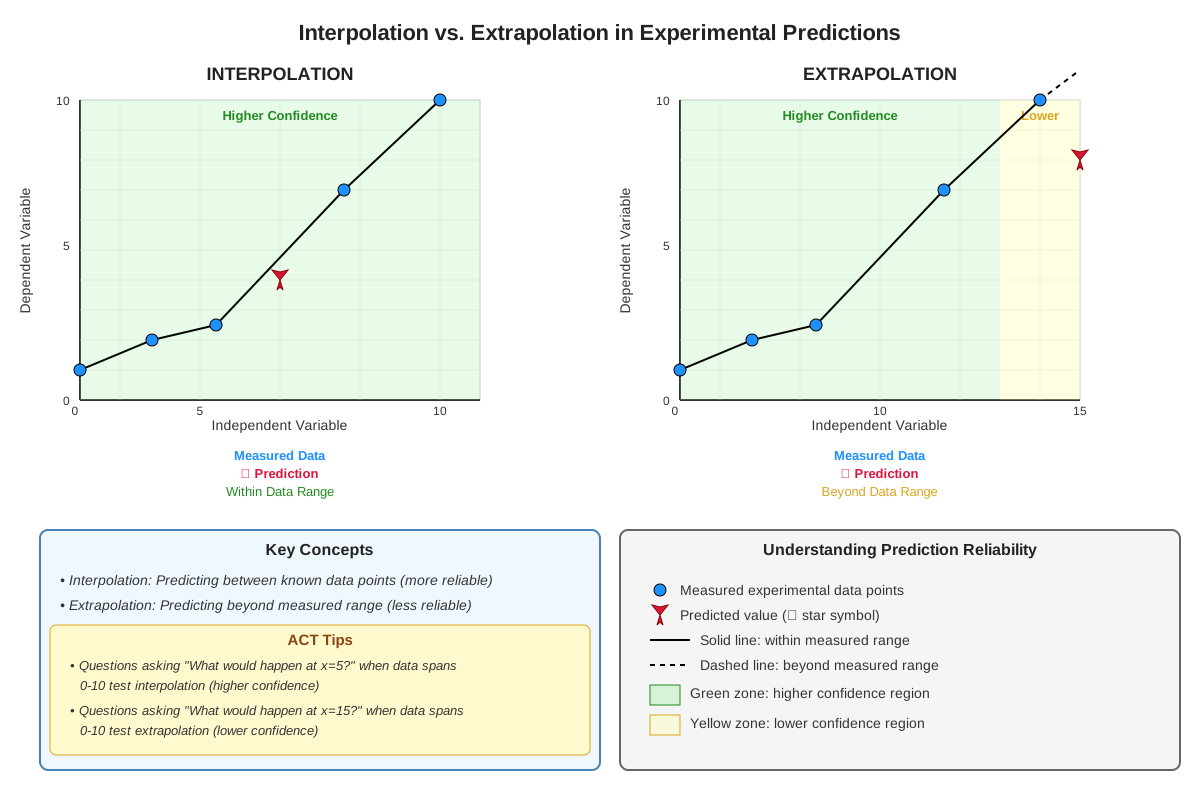
- [ ] Distinguish between interpolation (predicting within data range) and extrapolation (predicting beyond data range)
- [ ] Recognize the relationship between independent and dependent variables when making predictions
- [ ] Evaluate whether a prediction requires understanding of trends, mechanisms, or both
- [ ] Determine confidence levels for predictions based on data consistency and pattern strength
Prerequisites
- Basic graph reading skills: Essential for identifying trends and patterns that form the foundation of predictions
- Understanding of independent and dependent variables: Necessary to determine which variable changes affect which outcomes
- Familiarity with experimental design: Helps recognize controlled variables and what factors might influence results
- Data interpretation fundamentals: Required to extract the relationships that enable prediction-making
- Basic scientific reasoning: Enables logical extension of observed patterns to new scenarios
Why This Topic Matters
Predicting experimental outcomes represents real-world scientific thinking that extends far beyond standardized testing. Scientists regularly use existing data to predict results of future experiments, determine optimal conditions for processes, and make decisions about resource allocation. Medical researchers predict patient responses to treatments, environmental scientists forecast ecological changes, and engineers anticipate system behaviors under varying conditions—all using the same prediction skills tested on the ACT.
On the ACT Science test, prediction questions appear in approximately 25-35% of Research Summaries passages, making them one of the most frequent question types students will encounter. These questions typically appear 8-12 times per test across all science passages. The ACT specifically designs these questions to test higher-order thinking skills, placing them in the "Scientific Investigation" and "Evaluation of Models, Inferences, and Experimental Results" reporting categories—the two most heavily weighted areas for college readiness assessment.
Common manifestations in exam passages include: asking what would happen if a variable were increased or decreased beyond tested values; predicting outcomes for intermediate values not explicitly tested; determining results if experimental conditions were modified; forecasting which treatment group would show specific effects; and identifying expected patterns if experiments were extended in time or scope. These questions often use phrases like "Based on the results," "If the experiment were repeated with," "According to the data," and "Which of the following would most likely occur."
Core Concepts
Understanding Prediction Types
The ACT tests two primary types of predictions: interpolation and extrapolation. Interpolation involves predicting outcomes for values that fall within the range of tested data. For example, if an experiment tested temperatures of 10°C, 20°C, and 30°C, predicting the outcome at 25°C requires interpolation. This type of prediction is generally more reliable because it assumes the trend continues consistently within the observed range.
Extrapolation requires predicting outcomes beyond the tested data range—either above the highest value or below the lowest value tested. Using the temperature example, predicting outcomes at 40°C or 5°C would be extrapolation. These predictions carry more uncertainty because trends may change outside the observed range, but the ACT expects students to assume trends continue unless given reason to believe otherwise.
Identifying Trends and Patterns
Successful prediction begins with accurate trend identification. Linear trends show constant rates of change—each unit increase in the independent variable produces the same change in the dependent variable. These appear as straight lines on graphs and are the most straightforward for prediction. Non-linear trends include exponential growth (accelerating increase), exponential decay (decelerating decrease), logarithmic patterns (rapid initial change that levels off), and cyclical patterns (repeating increases and decreases).
The ACT frequently tests whether students can distinguish between these trend types and apply the appropriate prediction logic. For linear trends, students can calculate or estimate the rate of change and apply it to new values. For non-linear trends, students must recognize the pattern type and understand how the rate of change itself changes.
Variable Relationships
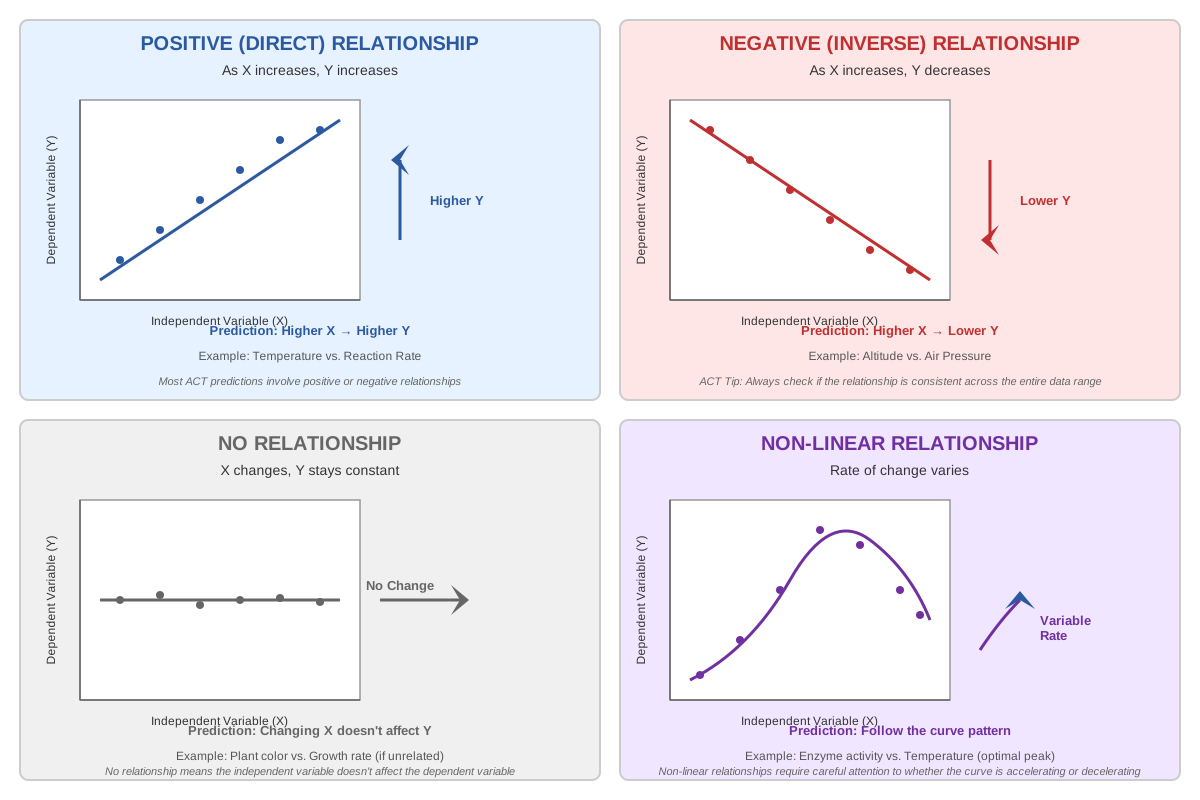
Understanding how variables relate is fundamental to prediction. Direct relationships occur when both variables change in the same direction—as one increases, the other increases. Inverse relationships show opposite changes—as one variable increases, the other decreases. Some experiments show no relationship, where changes in one variable don't affect the other, while others display complex relationships where the effect depends on the range or presence of other variables.
| Relationship Type | Characteristic | Graph Appearance | Prediction Strategy |
|---|---|---|---|
| Direct Linear | Constant positive rate | Upward straight line | Multiply rate by change |
| Inverse Linear | Constant negative rate | Downward straight line | Multiply rate by change |
| Exponential Growth | Accelerating increase | Upward curve (steepening) | Recognize accelerating pattern |
| Exponential Decay | Decelerating decrease | Downward curve (flattening) | Recognize slowing pattern |
| No Relationship | No correlation | Horizontal line or scatter | Predict no change |
The Prediction Process
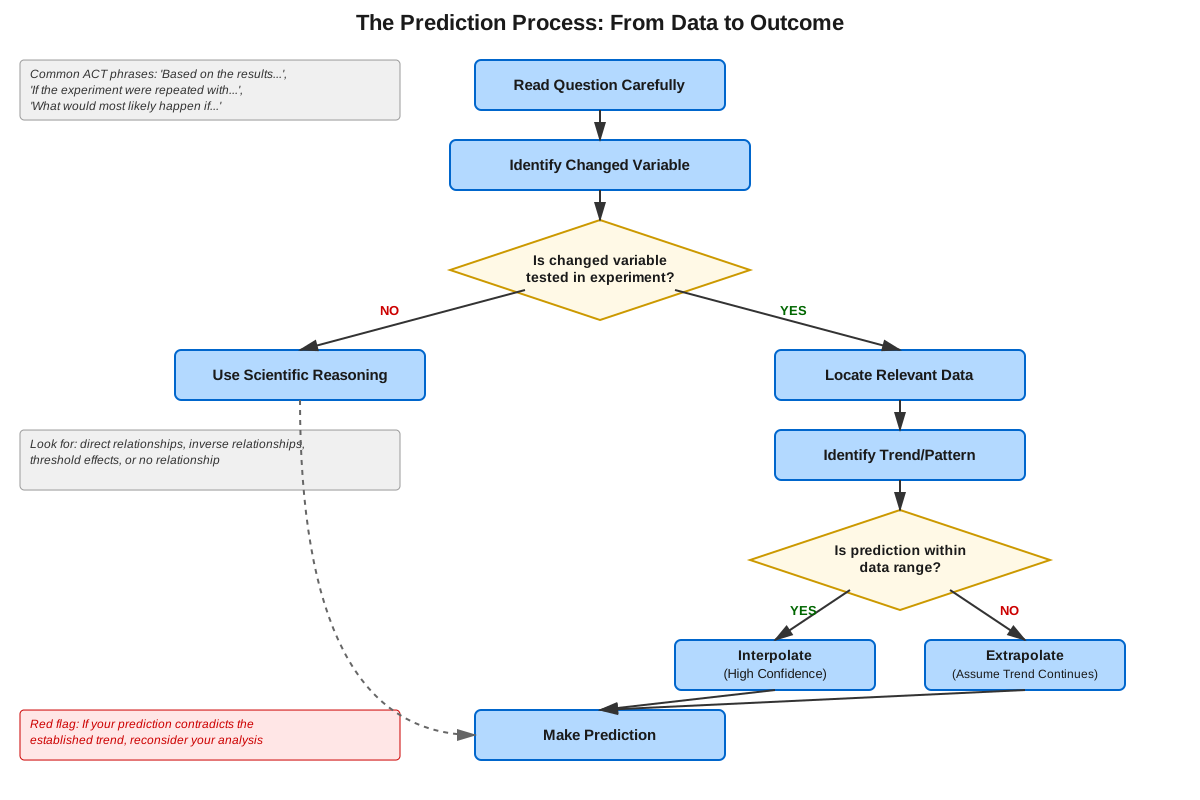
Making accurate predictions follows a systematic approach:
- Identify the question type: Determine whether the question asks for interpolation, extrapolation, or a conditional prediction (what if conditions changed)
- Locate relevant data: Find the specific experiment, graph, or table containing the relationship needed for prediction
- Determine the trend: Identify whether the relationship is linear, exponential, inverse, or another pattern
- Assess consistency: Check whether the trend holds across all data points or shows exceptions
- Apply the pattern: Extend the identified trend to the new scenario
- Verify reasonableness: Ensure the prediction makes scientific sense and aligns with the experimental context
Mechanism-Based Predictions
Some ACT questions require understanding not just the pattern but the underlying mechanism. For example, if an experiment shows that increasing temperature increases reaction rate, predicting outcomes at higher temperatures requires recognizing that molecular motion increases with temperature, leading to more frequent collisions. While the ACT doesn't require deep content knowledge, recognizing basic cause-and-effect relationships strengthens prediction accuracy.
Mechanism-based thinking helps students avoid common errors like assuming trends continue indefinitely when physical limits exist. For instance, if enzyme activity increases with temperature up to 40°C, students should recognize that extremely high temperatures would likely denature the enzyme, even if not explicitly stated.
Comparative Predictions
Many ACT questions ask students to compare predicted outcomes across different conditions or groups. These questions test whether students can apply the same trend to multiple scenarios and rank the results. For example, if three different catalysts show varying effects on reaction rate, students might need to predict which would be most effective at a higher temperature based on the observed temperature-sensitivity patterns.
Concept Relationships
The concepts within predicting experimental outcomes form an interconnected framework. Trend identification serves as the foundation—without accurately recognizing patterns, predictions become guesswork. Understanding variable relationships builds on trend identification by explaining why patterns exist, which strengthens prediction confidence. The prediction process integrates both trend identification and variable relationships, applying them systematically to novel scenarios.
Interpolation and extrapolation represent different applications of the same underlying skill—pattern extension—but with varying confidence levels. Interpolation relies on the assumption that trends remain consistent within observed ranges, while extrapolation adds the assumption that trends continue beyond observed ranges. Mechanism-based predictions enhance both by providing logical justification for why trends should continue or change.
These concepts connect to prerequisite knowledge through experimental design (which determines what variables are tested and how), data interpretation (which enables trend identification), and graph reading (which provides the visual representation of relationships). They lead forward to more advanced topics like evaluating experimental validity, comparing multiple experiments, and synthesizing information across passages.
Relationship map: Graph Reading → Trend Identification → Variable Relationship Understanding → Prediction Process → Interpolation/Extrapolation → Mechanism-Based Refinement → Comparative Predictions → Experimental Evaluation
High-Yield Facts
- ⭐ Prediction questions typically use trigger phrases: "most likely," "would probably," "if the experiment were repeated," "based on the results," and "according to the data"
- ⭐ When extrapolating, assume the observed trend continues unless the question or passage suggests otherwise
- ⭐ Linear relationships allow for direct calculation: find the rate of change and multiply by the difference in the independent variable
- ⭐ For interpolation questions, the answer will fall between the values of the surrounding data points
- ⭐ If multiple data points show the same trend, predictions based on that trend are more reliable than predictions from a single data point
- Inverse relationships mean that as one variable increases, the other decreases proportionally
- Exponential trends show accelerating or decelerating rates of change, not constant rates
- When comparing predictions across groups, apply the same trend logic to each group separately
- Questions asking about "intermediate values" are testing interpolation skills
- If a graph shows a plateau or leveling off, predictions beyond that point should reflect the leveling trend, not continued increase
- Cyclical patterns require identifying the period and phase of the cycle to predict future values
- When variables show no relationship in the data, predict that changing one will not affect the other
Quick check — test yourself on Predicting experimental outcomes so far.
Try Flashcards →Common Misconceptions
Misconception: All trends continue indefinitely in the same pattern when extrapolating.
Correction: While the ACT generally expects students to assume trends continue, physical and biological systems often have limits. If data shows a trend approaching a maximum or minimum, predictions should reflect this leveling off rather than unlimited continuation.
Misconception: Prediction questions always require complex calculations.
Correction: Most ACT prediction questions test pattern recognition and logical reasoning rather than mathematical computation. Students should focus on identifying the direction and type of change rather than calculating exact values.
Misconception: Interpolation and extrapolation are equally reliable.
Correction: Interpolation is more reliable because it assumes consistency within an observed range, while extrapolation assumes trends continue beyond observed data, introducing more uncertainty. The ACT may test this distinction by asking about confidence levels.
Misconception: If one variable affects another, the relationship must be direct (both increase together).
Correction: Variables can have inverse relationships (one increases while the other decreases), no relationship (changes in one don't affect the other), or complex relationships (the effect depends on other factors or ranges).
Misconception: Mechanism understanding is unnecessary for prediction questions.
Correction: While the ACT doesn't require deep content knowledge, understanding basic cause-and-effect relationships helps students make more accurate predictions and avoid illogical answers, especially when trends might change under extreme conditions.
Misconception: All data points must fit the trend perfectly for predictions to be valid.
Correction: Real experimental data often shows minor variations around a trend due to measurement error or natural variation. Students should identify the overall pattern rather than being distracted by small deviations.
Worked Examples
Example 1: Temperature and Enzyme Activity
Passage Context: An experiment measured the activity of an enzyme at different temperatures. The results showed:
- At 10°C: 20 units of activity
- At 20°C: 45 units of activity
- At 30°C: 75 units of activity
- At 40°C: 95 units of activity
Question: Based on the results, the enzyme activity at 25°C would most likely be closest to:
A) 30 units
B) 50 units
C) 60 units
D) 80 units
Solution Process:
Step 1 - Identify question type: This is an interpolation question because 25°C falls within the tested range (10-40°C).
Step 2 - Locate relevant data: The values at 20°C (45 units) and 30°C (75 units) bracket the target temperature.
Step 3 - Determine the trend: Calculate the rate of change between 20°C and 30°C:
- Change in activity: 75 - 45 = 30 units
- Change in temperature: 30 - 20 = 10°C
- Rate: 30 units per 10°C = 3 units per °C
Step 4 - Apply the pattern: 25°C is 5°C above 20°C:
- Predicted increase: 5°C × 3 units/°C = 15 units
- Predicted activity: 45 + 15 = 60 units
Step 5 - Verify reasonableness: 60 units falls between 45 and 75, which makes sense for a value between 20°C and 30°C. The trend appears roughly linear in this range.
Answer: C) 60 units
Connection to learning objectives: This example demonstrates identifying interpolation questions, applying the systematic prediction process, and using variable relationships (temperature affects enzyme activity directly).
Example 2: Plant Growth Under Different Light Conditions
Passage Context: Three groups of plants were grown under different light intensities for 4 weeks. Average height was measured:
| Light Intensity (lumens) | Week 1 (cm) | Week 2 (cm) | Week 3 (cm) | Week 4 (cm) |
|---|---|---|---|---|
| 100 | 5 | 8 | 10 | 11 |
| 200 | 5 | 10 | 16 | 23 |
| 300 | 5 | 11 | 19 | 28 |
Question: If the experiment were continued for another week under the same conditions, which group would most likely show the greatest height increase from Week 4 to Week 5?
Solution Process:
Step 1 - Identify question type: This is an extrapolation question asking about future time points and requires comparing growth rates across groups.
Step 2 - Analyze trends for each group:
- 100 lumens: Growth is slowing (3→2→1 cm increases per week)
- 200 lumens: Growth is accelerating (5→6→7 cm increases per week)
- 300 lumens: Growth is accelerating (6→8→9 cm increases per week)
Step 3 - Determine patterns: The 100-lumen group shows decelerating growth (approaching a plateau), while the 200 and 300-lumen groups show accelerating growth. Higher light intensity correlates with faster acceleration.
Step 4 - Make predictions:
- 100 lumens: Next increase likely ≤1 cm (continuing deceleration)
- 200 lumens: Next increase likely ~8 cm (continuing acceleration pattern)
- 300 lumens: Next increase likely ~10-11 cm (continuing stronger acceleration)
Step 5 - Compare and conclude: The 300-lumen group shows both the highest absolute growth rate and the strongest acceleration pattern, making it most likely to show the greatest increase in Week 5.
Answer: The 300-lumen group
Connection to learning objectives: This example demonstrates distinguishing between trend types (linear vs. accelerating), comparing predictions across experimental groups, and recognizing when mechanism (light intensity affects growth rate) supports predictions.
Exam Strategy
When approaching prediction questions on the ACT Science test, students should first scan for trigger words that signal prediction questions: "most likely," "probably," "if the experiment were repeated," "would be closest to," "based on the results," and "according to the data." These phrases immediately indicate that the question requires extending beyond explicitly stated information.
Exam Tip: Spend 5-10 seconds identifying the trend before looking at answer choices. Students who look at answers first often get distracted by plausible-sounding but incorrect options.
The most efficient approach follows this sequence:
- Locate the relevant data source (specific graph, table, or experiment description)
- Determine whether the question asks for interpolation or extrapolation
- Identify the trend type (linear, exponential, inverse, etc.)
- Check trend consistency across multiple data points
- Apply the trend to the new scenario
- Eliminate answers that contradict the identified trend
For process-of-elimination, immediately remove answers that show the opposite trend (increasing when data shows decreasing, or vice versa). Next, eliminate answers that fall outside reasonable ranges—for interpolation, answers should fall between surrounding values; for extrapolation, answers should extend the pattern logically. Finally, choose between remaining options by considering the rate of change and whether it's constant or changing.
Time management is crucial: prediction questions should take 30-45 seconds on average. Students who spend more than one minute on a prediction question are likely overcomplicating the analysis. The ACT designs these questions to test pattern recognition, not complex calculation, so if the solution seems to require extensive math, reconsider the approach.
Watch for these common trap patterns:
- Answers that use numbers from the passage but don't represent the correct prediction
- Options that show the correct trend direction but wrong magnitude
- Choices that would be correct for a different variable than the one asked about
- Answers that ignore the trend and simply repeat an existing data point
Memory Techniques
PREDICT - A mnemonic for the systematic prediction process:
- Pinpoint the question type (interpolation/extrapolation)
- Review the relevant data
- Evaluate the trend pattern
- Determine consistency across points
- Infer the new value
- Check reasonableness
- Test against answer choices
"Same Direction, Direct; Opposite Direction, Inverse" - A simple phrase to remember variable relationships. When both variables move in the same direction (both increase or both decrease), the relationship is direct. When they move in opposite directions (one increases while the other decreases), the relationship is inverse.
The "Between or Beyond" Rule - For quick categorization: If the new value falls BETWEEN tested values, use interpolation (more reliable); if it's BEYOND tested values, use extrapolation (less reliable but assume the trend continues).
Visualization Strategy: When looking at graphs, physically trace the trend line with your finger or pencil beyond the data points. This kinesthetic action helps your brain naturally extend the pattern and makes extrapolation more intuitive.
The "Three-Point Check": Always verify trends using at least three data points when available. Two points might show a pattern by coincidence, but three points confirm a trend. This helps avoid predictions based on anomalous data.
Summary
Predicting experimental outcomes represents a core ACT Science skill that tests students' ability to extend observed patterns to new scenarios through interpolation and extrapolation. Success requires systematic trend identification, understanding of variable relationships, and logical application of patterns to untested conditions. The ACT expects students to assume trends continue consistently unless given reason to believe otherwise, making pattern recognition more important than complex calculations. Students must distinguish between direct and inverse relationships, recognize linear versus non-linear trends, and apply appropriate prediction strategies based on whether new values fall within or beyond tested ranges. The most effective approach involves identifying the question type, locating relevant data, determining the trend, assessing consistency, applying the pattern, and verifying reasonableness—all within 30-45 seconds per question. Mastery of this topic directly impacts performance on 25-35% of Research Summaries questions, making it one of the highest-yield skills for ACT Science success.
Key Takeaways
- Prediction questions appear 8-12 times per ACT Science test and use trigger phrases like "most likely," "would probably," and "if the experiment were repeated"
- Interpolation (predicting within data range) is more reliable than extrapolation (predicting beyond data range), but both assume trends continue consistently
- Identifying trend type—linear, exponential, inverse, or complex—is the critical first step that determines prediction strategy
- Direct relationships show both variables changing in the same direction; inverse relationships show opposite changes
- The systematic PREDICT process (Pinpoint, Review, Evaluate, Determine, Infer, Check, Test) ensures accurate and efficient predictions
- Most prediction questions test pattern recognition rather than calculation; if extensive math seems necessary, reconsider the approach
- Always verify trends using at least three data points when available to avoid predictions based on anomalous data
Related Topics
Data Interpretation and Analysis: Building on prediction skills, this topic covers extracting meaning from experimental results, comparing datasets, and identifying significant differences—essential for understanding what data reveals before predicting what it suggests.
Experimental Design and Variables: Understanding how experiments are structured, which variables are controlled versus manipulated, and how design choices affect results provides the foundation for making informed predictions about modified experimental conditions.
Trend Analysis and Pattern Recognition: This advanced topic extends prediction skills to more complex scenarios including multiple interacting variables, threshold effects, and non-linear relationships that require sophisticated pattern recognition.
Scientific Reasoning and Hypothesis Testing: Mastering predictions enables students to evaluate whether experimental results support or refute hypotheses, a higher-order skill that integrates prediction with critical analysis of scientific claims.
Practice CTA
Now that you've mastered the core concepts and strategies for predicting experimental outcomes, it's time to put your knowledge into action! The practice questions and flashcards are specifically designed to reinforce these skills with ACT-style scenarios. Each practice item targets the exact question types you'll encounter on test day, helping you build speed and accuracy. Remember, prediction questions represent some of the highest-yield points on the ACT Science test—mastering them now will directly boost your score. Approach each practice question systematically using the PREDICT process, and review any mistakes to identify pattern recognition gaps. You've got this!
Sign up free to keep reading
Create a free AnvayaPrep account to finish this ACT guide on Predicting experimental outcomes — plus flashcards and practice questions.