Overview
The procedure section of Research Summaries passages on the ACT Science test represents one of the most frequently tested and high-yield areas students will encounter. Understanding experimental procedures is fundamental to interpreting scientific research, as the methodology determines the validity and reliability of any study's conclusions. On the ACT, procedure-related questions assess whether students can identify the steps researchers took, understand why specific methodological choices were made, and recognize how changes to procedures would affect experimental outcomes.
ACT procedure questions appear in approximately 40% of all Research Summaries passages, making this topic essential for achieving a competitive score. These questions test scientific literacy beyond mere data interpretation—they evaluate whether students understand the logic of experimental design, can identify controlled and manipulated variables, and recognize the relationship between methodology and results. Students who master procedure analysis gain a significant advantage because these questions often serve as gateways to understanding the entire passage structure.
The relationship between procedure and other Science concepts is foundational. Procedure understanding connects directly to experimental design principles, variable identification, data interpretation, and hypothesis testing. Without grasping what researchers actually did in an experiment, students cannot accurately interpret graphs, tables, or conclusions. This topic serves as the bridge between the theoretical framework of a study (its hypothesis and background) and the empirical evidence (the data and results). Mastering procedure analysis enables students to approach Research Summaries passages systematically and confidently.
Learning Objectives
- [ ] Identify when Procedure is being tested in ACT Science passages
- [ ] Explain the core rule or strategy behind Procedure analysis
- [ ] Apply Procedure understanding to ACT-style questions accurately
- [ ] Distinguish between independent variables, dependent variables, and controlled variables within experimental procedures
- [ ] Predict how modifications to experimental procedures would affect results
- [ ] Evaluate whether a given procedure adequately tests a stated hypothesis
- [ ] Sequence experimental steps in logical order based on passage descriptions
Prerequisites
- Basic scientific method understanding: Recognizing the components of experiments (hypothesis, variables, controls, results) provides the framework for analyzing procedures
- Reading comprehension skills: Extracting key information from dense scientific text is necessary to identify procedural details embedded in passages
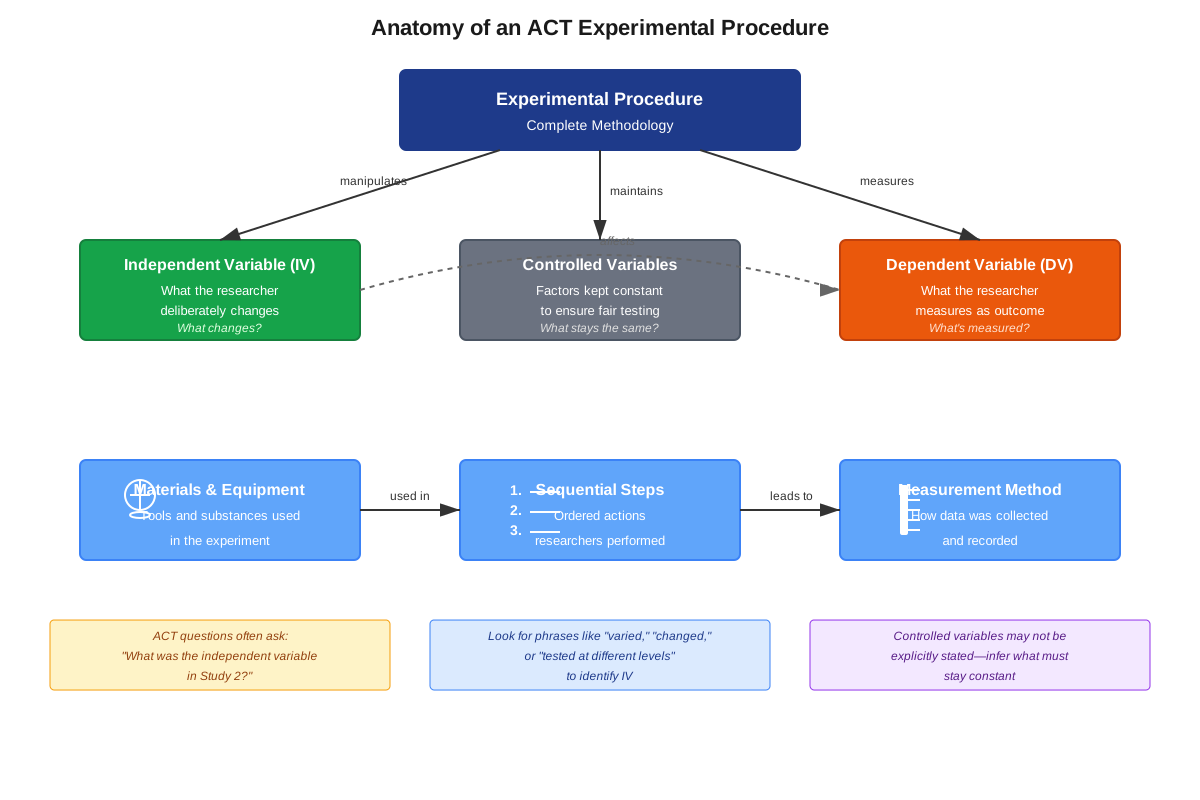
- Variable identification: Distinguishing what changes, what's measured, and what stays constant forms the foundation of procedure analysis
- Basic laboratory equipment familiarity: Knowing common tools (beakers, thermometers, microscopes) helps students visualize experimental setups quickly
Why This Topic Matters
Understanding experimental procedures extends far beyond standardized testing into real-world scientific literacy. Every medical study, environmental report, and technological innovation relies on sound methodology. Citizens who can evaluate procedures critically can assess whether research claims are valid, whether studies were properly controlled, and whether conclusions are justified. This skill becomes increasingly important in an era of widespread scientific information and misinformation.
On the ACT Science test, procedure-related questions appear in approximately 8-12 questions per test, representing roughly 20-30% of all Science questions. These questions typically appear in Research Summaries passages (3 passages per test), where students must analyze experiments involving 2-4 studies. The frequency and predictability of procedure questions make this topic one of the highest-yield areas for focused study. Students who can quickly identify and analyze procedures gain valuable time for more complex data interpretation questions.
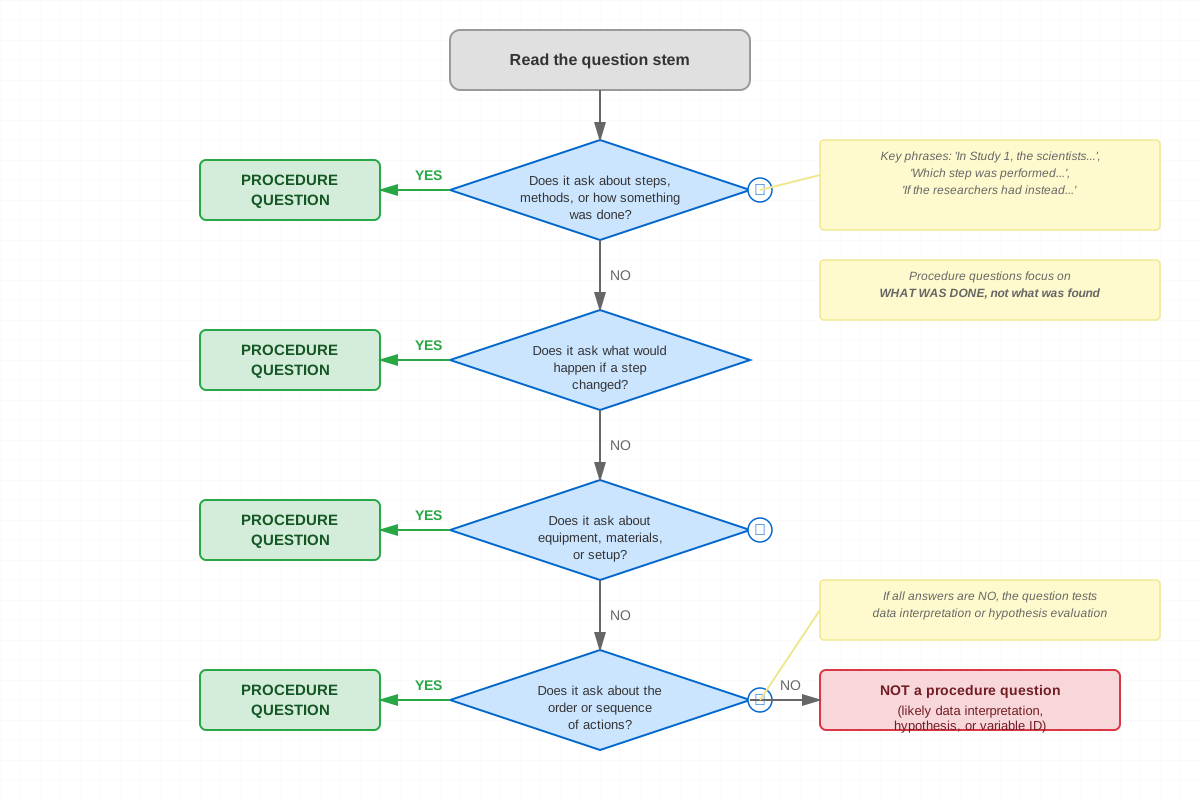
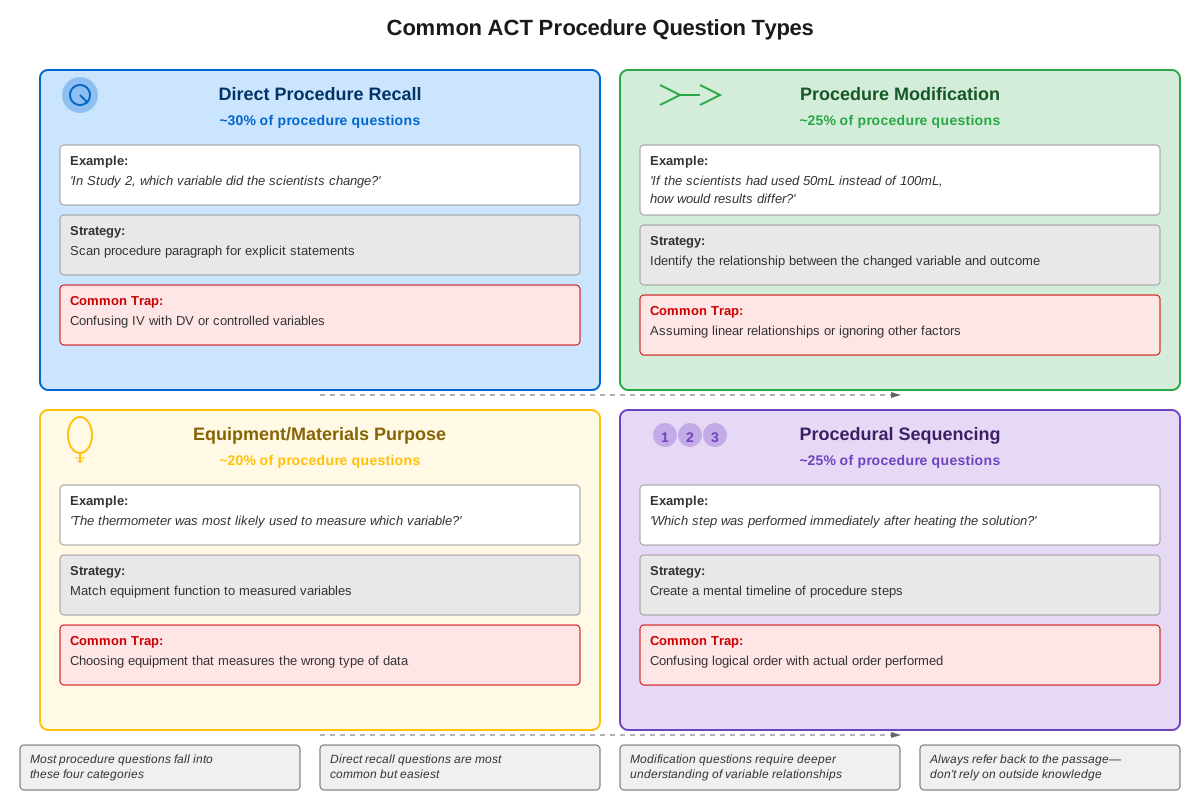
Procedure questions manifest in several common formats on the ACT. Direct procedure questions ask "According to the description of Experiment 2, which of the following steps occurred first?" or "In Study 1, what was measured?" Comparative procedure questions require students to identify differences between multiple experiments: "How did the procedure in Experiment 2 differ from Experiment 1?" Application questions test whether students can extend procedural logic: "To test whether temperature affects the reaction rate, which variable should be changed?" Recognition of these patterns enables strategic, efficient test-taking.
Core Concepts
Understanding Experimental Procedures
An experimental procedure is the detailed, step-by-step methodology researchers follow to test a hypothesis. On the ACT, procedures are typically described in 3-6 sentences within Research Summaries passages, often using past tense and sequential language. The procedure section explains what materials were used, what actions were performed, what measurements were taken, and in what order events occurred. Students must extract this information quickly and accurately to answer procedure-specific questions and to understand the context for data interpretation.
The structure of ACT procedure descriptions follows predictable patterns. Most begin with setup or preparation (assembling materials, preparing samples), progress through manipulation (changing variables, applying treatments), continue with observation or measurement (recording data, taking readings), and conclude with analysis or repetition (calculating results, performing multiple trials). Recognizing this sequence helps students mentally organize complex procedures even when passages present information in non-linear formats.
Types of Procedure Questions
Direct identification questions ask students to locate specific procedural details explicitly stated in the passage. These questions typically begin with phrases like "According to the passage," "In Experiment 1," or "The researchers measured." The answer is always directly stated, requiring careful reading but no inference. Example: "What instrument was used to measure temperature in Study 2?"
Sequencing questions test whether students understand the order of experimental steps. These questions may ask what happened first, last, or immediately after a specific action. The ACT frequently tests this because proper sequencing is essential to experimental validity—certain steps must occur in specific orders for results to be meaningful. Example: "Which of the following steps occurred immediately before the solution was heated?"
Comparison questions require students to identify similarities or differences between procedures across multiple experiments within a passage. These questions assess whether students can track procedural variations that explain different results. The key strategy involves creating a mental or written comparison table while reading. Example: "How did the procedure in Experiment 3 differ from the procedure in Experiment 2?"
Application and extension questions ask students to apply procedural logic to new scenarios. These questions test deeper understanding by requiring students to predict what would happen if procedures were modified or to suggest procedural changes to test new hypotheses. Example: "To determine whether light intensity affects plant growth, which variable should be changed?"
Key Procedural Elements to Identify
| Element | Definition | ACT Testing Focus |
|---|---|---|
| Independent Variable | The factor deliberately changed by researchers | Identifying what was manipulated across trials |
| Dependent Variable | The factor measured or observed as an outcome | Recognizing what data was collected |
| Controlled Variables | Factors kept constant across all trials | Understanding what remained unchanged |
| Sample/Subject | The material or organism being studied | Identifying what was tested |
| Equipment/Materials | Tools and substances used | Recognizing measurement instruments |
| Measurement Units | How quantities were expressed | Understanding data precision |
| Number of Trials | How many times the procedure was repeated | Assessing reliability |
Reading Strategies for Procedure Sections
When encountering a Research Summaries passage, students should employ active reading strategies specifically designed for procedure extraction. First, underline or circle action verbs (measured, heated, placed, recorded) as these indicate procedural steps. Second, box numerical values (temperatures, volumes, times) as these specify exact conditions. Third, star equipment names (thermometer, balance, spectrophotometer) as questions frequently ask about measurement tools.
The annotation method involves creating shorthand notes in margins: "IV = temp" for independent variable, "DV = growth" for dependent variable, "CV = light, water" for controlled variables. This external memory system prevents the need to re-read entire paragraphs when answering questions. Students should spend 30-45 seconds annotating procedures during initial passage reading, which saves 2-3 minutes during question answering.
Procedural Logic and Experimental Design
Understanding why researchers chose specific procedures requires grasping basic experimental design principles. Controls exist to isolate the effect of the independent variable—if multiple factors change simultaneously, researchers cannot determine which caused observed effects. When the ACT asks "Why did the researchers keep the volume constant in all trials?" the answer relates to controlling variables to ensure valid comparisons.
Replication (repeating trials) increases reliability by reducing the impact of random errors or anomalies. When procedures mention "three trials were conducted" or "the experiment was repeated five times," this indicates attention to data quality. ACT questions may ask about the purpose of multiple trials or how results would differ with fewer repetitions.
Standardization ensures that procedures can be reproduced by other scientists. Specific measurements (25 mL, 100°C, 30 minutes) rather than vague descriptions (some water, hot, a while) characterize rigorous procedures. The ACT tests whether students recognize that precise procedural details enable replication and verification.
Concept Relationships
The concepts within procedure analysis form an interconnected system. Understanding procedural steps enables identification of variables, which in turn allows prediction of expected results. The relationship flows: Procedure → Variables → Data → Conclusions. Each component depends on the previous one, making procedure the foundational element of Research Summaries analysis.
Procedure connects to prerequisite knowledge of the scientific method by representing the "methods" section of formal research. The hypothesis (from scientific method) determines what procedure is needed; the procedure generates data; the data supports or refutes the hypothesis. This cyclical relationship means procedure questions often implicitly test hypothesis understanding.
The connection to data interpretation is direct and essential. Students cannot accurately interpret graphs or tables without knowing what was measured (dependent variable), what was changed (independent variable), and under what conditions (controlled variables). A graph showing "temperature vs. time" means nothing without procedural context explaining how temperature was manipulated or measured.
Textual relationship map:
Hypothesis → determines → Procedure → manipulates → Independent Variable → affects → Dependent Variable → produces → Data → displayed in → Graphs/Tables → supports/refutes → Hypothesis
Quick check — test yourself on Procedure so far.
Try Flashcards →High-Yield Facts
- ⭐ Procedure questions account for 20-30% of ACT Science questions, making them one of the most frequently tested topics
- ⭐ The independent variable is what researchers deliberately change between trials or groups
- ⭐ The dependent variable is what researchers measure or observe as the outcome
- ⭐ Controlled variables must remain constant across all experimental trials to ensure valid comparisons
- ⭐ Sequential language (first, then, next, finally, after, before) signals the order of procedural steps
- ⭐ Equipment names (thermometer, balance, graduated cylinder) frequently appear in procedure questions asking "what was used to measure..."
- Multiple trials or repetitions increase experimental reliability by reducing random error
- Procedures described in past tense indicate completed experiments, while future/conditional tense suggests proposed modifications
- Comparison questions require identifying what changed between experiments, not what stayed the same
- Procedural modifications questions test whether students understand the relationship between methods and results
- The phrase "according to the passage" signals a direct identification question requiring no inference
- Standardized measurements (specific numbers with units) indicate rigorous, reproducible procedures
- Control groups receive no treatment or a standard treatment for comparison purposes
- The order of steps matters—certain procedures must occur in specific sequences for valid results
Common Misconceptions
Misconception: The independent variable is what gets measured in an experiment.
Correction: The independent variable is what researchers deliberately manipulate or change. The dependent variable is what gets measured as the outcome. Remember: the dependent variable depends on the independent variable.
Misconception: All variables mentioned in a procedure are either independent or dependent.
Correction: Most experiments have one independent variable, one dependent variable, and multiple controlled variables that remain constant. Controlled variables are equally important because they ensure fair comparisons between trials.
Misconception: Procedure questions always ask about the order of steps.
Correction: While sequencing is one type of procedure question, the ACT also tests identification of variables, equipment, measurements, and comparisons between experiments. Students must prepare for multiple question formats.
Misconception: If a procedure mentions multiple measurements, all of them are dependent variables.
Correction: Researchers often measure multiple factors, but only the primary outcome being studied is the dependent variable. Other measurements might be controlled variables being monitored or supplementary data. Context determines which measurement is the dependent variable.
Misconception: Longer, more detailed procedures indicate more complex or difficult questions.
Correction: Procedure complexity doesn't correlate with question difficulty. Sometimes simple procedures generate challenging application questions, while detailed procedures only require direct identification answers. Question type, not procedure length, determines difficulty.
Worked Examples
Example 1: Variable Identification
Passage excerpt: "Researchers investigated how water temperature affects the dissolution rate of salt. In Experiment 1, 10 g of salt was added to 100 mL of water at 20°C, and the time required for complete dissolution was recorded. The experiment was repeated with water temperatures of 40°C, 60°C, and 80°C. All trials used the same type of salt and the same stirring rate."
Question: In Experiment 1, which of the following was the independent variable?
A) The mass of salt
B) The volume of water
C) The water temperature
D) The dissolution time
Solution Process:
- Identify what was deliberately changed: The passage states temperatures of 20°C, 40°C, 60°C, and 80°C were used—temperature varied across trials.
- Identify what was measured: "The time required for complete dissolution was recorded"—time is the outcome.
- Identify what stayed constant: "10 g of salt," "100 mL of water," "same type of salt," "same stirring rate"—these are controlled variables.
- Apply the definition: The independent variable is what researchers change to observe its effect.
Answer: C) The water temperature
Connection to learning objectives: This question tests the ability to identify when procedure is being tested (variable identification format) and apply the core strategy of distinguishing independent, dependent, and controlled variables.
Example 2: Procedural Comparison
Passage excerpt: "In Experiment 1, seeds were planted in soil and watered daily with 50 mL of tap water. The plants were kept in a room with 12 hours of light per day at 25°C. In Experiment 2, the procedure was identical except that plants received 50 mL of a nutrient solution instead of tap water."
Question: How did the procedure in Experiment 2 differ from the procedure in Experiment 1?
F) The amount of liquid provided to plants
G) The type of liquid provided to plants
H) The duration of light exposure
J) The temperature of the room
Solution Process:
- Create a comparison table mentally or on paper:
- Experiment 1: tap water, 50 mL, 12 hours light, 25°C
- Experiment 2: nutrient solution, 50 mL, 12 hours light, 25°C
- Identify what changed: Only the type of liquid (tap water vs. nutrient solution) differs.
- Eliminate what stayed the same: Amount (50 mL), light duration (12 hours), and temperature (25°C) remained constant.
- Select the answer describing the difference: The type of liquid changed.
Answer: G) The type of liquid provided to plants
Connection to learning objectives: This demonstrates applying procedure analysis to comparison questions, a high-frequency ACT format. The strategy involves systematically comparing each procedural element across experiments.
Exam Strategy
When approaching procedure questions on the ACT Science test, employ a systematic three-step strategy: Locate, Identify, Apply. First, locate the relevant procedure description in the passage—usually found in the opening paragraphs of each experiment. Second, identify the specific procedural element the question asks about (equipment, sequence, variable, etc.). Third, apply the appropriate analysis technique based on question type.
Trigger words and phrases signal procedure questions immediately:
- "According to the description of Experiment..." → Direct identification
- "Which of the following steps occurred first/last..." → Sequencing
- "How did the procedure differ..." → Comparison
- "To test whether..." → Application/extension
- "What was measured..." → Dependent variable identification
- "What was changed..." → Independent variable identification
- "What was used to measure..." → Equipment identification
Process-of-elimination strategies specific to procedure questions include:
- For variable questions, eliminate any factor that stayed constant (controlled variables cannot be independent variables)
- For sequencing questions, eliminate steps that logically must occur later (e.g., "recording results" cannot happen before "conducting the experiment")
- For comparison questions, eliminate similarities between experiments (the question asks what differed, not what stayed the same)
- For equipment questions, eliminate tools that measure different quantities than what the passage describes
Time allocation advice: Spend 30-45 seconds during initial passage reading to annotate procedures with variable labels and step numbers. This upfront investment saves 15-20 seconds per procedure question, yielding a net time savings of 1-2 minutes per passage. For direct identification questions, allocate 20-30 seconds; for comparison or application questions, allocate 40-60 seconds.
Exam Tip: If a question asks about "Experiment 2" but you're unsure, quickly scan for the heading "Experiment 2" or "Study 2" in the passage. ACT passages clearly label different experiments, making location straightforward.
Memory Techniques
MIDAS Mnemonic for analyzing any procedure:
- Materials: What substances/equipment were used?
- Independent variable: What was deliberately changed?
- Dependent variable: What was measured as the outcome?
- Action steps: What did researchers do, in what order?
- Standardized conditions: What was kept constant (controlled variables)?
Visualization strategy: Picture yourself performing the experiment as you read the procedure. This mental simulation helps identify illogical sequences and clarifies the relationship between steps. If you can't visualize a step, re-read that sentence carefully.
The "Change-Measure-Control" acronym (CMC): Every experiment has something that Changes (independent variable), something that's Measured (dependent variable), and things that are Controlled (controlled variables). When confused, ask: "What changed? What was measured? What stayed the same?"
Sequencing memory technique: Use the acronym SPMA for typical experimental order:
- Setup: Prepare materials and equipment
- Procedure: Perform the manipulation
- Measure: Record observations and data
- Analyze: Calculate or compare results
Summary
Mastering procedure analysis is essential for ACT Science success, as these questions appear frequently and serve as gateways to understanding entire Research Summaries passages. The core strategy involves identifying three types of variables: independent (what's changed), dependent (what's measured), and controlled (what stays constant). Students must recognize procedure question formats—direct identification, sequencing, comparison, and application—and apply appropriate strategies to each. Effective procedure analysis requires active reading with annotation, creating mental comparison tables for multiple experiments, and understanding the logical relationship between methodology and results. The ability to quickly extract procedural information, distinguish between variable types, and predict how procedural modifications would affect outcomes represents a high-yield skill set that translates directly into correct answers. Success requires both content knowledge (understanding experimental design principles) and strategic skills (recognizing question patterns and eliminating incorrect answers efficiently).
Key Takeaways
- Procedure questions constitute 20-30% of ACT Science questions, making this topic one of the highest-yield areas for focused study
- The independent variable is what researchers deliberately change; the dependent variable is what they measure; controlled variables remain constant
- Active annotation during passage reading (underlining action verbs, boxing numbers, starring equipment) saves significant time during question answering
- Comparison questions require systematic analysis of what differs between experiments, not what stays the same
- Understanding procedural logic (why researchers made specific methodological choices) enables accurate prediction of how modifications would affect results
- Trigger words like "according to," "first," "differ," and "to test whether" immediately signal specific procedure question types
- The MIDAS framework (Materials, Independent variable, Dependent variable, Action steps, Standardized conditions) provides a systematic approach to analyzing any procedure
Related Topics
Experimental Design: Understanding how scientists structure studies to test hypotheses builds directly on procedure analysis. Mastering procedures enables evaluation of whether experimental designs adequately test their stated hypotheses.
Data Interpretation: Graphs and tables display the results of procedures. Students who understand what was measured (dependent variable) and what was changed (independent variable) can accurately interpret data representations.
Variable Relationships: Analyzing how changes in independent variables affect dependent variables requires understanding the procedures that generated the data. This topic extends procedure analysis into quantitative reasoning.
Scientific Method: Procedure represents the "methods" component of the scientific method. Understanding how procedures test hypotheses and generate evidence connects to broader scientific literacy.
Controls and Experimental Validity: Advanced analysis of why specific procedural choices (controls, replication, standardization) ensure valid results builds on basic procedure identification skills.
Practice CTA
Now that you've mastered the core concepts of procedure analysis, it's time to apply this knowledge to ACT-style questions. The practice questions and flashcards are specifically designed to reinforce the strategies and concepts covered in this guide. Focus on identifying question types quickly, applying the MIDAS framework, and using process-of-elimination techniques. Remember: procedure questions are highly predictable and represent some of the most straightforward points available on the ACT Science test. With focused practice, these questions become reliable score-boosters. Challenge yourself to improve both accuracy and speed—your goal is to answer procedure questions confidently in under 30 seconds each. You've got this!
Sign up free to keep reading
Create a free AnvayaPrep account to finish this ACT guide on Procedure — plus flashcards and practice questions.